Home Blog Page 9

Investing in mail service is a nation-sustaining project

0
a photo of three Canada Post mailing boxes.
PHOTO: Prerita Garg / The Peak

By: Sofia Chassomeris, Peak Associate

Like many of us recently, Canada Post has a money problem: they don’t have enough. On September 25, the Canadian Union of Postal Workers’ (CUPW) strike resumed in response to a statement by the minister of government transformation, public works and procurement. Minister Joël Lightbound declared that Canada Post would end door-to-door delivery and restructure to sustain itself financially. As a reminder, the strike began in November 2024 and was forced to halt by the government a month later. This pause, along with unresolved negotiations over key bargaining issues, surrounding wages, safe working environment, among other issues, ultimately led CUPW to adopt a rotating strikes strategy. This strategy is used to maintain pressure on Canada Post, while minimizing disruption to the public.  

As a public service, it should only need to break even, but the company claims it hasn’t been able to in eight years. Canada Post is a Crown corporation, which is a government owned entity that seeks profit like a business, while under orders of the federal government. The introduction of the Canada Post Corporation Act in 1981 outlined “the need to conduct its operations on a self-sustaining financial basis,” which severed the service from government funding in exchange for a nationwide monopoly on letter mail. This means Canada Post, as we know it, does not run on taxpayer money; it uses the money it makes from stamps sales and parcel delivery to cover the cost of delivering mail. Of course, there’s been a notable decrease in letter postage since the dawn of the digital era. Competing retail and delivery services are also able to offer cheaper shipping by mistreating their workforce. Canada Post is noted to be mistreating their workers as they are negotiating for better safety protocol and healthcare benefits. And yet, according to the corporation, the revenue can no longer cover operating costs or offer the union wages that match inflation. 

The interests of the CUPW are principally at odds with the interests of the corporation. For example, one of the union’s key demands is improved wages for the employees, considering the overall rising costs of living, and the lack of reciprocal rise in wages by Canada Post. Unsurprisingly, they had most recently tabled a worse version of previous offers to the union. In an open letter to the minister of labour Patty Hajdu, the national president of the CUPW, Jan Simpson, expressed that the announcement is dismissive of significant negotiations while maintaining unaccountability for its negligence. She clarified that calls to restructure are intentional ways to discourage employees and shift the public’s blame onto them. 

Mail has been a fundamental Canadian service for correspondence since the 19th century. These days, anything slower than instant is inconvenient, and the implications of a dying postal service are cause to worry. 

Prior to 1981, mail delivery was run through a branch of government called the Post Office Department with a Cabinet Minister overseeing its finances. Nearly 45 years later, we’ve come back to the government using loans from tax dollars for the postal service. Instead of acknowledging the service’s necessity and the dignity of thousands of Canadian workers, the federal government has decided not to fund Canada Post beyond a $1 billion “bailout” loan earlier this year to keep the company afloat. It’s here we see that Prime Minister Mark Carney’sspend less and invest more” mantra translates abysmally to policy that actually benefits Canadian workers. This struggle reflects a broader shift in Canadian governance; one that increasingly prioritizes corporate profit and state surveillance over public welfare and workers’ rights.

Following his party’s federal win in March, Carney has flaunted several “nation-building” projects, such as doubling LNG production here in Kitimat, BC. His framing is: spending equals loss, and investment equals gain.

I can’t help but feel this is a sinister abuse of the fact people think “good economy” equals “personal survival.” Inflation’s going down, and groceries still cost more than ever.

But it’s easier to blame your mail carrier than it is to imagine a government that cares.

Bill C-12 (the newest iteration of the Strong Borders Act) has already completed second reading in parliament. When it was introduced, the bill allowed warrantless mail searches. Written into the Canada Post Corporation Act are the guarantees of security and privacy — it’s currently illegal to open, keep, or hide someone else’s mail, save for a few cases under an Act of Parliament. Even though this has been removed in amendments, it’s disturbing that this was even proposed because mail is the most secure communication we have. 

Bill C-12 threatens how we communicate online. If passed, the bill could allow police and the Canadian Security Intelligence Service (CSIS) to obtain “lawful access” to internet providers’ client account data without a court order. The amendments put forward in C-12 are a breach of privacy hidden behind the flimsy pretext of safety. If the government can do something without a warrant, in this case intercept communications, then they will create grounds for suspicion to do so. 

Criminalizing political opposition is not new within the Canadian context; it has always been an integral aspect. Just as the government forced CUPW workers to stop the strike, this shows how the Canadian government cares more about profit than its people. For example, three Indigenous land defenders (Sleydo’, Shaylynn Sampson, and Corey “Jayohcee” Jocko) upholding ‘Anuc niwh’it’en (Wet’suwet’en law) were given suspended sentences to be served if they continue to defend their land from construction of the Coastal Gaslink pipeline. According to Amnesty International, land defenders are consistently, continuously, and aggressively surveilled by police.

Carney’s “nation-building” is not only premised on economic growth that won’t help us, but it also manufactures the “need” for increased suppression as a solution to silence the voices raised in opposition.

It positions First Nations as obstacles instead of allies, perpetuating colonial violence and barrelling further from real truth and reconciliation. 

If the Liberal government wants to take seriously its claim to “build Canada strong,” it should invest in Canada Post instead, and by extension, their postal workers, connecting and actually resourcing out-of-reach communities. Postal workers have already been planning how the service can grow and adapt with us; the government could take initiative to have delivery trucks replaced with electric vehicles and invest in domestic manufacturing for them. It could create jobs building facilities and a coast-to-coast system of charging stations. To compete with private delivery services, the government could grant the corporation a monopoly on small parcels as well, which would lessen Canadian dependence on giants like Amazon. In addition to expanding CUPW positions, this would employ many Canadians with livable wages and job security that has been so scarce. The only thing stopping this from being a feasible reality is that it will not make CEOs or their investors disgusting amounts of money. But Carney, employing Canadians is only a waste of money if you don’t care about them.

Email your MP and the Minister of Labour in support of the CUPW at cupw.ca/en/campaign/resources/take-action-stop-attack-canada-post

Support the Wet’suwet’en land defenders legal fund at chuffed.org/project/yintahlegal
 

Student journalism’s role in our media cycle can’t be ignored

0
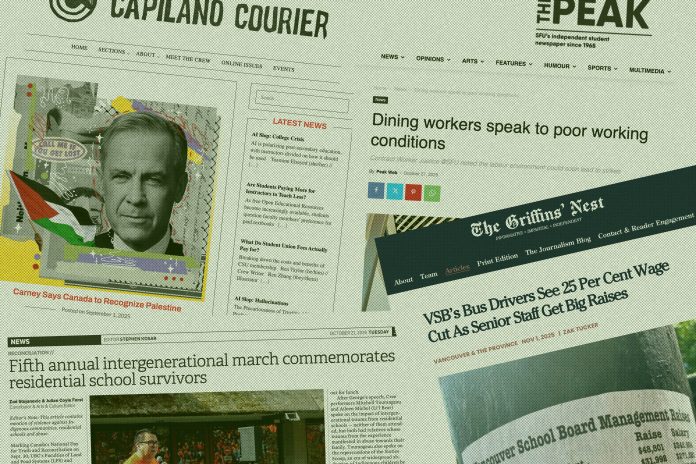
a collage of various news articles from different student-led publications.
COLLAGE: Gudrun Wai-Gunnarsson / The Peak

By: Niveja Assalaarachchi, News Writer

The media landscape we live in is diverse. From social media platforms, to traditional news sources like cable news, there are many different ways in which we can consume media. However another form stands: the iconic newspaper. Once, it was the main way Canadians interacted with the news cycle — but has since seen a precipitous decline. According to a CBC article, 11% of  independent newspapers and other media outlets have closed since 2008. 

As The Peak celebrates its 60th anniversary, it might be relevant to revisit, what makes  celebrating a dying form of media important? Especially since this publication is student-run. I mean, really, what is the point of relying on student journalists like us, who might not have prior formal training? I might have the answer to that. Simply put, with the decline of traditional news media, student journalism fills the gaps left by mainstream media, shapes student identity, preserves local voices, and stands as a resilient symbol of free expression and accountability. In many ways, student journalism is a fantastic source of information due to its connection with the members of its community.  

Currently, student journalism is a vital media platform. Through its coverage of underrepresented stories and keeping authorities accountable, student journalism not only stands as a symbol of their school, but as a symbol of free press in this country. Student newspapers have historically helped to highlight issues that matter to students and help shape the image of the institution it represents. They have reported on issues like student governance, local controversies, and unique insights into life here on campus and the Lower Mainland. The Peak is one among many other student publications that does such work. Other student newspapers like The Ubyssey, and high school publications like The Griffins’ Nest have contributed to the coverage of community relevant stories. 

Student newspapers also play an important role in reporting issues that often go unnoticed by bigger media organizations. Due to news deserts, which are particular geographical locations with little to no coverage, some stories go unreported. They often come as a result of bigger outlets leaving areas they deem to be unprofitable. In this void, student journalists help report on issues that impact people on a daily basis, that might otherwise not get reported on. Moreover, student journalists help uncover stories that can later get picked up on by larger media institutions, and thus can occasionally serve as a primary source. 

The relevance of student journalism does not always exist unobstructed. For example, slightly less than a hundred years ago, the student journalists of The Ubyssey, in 1931, faced threats from their university administration to cease publication. An order that was denied, leading to the then editor-in-chief being suspended due to his comments regarding the government’s short-staffing. 

It is clear that student publications have remained vital for decades because they have served as an outlet where students can contribute and document their communities’ issues. In an age where media outlets are under attack from authoritarian governments throughout the world, or face severe financial issues, student journalists stand strong and send a strong message: we aren’t leaving.

We will persist to bring stories to the attention of readers, not just on our campuses but throughout our local communities.


SFYou: Kelly Chia discusses Memories of Home zine

0
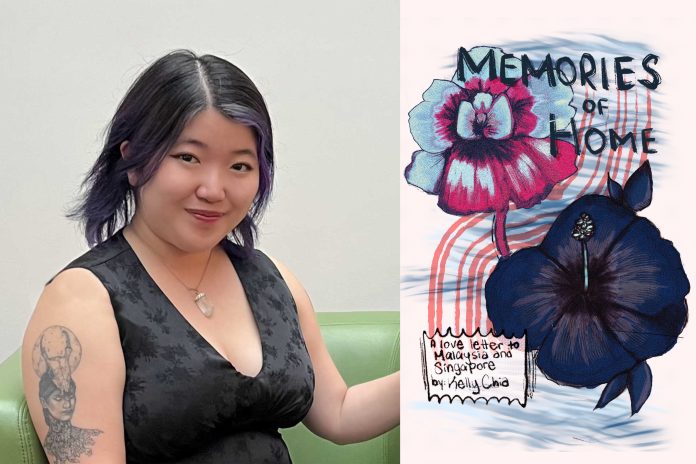
A headshot of Kelly Chia, next to the cover of her zine, which has beautiful purple pastel flowers.
PHOTO: Euan Secaluya IMAGE: Courtesy of Kelly Chia

By: Michelle Young, Co-Editor-in-Chief 

Memories of Home is a vivid and tender zine written and illustrated by SFU alum, Kelly Chia. It explores identity, and interrogates the dominant narratives that outline history. The zine’s opening is striking: “I am Malaysian-Chinese. There is so much this hyphen is carrying.” Memories of Home also features colourful hand-drawn illustrations of durian, starfruit, the Tambuakar (a water dragon), and more. Chia writes, “Home in the sense I’ve been exploring in this zine, is the stories we continue to tell, to listen to, and to learn from.” Memories of Home is filled with emotion, imagery, and crafted with care. The Peak sat down with Chia to learn more about her work. 

This interview has been edited for concision. 


Can you tell me more about what it means to you to be “Malaysian-Chinese” and how you view your identity in the context of being part of the diaspora? 

It’s really interesting to hyphenate my identities to explain who I am. Like, when I’m speaking in Chinese, there isn’t that sort of nuance. But because I’m speaking in English, the most succinct way I can summarize my identity is by using “Malaysian-Chinese.” I feel like I have to explain a bit more when I use this term because I’m not Malay. I’m Chinese, born in Malaysia

I was also living in Singapore for a number of years before I migrated to Turtle Island. I wanted to explore a bit more about what that meant to me — it was a lot of conflicting feelings because I haven’t lived there in such a long time. Having political opinions about Malaysia and Singapore feels difficult because I don’t feel like I have as much knowledge as I need. I also don’t have the lived experience that I would have had if I were raised as an adult in Malaysia. 

Sometimes, there’s an outpouring of love I feel towards where I came from”

— Kelly Chia, author of Memories of Home

“That I can’t otherwise express, except in writing. Memories is a way to say, “This is the way I’m engaging with my countries.” I’m entering my home through my memories.  


What inspired you to create this zine and what was the process of creation like? 

Among my small friend group of artists, they invited me to join a zine group. It’s something I’ve wanted to do for a while because of the qualities that make a zine great: it’s affordable, it’s often made by one person, and a way to connect with your community. I’ve sort of been burnt out of writing over the last few years. It was about Malaysia and Singapore specifically because the original prompt was “folklore,” and I remembered a lot of stories growing up. Ironically, the original folklore part is contained to a two-page spread. As I started writing it, I had a lot more to say. 

It’s always challenging to write about diasporic experiences, because like I said, I haven’t lived in Malaysia and Singapore for a while. Whenever I’m talking about Singapore, I feel like I have to talk about the nuances of it being a strong economy. It’s a great country for its size, but it also has a very militant governance and you can’t talk about one without the other. I don’t have those same feelings about Malaysia because I was six when I left the country. Though, I was also pretty young when I moved out of Singapore. 

As an immigrant, when you’re discussing your own experiences, you’re like, “Am I making my countries, am I reducing them for someone else’s experience? Am I compartmentalising these very complicated and nuanced histories just to be like, ‘Hey, this is the place I came from?’”

As a creative person, I think you always worry about whether you’re being authentic or packaging your authenticity. 


You wrote about complex feelings on how your education covered Singapore’s Japanese occupation in-depth, but didn’t discuss pre-colonial history. Can you tell me more about what particular aspects of history you’d like others to engage in?

This is tough, because as a Chinese person growing up in Singapore, it’s a lot of acknowledging that I’m Hakka. I don’t speak Mandarin as well as I speak Hakka, but other dialects get subsumed into you having to learn Mandarin in schools. There’s this perspective that Chinese history and immigration feel the most important, even though it’s not what’s said, it just feels like it’s “economically important” to learn Mandarin.

I had a few friends who were from Myanmar, or who were Filipino, and there was no option for them to learn Tagalog or other of their so-called mother tongue languages in school, so oftentimes they’d be assigned to learn Chinese instead.

So much of what dominates my thought of the history of Singapore has to do with the Japanese occupation, that even the founding story feels almost mythical — it’s very real. In the zine, I mention that the founding story includes a slim mention of Sang Nila Utama and primarily focuses on Singapore after Sir Raffles comes and sets up a post, but that there’s 500 years of respectable history prior to this, when Utama named Singapore “Singapura.” I had to step back and reexamine my privilege and history, to be like, “I never learned this part.” 

There’s a narrative that our national history starts in 1819, when in 1299 we already had years and years of trading history and it would be cool to elevate it to the same amount of importance.  


Having graduated with a Bachelor’s in English, and also being a previous Peak Editor-in-Chief, how did your experiences at SFU inform your work?

I feel like what I enjoyed most about working at The Peak was that SFU stopped being just a building, but became communities I connected with. A lot of my work was informed by speaking with the fellow people around me. A lot of these experiences, and thinking about what’s important when you put out a work that other people are going to read, plays a lot into how I write. It’s been a long time since I felt that writing was just for me. Working at a small news publication, knowing who can read it, who might be impacted by it, has infinitely impacted how I approach my work. I always hope that they either feel seen by it, or can engage with it in a way that makes sense to them. Overall, I would say my SFU experiences made me more community minded.


Read Memories of Home at heyzine.com


Monday Music: Gloom and grey

0
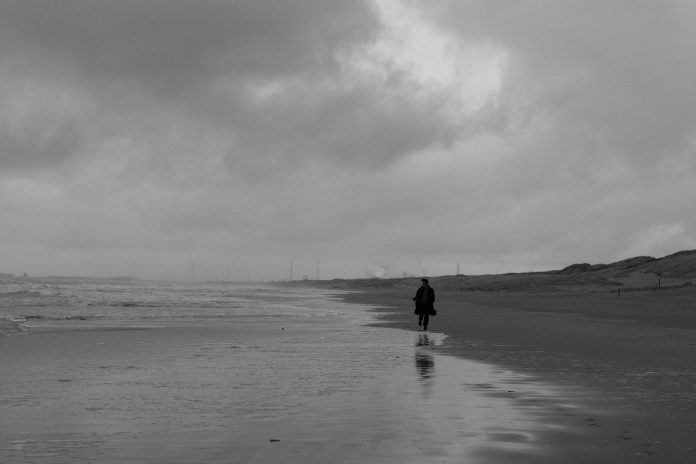
PHOTO: Alina Chernii / Pexels

By: Lucaiah Smith-Miodownik, News Writer

Past Lives by Jay Som & Hayley Williams

“I’m stuck in the mud, I’m spiraling up [ . . . ] it’s falling apart.” Som and Williams come together on “Past Lives” to deliver a beautifully sorrowful ballad that puts words to a mind wrought with anxiety. “An open echo,” not all too different from the constant sound of raindrops, reminds the listener of those moments where peace seems out of reach. 


Nights in Armorby Water From Your Eyes

Water From Your Eyes blends the line between lyricism and internal dialogue, crafting a song that could easily pass as a journal entry. With lines that evoke a certain directionless anger, the band perfectly captures the cold, wet, and damp feeling that listeners likely know all too well — “I just wanna fight you ‘cause I’m tired [ . . . ] Spite me, I’m on fire.”


Vacationby Florist

Gloom begets internal reflection, as wet socks and windblown leaves cause us to sink deeper into our own thoughts. “I don’t know how to be what I wanted to be when I was five,” Florist writes. “Maybe I just want to get married, or maybe I just want to fall asleep,” they add. Faced with such uncertainty, we often take refuge in that which we hold true. “At least I know that the world is spinning when we’re tangled in the bedsheets,” the artist sings.


jenny’sby WHATMORE

“I know why she could make it big time, but she’s scared to try again.” With a gravelly voice that cloaks the listener’s ears like the comfort of a weighted blanket, WHATMORE delivers a uniquely avant garde rap style that perfectly encapsulates that feeling of being stuck. Whether you are glancing longingly at the window wishing for sunnier days or scared to take the next step in life, this song is there for you to lean on in the meantime.

See Red at the Cultch

0
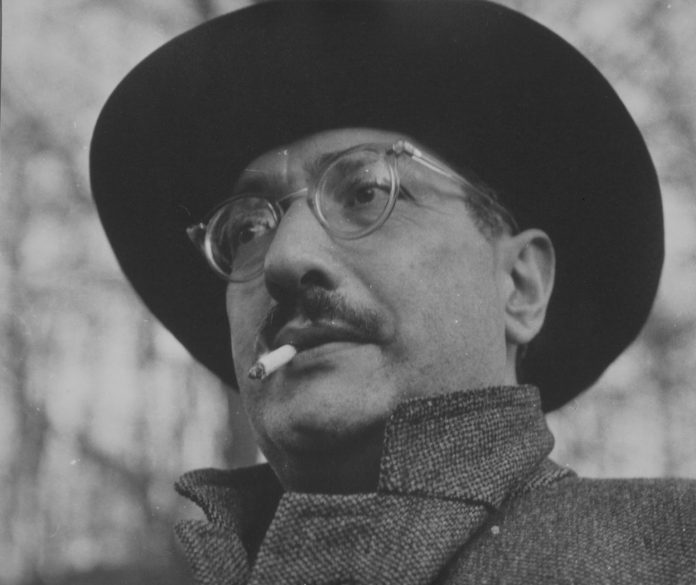
PHOTO: Consuelo Kanaga / Wikimedia Commons

By: Noeka Nimmervoll, Staff Writer

From November 27 to 30, Just B Productions will present the Tony-award winning play Red, by John Logan, at The Cultch Theatre. The play tackles themes of legacy and the inherent conflicts of meaningful commercial art, in a conversation between the acclaimed abstract artist Mark Rothko and his assistant, Ken. Directed by Stephen Heatley, the play will be the debut production of Just B Productions, a theatre and film production company founded by actor and producer Blake Buksa. The Peak spoke to Buksa and Gabrielle Nebrida-Pepin, stage manager and producer of Red, to learn more. 

“It’s based off of the real life artist, the expressionist painter Mark Rothko. He is painting a series of murals for the Seagram Building, which is the fourth of Four Seasons restaurants that was opening back up in [1958], in New York City. And so then the fictional point is that he brings on this assistant by the name of Ken,” explained Buksa. Rothko, played by James MacDonald, is a renowned painter of the 1930s1970s and is credited as a key figure in the art movement Abstract Expressionism, as a spearheader of the style called colour field painting. Ken, played by Buksa, listens and challenges Rothko as he grapples with his ideas about the role of art: to please the viewer, or to stir intense human emotion.

“One word that always resonates with me with this show is legacy,”

 — Blake Buksa, executive producer of Just B Productions and actor

“It is really this passing down to new artists.” The transfer of legacy is not so simple, however, and creates tension between the master and his pupil.

Both Buksa and Nebrida-Pepin are graduates of the UBC acting program. In January, the play’s initial steps began with “pitching the show to Stephen Heatley, who is our director, and also [was] our teacher back at UBC,” shared Nebrida-Pepin. MacDonald, the lead actor, was also Heatley’s student in the late ‘90s. The beginning and end of the professor’s career marked significant times in his students’ lives. “It’s very intergenerational,” shared Nebrida-Pepin. 

Just B Productions started out as a shared ambition between Buksa and Nebrida-Pepin during their studies that developed later into Buksa’s production company. “I always just kept seeing [the message that] if you want to be that working actor and stuff, you have to create your own work.” He spent some time post-university as an actor waiting for opportunities to come, and decided, “it’s time to start pulling up my socks and get things going.” His goals for the company include paying his people well, casting talented friends in their dream roles, and creating a platform for underrepresented talents in the industry, actors that are constantly auditioning without landing roles — a reality for many in this line of work.

This mission is already having impacts. Nebrida-Pepin shared, “As a new time producer, what’s made this really exciting for me is the prospect to [ . . .]  to step into a role that I know I probably would have otherwise had to have worked for nothing and then make my way up into becoming an associate producer for a theatre company.” Now, with this production and stage management experience, Nebrida-Pepin is able to bring her skills to other companies in the arts. 

Follow @JustBPro on Instagram to stay up to date on show details and upcoming fundraising events.

Powwow meets the Blues in Get Your Feathers Ready

0
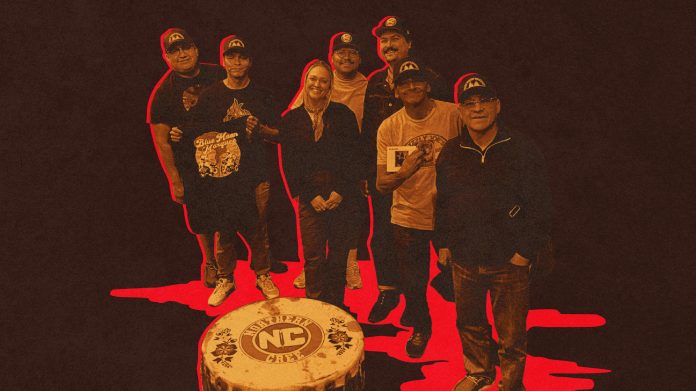
Courtesy of Susan O'Grady

By: Heidi Kwok, Staff Writer

Blue Moon Marquee, a swing blues duo from British Columbia, have collaborated with Northern Cree: a Powwow, round dance drum, and singing group hailing from the Cree Nation based in Treaty 6 (traditionally known as Maskwa cîsihk, Alberta). Together, they produced Get Your Feathers Ready, an alluring album that pulls listeners in through an infectious blend of bass, electric guitar, and Cree drumming.

Created in a single eight-hour recording session, the album was inspired by the monumental contributions of Indigenous Peoples on contemporary North American music and pop culture, as well as by the documentary, Rumble: The Indians Who Rocked the World.

Blue Moon Marquee’s bass and guitar arrangements are hallmarks of the swing blues genre, creating melodies with a natural lilt and rhythmic looseness that bring a touch of emotional nuance and vulnerability to the entire record. The leading vocals from the group’s A.W. Cardinal and Jasmine Colette, are grounded and unfiltered. Cardinal’s soulful and smooth singing commands instant attention, charging out without hesitation like a burst of a firecracker. His voice aches with troubled yearning in “Soul of a Man,” a gripping track about self-identity and discovering oneself. “I travelled different countries, I travelled foreign lands, ain’t no one could tell me, just what is the soul of a man.”

Northern Cree’s drumming reverberates through Cardinal’s rich vocals in a varied and upbeat rhythm. The group enriches each track with their raw and synchronized chorus in the background, their registers soaring effortlessly like an eagle — from impossible highs to mournful lows — driving forward an electrifying energy. Their joyous whooping and powerful cries in “Rollin’ and Tumblin’” were captivating, as if reaching out across multiple generations through sound, while simultaneously blending old musical traditions with the new. 

The lead track “Put Your Feathers On,” is a call to dance and celebration. It begins with a steady heartbeat of drumming that gradually builds before ushering in a laid-back but catchy swing-style guitar melody, infusing the tune with warmth and groove. “Come on baby, put your red dress on / We go dancing ‘till the morning sun.” I couldn’t help but nod my head, tap my feet, and sway my body along with the contagious rhythm.

What I also found unique about this album were the interlude tracks that served as momentary outtakes, giving listeners a glimpse into the studio recording process. These quiet disruptions are a welcoming break — providing a window of reflection to appreciate the preceding song before preparing listeners for the next banger.


The Luddite Land Assembly weaves together craft, land, and music

0
PHOTO: Quang Nguyen Vinh / Pexels

By: Ashima Shukla, Staff Writer

In the age of instant everything, what if creativity could slow the world down? This is the ethos behind the Luddite Land Assembly, taking place from November 8 to 9 at The Roundhouse. This multidisciplinary slow art and music experience is part of the internationally celebrated 2025 Modulus Festival, inviting participants to connect deeply with land, culture, and creativity by partaking in two days of social gatherings and performances. Curated by Barbara Adler, an interdisciplinary artist, SFU alum, and artistic director of The Only Animal. The Only Animal is an interdisciplinary arts company that places artists at the centre of the ongoing climate crisis. Adler’s curation draws inspiration from the “Luddites,” textile workers who resisted the automation of their craft during the Industrial Revolution

Keeping this spirit of resistance alive through craft, visitors can join several hands-on sessions exploring natural dyeing techniques on November 8. These sessions allow participants to come together and slow down in transforming fabrics using plant-based materials as they listen to live personal stories of artists and recorded sound. The goal?

Over the two days, participants will learn how to co-create a large plant-dyed textile while learning to dye, eco-print, and embroider.

The natural dyeing process reveals hidden prints by artist Keely O’Brien, while the facilitators share stories of land, memory, and care. In the first session, Daphne Woo, once part of the fast-fashion world as a garment developer for 20 years, reflects on her transition to a mindful relationship with natural materials. Through logwood, she explores the legacy of her family as a second-generation Chinese settler. Session 2 is led by Rita Point Kompst, a xʷmәθkʷәy̓әm Elder and artist, teaching audiences to use mushrooms for natural dyeing while she narrates her experiences of healing through weaving with cedar and wool. Bernarda, founder of The Batik Library, leads the next session using marigolds, sharing stories to raise awareness of Indonesian culture and traditional Batik making techniques. Finally, Valérie d. Walker, a “Indigo Griot,” concludes the day with stories from her “decades-long collaborations with bio-fermented indigo vats,” teaching simple shibori techniques. 

On Sunday, November 9 at 7:30 p.m., the event culminates in the Luddite Land Assembly Concert, presented by Music on Main, programmers of classical and contemporary music who aim to reshape the concert experience by connecting musicians and audiences in a more intimate way. As you listen to Tsimka and Michael Red, whose collaborations merge the Tla-o-qui-aht ƛaʔuukʷiʔatḥ language with field recordings from Tsimka’s home, you are invited to stitch together the various dyed textiles into one. Joining them is Caley Watts, a Cree singer-songwriter whose folk and roots music traces the movements of rivers and the cadence of mountains. Her songs draw from the rhythms of the forest, bringing the weekend’s theme full circle: art, like nature, thrives with attention and reciprocity.

Together, these sessions and performances invite the audience to slow down and create with intention. Tickets are from $10 for the dyeing sessions, and $25 for the concert. Come dye, stitch, listen, and co-create. This is a public sphere that comes alive with care. 


Men’s washroom etiquette 101

0
ILLUSTRATION: Olivia Blackmore / The Peak

By: Akashdeep Dhaliwal, SFU Student

So here’s when it all started. In September of my first year, I walked into an SFU men’s washroom for the very first time. As I was walking towards the only available urinal, I saw him. There he was, standing entirely too far back from the loo, showcasing his spout for the whole world to see. This was the only time I saw a tinkle-time trickshotter in action. For what he lacked in public decency, he made up in range. Though I’ve only seen such an event once, there’s plenty of evidence on the floor that suggests that these creatures are still out there. 

What you’ll see more often nowadays are the urinal doomscrollers, the fellas who think swiping their feed is more important than keeping their pants up. My question is, are they not aware of how low their pants are sagging, or are they that proud of wearing horizontally-striped boxers? Furthermore, how are they so comfortable with having a camera pointed towards their crotch? How many people have they disappointed?

In most cases, I am a safe distance away from these disappointments. What really made me stop drinking liquids on campus was the grunters. These vocal pups will stand right beside you and will let out an aggressive moan when the process begins. Fellas, is it that difficult to lay off the Redbulls and take a sip of water? The worst is the violent arm jerk at the end, because why stop at noise? Logically, I know that they’re just being aggressive with the wiggle technique to get rid of the last drippy-drips, but from the corner of my eye, it looks . . . extremely suspicious.

The last part of horrendous washroom behaviour I’ve observed isn’t any better. You’d think that after all their crimes, redemption could be found at the sink. But you’d be wrong. Did you know that there’s a good chunk of men out there who don’t use soap after taking a leak? Imagine my surprise when I saw these soapless clowns rinsing their hands using nothing but water and friction. Why stop there? Some will just avoid eye contact with the sink entirely, hide their faces so the other guys don’t see them, and bolt out of the bathroom.

Is there any hope for more socially acceptable practices in the men’s washroom? Well, if a pandemic and nearly two decades of living haven’t taught some of us about sanitization and social cues, I doubt it. Regardless, if you want to survive, you can do what I do: switch from handshakes to fistbumps, keep a whole, full-size bottle of sanitizer in your bag, and let others open doors for you. Good luck!

Dear Peakie calls on Santa’s elves to unite against corporate greed

0
PHOTOS: Courtesy of @susanboylemusic / Instagram; Adolfo Félix / Unsplash; and Audrey Safikhani / The Peak

By: Ashima Shukla, Staff Writer and Mason Mattu, Humour Editor

Dear Peakie, 

Where have you been?? We haven’t seen you since, like, February? It seems as though you got replaced by a Beedie Bro advice column? How can I be as irrelevant as you are? 

Thanks,

Not a Beedie Bro 


Dear Not a Beedie Bro, 

You say I’m irrelevant, but you found me, didn’t you? That’s right. Obscurity marketing, baby. You can’t cancel what refuses to trend! Mr. Beedie Bro isn’t the only one with Machiavellian strategies up his sleeve. 

As for where I’ve been? I was this close to finding the mass line and starting a revolution in ECON 222: Intro to Game Theory by suggesting billionaires shouldn’t exist. But, alas, that wasn’t the “game” they meant. Escorted out by the invisible hand of the market, I’ve been stuck in a version of The Matrix where ChatGPT transforms into the oracle and the red pill costs $54,821 a year (aka studenthood at SFU). But if irrelevance is your dream, take a self-funded sabbatical to study the spiritual meaning of unread emails. RSVP to everything, attend nothing. Bed rot to new levels. As the Buddha probably said, suffering is mandatory but participation is optional.

Already forgotten you, 

Peakie 


Dear Peakie, 

My boyfriend put up Christmas decorations while I was sleeping. There’s tinsel on my toothbrush holder, a mistletoe above our pillows, and garland covering every corner of my home. He did this all in ONE NIGHT.  The worst part is, he wants me to dress up as Mrs. Claus tonight . . . WHY? Should I say something about how uncomfortable I feel, or just admit that Mr. Christmas Fever is the best I can do? 

Getting Peakie with it, 

Not Putting Up With This Excessive Christmas Vibe


Dear Not Putting Up With This Excessive Christmas Vibe, 

Ah, you find yourself in the classic Boyfriend-Industrial Complex. When men run out of emotional depth, they compensate with aesthetic lighting. Sounds like you’re dating the front-runner for the next SFU Performative Male Contest — the kind of man who tweets infographics about emotional intelligence, but cries when you ask him to recycle. Tell him to take down the garland, or start invoicing him for emotional labour per ornament. If he insists on being Mr. Christmas, demand benefits: a year’s supply of ethically sourced hot cocoa and guaranteed equal-pay for each gift you wrap for his family. The possibilities are endless. And if he refuses? Unionize, darling. Mrs. Claus is filing a grievance this Christmas. 

In solidarity, 

Peakie 


Dear Peakie,

I recently saw Susan Boyle rocking a new blonde hairdo. Iconic. However, a few days later, my own hair started turning blonde. I’m kind of confused . . . is this how fandom works now? Will I turn into an apology letter after seeing Céline Dion on my FYP? Any advice on how to reverse this celebrity osmosis? Am I just an iconic blonde diva now?

Thanks, 

Susan Boyle’s Fan Club President 


Dear Susan Boyle’s Fan Club President, 

Relax! You’re not turning into Susan Boyle. You’re just becoming content! Welcome to late capitalism, babe. Today it’s your reflection in the mirror, tomorrow it’s a monetized identity crisis. That’s how admiration slips into metaphysical imitation. Soon, your hair will sing power ballads in Safeway, and you’ll post unprompted get-ready-with-me’s. Lean in. Auto-tune your mid-morning cries and drop the remix. Outsell Bad Bunny. Break down AND break charts. 

Be the better Susan Boyle, 

Peakie 


Student organizations hold strike for Palestine at SFU

0
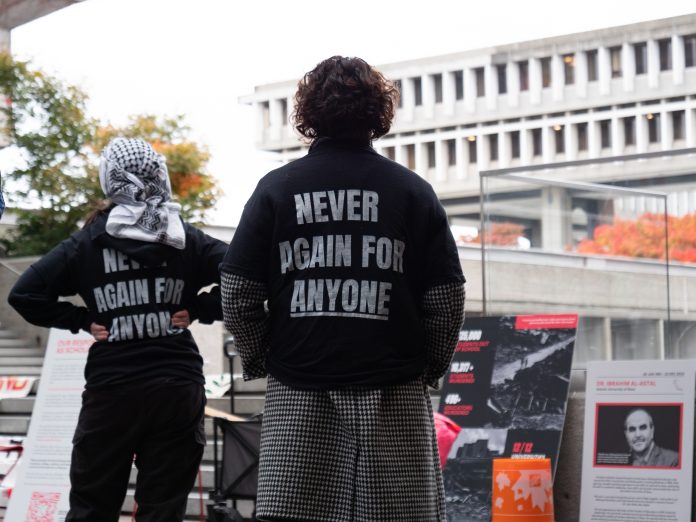
The back of two students’ shirts say, “never again for anyone.” One student is wearing a keffiyeh on their head, while a Palestinian flag and other posters are laid out on concrete steps in Main Mall.
PHOTO: Elliott Marquis / The Peak

By: Lucaiah Smith-Miodownik, News Writer

On October 23, chants echoed across convocation mall as SFU community members gathered for a campus strike in solidarity with Palestine. Organized by the climate justice organization SFU350 and the anti-Zionist group Independent Jewish Voices (IJV) SFU, the event featured several speakers and was inspired by similar protests at Belgian universities. The Peak attended the strike for more information. 

“You may be wondering how a group dedicated to the climate is co-hosting this protest,” said an SFU350 member addressing the crowd. “Well, that is because climate justice is Palestinian liberation.” 

In May, The Guardian reported that the carbon footprint from Israel’s genocide “will be greater than the annual planet-warming emissions of a hundred individual countries, exacerbating the global climate emergency on top of the huge civilian death toll.” Despite the most recent ceasefire between Israel and Hamas that came into effect on October 10, reports have revealed that airstrikes and violence continue in Gaza.

Since as early as the TSSU’s referendum in 2017, community members have been demanding divestment from “all war contractors complicit in the occupation of Palestine,” which includes Booz Allen Hamilton, BAE Systems, and CAE Incorporated. In a joint Instagram post, SFU350 and IJV SFU also stated that the school must “include arms producers and military services as going against SFU’s Responsible Investment Policy.” 

This call for divestment was one of four recent demands presented by SFU350 and IJV SFU. The second demand is ending “all partnerships with Israeli institutions and universities.” Currently, SFU is listed as a partner of Tel Aviv University, Israel’s largest university. SFU is also listed as having collaborated with the Israel Institute of Technology, also known as Technion, within the last five years. In a statement to The Peak, SFU said, “In response to these requests, we are working to review and revise our Responsible Investment Policy.”

“The third demand,” an SFU350 member said at the strike, “is for SFU to sign the Apartheid Free Community BC pledge, just as the City of Burnaby has done two months ago.” The final demand called upon SFU to “protect the students from anti-Palestinian racism, anti-Arab racism, Islamophobia, and antisemitism on this campus.”

SFU stated that they received the list of demands from SFU350 on October 28, and that they would be “discussed by the executive team and appropriate offices.” SFU said, “To be clear, Islamophobia, anti-Palestinian, anti-Arab, antisemitism, racism, and hate of any kind have no place at SFU. The university and its leadership are deeply committed to creating a diverse, equitable, and inclusive community where all feel welcome, accepted and valued.” They pointed to Campus Public Safety and the Bullying and Harassment Central Hub as resources for community members.

After hearing from SFU350, Gerardo Otero, professor emeritus at the School for International Studies, spoke to those in attendance. “Let me be unequivocally clear,” he stated, “this solidarity is not antisemitism.

“Our call for peace and justice is rooted in universal principles of human rights, and it is a call that includes and honours many Jewish voices who stand with us,” he added.

“This moral clarity must be translated into action right here at home.” 

 — Gerardo Otero, professor emeritus, School for International Studies

Otero spoke about a motion passed by SFU’s Faculty Association in June of last year, calling on the university to take similar action regarding divestment and support. One section specifically urges SFU to “work with partners to actively support Palestinian universities and the Palestinian educational sector more broadly through inter-institutional cooperation, including virtual instruction, exchanges, library sharing, and infrastructural support.” IJV SFU member Dina noted in her own speech, however, that “there are no universities left in Gaza.”

Every speaker at the strike concluded by expressing that SFU must take action to relinquish its role in enabling genocide.

“We are here to insist that our campus must remain a space for courageous conversation, for solidarity with the oppressed, and for the unwavering pursuit of justice, even when, especially when it is uncomfortable for the powerful,” Otero said.