Home Blog Page 876

COLUMN | GUESS AGAIN, GRANDPA: Polyamory isn’t for me

0

[dropcap]I [/dropcap]always thought that the ‘swinging Sixties’ was in relation to swing dancing. As it turns out, I was pretty far off. The 1960s began to relax many taboo aspects of society like racism and sexism. But running alongside these new and free ideas of love and peace, new romantic and sexual practices arose.

The term ‘swinging,’ or ‘wife-swapping’ in the 1950s, became a rising alternative to the mainstream monogamous relationships of yore. In today’s society, the term ‘polyamory’ is used to describe the relationship that many people share, sometimes two people in a ‘primary’ unit. In this case, both of these people may disclose to their primaries any dates and sexual relations with other partners, setting mutually agreed upon terms and boundaries so as to prevent jealousy and infidelity. People in this type of polyamorous relationship, then, can take part in meaningful relations outside of their primary without having to break up with their primary partner with whom they have built a solid relationship.

Upon sharing this newfound knowledge with my grandpa, he just laughed and said to me, “Well, we didn’t call it the Swinging Sixties for nothing.”

My grandpa was a very traditional kind of guy. It was monogamy or nothing, fidelity over everything. My grandparents loved each other and remained in a monogamous relationship despite the new wave of alternatives. And for myself, I’m not going to argue with it, because the idea of polyamory is something I can’t see myself subscribing to.

Call me a conservative, but I like the idea of one love. I’m not going to tell my man to cut off all ties with the women he calls friends, nor will I stop being friends with guys that I’ve known for a long time. But this is where trust and communication comes in — something that I would find confusing in a polyamorous relationship.

Our grandparents’ generation made it pretty clear-cut. You either were in a monogamous relationship, or you were out experimenting in secret. But once the taboo was lifted, ‘swinging’ turned to polyamory, a growing trend. With the rise of these new arrangements, research and interest in them reached an all-time high in the 1970s, making it somewhat ‘normal.’

My grandparents, content with the monogamous relationship they had, did not jump on the polyamory bandwagon, which most likely influenced the choices that my parents made. This, in turn, has a deep impact on my relationships and how I go about them. However, with more and more millennials viewing monogamy as just one possible option, it has also begun to raise questions within me.

My grandpa had his questions about polyamory: “Are they unhappy and underwhelmed? Because usually those kinds of things can either be worked out, or end in divorce.”

And being unhappy and underwhelmed is exactly what many polyamorous couples avoid. As an article in Rolling Stone states, some people in these relationships try to have “one long-standing relationship” while also having a “willingness to openly acknowledge that the long standing relationship might not meet each partner’s  needs for all the time.” As explained in an MTV video about Tran and Caleb — a polyamorous couple living in Brooklyn — the ‘itch’ is usually seen in monogamous relationships as the signal to say goodbye. But for Tran and Caleb, it was a sign that they needed to shake things up.

So, Grandpa, it looks like we agree on something. Whether you’re committed to your one true love or are committed and still ready to mingle, it seems that neither of our generations have the answer. But then again, love is love. Who are we to judge?


Adopt your dog, don’t purchase it from a store

0

[dropcap]T[/dropcap]he puppy mill industry is predicated on treating puppies like commodities, instead of living beings who deserve respect. With the high demand for certain breeds, dogs are treated with much more concern about profit than their well-being.

As a result, terrible living conditions and health problems arise. Since puppy mills are focused entirely on quantity over quality, they have little concern for the health of the breed, or the breed’s genetics. Consequently we are left with abused, sick dogs prone to several health conditions — from heart disease and parasites to lung problems.

In addition to physical health problems, the emotional trauma these dogs face is just as problematic. Separated from their mothers and siblings at a young age, dogs can become anxiety-ridden and scarred. All of this puts the idea of a cute puppy waiting for a proper home into question. What puppy mills deliver are frightened, stressed, disease-plagued dogs desperate for a way out.

Thankfully, the BC SPCA is stepping in with a proactive idea for a regulatory legislation of this industry. This will require breeders to follow exact standards for their treatment and living conditions of the dogs in their care. However, reputable breeders are not the problem. Under-the-radar puppy mills are the problem.

Currently, BC SPCA is only permitted by law to step in when there has been an outside complaint about unethical breeding on a specific puppy mill site. Then, and only then, are they able to obtain a warrant. Although this process has its merits, it does nothing to protect the majority of dogs being bred in puppy mills, and fails to set up a safe living situation for these animals.

If the BC SPCA’s new legislation passes, the organization will have the right to step in before the abuse begins, and require the breeders to adhere to stricter ethical standards. It will also allow for the SPCA to recommend criminal charges against abusive breeders, which seems more than fitting seeing as their actions clearly fit the bill.

According to the ASPCA, “responsible breeders would never sell a puppy through a pet store,” because responsible breeders screen potential buyers, and can’t ensure that the puppies go to good homes.

There is a chance that if you are purchasing from a pet store, you are buying a puppy originally from a puppy mill, and are directly supporting cruelty and suffering. On top of that, the cruelty is entirely unnecessary when there are beautiful dogs at shelters all over the province just waiting to be loved. Many pet store chains have become more aware of the issues with puppy mills, and have taken to sponsoring dogs and cats from local shelters. This, too, is a huge step forward.

Adopting is not only the more ethical alternative to pet stores and breeders, it’s also more affordable and just as rewarding. The fact of the matter is, if you are looking to come home with a new four-legged best friend, don’t buy — adopt!

Elisa Homer shatters GNAC record

0
After a summer perfecting her shot, Homer has come back to become arguably the best shooter in the GNAC.

February 4, 2016 is a night that will go down in the history of SFU Women’s Basketball. On that night against Northwest Nazarene, Elisa Homer set a GNAC record for most three-point shots made in a single game with 12, breaking the previous record of nine that she tied just 18 days earlier.

To put that feat into perspective, only two players in the history of the NBA have made 12 three pointers in a single game — Donyell Marshall in 2005, and Kobe Bryant in 2003. Not even Stephen Curry — widely regarded as the best shooter in the NBA right now — has hit that many in a single night.

“I think I beat [Curry] actually,” Homer said laughing as I brought up this fact.

“It was pretty cool,” she remarked on the historic night. “I guess coming off the game where I had nine three-pointers, I was stoked that I tied the record, but I knew that I had a couple looks that were that close, that could have gone in.” Following that, Homer knew she would eventually break that record. “Whether it was going to be 18 days later like it was, or in the years to come, I knew that was something that I was going to be able to [get].

“When we were in the game [on February 4th], I hit my first two threes, and then I think three of them, and I knew I was getting my looks, felt good about it, felt really smooth, and I was like ‘okay it’s a good day, it might be the day.’”

Homer was also quick to point out her teammates’ role in her success.

“Alisha [Roberts] actually made a comment in our halftime meeting [. . .] she was like, ‘okay, gameplan: give the ball to Homer, she’s hot.’ So everyone thought about it and was trying to give me my looks, which was awesome and super helpful.

“I kind of lost track of it in my mind, and then I guess I hit my 10th one to beat the record, and I look over at the bench, and [Head Coach Bruce] Langford and Jessica [Wallace], our assistant coach, and all the girls on the bench were standing up and screaming. [. . .] I hit two more after that, [and] they were stoked.

“I hit my first two threes [. . .] and I was like ‘okay, it’s a good day, it might be the day.”

“As much as it was an accomplishment for me, it is for them, too. I got an assist on pretty much every three; everyone was a part of it.”

While the record was of course amazing, it could not have come without hard work. Homer spent hours and hours in the gym over the summer, perfecting her shot for the upcoming season.

“This past summer, Langford actually challenged me to shoot a lot more than I had in prior summers,” she explained. “So we agreed for me to shoot 60,000. Just takes, not makes, but that’s still a pretty significant number.

“It worked to about 2,500 per week, five days a week, 500 shots each day. It wasn’t all threes, but it was half or more each day. Other days it might be finishes around the hoop, definitely some mid-range jumpers [. . .] so all of that work is starting to show up. And definitely free throws. I’ve always been a pretty confident free throw shooter, so having that as fallback really helps.

“Some weeks I’d only be able to get three days so then I’d have to shoot more on those days, some weeks weren’t as much, some weeks I’d end up getting 3,000 or 3,500. It was a lot, a lot of shooting.”

Homer is part of a deadly trio that has lead the Clan throughout the season. Along with her 17 points per game, which is the highest of any player in the GNAC, senior Alisha Roberts is averaging 11.6 points per game, and Ellen Kett’s 53.7 percent efficiency from behind the arc is the best in Division II, men’s or women’s.

“I think the three of us together, it’s really tough for teams to guard three shooters,” said Homer. Our mindset is that if we have an open three, we’re going to take it. And especially with the team this year, [. . .] we know we can get the momentum going. Even when we’re down, we know that we can hit two or three quick threes right away and be back in the game.

“We work together really well, we’re all super supportive of each other, we really enjoy getting each other open and setting each of us up. And I think the fact that none of us are really selfish, we all shoot within the offence, we all move the ball, we take so much pride in helping each other out and hitting all those threes.”

So what advice does Homer have for those looking to perfect the art of the three-point shot?

“Just a lot of reps, she answered. “Just always trying to focus on your form and getting good form every time. [Making sure] you’re balanced every time, making sure you get comfortable with just set shots first, and then trying to work up to shooting off the dribble, shooting off the move, and different footwork. But, definitely get the fundamentals and make sure your form is good.”

SFU replies!

0

Hi there,

What is the new SFU government going to do about international student fees? I know people who are seriously paying about $10,000 per year — this is ridiculous! This would bankrupt my family if we had to pay the same.

Also, why do Egyptian students receive free tuition if they sign up for that one engineering course? And what is the reasoning behind the new pyramid structure surrounding the observatory?

Kim Bousa

To Kim,

Thank you for your letter. We at SFU administration would like to reassure you that there is nothing shady or unusual going on at SFU.

I understand that money concerns you, and many SFU students. Money must be attained through working in Canadian society. Many say that students cannot find jobs after graduation. I show sympathy for you.

Concerning SFU’s new Egyptian engineering students, is the league of the undead bothering you? I’ve seen them be nothing but polite to students. Their selfless determination will ensure SFU Burnaby’s infrastructure is secure and will last for one hundred millenia. They are fed. Their drive is something we can all learn from, Kim.

You are concerned about money, and SFU can help. We can never have too many engineering interns. Join this internship and we will waive all your student fees and promise you lifelong work. The role takes guts, a heart, and a lifetime of devotion to Ra.

Kim, I would like to give you an amulet. Mine protects me from financial burden, and this one can protect you, as well.

I don’t have much more time. I have many things to show you. I would like to meet you, Kim.

Ra be with you,

Nesperennub, SFU Engineering Department head

Woohoo, Boohoo

0

Woohoo: Dreaming of moving out

I’ve dreamt of moving out of my parent’s house since my first year of university. Three long years have passed, and I am now finally leaving to my new home. It’s a good location, good price, good roommates — everything I was patiently waiting for.

Finally, I’ll have my very own space, no parents to tell me to clean my room, to do the dishes, and to stop eating all the cookies. I’ll get to decorate my apartment however I want. Buy the food I actually want to eat. Put actual content on the TV I want to watch.

I’ll be no longer living in the isolated suburbs, but in the happening city. Unrestrained by distance, I’ll be able to walk to the grocery store, bike to school, and reasonably transit to work. Amazing. I will finally feel like an actual adult, with complete freedom.

Boohoo: Actually moving out

Yes, complete freedom —at the cost of over half my pay cheque each month, and the safety net of coddling parents. The fear of making the right choice, of having to choose which of my belongings will make it to the new home, and the fear of just plain real responsibility.

After paying the safety deposit, everything finally felt real, and it fucking terrified me.

This is pure fear that only continuing to binge-watch The Wire can absolve. All I can do to calm myself is to repeat: “You’ve wanted this for so long. It’s a good place. And you’ve already paid your money, so there’s no backing out now!” Let’s just hope that the fear subsides once I move in the first of March — wish me luck!

Stand by your decisions

0

[dropcap]$[/dropcap]32,943.62. Sounds like a lot of money, right?

I haven’t even finished my second year at SFU, and that’s how much I’ve been charged in tuition fees as an international student. That’s how much it costs for a whopping total of 48 credits. And this amount is just for my tuition fees. I haven’t even added in the cost of the U-Pass, health insurance, and other student fees.

Each time I think about how much the international tuition fees go up at SFU, I try my best to suppress my anger, but, of course, it leaks out from time to time. And each time it does, I tell myself that I should’ve gone to McGill. My IB credits would’ve still transferred over and my tuition would’ve been lower. Then I instantly feel guilty, because if I had gone to McGill, I never would’ve met the love of my life, I never would’ve met any of the amazing people I have the good fortune to call friends, and I never would’ve become the Photo Editor of this very paper you hold in your hands.

Still, my mind wanders from time to time: what if I had known about SFU’s consecutive three-year 10 percent tuition increases? Would I have still have come to SFU? What kind of person would I be if I had gone to McGill? Would I have continued to pursue my childhood dream of becoming a doctor? Would I have stayed together with my high school sweetheart? Would I still even be a photographer? These questions have plagued me endlessly for the last month, and I wish I could give myself a clear cut answer, but I can’t. I can’t say for sure what could’ve been.

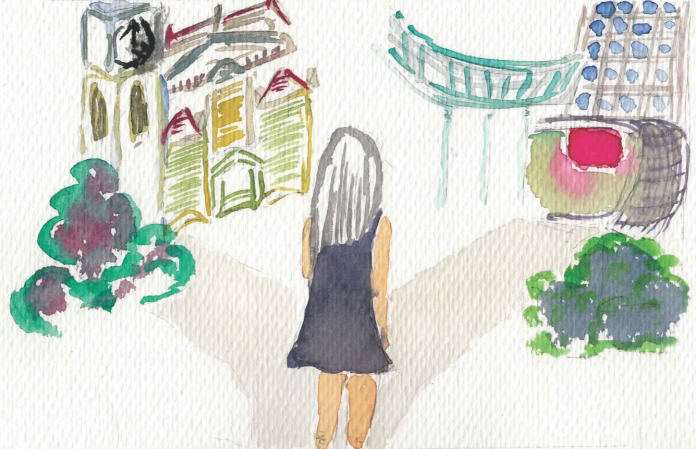
I contemplated this issue for the entire month of January, holding my heavy heart with regret, shame, guilt, and anger. I was so unsure of myself for the longest time. I lost sight of who I was because I was terrified of who I could’ve been with a simple step in the opposite direction — to the east coast rather than west — when choosing my university.

The revelation came slowly and quietly. It came in the form of ordinary, but profound moments. It came in the form of late night production days with the whole staff still in the office, joking and laughing. It came in the form of enthusiastic debates with my favourite professor, in the form of my partner’s arm around my shoulder as we walked around campus, in the feeling of a camera in one hand and a recorder in the other. The revelation came slowly, but eventually I admitted that while lower tuition would be nice, I wouldn’t trade these moments for anything.

Will I ever stop wondering what could’ve been? No. I don’t think so. It’s still jarring to think how my life could’ve turned out so differently with only one simple choice. I don’t think I’ll ever get over that. But at least I’ve stopped regretting it. The choice was mine to make, and there wasn’t necessarily a better or worse choice, just a different one. I’m happy with the life I’ve made for myself and I’ve realized that instead of thinking about what could have been, I should be appreciating what I already have.

Implement mandatory Indigenous studies the right way

0

[dropcap]I[/dropcap]n the last few months, there has been quite a bit of discussion on the prospect of introducing mandatory Indigenous studies courses into university curriculums in Canada, most recently at SFU and UBC.

The pressure to make this addition comes from the Truth and Reconciliation Commission (TRC) report, which calls for Canada to take further action to assist with reconciliation. The University of Winnipeg and Lakehead University have already made an Indigenous Studies course a part of their graduation requirements, and other Canadian universities are expected to follow.

The more educated an individual is on an issue, the more they can do to engage with current events and help push the agenda in the right direction. Aboriginal people in Canada have been systematically discriminated against since our country’s founding (and let’s admit: we still discriminate against them).

We need better education about the dark parts of Canada’s history and a better approach to combat the chronic ignorance around Indigenous issues in this country. It shouldn’t be a controversial issue whether or not to make this requirement happen, but it should certainly be done in the right way.

In my first year of university, I took two elective courses: First Nations Literature and Anthropology of BC First Nations. While I chose the courses out of personal interest and in no way needed for them for my degree, they undoubtedly have influenced the way I engage with the news and cultural events.

While I am likely an exception to take these courses outside of my faculty and requirements for graduation, I do believe there are ways to implement a mandatory credit that will roll smoothly into students’ course plans and benefit them the same way my electives did for me.

To properly implement Indigenous education during post-secondary it is important to make the required courses valuable to each faculty. It is more valuable if the course is directly related to what students are studying in their degrees. Students are more willing to integrate knowledge into their thinking and their lives if it is relevant to what they want to study.

Each faculty has particular WQB courses that involve that faculty’s studies; this means science students will take a writing course on academic science writing and a business student will take an academic business writing course.

Each faculty could have options for mandatory Indigenous Studies courses, like UBC’s course about Aboriginal rights and treaties for their law students. It is easy to see how the same approach could be used for business, criminology, and health science students. Some Canadian universities are even offering courses in First Nations languages.

Other complaints about this kind of course requirement like to label it a cash grab for universities. As a student, I can see where this is coming from, but we already pay $400-plus for our breadth social science electives; there is no reason why an Indigenous Studies elective cannot be combined with one of the pre-existing requirements, killing two birds with one stone and keeping the tuition costs the same.

The point of breadth requirements in a degree is to make students well-rounded and knowledgeable graduates, and hopefully make them overall better citizens. Learning about Canada’s history from another perspective that is more intellectually challenging than grade 11 social studies will help students become more open-minded people.

Our new Prime Minister is looking for ways to advance Canadian reconciliation; I think finding the right way to implement a mandatory Indigenous Studies credit is our moral obligation, and could very well be a step in the right direction.

SFU researchers speak out in favour of Aboriginal schools

0
The entrance to the AFS is marked by a carving by elder Henry Robertson of the Haisla Nation.

A recent report released by SFU researchers has found that 57 percent of parents with children enrolled in BC’s only Aboriginal Focus School (AFS) would enroll another child in the program.

The findings came after the school, located at Sir William MacDonald Elementary in Vancouver, faced controversy and was nearly closed by the Vancouver School Board (VSB) last fall.

SFU psychology professor Michael Schmitt and graduate student Scott Neufeld teamed up with the alumni and the first principal of AFS, Vonnie Hutchingson, to collect interviews with 71 parents, teachers, and staff to make recommendations to the community and the school board.

Fourteen parents of the 50 children enrolled in the school were interviewed.

Of that number, eight said they would definitely send another child to the school, while another three reported they would consider it.

“The parents that we talked to were pretty happy,” explained Schmitt. “It’s helpful to know when you’re considering all the pros and cons of the focus school that at least parents are seeing real benefits for their [children].”

Those who participated in the study also said that they appreciated the diversity in the school and wanted to see even more Aboriginal content in the curriculum.

Forty of the students currently enrolled in the ASF’s kindergarten to grade five program identify as Aboriginal, while another 10 come from a variety of non-Aboriginal backgrounds.

The report confirmed that since the school opened four years ago, there has been a common misconception that the program is meant only for Aboriginal students. This makes it clear, says Neufeld, that there’s more the school board needs to do to promote the school for non-Aboriginal children.

Of interviewed Aboriginal parents whose children did not attend Macdonald Elementary, 28 percent responded that they “definitely would not” send their Aboriginal child to the focus school. Only one parent said they “definitely would.”

Three non-Aboriginal parents from the surrounding area were in favour of  enrolling their children in an AFS.

Through one-on-one interviews and focus groups, the report’s authors determined that much of parent’s hesitation could be attributed to misinformation. Other reasons expressed were a lack of confidence in the school board and classroom academics, and, additionally, many Aboriginal parents said it “reminded them of residential schools.”

“There’s good reason for people to be skeptical of a focus school that’s run by [the]Vancouver School Board,” explained Schmitt. “Given some past experiences with Aboriginal education and residential schools that have been extremely negative [. . .] it’s really critical [that] the VSB builds a relationship of trust with members of the Aboriginal community here.”

Hutchingson, who has been an educator for 30 years and is a member of the Haida and Tsimshian First Nations, said that none of the results of the report surprised her. There have been concerns raised for years regarding Aboriginal education and Indigenous academic content.

Hutchingson, Schmitt, and Neufeld are calling on the VSB to consult with the community and take another look at  having the school move forward.

“The model that would make sense to me,” explained Hutchinson, “would be to have Aboriginal content throughout every school in this school district and maybe have one that specialized in it.”

This critique of the school board’s approach is echoed by a vocal critic of the project, Scott Clark — executive director of the Aboriginal Life in Vancouver Enhancement Society. He says that even with the new findings, he is still opposed to the school.

“We’ve always maintained the position that we need to start educating everybody,” he said. “The premise of taking such a small number of students and putting them away in a little school doesn’t begin to address any of the systemic issues.”

He maintains that the focus school still segregates Aboriginal youth and attests to the VSB’s unwillingness to incorporate Indigenous topics into their larger educational framework.

Neufeld, however, is optimistic that the report can change the future of the school for the better. “I think the report speaks to this — part of the trick is figuring out how to not make it a segregated program,” he explained.

The researchers say that the report — and the VSB’s renewed five-year commitment to the school’s operation following an outcry over its potential  closure  last October — might give the school a chance to meet its full potential. 

Why can’t gay characters be given proper TV representation?

0

[dropcap]R[/dropcap]ecently, How To Get Away With Murder came back with its mid-season premiere. It’s everything you’d expect from another great Shonda Rhimes production, including trademark gay characters. The series has quickly made a reputation for being a high-adrenaline legal drama with killer cliffhangers that all started with the questions, “Who killed Sam?” then, “Who shot Annalise?”

But the real question that needs answering, and the one on the stand today, ladies and gentlemen is, “Are stereotypes in gay characters ever going to end?’

Our first piece of evidence comes from one of the earlier episodes of the series: law student Connor Walsh sits in the courtroom on “Humpr” (a fictionalized version of gay hook-up app “Grindr”). From that moment, we’ve learned that Connor is quite the player. And though he has grown a lot from the first season, he was nonetheless first introduced as promiscuous, sassy, and narcissistic — very stereotypical traits upon which to build a gay male character.

Connor isn’t the only character to have being gay as a dominant facet to who they are. I’m sure you all can think of some off the top of your head, like Will and Jack from Will and Grace, or pretty much any character from Glee.

It’s increasingly frustrating to see writers use a character’s homosexuality as a gimmick to simply create a more ‘complex’ character. And this is not to say that sexuality is not complex, but when it’s the sole facet that dominates a character, what more do they have to offer a storyline other than periodic sassy, comedic relief?

There are other ways to make LGBTQ characters interesting besides featuring their sexual preferences.

There are other ways to make a character interesting besides revealing they have sex with someone else of the same gender. Creating characters devoid of a truly fresh perspective makes them incredibly one-dimensional. When people only base characters off of already insidiously established stereotypes, then there isn’t really much flexing of creative muscles, is there?

Ladies and gentlemen, I now present to you a solution. Characters should be created as people first. Because, if you start off with knowing someone’s sexual orientation, then it already implants a plethora of pre-conceived notions of what they might be like. Wouldn’t it be nice to see a law student drowning in student loans, struggling to keep up with his classes, who just happens to be falling out of love with his boyfriend for once?

I argue that we need characters that are people who just happen to be gay, not gay characters.

Unless the premise of the show is to centrally focus on shedding light on issues only the LGBTQ+ community experiences, a characer’s sexuality should not be their dominant trait. Take, for example, HBO’s Looking — a series that walks you through the lives of very different gay men. And as a gay man, I think it’s appropriate to say that in this case, basing storylines off of the characters’ sexual orientation is important, as one of the results has been to educate people on LGBTQ+ communities.

It’s 2016 and we’re seeing progress; however, much more needs to be written into characters so that this discussion need not happen again.

As a writer who just happens to be gay, I plead this case to you: give us more just representation of LGBTQ+ characters.

Harry Potter and the flogging of a dead horse

0

[dropcap]I[/dropcap] don’t remember what I did when I first watched the trailer for the new Harry Potter film spinoff Fantastic Beasts and Where to Find Them, but I do recall my excitement. So why am I so bummed for the new Harry Potter book that’s also to be released this year?

Perhaps it’s the fact the Fantastic Beasts spinoff is only situated in the wizarding world, and is bereft of the boy wizard himself? The book series belonged to Harry; it followed him through his school life, transforming from the child-like wonder of the first novel to the dark, edgy nature later in the series.

Now imagine my surprise when Scholastic Canada confirmed that it’s publishing a script-book version of the upcoming play Harry Potter and the Cursed Child. After researching the play, I noticed several things that bothered me.

First, the play will be published in two parts. This decision only reinforces the idea that revenue plays a large part in the creation of the latest addition to the Potter world.

‘But Josh!’ I hear the cries. ‘They need two parts to fit all the story in!’ Fine, that’s a possibility. But the play features a Harry Potter who is “an overworked employee of the Ministry of Magic, a husband, and father of three school-age children,” according to the official website.

The Harry Potter series captivated me when I was young because of how wondrous the world was. As a child, Harry grew up in a non-magical environment, just like me. Hearing the fantastic explanations of how specific magic worked and what different incantations did, it was interesting to experience all of the crazy magical shenanigans alongside Harry.

But now, we have a world-weary Potter, overworked by his job, and once again he is thrown into the adventure. I may be a little naïve about this, but my interest in hearing about Harry’s life, now that it has become too much like my own, is waning. His story concluded in the seventh novel, and now his character seems left to enjoy the mundanely magical, but hopefully happy ending. I don’t think I can handle two separate plays about this!

It is all for nought, evidently. J.K. Rowling did the unthinkable and resurrected Harry from the literary grave of happy endings. And what’s more, Jack Thorne, who based it on Rowling’s story, is writing the actual play. This means the play isn’t even J.K. Rowling’s original work.

While some people may feel that I’m being too cynical about this, I stand by the notion that Harry’s tale has already been told. Bringing him back as an adult will simply ruin the timeless magic.

No matter what I think, the magical world of Harry Potter will continue with this new tale of the boy wizard and his magical shenanigans. It’s only a matter of time before this new storyline potentially ruins the character’s classic conclusion.