It’s Canada Day today, so we ask SFU students what their favourite thing about Canada is.
Created by Adam Madojemu
Special thanks to Zach Siddiqui


It’s Canada Day today, so we ask SFU students what their favourite thing about Canada is.
Created by Adam Madojemu
Special thanks to Zach Siddiqui

Since the Highland Pub is closed this summer, we’ve taken matters into our own hands and started The Peakeasy!
Drink of the Week: Ginger Pepsi
Stay tuned for weekly videos where we make cocktails and drink them and talk and stuff!
Shot by Adam Madojemu
Featuring Jess Whitesel, Nathan Ross, Maia Odegaard

Zoom through some of SFU’s scenic locations on the Burnaby Campus.
Created by Adam Madojemu.

Since the Highland Pub is closed this summer, we’ve taken matters into our own hands and started The Peakeasy!
Drink of the Week: New Yorker
Stay tuned for weekly videos where we make cocktails and drink them and talk and stuff!
Shot by Adam Madojemu
Featuring Jess Whitesel, Nathan Ross, Maia Odegaard
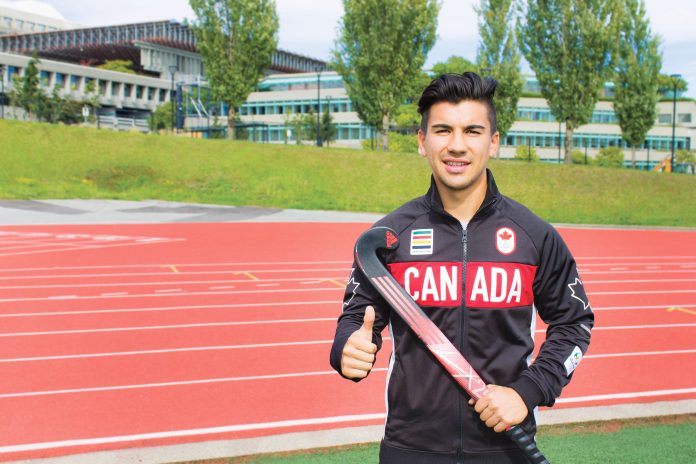
[dropcap]S[/dropcap]FU will not be without representation at the Rio de Janeiro Summer Olympics. In the opening ceremonies, keep your eyes peeled for student Gabriel Ho-Garcia, playing men’s field hockey for Team Canada .
The Peak caught up with Ho-Garcia after he’d attended a barbecue held in honour of those going off to compete in Rio. Leaving on July 25, Ho-Garcia was looking forward to his Olympic debut as an athlete on Canada’s men’s field hockey team. You could see the excitement in his face.
The field hockey team’s first match in the Olympics is on August 6, giving the players about 10 days to warm up and get acclimatized to the temperature, time change, and, what Ho-Garcia emphasized as a big one, humidity.
While looking forward to stepping onto the world stage, he also looked back on his beginnings as an athlete. Ho-Garcia explained how his mother enrolled him in soccer for his first sport: “I was kind of a chubby kid growing up, so my mom wanted to keep me active and out of the house,” he chuckled.
He ended up being a huge soccer fan, but when the season ended he was left with nothing to do. Though the budding athlete’s mom vetoed baseball because it didn’t involve enough cardio, she found field hockey a suitable exercise when one of his friends recommended he try it out.
“At the Olympics, the whole world is watching.” – Gabriel Ho-Garcia
“I never took field hockey seriously; it was always a second sport [to soccer],” Ho-Garcia admitted.
He recalled that he started to dedicate himself more to field hockey when he made his first provincial team at age 14. The turning point in his career came when his soccer coach in Grade 12 told him he had to choose one sport because of time conflicts between the training sessions of soccer and field hockey.
“So that year, in Grade 12, I had to make the choice of dropping soccer,” Ho-Garcia said. “It was heartbreaking, I was devastated. So I didn’t really choose field hockey, I was kind of forced into it.
“But now I’m so happy about the decision I made,” he reinforced. “I love field hockey.”
Ho-Garcia outlined part of the brutal training schedule that athletes such as him take on leading up to the Olympics: “For a year and a half, we trained at 6:30 a.m. It was insane,” he recalled. “I would train at 6:30 a.m., shower, go to class right after, fall asleep in class, take no notes, and somehow still pass.”
He described the month in between where the team trained at 6:30 a.m. for five days a week as the hardest month, “but it gave us the mindset of what it was going to take to qualify [for the Olympics].”
When asked how he stayed motivated to push through the most difficult practices, Ho-Garcia gave his most honest answer: “Truth be told,” he began, “I’m known on the team for being the slacker lazy guy.” But, reflecting back, he admitted that ever since the team qualified for the Olympics a year ago, he’s been a lot more motivated than he was before.
“I’ve gone to the Commonwealth and the Pan Am games, and that was awesome,” he said. “But at the Olympics, the whole world is watching. Realizing that I’m representing Canada in front of the whole world has definitely made me a lot more motivated; I want to make my country proud.”
Throughout both his athletic and academic endeavours, Ho-Garcia named his family as his biggest support system.
When asked for any rituals he adheres to as an athlete, Ho-Garcia produced an impressive list. He always puts his left shin pad on first; he always kisses his wrist whenever he scores a goal; and, the most complex, he wears two pairs of socks: the inner socks are worn on the correct feet, but the outer socks are worn on the wrong feet. And to pump him up pregame, he listens to Lana Del Rey.
Actually, he listens to Lana Del Rey to pump him up for exams, too.
“Lana Del Rey has gotten me through so many exams. Thank God for Lana Del Rey.”
He’ll probably need the singer a few more times this fall: along with all that’s going on with his athletic career, Ho-Garcia is looking to complete his marketing and finance degree at Beedie School of Business.
While excelling in athletics, he described himself as highly career-oriented as well. Along with a couple of Beedie friends, he initiated a startup company a couple years back in commercial and hospitality furnishing. They recently finished their first project at a lounge on Hastings, and are in negotiations with Spacecraft to furnish more office spaces.
Throughout both his athletic and academic endeavours, Ho-Garcia named his family as his biggest support system.
“They’ve been there for me financially: when the junior [field hockey] team was self-funded, they made sure I could go on every trip and training camp. Before I got my licence, my mom would drive me to UBC three to four days a week for practice,” he remembered.
If there’s one thing I picked up on during the interview, it was that despite all of his successes and the demands on his time, Ho-Garcia is a down-to-earth, easygoing person who isn’t afraid to make fun of himself. When asked about what he’s most looking forward to these next few weeks, he responded: “Walking out during the opening ceremonies in Rio.
“Although you probably won’t be able to see me, because I’m so short.”

Syphilis is on the rise in Canada — so much so that the demand for medication is too high for local suppliers to keep up.
Pfizer is Canada’s only manufacturer of Bicillin, the best antibiotic to treat syphilis, and is currently so depleted, they don’t anticipate being able to rebound until this month. The shortage has gone on for months, leading Health Canada to reach out to countries such as Australia for supplemental medication.
Vancouver has not been immune to this outbreak. A recent syphilis outbreak amongst gay and bisexual men has left doctors advising young men to get tested. According to Vancouver Coastal Health, 97 percent of syphilis cases they see are present in men, and over 90 percent are men who have sex with other men. The current rate of the sexually transmitted infection (STI) is the highest it’s been in 30 years, with nearly 500 cases reported in 2015.
This is in line with the rest of Canada, where the average number of cases jumped from less than one in 100,000 to over six in 2013, which gives a jump of nearly 700 percent over the 15-year span.
Syphilis is a common bacterial infection transmitted through vaginal, anal, or oral intercourse with someone who has the infection. It can also be transmitted through the sharing of needles, or through childbirth. Although it sometimes exhibits no symptoms whatsoever, having syphilis can increase the risk of contracting HIV. As well, syphilis can have serious long-term effects, such as blindness, bone pain, neurological issues, and sometimes death.
Syphilis can remain dormant in the body for several years without showing symptoms. However, during the dormant stage, it is still possible to transmit the infection, which is why getting tested is so crucial.
Once tested, early-stage syphilis can be cured through the use of penicillin or other antibiotics.
In February, Vancouver Coastal Health collaborated with other sex-positive health organizations such as the BC Centre for Disease Control YouthCO and Health Initiative for Men, to create an LGTBQ-friendly marketing campaign. The ads went up on public transit, in newspapers, and on dating websites in February, when the VCH announced a formal outbreak response.
BC and Canada aren’t the only areas seeing a spike in the infection. Syphilis and gonorrhea are both spiking in the UK due to a lack of funding for STI testing resources. This crisis is also disproportionately affecting men who have sex with other men, as well as lower-income individuals who don’t always have access to the health resources they need.
According to Vancouver Coastal Health, men who have sex with men should get tested for syphilis every three to six months, and talk to their doctor if any unusual skin irritations occur around their genitals.

University is a time when many students leave home for the first time and are free to explore and experience new things. Accordingly, SFU Health and Counselling Services (HCS) offers free services for all students, in order to make sure that they take care of their mental and sexual health.
Students have an “opportunity to take control of their own health,” Martin Mroz, director of SFU HCS, told The Peak. Without a family doctor present, students can freely inquire about birth control, sexual activity, and mental health without having to worry that their parents might find out.
Being proactive about sexual health is important, because “a lot of things change in university,” said Mroz. Even if not sexually active, students have relationships and are exposed to parties, drugs, and alcohol for the first time. SFU HCS offers education on these subjects.
For students who are already sexually active, it’s important to have regular check-ups. Reports show that STIs have increased in the past decade across Canada and North America.
“There’s still a lot of taboo” when talking about sexually transmitted infections, birth control, and mental health, explained Mroz. SFU HCS offers stigma-free information and counsellors who are clinically certified.
“I think we as a society have become more open about things like nudity, but when you start talking about birth control or STIs, it’s still more awkward with more shame involved,” said Mroz.
There’s a lot of misinformation about healthy relationships and lifestyles in the media, said Tammy Blackwell, manager of clinical health services at SFU. HCS offers better education for SFU students.
Where is Health and Counselling Services located?
Burnaby: MBC 0101, at the bottom of the Maggie Benston Centre
Vancouver: Room 300, across from the SFU bookstore on the bottom floor
Surrey: Room 2534 (counselling only)
How do I book an appointment?
Appointments must be scheduled — no drop-ins. Give HCS a call or go in person to book an appointment. I called, and got an appointment the next day.
How much does an appointment cost?
HCS appointments are covered by MSP and out of province healthcare. They are free to book, but cancellations will cost you.
What can HCS help me with?
There is a wide range of sexual health services and supplies, including: birth control resources and information, pregnancy tests and information on what to do if there’s a bun in the oven, STI testing and education, UTI testing, and “Well-Woman Exams” which can include Pap smears, pelvic exams, blood pressure checks, and breast exams.
Where can I get contraceptives?
SFU Health and Counselling Services has free condoms, and offers NuvaRings and oral contraceptives (the Pill) that must be prescribed by a doctor. The SFSS offers free contraceptives through the Women’s Centre. This includes condoms, lube, flavoured condoms, female condoms, and dental dams.
Does HCS offer vaccinations?
They offer many different vaccinations against hepatitis, HPV, and a range of other illnesses both sexually and non-sexually transmitted.

Can love only happen between two people? Not necessarily, and there are many individuals who live in polyamorous relationships to prove that. The first question those of us who don’t practice polyamory usually ask is: how do you deal with jealousy?
While completing her PhD in the department of sociology at SFU, Dr. Jillian Deri wanted to explore this question and understand more about how polyamorous couples navigate jealousy. Her research on the subject led to the creation of the book Love’s Refraction: Jealousy and Compersion in Queer Women’s Polyamorous Relationships, which was written with the intention of appealing to anyone who is interested in polyamory, emotions, and love.
Deri explained to The Peak that those who practice polyamory “want love and emotional connections, and sexual connections with multiple people where everyone knows about it.” This is distinct from consensual non-monogamy, where there is usually one main partner with sexual explorations outside of the relationship, and from cheating where sexual explorations outside of the relationship are unknown and not consensual.
“Hookup culture, to me that’s a form of non-monogamy, and should be valued as a way of doing relationships too.” – Dr. Jillian Deri, PhD, department of sociology
Whereas jealousy is certainly an aspect of polyamorous relationships — and to an extent, arguably all relationships — polyamorous relationships also aim to achieve compersion. Deri describes compersion as the opposite of jealousy: it refers to the positive feelings one has about their partner’s experiences in other relationships. “When a friend does really well you feel happy for them, and [compersion is about] translating that joy into a romantic context,” Deri explained.
For the book, Deri chose to focus on queer, lesbian, and bisexual women because they tend to be understudied. She also wanted to investigate whether there was a unique culture among polyamorous queer women that differs from heterosexual polyamorous relationships. She accomplished this by interviewing queer women in polyamorous relationships to learn what the community was doing to achieve compersion.
Deri found that “there is a culture to it, and there is potentially different dynamics between queer culture and heterodynamics.” This is partly shown in the different challenges faced by women in these relationships. In queer communities, there tends to be more overlap between partners since the dating pool is smaller than it is for heterosexuals. Therefore, there is an increased likelihood of, for example, knowing your ex’s new lover.
This unique experience in the community brings about accountability and care because there is an increased likelihood of coming across one another again.
When asked whether polygamy or monogamy are a result of human nature or socialization, Deri explained that it is likely a combination of both. “Some people feel much more at ease with open relationships, [and] some people feel more at ease with monogamous relationships. Just like how some people might be more inclined to be queer, [some] straight, some bi, I think we might have a bit of an orientation towards monogamy, or open [relationships], or polyamory.”
While it might seem that open relationships have become more common in recent years, Deri notes that it’s difficult to tell what percentage of the population pursues polyamorous relationships. In fact, the very definition of what it means to be in different styles of relationships can be tough to define.
“It’s hard to know where to draw the line,” Deri said. “Hookup culture, to me that’s a form of non-monogamy, and should be valued as a way of doing relationships too.” Among millennials, it is also very common to have multiple partners with the intention of eventually ending up in a monogamous relationship, she noted.
There is a spectrum of ways to be in a polyamorous relationship, and with increased access to information it is easier than ever for individuals to learn how to pursue such a relationship successfully.

Pokémon Go has taken over the world.
The app, which combines the popular Japanese franchise with features borrowed from augmented reality (AR) and geocaching, has quickly become one of the most popular pastimes in North America. Seriously, it even briefly eclipsed porn in terms of Google searches.
SFU hasn’t been immune to this trend, and students and faculty alike will have noticed trainers crowding around popular PokéStops on campus to catch their favourite monsters and retrieve eggs and other items — if they’re not too busy playing the game themselves.
Many of us at The Peak are also aspiring Pokémon Masters, and we’ve scoured Burnaby Mountain and sacrificed our monthly data bills in a quest to find the most popular PokéStops, the most competitive gyms, and the best spots to find a high CP Squirtle that won’t goddamn run away from you again.
Happy hunting!
sp
sp
There are a whopping 40 different PokéStops on the main part of Burnaby campus, ranging from Residence all the way to UniverCity and down to Discovery Research Park. If you’re looking to stock up on Pokéballs or just gain a little extra XP, here are some spots for you to check out. They appear on the map in blue.
sp
There are five gyms on Burnaby campus, all at varying levels of difficulty and accessibility. If you’re feeling ready to challenge one, here’s what you need to know. They appear on the map in yellow.
On top of all of the PokéStops and gyms to be found on Burnaby Mountain, there are also plenty of rare Pokémon to be caught. Here are a few harder-to-find monsters that have been found by players on campus. They appear on the map in red.
Though we made an effort to be as thorough as possible, we probably missed some things. If you notice a PokéStop we didn’t catch or a rare Pokémon we didn’t mention, let us know on Facebook or at www.the-peak.ca!

Finding the right music for a night in the sack can be a challenge. You don’t want something distracting, but you also don’t want elevator music or something cheesy like Enya. Luckily for you, the 2010s have already given us more than our fair share of sexy records perfect for smooching your sweetie. Here are five of my personal favourites.
Beyoncé – Beyoncé (2013)
Were you really expecting anything else? While Lemonade is proof that hell hath no fury, Bey’s self-titled is the calm before the storm: a sexy, confident, and courageous platform on which Beyoncé owns her sexuality, her marriage, and her feminist worldview. There are sex jams (“Rocket”), self-love anthems (“Flawless”), and a bouncy ode to cunnilingus that’s a lot less subtle than it thinks (“Blow”). To top it off, Bey filmed a suite of music videos to match each song, all of which bring their own flavour of sexiness to the table.
D’Angelo – Black Messiah (2014)
While not as overtly sexual as his LP Voodoo, D’Angelo’s latest retains his charismatic vocal delivery and effortless knack for all things groovy. Equal parts Prince and George Clinton, the album has an undeniably progressive undertone that matches perfectly with its more primal instincts, especially on tracks like “Betray My Heart” and “Ain’t That Easy.” Black Messiah is sex music for activists and world changers, proving that the personal is indeed political — and D’Angelo is more than capable of handling both.
FKA twigs – LP1 (2014)
Tahliah Barnett is the ultimate girl next door — you know, if your next door neighbours are art school dropouts who have a lot of loud tantric sex at weird hours of the day. LP1 strikes that perfect balance of sexy and vulnerable that has made Barnett’s work as FKA twigs so intriguing and so painfully, achingly human. Lyrics like “Pull out the insides / And give me two weeks / You won’t recognize her” might be a little bit heavier than your usual late-night bedroom jams, but no less well-suited for gettin’ it on.
Miguel – Wildheart (2015)
Miguel is Marvin Gaye reborn. After his commendable breakthrough record Kaleidoscope Dream, the 30-year-old Los Angeles native expanded his horizons with last year’s Wildheart, a churning mix of R&B, soul, psychedelic rock, and new wave. But like any great sex record, Wildheart is about a lot more than just doing the deed; it’s also about love, life, death, and what it means to live in the world today. If that sounds broad, it’s because it is. That Miguel handles these themes with aplomb (and more than a little bit of carnal charisma) only makes the record even sexier.
Washed Out – Within and Without (2011)
Ernest Greene, also known by his stage moniker Washed Out, is probably best known as the guy who does the Portlandia theme song. But as he’s proven on his studio LPs, Greene also has a talent for sensual, dreamlike synth-pop that seems to evoke stale cigarettes and late-afternoon slow dances in bedrooms. If sexy for you means comfy sweatpants and mugs of licorice tea, look no further than Within and Without.

Simon Fraser University’s independent student newspaper since 1965.
For advertising inquiries: [email protected]
For promotional inquiries: [email protected]

Simon Fraser University’s independent student newspaper since 1965.
For advertising inquiries: [email protected]
For promotional inquiries: [email protected]