Home Blog Page 772

Four films to put SFU’s snow crisis into perspective

0
SFU might have been snow covered and students might have been stuck on campus, but at least nobody had to sleep in a tauntaun.

SFU Burnaby had suffered an endless onslaught of snow. Classes were cancelled and snow and ice blocked routes that students normally took to reach their destinations. Despite the hills of white, the slush that covered our every step, and the AQ pond being a frozen tundra of its previous self, we’re still way better off than some places (even if most of them are fictional). As proof, here are four films with snow or winter weather conditions far worse than what we could ever experience on campus.

The Day After Tomorrow

Nothing says doom in this film like big tornadoes and snow storms that devastate cities. Be glad that we’ve never experienced weather phenomena as dangerous as those in this film. Unlike what people had to do in The Day After Tomorrow, we won’t need to burn books to stay warm. Starbucks and Tim Hortons has us covered. We may have a frozen pond and piles of snow everywhere, but better that than a snowstorm that will freeze you (and most of the northern hemisphere) to death.

Star Wars: Episode V: The Empire Strikes Back

It gets cold on campus, but our snow conditions can never be as cold or hostile as what Luke Skywalker suffered on the planet Hoth. Unlike us, Luke didn’t have heated buildings for refuge. He not only had to spend time inside a tauntaun, but also hallucinated about a dead Jedi master during a snowstorm. Let’s be eternally grateful that we won’t ever experience what Luke went through on Hoth. It may be slightly chilly on campus, especially from past weeks due to the snow, but remember this: Luke had to keep warm using a freshly killed tauntaun as a sleeping bag.

The Huntsman: Winter’s War

If there’s one film from last year that demonstrated the power of ice in a fantasy world, it’s this one. Our campus was no stranger to ice and its slippery reputation. On the bright side, at least our ice wasn’t due to the sorcery of a snow queen. Slipping on ice is a pain, but it’s better to face the prospect of slipping on ice and slush around campus in our natural world than to face the dangers of magical ice in an enchanted realm.

Snowpiercer

This film proved there was no better way to protect humanity from the dangerous snowy conditions of the outside world than to have it cooped up inside a moving train while under an oppressive social class system. So, don’t fret too much over our snow. As frigid as it could get on campus, we could still go outside and get where we needed to go. SFU might have had its off days, given the snow’s unwelcomed visit and the annoying slush we’ve recently had, but at least we won’t be stuck in a dirty and confined dystopian society like the people in this film.

JFL NorthWest preview

0
Trevor Noah returns to Vancouver on February 23 as part of Just For Laughs NorthWest.

In the dead of winter, it’s important to keep your sense of humour and have a little fun. JFL NorthWest (a partnership between Just for Laughs and the NorthWest Comedy Fest) comes along at the perfect time; from February 16–25, the festival is back for a second year with a variety of performances at multiple venues in Vancouver. With so many comics and variety shows, there is a show for everyone’s sense of humour.  

Best show for political humour: Trevor Noah | February 23 | Queen Elizabeth Theatre

If you missed his show at last year’s festival, you don’t want to miss out again. Since Trump’s election to the White House, Noah is sure to have more political material to add to his cultural comparisons from a South African perspective. The Daily Show host knows how to tell it like it is and make his audience think globally.  

Best show for dad humour: Jim Gaffigan | February 24 | Queen Elizabeth Theatre

This father of five shares his observations on being a dad, the meaning of life, and food. With four comedy specials on Netflix, he’s easily accessible from the comfort of your couch, but nothing beats laughing simultaneously with hundreds of other people. Gaffigan can also be seen in TV shows such as Portlandia, Flight of the Conchords, and Law & Order.

Best show for sarcastic humour: Sarah Silverman | February 25 | Queen Elizabeth Theatre

You may have heard Sarah Silverman’s voice on Bob’s Burgers, and now you can hear her live as she shares personal stories and tackles subjects such as racism, sexism, and religion. The Saturday Night Live alumna has racked up a number of awards over the years including two Emmys, a Grammy, and a Webby. Silverman’s humour is always thought provoking and challenging.

Best show for bro humour: Chris D’Elia | February 24 | Vogue Theatre

Chris D’Elia’s comedy is like watching a guy try to impress his friends. If you’re into that style of boastful, self-important humour, then you’ll love D’Elia. He doesn’t pull any punches, and he isn’t afraid to play into stereotypes — especially of females or minorities. D’Elia enjoys impersonations and topics such as drunk girls, Cubans, and Drake.

Best show for a girls’ night out: Iliza | February 17 | Vogue Theatre

Grab your girlfriends and go have some laughs with Iliza (who, somewhere along the way, dropped her last name, Shlesinger). She got her start on the reality show Last Comic Standing, her stand-up can be seen on multiple Netflix specials, she has many television credits, and her first book, Girl Logic, is set to be released in April 2017. Iliza is a girl’s girl who touches on subjects such as girls at bars, girl GPS, girls’ night, and girls eating — you get the picture.

Best shows for local humour: Best of the West series

Sure, we’ve got international superstar comedians coming to Vancouver for this festival, but we also have some great homegrown comic talent. Support your local comedians in this series of shows that includes legendary troupe The Sunday Service; The Gentlemen Hecklers providing humorous commentary to the best bad movies; Vancouverite commenting on what it’s like to live here; All You Can Eat Laundry, a variety show hosted by Maddy Kelly; Cords Comedy; and Eight and a Half Inches of Comedy.

Best show for film lovers: Comedy Short Shorts | February 18 | Rio Theatre

This third annual showcase of local short films is judged live by a panel of industry experts, and the winner will go on to be screened at the Just For Laughs Festival in Montreal. You never know what you’re gonna get in this grab bag of short films and sketches, but it’s sure to fill the Rio with laughter.  

Kama Sit-ra

0

Kamasutra1_ChristinaKrugerWoodrow
Missionary

Your classic classroom sleeper.

Simply try your best to keep your eyes open after the first half hour of class. Eventually, give in and put your head down on your desk — pray that your prof doesn’t notice you.

Kamasutra3_ChristinaKrugerWoodrow

Reverse Cowgirl

Perfect for classrooms with rolly chairs.

Roll yourself into a nice corner and turn your chair around. Straddle it, resting your arms and head on the back. Cling onto the chair for comfort as you drift off to sleep, wishing that you had friends to get notes from.

Kamasutra2_ChristinaKrugerWoodrow

Doggy Style

Best attempted in a three-hour lecture, after back-to-back all-nighters.

Just give up all together on trying to stay awake. Get out of your seat and curl up on the ground, then proceed to take a much-needed nap. We all know this is better than trying to sleep on your desk anyway.

Kamasutra4_ChristinaKrugerWoodrow

Spooning

Fun with new friends.

Summon the courage to say “Hello!” to the classmate beside you. After trying very hard to stay awake and take notes to make a good impression — fall asleep on their shoulder. If they are still there when you wake up, ask them if they will share their notes.

Kamasutra5_ChristinaKrugerWoodrow

69

For those who lack in motivation.

After realizing you haven’t been paying attention for the past hour, decide it’s too late to catch up now. Allow yourself to zone out peacefully, catching the occasional micro-nap. That is, until you think about the 69% you received in your class last semester—that extra percent robbed you of the C you could have gotten.


SFU campuses ranked by sex appeal

0

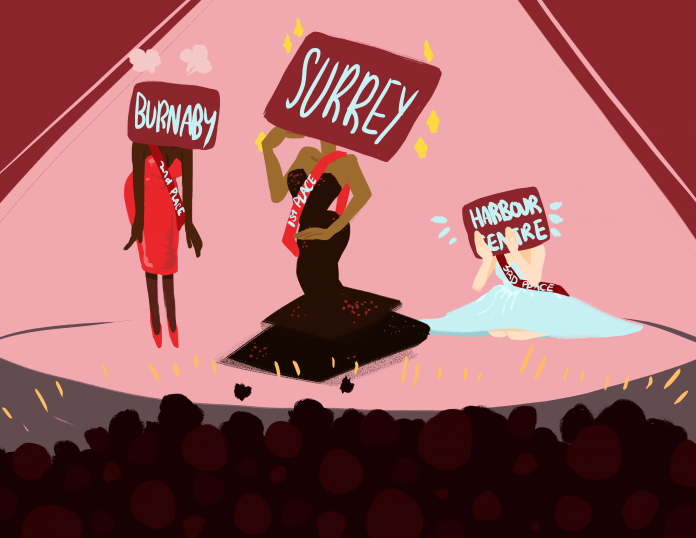
Probably the least sexy thing on the planet would be the place you go to school. It’s where you sit and listen to someone talk for way longer than you’d like, and stress over how much you have to do. But we go to a school that was almost named “Fraser University” and would have had the unfortunate acronym of FU — maybe that almost-acronym was an open invitation from our campuses to explore their many titillating hallways. These sexy SFU campuses will have you going from “fuck you” to “fuck you” (raises sensual eyebrow).


       Surrey

Sleek, modern, and sophisticated AF, many feel groan-worthy pleasure from looking at its elaborate wooden roof. This campus is begging you to plop your ass in a chair in their virtual reality lab so you can experience a whole new world. Also, Trudeau has been within its walls so that’s an added bonus.


     Burnaby

While this campus is older and not in top shape, the gorgeous mountain views at the study spot in West Mall Centre will help you get in touch with your wild side while hitting the books. There are also plenty of coffee shops around, if you are in need of an aphrodisiac to get the ball rolling. And, of course, nothing satisfies a sexual appetite more than the avocado (I have to put this in here even though that joke needs to die).


      Harbour Centre

Aaand this brings us to the campus that is reminiscent of an airport lounge. Is there anything sexy about an airport lounge? No, because you are cranky and hungry and in a hurry to catch a flight, and being horny is the farthest thing from your mind. Keep this one on your list for actually studying and getting shit done.


SFU vs. UBC: the decades-old rivalry lives on today

0

An ongoing, light-hearted feud between my grandfather and I is whose alma mater is better. When I bought him an SFU T-shirt for Christmas, I was pleasantly surprised he didn’t burn it. I was also surprised that when I asked him where this rivalry came from, he wasn’t able to tell me.

Despite not knowing why he scoffs at SFU, after a short conversation, it’s evident that he does and probably always will. “I was 35 when I started second year at UBC and being much older than my fellow students, there wasn’t much of a bond. I don’t remember attending any sporting events between the two [universities],” which, for many, is the most obvious instance of rivalry in the past.

“I did attend a football game once at Thunderbird Field, not against SFU, and there were a few moms, dads, and girlfriends, and that was it. Simon Fraser was not very old at that time [1973], and was thought of as ‘that little college on the hill’. Perhaps a rivalry existed, but nothing that I saw. My main rivalry with SFU started a couple of years ago, when I learned that a blood relative was attending.” I’d like to note that he’s talking about me. . . as I’m interviewing him.

“I am beginning to recover, but it has been a long process. I believe that SFU has come a long way and is now likely to be the second-best university in the province.” Even after admitting he did not get caught up in the rivalry during his time at UBC, he still insisted on making fun of SFU over four decades later. So why does this rivalry exist? And how has it changed in the past fifty years?

A peek back in time

Back in 2015, a former sports editor for The Peak, Austin Cozicar, wrote a feature in The Tartan magazine — a brief side project of The Peak’s — about the history of the Shrum Bowl. For those unfamiliar with it, the Shrum Bowl was an annual football contest between UBC and SFU that started around SFU’s second anniversary.

Founded by SFU’s first chancellor, and former UBC professor, Gordon Shrum, the Shrum Bowl was famous for its antics: a topless woman on horseback, a fight broken up by police, and fans stealing the goalposts during the final quarter, to name a few.

The Shrum Bowl was the beginning of the SFU vs. UBC rivalry. Despite SFU’s age and size, the university was able to win the first five Shrum Bowls. Cozicar believes there was more to this rivalry than just football.

“One big thing between [the two institutions], at least from an athletic standpoint, [is that SFU] decided to go the ‘American way.’ [SFU athletics] went to the National Association of Intercollegiate Athletics (NAIA) which is sort of like the National Collegiate Athletic Association (NCAA), but not as cool,” Cozicar added.

“UBC was old school Canadian football.” And as far as Cozicar is concerned, this was a rupture of sorts in the athletic rivalry between both schools. “The main reason SFU [entered the NAIA] was because they offered scholarships.” While universities in most, if not all, leagues today can offer scholarships, this was a big deal back then. “I think SFU rubbed a lot of them the wrong way by doing that,” said Cozicar.  

Chris Connolly, who graduated from SFU in 1996 and completed a one-year bachelor of education at UBC in 2001, said there was very little rivalry at the time. “Having the perspective of attending both universities, it is apparent that SFU students care more about what is happening at UBC than UBC students care about SFU,” Connolly stated, adding that many no longer cared about the Shrum Bowl by this point.

Deborah Preddy, an SFU alumna who completed a BA and PDP between 19921998, also thought this once-great sports rivalry had lost a lot of its fire. Most of the rivalry Preddy saw during her time at SFU was more conversation based. “Overall it was more good-natured rooting for your home team kind of discussions,” she said.

What’s left of the rivalry?

Our once-great rivalry now seems to have stagnated. Most current students, both at UBC and SFU, don’t even know the famous hijinks of the Shrum Bowl. It makes sense; ever since SFU switched to the NCAA, it has been next to impossible to schedule games, which is why there hasn’t been a Shrum Bowl since 2010.

Even administration has shied away from the rivalry in recent years; a much different attitude than they in held in the 1960s. All of this begs the question: is there still a rivalry between SFU and UBC? “Definitely,” said Soraya Bellou, a third-year UBC biology major.

While Bellou was unclear on the rivalry’s origins, she said she’s always been aware of it. She believes that what remains of the rivalry is rooted in the past, but has taken on new aspects in recent years.

In my opinion . . . the rivalry stems from the [idea] that UBC has a higher reputation internationally and is . . . viewed as [a] more prestigious institution than SFU. [. . .] There’s [also] a resentment towards SFU campus[es] for having more flexible course schedules than UBC.”

Fourth-year BPK and chemistry student, Anupama Rangi, seems to agree. Having the unique perspective of being an SFU student who works at UBC as a residence front desk service representative, Rangi has seen both sides of the rivalry.

When asked if students from either university treat her differently when they find out her situation, Rangi said they mostly just ask why she would transit to get from work to school or vice versa. “If there are any judgements, it’s never been said to my face.”

While admitting there is still a heavy comparison between the two schools, Rangi seems hesitant to call it a rivalry. “I think the general opinion is that UBC is the better university, because of higher admission requirements [faculty specific], a bigger campus, a more widespread reputation, and more people. This comparison is rather inbred — I listened to my parents telling me that UBC was better, I listened to other people’s parents telling me that UBC is better. [. . .] I think it’s less of a ‘rivalry’ now, and more so of a comparison that doesn’t need to be made anymore.”

Cozicar, now the host of CJSF’s Sports Report (Thursdays at 9:00 a.m.), also weighed in on the changes to the SFU vs. UBC rivalry. “From what I gather, back in the sixties there was a lot of perception of snobbery from UBC, which I think we still kind of believe nowadays.”

Touching on what is the most notable form of modern rivalry between the two schools, Cozicar referred to the common ‘Oh, I got rejected from UBC so I went to SFU’ myth that has been perpetuated for years. “It’s actually a matter of pride [for me. . .] I didn’t even try to go to UBC. Only place I tried to go was SFU.”

The nature of our sports rivalry has also dramatically changed. With no Shrum Bowl, where do we see the competition between the two? “I think it’s hard to say there’s one athletically,” said Cozicar. However, Cozicar mentioned there are still soccer games between the two schools, but they don’t bring the same spirit that the Shrum Bowl did.

Picking between the two

Even alumni see how the nature of the rivalry has changed. Connolly, now a teacher at Thomas Haney Secondary, oftentimes has to help grade 12 students pick between several universities. “I think the rivalry is now with smaller institutions such as University of the Fraser Valley (UFV), Trinity Western, and places in the interior. There are more university colleges out there trying to create a name so that they may draw students,” he said, while acknowledging the still existing tensions between SFU and UBC.

“For Thomas Haney students, distance is the factor. SFU is within bus/driving distance, while UBC is just a little out of reach. UBC does have a sort of prestige about it, probably because of that.

“Much of the rivalry, interestingly, centres around the business schools and the education programs. SFU spends a lot of time making a fuss over the PDP program, when really, in my experience, both programs are comparable. In some ways, I do prefer the practicum offerings of UBC as it is a little more ‘hands off.’”

So how should students decide which university is right for them amidst comparison and rivalry? “I recommend students to attend both universities,” said Connolly, adding “if money was not an object, I would give UBC the edge. The campus is beautiful, and there are more networking opportunities due to its size. I also recommend both institutions over smaller colleges if the student is comfortable navigating a larger community.

“No matter where students go, they should stay away from the marketing, and visit each campus and ask themselves, ‘Would I like to spend four years of my youth here along with my hard earned money/loans?’”

Rangi has similar sentiments. “What people should consider when choosing a university at least, what I thought of when choosing where I wanted to go is ultimately what you want to study, what opportunities do you see yourself having, and of course, practical things like tuition feasibility and distance from home. UBC and SFU are both highly-ranked universities with opportunities for success wherever you go.

“What matters in the long run, is what you do and what you experience. If you do nothing to enhance your degree and up your experience, then it doesn’t really matter if you go to UBC or SFU.”


SFSS turns Highland Pub into marijuana dispensary

0

In an effort to curb the constant money hemorrhaging of the Highland Pub, the Simon Fraser Student Society (SFSS) has decided to turn it into the City of Burnaby’s and SFU’s first marijuana dispensary.

“It’s a great idea. I don’t know why they didn’t do it sooner,” said Brendan Bunkis, a first-year business student. “Finally, I can indulge two of my passions — supporting student-run businesses and getting really, really stoned.”

The dispensary has a number of amenities, including a lounge area where students can discuss the latest Steven Universe episodes and how they can “totally start a YouTube channel.” It also includes on-site tutors who will be able to assist you in any schoolwork you have and help you roll a fat joint.

“The dispensary has been a lifeline for the SFSS,” said director of finance, Hangue Kim. “Not only has the entire debt of the old pub gone, but we actually have a surplus. Now, we can afford to book even more obscure EDM acts for our Spring Kickoff.”

But at what cost has the new attraction had on student performance? Some people, including Zoe Moore, a professor in the biology department, don’t see the benefits.

“SFU is a place of higher learning,” she explained. “Students should be focusing on furthering their education, not getting high on the devil’s pollen all day.

“Did you know that 100% of people who smoke marijuana die in their lifetime? It’s proven science.”

She also pointed to the fact that the cumulative GPA of undergraduates has fallen by 40% to a measly 2.25.

“Now, I’ve got students showing up to my lectures who just start laughing when I start discussing the female anatomy. They show up to quizzes high as a kite and just draw penises all over the paper. It’s not a conducive environment for learning.”

Reached for comment, the SFSS said it is working on a campaign to help educate students on the effects of marijuana use, but not before they decide what multimillion-dollar project to cancel next via Twitter.

A journey with hockey leads back home for Jordan Liem

0
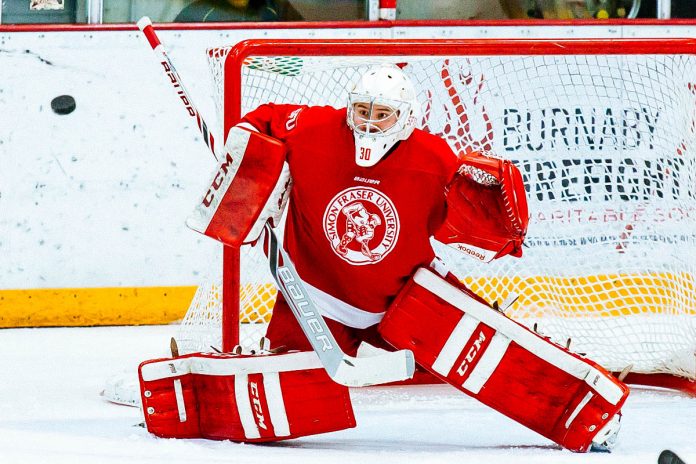
So far this season, Liem has six wins, along with a 2.34 GAA and a .917 save percentage.

Being a goalie in hockey poses some unique challenges. If you have a good game, you can single-handedly win it for you and your teammates. Have an off night, however, and you risk letting everyone down.

Throughout his SFU career, Jordan Liem has been a model of consistency. The third-year goalie from New Westminster has become an integral part of a SFU team that is always near the top of the BC Intercollegiate Hockey League (BCIHL) standings.

“I wanted to stay at home,” said Liem on his decision to come to SFU. “I played in Saskatchewan for a bit, so I wanted to come back home and start playing here again, close to family and friends. My sister actually came to SFU and said she liked it a lot. That kind of persuaded me to come here and they contacted me to come try out.”

Liem’s hockey career began with being drafted to the Western Hockey League. He was a ninth-round pick of the Tri-City Americans back in 2008.

“It’s quite the process,” explained Liem on getting drafted. “It’s definitely something you’re always focused on in your second year of bantam at 15 years old. And when I look back at it now, I think, ‘Wow, these 15 year-olds are getting this huge opportunity to play in a league where you’re getting seen by NHL scouts.’

“For me, I was at school; it was just a regular school day. We knew the draft was going on, so we were trying to keep posted and see if we were going, because a lot of us get contacted throughout the year from interested teams.”

After spending time at the junior B level in BC with the North Van Wolf Pack and not getting “much interest from junior A teams,” Liem then was off to Nipawin, Saskatchewan — population around 4,000 — to try out for the Nipawin Hawks. He ended up making the team.

“It was like the Canadian hockey cliché: move to a small town and play away from home,” Liem said of the experience. “It was kind of like living out that adventure you always envisioned yourself doing. The people were nice; you’re like a town hero. You’re always kind of under scrutiny, because people recognize you all the time. But you’re always welcome everywhere and people are really nice to you.”

After finishing last season with 11 wins in 17 starts with a 2.87 GAA and .915 save percentage, this season has been a bit different. Although he’s improved his GAA and save percentage from last season, he’s been splitting a lot more starts with the team’s other goalie, Lyndon Stanwood.

“There’s never a lull where anyone on the team thinks that we’re shutting down for the rest of the night.”

“I’ve been in some tandems where you kind of butt heads, especially if you’re competing with ice time. But with us, with how good he’s been playing, I have no problem splitting ice time with him.

“We feed off each other a lot and we bounce ideas off each other a lot, which makes it a lot easier. It’s competition within the framework of your team, but it’s not like socially competitive. We’re not angry at each other about anything, it’s just the regular competition that comes between teammates.”

This goalie tandem has led to a brilliant season thus far for SFU hockey. The team is currently top of the BCIHL standings — but they were last year around this time, as well. The trick for this year’s edition will be to avoid the late season collapse that put them in second place, and eventually bounced them out of the first round of the playoffs.

“It’s hard to pinpoint,” said Liem on what makes this year’s team different. “I think I’ve said all year the leadership group is a little bit different. We’re kind of overall never out of a game.

“There’s never a lull where anyone on the team thinks that we’re shutting down for the rest of the night. I don’t know how many comeback wins we have this year, but at no point in any game have we felt like that’s it; we’re done. We’ve never felt out of it all year, and I think this year, too, just the attitude everyone has coming to the rink is pretty positive.”

Liem’s ultimate goal is to win the BCIHL championship after coming so close his first year. After that, the future is uncertain, but Liem says he does have a passion for goalie coaching.

“There’s a former SFU goalie, Justin Mulholland, who’s starting a goalie school. It’s been getting a lot of popularity and he’s been keeping in contact with me and he gives me some opportunities to coach younger kids. [. . .] I don’t know if I’d want to do team coaching, but goalie coaching is kind of an interest in mind.”

FUN FACT: Favourite place to eat on campus?

“Definitely Mackenzie [café]. Their sandwiches are just killer.”

Ontario judge stands up with residential school survivors

0

By: Manon Busseron

Canada failed to protect thousands of Indigenous childrens’ cultural identities during the “1960s Scoop,” Superior Court Justice Edward Belobaba stated.

After an eight-year lawsuit, Ontario judge Edward Belobaba stated that the Canadian government did not fulfill its “duty of care“ to the children by placing thousands of Indigenous children in non-Indigenous families and residential schools. The term “Sixties Scoop“ was coined by Patrick Johnston in 1983, and refers to the forced mass removal of Indigenous children from their families.

Between 1965 and 1984, about 150,000 Indigenous children were forcibly removed from their families and taken to residential schools run by the church. The government decided that it was its responsibility to assimilate Indigenous children into white society. They were prevented from speaking their languages and had to abandon their traditional customs. Those who refused to obey were beaten and severely punished. Many were separated from their siblings and faced physical, moral, and sexual abuse.

In his decision, Justice Edward Belobaba acknowledged the psychological harm caused by residential schools and the responsibility of Canada in the loss of Indigenous identities for many of the children at that time, saying that it “left the children fundamentally disoriented, with a reduced ability to lead healthy and fulfilling lives. The loss of Aboriginal identity resulted in psychiatric disorders, substance abuse, unemployment, violence, and numerous suicides,” according to the CBC.

Over one billion dollars are at stake in the lawsuit on behalf of 16,000 Indigenous children from Ontario who claimed being harmed after being sent to a residential school or non-Indigenous homes. Justice Belobaba argued that the state did not respect the child services agreement by failing to consult with First Nations regarding the transfer of children to non-Indigenous environments. The government responded that the consultation would not have changed anything for these children, but Justice Belobaba strongly disagreed, calling this opinion “odd and frankly insulting.“

Justice Belobaba has not settled a financial arrangement yet, but intends to negotiate with survivors. Indigenous Affairs Minister Carolyn Bennett said that the government will not appeal, but will try to prevent the release of the decision and ask for “technical clarifications.“ Bennett insisted that money was not the most important part of the decision, declaring that “getting their language and culture back, making sure their children will be able to speak the language, and getting their culture back, is so important.“

The lead plaintiff in the action was Marcia Brown Martel from the Temagami First Nation. After being adopted by a non-Indigenous couple when she was nine, Canada “declared her original identity dead.“ She said, “Our voices were finally heard and listened to. . . It is a gain for all of us a step forward and a step closer to reconciliation.“

With files from CBC and Indigenous Foundations at UBC


Ellen Kett sets GNAC single-game record with 20 assists in 87–65 Victory

0
Kett’s (#5) 20 assists in one game were not only the most in GNAC history, it was also the fourth-most in NCAA Division II history.

Ellen Kett’s dominant season continued Saturday night, as the senior point guard recorded a record 20 assists in one game against Montana State Billings. This set the record for most assists in a game in Great Northwest Athletic Conference (GNAC) history, as well as the fourth-most all time in NCAA Division II history. Kett smashed the old record of 16 assists, previously set by Ally Schmidt of Central Washington in 2012.

Kett’s phenomenal passing ability was on display throughout the game, and her teammates were able to convert on the opportunities she gave them — evidenced by SFU shooting 61.8% from the field.

The team got off to a great start behind a 102 run to begin the first quarter. Of the five baskets scored during this run, Kett assisted four of them, establishing herself as a primary playmaker early on. The Clan struggled for the rest of the quarter. However, the Yellowjackets went on a 102 run of their own to make the score 1212 heading into the second frame.

In the second quarter, Simon Fraser was able to separate themselves from their opponents. As expected, Kett’s passing ability was on display throughout the quarter, as she added seven assists to her total in the frame. Going into the half, she had a game-high 11 assists. Meg Wilson and Rachel Fradgley were both a perfect 44 from the field, with nine and eight points respectively. Rachel Swant scored eight points off the bench in the half as well, including two three-pointers. The teams headed into the half with a score of 38–30 for the visiting team.

Simon Fraser stretched the lead out a little more in the third quarter with a 155 . During it, SFU dominated the paint and propelled the Clan to a 5742 lead with three and a half minutes to go in the quarter. At 2:21, a Tia Tsang three-pointer marked the 16th assist by Kett, tying the previous GNAC single-game record. The score was 6251 heading into the final quarter, and Kett had 10 more minutes to create a new record.

She broke the record convincingly, adding four assists as well as eight points in the final quarter to finish the game with a line of 14 points and 20 assists. The team won by a blowout score of 8765, ensuring the team will finish third in the GNAC.

For those who have followed the Clan this season, a breakout game like this by Kett is no surprise. Her playmaking ability at the point guard position has been the catalyst of the team’s success throughout the year. Head coach Bruce Langford has always trusted in his senior point guard, playing her for big minutes in almost every game this season. Games like this are simply a reminder as to why she is so integral to the team’s success. As Langford told SFU athletics, “Our offense is designed to put the ball in [Kett’s] hands for a reason.”

The Simon Fraser front court were beneficiaries of Kett’s passing in this one. Wilson led the team in scoring with 19 points on a very efficient 8–9 from the field and 22 from the free throw line. Fradgley had 12 points on a perfect 6–6 from the field. Elisa Homer had 11 points, including three three-pointers. Tayla Jackson rounded out the double-digit scorers with 10 points off the bench.

With this win Simon Fraser are now 144 in the GNAC and 23–5 overall. They will finish as the third seed in the GNAC with only two conference games left to play.

Next Game: Simon Fraser will host the University of Alaska Fairbanks in their second-last game of the season on Thursday, February 23. The Nanooks are an even 9–9 in conference play and 13–12 overall. Last time these two teams played, SFU squeaked out a 79–77 victory, behind freshman Tia Tsang’s 16 points.

Tip-off is at 7:30 p.m.

Team Canada unable to claim victory against USA in Americas Rugby Championship

0
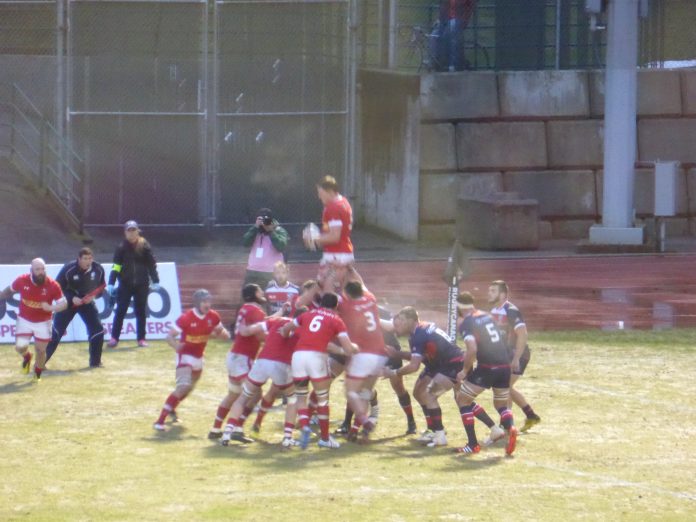
Canada's Reegan O'Gorman claims a lineout in their loss to the USA.

With less than two minutes on the clock, it was the USA who made the dream start in front of the Swangard crowd.

Fly-half Will Magie’s long pass opened up space out wide, before captain Todd Clever’s offload sent Ryan Matyas sprinting under the posts for the game’s opening try. Shaun Davies added the conversion for the extra two points, and the Eagles led 70.

It was to get even better for the visitors just two minutes later. A stolen lineout saw the ball spun wide, and Mike Te’o’s lethal combination of footwork and pace saw him cross out wide. Davies was unable to add the tricky conversion from out wide, but the USA led 120 with less than six minutes played.

The USA continued to dominate the early exchanges. They also added another three points when Magie was on target with a penalty after referee Damian Schneider punished Canada for an infringement at the breakdown.

The home side finally had the chance to get themselves on the scoreboard on 13 minutes, after the USA was penalized for not rolling away from the tackle. However, Robbie Povey pulled his penalty attempt wide of the posts.

Povey almost immediately made amends, though. Spotting a gap in midfield, the fly-half accelerated through the USA defence before feeding Taylor Paris, who sprinted home for his fourth try in two games. The conversion was wayward, leaving the score at 155 in the USA’s favour after 15 minutes.

The home side was fighting their way back into the game, and were rewarded with their second try on 20 minutes. After finding some success at the scrum, Phil Mack darted through a gap close to the try-line to score. Povey was on target with the conversion, and the gap was down to three points.

Davies extended the Eagles’ lead on the half-hour mark, taking his side’s lead to 1812 with a penalty after Canada was penalised at the ruck. The home side soon hit back though, with Povey’s kick reducing the deficit once more.

However, just before halftime, the Canadians were dealt a blow as captain Ray Barkwill was shown a yellow card for a dangerous tackle. In his absence, the USA struck, a rolling maul powering over the try-line, to allow Tony Purpura to score. Davies converted to give the USA a 2515 lead at the halftime interval.

Once again, the USA got the ideal start to the half. With five minutes of the second half played, Magie’s cross-field kick was knocked down by Matyas, with Te’o following up for his second try of the evening. Davies was off-target with the conversion, but the USA led 3015 as Barkwill returned to the field.

Canada’s indiscipline was costing them, and the USA was capitalizing. Another penalty was kicked into the corner, and from the resulting maul, Clever was able to crash over for the try. Davies converted, and the Eagles had a 3715 lead with 55 minutes played.

The home side responded in the best possible way. Substitute scrum-half Gordon McRorie found Paris on an outside arc, with the former Glasgow Warriors wing scything his way past three defenders en route to the line for his second score of the night. McRorie was unable to add the extras, with the USA’s lead now standing at 3720.

In an end-to-end affair, it wasn’t long until the next try came. After maintaining possession for a number of phases, USA replacement back row John Quill latched on to a delayed pass from Davies to score the visitors’ sixth try. Davies converted for a 4420 lead.

With the result now looking beyond them, the Canadians were still looking to play enterprising rugby. With referee Schneider holding an advantage against the USA, Povey’s chip over the top was gathered by replacement winger George Barton, who was able to touch down despite the attentions of two defenders. McRorie added the extras for his first successful kick of the night.

Just seconds later, however, the USA responded. The impressive Te’o was first to the kick ahead from Magie, touching down for his hat-trick out wide. Davies conversion took the Eagles past 50 points, as they took a 5127 lead into the final 10 minutes.

There was still time for another Canadian score, and it was possibly the most popular of the evening. From a scrum five metres from the American try-line, number eight Admir Cejvanovic, a member of the Burnaby Lake club, drove over the line to score. McRorie was once again on target with the conversion, leaving the final score at 5134 to the USA.

The Americans, therefore, keep pace with Argentina at the top of the Americas Rugby Championship as they travel to Chile next week. Canada, meanwhile, will look to pick themselves up in seven days’ time when they face Uruguay.

Canada: Brock Staller, Dan Moor, Nick Blevins, Guiseppe du Toit, Taylor Paris, Robbie Povey, Phil Mack; Rob Brouwer, Ray Barkwill, Matthew Tierney, Conor Keys, Reegan O’Gorman, Lucas Rumball, Oliver Nott, Admir Cejvanovic.

Replacements: Benoit Piffero, Djustice Sears-Duru, Cole Keith, Liam Chisholm, Lucas Albornoz, Gordon McRorie, Gradyn Bowd, George Barton.

USA: Mike Te’o, Ryan Matyas, Bryce Campbell, JP Eloff, Nate Augspurger, Will Magie, Shaun Davies; Tony Purpura, Peter Malcolm, Chris Baumann, Nate Brakeley, Nick Civetta, Todd Clever, Tony Lamborn, Cam Dolan.

Replacements: James Hilterbrand, Ben Tarr, Dino Waldren, Siaosi Mahoni, David Tameilau, Ben Cima, Aaron Davis.