Top Dawg Entertainment (TDE) is one of hip hop’s biggest labels, an absolute powerhouse of overwhelming talent that decided to bless their fans by taking the whole team (minus, unfortunately, personal favourite Isaiah Rashad) out on “The Championship Tour.” To see such top-tier artists as Kendrick Lamar, SZA, ScHoolboy Q, Jay Rock, Ab-Soul, and SiR together outside of a festival setting is a rare opportunity, and one I couldn’t pass up. Even watching from the (relatively) cheap nosebleed seats, the show was phenomenal.
As a label, TDE has always been collaborative, with members frequently appearing on their label-mates projects; fans reasonably expected this tour to be a rare opportunity to hear collaborative tracks in their entirety. The performances were nothing short of fantastic, but there’s something disappointing about hearing “Collard Greens” or “Doves in the Wind” performed solo, knowing full well that Lamar is probably just meditating somewhere backstage.
There were only three instances of onstage collaboration between the artists: SiR and ScHoolboy Q’s “Something Foreign,” Lamar and Zacari’s “LOVE.,” and, most notably, Lamar and Rock’s “Money Trees.” The latter was, at least for me, the high point of the night: seeing Rock join Lamar on stage to perform the best verse of his career was worth the ticket price alone. For a concert that could have been filled with moments like that, one can’t help but feel TDE dropped the ball on what fans expected from the tour. However, despite this unfortunate disappointment, this was one of the most excellent concerts I’ve seen to date.
TDE’s latest signee, Inglewood R&B singer SiR, opened up the show with a quick three-song set of tracks from November, including a stellar rendition of album-standout “D’evils.” Rock, TDE’s first signee, tagged in next to perform a few tracks off 2015’s 90059, as well as his recent Black Panther single “King’s Dead.” Rock briefly surrendered the stage to Ab-Soul, TDE’s high-minded, conspiracy-obsessed lyricist who, disappointingly, performed only a single song: “Terrorist Threats,” from 2012’s Control System. Soul wasn’t seen again for the rest of the night; Lance Skiiiwalker, another label signee who was slated to perform, didn’t even make an appearance.
After these brief but excellent sets from Rock, Soul, and SiR, the label’s three biggest heavyweights followed with more substantial sets. ScHoolboy Q arrived onstage on a stretch golf cart, and performed his infectious, Kanye-assisted single “THat Part.” He put on a high-energy show, performing the biggest hits off his last two albums, including “JoHn Muir,” “Man of the Year,” and “Collard Greens.” SZA followed shortly thereafter, delivering one of the most moving performances I’ve ever seen. Ducking in and out of a boxing ring set up in the middle of the stage, the St. Louis songstress belted out a series of tracks off her phenomenal 2017 album Ctrl, bringing all the grace, humility, and inspiring talent of her studio work to the stage.
Lamar predictably ended the night, and gave a performance worthy of his status in the rap game. Opening with “DNA.,” Kendrick never let the energy die, performing hit after hit from his seemingly endless arsenal of singles, from “Backseat Freestyle” to “King Kunta” to a fantastic “XXX.”/ “m.A.A.d. City” medley. For his encore, after a rousing performance of “Alright,” Kendrick performed “HUMBLE.” twice: once, with the entire audience performing it a cappella, and once on his own, and the experience was nothing short of spiritual. Despite the missed collaborative opportunities, TDE provides such an overwhelming array of talent that The Championship Tour was still extraordinary.
Do you like mazes? Do you enjoy students losing their minds walking in our maze of a school? If you’ve said yes to both these questions, this job is for you!
As an SFU Maze Builder, your job is to give SFU students the worst experience they’ve ever had. You will madly create a maze on campus that changes its structure as students walk within it. The maze must frustrate students, misleading them into the school’s many construction sites. These sites’ maze-like properties will further unhinge students’ sanity and make them question the reality of academia. The maze must include many elaborate traps, such as elective darts, tuition spears, and waitlist spikes. It will take three semesters to complete, leaving no time for fun, friends, or family. Just like university students, you’ll be expected to work as a sad, forgotten hermit with no bright or happy future ahead of you.
Requirements for the Job:
Must have read James Dashner’s The Maze Runner and watched Christopher Nolan’s Inception
Must have taken Maze Building 101 (MazeB 101) at any SFU campus (distance education doesn’t count)
Must be at least as evil as three-hour classes without breaks
Must have an ego the size of midterm anxieties
Must have a pitiful CGPA of negative 2.75 to qualify
Must be uncertain about plans after graduation while planning out the maze
Must be stressed out by final paper deadlines while building the maze
Must be capable of successfully navigating RCB Hall
Perks of the Job:
Because of you, students will have an existential crisis about the meaning of walking
Because of you, students will have the most demoralizing university experience ever
Students will hate you for making their lives more difficult
Salary:
$40,000 shall be awarded for each lost and frustrated student that gets late for class in the school maze. However, you will be held back a year for every student that solves the maze.
Recommendation:
It is highly recommended that you speak with a maze building advisor before you take this job. The job has no breaks, no life insurance, and no lunch hours. You will be tired. You will be stressed. You will be hungry. Your supervisor will NOT compensate you. Any takers?
Welcome! For those of you who are new to SFU or just stopping by for a visit, you’re probably wondering where to go and if there are any interesting things to see. Well, this is your lucky day. Read on for a few ideas on how to make the best of your time here!
Burnaby Campus:
The AQ Pond: The pond is a beautiful body of water usually filled with fish. On sunny days, many students like to hang out on the grassy areas all around it. However, beware: the walkway going through the pond doesn’t have any kind of railing or barrier, so falling in is a possibility. Not only would this obviously cause you to instantly become a soggy mess if it were to happen, but the idea of potential fish bites is scary too.
Images Theatre: One of my personal favourites, Images Theatre is located in Robert C. Brown Hall just past Renaissance Coffee and Jugo Juice. It is a dark, cold lecture hall that makes everyone and everything look like they’re going to eat you. As someone who has previously taken a couple of courses delivered in this particular room, I can honestly say your mood will change once you’ve stepped inside. The atmosphere is going to give you an experience you’ll never forget! Whether it’s leaving you with an extremely eerie feeling or relief after getting out, I would highly recommend it!
Surrey Campus:
Holland Park: This park is right across the ways from the Surrey Campus. If you want to go to a nice park that looks just like every other park you’ve ever seen, why not? The park is pretty big, so I find that this is a great way to take out all of your frustrations in a public space — after a really tough exam for instance. Run around and scream your heart out!
Vancouver Campus:
Morris J. Wosk Centre for Dialogue: This might seem a bit confusing for some folks. There are several different locations that make up the Vancouver campus. Morris J. Wosk Centre is absolutely stunning. I kid you not, just walk up to the building and stare at the front entrance. It’s that mesmerizing. Make sure to plan. You’ll be spending a couple of hours staring. Bring a chair and a cold drink, and just sit yourself on the sidewalk. Don’t worry about the passersby who give you weird looks.
Star Wars Battlefront and Star Wars Battlefront II (2015/17)
Image courtesy of Pandemic Studios
You’ve stolen the Imperial plans and you’re sprinting along the trenches of volcanic Sullust. You hear the howl of a TIE fighter and the rock around you explodes in flame. You and your ally find cover in a hangar and commence a brutal fight for survival against Imperial forces until you can be extracted.
This was my first experience with the 2015 Star Wars Battlefront game, and it was incredible. The visuals were stunning: the particles, explosions, and other effects were lifelike, and the sounds were impactful. You could customize characters so that you would have exactly the items you wanted. I spent hours playing it with my brother, but the novelty soon wore off. The few maps coupled with the lack of game modes made for little replayability. It had no campaign, making it mostly a multiplayer or split screen game. Its 2017 sequel, Star Wars Battlefront II, had a campaign and more game modes, but by then the novelty was gone and it felt like it was no more than an update to its predecessor; it was what Battlefront should have been on initial release. EA, the developer, had already undergone a crisis due to the community’s severe backlash at the game’s progression system. They did little to repair that breach in trust, instead turning the series into a Star Wars-themed Call of Duty clone.
Star Wars: Battlefront and Star Wars: Battlefront II (2004/05)
Image courtesy of Electronic Arts
The classic Star Wars: Battlefront and Battlefront II were released over ten years earlier than the new ones, and this is reflected in the games. The graphics haven’t aged well — everything looks rigid and choppy, the effects are flat, and the maps are mostly devoid of detail. However, they make up for this with a long main campaign whose story follows that of the movies, but from an interesting and unique perspective. It has a secondary single-player mode, “Galactic Conquest,” a turn-based campaign where you plan your domination of the galaxy as either the Empire or the Rebels and fight battles to achieve this goal.
There are a dozen multiplayer game modes, dozens of maps, dozens of characters, and dozens of vehicles available. The games also give you the ability to create and download custom, fan-made maps to provide near-infinite replayability. The versatility in play styles (the ability to crouch, roll, go prone, etc.) and the more team-based gameplay further enhances the lifespan of this game, even more so when played with friends. They never lose their novelty.
Verdict
The two series have a very different scope. If what you’re looking for are stunning graphics, sound design, and deathmatches where you can embody iconic Star Wars characters, the 2015/17 Battlefront games are for you. However, if you want hours of singleplayer and multiplayer fun on a variety of maps with plenty of different characters, vehicles, and items, and can stand the lower visual and auditory quality of earlier-made games, the classic 2004–5 games should be your go-to. The classic games will always be my first choice when it comes to cost-to-fun ratio; they provide hours upon hours of fun, costing no more than $5 for the duo during a Steam sale. The new games are only entertaining for a couple of weeks and the pair costs about $60 right now.
The document has been put together by Alliance of BC Students (ABCS), the College Student Alliance, the Ontario Undergraduate Student Alliance, Union étudiante du Québec, New Brunswick Student Alliance, Students Nova Scotia, the Canadian Alliance of Student Associations, and the University of Prince Edward Island Student Union.
In April 2016, the B.C. provincial government introduced Bill 23, or the Sexual Violence and Misconduct Policy Act. The bill defined sexual misconduct to include related acts of voyeurism, harassment, and sexual assault. It directed public post-secondary institutions to set up sexual misconduct policies to take care of sexual and gender violence in universities. While the bill has been in effect for a year now, The Globe and Mailreports that students feel that disparate levels of support and resources are provided at different universities.
While SFU’s Sexual Violence Support and Prevention Office, which was established in February 2017, has a budget of $340,000 and four employees to help students with reporting and education, Kwantlen Polytechnic has no such designated office yet. The joint publication by students highlights this inequality in resources and services as an obstacle to the proper implementation of Bill 23.
In the report, members of ABCS further stressed that despite the presence of Bill 23 and the institutional initiatives it has sparked, the overall progress in tackling sexual violence in BC has not been very effective. The publication critiqued Bill 23 for lacking “substantive defining principles.” It stated that the fact that each institution must individually research and establish their own best practices, supports, and procedures leads to further inconsistency and delays in implementing the bill.
According to ABCS members in the report, the definition of “sexual misconduct” needs to be worked upon. Meg Neufeld, education coordinator for Anti-Violence Project was quoted in the report, stating that the term “sexual misconduct” as used in the bill “dilutes the fact that sexualized and gender-based violence is violence not misconduct.”
“You cannot equate sexual assault to plagiarism.” – Meg Nuefeld, education coordinator for Anti-Violence Project
While evaluating the advantages and disadvantages of the bill, the publication suggests ways it could be improved. The ABCS recommends that the provincial government of BC fund a comprehensive action plan, and that the action plan include “guiding principles and procedures, with a focus on prevention work, education, and support services that include and centre frontline workers and survivors.”
The contributors of the joint publication stress the need for a comprehensive policy that leads to consistent actions across institutions. To this end, the members of the ABCS further recommend that the older policy be updated with the new action plan, which should then be equipped with funding, “strategically allotted based on need of institutions, creating equal and standardized access to support across the province.”
We can all agree that gargoyles are timeless; there is absolutely no other way to describe them. Their hunched posture, dragon-like wings, and overall demonic appearance give any home an air of pure gothic beauty. I know what you are thinking: gargoyles are the perfect home adornment. Flawless the way they are, there is no way that they can be improved. But here at Gargoyle Guys we are always thinking of ways in which we can improve our gargoyles.
Imagine your current gargoyle — stony and motionless, sitting on your front porch. It is grey, maybe covered in a little bit of moss, but worst of all, it is just a statue. Now what if I told you that your gargoyles no longer have to look so much like one of Medusa’s dumb, dead-eyed victims?
That’s right. With our unique business, anyone can grace the exterior of their home with a living,breathing gargoyle, which they hire through my company. Our gargoyles are 100% alive because they are children wearing costumes. For the kids, this job is much more fun than a paper route, and for the homeowner, their house automatically acquires a new, truly original aspect of charm.
Let me tell you how it works. You call and tell us what type of gargoyle you want. We hand-sew the perfect costume to match your request, and then give it to one of our elite and highly-trained gargoyle-children, who then puts the costume on. Next, the face paint is applied to the child by our master makeup artist: my brother, Sven. The gargoyle is then given an address on a stone tablet and transit fare for the bus. With the help of their acute child’s sense of direction, they will walk right to your doorstep, not slowed down at all by the huge rock they are carrying. Absolutely no effort is required of you, the homeowner. Once you give the child a nice snack, and direct them to where you want them to sit, stand, or crouch you can sit back, relax, and enjoy the pleasures of having a high-quality living gargoyle adorn your front steps.
Our gargoyles are safe, effective, and rarely bite. Even if they do bite, we’re pretty sure they don’t have rabies.
Here are some testimonials from both our staff and our satisfied customers to show why investing in our company, The Gargoyle Guys, is not only a good idea, but NECESSARY.
“My gargoyle would not stop crying, and their face paint dripped all over my patio.” Edward, Customer from May 2018–May 2018
“I hated doing a paper route so much that pretending to be a statue sounded better to me even though I am bad at not moving. Sometimes I pee in people’s gardens when no one looks, and I only got in trouble once.”. Joey, age 6, Junior Gargoyle
“A child arrived at my door dressed in a modified elephant Halloween costume. I think my neighbor a few houses down hired a gargoyle from Gargoyle Guys, but the child got lost and came to me. I called the police because I truly did not know what else to do.” Jane, Was Never a Customer
“I’m dis many years old.” Sarah, age 7, Senior Gargoyle
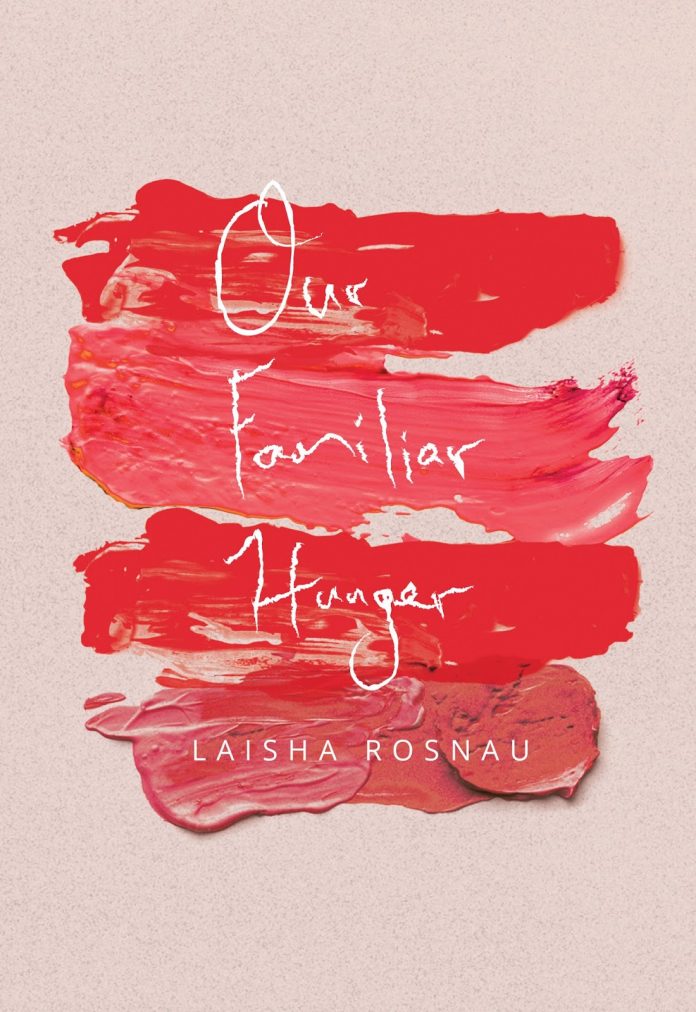
Though the premise of a poetry collection on Ukrainian-Canadian women sounds straightforward, Laisha Rosnau taps into a long, ugly, and complicated history that includes concentration camps, global waves of immigration, westward expansion, government abuse, urbanization, shifting conservatism, the patriarchy, and the sex trade. By the way, Our Familiar Hunger isn’t a particularly cheerful book.
This small pink book contains a litany of themes, but they all support a bigger message of community and resilience; Rosnau jumps not only from Ukraine to Canada, but also across generations of women. It’s a creative and mesmerizing way to recall an often forgotten piece of history.
Rosnau doesn’t focus on the facts themselves, but on the people, emotions, and experiences that will lead a curious reader to the facts. Her work illustrates what these experiences look like under different lights and perspectives. As someone who’s worked in historical interpretation, I admire the cleverness of Rosnau’s concept and approach to sharing these stories, even if her writing style didn’t blow my mind or strike me as anything out of the ordinary.
Every poem helped you understand the next, or made you go back to another. A particularly striking moment was a young girl with an eating disorder being told to eat because her mother, upon immigrating from Ukraine as a young woman, had starved for her first few years in Canada. Future poems about first-generation immigrants always made me think back, is this the grandmother from before? Rosnau reimagines the stories and histories of these Ukrainian-Canadians, and by doing so makes sure they aren’t lost forever.
The Faces vs. Edges Series, photo credit to Chris Ho
By: Jennifer Low
As an SFU student entering my third year, I was sure I had seen it all. I’d reflected on Oval Reflections, I had Googled what was going on with the AQ’s Blue Pyramid, and I’d even educated myself on the Mosaic Mural featured in every graduation photo on Instagram. However, until I was given the opportunity to fully explore and research SFU’s public art collections, I’d never realized how many pieces of art I’d simply never noticed — or even realized were art!
In the spring of 2018, The Peakshed light on some of the weird and interesting art featured across SFU’s Burnaby campus. It finally provided answers to the questions that have been plaguing us since the day we first looked across from the Trottier Observatory and saw the mysterious swimsuit-clad bronze statues lounging about and mocking our stressed, caffeine-fueled existence. While some questions were answered, there is still so much more we long to know! That’s right: it’s time to go on another art walk.
North Face, photo courtesy of Chris Ho. Banana for scale.
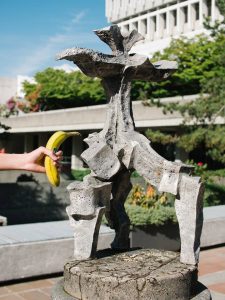
When: Gifted to SFU in 1982 from David M. Campbell
I discovered the big welded steel sculpture the way most students discover anything interesting . . . through getting lost and stumbling upon it.
At first, I thought it was just another part of the building. This makes sense considering the fact that Hide’s work is recognized by its use of vertical structures, leading it to become associated with Edmonton-style sculptures. Hide once spoke about his unique perception of form in an interview, stating, “It’s an odd mixture of architecture and sculpture. It’s as if architecture and sculpture have been combined into a single art form, almost. At least the way I feel about it anyway.”
Upon noticing that the stained and varnished structure of welded steel included a plaque marking it as a piece of public art, my first thought was, “Umm. . . what is that supposed to mean?”
Now I’m sure that you have experienced that moment where you stare at a piece of abstract art, looking it up and down, left and right, and then kick yourself for not being able to decipher its meaning. I, for one, have never been the best at analyzing art, but I was fascinated by the sculpture’s strong and commanding presence. Despite its rust-coloured exterior, it seemed powerful.
According to Hide, his rigid and angular sculptures “suggest anthropomorphic feelings or lurking imagery.” This marked Hide’s work moving away from the style of his mentor, British sculptor Sir Anthony Caro, whose work was characterized by its use of space and tendency to sprawl. I found this comment very interesting as it made me consider that perhaps the reason I could not decipher the solid meaning of Hide’s work was because I did not consider the sculpture’s meaning to be a feeling, especially when it was constructed out of an inflexible material.
Some have criticized welded metal sculptures, as compact and stiff as this one, for lacking warmth and the emotion that we so often search for in art. Hide has stated that the “steel sculpture has great freedom…to make surprising juxtapositions and scale changes… but it isn’t a warm humanistic material, no. But then I don’t think that great art has to be that, necessarily.”
The Faces vs. Edges Series, photo credit to Chris Ho. Banana for scale.
The Faces vs. Edges Series by Alan Chung Hung (1981)
Where: The Courtyard off the south concourse of the AQ
When: On Long-term loan to SFU (Created for the Charles H. Scott Gallery’s 1982 exhibition: Infinity vs. Limit A Non-mathematical Dialogue of Self-Identity)
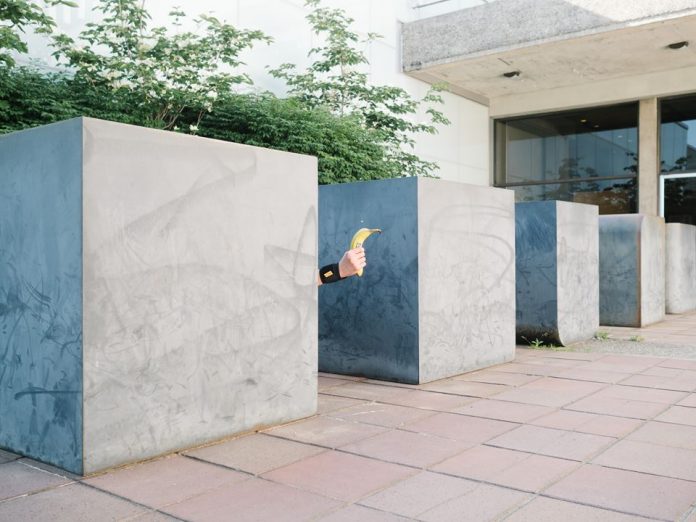
“But I thought those were chairs!” every lazy SFU student protests earnestly as they realize that the five blocks of curved and sharp-edged steel that they’ve been eating their lunch upon are in fact part of Simon Fraser University’s Art Collection. Not to worry: I’m sure they are not alone.
According to the SFU Art Galleries’ Public Art Guide,The Faces vs. Edges Series describes the story of a steel cube’s weathering process. It displays the succession of rounding off each of the cube’s sharp edges, as the six faces of the cube are slowly shaved down to two as its twelve edges are reduced to one.
Perhaps it’s describing how boring lectures wear down a student’s mind, or how professors expect us to produce a strong thesis statement by narrowing our ideas to a single narrow point. I suppose, as it is abstract art, it is up to your interpretation.
The sculptor, Alan Chung Hung, is well known for his outdoor sculptures displayed throughout Vancouver. A few pieces you may recognize include the Monument to George Vancouver (1980) located in Vanier Park and Red Spring (1981) which can be viewed in Robson Square.
Frog Constellation, courtesy of Chris Ho. Banana for scale.
Frog Constellation by James Hart (1995)
Where: Atrium Gathering Space, Saywell Hall
When: Collection of Bill Reid Foundation (2000)
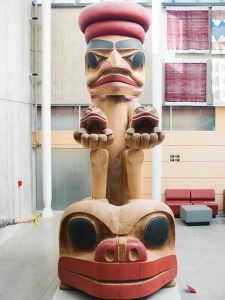
The Atrium, just down the stairs from Saywell Hall is home to a beautiful piece of Haida art carved from red cedar. It is a tribute created by James Hart, one of the Northwest Coast’s most prominent artists, to a shamanic piece from the mid-19th Century.
Apparently, The Frog Constellation is a representation of an old Haida love story. Essentially, a frog king once kidnapped a young man’s girlfriend. The young man, who was unable to find her, encountered a wise old man who advised him on where to search. The young man dug a hole in the ground where the old man told him to look, and millions of frogs erupted from the earth. The last frog that surfaced carried the young man’s love back to him.
I’ve always been a fan of art that depicts the myths, legends and stories of different cultures, so I was fascinated by the story that surrounded Hart’s sculpture. The story features themes of loss, determination, recovery, love, and the combined efforts of the wisdom of elders and the strength of youth to resolve conflict. This makes it a great art piece to interpret and reflect on whilst procrastinating in the atrium.
Hart spent three-and-a-half years on the project, only for it to go into storage in Vancouver upon its completion in 1995, instead of its intended display location at an office building in California. Hart spent so long working on the project that he refers to the piece as his “PhD” .
Hart’s hard work eventually paid off, as 12 years later, the director of the Bill Reid Foundation and Bill Reid Centre at SFU brought the sculpture back out of storage to give it the recognition and audience it deserves. Now the sculpture has become an iconic part of SFU and it contributes to SFU’s growing collection of Northwest Coast Indigenous art.
Arc de Triomphe, photo courtesy of Chris Ho. Banana for scale.
Arc de Triomphe by Jacques Huet (1967)
Where: North of Convocation Mall, outside the AQ
When: Given as gift in 1999 from Jacqueline Brien
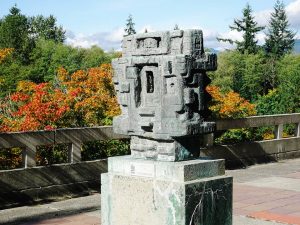
It’s a dog. . . It’s a person with three legs. . . It’s a horse and rider?
The rough and abstract figure of the horse and its rider displayed on the north side of the Convocation Mall is one of those pieces of art that triggers the “oooohh… I can see it now” response. There is nothing quite like that wonderful rush you get when you finally see it.
The SFU Art Galleries’ Public Art Guide suggests that the carving may be a reference to “the tradition of equestrian sculptures monumentalizing important men, or more specifically, the low relief carvings on the Arc de Triomphe in Paris” given the sculpture’s title.
The Arc de Triomphe in Paris, for which the sculpture was named, was built to honour the soldiers who fought and died for France during the French Revolutionary Wars and the Napoleonic Wars. Perhaps Brien’s sculpture of the same name was placed at SFU to give strength to students as they march along the corridor to face their final exams, and to commemorate those who never made it out victorious. . .
Guardian II, courtesy of Patrick (knightbefore_99) via Flickr. No banana for scale.
Guardian II by Elza Mayhew (1967)
Where: South of Convocation Mall, outside the AQ
When: Given as gift in 1967 from the Rothmans of Pall Mall Canada Ltd.
Elza Mayhew’s Guardian II always reminded me of an ancient artifact like the Rosetta stone, or maybe the “Word of God” tablet from Supernatural. It seems like an antique relic that stubbornly refuses to become irrelevant, as each viewing allows you to discover something new. In other words, it looks like something that Indiana Jones would have been interested in.
According to the SFU Art Galleries Public Art Guide: “Mayhew travelled extensively and her modernist sculptures often recall the ancient architectural and monumental forms that she’d seen in Asia, Europe and Central America.” Some ancient influences in Guardian II’s myriad of geometric shapes and vertical and horizontal lines remind viewers of hieroglyphics, Mayan stelae, and ancient Assyrian bas-relief carvings. Mayhew herself cites architecture as one of her main influences, but states that her work always returns to the human form.
Mayhew’s piece has been called a “Janus sculpture” in reference to the dual-faced ancient Roman god of beginnings, gates, transitions, doorways, duality, passages, endings and time. He is depicted as two-faced since he looks to both the future and the past. It is fitting that her work was linked to the god, as she was quoted in an interview for the Monday Magazine in 1978 that her works “tie people to their past and future…and are markers in time and of a place.”
Mayhew was so dedicated to her art that she actually suffered brain damage and struggled with mental health as a result of toxic fumes generated by the styrofoam casting moulds she pioneered and created.
Canadian comedian Nicole Arbour recently published a “women’s edit” of Childish Gambino’s politically charged song, This is America. Arbour received backlash for her neglect of the song’s original racially charged message. She was also criticized for the fact that the women’s issues she addressed were only focused on upper middle class women’s experiences, being a classic example of a white feminist in action.
This begs the question: are the efforts of white feminists like Nicole Arbour, Lena Dunham, Amy Schumer, and others like them beneficial to the feminist movement overall?
To me, feminism without intersectionality isn’t feminism. By only labelling the plights of upper middle class white women as “feminist issues,” we risk isolating a whole other diverse community of women that don’t fit that mold. But before I go on, let’s talk definitions.
White feminism is feminism that only addresses the issues and only validates the identities of predominantly upper middle class cisgendered, heterosexual Caucasian women.
Intersectionality is when an individual’s experience of the world is shaped by their interconnected or overlapping identities such as race, gender, class, and sexuality. Therefore, intersectional feminism would mean feminism that addresses a wide range of issues and identities that apply to all womankind.
By having white feminists address issues that are only relevant to themselves and labelling it as “feminism,” it reinforces the notion that those are the only issues women face, and therefore, that these white women are the baseline idea of what a “woman” is. To say that upper-middle class cisgender (when one’s sex matches their gender) and heterosexual women are the only kind of women is, at best, a bad habit on behalf of the community. At worst, it’s a blatantly homophobic, racist, ableist, and overall prejudiced declaration of what a woman is and isn’t. The quest for equality that white feminists fight for is not a fight for all women, but only a fight for themselves.
When other women’s identities are ignored, they suffer as a result. Firstly, non-white women such as Indigenous women are isolated from the community. Secondly, women who are in the LGBTQ+ community, such as transgender, neurodivergent, disabled women, etc. don’t feel like they belong.
With that said, white feminists do raise valid points. Arbour for instance brought up issues like the need for equal pay, the rampancy of date rape drugs, women’s inavailability to breastfeed in public, etc. However, there are so many other issues that must be included at the forefront of the movement that is feminism.
One could argue that such labels of race, sexual identity, etc.“don’t matter” and that, in the end, we are all women. But to ignore labels is to ignore how such identities have shaped a woman’s existence. If such identities and the issues that they facilitate are not addressed, women can experience feminism that can feel very isolating and betraying — feminism that doesn’t champion their plights.
Journalist Vicky Mochama acknowledged this lack of support between communities of women in an article she wrote for the Toronto Star in 2017, titled, “White women, where were you?”. She discussed the betrayal that women of colour (namely black and Indigenous women) felt when their white counterparts had not offered them the same support that they offered other white victims of sexual assault This illustrates another occurance of the lack of support that white feminists have for their fellow PoC women.
For feminists who are white: just because that identity is part of you, doesn’t mean that you’re a White Feminist™. To be a better intersectional feminist, and therefore, a better ally to your fellow women, be sure to focus on issues that are outside of your identity. If you are a straight, cisgendered woman, be sure to listen to queer women and trans women. If you’re a white woman, be sure to listen to non-white women when they talk about their experiences with racism. It is important to listen to their stories and support their voices and perspectives.
Modern feminists, especially university students like us, must strive for a feminist movement that is intersectional to show solidarity with our diverse sisters. White feminists serve as a reminder that feminism is not only about women who look like ourselves, but for women who are not like us, and experience the world differently than us. At the end of the day, intersectional feminism that welcomes all types of women is simply feminism.
Author’s Note: The writer is a cisgendered, heterosexual Pacific Islander woman who was not raised in North America. The writer would like readers to be aware of their identity so that they take note of whatever possible biases may be present in this article.
The presentation focused on the “unprecedented demand for campus mental health (MH) services & support in Canadian Post-Secondary Institutions (PSIs).” Based on the findings from the 2016 National College Health Assessment report (NCHA), 2017 SFU Undergraduate Preliminary report, and the 2018 Student Health Advisory Committee report (in progress), Chen and Zenone pointed out that the 2015 and 2017 Undergrad Student Surveys showed a 2% decline (from 58% to 56%) in self-reported rates of “thriving as a university student”.
While they highlighted the benefits of the upcoming keep.meSAFE Student Support Program (SSP), a 24/7 clinical support service for all SFU students to be launched on August 1 2018, Chen and Zenone stressed that “there’s more work to be done.”
Using statistics from the NCHA report findings, Chen and Zenone pointed out that “academics (course policies) significantly influence mental health and wellness.” The presentation emphasized the need to “promote mental health and wellness while preserving academic integrity.” To this end, Chen and Zenone presented some suggestions prompted from students, including student opinions about “limiting use of timed exams in 50-minute classes,” and offering “flexibility in exams.” Ideas for creating more flexible exams included providing more options in questions, such as presenting seven possible questions and only requiring the completion of five, or taking more exams in a course and only counting the highest subset of marks out of all the exams.
Chen and Zenone then suggested some potential actions the university could take to create an academic environment more conducive to students’ mental health. One of the recommendations focused on the usefulness of “collaborative involvement and contributions of students, mental health groups [referring to the Student Health Advisory Committee], faculty & department members, service providers [referring to Health and Counselling Services], SFU administration champions, etc.”
Following the presentation, the Senate floor was opened up for discussion. The floor discussed if there were any specific policies or processes which led to “undue stress through the policy itself or through the communication of the policy.”
Senator Daniel Leznoff opined that, in his experience, “scheduling of courses and exams” have proved to be significant sources of stress for students, even though it is “not directly related to the academic performance of a student.”
Acknowledging that “sometimes we do things that we do not realize,” Senator Aoife Mac Namara brought up the ratio of the number of credits to workload. Describing the process as “content-creep or work-creep,” Senator Mac Namara explained that “sometimes a combination of courses worth 15 credits can give the student a workload of 20 credits or more to work with. This can cause significant stress to students and it is time we reviewed the processes behind it.”
When asked about her takeaway from the discussion, Larissa Chen stated, “given the variety of constructive feedback we received at SFU Senate today, I feel immensely proud to be an SFU student surrounded by such brilliant educators who are keen for proactive ways to support students’ academic success and mental wellbeing.”
Chen highlighted the need to “co-create solutions,” and continued by saying that “as student leaders, it’s important for us to advocate for such areas of improvement on a proactive and institutional level so we can fill the gap between data and action — but we must do so collaboratively. In consulting multiple stakeholders, we can identify gaps and uncover insights and missing narratives.”