Home Blog Page 644

POLITICAL CORNER: Refusing to reform Northern Ireland’s abortions law is a step backwards for the nation

0
Photo courtesy of The Times of London

Written by Winona Young, Staff Writer

The United Kingdom courts recently dismissed the appeal to reform abortion rights for Northern Ireland. This is an immense disservice to women. It’s plain and simple: Women need the right to terminate their own pregnancies. Anything less robs a woman’s agency over her own body.

A member of the Northern Ireland Human Rights Commission (NIHRC), Les Allamby, argued that the current laws in place were “incompatible” to human rights. Allamby is right. Dismissing a woman’s agency over her body affects her life path financially, physically, and emotionally. The Northern Irish Assembly has been at a hiatus regarding this decision for too long.

Northern Ireland is the only place in the British Isles where abortion is only allowed for certain cases. It is only permitted if a woman is physically or mentally threatened by the fetus. This is as if to say that a woman can only gain control over her body if she is severely in harm’s way.

Since it is the only case in the British Isles, UK Prime Minister Theresa May needs to be proactive with her voice and advocate for these women’s rights. Simply referencing women’s’ rights to abortion on the way to the G7 summit is great talk. But right now, it’s only that — talk.

The Northern Irish Assembly along with the UK haven’t followed countless European countries’ approaches to abortion. They have not recognised that over 66% of the Irish Republic’s voters voted to repeal their constitution’s old prohibition of abortion. It’s up to those in power like Theresa May to help push abortion reform for Northern Ireland. Otherwise, generations of women of Northern Ireland will suffer.

SFSS logo used to promote event without the society’s knowledge

1
(Photo courtesy of The Star)
By: Gabrielle McLaren, Features Editor


On June 21, students noticed posters going up around the Burnaby Campus advertising “Get-a-Grip 2018: A ground-breaking youth conference.” This year’s theme “LGBT: Let God Be True” concerned students as the posters had been put up by the Redeemed Christian Fellowship (RCF), a club recognised by the SFSS.

     According to the poster, one of the event’s facilitators is Kari Simpson, Executive Director of Culture Guard, a group which has received heat in the past for its treatment of the LGBTQ+ community and its opposition to BC’s more inclusive sexual education curriculum.

     As concerns grew about the nature of the event over social media, SFSS released a statement saying that they were not aware that their logo was being used to promote the event. According to the statement, SFSS has instructed the club to remove the logo from all materials related to the event until they have had a chance to meet with representatives from the RCF and learn more about it.

     According to the statement by vice-president external relations Jasdeep Gill, “Typically, clubs submit their requests for printed materials (banners, posters, flyers, etc.) in advance, which provides us with an opportunity to review these requests and approve or reject them for publishing.” According to SFSS, this protocol was not followed in this case.

     Guidelines for printing can be found on the SFSS Brand Guide and the SFSS Printing Guidelines for Departmental Student Unions and Clubs. The latter reads that: “All promotional material MUST include an SFSS logo, regardless of funds used to print the documents, to remain an active club.” The SFSS Communications Coordinator is responsible for reviewing all material and ensuring that it corresponds with SFSS values.

     The SFSS statement ends by noting that “The Simon Fraser Student Society stands in strong support of the LGBTQ+ community. We have a long history of LGBTQ+ advocacy and have also established and continue to support an active Out on Campus office. While we support the right of our student clubs to determine and advocate for their own beliefs, we do not support any speech that is hateful, racist or otherwise demeaning.”

     The venue scheduled to host Get-a-Grip 2018, the Anvil Centre in New Westminster, also announced that the event did not correspond with their space allocation policy, and that they would no longer be hosting the event. Simpson informed The Star of her plans to consult lawyers to contest the venue’s cancellation of the event.

     The Peak reached out to RCF and the SFSS for comment on Thursday night, but did not receive a response by the print deadline.

     More details to come as the story unfolds.

     With files from The Globe and Mail, The Star, and News 1130.

Witchling is a gorgeous, albeit incomplete, tale

0
Image courtesy of Renee Nault

By: Natasha Tar

I picked up this zine four years ago, yet even now I like flipping through it for the art. Witchling is a single-issue comic zine by Renee Nault, a Vancouver-born artist. The story follows a young woman and orphan, Jane, who’s outcasted for being small, extremely freckled, and able to talk to animals. She lives in a town called Lymes that’s next to a dangerous wood, which, like most dangerous woods, tends to attract people who are never seen again after venturing into it.

     The first six pages don’t contain a word of dialogue, but they are my favourite pages in the entire zine. The art shows a powerful dream sequence, rendered in watercolours and containing a gorgeous, peaceful woodland scene that becomes creepier and creepier as you read on. The whole zine follows this format, going from sweet and bright to dark and unsettling within a few panels. Despite this contrast, Nault masterfully balances these elements, keeping the art interesting and cohesive, and the dialogue snappy.

     The biggest problem I have with this zine, however, is that the story was never finished. Online you can find scenes beyond the first comic that should’ve been made into a second issue, but this never happened (which will always be a disappointment for me). I think this has something to do with her work on the graphic novel adaptation of The Handmaid’s Tale, which was apparently supposed to come out in 2017, but didn’t. Unfortunately, while her art is detailed and beautiful, Nault seems to be a master of empty promises, which deters me from picking up her stuff in the future.

Witchling is available online for free.

SFU PhD student awarded Wendy McDonald “Women to Watch” Diversity Award

0
(Photo courtesy of Careesa Liu)
By: Kitty Cheung, SFU Student


The Wendy McDonald Diversity Awards, hosted by the Greater Vancouver Board of Trade’s Women’s Leadership Circle, celebrates gender and diversity in leadership. This year, an SFU engineering PhD student has won in the “Women to Watch” category.

     Careesa Liu, a biomedical engineer and co-founder of the Surrey Collaborative Outreach and Research Experience (SCORE), is the 2018 recipient. She has earned the award for her research in brainwave-based technologies to assess brain function, as well as for her leadership in a healthcare training program for youth.


On women’s empowerment

Named after Wendy McDonald, the board’s first female chair, Liu describes this award, which recognizes women under 35 who have made a difference in their organization, as an “incredible honour.”

     “Wendy McDonald was truly a pioneer who helped pave the way for so many women afterwards,” wrote Liu in an email interview with The Peak. “She worked tirelessly and led her family business to become a multinational conglomerate – at a time when few women even worked outside the home, and in an industry that is extremely male-dominated.

“I’m still in the early stages of my career, and receiving an award in [Wendy McDonald’s] name is a great inspiration for me to continue pursuing my passions and try to follow in her footsteps.” – Careesa Liu

     As a woman succeeding in another male-dominated field, Liu encourages other young women wishing to pursue science, technology, engineering, and mathematics (STEM) fields to “believe in themselves, work hard, and persevere. But more importantly, they should also seek out mentors (male or female) who can help guide and support them in their career, as there will be difficulties and obstacles along the way, but having the right support will go a long way to ensuring their success.”


In the blink of an eye

Regarding her passion for research, Liu speaks about how “something as simple as blinking your eyes can actually reveal so much about how our brains process information.” As many brain function assessments are behaviour-based and therefore subjective, Liu’s research provides an objective and non-invasive method by measuring the brain’s electrical activity, capturing how it responds to certain stimuli.

     In particular, Liu is looking into the cognitive functioning behind spontaneous blinking with its connection to the precuneus, a region of the brain involved with neurological diseases and disorders.

     “Being able to capture precuneus function using brainwaves from blinking has the potential to open a new window into brain function,” says Liu, “and [it] enables improved monitoring of brain function in diseases like brain injury and dementia.”

     Liu’s previous work as a biomedical research engineer at the National Research Council Canada allowed her to witness the “impact that advanced brain technologies can have on improving the care and quality of life for brain-injured patients and their families.” Her current research involves developing a form of technology that is “portable with fully automated software, easy to use, and produces results that are easy to interpret,” allowing her to fulfil her desire of pursuing knowledge while helping people.

     When discussing her work environment at the Surrey Neurotech Lab, SFU’s first clinically embedded laboratory located at Surrey Memorial Hospital, Liu states “I work with amazing people every day who are driven and passionate about not only advancing science, but also creating scientific breakthroughs that positively impact people’s lives. Most days we run studies or are huddled doing our respective data analyses and other graduate work, but that never stops us from joking around or poking fun at each other.”

     Later this month, Liu will be heading to Australia to represent SFU as a delegate at the International Student Research Forum, where she will share her learning with health researchers from around the world.


Developing Surrey’s human capital with SCORE

Liu was inspired by the advancements in technology and infrastructure around Surrey’s Central City community to create the Surrey Collaborative Outreach and Research Experience (SCORE) with co-founder Sujoy Ghosh Hajra. This youth summer course enables students to gain hands-on experience with medical technologies by pairing them with partner organizations.

     Students in the SCORE program have the opportunity to learn from university researchers, business leaders, and tech innovators by participating in service-learning experiences, seminars, and field trips. The SCORE program has received recognition by the SFU Surrey-Central City Community Engagement competition as well as the 2016 Global Best Awards for Excellence in STEM Education.

      With the development of SCORE, Liu has also been granted the Spirit of Canada 150 Award for outstanding community service: “In a way SCORE is a way to give back to the community, and for the young students in the community to gain access to the amazing opportunities being created here.”


With files from The Vancouver Sun.

An impulsive tattoo of your significant other could very well lead to a cover-up

0
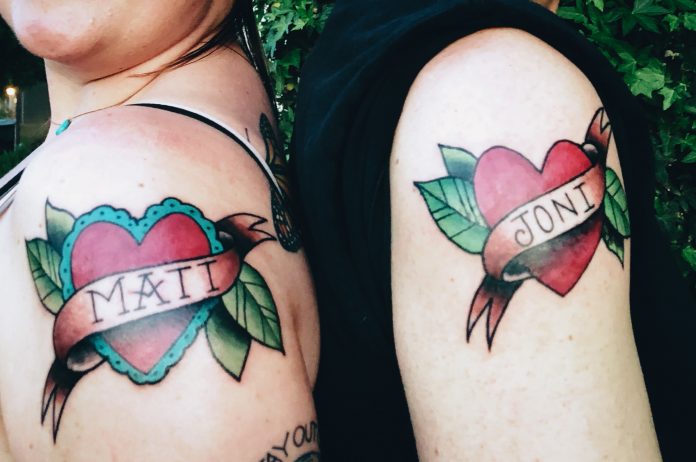
Photo courtesy of Joni Edelman

Written by Simran Randhawa

Tattoos usually symbolize deep commitment, not only in a monetary sense but also through the requisite pain endurance and the permanency of the alteration. Tattoos can serve as artistic self-expression, mementos of significant life events, or symbols of love.

Over the past couple of years, people have started tattooing the names of their significant others or deceased loved ones. Getting a tattoo of the latter is a nice way to showcase their significance to you, but marking your skin with the name of your partner? That’s a dumb decision, considering the global separation and divorce rates. In 2017, the global divorce rate was 44%, up 3% from 2010 and 32% from 1960.

If you think your love will last, then congratulations! But what if it doesn’t? What happens to that patch of ink after you break up? You’ll either have to live with the regretful tattoo for the rest of your life or ask for an entertaining — well, entertaining for us — cover-up. From the infamous blackout cover or the simple strikeout, you scarred your body in a moment of passion. Does anyone not remember watching 500 Days of Summer? It should have taught you that your love is probably not the one that conquers all.

What makes relationships last is much more intangible than a tattoo: it’s commitment to the person in any situation, both good and bad, rather than extravagant overcompensation. It’s a good thing tattoos aren’t totally forever; there are always options of painful and highly expensive tattoo removal process to put a cherry on the already
painful breakup.

The latest in lovestruck tattoos are the two Pete Davidson got in commemoration of his girlfriend (and now fiancée) Ariana Grande. Not that this is the first tattoo ever created to celebrate Grande, as her fans have been doing it since she reached stardom, but getting a tattoo for a romantic partner is a little more risky than that. Davidson seemingly didn’t learn his lesson from covering up a tattoo of his ex, Cassie David. Davidson’s tattoos have been widely seen, so now the interesting part will be seeing how their
relationship unfolds.

The example of one Zayn Malik also comes to mind, back when he was still engaged to Perrie Edwards — you know, before Gigi Hadid. He got a massive illustration of Edwards on his arm and had to get that covered up with an even larger tattoo. That couldn’t have been a painless experience. As if that wasn’t a lesson enough, he was rumoured to have gotten Hadid’s eyes tattooed on his chest . . . yikes! Wonder what that cover up will look like.

Getting a tattoo is hit or miss. You could regret it in future because you no longer like looking at it, or maybe your workplace doesn’t allow tattoos. The worst tattoo regret of all is after
a breakup.

The pro of a tattoo in dedication to a romantic partner is that it’s a great expression of love. The only act topping that would be screaming into a microphone and having it go viral. The con is that you can’t take back the decision. You think seeing your ex is bad? Imagine having their likeness carved in your skin, or having to spend more money to remove it. None of these are feasible options to choose from. You know what some better options would be? Buy them a gift, cook them a nice dinner, or take them on an adventure. Don’t take the risk of a post-breakup tattoo cover-up.

The life cycle of the student

0
Illustrated by Tiffany Chan

By: Iain Edgar

To some, the student may seem to be a useless organism: a creature devoid of individual thought whose only purpose is to wander through the campus halls, wide-eyed and panicked. Organisms higher up on the food chain, such as professors and TAs, often see students as nothing more than parasites leeching off of them for the knowledge they have carefully gathered over their long careers. However, even these lowly life forms have a place in this ecosystem. In fact, every organism in the university depends on the tuition offered by the students for their existence — even the mighty professors.

The life cycle of the student displays three key variations, each shown in different stages of their university life: early, middle, and late. The first stage of the student life cycle is the early student, characterized by their bright eyes and enthusiasm. These hapless wretches complete their assignments and exams with cheerful exuberance, not yet understanding the toll the harsh university exerts on them. They still have bright ideas about the exciting ecosystems they could migrate to in the future: many speak of medical school and law school with hopeful optimism, not realizing the sad fact that most students never make it to such environments.

The early student leads a fearful life, going from hall to hall in a state of perpetual panic, feeding the ever-hungry professors with essays and regurgitating knowledge on command in the form of exams. There is no respite for them, for at any moment they could be given a new assignment, or suddenly recall the iClicker quiz they forgot they had the next day. Students flit from lecture to lecture, seen in magnificent droves throughout the hallways at key points in the day.

When not out and about, they are found huddled in lecture halls, their listening organs oriented towards the front. The early student has been shown to exhibit a particularly interesting biological adaptation: while their brains may be entirely asleep, their bodies can operate independently, scribbling down notes while they make up for the miniscule amount of sleep they received the night before.

It is around the second or third year that the student enters its next incarnation. Like a doughy caterpillar emerging from a cocoon to become a beautiful butterfly, so too does the early student lose its youthful enthusiasm. In its place forms a dour pessimism, and a dead-eyed shuffle. The lack of sleep along with the constant work have finally taken their toll, and from the ashes of the early student rises the next form: the middle student.

If possible, the middle student procrastinates and puts off even more than the early student, often not even showing up to class, claiming they will simply “retake it in the summer,” as if it were that simple. Many will take on secondary purposes at the university, performing research or providing assistance to the more tolerant professors while engaging in the most menial tasks. This is in the hope that the professor may offer them some evidence that they aren’t as useless as the rest of their kind in the form of a short letter.

The final iteration of the student occurs once they reach the fifth year of life within the university. If possible, this form becomes even more disappointed and withdrawn about their purpose at the university as they approach the end of their fabled “degree.” Often you will find them touting such false statements such as “Einstein failed math in school too,” just to make themselves feel better about their own grades. When this behaviour fails to convince even themselves, the late student will hastily hurtle to the end of their university career with reckless abandon, not realizing that, while the university ecosystem may be dangerous, the outside world is even worse.

WHAT GRINDS OUR GEARS: Revenge of the remake

0
Photo by GeekTyrant

Written by Alexander Kenny, Peak Associate

The overabundance of remakes, sequels, and superhero movies in theatres is starting to become incredibly boring. It feels like over half of theatre releases fit one of these categories! I can’t tell what’s worse: the most recent Terminator movies, or Jurassic World with Chris Pratt, which is just an extension of the trilogy which spanned from 1993 to 2001. These sequels are just unbelievably redundant. Once the nostalgia factor wears off, these films are just formulaic and capitalizing on franchises. Each is like a lazier version of its original from a few years ago — but, look, this one has Chris Pratt! If I wanted to watch something purely because of a brand name, I’d see Queen in concert. At least the original members are still involved. There are nearly two dozen movies in the current Marvel Cinematic Universe. A few of them have been great, such as Avengers: Infinity War. However, a majority have been forgettable, just one wave after another. They’re not big releases anymore, they just happen. It’s all become about milking brand names, which is truly reducing compelling storytelling. It’s fine when it happens every once in a while, but it’s done so frequently now that it doesn’t even register. We need more movies like Spotlight or The Post, with Tom Hanks. Come to think of it, anything with Tom Hanks is a movie worth watching.

Talking superheroes and superqueers with Dani McNeil-Willmot

1
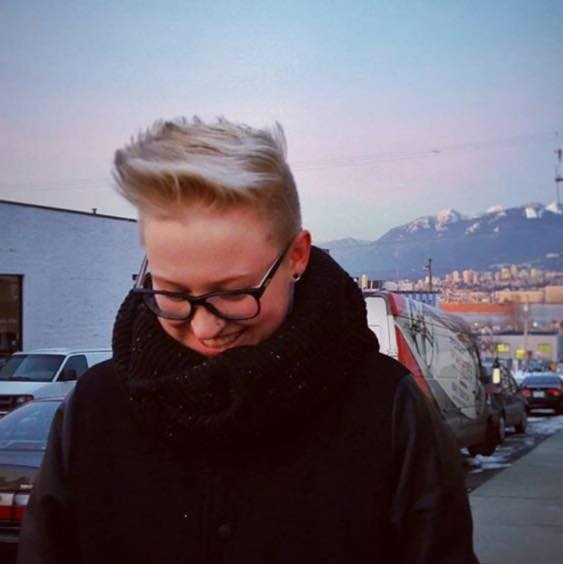
Photo courtesy of Dani McNeil-Willmot

By: Lauren Wallace, SFU Student 

Fast Facts on Dani

Name: Dani McNeil-Willmot

Pronouns: They / Them / Their

Education: Bachelor’s Degree in Biology and Psychology from Cape Breton University

Past work and volunteer experiences: Advocacy work with previously incarcerated self-identified women, The Cape Breton University Pride and Ally Centre, arranging talks with medical professionals about queer and trans health, and lots more!

Fun Fact: Dani is a big comic fan, and really enjoyed our local Vancouver Comic Arts Festival.

Favorite Comic Couple: Harley Quinn and Poison Ivy


Walking into the Out on Campus (OOC) space is always a little daunting for me. The double doors feel like I’m entering into someone else’s personal hangout zone, even though I know it’s a welcoming space where I belong. Located in the Rotunda, I’ve passed by it daily since my first year at Simon Fraser, but I’ve been too shy to intrude on the cozy and quiet space that’s been sheltering LGBTQ2IA+ students for so long. Luckily, this time I had the pleasure of sitting down with Dani McNeil-Willmot, the new OOC Coordinator, to talk about everything coming up on the horizon for OOC.

Dani has been working in advocacy and creating safe spaces for LGBTQ2IA+ folks for five years, since the third year of their undergraduate studies in Nova Scotia, after coming out as queer in a small, rural community. Dani recounts the challenges of finding a place for queerness in their community.

“I made it my mission to get involved . . . I did a number of presentations talking about internalized homophobia, and the whole ‘coming out as being queer’ thing,” Dani says.  

Their role in advocacy and education spanned from talks with medical professionals about queer issues to talks with self-identified women seeking employment after incarceration, plus starting support groups with young trans folks.

“I just fell in love with it … [and it] snowballed from there,” Dani was excited to explain some of their first forays in the trans community helping trans youth and assisting with the Pride and Ally Centre at Cape Breton University, where they graduated with a double major in psychology and biology.

When describing their motivation to move out to BC, they smile rather wryly, and share their story of growing up in a rural, very small community, which definitely impacted their journey as they embraced not only their sexuality, but also their gender identity: “I wanted to have more access to services, to opportunities to get involved, and grow a little bit more . . .”

Dani then chose to pursue a masters in women and gender studies, to give an academic backing to the work they had been doing and add extra confidence to their voice. The gender, sexuality, and women’s studies program at SFU was a huge influence on their decision to move west, with SFU being the first university in Canada to offer such a program.

“Plus I knew I wanted to be on the West Coast anyways, because of the mountains and oceans and all of that good stuff,” Dani laughs.

The biggest hurdle they’ve had since making it out to the coast and starting as coordinator? Making sure people actually are aware of Out On Campus and its existence as a safe and welcoming space, especially with the new Student Union Building coming to Burnaby campus and OOC’s upcoming relocation to the SUB.

“Because we have been historically located in the Rotunda, I think the move in and of itself is going to be a big shift for a lot of folks.”

Not to worry, though! Dani reassures OOC’s regular and future visitors: “We are going to have a space in the SUB building, and I believe it’s even going to be a little larger.”

One of Out on Campus’ current features is its massive library. When I told Dani that I was a huge nerd myself, they immediately had a recommendation for a comic book with good queer representation, despite their heavy reading schedule for school and their having recently splurged at VanCAF (Vancouver’s Comic Arts Festival) — which features tons of local artists, including many artists who are part of the queer community.

“There’s a huge plethora of queer and trans local art and narrative that you can get your hands on,” Dani says.

In the mainstream, Dani is all about Harley Quinn — of whom they even have a tattoo, and whose representation and problematic reception they have even written a paper on once.

“But that’s a story for another time,” Dani laughs.

Moving forward as the new coordinator, Dani really hopes to push for spaces that are open to marginalized folks on campus, especially the BIPOC+ (Black, Indigenous, People of Colour) community and Indigenous students in particular.

“Historically, Out On Campus has had some issues with not being necessarily a safe space for our more marginalized folks . . . I want to make a very active effort to make this space safe for everyone, but particularly our most marginalized students, because that’s who safe spaces are meant for.

“Reaching out . . . and making sure we are partnering with the First Nations Students’ Association and partnering with the Indigenous Student Centre, and [not only] making sure we are making programming and events for these students, but that we are partnering with the areas of our school that can be the voice and actually drive which way our programming and events are going, and having OOC be a vehicle for enacting what they want to see.

“I want to create programming and events that are relevant, but obviously my lived experience is very different from many of our Indigenous students’ lived experiences.”

Dani is starting off their time at SFU with a long lineup of Summer events. The best way to stay up to date with OOC’s schedule, workshop, and events and activities is through Twitter, Facebook (SFSS OOC), or their newsletter — which you can sign up for by emailining ooc@sfu,ca.

If you’re like me and still feel shy about crossing the threshold into OOC, Dani closes our time with some words of encouragement, even if they admit this might sound cliché: “University is such a time for you to break out of your shell and learn a lot about yourself, which I know was a huge thing for me in my undergrad . . .  I encourage first years or anyone who wants to learn more, regardless of whether they identify as a part of the community or they identify as an ally, stop by the space, say hello. Get to know what we do, because we do quite a bit.”

As if telepathic, they go on to speak to my own shyness. “Just be willing to step through those doors. I know two sets of doors can be daunting for folks, especially if they haven’t entered a space like this before, but I encourage you to take that leap because it’s totally worth it, on so many different levels.”


The current SFU gym dress code isn’t working

0
Eva Zhu / The Peak

Written by Victoria Lopatka, Peak Associate

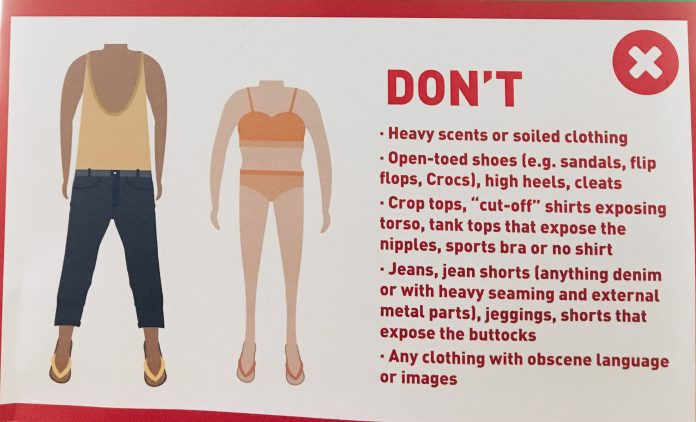
The SFU Recreation Dress Code, as outlined by posters in the gym, dictates that students must wear clean clothing, closed-toe shoes, shirts or tank tops that cover the nipples, lower back, stomachs, and waist, and shorts or tights that cover the buttocks. Students are asked to avoid wearing heavy scents/perfumes, open-toed shoes (like Crocs or sandals), high heels, cleats, crop tops, “cut-off” shirts that expose the torso, tank tops that expose the nipples, and sports bras (assumedly just a sports bra, with no shirt on top). Students are also expected to avoid jeans, jeggings, shorts that expose the buttocks, as well as anything with obscene languages and images.opinionsop

Now, I understand why some of these policies are in place. Obviously, you shouldn’t be wearing high heels on the treadmill, or wear jeans while operating workout equipment — do you even need to be told that explicitly? With other rules, I can stretch my imagination to think why they’re in place. As far as some of these policies go, though . . . I have some questions.

Specifically, I’m a little confused as to why crop tops, cut-off shirts, sports bras, short-shorts, and tank tops that expose the nipples are no-nos. I’m not sure how three or four inches of my stomach and back, or some extreme v-neck tank top, pose a risk to the health and safety of myself, other gym attendants, staff, or the gym equipment.

It should be pointed out that not all university fitness centers have restrictive dress codes like SFU. UBC’s Recreation dress code can be summed up quite simply: proper footwear must be worn at all times, athletic attire is “strongly encouraged”, and a shirt must be worn at all times.

A short history on dress codes

A dress code, for those who may not know, is a “set of rules or guidelines regarding the manner of dress acceptable in an office, restaurant, etc.” The first school dress code law was established in 1969, when the US Supreme Court dictated that schools could enforce a dress code in order to limit disruption in the classroom and prevent students from feeling uncomfortable.

Today, many elementary and high schools have dress codes, and there are many people that have a problem with them. Dress codes are often critiqued for being sexist, unfair, and/or unnecessary.

What do SFU students think of the dress code?

I caught up with some regular gym attendees to see if other students felt the same way about the dress code as I do. A resounding number of gym-goers I spoke to felt the dress code was unnecessary, juvenile, and almost insulting to the intelligence and maturity of students. Many students weren’t even aware of a dress code at the gym and were frustrated with it when I explained it to them.

“I was completely unaware of [the dress code]. I think it’s unnecessary. Completely. There are no children at SFU. Everyone is an adult and can decide to wear whatever makes them comfortable,” says Aidan Brown, a regular male gym-goer.

“I just don’t think they should be policing what we wear, I thought we left dress codes in high school,” another student, Charity Ywaya, adds.

Other students, such as Faisal Atif, pointed out the fact that the dress code doesn’t seem to be heavily enforced or followed: “I am aware that there’s a gym dress code, but no one really seems to care about it. At any particular time, there’s at least a couple [of] people who aren’t following the dress code.”

“Even CAs who are supposed to be role models or whatever to students, you know, people who are supposed to follow the rules, don’t really care that much about it,” Atif claimed.

When I entered the gym on a Monday afternoon around 12:30, I could immediately spot six or seven students who were breaking dress code. None of the violations stemmed from improper footwear or wearing jeans in the gym — all of them were instead related to the ban on crop tops, cut-off shirts, and tank tops that do not fully cover torso and chest.

Students overwhelmingly expressed that they would like to able to just wear what they want. Multiple female students said that they wish they could wear crop tops or cut-off shirts since they feel most comfortable in those types of tops.

“It’s really hot and sweaty so I don’t think it should matter if I wear a crop top or cut-off shirts. I’m not exposing my tits or anything,” says Laurie Solkoski, my fellow female student and new hero.

Despite the dress code seemingly not being strictly enforced, some students still get dress-coded. I spoke to a second-year criminology major who had experienced what happens when you violate the dress code.

Despite the dress code seemingly not being strictly enforced, some students still get dress-coded. I spoke to a second-year criminology major who had experienced what happens when you violate the dress code.

“I went to the gym in the morning wearing a shirt with cut-off sleeves, and one of the girls at the front desk told me that it was against dress code. She asked if I had a shirt on me that I could change into, but I did not, so she told me it was OK for today but that I can’t wear it at the SFU gym in the future,” the student said.

She described the top she was wearing, a T-shirt with the sleeves cut off, with armpit holes that show the sides of her sports bra and a small strip of skin. She also describes how, at the time, the dress code signs had just been put up, so the reprimand seemed “very out of the blue.”

“I think that the dress code as it is at the SFU gym is very juvenile. I would expect such rules at a high school gym, but not at a gym for adults. I personally do not wear crop tops or just sports bras at the gym, but I don’t think they are problematic apparel for a gym. They do not impede other gym-goers from exercising, so it seems like an arbitrary restriction.”

Not all students felt completely negatively about the dress code, though. “I believe it is somewhat necessary as the gym is a part of the professional learning space, the university,” Maryam Saffarzadeh says. When asked to elaborate, she continued, “It’s possible that the gym dress code is there because of safety reasons. There are guys who go there solely to creep on girls and I believe this could’ve become a bigger safety issue for girls if they wore more revealing clothes.” Sigh.

“The way I look at it, you’re there at the gym to get your workout done and leave, and not there to show off your sick chest, abs or butt,” Atif adds to his previous statements.

Other students, such as gym-goers Joseph Cameron and Celine Ho, felt that the dress code was acceptable, since some of its regulations were for hygienic purposes. “I think the dress code is alright as long as the reason is because of sanitary reasons, not for gender or biased reasons. I do not think it is necessary to have a dress code; however, I am willing to accept and abide by it,” says Ho.

None of the students I spoke to felt overwhelmingly positive about the dress code.

Speaking to fellow students confirmed for me that I am not the only one who thinks the dress code is unnecessary and downright silly. The passionate dislike for the dress code I was met with made me more and more curious: why do we even have a dress code, then? I decided to take my questions straight to those who make and enforce the rules: SFU Fitness Center staff and administration.

Stay tuned for part two.

 

SFU to begin new Sustainable Energy Engineering program in fall 2019

0
(Alexa Tarrayo / The Peak)
By Srijani Datta, Assistant News Editor


On June 5, SFU’s new Sustainable Energy Engineering (SEE) program was approved by the B.C ministry to be hosted in a new building being constructed at SFU’s Surrey campus.

The provincial ministry has granted approval to the Faculty of Applied Sciences (FAS)  to begin classes in fall 2019. The student capacity is projected to be 80 and 40 for first-year and second-year students, respectively.

SFU President Andrew Petter said, “SFU is hugely appreciative of the Province’s financial support for and approval of the SEE program.” He continued, “This innovative new program will create exciting educational opportunities for students, while helping to position B.C. as a global leader in cleantech and sustainable energy technologies.”

The SEE program is reported to be the first of its type in Western Canada. A recent addition to SFU’s program on applied sciences, it has been prepared to ready students for the cleantech energy sector. The program offers an interdisciplinary learning environment, aimed at preparing students to work in cleantech sectors, such as renewable energy and sustainable manufacturing. The program is also reported to prepare students for employment in other related industries as clean power generation and sustainable food and water solutions.

Students in the program will be offered access to new facilities, including engineering labs to be featured in the newest addition to the SFU Surrey campus which is set to be open in 2019.

The program is supposed to contribute to SFU’s expertise and faculty specialization in areas such as fuel cell materials and technologies, management of environmental resources, alternative energy, ecological economies, and technology entrepreneurship.

Kevin Oldknow, the associate dean of FAS, has been appointed as the program’s director. Oldknow stated that the SEE program will combine courses from other faculties, including those from science, environmental science, and the Beedie School of Business. “The program is unique in that its focus will be on sustainable energy systems, from beginning to end,” said Oldknow. He further added that “The program aims to be immersive and experiential, with team-based projects and integrative design experiences woven throughout the curriculum.”

When describing the workings of the program, FAS dean Eugene Fiume stated that the program encompasses “what they are telling us are key areas in the decades to come.”

“We are working with leaders in the cleantech sectors to ensure that our curriculum aligns with what is needed for students to be thought leaders ready to meet real-world challenges.” – Eugene Fiume, Faculty of Applied Sciences 

We are working with leaders in the cleantech sectors to ensure that our curriculum aligns with what is needed for students to be thought leaders ready to meet real-world challenges.”

Applications will open in fall 2018 with options for internal and external transfers.