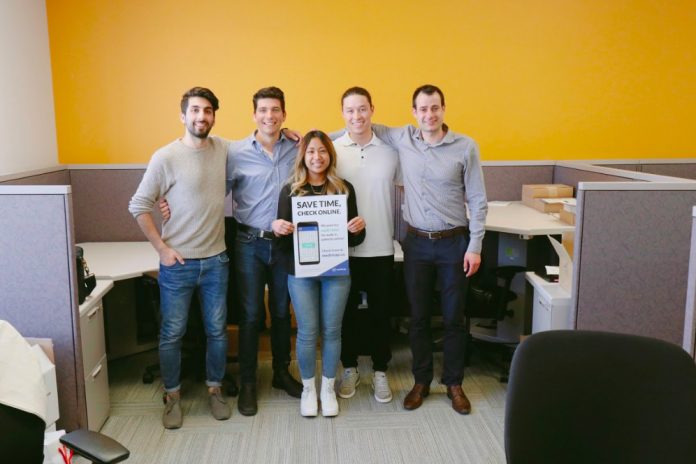
SFU VentureLabs start-up Medimap has been awarded third place in 2018 Innovate BC-New Ventures Competition, with a prize of $35,000. The annual competition, run by non-for-profit organization New Ventures BC, is open to early-stage startups and aims to support innovation in BC.
Medimap is an app that lets users check wait times at nearby walk-in clinics and add their names to a waitlist remotely. Clinics must opt in to be listed on the app, and they must have staff updating the wait times often. Users are able to see the most recent wait times posted as well as the time of update.
In turn, users of the app may wait from wherever they are and spend less time in clinic waiting rooms. According to Medimaps’ BC New Ventures company profile, there is often uncertainty around walk-in clinic availability and wait times. Patients looking to circumvent wait times may seek medical aid from emergency departments unnecessarily or decide not to seek medical aid at all.
Not only does Medimap make it easier for people to receive care, but by giving users access to wait-time information, it can allocate patients across local clinics more evenly and efficiently. According to a New Ventures BC email press release, Medimap aims to reduce wait times at walk-in clinics by more than 50%.
“[Medimaps] is an entry point into the primary care system for patients that need access to care,” said CEO Blake Adams in a phone interview with The Peak. He explained that he and co-founder Jonathan Clark “wanted to make it really easy for people to get access to care when they need it. We are trying to give people the information and tools they need to save time.”
Medimap is one of the many Vancouver-based start-ups that have taken advantage of SFU VentureLabs, a technology business accelerator program located in Harbour Center. VentureLab’s website states their mission as “scal[ing]-up world-class technology companies by powering up these ventures with amazing talent, technologies, entrepreneurial expertise, research capacity, access to capital, government. assistance programs and international market expansion opportunities.”
Adams found working with VentureLabs to be a great partnership. “They’ve been super supportive and it’s a great opportunity to work alongside other innovative startup companies. They provide a lot of mentorship as well as connections within the industry,” he said. He also noted that working out of the Harbour Center office space allows them to network and collaborate with other tech start-ups.
Currently, Medimap includes clinics from across B.C., Alberta, Saskatchewan, Manitoba, Nova Scotia, and Ontario, but they hope to expand their reach across Canada. Adams explained that in the future, they will focus on building up both sides of the user base, meaning the patients as well as the clinics.
“We are now focused on expanding our presence across Canada and working toward the goal of ubiquity in the walk-in clinic industry,” said Adams. From there, they will focus on looking at what other services they can provide for patients in need of care.
The night after the last convocation ceremony finished and graduates had taken their thousandth photo of the AQ pond, as the mystical glow of moonlight fell over the Convocation Mall, another ceremony was taking place. It was less glamourous, and it was done for a smaller and less illustrious, but no less important, audience.
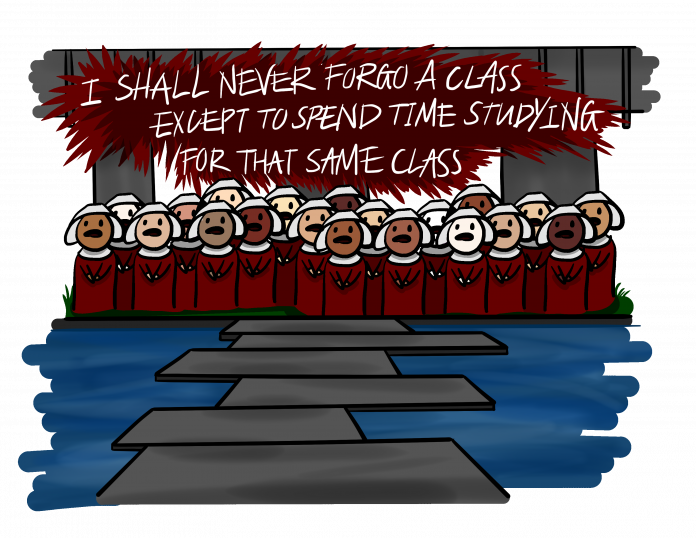
After finishing their first month at SFU, cloaked in the blood-red of the institution’s colours, the new students are finally ready to partake in the all-important Student Oath where they will pledge themselves to work, research, and hardship in order to reach . . . enlightenment? They pledged as well to begin anew the student scholar lifecycle. Undergraduates will be led by perennial sixth- and seventh-year undergraduates, while graduate students will be led by their Principal Investigators (PIs). The Peak managed to cover this solemn event and record the words of this sacred oath.
The Undergraduate oath
I, [name, institution, and student number] pledge that from this day hence, as a student, I will be diligent in telling the masses how much I need to study rather than actually studying. I shall never forgo a class except to spend time studying for that same class. Therefore, I will ask for aid should I require it, but only via email at 3 a.m. just before exams. To no less than 10 clubs will I give fealty and my SFU email in my first semester, but I will remain faithful to only one by my second. All the money I have earned or won with blood, sweat, and tears to pay for my education shall I give freely to the many caffeine merchants who sell me their wares. All this swear I, on the mercy of the gods of the curve and upon thy Holy Avocado.
The Graduate oath
I, [name, institution, and student number], hereby declare that, having entered the service of [name of your PI], I promise to provide them as much data as they desire by dedicating all my ability and endowments to my research and forsaking all others until happy hour at Club Ilia. No seminar within my discipline will I forgo, as long as coffee and snacks are granted there with my attendance. Likewise, I will submit my work to any research conference, so long as it takes place in some equatorial promised land. Remembering where I came from, never will I turn away undergraduates who seek my wisdom, but I shall bear no blame if they leave as befuddled as when they came. Upon my beloved Burnaby Mountain, do I call to witness, to give me the strength to fulfill this oath.
After months of uncertainty regarding the North American Free Trade Agreement (NAFTA), we learned this past week that it is officially dead, and will be replaced with the United States Mexico Canada Agreement (USMCA). Essentially, NAFTA 2.0, but with several new challenges for Canada’s economy and international trade.
NAFTA was in place for 24 years with few significant problems, so why the change? In short, because U.S. President Donald Trump wanted it. One of his campaign promises was that he would kill NAFTA, citing it as one of the “worst trade deals” in U.S. history.
This is one of the few promises that Trump had made about trade, alongside removing China from the World Trade Organization and raising tariffs on imported goods. It still has to be approved by the U.S. Congress, butit’s estimated that the deal will be signed into law before December.
So, what was the United States able to achieve with their new deal?
American automotive industry push
The USMCA stops manufacturers from getting automobile parts from other countries, so that more production can take place within the U.S. As well, new wage rules mean that the average minimum wage in automobile factories will be $16 going forward. Under NAFTA, there were none of these restrictions; tariffs were low on car parts and there were no caps on automobile imports. This is likely meant to make American automotive companies more productive.
Canadian dairy protections lost
Canada’s also lost some of their dairy protections under the new deal. Under NAFTA, Canada had protections that gave their dairy farmers the edge in both the domestic and international markets, allowing Canada to set their own tariffs. Under USMCA, Canada is forced to give U.S. dairy farmers access to Canada’s domestic markets. If America offers cheaper products, this may provide brutal new competition for Canadian farmers.
Canada was also able to keep chapter 19 of NAFTA in the new deal. Chapter 19 gives all three countries a forum to discuss dispute resolution mechanisms, which ensures that both Canada and Mexico aren’t completely defenseless against to the United States should conflict arise.
But even with this, things are bleak. Letting another country veto your own trade deals is tantamount to giving up part of your country’s sovereignty — part of your country’s ability to be free and independent from outside pressure. The United States could threaten to kill the USMCA any time Canada doesn’t do as they say.
Mexico also lost a lot under USMCA. While they had initially negotiated a bilateral trade deal with the U.S. back in August, a lot of what had previously been negotiated was forgotten. While it is easier for Mexican labourers to unionize under USMCA, they are being backed into a corner with the new minimum wage being placed on automobile factories. Mexico’s current minimum wage is $5.53 CAD and the increase to $16.00 will be one that most factories simply will not be able to afford. This will probably result in production being moved back to the United States, therefore costing Mexico jobs.
As far as the United States is concerned, this is a win. It’s also one of the only campaign promises that Trump has been able to fulfill. The USMCA shows a concerning power that the United States has over its neighbours. They essentially negotiated a deal that gives them huge oversight over Canada’s and Mexico’s actions, and brings several seemingly minor changes to two of our largest industries. This is a frustrating example of what a continent can become when some businessman, not a politician, is running one of its largest countries.
It’s that horrible time of year again: midterm season. Students like you once again bury themselves beneath mountains of notes and retreat into the depths of the library, hunting for the perfect spot to study, and each one dreading the sight of the Scantron sheet that signals their slow three-hour death.
It is in these moments that you wish you had some helpful advice or a mantra to keep you sane. The last thing you want in your inspirational mantra is more lies. Honesty is the best policy. Fear not, poor students, because The Peak has got you covered.
You are enough . . . for now
Each of you little snowflakes are perfect just the way you are. But of course, if university philosophy has taught us anything, it is that we are always in the process of becoming. So in times of hardship, remember you are the best person you can be . . . at the moment. You could be better, but for now you are . . . OK.
If at first you don’t succeed, RELAX or you will probably fail again
This is something to keep in mind during tests.If you don’t succeed on your first midterm, chances are you’re going to mess up the next one too if you don’t “let it go.”
The journey of a thousand miles begins after you decide to actually get out of bed
Just some motivation to make sure you stick to your schedule and don’t get too distracted. When all hope seems lost and procrastination has taken over your life, it’s important to remind yourself that you actually have to drag your lazy butt off the mattress and park it at your desk if you’re going to try to get any work done today. Some work done is better than no work done, even if the only thing you’ve written on your 1000-word essay is your name.
Go in there and give up
It’s 4 a.m. and you can’t study anymore. At this point even showing up to the exam room would be an accomplishment. Treat it as such! It’s not worth the overstressing anymore. Just go in there, regurgitate any information you’ve absorbed and leave knowing that you gave up. You won’t spend hours obsessing over whether you did well or not, because you won’t care.
You will only stop failing when you succeed
Just stating the obvious. The key to success is to simply not fail.
You don’t got this
What you do got is improper grammar. If your grammar is as bad as it is in this inspirational quote, then you better take a long look at your life choices and proceed to do absolutely nothing to fix it.
Best For tags: Star Trekkers, Space Privateers, 1-Season Bingers
Firefly is one of my favourite shows, and after a weekend with it, it’ll be yours too.
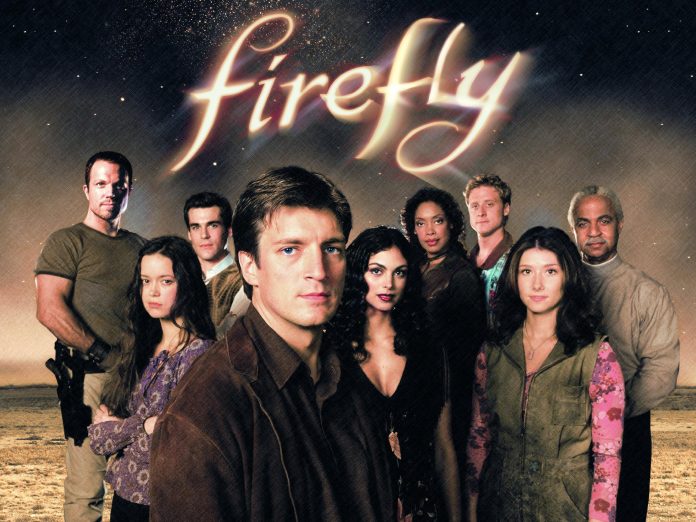
Firefly is a short adventure series featuring loveable characters and a deep, meaningful story. After only one season, the show garnered a massive fanbase of people like myself, immediately enraptured by the unique setting. It’s very similar to the well-loved anime Cowboy Bebop, which also features what effectively amounts to space cowboys.
Starring Nathan Fillion and a host of other skilled and recognizable actors, Firefly follows Serenity (a starship), and its crew: a band of smugglers taking on passengers to disguise themselves as a transportation vessel. In a fantastic blend of futuristic sci-fi and old westerns set five hundred years in the future, the crew — unofficially referred to as “space-cowboys” by fans — go on great adventures, hunting for excitement and wealth.
While Firefly can be watched as a simply comedic drama, viewers will note that it employs social commentary to which discusses social issues like race, gender, sexual orientation, and belonging. The show forces the viewer to stand witness to tough moral decisions, ultimately providing that viewer with a broader world perspective.
Firefly is also home to some of the best costumes, set design, and sound design I’ve seen in anything short of Star Wars, which is notable for a small, one-season show. Its effects may be somewhat dated now, but I find it only adds to the show’s charm.
I’ve watched Firefly three or four times now, and you really need to in order to fully grasp all it has to offer. It’s silly and light-hearted but there’s a lot to take away if given the chance. When you finish the meager one season, you’ll be pleased to know that a full-length movie, Serenity, was released as a pseudo-sequel for your next binge weekend.
Firefly is available on Google Play, Hulu, and Prime Video. Firefly’s movie adaptation, Serenity, is available on Netflix, Google Play, Prime Video, iTunes, YouTube Movies, and other streaming services.
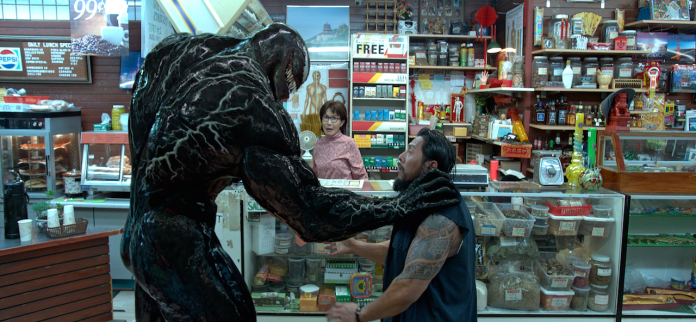
Attention Marvel Comics fans! Venom’s origin story is finally told in director Ruben Fleischer’s latest movie about the iconic supervillain. Fleischer (best known for Zombieland) delivers a film that will easily elicit mixed reactions, but overall, it entertains with its original storytelling about one of Spider-Man’s most fearsome adversaries.
The film’s most captivating aspect is Tom Hardy’s exceptional performance as Venom and Eddie Brock. Hardy shapes these characters’ relationship as a fun brotherhood to watch through their riveting interactions with each other. Layered with light-hearted humour and impressive yet unsettling visuals, Hardy instills their complex bond with authentic depth that surpasses Topher Grace’s portrayal of Venom from Sam Raimi’s Spider-Man 3. Hardy also develops his characters’ unique dynamic as a metaphor for the instability of power and control, but humanizes these characters through their shared pain as outcasts of their own worlds.
Although Fleischer’s slow start affects the story’s rhythm, the film’s fierce action sequences offset this drawback through fast-paced thrills and raw brutality that builds up momentum. Fleischer makes these sequences thoroughly enjoyable, especially during a frenetic car chase that gives a Mad Max: Fury Road dimension with its edgy guitar riffs and stylized stunt choreography. He subsequently employs the film’s action to evoke frightening realities from a violent world deprived of any superheroes to save it. Fleischer also structures the story’s devastation as ominous set pieces that, when balanced with gloomy wide shots of the film’s cityscape, further reinforces the metaphysical destruction of Brock’s identity as an ordinary person and the disturbing creation of the film’s titular supervillain as his alter ego.
Despite the film’s fresh approach to Venom’s origin story, the narrative still suffers from numerous shortcomings. Without Spider-Man to contrast with Venom, the movie is unable to push beyond its themes about identity. Given the film’s special focus on the ethical ramifications of corporate ambition, the story transforms into a mad scientist archetype that has already been explored by previous sci-fi films. Otherwise, these themes are adequate enough for the narrative, even though they offer nothing new to the movie.
Aside from themes, the lack of chemistry between actors impedes the film’s flow. Hardy’s interactions with co-star Michelle Williams (Anne Weying) are bland, except for a few moments of heartfelt closure between them. As for Hardy’s brief scenes with Riz Ahmed (Carlton Drake), they create a better dynamic than the one Hardy has with Williams. Ahmed is a satisfying villain in the film, but his chemistry with Hardy still falls short due to their constrained screen time together.
Despite how mixed one can be about the film’s quality, the story reimagines Venom as a complicated anti-hero living in an equally complicated world. Whether you are a Tom Hardy fan or just want to watch Venom in his glorious solo appearance, Ruben Fleischer still delivers a worthwhile origin story about one of the most iconic super villains from the Spider-Man comic book universe.
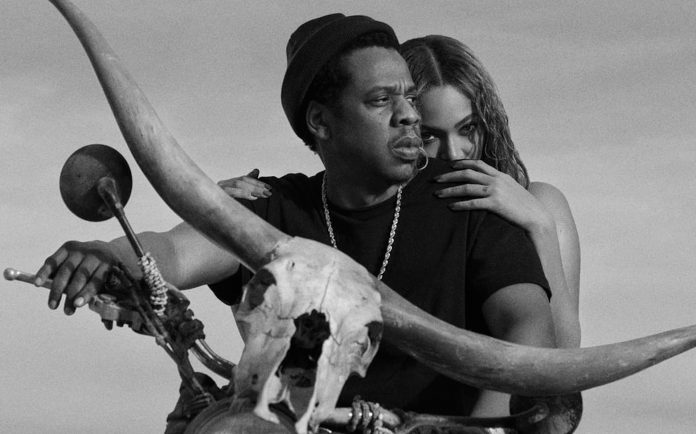
On October 2, at BC Place, Beyoncé and Jay-Z brought their album Everything is Love to Vancouver with their On The Run II tour. While watching Beyoncé effortlessly sing some of R&B’s most defining songs, and Jay rap some of hip hop’s most imperative tunes, I found myself travelling through their discographies to remember how both of them became the accomplished artists they are today.
In 1996, Jay-Z dropped his debut LP, Reasonable Doubt. As the prodigy of the legendary Notorious B.I.G., the young Jay impressed music-industry titans and fans alike with tracks like “Brooklyn’s Finest,” “Can’t Knock the Hustle,” and “Dead Presidents II.” The swagger, impeccable flow, and sharp lyricism of this record let the world know that the new MC was not to be overlooked.
Within the next two decades, Jay-Z would drop a number of classic rap records, including 1999’s Vol.2…Hard Knock Life, 2001’s The Blueprint, 2003’s The Black Album, and 2017’s 4:44. In the span of these 20 years, Jay-Z ascended to the top of hip hop’s industry. By becoming the president of a record label (Def Jam in 2004, and now ROC Nation), and through signing some of contemporary music’s biggest names (Rihanna, Kanye West, and J.Cole), Jay-Z has become the most successful MC of his generation.
Beyoncé’s musical legacy is also one which none can match. As the lead singer of the highest-selling female group, Beyoncé was first introduced to the world through Destiny’s Child’s 1998 debut. Beyoncé proceeded to write some of the group’s most defining anthems, including “Independent Woman (Part 1)” and “Survivor.”
In 2003, as she released Dangerously in Love along with the global hit singles “Crazy in Love”and “Baby Boy,” Beyoncé began her solo career. With each subsequent album release, her singles and deep cuts challenged her pop counterparts by sparking conversations about the social and systematic constructs that continue to plague America. Her last two visual albums, 2013’s Beyoncé and 2016’s Lemonade, are her most notable works to date. In addition to releasing these albums by surprise, and forever altering the way contemporary musicians release music, Beyoncé has carefully crafted her music to embody both feminism and the celebration of African-American culture. As a result of the integral messages laden throughout her art, Beyoncé has manifested into the most prolific performer of her time.
Through reviewing both these artist’s musical journeys, I reflected on the state of music today. Musicians emerge, smash the music charts for two to five years, then fall into obscurity because they find themselves more concerned with current trends and fads than establishing a timeless discography or a respected legacy. It seems that someone’s number of #1 pop records, or their ability to emulate what’s trendy, has taken priority over their drive to make impactful art.
Seeing Beyoncé and Jay-Z come together to perform an impressive catalogue of music was much more than an exciting concert experience. On the Run II shares the story of how a Black boy from Bedford-Stuyvesant and a Black girl from Houston used their talent, innovative art, and resilient work ethic to reach the top spot of the music industry.
More than just social media exposure, record sales, or even chart placement, Beyoncé and Jay-Z have redefined what it means to be successful in an industry where everything but the music has taken precedence.
Welcome to yet another SFU art walk! After reading the other two that The Peak wrote up, I’m sure you folks are all ready for another one. Art is as rampant as the common cold on our campuses, and it’s about time we gave it a nod and some undergraduate-student analysis. This time around, we will be looking at five pieces, including one that has literal chunks of rose quartz embedded in it.
Theatres of the World, photo courtesy of Natasha Tar
Theatres of the World by Buell Mullen
Where? In the Leslie & Gordon Diamond Family Auditorium at Burnaby campus
When? Given as a gift from the International Nickel Company of Canada Ltd. in 1965
Sometimes I like to think people steal the koi in the reflecting pond and sell/eat them. I mean, c’mon, if SFU gives out free stuff, you take it, right? So when I saw the bright murals that are Theatres of the World for the first time, my fingers were itching to cross the defenseless velvet rope that separated me from the piece and yank off a chunk of precious mineral.
Buell Mullen’s two murals look like intricate and abstract world maps, though SFU Galleries’ public art guide states that the inlaid rocks, such as quartz and gold, were all unearthed from within the vicinity of the school.
The Chicago artist has done similar steel murals for other places, and some publications such as Arts Education Policy Review commentthat her work has a hardiness that will easily allow it to outlast canvases. This may be another reason that SFU embraced this piece; the murals’ tough nature suggest that the university and its impact will also last a long time. The stainless steel pieces were also built specifically for the auditorium.
Theatres of the World, to me, symbolizes connecting the world together in the lecture halls of SFU. After over 50 years, this has happened to an extent, but we’re still working on the “friendliness” part of being together.
Steptease, photo courtesy of Natasha Tar
Steptease by Sorel Etrog
Where? At Saywell Courtyard at Burnaby campus
When? Created in 1976, given as a gift in 2009 by the artist
Steptease is one of three strange-looking statues that grace the Saywell Courtyard. When I first wandered up to these things, I definitely thought their names were sexually suggestive. Steptease caneasily be misread as “striptease,” and Ritual Head . . . well . . . I’m sure you can make what you will of that one. (Can you see the two hand-like objects grasping a long rod?)
Sorel Etrog is a Romanian-Canadian who started his artistic studies in Israel. SFU Galleries explain that “his forms register as levers, hinges, and blades, but also resonate as limbs and lobes . . .” After reading this, I realized that these sculptures make sense on a university campus because students are definitely part-machine. At least, schools work us as if that were the case.
I would say that Steptease doesn’t really evoke teasing for me. There’s definitely a compass (the math kind, not the “I’m lost, help” kind) and a human body in the statue’s shape, but it’s taking a very non-sexy step. Perhaps Etrog meant to tease us with an inhuman sculpture that our minds interpret to have a curvy, female form. Either way, and despite being covered in bird crap, these statues make for a nice visit on rare sunny days.
Sey̓em̓, photo courtesy of Natasha Tar
Sey̓em̓ (Musqueam Welcome Figure) by Brent Sparrow
Where? In thelobby at Vancouver campus
When? Created in September 2017
It’s always enjoyable to walk into a building and immediately be greeted by art. This figure is especially remarkable because it was built specifically for welcoming, and it reminds people of the traditional land they live and work on. Sey̓em̓ was carved from a Vancouver Island cedar log by Musqueam artist Brent Sparrow. According to the informational plaque beside the piece, sey̓em̓ means “noble, influential, and wealthy members of the community.” The plaque also explains that the figure is wearing the clothes of a noble, such as a wool blanket and a woven red cedar hat.
For me, Sey̓em̓ definitely gives off a powerful vibe. It stands out boldly from the living wall installed behind it, and there are bright lights shining on its tall figure. It’s impossible to miss if you are entering the campus, and I believe that having an immediate Indigenous presence in a university, or anywhere really, is an important step towards acknowledgement and reconciliation.
Heads of State, photo courtesy of Natasha Tar
Heads of State by Gu Xiong
Where? In the quiet study space of Belzberg Library at Vancouver campus
When? Created in 1992, given as a gift from Russell Precious in 1995
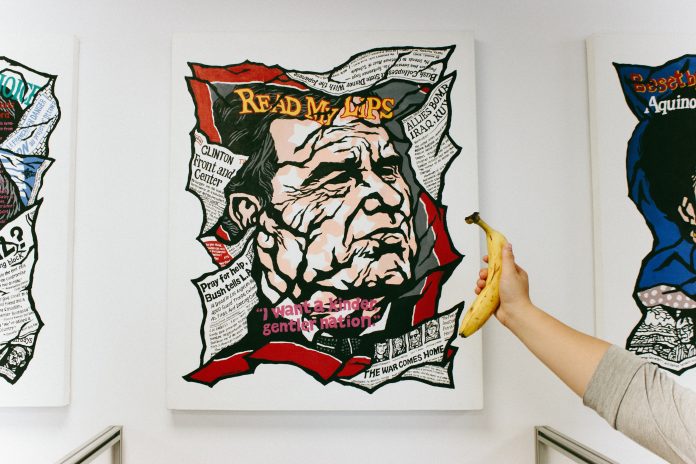
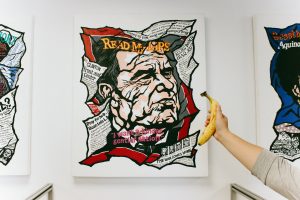
The Belzberg Library at the SFU Vancouver campus is pretty unassuming, until you walk into the quiet study area on the second floor. There, you will find a variety of infamous political figures staring at you from the walls, such as George Bush, Saddam Hussein, and Fidel Castro. The acrylic paintings by Canadian-Chinese artist Gu Xiong feature political figures on crumpled magazines, usually with one of their famous quotes and a few news articles. I’m not a political person, but these paintings immediately struck me.
My favourite is the one of Bush, with his famous quote, “I want a kinder, gentler nation,” alongside article scraps from his presidency that mention war and bombings. This piece, like the others, features Bush as crumpled, but not completely torn up. Could the crumpling be a result of him, a powerful person and icon, being discarded? Or was he crumpled, thrown away, but somehow found and uncrumpled? There are multiple meanings you can draw from these pieces, which is part of what makes them great and fun to look at.
Skins, photo courtesy of Natasha Tar
Skins by Gloria Massé
Where? In Maggie Benston Centre at Burnaby campus
When? Created in 1989, given as an unspecified donation
Hailing from Gibsons, B.C., Gloria Massé’s art focuses on one of her greatest loves: nature. Most of her art also has a strong focus on texture, and Skins is no exception. The name reflects the simple images the painting provides: the skins of different things is nature. The “skins” are separated into individual boards.
When you hear “skin,” the first thing that comes to mind is probably human skin. However, Massé’s piece does not feature human skin, but rather the “skins” of nature we don’t think as much about. Some of the skins I can recognize right away are fish scales, feathers, and leaves. The others are a bit more ambiguous, but one can interpret a bug’s wing or bark depending on how they look at it.
The piece might be reminding us of our close ties to nature, or that we should try to reflect more on nature because we all share this world together. Skins is also a beautiful examination of texture which contrasts nicely with the plain cement walls of MBC.
The Vancouver Canucks made for an interesting headline recently, when the team introduced a video-game ban for the players during away games.
While this affects all games, Fortnite, a massively popular battle royale shooter, has been mentioned as the primary target. Bo Horvat, a centre for the Canucks, defended this ban as being about ensuring the team is bonding and spending time together, but the targeting of video games and Fortnite specifically is probably not worth the time.
This isn’t the first time Fortnite has been named in a news headline about people shirking responsibilities. Last month, an article on a U.K.-based divorce blog noted that nearly 200 divorce cases in the U.K. cited Fortnite as a reason for the divorce (with general online-related addictions being cited in about 5% of all divorces). While there are always some video games garnering a lot of attention and a lot of popularity, Fortnite’s name pops up in very bizarre places.
Why this game specifically is getting mentioned so often? These headlines rope it back to a problem with video games as a whole, but I think it’s a lot deeper than that. There are a few traits of Fortnite and its presence in culture that make a ban seem unnecessary to me.
Just a game
Athletes are often treated as being larger than life, but the fact is that the Canucks’ players are employees. At their core, like retail workers or office clerks, they have a routine to which they have to adhere if they want to get paid.
The day-to-day events and expectations differ in certain ways, but if these players value their jobs and respect their teams, then freedom to play video games shouldn’t get in their way. If they don’t meet their job’s standards, then they’ll likely be removed or singled out for their job performance.
There’s some debate between certain players on whether there are actually players skipping their responsibilities to play Fortnite or other games, but if they were, the headlines should be about the obsessed players being fired or approached about it. Gaming in general is like any other hobby; some people get too into it. But it’s a worldwide industry and pastime, making this ban feel archaic and equivalent to banning books or movies.
Free and accessible
For those who have never played Fortnite, it’s beyond easy to get started. The game is free to download on most gaming consoles, and starting a game is as easy as hitting a “start” button. Doing poorly in the game has no consequences besides losing experience points, so you have nothing to lose by trying it. When you see a friend or a popular streamer playing it, there’s little reason not to try it if you find it interesting.
To me, this is a big part of why so many people are playing it. I’ve chosen not to purchase certain games solely because I can’t find others to play them with, and I also don’t feel comfortable spending $80 for a game I might not enjoy. For Canucks players, $80 might not be an issue, but the game being free and quick to download has still likely contributed to its presence among them. Banning something that’s free and easy for them, while also having no real harm besides taking their time, is a hard sell.
Beyond popular
This is probably the main reason the game has been brought up in so many circumstances. This isn’t to say I think news headlines are using it to get hits, because Fortnite is a specific character in these stories. Rather, the popularity is a cause of the obsessive nature some players have.
This couples with the game being constantly active; it has patches released nearly every single week, with new content and changes to the game’s balance. When a game has this much activity, it’s easy to invest a huge amount of time and energy into it. However, this is just inherent to the game’s design and marketing and a video game ban anywhere can’t change that it’ll be in people’s minds way more than some other hobbies.
Entertainment and competitiveness
There’s also something to be said for competitive athletes finding new ways to spend time with each other. Not every hangout needs to be team dinners and movies with the boys. It’s fully reasonable for teams to spend time with each other staying in and playing something cooperatively could be just a safer (and possibly more intimate) activity.
This game also fills a niche of being simple, hugely competitive fun. Fortnite is played by a huge population, but it has a clear winner of each round (whoever’s the last player alive) and a growing competitive scene.
So is Fortnite a problem? Probably, but it’s not because it’s a video game or because it’s a new craze that people want to wag a finger at. It’s because it’s an entity that’s popular for reasons that we don’t really have a comparison for, and we don’t know how to properly understand and work around that. The Canucks can ban Fortnite, and it may or may not help them, but it won’t fix the reasons they got hooked on it in the first place, and it’ll still be a major obsession elsewhere.