Home Blog Page 569

SFU women’s basketball Ozioma Nwabuko discusses her return from injury

0
Nwabuko is leading the team with a .591 field goal percentage so far this season. (Photo courtesy of SFU Athletics)

By: Shepard Kanyekanye

Year: Third-year

Hometown: Port Coquitlam, BC

Major: Sociology major, and Criminology minor

Ozioma Nwabuko, an energetic force on the SFU women’s basketball team, has bounced back extraordinarily from a knee injury that sidelined her for 13 months and forced her to miss all of last season. However, as frustrating as this time was for her, it gave her time to refocus on certain things outside basketball, such as her Christian faith. This faith created a strong mental foundation to allow a community of people in her life to not only support her but comfort her as well.

This season, Nwabuko is leading the Clan in field goal percentage (.593) and rebounds per game (5.7). She is also a force on the defensive end and consistently locks down the opposing team’s best player. With her back on the team, this year’s SFU women’s basketball team have enjoyed a lot of success, currently boasting a 12–4 conference record and poised to make some noise in the playoffs.

The Peak: Who would you say is the most influential person in your life?

Ozioma Nwabuko: My mother. That woman is like a powerhouse, she’s honestly my idol. I just feel like she’s the smartest person I know and she also used to be an athlete, she used to do track and field.

P: Where would say your passion for basketball comes from?

ON: So we had just moved to Canada and I wanted to play volleyball or basketball because they seemed so much fun. A couple of years down the line [Grade 8] I started playing both of them and the length I had was a big part of me coming into basketball.

I started playing with a club coached by Coach Langford, and he took me under his wing because I was not going to be good enough to make the Grade 9 team. So that summer, he helped me work out so that I made the team that year, and in the year after, he would help me again by finding [me] a team for the summer. So seeing how basketball could form such a community was what made me more into it, because before it was just this fun sport that I thought would be nice to play.

P: Could you take me through the knee injury that happened?

ON: My injury wasn’t a one-time, something happened and my knee snapped. It built up over time. Grade 10 was when I started having knee pains and stuff but it really wasn’t a big deal [ . . . ] So it never got worse than that during my high school career but coming to university amps up drastically how much you train, how much you play and how hard you play.

After preseason training, I found that my knee had gotten significantly worse, so by the time we were playing games I was already wearing a knee brace. I played the entire season with it and got some minutes as a freshman but it just got really painful. The doctor [said it was] just a torn meniscus so it shouldn’t [have been] that much of a problem, but because it [was, we’d do] a procedure and trim it.

I was told that I was going to have a six-week recovery period. However, during the surgery they saw that the tear was a lot worse than they anticipated and that the layer of cartilage over my femur was gone, so I had been having bone-on-bone grinding in my knee. That extended the healing time because the procedure they had to do couldn’t guarantee a certain recovery time, since everybody heals differently. It went from six weeks to six months to nine months. Still, some things were not great, so thirteen months later, I came back.

P: How was that process of taking in this constant bad news and not being able to play?

ON: As much as basketball stresses me out its still always been a release from the rest of the stresses of my life, because when I’m on the court, I’m not thinking about the midterm I have tomorrow or the final I’m yet to study for — it’s just basketball. So having that release taken away from me, especially so unexpectedly, [was difficult]. [. . .]

So I found that that year I struggled with staying motivated with a lot of things in my life. It was almost that post-athletic depression people can get, and not being able to do any form of exercise — for the first two months, I wasn’t allowed to walk on my own, but it got better towards the end. I mean, there were lessons to be taken from it and I think anyone who has had an injury out of any sport or anything that they love for a while can attest that it’s terrible in the beginning. It can be terrible throughout, but your sport, as much as you love it, is not your entire life.

It’s coming to find other things that define you and finding your identity in other things.I know for me that year was an interesting battle with my faith and figuring out who I was in God as opposed to my worth being equal to my performance on the basketball court. So I began to ask, “Who am I outside basketball? Who am I when it’s over?” By the end of it, this injury was probably the best thing that could have happened to me.

Athlete’s Corner:

Everything happens for a purpose and that purpose is hardly ever visible while you’re going through it. One of my housemates spoke to me about this analogy about a crucible. Basically, a crucible is something you put metals in to purify them and the longer the metal is in the crucible, which is this incredibly hot oven, the purer it comes out. I think that’s the truth for a lot of setbacks in our lives. The worse it feels while you are in it the better you will be for it.

It’s so easy to say, but I know that when I was going through it, so many people told me it was for a reason. It’s so true but you can’t see it at the time. You need to trust your process [ . . . ]

For me it was faith, but not everyone is Christian. But find that thing that feels unconditional. I mean I believe in God and I believe in a God that loves me unconditionally. It sounds wild because I believe we are just used to this conditional love were if you do well people love you a bit more [ . . . ] Finding something in your life that makes you feel that way no matter how much you messed up or feel like you’re not living up to expectations, something you can still go back to and still has love there, still have someone who genuinely cares.    

 

What grinds our gears: The egg-shaped chairs of Vancouver campus

0
Illustration by Carolyn Yip/The Peak

Written by: Gene Cole, Opinions Editor

I used to spend a lot of time doing homework at the Vancouver campus inside Harbour Centre. I never had classes there, but being quiet and close to great places for lunch made it worth the trip for a pleasant and unique work space. There’s also always plenty of chairs all around the second floor with power outlets next to them, meaning I can keep my laptop charged while I work in comfort.

But unfortunately, many of the seats take the form of a vexing ovular chair, and these might be the greatest trap I’ve fallen into as a student.

These egg-shaped chairs seem comfy at first, with their curved, padded seat and huge width to stretch out in. But after getting inside, you’ll quickly realize just how big it is, as you keep readjusting yourself in pursuit of the most comfortable way to rest your body inside it. Maybe you’ll try putting your legs inside, or recline as far out as you can, or awkwardly shift your weight diagonally, but you’ll never find true comfort just because of their unusual shape.

What’s most distracting about them, though, is their ability to rotate, which lets you fidget way more than you should be able to in a work environment. The last time I was in one, I couldn’t get halfway through my reading because my legs felt exhausted as I rocked myself left and right, almost putting me to sleep like the large baby I truly am inside. These chairs are stylish and unique, but if they were my only option, I wouldn’t hesitate to just leave the campus and look for a coffee shop to work at instead.

Spotlight: African Students Association

1

Reggie Watts: A Jack of All Trades Entertainer

0
Image courtesy of Hearing Review

By: Hannah Davis, Staff Writer


Imagine a child, standing silently on the edge of a playground, bundled in a coat covered in “[dangly] buttons.” A different child approaches and pulls on one of the jacket’s adornments. The boy in the coat responds unpredictably, in song, changing stations like a radio with each tug of a tassel or poke of a button. That child pretending to be a radio is a young Reggie Watts.

He’s the bandleader on the Late Late Show with James Corden, the creator of multiple music and comedy albums, and a downright fearless performer. In the wake of the upcoming Just for Laughs Northwest Comedy Festival, The Peak interviewed Reggie Watts to talk about technology, comedy, and viewing “everything as everything.”

Growing up in Montana, Reggie’s school offered a rich variety of drama, arts and sports programs, so he was able to “try out as many things as [he] wanted to.” Of his childhood, Reggie says that he was “very social and involved in school and the arts”, which he says “had a huge impact on [him] later in life.”

When asked what advice he would give students who may want to pursue a similar career path as him, he says that “one thing that most kids have access to these days is cheap computers and tablets and phones and things like that,” devices, he continues, that can help in “finding things that you’re interested in.”

From there, he says that to build a community, it’s best to “work with friends and people that you love [ . . . ] to make stuff in real time together.”

It’s fun to browse through Watt’s videos on YouTube. The selection is diverse, spanning “Reggie’s Question” segments on the Late Late Show with James Corden, improvised comedy sets, to JASH content, and music videos like If You’re Fucking, You’re Fucking (another JASH production).

“I just thought it was ridiculous,” he says of his inspiration for the latter piece, “and I just liked the idea of taking something generally extreme and then saying it over and over again, and then kind of re-formatting and re-contextualizing [it]. It was just really hilarious to me.”

More recently, Watts ventured into the realm of combining virtual reality with comedy, music and performance. I asked him to elaborate on the potential he sees with music, comedy and its relationship with virtual reality and other emerging technologies.

“I think it’s a pretty natural evolution,” he replied. “It’d be the same thing as doing a regular show; it’s just you’re in VR, so obviously it would make the possibilities of what you can see and experience visually.”

His interactive VR music video Runnin’ played in the New Frontier Exhibitions at Sundance this year, and this past January he performed a live VR comedy/music show with Altspace VR.


On Improvisation: Everything is Everything

Reggie’s sets are at times confusing. His TED Talk YouTube video from 2012 is titled “Reggie Watts Disorients You in the Most Entertaining Way,” and the title does not disappoint. The speed at which Reggie associates topics and ideas on stage is fascinating and hilarious. He slides smoothly from one convincing accent to another, weaves improvised songs into his sets and turns objects into props on stage, all making for an entertainment experience you’d be hard-pressed to find anywhere else.

“When I am on stage, I wanna be having a great time,” he says of his performance style. “I have to be playful [ . . . ] I need to have a good time so people out there can have a good time. I’m just always looking for fun stuff that’s humorous to me on stage: that’s part of the engine that drives it all.”

The dangly button coat from before feels like a strange yet fitting analogy for Watts, who boldly and seamlessly combines comedy, music and more recently virtual reality in his one-of-a-kind improvisational comedy shows.

“I would just stand [on the playground] and be silent, and then [other kids] would poke and pull on the little button thing and then I would start doing a song, and they would tug it again and I would change like I was a radio and changing radio stations,” Watts shares. “I think that that, mixed with watching Monty Python [who were] seamlessly melting from one idea to another, was inspirational as well.”

“I just saw everything as everything,” he concludes.

Touring

Though his sets are improvised, I asked Reggie if he could take a guess at what people could expect at his show in Vancouver on February 23 at the Vogue Theatre. He replied, “I guess they should expect to hope to have a good time.”

Reggie Watts will be performing his show, “Hey, It’s Me, Reggie Watts”, in Vancouver on Feb. 23, 2019 at the Vogue Theatre

We aren’t taught nearly enough about how to avoid plagiarism

0
Screenshot by Hannah Davis/The Peak via Canvas

Written by: Hannah Davis, Staff Writer

One of my biggest fears in handing in an assignment is that I unknowingly committed plagiarism, boldly claiming ideas or words as my own without even being aware of it. It seems that most university students know how to avoid plagiarism in a very basic sense, in that it’s wrong to steal someone else’s writing and pretend it’s our own.

This may be enough in high school, where they may not check as closely and the stakes are much lower, but is it enough once we continue into post-secondary? Probably not.

In most of my classes, the threat of plagiarism feels like a vague intimidation tool, as a way to encourage us to not be tempted by shortcuts like essay writers or copy-pasting something into our essay. The term plagiarism itself is waved around like a small red flag, warning us of something that could go wrong, but not necessarily informing us of how to avoid the academic catastrophe outside of clear and explicit cheating.

What’s more is that most professors will just assume that the class has a working understanding of plagiarism, even though many students aren’t guaranteed to have perfect knowledge on the subject. Even in first year, I never had a professor take the time in lecture to explain in greater detail what is and what is not considered plagiarism, and this topic feels subjected to the professor’s discretion.

As it is, it’s difficult for many students to learn the more complicated forms of plagiarism. For example, it’s still plagiarism when you change most of the words but copy the sentence structure. Some might not get that just putting an in-text citation doesn’t prevent it from being plagiarism. You’re even able to plagiarize your own ideas, as weird as it sounds. Students need greater guidance if they’re going to be able to avoid committing academic fraud.

The most common thing students are consistently provided with is an online plagiarism tutorial on Canvas, where you can read and do multiple-choice quizzes to verify your knowledge. This could have the potential to provide standardized knowledge of plagiarism, but the module is often fully optional and the tests are infinitely redoable. Despite being an important thing to be conscious of throughout your academic career, the module feels more like a piece of forgettable homework for participation marks.

Even so, some of the information in that Canvas module is either vague or downright unhelpful. One answer key even claims “the correct answer is *probably* plagiarism,” alongside a lengthy paragraph talking about how plagiarism in this context could be a grey area, making the question feel uninformative and oversimplified.

Other than that, though, there’s not a whole lot we’re given. Maybe a prof will direct the class to an SFU policy about the consequences of plagiarism, a copy of a guide designed by the school, or maybe we’ll get a link to a PurdueOWL page.

But I wonder how many students actually take these recommendations seriously when they’re stuck in the thick of midterm season and barely having time to get enough sleep. More than that, with these resources being briefly thrown to us, I have to wonder how many students think they know what plagiarism is, but don’t truly understand the full extent of it.

This isn’t to say it’s entirely on SFU to make sure students don’t commit plagiarism. It’s still important for students to take academic responsibility for their own work, and these pages of information are thing students should be independently seeking regardless.

Nonetheless, the university could be doing more in helping students understand plagiarism, especially when the consequences for plagiarizing can include suspension, loss of funding, or denial of re-admission.

A start would be improving the Canvas plagiarism module, and integrating it further into all first-year courses by providing regular testing throughout the semester. Enforcing its completion with higher stakes could help students get more benefit out of it, and it could give students a reason to internalize the information more.

The information that exists about plagiarism also needs to be provided more aggressively to students. While some classes might have included some websites and workshops as “additional resources,” I at least was unfamiliar with what was out there, and how easy it is to commit plagiarism. While it’d be costly, more mandatory workshops might be a further way to ensure students have a shared knowledge of plagiarism.

With what we have now, I think many students are missing a lot of specifics about plagiarism. While we may generally understand the concept when we come into university, it seems there is a substantial amount of information about plagiarism that students may not know or intuit if they were not specifically told. Academic dishonesty is a huge and complicated topic, and we shouldn’t expect understanding it to come naturally to every student.

Chris Fleming rocks Rio Theatre

0
Image courtesy of JFL Northwest Festival

By: Zoe Vedova, Humour Editor

Theatre lights dim and comedian Chris Fleming struts out across the stage like a prehistoric emu who’s stumbled onto a fashion runway. Adorned in a purple velour jacket and indigo velvet pants that don’t quite reach his ankles, Fleming could be cast as Willy Wonka in a Wes Anderson remake of Charlie and the Chocolate Factory at any moment.

Cheers of thrilled anticipation burst from the crowd at the Rio Theatre as soon as he enters. He instantly commands the stage without ever impressing an authoritative distance between himself and the audience. With a conversational grin, he declares he looks like a “used party napkin that went through the laundry.” The humour might be self-deprecating, but the joke is delivered with intrepid confidence that creates easy amiability with the crowd.

My voice raises to join the shrikes and jolts of laughter. I’ve followed Chris Fleming’s comedic work for years online; after watching his YouTube videos mocking the antics of theatre kids and viewing his webseries, Gayle, with near scholarly dedication, I was awestruck as brand new song and dance routines were mixed into fresh monologues. The audience gasped with laughter as a psychedelic pop beat started and Fleming launched into song , the part-dance-part-slideshow production called, “The Grad Student Shuffle.” It mocked the pretentiousness of University grad students with lines like, “now appear mindful, even though you’re addicted to porn.” He even had a few quippy comments about Vancouver, such as, “I have never felt farther from a crime in my entire life,” which, without space for disagreement,  was met with startled laughter.

Chris Fleming is a queer icon helping inspire a new wave of incredible LGBTQ+ comedy for everyone to enjoy.


Ken Jeong in Vancouver weaves between vulgar and heartfelt humour onstage

0
Image courtesy of Just For Laughs Northwest Festival

By: Kitty Cheung, Staff Writer

As an Asian-American who proclaims that he “Korean’d” himself into medicine. Ken Jeong is a doctor-turned-comedian-actor-writer-extraordinaire whose decision to pursue comedy and acting full-time is nothing short of audacious and inspiring. As part of the Just For Laugh’s Northwest Comedy Festival, fans had the opportunity to see Jeong perform live comedy on Tuesday, February 19 at the Orpheum. Jeong’s comedic persona, likened to a family man who jokes about dicks, was all at once vulgar, heart-warming, and hilarious.

He performed material from his Netflix comedy special, “You Complete Me, Ho,” cracking jokes about his badass wife, losing his brainchild show “Dr. Ken”, as well as additional improv’d bits for the audience. Joking with fans was not out of the question for Jeong as he noticed one waving a huge poster saying “I found you daddy” from the crowd. Bringing the sign up to the stage, Jeong gave the fan a shout-out and even brought him over close to the stage for photos. Opening the floor up to ask medical questions, Jeong was even teased himself when he advised someone to get a cheap blood test, to which many Canadian audience members screamed “It’s free!”

Following the performance, there was a separate, more intimate event titled “In Conversation with Ken Jeong“, held a mere six-minute walk away at the Vancity Theatre. Moderator Zain Meghji sat down with Jeong to ask questions about his comedy, his creative process, his past as a physician, and more. Jeong, known for playing outrageous characters such as Leslie Chow in “The Hangover” trilogy or Señor Chang in television series “Community,” shed his over-the-top persona for a more reserved and professional demeanour during the discussion with Meghji. The latter part of the night involved giving fans the chance to ask questions and share stories.

Jeong mentioned experiencing social anxiety in his set earlier in the night, so I asked Jeong what advice he had for budding comedians and writers who experience anxiety performing. Jeong stressed the importance of repetition and practice. He mentioned that anxiety could be used for good, that it was a natural feeling that could be used to ground oneself and help improve writing and performance.

Known for responding to tweets and social media messages from fans, a particularly heartfelt moment occurred when one fan told Jeong about how he had responded to her tweet over New Year’s, which prompted not one, not two, but three (!) hugs from Jeong as she told her story.

The crowd was even treated to Jeong singing a rendition of Radiohead’s “Creep.” When discussing his involvement in “The Masked Singer,” a celebrity singing competition on which he sits as a judge, Jeong was raucously encouraged by fans to sing after having performed the song on the show’s Korean version. The audience swayed and sang along to Jeong’s gentle crooning, making for a night of laughter and ardent connection.

Jeong’s premier comedy special “You Complete Me, Ho,” a hilarious and heartwarming tribute to his wife, is available on Netflix.

SFU track and field have strong showing at GNAC Championships

0
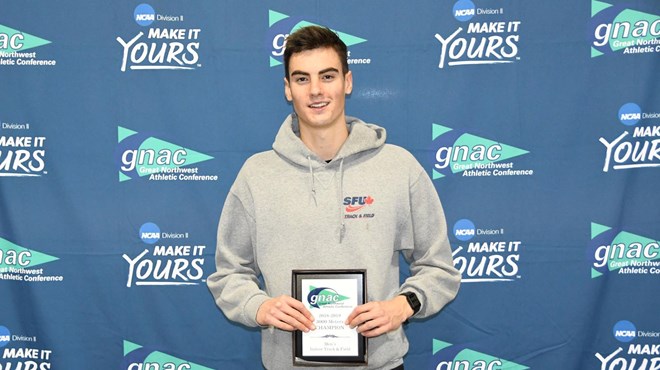
Rowan Doherty was named Track Athlete of the Meet. (Photo courtesy of SFU Athletics)

On February 15 and 16, the SFU track and field team travelled down to Nampa, Indiana for the GNAC Championships. Overall, it was a successful meet for the Clan, highlighted by a record-setting performance by the men’s team in the distance medley relay, and the individual performance of Rowan Doherty.

The last event of the competition’s first day was where the track team was at its best, as

Pierre-Louis Detourbe, Nate St Romain, Aaron Ahl and Rowan Doherty stepped up to race in the distance medley relay. They pulled away for the win with a time of 9:58.18, beating the previous meet record (also set by the Clan in 2012) of 10:04.58. This time also ensured that they met the NCAA DIV II provisional standard.

The SFU women’s team had an excellent performance in the 800 metre event, taking home the top four finishes in the preliminaries. Addy Townsend led the way, nearly beating the NCAA DIV II provisional standard, and was followed Paige Nock, Mairin Shields-Brown and Megan Roxby. In the final on the next day, Townsend would lead the way once again, this time winning the event officially with a time of 2:10.12. It was a tight finish, as she beat Olivia Woods from Western Oregon University by only a hundredth of a second.

Townsend was also a part of the 4×400 women’s team that finished first. Accompanied by Bryce West, Sophie Dodd, and Renate Bluschke, the team finished with a time of 3:49.99.

The star of the meet, however, was Doherty, who took home the Track Athlete of the Meet award. After anchoring the winning team in the distance medley relay, Doherty also won the 3000-metre individual event. He finished with a time of 8:31.30, barely beating Detourbe in the event.

Overall, the both the men and women’s team finished fifth at the event.

What’s next:

SFU will now prepare for the Seattle Pacific Final Qualifier on February 23. The event will provide the Clan athletes another chance to race under the NCAA DIV II provisional standards and qualify for the NCAA DIV II Championships.

SFU Hockey lose Family Day matinee 7-3 to league-leading Spartans

0
Nothing went the Clan's way on Monday afternoon. (Photo courtesy of SFU Hockey)

By: Dylan Webb

SFU hockey dropped their last regular season meeting with the Trinity Western University Spartans 7–3 at the Bill Copeland Sports Centre on Family Day. The loss concluded the season series between the two teams with SFU winning just two of six matchups with their Langley-based rivals. More importantly for the Clan at this point in the season, the loss cost them a valuable two points in a tight playoff race for second place and home ice advantage in the first round of the playoffs.

In the first, the Spartans leapt out to an immediate one-goal lead within a minute of the beginning of the frame. The Spartans built their lead throughout the first period by converting on power-play and odd-man rush opportunities. After getting one back on a seeing-eye point shot from captain Matthew Berry-Lamontagna, the Clan found themselves trailing 3–1 after the first period.

In the second, the Clan were able to regain their defensive structure and keep the puck out of their own net. Also benefiting from an impressive conversion on a partial breakaway by Mitch Newsome, the Clan won the period and found themselves within just one goal heading into the third.

Unfortunately for the Clan, the wheels came off in the third period as the Spartans scored a couple of goals early in the frame to put the game out of reach and chase goaltender Ryan Sandrin. The Spartans would add an empty netter late to cap a 7–3 win that only padded a first-place record that they had clinched a night before with a win over the VIU (Vancouver Island University) Mariners.

Discussing the loss following the game, defenseman Daniyal Nussipakynov pointed to “inconsistent play as an entire team” that resulted in the relatively large margin of defeat. Asked about the need for a 4–0 sweep of their remaining games, while not allowing a single point to Selkirk on the final weekend of play, Nussipakynov reiterated the team’s commitment to “taking it one game at a time while understanding the process that will lead us to the championship.”

The Clan will now have to face the possibility of playing the Spartans in the first round if they are unable to take at least six of eight points in their remaining four contests given that the Spartans have clinched first place in the league for the second year in a row. If the Clan are able to take four points from UVIC this coming weekend, it would set up a double header with the visiting Selkirk Saints that would have extensive playoff implications.

Regardless of these implications for playoff seeding, though, the Clan will have to focus on building momentum for the playoffs against the last-place UVIC Vikes. The Clan will host all of their remaining four games at the Bill Copeland Sports Centre with the Vikes visiting this coming weekend followed by the Selkirk Saints.

Meditate your way out of SFU

0
Photo curtsey of Flickr

By: MaxWell Gawlick, Peak Associate

Every exhausted student has heard the typical “You just need to sleep more!” from people who have left and forgotten what university life is really like. SFU does recognize that mental health is important and has released an alternative guide to maintaining your mental health that doesn’t involve shutting down the school when it snows: meditation.

Unlike typical meditation strategies, this guide doesn’t ask you to find your “happy place.” Instead, it’s asking you to think of your school life as it could be, replacing all the negative aspects of each day with the best possible ones.

The following are examples of scenarios reported by student participants in a beta test, compiled by research experts to aid students in meditation goals.

Tracy, first-year undeclared major: “In my pretend-SFU, I just kind of like, walked around the campus and looked at stuff. Um, the ivy on the side of the library was really pretty — it’s like the only colour other than grey on campus. Oh, there were also some people stopping students for donations. The initiative made me happy, but thankfully I managed to avoid them. I got distracted on my walk and forgot about my class, but there was also a room change today so they didn’t dock anyone marks. I didn’t know about the room change, but nobody has to know that.”

Donna, fourth-year English major: “I made it to tutorial punctually in my meditation session, not a second late nor a second wasted. The TA announced that the midterm exam will be challenging, but it’s on a poem I know really well, so I’m going to ace it. Then we’ll see who Karen thinks is smarter. They ended tutorial 57 minutes early as they had an engagement. I was famished and decided to treat myself; I purchased a coffee from the nearby proprietor. It warmed my fingers perfectly, warding off the cold of these dreary winter months. In lecture, the professor noted that the author of the text has been found to have falsified some information, so there shan’t be any further readings for the rest of the semester. Class is cancelled until the syllabus can be amended.”

Chad, seventh-year “athletics major”: “The construction was all finished. The new Student Union Building looked fine, but I was more occupied with the new stadium. They finally fixed that thing with the lights. More equipment too. Yeah, it was pretty cool. I checked my phone to see if I had slept through to 2035 and found that I was still half an hour early for class. I figured it was probably enough time for a couple laps. Before I knew it, the whole day was gone. But they didn’t really do anything in class.”

Maggie, second-year health sciences major: “I imagined waking up 15 minutes before my blaring alarm and having a shower I usually don’t have time for. I had a healthy, balanced breakfast — my eggs just firm enough, the toast darkly browned but not burnt — and I felt healthy and revitalized. Also, I remembered to pack the notebook I always forget.”

Despite the initial promising results, follow-up surveys were less encouraging. Results show a decrease in levels of happiness in the days following meditation. Participants agreed that their imaginary SFU was so much better than reality that they were depressed upon their return to the loud jack-hammering and jarring concrete-drilling consuming the campus. Further research is required to interpret this data.
SFU currently maintains their position that it is a beneficial exercise.