Home Blog Page 520

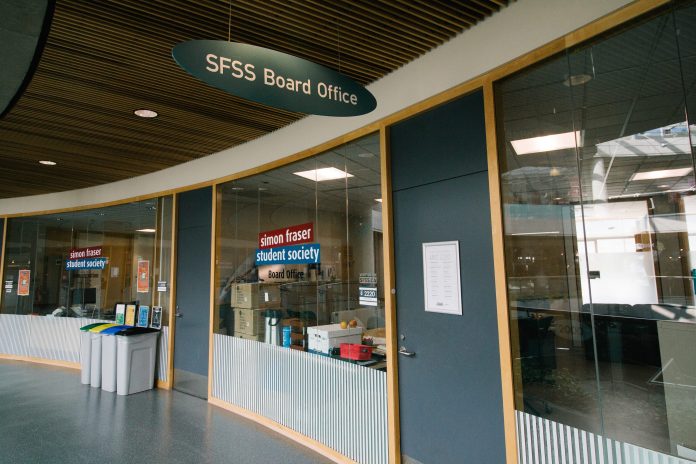
SFSS Board set to develop an internal accessibility standard policy

1
Photo by Andres Chavarriaga/The Peak

By Onosholema Ogoigbe, News Team Member

On May 30, Jennifer Chou, SFSS arts and social sciences representative, proposed that the SFSS create an internal accessibility standard policy.

“The Accessibility Fund Committee has not had a chance to meet to discuss this. I have submitted this as a discussion item for the Board of Directors to review,” Chou writes.

Chou sent a document to the board outlining some key issues around accessibility in the SFSS, particularly concerning board meetings. These included board meeting locations being inaccessible, the fact that board meetings are not live streamed, the lack of amplification and closed captioning during board meetings, and the use of jargon in meeting minutes and agendas.

“SFSS accessibility is inconsistent — meetings have [accessibility accommodations] sometimes, but not all the time,” Chou writes in the document. “This is why an Accessibility Standard Policy would be useful.”

“SFSS is supposed to represent all undergraduate students, so we cannot just leave these students out of discussions and meetings just because it is not accessible for them.”

The Peak reached out to Chou for comment about a portion of the document, which seemed to imply that live streaming by students during board meetings were allowed. The information seemed to contradict SFSS executive director, Sylvia Ceacero’s previous statement on the matter. Chou replied that livestreaming “is not explicitly allowed or disallowed [ . . . ] whether it would be ‘allowed’ or not really depends on the Board of Directors.”

She went on to emphasize that “bringing livestreaming to SFSS Board of Directors meetings may make them more accessible, and thus gain more engagement from anyone with accessibility needs.”

According to a statement given to The Peak by SFSS president Giovanni HoSang, the SFSS does not currently have an accessibility standard policy. However, he went on to say that they do have an accessibility committee that works on addressing accessibility concerns as well as reviewing student grants for the SFSS accessibility fund.

He also stated that the SFSS does try to make itself accessible but acknowledges that “having it written down [in a policy] would actually hold [them] accountable to it.”

Chou’s document also gave recommendations of what a policy should include such as “basic accessibility measures for all public meetings” and “training of staff to carry out these measures.” It also recommended that the board consult with the Campaigns, Policy and Research Coordinator, the Centre for Accessible Learning, and other students with disabilities before finalizing a policy.

The discussion was referred to the Accessibility Committee for them to develop a policy and present a subsequent motion to the board.

According to HoSang, Christina Loutsik, vice-president student services and the chair of the Accessibility Committee, is currently working with the Nominating Committee and the SFSS Board of Directors to appoint at-large members to the Accessibility Committee. After this, the committee can start meeting and work on developing an accessibility standard policy to recommend for board approval.

Chou also told The Peak that discussing an accessibility policy has sparked dialogue on accessibility within the SFSS. The discussion will be brought to the Accessibility Committee meeting on June 17. Chou, who is also part of the Disability and Neurodiversity Coalition student group, will bring up the discussion item during the coalition’s meeting on June 24 for further discussion.




News Beat: Convocation

0

Long story short: Overwhelming myself in co-op taught me to take care of my mental health and respect my personal boundaries

0
Image credit Tiffany Chan

By: Tiffany Chang, Peak Associate

When I was in Grade 12,  I’d already decided on doing co-op during my third year of university;  I thought it looked like a good way to map out my academic career. After two years at SFU, I’d get used to the campus environment and the workload, maintain a good GPA, and start co-op before finishing too many units to qualify for the program.

I was admitted into co-op spring of 2018, and I landed an eight-month, part-time position that spanned from September 2018 to April 2019. The plan was to take a course simultaneously both semesters.

Everyone congratulated me, telling me how great of an opportunity it was. On the surface, everything seemed fine. I seemed fine.

But I wasn’t.

Last summer, the stress of it all had really gotten to me. I was going to school, working eight hours a day, four days a week, and still managing to apply for co-op jobs and schedule interviews with potential employers in between. I was so exhausted that even after taking a relaxing trip with my family at the end of August, I still felt burnt out. By the time my work term rolled around, I didn’t feel anywhere near ready for it. With a mindset progressively getting worse, something was bound to go wrong, and I wanted to run far away and hide.

A huge part of who I am is that I’ve always been a “people-pleaser.” As far back as kindergarten, I did things I didn’t want to do to make other people happy. I wanted people to like me. Unfortunately, this habit reinforced the idea that my value as a person was determined by doing things to please other people . . . often at the expense of my own happiness.

Things were complicated in this case, as co-op was a direction I went that made those closest to me happy. I always thought that to be a people-pleaser was to completely disregard what I wanted or thought was right.

Although I like the organization I worked for and love what it represents, I realised early on that I wasn’t the right person for what my supervisor needed. The atmosphere made me feel extremely insecure and I constantly worried about making mistakes or disappointing the established people around me. I felt paralyzed with anxiety whenever I thought I couldn’t do certain things that were assigned to me.

Getting out of bed on days when I had to go to work became a major struggle. I would show up looking put-together but was a tired, nervous wreck on the inside. On horrible, sleep-deprived mornings when I had no motivation whatsoever to commute to the workplace, I actually thought about jumping in front of the oncoming SkyTrain.  

I remember crying while looking at my goSFU account in October with the cursor hovering on the “drop” button for my class, wondering if I should just focus on the job that was sucking all the energy out of me without worrying about school. But after several minutes of staring at the screen, I decided that as much as I wanted to, I just couldn’t. Our class was in the middle of working on group projects and I’d never forgive myself for letting down classmates. Ditching, especially with no explanation, is not my style. It never has been, and it never will be.

According to the professor, my group’s presentation turned out as one of the best that semester. After all the hard work we put in, I was ecstatic with the outcome. The course became one necessary hurdle I was glad I didn’t avoid or postpone, though the option to was literally at my fingertips.

As relieved as I was about finishing the presentation and felt that I had the course under control, it obviously didn’t help with getting rid of the black cloud that magically appeared above my head when it I went to do my job.

Don’t get me wrong. I worked with very friendly people and some days were better than others. It wasn’t them — it was me.

I wasn’t good enough. My internal voice just kept repeating it time and time again. It isn’t hard to imagine that I dreaded every single shift throughout the three-and-half months I was employed there.

“Wait . . .” you say,  “Hold on . . . I thought you said it was for eight months.”

It was. But because of funding issues, the position had to be cut short in the middle of January.

That’s right. I got laid off from my very first co-op job.

Here’s what’s hilarious about this: I seriously considered quitting a week before what I found out would be my last day. A tug-of-war was happening in my mind as I ping-ponged back-and-forth, wondering if the credits were worth losing my sanity over. I remember going over what the consequences might be if I did: Is my supervisor going to freak out? Does this make me a ‘quitter?’ Would all the work I’ve done so far amount to nothing? Have any co-op advisors ever dealt with students who’ve wanted to quit? 

I took a deep breath before bringing it up with my supervisor and we spent some time weighing the options together. One long, emotional conversation later, we agreed to make it work. Little did I know that my sanity would be spared within the next seven days.

To say the least, they were the longest, most emotionally draining three-and-a-half months of my life. While I was proud of myself for finding the strength to stick with it until the end, I should’ve considered my own needs more carefully before taking such a huge step. It’s probably one of the worst choices I’ve made since severely overplucking my eyebrows back in high school.  

I admit that the reason why I applied for co-op was not only to gain the supposedly “valuable experience,” but also for a more personal reason. I’ve always felt as though students in the same year as I am are maturing faster than me, and co-op looked like the best means to keep up with them at the time. Feeling like a young kid and wanting to appear “grown-up” has dictated a lot of decisions I’ve made in the last three years and these decisions haven’t exactly made me happy.

“Maybe if I got a job in ‘the big world’ right now, people would notice that I’m ‘adulting.’”

I mean . . . clearly, this was a mistake. I prioritized a three-year-old plan, that honestly could have waited a little longer, over my own mental health and sanity. Although, there have been times where I wish that I could turn back the clock and stop myself from going through with it in the first place, deep down I know that this rough patch led to learning an important lesson. I signed up for co-op when I wasn’t ready because I let my lack of confidence and fears get in the way of what really matters.

Overall, I’m grateful co-op helped me come to this realization. It took the experience of feeling trapped and alone to finally say to myself that I’ve had enough. I apologize to myself because I tried to quiet down my voice.

I will never try to quiet my voice ever again.

The big takeaway: Don’t let what you believe people’s opinions are overshadow your opinions of yourself or what’s best for you. There’s information shoved down our throats from basically everywhere, especially for us students, but nobody knows what’s best for you better than you. I realized it’s OK sometimes to put yourself first.

Aladdin’s live action remake is a whole new world of mediocre

0
Image courtesy of Walt Disney.

By: Kim Regala, Peak Associate

Magic flying carpets, wish-granting genies, and a charming young prince eager to show you a whole new world: what else could you need? When Disney announced that a live-action remake of Aladdin would be coming to theatres, the world sat in anticipation. While the original film sparked magic in the hearts of many young children (and adults too), the 2019 release fails its attempt to relive this glory.

A lot of the excitement leading up to the film could quite easily be credited to the casting of Will Smith as Genie. Genie remains as one of the most memorable Disney characters and Smith delivers a refreshing take on this old-time classic. With clear Fresh Prince of Bel-Air influence, he brings his own sense of humour and swagger into the mixture, which makes for an enjoyable viewing.

Smith’s performance is definitely not one you would want to miss out on, but Egyptian-Canadian actor Mena Massoud steals the spotlight with his stunning portrayal of Aladdin. Massoud’s Aladdin is impressive considering that this is his first-ever lead role. His performance also incorporates a more modern take on the character, but still manages to capture and maintain the essence of Aladdin’s persona. Admittedly, Massoud’s charming looks play a large role in winning the hearts of the audience, but he showcases his singing and dancing too, giving us a few reasons to admire him.

While Smith and Massoud’s acting are definitely worth the view, these two casting decisions seemed to be the only thing going for the film. Jafar loses his comical and over-the-top personality in the remake and instead only exists as a more stereotypical and far less interesting antagonist. The Sultan, Jasmine’s father, also loses his beloved childish attitude, his character relegated to the background.

Where the film really hits its lowest of lows is its clumsy special effects and editing. While this can sometimes be forgivable with a decent storyline and acting, Aladdin is a film that depends heavily on these elements in order to immerse us into its world of magic and fantasy. The lack of attention to good special effects is most noticeable through Aladdin’s monkey Abu, Jasmine’s tiger Rajah, and Jafar’s parrot Iago. The clear lack of detail in achieving the most realistic appearance is disappointing, especially for a Disney production.

The disappointment doesn’t end there, as the stylistic decisions in editing also prove to be more jarring than impressive. Dance sequences are subtly sped up to create the illusion of fast-paced choreography while certain moments in the film are slowed down for artistic purposes. Unfortunately, these choices only make for a distracting viewing experience which takes away from the world that the film meant to create.

Disney’s live action remake comes to a not-so-close second to the original. Still, despite the film’s flawed decisions in character portrayal and editing, Smith and Massoud’s performance are reason enough to come out and relive the magic of Aladdin. Just . . . maybe wait ‘til you can watch it almost free of charge on Netflix.

Why is our mascot a kilt-wearing, moustached Scottish Terrier?

0
Image Courtesy of @SFU Twitter Account

By: Jennifer Low, Features Editor

Who decided that SFU was  going to be represented by an anthropomorphic, tartan-wearing terrier mascot? Why on Earth does he have a moustache and why is he Scottish? What kind of name is McFogg? Is that just because it’s foggy at SFU and rhymes with “dog”? There’s just so many unanswered questions!

Turns out all you need to do to find most of your answers is look at the history of a very important SFU figure, founding president Patrick McTaggart-Cowan.

McTaggart-Cowan was born in Edinburgh in 1912, emigrating to Vancouver a year later. Studying math and physics at UBC, he went on to study natural science at Oxford.

He served during the Second World War as the chief meteorologist for the military unit known as RAF Ferry Command. In this role, McTaggart-Cowan determined when the weather conditions would permit safe journeys for the planes travelling from North America to Europe. McTaggart-Cowan earned the nickname, McFogg, due to his seeming ability to always accurately predict the weather for the pilots flying across the Atlantic.

In a 1996 interview with SFU News, McTaggart-Cowan addressed the extended period of poor weather conditions that gave him his nickname. “Air crews began referring to me as [McFogg] after a 40-day spell of bad weather,” he said.

McTaggart-Cowan joined the university in 1964, and he was an unlikely choice for the school’s president, considering he was a well-known meteorologist and director of the Meteorological Service of Canada and lesser known in the world of education and academia.

Nevertheless, he was recommended by Gordon Shrum, a key figure in building the new university. McTaggart-Cowan was well known for his work ethic, enthusiasm, and energy, all of which enabled him to help develop the new university.

His unorthodox mandate was “to ensure SFU did things ‘differently’ from other universities,” says SFU News in their 2016 feature on him. McTaggart-Cowan did many things differently indeed.

While born in Edinburgh, the Capital of Scotland, the Scottish theme of SFU was actually initiated by McTaggart-Cowan to honour someone else, SFU’s namesake. Explorer Simon Fraser is descended from the Scottish Frasers of Culbokie and the Frasers of Lovat. Fraser’s Scottish ancestry inspired McTaggart-Cowan to commission SFU’s coat of arms which is based on the arms of Fraser Lovat. Several of these traditions are still celebrated today including the use of ceremonial bagpipers and the name of the Clan sports teams. Even the university’s motto, “Nous sommes prêts,” references Fraser’s Scottish lineage as it is a variation of Clan Fraser’s traditional motto. Unfortunately, the school no longer runs the annual cricket matches or president’s ball which had also been initiated during that time.

In 1996, a year before McTaggart-Cowan’s death, SFU Athletics unveiled its new Scottie dog mascot, named after McTaggart-Cowan’s WWII nickname, to replace SFU’s retiring mascot, a gorilla named Joe.

“I’m very flattered that you’ve chosen to share the name [McFogg] with me,” an 84-year-old McTaggart-Cowan said in an interview with SFU News, published September 19, 1996. The new mascot also paid homage to Simon Fraser’s Scottish heritage, calling back to the theme McTaggart-Cowan initiated through its Scottish Terrier breed and traditional attire.

SFU’s gorilla mascot officially retired at an October 18 basketball game in 1996. Local mascots came to play a half-time soccer game to celebrate the reign of SFU’s long-serving though, technically, unofficial mascot. McFogg made his first appearance at “A Dog’s Breakfast” at the Diamond University Club on the morning of September 5, 1996.

Since then, good old McFogg has proudly been a symbol of SFU’s sports team, the Clan, and has gone on to star in many articles for The Peak as well as in an award-winning 1950s-style earthquake preparedness video.

While not the most intimidating of mascots, and despite petitions that seek to change SFU’s mascot to a raccoon, McFogg the Dog still continues to represent the friendly, approachable SFU student population.

Some Fun Facts about McFogg the Dog:

  • The SFU Athletics website features a piece of historical fiction that details some of McFogg’s background. For example, it describes the mascot’s long hiatus (arguably due to a low interest in the new mascot) as a transformational event in McFogg’s life when an incident involving UBC and its Thunderbird mascot left him with a tail injury and an existential crisis. It didn’t help that his chihuahua girlfriend, Lulu, had just dumped him!
  • During an SFU Open House in 2008, McFogg accidentally flashed the crowd when his kilt fell down!
  • The 1996 design of the McFogg costume featured a fan inside the suit to help McFogg keep cool.
  • The identity of the first person to don the McFogg costume was kept secret.

Because We Are Girls explores the true impact of sexual abuse and the true importance of community

1
Still from the Because We Are Girls courtesy of Baljit Sangra.

By: Kaila Bhullar, SFU Student

From exposing harsh realities and implications of Indian cultural influences (in both tradition and media) to openly sharing firsthand experiences of sexual abuse, Baljit Sangra’s Because We Are Girls is an objective and completely raw new film. It bravely opens up a conversation about the highly stigmatized topic of child rape and the retraumatizing process of dealing with the justice system. On Thursday, June 6, the film was screened by Reel Causes at SFU Woodward’s for an evening of film and open discussion.

The evening began with a warm introduction explaining the goal of Reel Causes films and events: to encourage positive social change around the world, and to create a safe platform to talk about difficult subjects like abuse and trauma.

Because We Are Girls centers itself around the collective experience of the Pooni sisters Jeeti, Kira, and Salakshana in their journey to report and reconcile childhood sexual abuse. It follows them as they deal with their shared trauma and how it has affected every generation within their family. It grapples with the highs and lows of the after-effects of dealing with trauma and how living with heavy burdens and secrets have damaging consequences personally and communally as we move through life.

Through the three sisters’ brave sharing of their compelling stories, we see that they are survivors. They show us that we should never let go of hope, that we are capable of persevering through anything despite how vulnerable and alone it may make us feel, and that above all we must never stay silent. The sisters together remind us of the importance of community — that healing does not exist in finding validation through the justice system but rather in coming to peace with ourselves and learning to move forward from, and with, trauma.

Looking around the audience at the end of the evening, I could barely see a dry eye. After an emotional and praise-filled Q&A with the sisters, Baljit Sangra, and Family Services of Greater Vancouver representatives Gregg Taylor and Lillian Chen, we are left with the tragic current statistics of sexual abuse. A third of Canadian women and a sixth of Canadian men will experience sexual abuse at some point in their life, and 75% of times victims will know the perpetrator. The film and Q&A was a wonderful discussion about healing that gave us hope for the future without forgetting the long way we still have to go.

I would highly recommend this film, but due to its sensitive and raw content, I would give a strong content warning and recommend seeing it with a close friend or family member. The film opens our eyes to the very real and upsetting impact that sexual abuse has on the lives of its survivors, their families, and their communities. It reminds us that there is much work to be done moving forward to create a safer world for girls, women, and all those affected by sexual abuse.

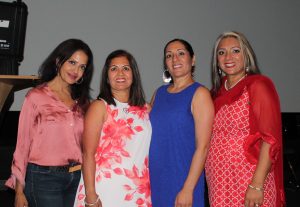
Balijit Singra, Salakshana Pooni, Kira Pooni, and Jeeti Pooni after the Q&A with Reel Causes. Image Kaila Bhullar / The Peak

Because We Are Girls will be playing at the Vancity Theatre from July 5–11, with a Q&A with the filmmaker taking place at the July 5 and 6 and screenings. Tickets are $11 for students and can be purchased online or at the door.

If you or someone you know is struggling, you can reach out to SFU’s Health and Counselling services (including their new My SSP initiative), the SFSS Women’s Centre, Out on Campus, or Women Against Violence Against Women (WAVAW) who also have a 24-hour crisis line. You can also use this list of Reduced-Cost Counselling Options in Vancouver for affordable and effective help.

Dr. Steven Tanaka talks Next Music from Tokyo

0
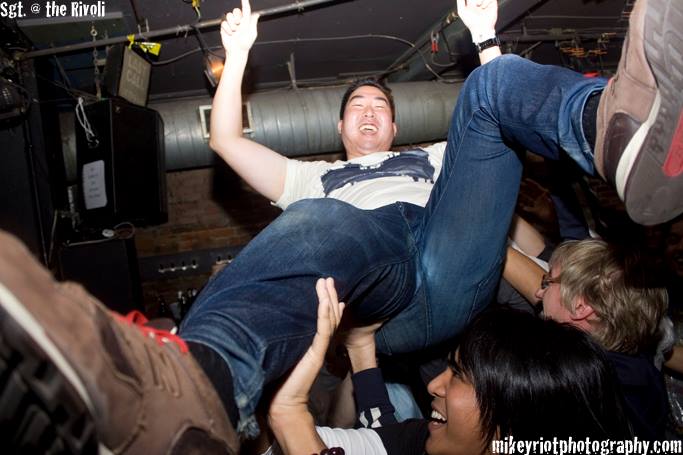
Tanaka crowd surfing at Next Music 2015. Image taken by Mike Stroud, retrieved via Facebook.

By: Kitty Cheung, Staff Writer

Next Music from Tokyo, an annual cross Canada tour of Japanese Indie bands, came to Vancouver for its fourteenth time this past May. The tour is organized, and funded, by Japanese-Canadian and Toronto Anaesthesiologist Dr. Steven Tanaka and seeks to show Canadians the Indie music Japan has to offer — and what Canada has to offer them in turn. After attending NMFT14 in May, Peak staff writer Kitty Cheung had the chance to interview Tanaka over email about the tour and where it’s headed next. You can find the review of the show in print in the June 17 issue or online.

Kitty Cheung: If you could travel back in time and speak to Steve in 2010, before the first tour began, what advice would you give him? In other words, how has this tour changed you and what have you learned?

Dr Steven Tanaka: I don’t think the tour has changed me all that much. There are times where I feel like my efforts aren’t appreciated enough by the bands or the fans in the sense that everyone has so much fun on the tour and at the shows but NMFT still gets very little love and support on social media. That’s caused me to become a little bit jaded, but overall the positives greatly outweigh the stress and financial negatives that come with the tour. So if I ran into myself in 2010 I’d tell myself, “Self, there are times where you might feel this insane tour isn’t worth it, but persevere and you will have the best time of your life, make lots of great friends, and [create] beautiful memories. And also, make sure you bring ミドリ (Midori) to Canada during vol 2 before they break up and don’t do something stupid like taking tricot off the line-up during NMFT4!! Have fun and don’t hit your head too often stage diving!”

KC: As an anaesthesiologist and music promoter, you seem to have two big parts of your life dedicated towards very different things: medicine and music. What advice would you give to students who are trying to navigate between both academic and creative fields?

Dr. Steven Tanaka: It’s a very competitive world so, unless you’re Vincent van Gogh and naturally talented at both academic and creative fields, you’ll probably have to sacrifice a lot more time honing your talent in one area over the other.  Personally, I chose a career path that focussed heavily on academics in my younger years so that I could have the time and money to do more creative things later on in life. My advice would be to study towards a career where you can make a living doing what you enjoy and still have the time to pursue deeper interests.

KC: How do you balance the workload of organizing the tour along with your duties as an anaesthesiologist?

ST: My duties as an anesthesiologist take the highest priority as the health of patients are at stake. Although organizing the tour is a lot of work, NMFT is more of a hobby in comparison. I usually have at least four to five months to prepare for a tour. Since I’ve been doing NMFT for ten years now I’ve become used to getting the essential preparations out of the way quickly and I’ve had fans volunteer to help out with things such as poster design and distribution and video creation for promotion of the tour.

KC: Can you tell us about the most memorable experience you’ve had with NMFT?

ST: The most memorable experience happened on the very first NMFT tour. It was actually a very frightening experience where Ryogo Kobata, the guitarist/violinist of a band called Goomi was electrocuted while performing on stage at the Rivoli in Toronto. It was a small short circuit between the microphone and violin due to an overzealous fan at the previous Montreal show spraying Ryogo’s mic and equipment with a bottle of sparkling wine. Ryogo collapsed on stage and briefly lost consciousness but felt much better quickly with no medical complications. We cancelled the show but had another show in Toronto at the Whippersnapper Gallery the following night.

Courageously, Ryogo insisted on performing the next show and Goomi’s performance the second night was, pardon the pun, electrifying. Ryogo said that after the previous night he realized [that] life is short and one can die at any time so he might as well treat every performance from now on as if it could be his last. Goomi played their show with intense vigor that brought the house down and they carried that passion and intensity back with them to Japan. Goomi’s fans in Japan were surprised saying they returned from Canada better and more confident than ever.

So it was a frightening experience with a positive outcome.

KC: How do you think university student life factors into your shows? With Stereogirl being a band composed of university students, as well as the students who I noticed in the Vancouver audience, I’m interested in hearing about students as both performers and spectators.

ST: The NMFT shows are 19 and over (18+ in Montreal) so unfortunately some younger university students may not be able to attend the shows. The age restriction even affects the bands. I had some band members who were 18 [year old] university students that were only allowed to be in the venue for the performance. They would enter the venue right at the start of the show, perform first that night, and then would have to be escorted out by security and not allowed to enjoy the rest of the show with the other bands.

You’re never too young or too old to rock and roll and NMFT attracts an audience of all ages *cough* 19+ *cough*. But most of the audience tends to be university student age or immediately post-graduate and they tend to be the most boisterous and ambitious when it comes to moshing and crowd-surfing. For the Japanese bands with student members, NMFT is a time of vacation from school and they’re out to have as much fun as they can and make new Canadian friends.

KC: Based off of interviews I’ve read, you say that your family wasn’t aware of this tour and your financing of it, at least for the first few volumes. Has anyone in your family ever attended a show, and if so, what was their response?

ST: My dad has been to a few shows in Vancouver and has enjoyed himself a lot despite being more of a 60s/70s music kind of guy. He currently holds the record for most stage dives… j/k

KC: As May is Asian Heritage Month, I’m interested to see how this tour connects to your Japanese-Canadian upbringing. Would you say that organizing NMFT is a way of celebrating your Japanese heritage?

ST: I was born and raised in Vancouver, pretty much like a regular Canadian, with very little exposure to Japanese culture other than eating more miso soup and white rice than the average non-Asian and hearing my parents converse in Japanese. I didn’t listen to Japanese music at all until after I graduated from university. In fact it wasn’t until about 2007 when I went to my first underground show in Shinjuku, Tokyo, that I realized how amazing and ground-breaking the indie-underground music scene is in Japan. Being a foodie, I also became infatuated with all the great yakiniku, yakitori, ramen, and izakaya spots in Japan.

Although my upbringing was much more that of a regular Canadian than Japanese, it’s great to be able to show fellow Canadians how fascinating and creative bands from Japan can be through the NMFT tour. Conversely, I’m able to show the Japanese bands (most of whom are travelling outside of Japan for the first time) how beautiful Canada is, how appreciative and [raucous] we get for good music, and that Canada also has great food!

Tanaka confirms that Next Music From Tokyo Volume 15 will be held in May next year, “Most likely centered around the long weekend (May 15-20, 2020).” More information about the tour, visit nextmusicfromtokyo.com.


Excerpts from a blogging mom: Sanity Straight from the Oven

0
Photo curtesy of Pexels

Written by: Zoe Vedova, Humour editor

Hello, world! My name is Sheela McGummery
and I blog about my baking!
I am a proud woman of the suburbs and I
bake to fill my life with the sort of sweetness
I used to find in my marriage. LOL
For any baking inquiries, please email

s[email protected]

VEGAN LEMON BAR RECIPE

Now here is a neat twist on a fun, summery treat that will really boost your neighborhood cred when you show up to your stepchild’s little league BBQ with a tray of these healthy snacks!

I can assure you this recipe is a foolproof way to get into the inner circle of moms who secretly do MDMA behind the concession stand at youth baseball tournaments.

God, I wanted in on it so bad, hahahahaaaahahah . . . we’ve all been there, it’s time to be out in the open about loving . . . Lemon bars!

Just licking the icing sugar off the top . . .

I came up with this recipe last month.

It was one Saturday morning, after returning from my biweekly meeting as the treasurer on the board of Moms for Cross-Fit for Toddlers, and I had sooooo many lemons left in my fridge. (Way too many for just gin and tonics, am I right, ladies?! Find my Alcoh-lishous Adult Gin Juice Box recipe here.) I had to whip up something simply fantastic for my step-sons baseball BBQ!

That snake in the grass Rebecca was going to be there parading around a pie, as if that pastry harlot could craft a perfectly formed pie crust herself and didn’t purchase a Tenderflake® Pie Shell for $3.99 from Thrifty’s like the kitchen coward she is.

We have such a fun relationship.

My therapist (find her at www.facebook.com/Cul-de-sac_Saviour_Moms/) says baking is a constructive way to release my anger towards my late father, who abandoned my mother and I to become a vaudeville actor in Winnipeg in 1971. Though my obsession with light, lemony, summer nibbles is only to protect the health and safety of my Family!!!1! Just like that time I had to knock that insurance salesman out cold with a Yellow Pages phonebook (they’re still good for something) and I pulled his unconscious body out to the street to make it appear as if my neighbors had run him over with their car.

I was acting on karma’s will. Those people are always parking on the street when the community bylaw makes it perfectly clear you cannot park where the sidewalk line is painted WHITE. They do not get to evade the municipality’s cold hard judicial judgment when I’m around.

Back on to the lemon bars. I firmly believe that baking has the power to bring families together. My eldest (biological) son has just returned from his first-year at university, and I was SO worried he’d turned into a liberal while away in the big city. But if there’s anything that can bring family values back into our lives in this modern age, it’s MY vegan lemon bars.

This recipe simply needs organic lemons. If you can’t afford them, maybe you should try this lemon bar recipe: Low-Income Lemon Bars I made for the annual Frugal Friday! Organic lemons show you really respect the lemons for everything the faithful fruit has done for our country. Especially in the Second World War.

RECIPE CONTINUED ON Page 2 >

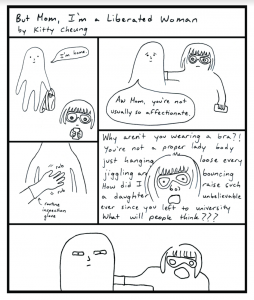
Comic – But Mom, I’m a Liberated woman!

0

Comic by: Kitty Cheung

Long story short: My journey into the exclusive world of wellness taught me to check my privilege

0
Image credit Tiffany Chan

By: Molly Johnston, SFU Student

I have a confession to make: I drank the green Kool-Aid and bought into the oh-so-exclusive club of wellness.

Ever since I can remember, I have struggled with chronic stomach pain — a persistent discomfort accompanied at times by heartburn so bad that it could often be hard to breathe. After twenty-something years of being bounced from specialist to specialist, I was given the ever ambiguous diagnosis of IBS (irritable bowel syndrome) which is basically medspeak for “we don’t know why but your bowels are just easily irritated.”

The solution? Try cutting out different foods and see if your symptoms improve. But even after years of discomfort, I was unable to comprehend not being able to indulge in my mother’s ever-present cheese plate. Without any clear answers or advice, I accepted the pain as my normal.

It wasn’t until I discovered a sizeable bald spot atop my 26-year-old head that the seductive cure-all promises of clean eating, kale-smoothies, and the power of chia seeds truly became appealing.

While I had always scoffed at the idea of fad diets, I started following blogs, Instagrammers, and hashtags preaching how I could finally reach a state of wellness, if I only tried hard enough.

To my surprise, and bank account’s distress, I felt fantastic. I was now a card-carrying clean eater; a membership that required me to spend my already jam-packed days as a full-time working student recipe planning, curating the perfect grocery list, and hours upon hours of batch-cooking. My health problems had all been repacked into aesthetically pleasing miracle cure-alls; $35 organic collagen powder to mix with my $2.50 apiece avocados and coconut water for an Instagram-worthy smoothie that promised to improve my gut health and promote healthy hair growth.

But as I made the weekly pilgrimage to the organic mecca of Whole Foods, something ate away at my conscience; the same something that had deterred me from ever venturing into the modern world of wellness before. I cringed at the righteousness that permeated its culture, flinching every time I read the word clean in relation to what I was eating.

After being fraught with feelings of guilt, without a clear understanding of why, I was somewhat relieved to discover “The Whole Foods Market Effect.”

Shopping at Whole Foods requires a lot more than just the high-limit credit card you need to afford staple products. When I go to Whole Foods, I watch as Kevin carefully selects which hormone-free cheese he will be adding to his charcuterie board, and realize that either way he will still be spending 57% more than at a conventional grocery store. I also spot Skye, the green-juice guzzling, Lululemon-clad yogi, as she preaches that a plant-based diet is the solution to any health problem. She has her naturopath on speed-dial to help her navigate the endless choices of supplements and superfoods. As I finally complete the obstacle course of aisles, I then need the patience of a saint to ignore Karen the cashier, who gives me the side-eye as she hands over a brown paper bag of groceries because I’ve forgotten to bring my reusable canvas tote.

But what if I don’t have one, Karen? What if I don’t have somewhere to store one, or I couldn’t spare $10, after spending that money on food rather than a bag that reads “BUY LOCAL” and ensures people know that I am supposedly a good, ethical, clean consumer?

Just because Kevin is able to shop at Whole Foods for “clean,” hormone-free cheese, does that make him better than the individual who buys the No Name brand at No-Frills for a substantially lower price?

By using clean to describe food, wellness circles make wellness not so much about actual health or nutrition but morality. Clean eating implies that any other form of eating is dirty, and that consequently, so is the eater. It implies that because I was shopping somewhere that described their products as clean, I was somehow better than someone who couldn’t.

The idea that my premature balding was simply caused by my own irresponsible eating habits . . . it failed to account for the fact that to make ends meet, I needed to work two jobs while attending school full-time and constantly stressing over rent and ever-increasing student loans.

I have since shed the food-ridden guilt and given up my strict diet in favour of allowing a few indulgences of my favorite cheeses and chocolate. To my surprise, I still feel better than ever and I’m thankful to report that my bald spot is filling in quite nicely.

In the end, my quest for wellness wasn’t found in collagen-boosting smoothies or the right brand of coconut water. I realize that my membership to the wellness club was a privilege that many aren’t afforded to. By not acknowledging this it’s easy to perpetuate the idea that the onus is on us to just eat better and exercise more instead of demanding things like affordable healthcare, and access to nutritious food for all. I, like many others, realistically don’t have the time or resources to think about the next wellness fad, and neither should we be held to this standard of health when our most pressing concern is having access to enough food, period.