Home Blog Page 515

Makeover on the mountain: Club Ilia reopens after renovations

1
Gurpreet Kambo/ The Peak

By: Gurpreet Kambo, News Team Member

Club Ilia reopened last week after being closed for two months for renovations. The restaurant/bar was closed for May and June due to changes that were made to the dining area, kitchen, and menu. Inside, a closed balcony area has been removed and opened up, while a carpeted closed “meeting room” has been built in the back of the venue. 

“We’ve changed [ . . . ] the concept based on community feedback,” said Club Ilia general manager, Tina Blakeman, on the subject of the restaurant’s reopening. 

“[Some patrons said] areas were too loud, and it [was] hard to hear each other for meetings that were happening. We created spaces, that are either meeting areas or areas that allow separation from the noisier areas of the restaurant [ . . . ] Our sound system allows for different zones to be set up, to change the volume of music, [which] will also help with that.”

Along with the dining area, the menu has been changed to reflect modern tastes and recent changes to the Canada Food Guide. 

“Healthier options on our menu was probably the number one thing that people were looking for. More and more people are looking for plant-based protein options, vegan and vegetarian offerings. Being mindful of people who have gluten-intolerance [ . . . ] we wanted to take those people into consideration,” said Blakeman. 

“[We’re] trying our best to be available to everyone in the community, and have something that everyone can have something to eat.” 

She also noted that the kitchen has added an additional fryer specifically meant for gluten-free frying. 

“Anyone that has a gluten intolerance or Celiac’s disease, they can actually have fries. One of the fryers might be used for calamari or fish and chips, where the breading can create cross-contamination in that fryer. 

“Having that specifically dedicated fryer so no gluten goes near it, it gives you that option that somebody that comes that has Celiac [disease], they can have a burger, we make our patties here, no gluten in it, gluten-free bun, and they can have fries too.”

Blakeman also adds the kitchen has a new flame-broiled grill.

A keg fridge visible when walking to the entrance of the restaurant has also been built. Massive kegs lay inside that feed the taps in the bar, expanding from eight to 18. 

However, she notes, “The food concept has mostly stayed the same. We still have the same customer base; there are favourites on there that we didn’t want to change.” 

Club Ilia has been on campus since 2009, though Blakeman has worked for the business for 19 years. 

Reflecting on how Club Ilia has changed since opening, she says, “Initially I think we didn’t know what we were.“

“Perhaps we thought we were a wine bar,” she says, noting that there was a wine glass in the old logo. “We thought there was going to be more charcuterie board, tapas, and wine. That was all well and great, we had a handful of professors that would come in,” she added.

“I said to our first general manager, ‘There’s a lot of students walking around, why don’t they come in here?’ [ . . . ] I thought it was a good idea to start marketing to the students [ . . . ] so we started out doing our poutine coupons,” she says, referencing the coupons for free poutine that Club Ilia gives out at the start of each semester.  

“It kind of changed the concept from being a wine bar, to being a community space,” she says, adding that the current changes are meant to further this goal that was identified so many years ago.  “Anybody is welcome.” 


Writers Art BC Youth Poetry Contest Winning Submission

0
Image courtesy of The Writer's Art

By: Rena Su, Pacific Academy High School

Editor’s Note: Alison Wick

This spring, The Writer’s Art, a club run by SFU students passionate about poetry and literature, hosted their inaugural BC Youth Poetry Contest. The contest was open to young writers from across B.C. and this year’s theme was “Born from Ashes.” The poems were judged based on relevance, originality, and technical ability by a panel of SFU students. 

The winner of this year’s contest was Rena Su, a 15-year-old student from Pacific Academy High School in Surrey. The Peak has been given permission to publish her poem, Her Own Memorial, on the-peak.ca so that the winner’s work can be shared. Find the poem, in full, below.

  1. i) HER OWN MEMORIAL

She found herself in a sterile room, empty

Buried within roads of bandages

Epitaphs etched upon open scars branded

In pools of ashen skin

‘Acid Attack Victim’ meant

The ensnaring vines of wires 

Tightening around her body

Constrained.

Caged.

Coiled.

By a thousand white snakes.

She was no longer epitome of a golden age 

Instead fabric buried her golden face of flaws.

The sink mirror showed a stranger.

Glaring; grimacing through winding waves of gauze.

She grimaced back. It burns.

The girl bride remembered

The day she wore gold chooriyan bands

Veneered with crimson

As she aimlessly glided to the bhangra with grace

Her lehenga drifted and her bangles glistened

Pain lingered in her beaded ankles but also 

Behind her sweat-beaded face

He asked for her hand — with the crowd watching

A mutter amidst strumming of Indian folk chords

He was thirty-six. She was sixteen.

The cheers of the relatives said yes for her.

While a rejection rested upon her vocal cords

It burns.

She remembers

His constellation of gifts. 

Of foreign sweets and bollywood movies

Amid those boxes were questions of marriage 

Once and once more

They burnt her.

It still burns.

Is she gone? Inside she screams and calls

But to no reply — only the clock shuffled on.

She gazes towards the bandaged monster

Who suffocates within the white shawl.

The constellation of gifts became constellations of broken glass

Torn like her grades and tests; mangled like the skin on her back

Those bottles were empty but the more he drank the emptier

He became.

And he poured acid. When she ran.

As if the world’s trail diverges

Into meanderings of the multitude

Of things in her mind, sprinting

From all the trouble, sparring

The echoes that say it’s her fault.

Her peeling eyes still see his face

It burns.

The hospital linoleum becomes burning flashes

Beauty’s widow ponders as her skin is seared

What would become of her

What good is born from mere ashes?

What good?

The echo becomes rhetoric to the winds, 

Away to the boulevards of Kanpur

As she absorbs the sizzling anger 

Embedded on her face, blazing fires

Not of hell 

But of scorching, searing injustice tattooed 

Upon her golden russet shoulders

Broken out of the shackles of chooriyan, washed of vows

  1. ii) POST-CREMATION PRELUDE

She peers back at the stranger of the mirror

Traversing down the lines of gauze with her finger

She wears the sweltering deserts, blazing sun

On the side of her cheek.

She runs down her skin and sees

The valleys of dawn 

She gazes and finds rivers of power

On her tongue, and she speaks

Past the drowning liquid flame

May she rise.

Like smoke and the fire

She will rise.

Past the unbounded inferno of injustice

Past Hatred’s smoldering chains.

Candlelit kerosene no longer an entity within a lantern

But a flame powerful and consuming

The fuels of Injustice’s ammunition

Prelude to a rising phoenix

She found herself in a sterile room, empty

Taking threads off bandages, unravelling.

As she uncovers the flames on her skin, rattling.

Her story too shall burn on.

‘Acid Attack Victim’ meant

Resilience.

Resilience. Amid pain. Amid suffering.

Resilience. Towards the unknowable.

Liquid fire burnt away her skin

But the fire inside her remained, uncontrollable

As it burns and burns

And as it burns away the shadows of lament

The sink mirror shows — Her.

Peering. Focusing. 

Scars.

But only a scarred face,

Not a scarred heart.

She smiled back, a phoenix.

Rising from Transgression’s embers,

She burns — Glowing.

Need to Know, Need to Go: July 8-12

0
Logo courtesy of Indian Summer Festival.

By: Alison Wick, Arts Editor

Indian Summer Festival at Woodward’s, July 9 and 10

The Indian Summer Festival, of which SFU is a founding partner, runs annually at the beginning of July and features both local and international South Asian artists. Three events will be held at SFU Woodwards this week: a presentation from author Amitav Ghosh on July 9, a lecture from author Deborah Baker the evening of July 10, and a comedy show the late evening of July 10. 

Amitav Ghosh recently published a non-fiction work titled The Great Derangement: Climate Change and the Unthinkable, which calls readers to think critically of the legacy and world we are leaving for our future generations. This event is held in conjunction with SFU Vancouver’s 30th anniversary celebrations. Ghosh’s presentation will be followed by a conversation with Maureen Maloney, a professor in SFU’s School of Public Policy.

Deborah Baker is an American non-fiction author whose lecture recounts the stories of a series of American writers who traveled to India in the 20th century. The talk, called The Beats in India, refers to the literary generation of young people in the 1950s and 60s interested in anticonformity and personal freedom, called the “Beat Generation.”

Following her talk, the separately ticketed Trigger Me This brings together Canadian comics to discuss the complexity of offensive comedy. Half stand-up and half audience participation, comics discuss the lines between humorously offensive jokes and toxic speech in the world of comedy.

Amitav Ghosh on ‘The Great Derangement’ is Tuesday, July 9, at 8 p.m. and advance tickets are $25 for the public and $15 for students. The Beats in India with Deborah Baker is July 10 at 6 p.m., advance tickets are $30 for the public and $22 for students. Trigger Me This is July 10 at 8 p.m. and advance tickets are $20 for the public and $15 for students. 

All tickets can be purchased online through their respective Woodward’s event pages. Prices for all three events will be higher at the door.

Gudrun Wai-Gunnarsson / The Peak

Medicine for a Nightmare (they called, we responded) Exhibition Responses July 9 and 10

Nep Sidhu’s travelling exhibition opened a month ago at SFU’s Audain Gallery and has been received with both praise and controversy. SFU Galleries have been putting on lectures and performances in conjunction with the show and this week the last two performances will be held in the Audain Gallery. These are co-presented by the Indian Summer Festival.

On July 9, from 6 to 7:30 p.m., Toronto-based musician Gurpreet Chana will be giving a talk and performance, Omnipresence Through the Instrumental. Using a multimedia mix of instruments from different cultures and time periods, Chana “invokes sounds of time-honoured traditions for infinite possibilities of the ancient and the now,” according to SFU Galleries.

The next day, July 10, from 6 to 8 p.m., Chana will be returning to the gallery to perform a response to the exhibition. This performance, entitled Kirtan, is a participatory musical performance in response to both the historical context of the exhibition and the exhibition itself. SFU Galleries writes that the title comes from traditions in the Sikh faith: “Kirtan is a means of musically transforming a community gathering into a sangat, which is a form of fellowship specific to the Sikh faith that is open to all, for all.” This gathering of people and cultural connection is what this performance hopes to do in connection to the exhibit.

Talk and Performance: Omnipresence through the Instrumental with Gurpreet Chana is Tuesday, July 9, at 6 p.m. and Kirtan (exhibition response): Come As You Are / Medicine for a Nightmare with Gurpreet Chana is Wednesday, July 10, at 6 p.m. Both performances will take place in the Audain Gallery and neither require tickets or RSVP.

Cole Pauls (left) and Leena Minifie (right). Image courtesy of Education Department.

A Learning Circle on Indigenous Graphic Novels, Art, and Storytelling July 11

This Friday, the Indigenous Reconciliation Council and Equity Studies in Education Program from SFU’s Faculty of Education is sponsoring a free evening of Indigenous graphic novels at the Aboriginal Friendship Centre. Indigenous graphic novelists will be present to talk about the art of storytelling through comics, including Cole Pauls, Leena Minifie, and others to be announced. 

Cole Pauls is a Tahltan artist interested in language revitalization and community connection through comics. He has written the zine-become-book-soon-to-become-movie Pizza Punks as well as the language revitalization comic series Dakwäkãda Warriors. In this second series, Pauls creates two Indigenous superheroes whose aesthetic and style draw from both sci-fi and Tahltan Culture.

Leena Minifie is a Gitxaala and British film and video artist who has worked across Canada for APTN, CBC, and other independent productions. She curated the exhibition and book When Raven Became Spider which, as she says in a curatorial statement for the exhibition, “blurs the line between modern oral stories and contemporary pop art” and reimagines Indigenous tricksters and other beings through the visual language of superhero comics.

A Learning Circle on Indigenous Graphic Novels, Art, and Storytelling will be held at the Aboriginal Friendship Centre at Hastings and Commercial on July 11 from 5:30 to 7:30 p.m. It is free but RSVP is required as there will be sushi, snacks, and door prizes. All are welcome to attend but Indigenous Youth are especially encouraged.

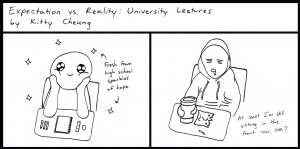
Comic: Expectation vs Reality

0
Comic curtesy of Kitty Cheung

Online petition to keep SFU Burnaby’s free shuttle running goes live

3
Chris Ho/ The Peak

By: Onosholema Ogoigbe, News Team Member

SFU student Robyn Jacques started an online petition on change.org in a bid to keep the Campus Community Shuttle operational past the project’s fall end date.

The free shuttle was launched at the start of the Summer 2019 semester by SFU Parking & Sustainability Mobility. This shuttle was slated to stop operating before Fall 2019. 

According to Jacques’s petition, the shuttle has become more than just a way for Fraser International College (FIC) students to get to and from school. In the text accompanying the petition, Jacques wrote that “it has become an important fixture on campus, especially for women living in residence.” 

Jacques also states that making the shuttle a permanent fixture is a matter of student safety. 

“The safety of students who live on campus needs to be taken more seriously, and this is an important first step.”

The Peak reached out to David Agosti, SFU’s director of parking and sustainable mobility services, for comment.

 “The shuttle was a temporary measure put in place [ . . . ] to address the loss of transit service to the southeast area of campus during road closures as a result of construction. Those road closures are expected to end August 31, and buses would return to their original routing.”

Agosti told The Peak that the Parking & Sustainability Mobility services are aware of the shuttle’s positive reception, especially from FIC students living on residence. He added that they are “examining the possibility of extending this into a longer temporary pilot to fully assess demands and needs.” He also mentioned that conversations with FIC are ongoing.

When asked about his thoughts on the petition, Agosti replied, “I was not aware of the petition in particular, but we welcome feedback from the community. Community members are welcome to send Shuttle feedback to [email protected].”

The Peak reached out to Robyn Jacques for comment and did not receive a reply in time for production.

At the time of publication, the petition had garnered 140 out of 200 signatures. 


Mackenzie Cafe seating closed from July-August

0
Andres Cahvarriaga/ The Peak

By: Gurpreet Kambo, News Team Member

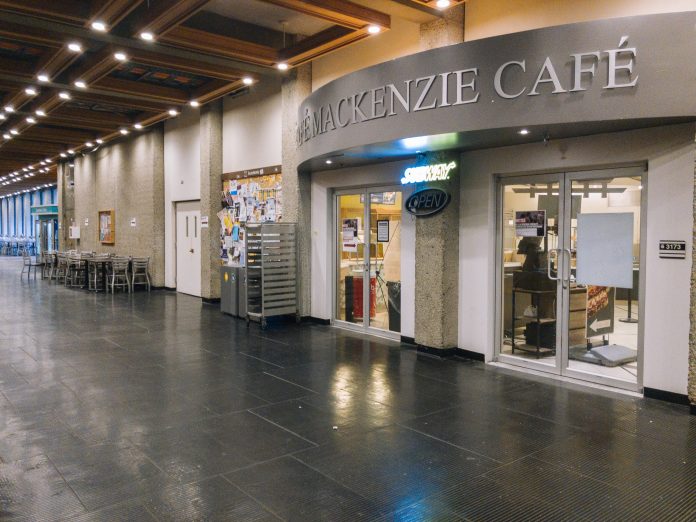
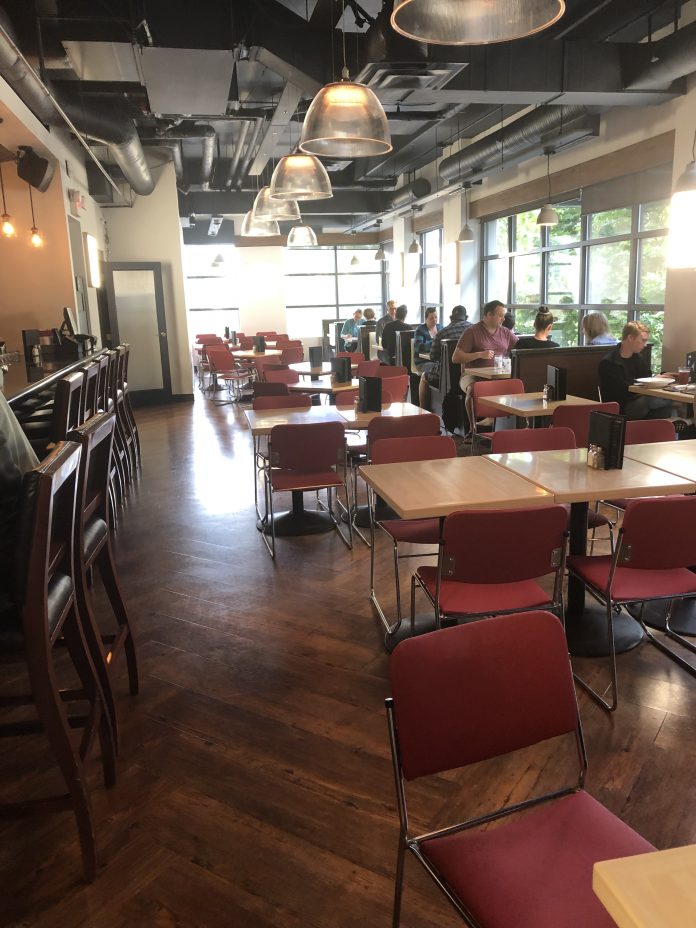
Due to plaza renewal construction, the seating area in Mackenzie Cafe closed on June 29. It will remain closed until the end of August due to the ongoing construction. All of the food service providers will stay open, continuing to be available through the construction period. 

To alleviate the lack of seating, SFU has placed additional tables and chairs in the hallway on the north end of the Academic Quadrangle, right outside of the cafeteria. 

The Peak spoke with some of the relocated Mackenzie Cafe patrons to see how the change affected students.

“We get why it’s happening, but it’s kind of an inconvenience,” said first-year student Harry Gupta. “I feel like they should’ve [at least] told us what they’re doing to begin with.”  

The area above the cafe is being renovated as a part of the ongoing construction effort. SFU is hoping to complete the immediate construction project and reopen the cafeteria seating by September. The closure of the cafeteria’s seating area is meant to expedite the construction process.

“This is the first time I’ve eaten in the cafeteria in a month, so it doesn’t bother me too much,” said Kay Badejo, a 3rd year student in Resource Environmental Management. “There’s people who come early for breakfast and study afterwards [ . . . ] I can see it affecting other people. They might not be able to do that during the renovation, if they prefer not to study in the corridor where there’s people roaming about. It might distract them.”

According to an update on the SFU website, the Plaza Renewal project is currently “the largest renewal project underway on the SFU Burnaby Campus and replaces waterproof membranes, plaza paving, seating and landscaping,” according to SFU News.  

SFU will remain Canada’s “engaged in construction university” at least until the Fall of 2020, with construction occurring in various stages across campus, including the AQ, Freedom Square, Convocation Mall, the Transportation Centre, and the West Mall Complex.


SFU Surrey Fire Fighters Computer Lab doors are a design nightmare

0
Photo by: Alexa Tarrayo / The Peak

By: Grace Lo, SFU Student

Imagine this: you’re walking through the Mezzanine at SFU Surrey, headed for the computer labs. You’ve got an assignment due soon, a couple of things to print off, and you should — THUD. 

You lose your train of thought. Your hand is clasped around the left door handle. Did the door not open? Is the computer lab closed? No, there are students inside. You try the door again, pushing and pulling. Alright, maybe it’s the door on the right that opens, so you try pushing that handle. Nope, you’re still stuck. 

You take a moment to ponder what sins you may have committed in a past life to land you in this purgatory of non-functional doors. Finally, you try pulling the right door. The God of Doorways is merciful and allows you passage for your suffering.

Clearly, as evidenced by the above scenario, whoever designed the doors to the SFU Surrey’s Fire Fighters Computer Lab didn’t get the memo that the best doors are doors you don’t even notice that you’re walking through. So-called “Norman Doors,” like the ones at the Surrey computer lab, are doors that trick people into thinking they can be opened a certain way.

The doors at The Fire Fighters Computer Lab aren’t just confusing, though; half of the set is entirely non-functional and are almost always locked. And if that isn’t enough to sell you on how mildly infuriating these doors are, the handles are mounted on an angle — different angles for the two doors.

If you’re ever down at Surrey campus, pop by and marvel at this architectural failure. And for a bit of schadenfreude, you can watch students die a little bit inside as they try and fail to open the doors.

Student Loneliness: You are not alone in feeling lonely

0
Image courtesy of Max Nelson via Unsplash

By: Kelly Chia, Staff Writer

When SFU undergraduates Jennifer Yi, Keith Chan, Grace Kim, Renmart Buhay, and Matt Li entered Map the Systems, they had no idea that they would go on to place second in SFU’s finals. The global competition asks students to explore a social or environmental challenge by looking closely at the factors that feed into it. The team decided on a local issue, choosing to research Metro Vancouver post-secondary students, aged 18-30, struggling with loneliness. Their report describes “the problems, solutions, gaps, and opportunities to address student loneliness in Metro Vancouver.” 

I had the pleasure of sitting down with Yi and Chan to discuss their report and ask them some questions.

In their report, the team suggests that the major reasons for loneliness in post-secondary students are financial, academic, and societal pressures as well the overall geography of Vancouver.

“I noticed that [in] Vancouver, compared to other cities I’ve been in and my friends have been in, there was kind of a perception of loneliness or just [having difficulty connecting],”  Yi says, recalling her own personal experience of moving to Vancouver. Factors such as extensive transit times can deter people from going out to socialize. This is pertinent when many popular events are also centralized in central Vancouver, which may be too far a trip for many people.

Despite being aware of their feelings of loneliness and perhaps even desiring to change their situation, many students find it difficult to confront or address these feelings.  A particularly moving comment from an anonymous student on the team’s visual report reads, “I don’t think people know where to go when they’re sad or lonely. Or who to reach out to.”

This hits home for many SFU students who lament the “commuter campus” status of their university. As an involved student at SFU, Chan notes that SFU’s Burnaby campus in particular has a general culture of students wanting to go home early after class. “No one wants to stay,” he says honestly. 

Yi suggests that SFU has three major factors that contribute to students’ loneliness and difficulty engaging in the school community: a lack of awareness of opportunities to meet people, financial and academic pressures, and the ongoing construction on the campus. 

When asked about the biggest difference in campus culture at the Burnaby campus compared to the Surrey campus, Chan responds, “The biggest difference is the physical space of Surrey, they hold events [ . . . ] and everyone has to pass by those events on their way to class.”

In contrast to the open and central location of the Mezzanine, Chan explained that the Burnaby campus has two bus loops, which means that some students might never see events happening on different sides of the campus. Some business students might arrive at SFU and only stay in West Mall Centre (WMC) for their classes and not go to the Academic Quadrangle (AQ). Likewise, some students might only stay in AQ and won’t go to WMC. Especially in Burnaby, Yi says that a central space is needed where students can physically see what’s happening on campus. 

In addition, finding events online at SFU can be overwhelming for students. “Each club has its own Facebook page, its own Facebook events, but if I was out on a Friday night looking for something to do, [I] wouldn’t know where to start,” Chan states, “SFU does have an official events page, but when I looked at it, a lot of the events were not for the [average] student. They would be [niche events] an average student wouldn’t go [to, like one for the] PhD Thesis Defence for the Department of Mathematics.” 

Yi adds that universities could look into creating positions for students, dedicated to social experiences would help communicate events for the students more effectively. Both Yi and Chan agree that having a physical space that students could hang out in as well as having one events page to go to would promote a stronger student community and alleviate post-secondary student loneliness. 

Yi and Chan acknowledge that SFU club leaders and administration are trying to address loneliness as a problem affecting the student population mentally. “SFU Health and Counselling has a lot of events that happen quite frequently (like programs and workshops),” Yi remarks, “SFU wellness [also] provides tea sessions, bunny yoga, and things students do enjoy.” 

Students can also now access My SSP, an app that gives post-secondary students “access to 24/7 mental health support through web, app, phone and chat platforms.” 

Yi notes that spaces like the Women’s Centre, Out on Campus (OOC), and the Centre for Accessible Learning are important physical spaces, especially for marginalized groups at SFU. In the team’s report, Ashley Brooks from OOC calls for these spaces to be protected as he believes there is “a need to support spaces for marginalized populations, [such] as queer spaces, which are currently being priced out and forced to move towards online spaces which leads to more shallow connections.”

Overall, the team give crucial attention to loneliness in Vancouver in their report. Particularly interesting was how the geography of the Burnaby campus can specifically alienate students. Finally, the report outlines possible causes for student loneliness as well as  some changes administrators can make. These include providing mental health services and a central hub where students can find events, which would help strengthen the student community at SFU. Click here to read the written report, and here for the visual report.


Editor’s note: In the spirit of the report, here are some resources for students to get connected on campus.


  • SFSS Clubs Directory Website : Interested in getting involved in student clubs at SFU? Even if you missed clubs day you can still find out  about all the different clubs SFU has to offer on the SFSS website. You can find information on how to join, and when different events are occuring.
  • SFU Events Webpage :  All the information for SFU’s events in one convenient location! This site gives you all the details of what’s happening on SFU campuses and how you can get involved. (BONUS for broke students: Many of these events are free which is indicated on the website.)
  • Join The Peak :  YES, a fantastic way to know what’s going on at SFU is to write for the paper that reports on said happenings… and you get paid! It’s as easy as sending an email to The Peak’s promotions / social media manager ([email protected]) telling us which section you’re interested in contributing to. 
  • Facebook Groups: There are many, many, many groups out there to connect students and build communities.
  • Volunteer! : Volunteering is a great way to learn about your school’s community, develop new opportunities and skills as well as meet many new people. Check out SFU’s myInvolvement website which is described as “your one stop shop for on-campus opportunities! Through this portal, you can register for career and leadership development programs; apply for volunteer and paid positions; sign up for campus events and workshops; and access your Co-Curricular Record.”


Enrolment dates: Exposed

0
Photo curtesy of Pixabay

Written by: Trevor Roberts, Peak Associate

It’s that time of year again. After weeks of uneasy waiting, the students of SFU finally receive their enrolment dates. 

While often dismissed as inconsequential, a person’s enrolment date is often the difference between them spending ridiculous amounts of time and money on something they hate and them spending ridiculous amounts of time and money on something they strongly dislike. 

Yet, the university’s explanation of using things like GPA, units completed, and scholarships to calculate these dates has kept the truth about how these dates are allocated hidden from students for years. It is time to expose the enrolment process. 

Enrollment Lie  Enrollment Truth 
Enrollment dates are decided by an unbiased group of hard-working SFU admin, dedicated to the success of all students. Enrollment selection begins with professors meeting in an underground lair underneath Convocation Mall* where they drink grad student blood to keep young.


*Due to construction, they were forced to hold their ritual in Halpern Centre

SFU cares for each faculty equally  Students are sorted into Beedie and non-Beedie students. Beedie students are given top priority, as part of a legally binding agreement that forbids Beedie students (or their parents) from buying the rest of the university and turning it into an oil refinery
There is no favouritism for wealthy students   All non-Beedie students are divided into groups based on how much tuition they have paid over their lifetime to SFU, with those that have the ability to pay the most given the next highest priority. This is done in hopes that wealthy students will donate to SFU after they graduate early. However, this priority is reversed for students who have spent more than five years at the university, individuals that the process refers to as “lifers.”
There is no prejudice against any student  Deans rate how difficult each student’s name is to pronounce, and give the most difficult ones low priority in an effort to delay having to say their names at convocation. 
First-years always get good enrollment dates Each incoming student is individually kidnapped and placed in a classroom somewhere in Robert C. Brown Hall, and given priority based on how many days it takes for them to make it out. The students then have their memory erased so that this information can never be released to the student population.


What SFU needs: better bus shelters

0
Bus shelters that protecc when nature attacc. Illustration by: Tiffany Chan / The Peak

By: Winona Young, Head Staff Writer

Is there anything worse than walking up to the sea of students fresh from their afternoon lecture, all congregated at the upper bus loop at 5:30 p.m.? Yes! It’s SFU’s lacklustre bus shelters — especially the lower transit centre, now that it has been relocated away from the larger shelter covers and security phone. SFU-goers are herded into those tiny shelters like overcrowded cattle running on too little coffee.

WHAT WE LACK

  1. Overhead shelters that protect people from harsh sunlight, rain showers, snow, and brisk gusts of wind
  2. Ample seating for sitting passengers
  3. Leveled terrain that is neither dangerously close to a curb nor too bumpy for passengers using wheelchairs or with strollers
  4. Heating and cooling mechanisms for climate control 
  5. Weather-proof seating 
  6. Lighting system to keep the area lit past sunset
  7. Nearby security-call button for the safety of passengers
  8. Mosquito netting at the lower transportation centre 

THE VISION

Introducing the SFSS (Shelters For Sweaty Students in the summer, or Shelters For Shivering Students the rest of the year). Inside this glass box with solar roof panelling that helps power the LED overhead lights, this bus shelter will beat sitting in the AQ for relief from the elements. With multiple wooden benches and a stylish rectangular shape, the SFSS allows for multiple students to feel safe and comfortable while waiting for their ride. The shelter includes a built-in fan for the summer and a radiator for the winter. Doors open automatically so commuters need not worry about gripping germ-ridden handles that are too hot or cold. And passengers commuting after a late night class can feel the slightest bit safer in this well-lit area with security just a phone call away thanks to the built in landline.

WHY SFU NEEDS IT

Commutes are an integral part of the majority of SFU students’ lives. That’s thousands of students traveling on and off the mountain, enduring every little weather change directly while waiting for transport. And let’s face it, TransLink bus schedules will never be perfect. But with SFSS bus shelters, there will be fewer students out in the sweltering heat or heavy snowfall waiting for a bus that may never come. There’s already enough to gripe about with SFU being on a mountain, but with these shelters, at least we can make the cattle of students a little less cranky on their commutes.