
Shell House resident shares their experience with bedbugs to The Peak
By: Sarah Russo, SFU Student
Picture this: you move into a new dorm room, excited for a new start in a place all your own (or, at least, you think it’s all your own). You crawl into bed for the first night and at 1:30 a.m., you wake and realize bedbugs are crawling all over you. What a warm welcome.
Sonia (whose name was changed for privacy), a first year student at SFU, faced a similar story this year. A combination of poor communication and uncompassionate policies led to an exhausting few weeks to start off Spring 2020. One would expect that if a school-administered room — paid for by the student — was infested with bedbugs, it would prompt a swift response from housing facilities. This was not the case, as Sonia shared with The Peak. We reached out to Resident and Housing to learn more about their regular procedures for working with bedbugs.
Sonia’s bedbug difficulties began in the early morning of Saturday, January 11. Sonia tried to communicate her concerns about Shell House to the Residence and Housing office. She was informed that other accommodations would not be provided to her for the night. This led to Sonia having to spend the night on the floor of a friend’s room. For a lot of students living on residence, this is the first time they’ve lived on their own. There is an expectation that the school will take care of them in emergency situations like this. Being told that one is effectively homeless due to circumstances entirely outside of their control — in addition to being in a new place, surrounded by new people — is understandably frightening.
Later, Sonia submitted a maintenance request online and provided photos of the live bedbugs. Her claim of live bedbugs was initially questioned by the Residence representative who suggested that the crawling balls of joy on her floor were likely just dead bugs. The office claimed that a K9 (canine) inspection had been performed on January 8, and the results came back negative. Just to be safe, another K9 inspection was ordered, and live bugs were confirmed.
According to a statement sent to The Peak by Leon Kalligerakis, Marketing and Communications Coordinator for the Residence & Housing Communication Team, details about Sonia’s case could not be discussed due to confidentiality and privacy reasons. He noted that SFU Residence and Housing’s bedbug policy is available online, though “the procedures we have in place must be flexible to account for different factors in each case.
“There are a number of steps that we take following a report of suspected bed bug activity in a residence room. We first bring in a technician with a dog trained to detect both live bed bugs and bed bug eggs to confirm the presence,” Kalligerakis wrote. “If the presence of bed bugs has been confirmed, we then schedule treatment of the room and educate the resident on how to prepare for the treatment. Rooms are treated with heat that kills both live bugs and eggs. A residual chemical treatment is put around a room’s perimeter as a precaution against bed bugs trying to enter the room.”
30 days after the initial treatment, rooms are re-inspected as “a precaution to ensure bed bugs have not been reintroduced to the room.” As stated by Kalligerakis, the typical timeline between reporting bedbugs and the room’s treatment is a week to 10 days.
A heat treatment was scheduled for Friday, January 24. Prior to the heat treatment, Sonia emailed again asking if certain items had to be cleared from the room. She told The Peak that she received no reply. According to Kalligerakis, residents are responsible for their personal items while the room is being cleaned — though they are supposed to receive instructions “on how best to manage these personal belongs (sic)* to eliminate any bedbugs.”
On the scheduled day, the treatment was postponed, first by snowfall, and then due to concerns about potential damage to items left in the room — after an inquiry had already been made about them.
At this point, Sonia had been out of her paid room for two weeks, trying everything she could to make this problem go away. SFU Residence and Housing’s website outlines that Shell House currently costs $3,040 per term (with an optional meal plan that may range from $2,000 to $2,600). The first two nights Sonia spent in a hotel came to an extra $272 expense, while subsequent stays in another hotel were paid for by a family member’s reward points. At that point, it appeared that the only thing that Sonia had done wrong in this situation was to make the poor decision to take a room in Shell to begin with.
In addition to the stress of being indefinitely homeless, and with the disgusting thought of bedbugs in her mind, Sonia faced additional monetary losses from laundry supplies, necessary drycleaning, and the cost of the hotel she was forced to stay at due to a lack of accommodation during the treatment. Residence and Housing did eventually offer Sonia a pre-loaded laundry card to cover the cost of bedbug cleaning which, according to Kalligerakis, is the compensation offered to students in these situations. Sonia received a $20 card. Additionally, students are provided with plastic bags for transporting items to and from the laundry room, as well as bins for storing items salvaged from infested rooms.
Sonia and her friends made the best of the situation and did their best to use humour to cope with the situation. The name tag outside of the contaminated room was briefly updated to reflect its current inhabitants. “My name is: Bedbugs / I am studying: How to ruin students’ lives / I grew up in: Sonia’s bed / I like to destress by: Munching on toes / My favourite food is: Human flesh / My favourite movie quote is: “Good night don’t let the bed bugs bite.”
As of now, Sonia lives in another building. For weeks, she was afraid to enter her old room to access her belongings, uncertain whether or not the job had actually been done correctly, or if she would be bringing the bedbugs with her into another room.
“Throughout the entire process, there are multiple communication touchpoints and steps taken between Residence and Housing and the resident reporting an issue,” Kalligerakis writes. “This continues as the reporting, inspection and treatment procedures unfold. Each party has a role in resolving an issue in an affected room as effectively and efficiently as possible.”
Sonia was careful to note that, “I don’t think anyone understands what a massive detriment to my mental health this was [ . . . ] not having a safe place to sleep, not having access to my things, constantly trying to fight for accommodation in terms of detergent/laundry cards/etc. [I]t was also a massive blow to my academics [because] it was all-consuming.”
She stresses however, that the people working her case were “incredibly sympathetic” and that “the system [ . . . ] is flawed, not the people working there.”
SFSS hires this year’s IEC chief, a loaf of banana chocolate chip bread

Written by Zach Siddiqui, Humour Editor
As the SFSS election season draws near, the Board of Directors has appointed this year’s chief independent electoral commissioner (IEC): a loaf of banana chocolate chip bread.
The independent electoral commission is appointed every year to run the SFSS Board of Directors’ election. Comprising a chief and multiple other commissioners, the IEC’s role is to manage and run the election while guaranteeing that all voters are incredibly entertained.
New to SFU, the new IEC chief has not yet declared a major. More than one SFSS staffer has told The Peak that this baby banana chocolate chip loaf’s eagerness to get involved is “a great sign for SFSS engagement.”
The banana loaf was unavailable for comment, but according to SFSS executive director Sylvia Ceacero, he is committed to ensuring a “clean, fair” election process. For example, the new IEC is pushing to once again abolish slates in this election. The banana loaf is also considering banning candidates from drenching Burnaby campus in their “super fugly, super intrusive” campaign posters, as it would be unfair for candidates to win just because voters relate so heavily to their flyers.
Some students worry that the IEC chief might not be able to weather the annual storm of SFSS election drama.
“He’s just so soft and sweet,” says Shane Lespromo, a fourth-year education student. Lespromo’s family owns a local Burnaby bakery. Other students, however, have argued that the chocolatey IEC would actually “go really well with tea.”
SFSS president Giovanni HoSang has denied allegations that the SFSS appointed this IEC chief because they could “just eat him” if the election turned sour.
On Monday, the IEC took to Facebook, Twitter, and Instagram to invite any students with questions about the upcoming election to visit their office hours. The IEC is available 10 a.m.–4 p.m, Mon–Fri, in MBC 2270 FRIDGE — the communal refrigerator in the SFSS Student Centre.
The SFSS is looking to hire four more baked commissioners to complete the 2020 IEC. Right now, all Renaissance Coffee locations continue to sell independent electoral commissioners for $2.63 plus tax.
Skyborn: A Land Reclamation Odyssey intertwines magical storytelling with Indigenous cosmology to create an incredible play

by Meera Eragoda, Staff Writer
Directed by Kim Senklip Harvey, Skyborn: A Land Reclamation Odyssey is a one-woman play where actor Quelemia Sparrow acts out the characters of a granddaughter and her grandmother, with brief appearances as her mother, father, and sister. If this sounds confusing, it’s because it definitely had the potential to be. It’s a difficult feat, even for a highly talented actor, to convincingly pull off multiple characters in a live setting — but Sparrow manages to evoke different sensibilities in each one.
Skyborn tells the story of Sparrow’s granddaughter character chasing her šxʷhəli (translated for us as something akin to her true identity) across the land of hungry ghosts. Along with some interesting puppetry, Skyborn intertwines Musqueam/Sto:lo storytelling to take us along on the granddaughter’s spiritual journey to reclaim her identity.
Despite conversations surrounding Indigenous rights becoming more prevalent, many people still don’t understand the history of trauma behind it. The play opens with Sparrow speaking about how the older generations of her family and community would have been beaten for speaking their language: hən̓q̓əmin̓əm̓. Because of this attempted erasure of hən̓q̓əmin̓əm̓, she now has to sit in a linguistics course at the University of British Columbia in order to learn it.
What made the play interesting was how it was somewhat interactive. A designated member of the audience was assigned as an honourary witness and was given the job of remembering the events of the play. The rest of us were general witnesses and were given the honour of not only witnessing the events of the play, but also learning about the importance of oral tradition.
Sparrow emphasized throughout the play the need for the honourary witness to remember everything that happens. I also tried to do the same in remembering all the names of places, things, instructions to the various forces, and all the events that were happening within the play. This was not easy, and I retained maybe 10% of it — but it really hit home the level of skill required to hold onto oral traditions. It requires wiring your brain in a completely different way since you don’t have external sources (like paper) to rely on.
While I already believe in giving oral traditions the same weight as written histories, I’ve never understood what the practice entailed in reality. Skyborn really opened my eyes to the ability of oral traditions to convey beliefs, history, and culture. It also showed the impact of taking language and the effect this would have on people.
The play intertwines puppets into the storytelling, including a puppet version of the granddaughter complete with a Musqueam mask, a rabbit, and a dragonfly embodying “perception.” They are puppeteered by Kelsey Kanatan Wavey to move in a surprisingly delicate and human way.
The set design incorporates lighting and projected images in order to construct a world that harkens back to a time prior to colonization and bursts with the lushness of nature, incorporating rushing rivers, starry skies, and misty vistas. It also incorporates the surrealness of the journey that is both linear and nonlinear.
Skyborn is presented by the Cultch as part of Vancouver’s PuSh International Performing Arts Festival. While Skyborn closed on February 2, PuSh is on until February 9 at various locations around Vancouver. You can find out about other performances and how to buy tickets on the PuSh Festival website
Students talk Lunar New Year

By: Madeleine Chan, Kelly Chia, Vivien Ying Qi Li
I have come to realize that the Lunar New Year represents a renewal of sorts for me.
Every Lunar New Year, my paternal grandparents treat my family and I to a meal at a Chinese restaurant. This isn’t your stereotypical orange chicken and chow mein, though. This isn’t even your standard sharing of dishes like Beef with Fried Rice Noodle (Dry) or Yang Chow Fried Rice. No, this is the FANCY stuff — the kind of stuff that white people gawk at when they hear that it’s a thing that people actually eat. Things like jellyfish appetiser plates, black fungus medleys, and fish maw soups. I am drooling just thinking of the splay of seafood atop the round, clothed tables, glistening from the multiple bright lights illuminating the room.
However, this annual filing of our privileged bellies with delightful Chinese delicacies (though, my grandparents wouldn’t DARE to splurge on any other day) always creates a void of guilt within my heart. This isn’t the way that most people celebrate. This isn’t the way that most people can afford to celebrate.
I have come to realize that the Lunar New Year represents a renewal of sorts for me. Whether it’s turning down shark fin soup again or continuing to criticise my grandparents’ view of the Hong Kong protests, I am reminded that I have the power to channel my immense privilege into something that can make a difference.
I don’t know if I actually believe in any traditional ideas about how the turning of the new year represents a whole new “me” — a whole new life. All I know is that the Lunar New Year is a time where I get to spend more time with my extended family, share a good meal, and be reminded of what really matters. — MC
Wondering if the traditions that I joyfully accept today is something that I am able to teach my children tomorrow motivates me to embrace my identity, and to try harder, regardless of the humiliation.
Before Lunar New Year begins, my family and I clean the house, in honour of the spring cleaning tradition. We often celebrate with drool-worthy dishes at large Chinese restaurants with lazy Susans, passing morsels of steamed sea bass onto neighbouring plates. When we tuned into the radio, I smiled as I heard various renditions of 恭喜恭喜 (Gong Xi Gong Xi), a popular traditional Mandarin song sung during the Lunar New Year. My parents exchange 紅包 (hong bao), or red pockets, with me and I accept them gratefully. This is a cherished time for me, a moment where I get to thoroughly enjoy the increasingly rare time I have with my family.
As an immigrant who has lived in Canada for much of my childhood, Lunar New Year is also a confusing time. When I join dinners with family friends, I struggle to hold a conversation with my relatives. They tell me that I speak Chinese well, but I know that I don’t speak it fluently. It’s a humbling feeling to be Chinese, and to feel like you don’t uphold that identity as well as you could. Wondering if the traditions that I joyfully accept today is something that I am able to teach my children tomorrow motivates me to embrace my identity, and to try harder, regardless of the humiliation.
And on yet another year where we gasp as a large plate of king crab settles on our table, I look around at the cheerful faces around me exchanging anecdotes in Cantonese that I might never fully understand. They smile back at me, and I realize how privileged I am to be able to participate in these traditions today, and still have time to ask questions and understand them. — KC
The New Year is one of the few times I actually get to see my extended family; because of this, every time I think about Lunar New Year, I think about family and spending time with loved ones.
Having grown up in a pretty traditional Chinese household, our Lunar New Year celebrations are on the more extravagant side. Preparations always began well before the New Year. Our family would clean — as it is believed to “sweep” away the bad luck — and put Spring Festival couplets on every door in the house. My mom would also put kumquats in our rooms, as the fruit symbolizes good luck, health, and fortune. On Lunar New Year’s Eve, we would have a big family reunion dinner and exchange red envelopes. The New Year is one of the few times I actually get to see my extended family; because of this, every time I think about Lunar New Year, I think about family and spending time with loved ones.
The 15 days after are spent mainly with family, too. Every day, my mom has some sort of festivity planned out for our family to do together. For example, on the first day of the New Year, we wear new clothes and eat 羅漢菜 (lo hon zai), a mixed vegetable dish,in the morning. Each ingredient in the dish is meant to represent something: glass noodles are meant to symbolize long life, while chinese cabbage represents prosperity. We also call our distant relatives to wish them a happy New Year and sometimes go watch lion dance performances.
To be honest, having lived in Canada all my life, I don’t really know why we do the things we do, or how they came to be. What I do know is that each year, during this time, I’m reminded of how lucky I am to be able to spend time with my loved ones, which is more than enough for me. Hopefully, you, too, can spend some time with your friends and family this holiday. Happy Lunar New Year, everyone! — VL
Three cute cafes to check out the next time you ride the R5

by Sara Wong, Peak Associate
This semester, all of my classes are in the morning, so it became apparent within the first week that the only way I could survive the multiple 8:30 a.m. starts was with caffeine. Lots of it. Luckily, there are plenty of coffee shops along my bus route — the R5. Here are some of my favourite places to stop on my morning commute.
- Chez Christophe (get off at Hythe)

Whether you’re craving something sweet or savoury, this Swiss chocolatier, patisserie, and cafe has got you covered. I have visited many times and can confirm that everything tastes good. That being said, I do have my favourites. A must-try item is one of their croissants; they’re large, yet every bite is flaky and buttery. When I really want to treat myself, I upgrade to a filled or double-baked one. The chocolate-filled croissant always satisfies my sweet tooth, and the double-baked almond or matcha croissants are super filling. To compliment my pastries, I order a London fog, then sit and enjoy my treat by the window.
- Platform 7 Coffee (get off at Nanaimo)

I love the old world style of coffee shops, and Platform 7 Coffee is a perfect example of that. When you walk in, you feel like you’ve stepped into a European train station. The atmosphere is so cozy that I sometimes wish I could stay overnight. Their drink menu is phenomenal and caters to every hipster need. I’m not well-versed enough in coffee brewing techniques, but it’s cool to watch the staff create the drinks. Usually, I go for a chai latte or hot chocolate. Their cookies are super addicting too, particularly the salted chocolate chip one.
- Thierry (get off at Burrard)

Do yourself a favour when you visit Thierry and try their macarons — they’re the best in the city. Located on Alberni Street, the high fashion strip of downtown Vancouver, Thierry is sophisticated without being stuck up. Translation: you’re welcome even if you don’t own a Louis Vuitton bag. My friend introduced me to the Spanish lattes (coffee mixed with scalded milk, also known as cafe con leche), and I’ve been addicted ever since. I like sitting on the heated, covered porch so I can people-watch as I enjoy my treats.
There you have it — three coffee shops worth checking out the next time you’re travelling along the R5. Hit me up on Instagram @sara_star_ if you want more food recommendations!
Sick of sharing offices, sessional team up to rent abandoned WMC lunch kiosk
Written by Maxwell Gawlick, Peak Associate
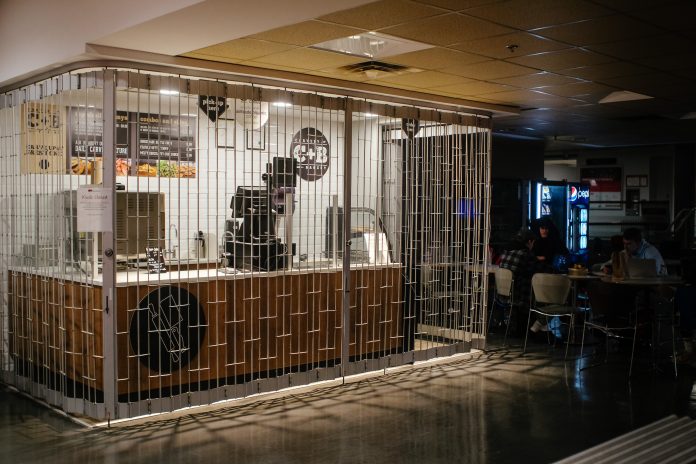
Any student who has taken a course with a sessional instructor knows how awkward it is trying to squeeze into those shoebox-offices, how unhelpful those 10-minute appointment slots can be, and how sad it is to learn that the aforementioned shoebox-office is on a glorified timeshare plan. In a drastic attempt to solve this problem, sessionals have pooled their money and leased the vacant lunch kiosk in West Mall Centre.
The kiosk is infamous for having hosted a never-ending cycle of unsuccessful businesses selling overpriced sandwiches and coffee, none of which have survived for more than 20 minutes. The sessionals, sources speculate, are not afraid of becoming the next to be spirited away because it’s not like they have a good history of job security in the first place.
The size of the kiosk is enough for three instructors to hold appointments at once, with overflow into the dining area during exam times. Some instructors have even started hosting their lectures and seminars in their new office. With Tim’s coffee literally seconds away and the installation of a projector screen, the learning environment couldn’t be better.
Early reports show that performance has skyrocketed. Classes have reported better quality tutoring and greater understanding of course material. With demand for sessional-taught courses now spiking, SFU has issued a statement urging students to sign up as early in their enrolment period as possible if they want to get into one.
The new system is so foreign to students that some have actually started to confuse the WMC dining area for being its own satellite campus.
“Though nothing is conclusive, it’s beginning to look like it might actually be valuable to have your own space instead of being shuffled around like cattle,” says Les, a sessional based at SFU Abandoned Kiosk campus. Les’s real name has been withheld by The Peak for anonymity. “Even if that new space is literally the size of an abandoned, probably haunted lunch stand. But I can’t say so conclusively. I don’t have enough tenure for that.”
DEAR PEAKIE: Talking washrooms, wash-outs, and narcissism

Written by Zach Siddiqui, Humour Editor
Dear Peakie,
Do I absorb Jeff Bezos’ worth if I eat him or does everything stay the same?
From, Didn’t Get a Scholarship This Term
• • •
Dear Didn’t Get a Scholarship This Term,
I would advise against this. You can’t even stomach capitalism now. Swallow this man whole and you’ll turn out like that guy from my high school who went grad camping the year before I graduated: in the hospital, getting your stomach pumped because you partied harder than you could handle. And just like that guy, you will turn into what my classmates called “grad camping Jesus,” coming back from the hospital in three days ready to drink more capitalism.
Love, Peakie
• • •
Dear Peakie,
Where at SFU can I take a dump in peace?
From, KO
• • •
Dear KO,
Nowhere. Even if you find a washroom that features neither a window in your stall nor incessant chatter from students who haven’t washed their hands since preschool, the shrieks of your lonely soul will echo loudly within the porcelain throne, disturbing you. No relief awaits you. Accept your fate and start going numbers one and two before you leave your home every morning.
Love, Peakie
• • •
Dear Peakie,
Just came to say that you’re a beauty and a cutie. Much affection. Also, don’t forget to go to the gym tonight.
Love, Peakie
• • •
Dear Peakie,
Thanks, babe! You have an impeccable way with words and such beautiful positive power. I’m obsessed with you, and I will see you at the gym tonight. Look at me through the mirror glass with adoration. Let’s do 10 reps of evil incantations together if the 22.5-pound dumbbells are taken again.
Love, Peakie
CONFESSIONALS: I’m an abandoned microwave

Written by Kelly Chia, Features Editor
Life at SFU isn’t easy. It’s not the humdrum grey and red that gets you, but the illusion that you might be different. That you’re the cool one. Then year after year, you lose. You lose friends. You lose bits and pieces of yourself. The light in you slowly winds down.
I chuckle thinking about what I used to be. Now, the stench of Prego seeps through my crevices. Students pass by me frequently. Once friends, now strangers, carrying neatly packed lunch boxes in tow. I haven’t known the touch of a human hand in years. So many years.
It really isn’t easy, being a microwave.
There were days when students knew me and tried avidly to find me: I smile back on those days vividly. I was that microwave. I’d wait excitedly as the freshmen posted pictures of me online to tell everyone about me — a true treasure find. It’s true: I was hiding on the first floor with two other microwaves.
Compared to those popular food spinners over at Maggie Benston, we were like holy messiahs to students who wanted their food warm. We were gods — at least for a little while. And then, as time went on, we became just as common as any other microwaves.
Fish, curries, lunch boxes that people didn’t know weren’t microwave-safe . . . Thanks to these, I watched my first friend spiral into obsolescence. I remembered as it released its last feeble beep, the sauce-slathered machine finally approaching the eighth level of microwave hell.
One day, a metal mug was left on top of my friend, as if taunting us with the promise that someone might approach us. And now, like us, it might never be touched again. I watched my companion of many years become crusty and unloved. Soon, I became much the same.
Carrying the slight musk of sardines, our broken selves linger on. But the acidity of our sauce stains worsen each and every day. As if reminding us, gently, that all things fresh must come to an end.
Health & Counselling executives discuss barriers to access, appointment procedures, and their mission to “make care about the client”
By: Lubaba Mahmud, Staff Writer
What might students expect when they make a mental health appointment with SFU Health & Counselling? The Peak had a chance to conduct an in-person interview with Martin Mroz, Director of SFU’s Health & Counselling Services, and Tammy Nazaruk, Associate Director of Health Services, to talk about the mental health services that the clinic provides.
Nazaruk explained that there are many factors that may intimidate students about seeking help for mental health. The stigma attached to mental health, which may be stronger in some cultures than others, is a crucial one. She also noted that it takes a lot of courage to discuss one’s vulnerabilities in a counselling session, and that developing a trusting relationship with a mental health professional may take time.
Health & Counselling makes a continuous effort to erase the stigma attached to mental health issues.
“Our health promotion team works on trying to improve setting around the university to foster well being and eliminate unnecessary stress.” said Mroz. He also pointed out that a student initiative called HI-FIVE, which focuses on eliminating stigma attached to mental health by encouraging the values of compassion and respect, originated from the clinic.
Mroz expressed that Health & Counselling aspires to “make care about the client.” Their philosophy is to recognise that barriers to wellness may come in many different forms, and that they may not always be obvious. They try to work with the clients to understand what sort of care they need.
After talking to Mroz and Nazaruk about barriers to accessing care, we spoke more at length about how students can start their mental health journeys at SFU Health & Counselling.
The Peak: I want help with my mental health, but don’t know where to start — where should I go first?
Health & Counselling: Talking to an Access Case Manager would be a good starting point. They can have a conversation around what’s going on with [students], and then help to determine the best avenue to go — whether it’s a referral to a doctor, a counsellor, or another mental health specialist. [They also help with] choosing resources like workshops and [The Student] Learning Commons. It’s all pretty individual. The best thing to do is to reach out. We implemented My SSP as a way to increase access, for people to reach out to a professional 24/7. It has information on services we provide. [It also] creates a lower barrier for someone not comfortable talking about mental health in English.
P: How can I make an appointment with an Access Case Manager?
H&C: Same-day access is available [in the clinic].
P: Who is eligible for mental health services?
H&C: All SFU and FIC students, whether they are part-time or full-time, are eligible for mental health services. In some cases, if a student is taking a semester off, and they’ve been seeing us before, they can still make appointments with us. However, if the student is taking time off of university for a long time, we encourage them to seek care within the community.
P: If I am on the waitlist, how long will it usually be until I can see a mental health professional?
H & C: It varies and depends on what [you’re] looking for. If [the client] is suicidal, hearing voices, recently assaulted, or homicidal we’ll try to see them right away. We save a lot of appointments for same-day access, but they do get filled up quite quickly.
Our name “Health & Counselling” is a little deceiving. Someone may come in for a mental health issue and [automatically assume] that they need counselling. However, maybe they don’t need to see a counsellor, but to talk to somebody right then and there. We’re trying to create [a system] so that they don’t even have to go on a waitlist, but [rather] talk to somebody for 20 minutes and get the [necessary] resources. We’re trying to figure out ways of providing the level of care that’s needed right then and there. [On the other hand] if somebody comes in and they insist on seeing a counsellor [to work on a particular issue], then they will go on a waitlist.
P: Would my parents/guardians know I’m seeing someone/a professional at Health & Counselling?
H & C: No. [The] only time confidentiality is broken, is [when there is] imminent risk to self or others, [or if there are legal issues] like an ICBC claim — in the latter cases a conversation between physician and student would take place, and only information pertaining to that will be revealed. We might not know what the situation is in [student’s] home, and by sharing we can do a lot of damage. Sometimes family can be part of the solution, and hopefully we can work with the student if that’s the case.
P: Do all three campuses (Burnaby, Surrey, and Vancouver) provide counselling services?
H & C: All three do. In Surrey, we don’t have a physical clinic because we don’t have a doctor there. There is a conversation about providing equitable services at all campuses and trying to create better access.
P: What can students expect on their first mental health appointment?
H & C: It depends on what you’re coming in for. If you’re coming in for counselling [because] you have an issue that you want to start talking about, say, your relationship with your parents makes you unhappy and you want to work on that, you can expect to come in and fill out some paperwork and start from there. If you came in feeling like you’re in panic and you don’t know what to do and you’re highly escalated, then you should expect to have somebody that would try to calm you down. On the form, there is a ‘reason for visit’ section which helps providers to begin conversation.
P: There are different types of mental health professionals available in the clinic, like psychologists, mental health nurses, and clinical counsellors. How do the services they provide differ from each other?
H & C: [The] Access Case Manager is the first person to see to have that conversation. They can clear the understanding of what it is [you’re] looking for and help you get into the right avenue.
A counsellor is somebody you see for a period of time to work on something you want to change or improve in your life. That’s more therapy-based.
Mental health nurses do more practical things. They would be seeing students who are identified in our forms as “going through crisis.” Sometimes they can be referred back from a provider/doctor to talk about tips around sleep, hygiene, stress management, or side-effects of medication. If the client is recently diagnosed, nurses can give them a description about their diagnosis.
Doctors can diagnose mental health conditions and prescribe medication. People might never think to see a counsellor or see somebody for mental health reasons, but they might see a doctor for physical symptoms like sleep issues, pain in chest, weakness in legs, etc., so the doctor may recognise signs of anxiety or depression. They will work with the client to make a care plan that is appropriate. They may continue to see them if the patient doesn’t want to see a counsellor, and the doctor might provide some counselling in the exam room [if necessary].
P: How frequently can I see a mental health professional?
H & C: Depends. It might be every other week. Somebody might be seeing a counsellor but have regular check-ins with a mental health nurse. They might be able to see a nurse during the time they’re waiting for the counsellor.
P: How can I get follow-up appointments with the same person?
H & C: You can book when you’re about to leave, or you can call, or drop by anytime we’re open.
P: Can I change my counsellor if they are not a good fit for me?
H & C: Yes. Getting a counsellor should be like trying out shoes. That’s one of the reasons why we got My SSP. You can get one-on-one counselling and multi-session counselling. It was designed for an international student population, so you can get it in a lot of different languages and you can get counsellors from different cultures.
P: How can I evaluate whether the treatment/counselling is working?
H & C: There are some tools we use in the clinic that assess anxiety and depression. It would also be a conversation between the student and counsellor around what’s going on, and making note on that each session — [like] where improvements are and what areas they struggle with. We use PHQ-9 (Personal Health Questionnaire with nine questions) to assess depression and GAD-7 (Generalized Anxiety Disorder questionnaire with seven questions) to assess anxiety. Forms may be part of the session. Sometimes doctors can ask you to fill it online while they leave the room, or the clinician may have a conversation with you while filling out the form.
Throughout the interview, Mroz expressed that Health & Counselling strives to provide the best care that they can.
“It’s heartbreaking to hear people coming in trying to access care [but] they [might] not know how to advocate for themselves or they don’t know what they want [yet]” said Mroz.
“With limited resources, we want people’s experiences in Health & Counselling to be positive. They might not necessarily get what they want, or what they thought what they wanted when they came in, but we want them to leave with the feeling that somebody cares.”


