Home Blog Page 447

7 Minute Majors: How to decide what to study

0
Photo courtesy of SFU

By: Meera Eragoda, Staff Writer

SFU’s Academic Advising Department held an event entitled 7 Minute Majors, on March 5 at 10:30 a.m. According to the event page, this event is for anyone who is unsure of what to major in, interested in exploring other program options, or would like to hear from directly from students in various programs.

The event took place in Saywell Hall and attendees were provided pizza and refreshments. A representative from each major was placed at a table and one to two attendees made their way to a table every seven minutes.

The majors represented were communication, health science, human geography, linguistics, political science, philosophy, resource and environmental management, economics, criminology, and actuarial science.

At each table, the representatives asked what the attendees’ majors were and, where possible, attempted to relate the major they were representing to the majors of the attendees. They covered what each program was like and why they were passionate about it, with the caveat that they were not allowed to talk about career opportunities that these majors led to.

Kaitlyn Brown, a first year student and undeclared major, found the event helpful. “I just wanted to get an idea of the possibilities that were out there to major in because I didn’t really know what was out there.” 

Prior to this event, she had taken a couple of linguistics courses and found herself very interested in it. As a result of this event, and getting to talk to the representative for linguistics, she believes she’s found her major. 

“It really helped me understand more about it so I found that really helpful because now I think I might major in it.”

A transfer student from Douglas College, Julia Brown, was at the event exploring minor options to complement her sociology major. When asked how she found the event, Brown responded, “Inspirational. It informs me that there’s a lot more major opportunities than what you think are there. You think of the big ones, english, psych, science, you don’t really think there’s all these facets you can get into. But this has now shown me that there are so many.” 

Brown also added, “It’s a tad overwhelming because there are so many options and you really have to take advantage of these resources, academic advisors, and career advisors because with so many opportunities you just have to narrow them down. In that sense, it might be overwhelming but it’s still really good.”

Leo Chen, the representative for actuarial science, told The Peak that he decided to volunteer because there are only about 12 people in the program this year. 

“Because of how small it is, I thought it would be nice to get the word out about our program because it may be something people might want to explore. But if [students] don’t know about it, how do they know to explore?”

Human Geography representative, Leo Dittmer said that he wanted to participate in this event because he changed his major since starting at SFU. 

“I think I understand what people might be thinking if they’re not sure what they want to go into. And then also because I think if I hadn’t taken a human geography course, I wouldn’t have any idea what it was like,” he said. “It’s one of those ones that unless somebody explains it to you, you have no idea what that is.”


Intro to Coding Workshop held by Women’s Centre and Women in Computing Science

0
Photo courtesy of SFU

By: Kim Regala, Staff Writer

In celebration of International Women’s Day (IWD), the SFSS Women’s Centre and Women in Computing Science (WiCS) SFSS club held an event called the IWD Intro to Coding Workshop on March 3.

Women and non-binary individuals were invited to a two-hour session of learning Python (a common programming language), networking, and a Q&A panel from WiCS members. Facilitating the workshop was WiCS Technical Coordinator Dawn Chandler, and Graduate students Carmen Riddel, Raquel Aoki, and Jennifer Dai.

The purpose of the workshop was to learn how to code a password generator, a tool that would generate complex passwords to be used in online accounts. Chandler first demonstrated how the application worked, giving an idea of what attendees would be working towards. In order to accommodate every person’s learning speed, each attendee had access to the instructions on the PowerPoint slides on their individual computers. This gave the option of following along with the whole group or moving at one’s own pace.

As this was an event to introduce beginners to the basic concepts of coding in Python, Chandler primarily stuck with simple items of instruction which did not require prior experience. The other WiCS mentors were also readily available for help, checking in on the attendees to answer questions and guide them through the process.

The event concluded with a Q&A panel, where WiCS members openly answered questions raised by attendees. This opened up an insightful discussion regarding personal experiences of learning how to code, as well as online resources for further continuing to learn coding.

After the event, attendees enjoyed networked and mingled with one another while enjoying a delicious selection of food provided by the Women’s Centre.

For any of those who were unable to attend but are interested in this workshop’s topic, a demo and the PowerPoint from the event are available to the public via the event’s page.

Peak Sports Mailbag: Golf

1
Learn how to improve quickly and save money on golf in this week’s Mailbag. — Photo: Amazon

By: Juztin Bello, Copy Editor

Hello readers of The Peak sports section,

Welcome to the Peak Sports Mailbag. My name is Juztin Bello and I’m this week’s host of the golf-themed Mailbag. I’ve been playing golf since I was five years old and come from a very golf-centric family — truth be told, we sometimes decide who pays for dinner based on whoever loses the round of golf.  

Thanks so much to all of our readers that submitted their golf-related questions, and my apologies if your question didn’t make it into this week’s edition. Usually, the Mailbag host will only answer three questions. Don’t worry though, you can find more of your questions answered online. Also, each question submitted counts for an entry into the raffle draw whether or not they are addressed in the Mailbag. Now, onto the questions!

Question 1: What are some of the best places to golf in the Lower Mainland? – Jay 

In the interest of length, I’ll only give you my top three courses. My first recommendation is Burnaby Mountain Golf Course. According to their website, they are rated on Golf Digest as one of the best courses to play in North America. As someone who has been several times, I can vouch for this. The fairways are well maintained, and it’s quite affordable in comparison to some other courses I’ve been to. The cheapest price (for weekdays and weekends) is $15 at sunset, with the most expensive rate being $43 for mid-day on weekends.  

Swaneset is another course I would recommend — it’s actually where I started doing lessons when I turned eight and my dad decided I should get some extra practice. Located in Pitt Meadows, Swaneset features two beautifully crafted courses: the Resort course and the Links course, which are both worth playing. I should also mention the food here is top-notch, which can be helpful in either celebrating a good game or coping with a bad one. 

Finally, if you’re willing to make the drive, Furry Creek is one of the most breathtaking courses you could ever have the pleasure of playing on. Described on their scorecard as “BC’s most scenic golf course,” Furry Creek features the best that a golf course the Sea to Sky Highway has to offer. While a little on the pricey side, the inclusion of a shared golf cart, three golf balls, bottled water, a cooler, a USB connection, and a club cleaner makes up for the higher price. 

Question 2: What recommendations do you have for the most efficient approach to improving at golf? Like, what parts of the game should I focus on first as someone relatively new to golf? – Rob

While some could argue that perfecting your drive and improving your distance are the most efficient, I personally think that working on your short game is huge. What I mean by short game is how you approach the green from a relatively short-range distance, usually at pitching distance (pitching being a type of swing used with a wedge). If you can hit a ball far from the tee box, that’s great, but how you get onto the green afterwards can really determine how well you finish a hole.

How you play on the green is also something you should work on — putting can truly make or break you. If you can get onto the green in two strokes, but it takes you four or five putts to get into the hole, you’ve basically wasted your approach. You’ll want to practice putting so that you can learn how to read a green; this can include knowing how a green is going to slope, how fast a green is going to be, and so on.

The best way to practice both your short game and putting would be through playing pitch and putt courses, which only have holes less than 100-yards long. A pitch and putt course I frequent is Kensington Pitch & Putt: it’s a relatively easy course for beginners and has a great variety of yardages and greens for practice.

Question 3: Golf seems like an expensive sport. How can I reduce costs associated with golfing and get better at golf without spending a ton of money? – Kyle 

For starters, some golf courses offer specials depending on the time of day. Look for twilight or sunset specials, as those tend to be the cheapest options. Another way you can reduce costs is by walking instead of renting a golf cart. What you’ll miss in speedy gameplay and ease of transportation you’ll make up for in saved dollars and added exercise. 

If you’re looking to improve and also want to save some money, you could always just hit the driving range. Eaglequest, which is a course I’ve been to numerous times since I started playing, has special bonus-ball hours at their driving range where you can get an additional 30 balls per unit. Bonus-ball hours are on their website, but I typically enjoy the 7:30 p.m.–9:30 p.m. slot since the volume of people is usually lower. A regular unit (60 balls) is $7.50.

If you would like to participate in future editions of the Peak Sports Mailbag and be entered in a raffle for an end-of-semester prize, here’s what you can send to [email protected]

  • Sports-related questions that our weekly host will answer
  • Weekly theme ideas to guide our questions

Or: sign up to host the Mailbag (and get paid)!

Thanks to all of you SFU sports fans for blowing up my inbox!

The next original Mailbag theme is: NHL playoffs

The host for the NHL playoff Mailbag is: Dylan Webb

Send in your questions to [email protected]

What Grinds Our Gears: I’m haunted by group project members ghosting in the chat

0
Screenshot: Chris Ho/The Peak

By: Juztin Bello, Copy Editor

It’s the first day of class and you’ve been forced into groups for a semester-long project — great start. You do the classic “none of us want to do this, so we’ll find solidarity in our disdain” round of small-talk with your group members, and decide that conversing over Facebook Messenger will be most productive. Being the keener that you are (purely out of an inherent desire for productivity, mothering, overachievement, and control), you decide to initiate a conversation in the group chat to get some ideas rolling and check in. And what happens to your message?

Seen. Read. Blatantly ignored. Hurled into the abyss — yeeted, if you will.

I get it, life happens. It’s unrealistic to assume that everyone will be available to respond to a message right away. But if you’re unresponsive for days at a time, how do you expect your group to know what you want to do and what your opinions are? 

And don’t get me started on group members who view a message and choose not to respond. If we’re in the midst of discussing group tasks or ideas and someone is just watching and not saying anything, what do you think you’re accomplishing? The great (but shady) thing about Facebook Messenger is it shows you who has seen a message. If you’re just lurking in the chat and choosing not to contribute, we see you.

Just in case you’re brand new, it’s called a group chat for a reason: it’s designed for a group of people to orchestrate a chat. Group chat doesn’t mean “one person asks a question, and only one person responds, despite everyone seeing it.” 


SFU’s student-run Indigenous film festival Skoden aims to further crucial conversations

0
Illustration: Samaqani Cocahq and Natalie Sappier / Skoden International Film Festival

by Kim Regala, Staff Writer

Editor’s note: Kim Regala is involved in SIFF’s organization through CA 334. 

Here to celebrate and feature the works of Canadian-based Indigenous filmmakers is the Skoden Indigenous Film Festival (SIFF). Skoden, which is Indigenous slang for “let’s go then,” is a unifying word that carries the spirit of bringing people together from nations far and wide. This year, SIFF brings forth a diverse selection of Indigenous films from all across Canada, aiming to continue the conversation of reconciliation at SFU.

The initiative for Skoden started with two former SFU film students, Carr Sappier (Wolastoqiyik) and Grace Mathisen. In a previous interview with The Peak, the two expressed their desire for a more proactive approach at reconciliation. Mathisen noticed that there was a lack of Indigenous representation within the classroom due to the lack of engagement from Indigenous perspectives. “A lot of our courses have an Indigenous component and [the School for Contemporary Arts] is supposed to be an institution creating the next generation of artists,” said Mathisen. “What does that mean when there’s such a small representation of Indigenous students in our classrooms?”

But what began as the students’ passion project for Indigenous voices has now been redeveloped in its second year, as a new collaborative SCA course. Open to all SFU students interested in organizing the event, this semester’s team is composed of twelve eager students (myself included), led by SCA instructor Sky Hopinka.

Reaching out to this semester’s student festival committee, The Peak spoke with members Connor Desharnais and Paulina Thiessen about their experiences of working on SIFF.

“My favourite part of the process so far has just been watching all of the films with my fellow students,” said Desharnais. “We get to watch so many neat films and it’s gotten me super excited about the festival.” 

Thiessen added that her favourite part about the course is being able to interact with new perspectives on film. “I am used to working alone on assignments, so this collaborative experience has really opened my eyes to using different viewpoints and frameworks in regard to works of film. My peers are often bringing up points about certain films that I didn’t notice, and I think it’s making me a more critical thinker about film.”

When asked about some of the challenges that the class has encountered in planning the festival, the two agreed that it came down to choices that had to be made for the programmes. 

“We received hundreds of submissions from all over the world,” Thiessen pointed out. “It has been so amazing to be able to see such a diversity of Indigenous voices, but it is so hard to decide which ones have a spot at the festival.” 

Desharnais also added that “not only that, but once we’ve decided on the films we want to show, we have to decide how we want to schedule the films into our final program, which is a lot harder than it sounds.”

While the selection process has definitely been a tricky one, Thiessen felt that the submissions were both inspiring and important. “They really offer an important perspective on Indigenous issues, especially with regards to current events.” 

On a more lighthearted note, Desharnais added that the festival is “also just a great occasion to go out with some friends (or even by yourself) and watch some movies.”

That being said, the student committee has worked incredibly hard over the semester to curate a wide selection of films that will hopefully bring forward the many voices of Indigenous artists across Canada. These genre-defying programmes offer you everything and more, from documentary shorts to experimental works, music videos to films set to spoken word poetry, and even a Vancouver-based feature film.

Thiessen hopes that attendees are able to recognize and admire the unique and visually alluring works of these Indigenous creatives. 

“Many of our selected films showcase important conversations that we all need to have as Canadians on Unceded lands.”

“My hope,” Desharnais said, “is that, after watching some fun, interesting, and thought-provoking film, attendees will have the enthusiasm to continue the conversation about Indigenous narratives long after the festival ends.”

Thiessen agreed, adding that “many of our selected films showcase important conversations that we all need to have as Canadians on Unceded lands.”

This year’s festival offers four film programmes and will be held at the Harbour Centre on March 27 at 7 p.m., and March 28 at 1 p.m., 3 p.m., and 7 p.m.

Animal therapy is an incomplete remedy for students’ mental health issues

0
Animals can’t solve all our mental health issues on their own. Illustration: Alex Vanderput/The Peak

By: Manisha Sharma, SFU Student

Whether you’re one of the 41% of Canadians who experience a significant amount of anxiety, or you’re trying to de-stress before finals, animal therapy at SFU is available to bring some light and happiness to your life. However, unless you have a personal service animal, animal therapy is only good for helping short, temporary episodes of minor poor mental health. And as the conversation about student mental health increases, we have to ask: is animal therapy a paltry offer for a problem that requires more dedicated resources? 

Animal therapy between a person and a trained animal is meant to be a coping tool for people struggling with health issues, including those regarding mental health. According to Healthline, there are a variety of animal-related therapies that range from casual interactions with an animal to those that are guided with specific treatment goals in mind. SFU-provided animal therapy workshops are more informal. During these sessions, students are invited to share snacks with bunnies or pet trained therapy dogs. It provides students with a safe place to reduce anxiety and stress in a social atmosphere.

While animal therapy may help with symptoms of poor mental health, it isn’t a cure-all. It’s meant to be one component in an ongoing treatment plan toward better mental health. Students need to be aware that as good as it feels to interact with animals, these services can’t replace counselling for persistent or serious mental health issues. Unfortunately, many students currently feel underserved by SFU’s Health & Counselling Services, and may ultimately mistake animal therapy sessions as “good enough” to deal with more serious problems as a stop-gap.

It’s important to be aware of the limitations of animal therapy. For example, while informal animal therapy may reduce symptoms of anxiety, stress, or depression in the moment, will a university-provided animal be available during a panic attack right before class? Animal therapy also does not help address the underlying issues that may be causing these symptoms. 

The fact of the matter is, the bunny café and dog therapy sessions do not occur frequently or consistently enough to be effective for students with more long-term mental health struggles. Though the effort is appreciated, without integrated counselling and long-term goal management, the type of animal therapy currently offered at SFU only provides temporary, short-lived relief for short-term mental health issues. 

While wait times remain an issue, to get actual help for more long-term, persistent mental health problems, students should go to SFU Health & Counselling Services as a better option. 

Many students have mental health issues that need more attention and time than can be being provided at SFU. If we’re going to integrate animal therapy into our counselling services to help address this issue, we should at least be doing it holistically and consistently. 


Sedin jersey retirement: the end of an era

0
Number 22 and 33 hanging from the rafters of Rogers Arena. — Photo: CBC

By: Harvin Bhathal, News Writer

February 12, 2020 marked a special moment for the Vancouver Canucks, the city of Vancouver, and, most importantly, Daniel and Henrik Sedin. Two years after retiring from the NHL as some of the most prolific linemates in NHL history, the Sedin twins watched their jersey’s ascend to the rafters of Rogers Arena in what was a climactic end to Vancouver’s Sedin era. Kyle Bergh and Arjun Badh, members of the SFU Hockey team, shared their thoughts on the Sedin era with The Peak. 

The Sedins represented everything a hockey player and person should be. They were tough and persistent, yet complete gentlemen off the ice. They showed the city a certain level of grace night after night,” said Bergh.

Coming off a run in 1994 when the Canucks made it to the Stanley Cup Final only to heartbreakingly lose to the New York Rangers, the Canucks proceeded to have one of the worst seasons in franchise history in 1998–99. The team and city were ready for a new direction.

After orchestrating trades to acquire the second and third overall selections in the 1999 NHL Entry Draft, Canucks General Manager Brian Burke finally had the means to draft the players he had eyed all along: Daniel and Henrik Sedin.

Although their time in Vancouver had a tumultuous start, with the twins falling victim to all sorts of physical abuse from other teams, Daniel and Henrik set the foundation for what was arguably the most glorious era of Canucks hockey in the franchise’s history. 

Bergh shared his first memory of the Sedins from a Canucks game he attended with his dad. 

“I recall the fans being hard on them, including my dad. He made comments about how they were soft, and questioned their decision-making process to pass instead of shoot.” 

However, Bergh saw something in them that many others at the time didn’t. “I just recall leaving that game in amazement about their on-ice intelligence and how they were able to manage the puck so effectively,” he said.

The connection the Sedin twins formed on the ice by playing alongside each other throughout their careers is unprecedented in NHL history. From their first foray into hockey, to playing for their country at the Olympics and World Championships, to reaching the 2011 Stanley Cup Finals, the Sedin twins rarely played apart from one another. 

Daniel and Henrik led a run of mesmerizing play on the ice that, combined with the team results that had been elusive for so long, brought the Canucks to within one win of a Stanley Cup. Though the loss to the Boston Bruins in the 2011 Stanley Cup Final surely still stings, it doesn’t overshadow the years of sustained success the twins helped bring to Vancouver.

Though the Sedins led the franchise for many years, their run would not have happened if not for teammates such as Roberto Luongo, Ryan Kesler, Jannik Hansen, and Kevin Bieksa, who were there to commemorate the career of the Sedins. Alongside them were Canuck legends Alex Burrows, Markus Naslund, Trevor Linden, and Stan Smyl.

The ceremony itself was beautiful, with an all-encompassing tribute video to their careers and work within the community as well as speeches from Bieksa and the Sedins themselves. 

“To the people of Vancouver and British Columbia, we came here in 1999 and it’s been home since day one,” said a visibly emotional Henrik during the ceremony. 

Asked about the ceremony, Arjun Badh said that,“The organization obviously cares a great deal about the Sedins and it was reflected in the quality of the [jersey] retirement ceremony.”

When asked about his favourite Sedin twin, Badh said, “When I think of ‘Sedin,’ they both come to mind, so they are equally respected to me.” 

On this note, Bergh added that, “I still probably wouldn’t be able to tell them apart.”

As the twins grew into bonafied NHL superstars, their legendary status within Canucks history did too. While they went through challenges on and off the ice, so did the city. Because of this, there is no doubt that Daniel and Henrik Sedin will always remain in the memories of Canucks fans in British Columbia and around the world. 

The Week Ahead in SFU Sports: March 9–15

0
The SFU Athletics logo. — Photo: SFU Athletics

By: Dylan Webb, Sports Editor

A trip to the NCAA Championships for the men’s wrestling team highlights a relatively light, yet important, schedule for SFU Sports this week. Clan fans can also root for the track and field team as they take part in the NCAA Indoor Nationals in Birmingham, Alabama, and the SFU Hockey team as they play in the first round of the British Columbia Intercollegiate Hockey League (BCIHL) playoffs.

Softball:

The SFU Softball team will travel to Washington State to play four games this week. First, the team will be in Ellensburg, WA on March 14 for a doubleheader against Central Washington University, beginning at 1 p.m. The team will then move to Lacey, WA for their second doubleheader of the weekend against St. Martin’s University on March 15. The first pitch is scheduled for 12 p.m.

Track and Field: 

A trip to the NCAA Indoor Nationals in Birmingham, Alabama on March 13 and 14 is on tap for the SFU Track and Field team this week. 

Men’s Golf:

The SFU Men’s Golf team is headed to Livermore, California to take on Notre Dame de Namur University at the Poppy Ridge Golf Course on March 9 and 10

Men’s Wrestling: 

It’s the most important week of the season for the SFU Men’s Wrestling team as they head to Sioux Falls, South Dakota for the NCAA Championships on March 13 and 14

Hockey: 

While the SFU Hockey team is guaranteed to take on the VIU Mariners in the opening round of the BCIHL playoffs, they will have to wait until the final game of the regular season has been played to know whether their first round series will take place in Nanaimo or Burnaby. You can refer to the league’s website for the latest updates on the BCIHL playoff situation. 

The Rotunda groups have won their space and that’s something we can all smile about

1
The long fight for SUB space is finally over. Photo: Chris Ho/The Peak

By: Meera Eragoda, Staff Writer

WOW! Did any of us think we would be students at SFU long enough to witness the SFSS Board of Directors doing something so wholly unproblematic as giving the Rotunda groups space in the new SUB? Honestly though, all snark aside, these kinds of actions are what the SFSS Board of Directors should continue to focus on moving forward. 

Though this year is young, the SFSS Board started it out embroiled in a financial fiasco. I understand that the SFSS Board can’t control all events that occur, and that not everyone on the SFSS Board feels the same way about every issue, but I hope they all find it nicer to be facing positive opinions with the SUB space decision, rather than student ire.

The Rotunda groups’ fight for space began before I started attending SFU, but in pondering this good news, I was struck by how long this fight has actually drawn out. There is a Peak article from back in 2013 that details the need to consider the Rotunda groups when constructing the SUB. 2013! Clearly, this advice was never actually taken into consideration back then, or students wouldn’t have had to fight so hard over the last few years just to get this current tentative agreement. 

By nature, universities have a constantly revolving door of students, with old ones graduating and new ones arriving. SFU has an additional factor to this revolving nature that comes from our commuter campus status. This all creates a feeling of impermanence or temporality with what goes on at our disbursed campuses. Given all of this, I am impressed by the ability of the Rotunda groups to organize and succeed in their fight, despite spanning multiple years and student bodies.

Now is the SFSS Board’s chance to lock this space down for the groups and show us that they are committed to supporting campus resources for students instead of taking them away.


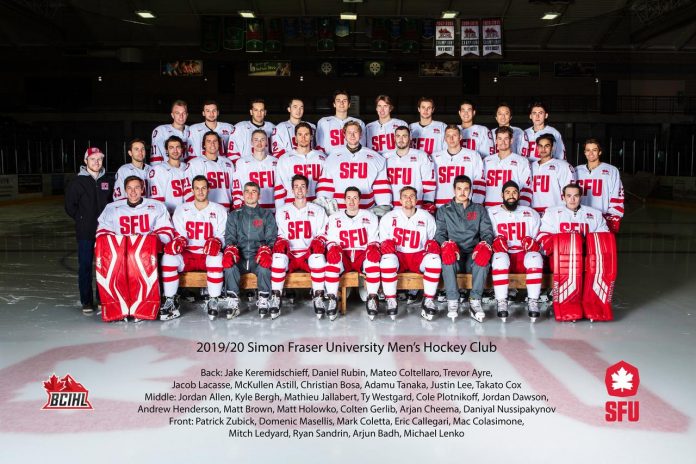
SFU Hockey set for playoff showdown with the Vancouver Island University Mariners

0
SFU has never won a BCIHL Championship in the current playoff format. — Photo: SFU Hockey

By: Michael Lenko, Peak Associate

The SFU Hockey team will take on the Vancouver Island University (VIU) Mariners in the first round of the British Columbia Intercollegiate Hockey League (BCIHL) playoffs. At the time of writing, SFU and VIU were tied for second place in the league standings with 28 points. Fittingly, the two teams will meet in the final game of the BCIHL regular season to determine home ice advantage in the first round of the playoffs. 

While SFU has two games remaining on their regular season schedule compared to one for VIU, due to the Mariners’ edge over the Clan in the season series between the two teams, the only game that matters is the final one of the season. Because of this, whichever team secures a victory in this game will host the first round playoff series.

Regardless of the location of the first round playoff series, the Clan will look to build off a strong regular season that was highlighted by standout performances by some team leaders. With just two games left in the season, forward Mac Colasimone leads the team with 26 points in 22 games. Rookie forward Ty Westgard has had an outstanding first season in the BCIHL, having accumulated 25 points in the same amount of games as Colasimone. On the blue line, defenceman Domenic Masellis leads all Clan defenders with nine points on the year. Between the pipes, which has arguably been the Clan’s strength this season, goaltenders Patrick Zubick and Andrew Henderson have combined to allow just 66 goals this season, which is second only to the league leading Trinity Western Spartans. There is no doubt that strong goaltending has played a large role in SFU’s success this year, given that the team also boasts the distinction of being one of only two teams with a positive goal differential

The impending playoff series against the VIU Mariners is likely to be a tightly contested battle between two evenly matched teams. The Mariners currently hold a 3-1-1 advantage in the season series, with the Clan’s only win coming in their first game of the season. SFU will certainly have their hands full as they attempt to deal with the Mariners’ potent first line that is headlined by Garrett Dunlop, who leads the team with 34 points and has recorded a point in every game of the season. The Clan will also have to keep an eye on the Mariners’ high-scoring defender Seth Schmidt, who has amassed 19 points from the backend this season. It’s also likely that Jeremy Balyk will be in goal for the Mariners to open the series. Balyk has turned in an impressive rookie season in the BCIHL by posting a .913 save percentage and nine wins in 16 games.

In advance of the playoffs, The Peak was able to sit down with members of the Clan to discuss the coming series against the Mariners and the general state of the team as they embark on the pursuit of their first league title since 2013. Assistant captain Eric Callegari believes that “Overall, the team chemistry has been way better [this year] and has shown in the standings, with us [likely] sitting in second place heading into playoffs.”

When asked what changes have led to the success the team has seen this season compared to last year, Callegari stressed the importance of the team chemistry exhibited by this year’s group. Callegari noted similarities between the 2019–20 edition of the Clan and the Aldergrove Kodiaks he captained to a Pacific Junior Hockey League title in 2017. He emphasized that the closeness of the group and the almost family-like atmosphere in the locker room were important aspects of the championship group in Aldergrove that he feels are present in the Clan this year. 

Parallel to this, associate head coach Ryan Sandrin is confident that one of the major improvements this year’s squad has made in comparison to previous editions of the team is the top quality talent up and down the roster. Sandrin trusts that this version of the Clan is one of the most talented groups in the history of the program. Additionally, Sandrin also feels that the player’s ability to successfully adapt to different roles the coaching staff have asked them to play this season has been central to their success.

When asked what he thinks SFU will need to focus on to beat the Mariners, Sandrin stressed discipline, speed, and systems, arguing that “while we are one of the least penalized teams, we need to clean up the dumb 200-foot penalties.” Sandrin trusts that, if the Clan are able to use their speed and get their feet moving, the team will have success against the bigger and slower Mariners.

A final point that Sandrin stressed was the need to stick to the systems the team has established throughout the season. He thinks that breakdowns that have come at inopportune times this season have stemmed from players neglecting the systems that have brought the team success. While Sandrin admits the team is young and will make mistakes, he believes their dynamic skills can compensate for this and that the team will find success in the BCIHL playoffs.

On this note, the Clan’s leading rookie scorer Ty Westgard feels that “playing our own game and not getting pulled into theirs” will be a key to the Clan’s success in the first round. Like Sandrin, Westgard argued that staying disciplined and using team speed will be crucial if the team is to overcome the Mariners to advance to the BCIHL finals. 

When asked what he can do to help contribute to a successful playoff run, Westgard noted his role on special teams as one of his individual points of focus for the upcoming series. Westgard feels that if the Clan are able to achieve a 20% success rate on the powerplay, it will be tough to beat them. Like his teammate, Westgard also cited a family-like atmosphere as a vital component of postseason success when The Peak asked what characteristics he sees in successful teams he’s played on. He affirms that the Clan has fully established this chemistry in advance of the playoffs. 

It’s not hard to make the case that this year’s edition of the SFU Hockey team is one of the most exciting groups the program has had in years. With high-end skill, team chemistry, and strong goaltending, the Clan has one of the best opportunities to hang a championship banner inside the Bill Copeland Sports Centre that they’ve had in years. While SFU will face an opponent they have struggled against this season, it’s clear that both the coaching staff and players are confident that they can use speed, discipline, and a commitment to team systems to claim their first BCIHL Championship since 2011.