Home Blog Page 44

Lotería: SFU edition

0
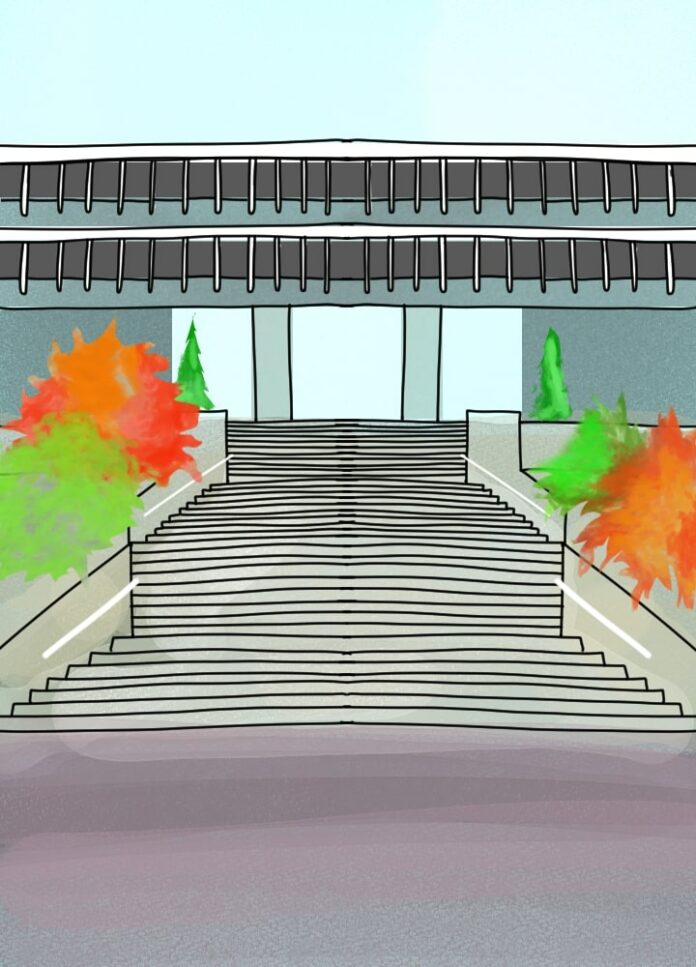
An illustration of the stairs leading up to the AQ at SFU Burnaby.
ILLUSTRATION: Cliff Ebora / The Pawn

By: Daniel Salcedo Rubio, Features Editor

SFU’s new pre-convocation event was honestly . . . not bad. There were the usual finger food and photo booth with the typical cardboard cutouts, as well as a couple of SFU-inspired board games, including my childhood favourite, Lotería. The game, a classic in connecting Mexican communities, is super simple. Just like in bingo, someone will call a card — they aren’t allowed to repeat it though, so you have to pay attention — and if you have it on your board, you place a coin to mark it. Once your board is full, you scream “LOTERÍA!” The first person to scream “Lotería” wins. The prize? A life-sized cutout of McFogg — signed by president Joy Johnson, no less. 

I collected my board and sat at a nearby empty table. The first thing I noticed was how varied my board was. I had the 145 bus and Burna . . .

“El Tutor!” the person reading the cards called out. 

Damn, I wasn’t expecting Joy Johnson herself to be calling the cards. I asked the person next to me about it and they whispered, “I heard she has a vacation home in Mexico where she’s known as the Lotería maestra.” I tried to ask a follow-up question but they shushed me to focus on the maestra. It was time to lock in and place my coin because I had El Tutor! Which sits right considering I was a TA most of my time here. Honestly, teaching is a lot of fun until you have to grade the midterms for a class of 500 students. Never aga . . .

“El Madrugador (the early riser)!”

OK, you’re playing for a life-sized cutout, a signed life-sized cutout of McFogg, get your head in the game, man! I didn’t have that one, but I sure was one taking all those 8:00 a.m. classes in the middle of winter, heading straight to the libr . . .

La Biblioteca!”

Honestly, creepy. Was Joy reading my mind? Probably. Anyway, I did have it on my board so I placed a loonie on it and waited for the next card to be called.

Several cards later

Well, it seemed Joy and I lost the connection we had. So far, 10 cards I didn’t have had been called, but El Aguacate (or is it an egg?), La Justicia, El Tesista, La Piscina, and eight more I did have had been. All great memories, like when I started swimming back in 2023, and literally a month later SFU closed the pool and hasn’t opened it nor given me any alternatives ever since. Or my first make-out session at 3:00 a.m. in the avo. . . actually, let’s skip that one. 14 out of 16, only two more calls missing. El Título and La Graduación. Interesting that the only two things pending from my board (and it seems like everyone else’s too) were the things still pending to conclude my relationship with SFU.

El Ladrón!”

Not it. We must be close to fini. . .

And with that, we conclude the game. Thanks for playing Lotería.”

What!? I was sure those cards hadn’t been called — no one had screamed “Lotería” yet. People all around were loudly confused.

“There must be a mistake! El Título and La Graduación haven’t appeared!”

“And they won’t for another month!” cackled Joy Johnson as she fled with the McFogg cutout.

Well, that was odd, but I should’ve expected it. Besides me not going home with my dream cutout of McFogg, the game really felt representative of my experience here, and the board’s illustrations look great! I was particularly impressed with the illustration of the Palestinian flag waving atop Convocation Mall for SFU to recog . . . wait, what’s that? There’s a small text in the corner. 

Lotería board created by The Pawn, not affiliated with Simon Fraser University. 

Ah, of course.

National Institute of Health funding cuts impact research across North America

0
This is a photo of a woman with blond hair on the left looking to the right with a large piece of scientific equipment in her hand. She is injecting something into smaller containers, and the lighting in the room is very warm.
PHOTO: National Cancer Institute / Unsplash

By: Phone Min Thant, Staff Writer and Hannah Fraser, News Editor

In February, the Trump administration undertook a number of “drastic” steps to reduce government spending on healthcare and medical research, according to PBS. On February 7, the National Institutes of Health (NIH) announced the administration’s policy that would cut research funding by “limiting the amount of indirect funding for research projects” to 15%. 

This equates to $4 billion in reduced funding. The NIH cut millions of dollars from accounts — and cuts continue — though US federal judges stepped in to block the policy. While the NIH is a US organization, Canadian research and education institutions also largely rely on its funding and grants. In 2024, Canadian institutions received and employed over $40 million from the NIH for various research projects. They also rely on funding opportunities from the Canadian Institute of Health Research for their research interests. 

In late February, Trump proceeded to block the submission of study sessions to the Federal Register. These are “meetings in which scientists peer review NIH grant funding proposals,” according to The Guardian. This also froze grants for institutions and research groups already reliant on the NIH. A news report from NPR listed the number as “more than 300,000 researchers at more than 2,500 universities, medical schools, and other institutions.” This decision also went against a federal judge’s orders that restricted the administration from “freezing or ending billions of dollars in government spending.” 

“Only a small number of our health researchers currently receive funding from the NIH or have applications under review.” — SFU Office of the Vice-President, Research and Innovation

Trump has been focused on rejecting grants funded by the NIH for studies focusing on Diversity, Equity, and Inclusion (DEI), vaccines, and 2SLGBTQIA+ issues. The NIH cited the administration’s memorandum, “Radical Transparency About Wasteful Spending,” which states, “The US government spends too much money on programs, contracts, and grants that do not promote the interests of the American people.” The message called for government agencies to be “radically transparent” about how they have “wasted” citizens’ “hard-earned wages.”

Many researchers have expressed concerns about the harm these recent actions could cause, as they prevent access to research on topics under scrutiny by the Trump administration, hindering further research and diagnoses. The Guardian reported that this “loss of whole websites and datasets sent researchers and journalists scrambling to preserve information” in a “datathon” on January 31. 

Fear also exists around the direct public health implications of these cuts. Researchers are concerned about how the loss of this research threatens a “decades-long effort to improve how the nation studies the health of women and queer people, or improve treatments for the medical conditions that affect them,” according to The 19th, a US not-for-profit “reporting on gender, politics, and policy.”

“[We] will see [AIDS] come back, and we see people dying the way we saw them in the ’90s and in 2000s.” — Winnie Byanyima, director, UNAIDS

As Winnie Byanyima, director of UNAIDS, told CNN regarding funding withdrawals for dozens of HIV studies, “[We] will see [AIDS] come back, and we see people dying the way we saw them in the ’90s and in 2000s.” The Centers for Disease Control and Prevention (CDC) also cut $11.4 billion in funding for COVID-19 research. NBS News reported that “hundreds of people still die every week from COVID-19, and Long COVID symptoms continue to cause debilitating medical problems.”

The Peak requested a statement from SFU’s Office of the Vice-President, Research and Innovation to understand how the university has been managing the NIH funding cuts. According to the office’s media team, “Only a small number of our health researchers currently receive funding from the US NIH or have applications under review.” An exact number was not provided. 

“We continue to monitor impacts to our research community in response to shifts in the US policy landscape. We are working with faculties to learn more about researchers’ specific needs, to provide support where possible,” they added.

Still, students across North America seem to be gripped by anxiety about their future academic pursuits. ABC News noted that federal judges continue to challenge and “slam” Trump in court, with USA Today reporting the federal judiciary established a task force on March 26 for “the continued security and independence of the courts.” Two faculty organizations at Columbia University also recently filed a federal lawsuit against Trump’s cancellation of “$400 million in federal grants and contracts.”

“I fucking quit,” announces Mr. Monopoly

0
ILLUSTRATION: Sofia Chassomeris / The Pawn

By: Sofia Chassomeris, Interdimensional-Space Traveller

Editor’s note: The Pawn obtained this letter via time travel through a portal gun we discovered in our games closet.

Dear valued constituents,

I write to you at the dawn of the year 3000 to make a very important announcement. I have been in the real estate game for over one thousand and 90 years, and let me tell ya, I’ve seen a lot. Flying cars, space delivery services — they even achieved (with lots of dubiously funded research) a semblance of immortality for those most worthy of preservation! However, never before had I seen such a succinct case of suffering from success before witnessing Elon Musk’s Head in a Jar purchase the last independently-owned property on planet Earth. That smirk immediately dropped once he realized he had bankrupted any and all of his potential human buyers.

And so it is with utmost disappointment that I regret to inform you of my resignation. I was brilliant, can you believe it? Mr. Monopoly: the arbiter of the free market, the monocled old hopeful who’s lived long enough to see the death of capitalism and ownership of private property.

I didn’t think it would happen in my lifetime. Do you know how long it takes to finish a full fucking game of Monopoly? I started this company with dreams of inspiring generations of laborious homeowners and landlords, but none of you can buy a goddamn house, can you? Yeah. Game over. That’s what happens once we have a winner — now every property is practically a hotel with maxed rental fees you have to pay just to breathe on.

“And so it is with utmost disappointment that I regret to inform you of my resignation. I was brilliant, can you believe it? Mr. Monopoly: the arbiter of the free market, the monocled old hopeful who’s lived long enough to see the death of capitalism and ownership of private property.”

If I were a good man, I’d tell you how it happened. But I’m a capitalist, and Monopoly’s biggest selling point has always been that mere participation in the game offers freedoms of monumental proportion. Until the winner eats the entire board, and you’re flat-out broke. Now that it’s actually happened, investors say my business model is “unrealistic” and “unsustainable.” Really? Now you have a problem with longevity? It seems nobody has the instruction manual for how to play Monopoly 2: Post-capitalist Hellscape; we’ll just have to make up the rules as we go.

My only request is that you do not blame me, Mr. Monopoly, for such a disastrous turn of events. Though this outcome can be attributed to a lack of foresight, it is technically not my fault! I am not resigning in defeat (this was an anticipated end), only disappointed that the era of free-market prosperity has finished with such an abrupt and destructive finale. The nice part about Monopoly was always that you didn’t have to deal with the catastrophic economic fallout after winning, you just pack-up and put the box back in the closet for a few years. Of course, I intend to uphold this practice of ignorant bliss despite not being able to afford literally anything on the Musk market.

If there is anything to be learned from capitalism’s grand flourishing and epic demise, it is that there will only ever be one true winner. As a longtime advocate for the free market, it is time for me to resign as a natural progression of my absorption into the greatest single corporate monopoly.

Best,

Mr. Monopoly Mann, MA in uncritical applications of economy, former-CEO of Monopoly Corp. and Affiliated Domains

Dismantlers of SFU — The Red Leafs’ Catan

0
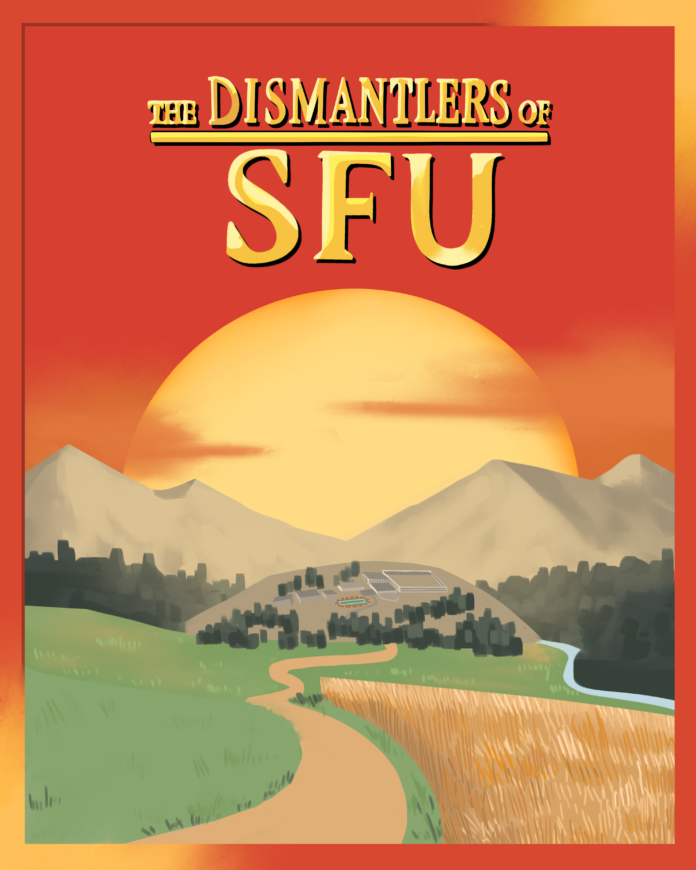
This is an illustration of the original Catan board game cover, with a sun rising behind mountains, except SFU is featured at the end of a path, and instead of “Catan,” it says “The Dismantlers of SFU.” The original terrain tiles (hexagonal shape) are replaced with vibrant illustrations of SFU equivalent settings, as mentioned in the piece.
ILLUSTRATIONS: Victoria Lo / The Pawn

By: Phone Min Thant, Staff Writer

In a stuffy boardroom on SFU’s Burnaby campus, our most esteemed president Joy Johnson listened to interns pitch new ideas about streamlining SFU’s budget. “Make governance easier and more convenient for SFU’s executives by simplifying budget initiatives onto a Catan map,” pitched a nervous intern. That evening, Dismantlers of SFU was born — an ironic opposite of Catan, as well as its exact copy.

But, how does the game work? Well, the same rules of Catan still apply: be the first to get 10 points to win, but, in this case, that constitutes taking 20 million dollars off SFU’s budget deficits. You can do this by building settlements and cities (dismantling departments and laying off employees) and constructing roads (collecting the money saved from all the budget cuts). It’s even simpler, actually — all the resources have been replaced with money while the six terrain tiles have been transformed into SFU equivalents: hills are now student support resources; forests have become faculties; mountains are community offices; pastures act as athletic services; and fields represent miscellaneous budget cuts. The desert — the unproductive, barren desert — is SFU itself (even Joy can’t take it away, yet). The knight card has been transformed into a “laid-off staff” list. 

While originally there was no intention of having “the Robber” in SFU’s Catan, the top brass insisted that there be a substitute TSSU piece in its place. The job of the Robber — sorry, the TSSU — is to take away half of everyone’s money cards if the combined number of the rolled die is seven. President Johnson added that having the TSSU piece “adds realism” to the board game.

That evening, Johnson wasted no time trying it out with her team of execs. Die started rolling. Johnson began by placing her first settlement on the intersection between community offices, athletic services, and faculty. Everyone watched with joy as she reached out for three money cards — gone were the Vancity Office of Community Engagement, the football program, and a few lecturers. The next turn was Dilson Rassier, SFU’s provost and the guy in charge of SFU’s budget and academic affairs. A roll of the dice and boom, a settlement and a road squarely close to a faculty tile and miscellaneous budget cuts. “Let’s take away the English Language and Culture program and maybe replace the paper towels with hand dryers,” the provost said before sitting back down and pulling two money cards. 

And so the rounds continued, with different executives dismantling different parts of SFU. With a few course rollbacks here, an arbitrarily fired social media team there, each player is making a good stride towards the 20 million goal, with over seven money cards each. Then, as stakes grew high, a desperate Johnson uncharacteristically fumbled. In her attempt to upgrade her settlements into penthouses, Johnson’s dice landed on a combined seven! Oops — the TSSU is demanding negotiations and striking against the hiring freeze!! After much grunting, delays, and veiled annoyance, everyone returns half of their money cards, disgruntled at not having enough funds to upgrade their parking spaces — sorry, roads — and improve their settlements. The rulebook reminded players that it’s not permissible to use money cards to hire external players in negotiations with the TSSU.

Now everyone began again in earnest. After all, they needed to recover the money. Johnson’s layoff list gets larger, adding two more money cards to her collection! The final stretch to the 20 million has begun. Other execs have started trading. Rassier began by bargaining his money card (from the closure of SFU’s Surrey Office of Community Engagement) in hopes of receiving two money cards from the current hiring freeze that other execs all seem to have. Then, by a stroke of luck, Johnson struck gold. After persuading the other players with promises of increased vehicle allowances, her final penthouse upgrade allowed her to extract one last resource from the community engagement tile. With the final money card — freshly extracted from the dismantling of SFU Woodward’s Cultural Programs — our beloved supreme president yelled “20 million” and claimed victory!

After the game, we were able to ask a few questions to some of the players. Johnson is hopeful to incorporate improvements to the game during her second term as SFU’s president, citing a lack of focus on athletic and student services tiles in this prototype version. The SFSS’ representatives hinted that the student society will also be making their own variant, seeing how easy it has been to use the board game to manage logistics. They hint that their version will include “a rave terrain,” but there is no further elaboration. Unfortunately, the interns who pitched the idea in the first place were laid off during the mid-game rush and were unable to provide statements.

Trump bans Go Fish

0
Donald Trump and a baby sitting on the steps of SFU’s reflection pond with each holding some cards.
ILLUSTRATION: Victoria Lo / The Pawn

By: Lucaiah Smith-Miodownik, News Writer

Since taking office in January, US President Donald Trump has passed a slew of executive orders. While some have generated significant buzz, skepticism, and pushback, others have managed to evade the hook of the public’s eye. One such order that Trump quietly signed revolves around none other than the classic, widely enjoyed pastime of Go Fish.

Officially, the presidential proclamation banned the ages-two-plus game from being played on American soil. Details regarding the ruling found on the White House website state the decision was made to destroy the “harmful leftist ideologies pushed by the game.” The site goes on to explain, “Go Fish teaches children lessons historically reminiscent of communism by encouraging labour without guaranteed monetary incentive.”

While sources confirm that Trump is quite the Risk player, it appears that his skills may not transfer to the pond. Recently, The Pawn corresponded with a source close to Trump under the pseudonym KC Lance, who revealed the real reason he banned the game may have to do with the president’s lackluster performances. “The truth is, he lost to Elon’s son too many times,” Lance said. X Æ A-12 Musk, who has recently been thrust into the spotlight due to his time spent at the White House, is rumoured to be ranked number one at the game for billionaire’s sons whose names contain numbers.

“He asks for twos, then eights . . . and then he’ll be right back to twos,” Lance told The Pawn. “And then when you least expect it, he goes for the aces. Like, who does that? It’s incredible, really.”

“Go Fish teaches children lessons historically reminiscent of communism by encouraging labour without guaranteed monetary incentive.” — US White House

While the news has hit hard at family game night tables and senior care facilities, some across the border seem to have a different outlook on the situation. One Canadian, SFU’s president Joy Johnson, offered her take. “As you may know, SFU is firmly committed to remaining neutral in the face of politics and events,” she told The Pawn. “That said, we could not be more excited to welcome our southern neighbours to our very own koi fish pond café. Come enjoy the game you love while getting to watch the real thing right in front of you. The cost is only $53,016, subject to tuition increase.”

Within the Trump administration, neither the president nor Musk could be reached for comment. Lance did inform The Pawn that vice president JD Vance was unable to offer remarks due to his schedule. “He’s actually a really legitimate and busy guy,” he said. “He’s definitely been doing a lot of important vice presidential tasks. I’m sure he would comment, but I swear, he’s just got a lot on his couch. I mean plate.” Lance added that the second in command “certainly hasn’t been banished to a shed behind the White House while Elon gets to have his office, or anything like that.”

The Pawn was able to secure a statement from Secretary of Health and Human Services RFK Jr., who offered his support for Trump’s executive order. “You know, we have some evidence coming out that consuming fish may cause eczema,” he said. “So it just makes sense that we’d ban the game.”

Currently, it is uncertain how exactly the Trump administration plans to enact the ban, or whether the order will stand up against the courts. In the meantime, Americans can always play War.

TRANSCRIPT: Survivor of a first-date Cards Against Humanity game testifies in court

0
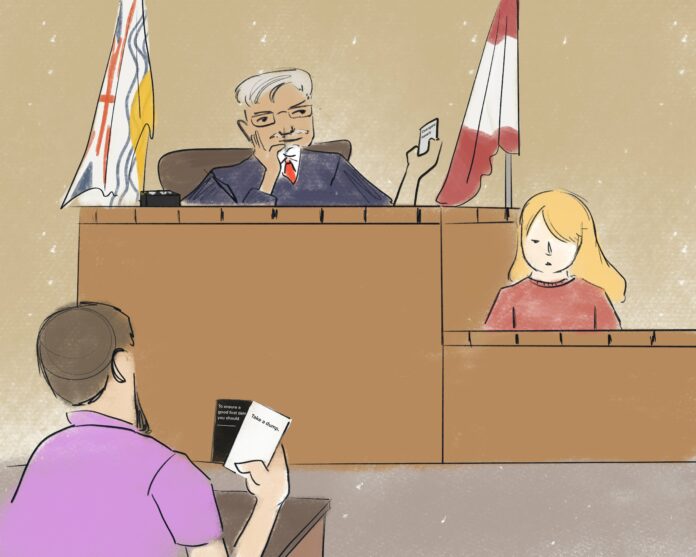
A court sketch of a woman testifying in court while the defendant and the judge are ignoring her and playing Cards Against Humanity.
ILLUSTRATION: Victoria Lo / The Pawn

By: Mason Mattu, Court Reporter

In an empty broken-down 143 Burquitlam Station bus at the upper bus loop, SFU FASS student Halley Cringer was having a typical first date with SFU Beedie student Jordan Belfort. Ms. Cringer reluctantly assisted Mr. Belfort with a colouring sheet — his BUS 201 midterm project — when Mr. Belfort asked Ms. Cringer the most exciting question known to humanity: “Do you want to play Cards Against Humanity?” Little did Ms. Cringer know what kind of sadistic turn Belfort’s game would take. The Pawn obtained a transcription of Ms. Cringer’s testimony to the BC Supreme Court during a cross-examination by Mr. Belfort’s defence lawyer, Mr. Fancépants. 


Mr. Fancépants: Ms. Cringer — my client, Mr. Belfort, describes your Tinder profile as “the most disturbing thing any down-bad dating app user has ever seen.” Your account allegedly features photos of you posing with wax figures from a Madame Tussauds wax museum, claiming they are your ex-boyfriends . . . I’m not too sure how reliable your testimony will be, especially considering you found Cristiano Ronaldo’s wax figure — with his mouth so heinously open — attractive. Please describe what happened when my client pulled out a deck of Cards Against Humanity. 

Ms. Cringer: OK (takes a puff of her e-cigarette). First of all, I’ve seen you on Tinder and swiped left. Just saying (takes another puff of her e-cigarette). Basically, Jordan pulled out the deck and smirked at me. I had no idea what was going on. He begged me to colour his colouring sheet for a midterm — a picture of the West Mall Centre of all places. He was so fucking pathetic that I gave in, I kind of felt bad for him. And I still thought he was kind of hot at that point.

Mr. Fancépants: Erm. Are you a fan of Cards Against Humanity? 

Ms. Cringer: Yes, I am, jackwad. However, when I took the deck from his hands, I rolled my eyes. The box didn’t say Cards Against Humanity, it said Cards for Humanity. 

Mr. Fancépants: Now, Ms. Cringer. I have no clue what you are trying to accuse my client of —

Ms. Cringer: Shut up you condescending, toxic, SUIT! (the gallery lets out a collective gasp as Ms. Cringer chuckles). I took the damn deck of cards from his hands and opened the box. I was even more shocked when I saw a disgruntled deck of regular playing cards inside with all the writing crossed out with Sharpie. That’s when I realized these were not any regular cards — they were homemade. What kind of cheap ass bozo is this?

Mr. Fancépants: OK, and? 

Ms. Cringer: Every single black card had the same prompt on it —  “Being a business student is better than _____.” So, uh, that was kind of awkward — Anyways, every single time I put a white card down on the musty bus chair, he’d tell me that it wasn’t funny enough. Like I even used that one card that said “Big Bird’s brown, crusty asshole.” I tried again and again with different cards, mind you all plagiarized from the original game, and he kept mocking me. Every few minutes, he’d go to the washroom in Blusson Hall to hit a maple-syrup flavoured joint and perform another devious lick challenge for his LinkedIn hustler network. After a few rounds, I couldn’t take it anymore. 

Mr. Belfort approaches the judge with a black prompt card that reads, “Being a business student is better than _____.” The judge winked at Mr. Belfort and drew another black card from the box with the exact same prompt. 

Mr. Belfort: You went to Beedie too, your honour?

Judge: You know it, broski. Gotta stay on that grind, you know? 

Ms. Cringer: What the ACTUAL FUCK is going on? I’m never dating a Beedie bro again. Y’all are toxic as fuck. Court adjourned, y’all, I win.

Bhabi Confusion-itis hits SFU Surrey campus by storm

0
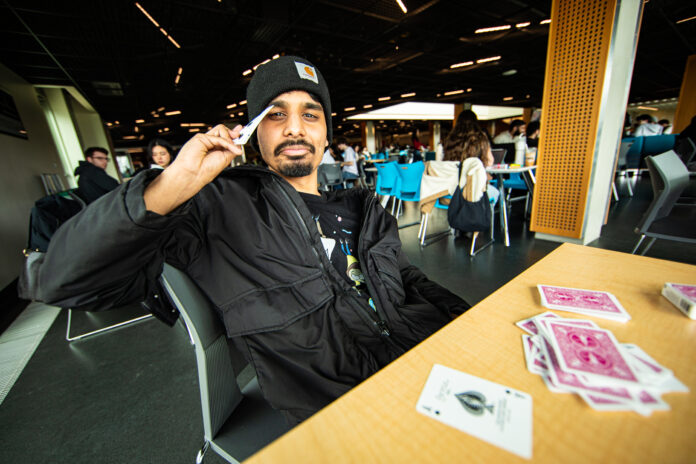
Photo of Pawn Staff Writer Yildiz Subuk sitting at a table with a deck of cards. He is wearing a black hat and a black jacket. He is holding multiple cards in one hand facing him and one card in the other facing the camera. He looks very confused.
PHOTO: Gudrun Wai-Gunnarsson / The Pawn

By: Mason Mattu, News Writer

At least 300 SFU students have been diagnosed and hospitalized with “Bhabi Confusion-itis” following a significant surge in the popularity of the Punjabi card game at the SFU Surrey campus. Bhabi Confusion-itis is a communicable virus whose primary symptom is “being so confused while playing Bhabi that you start behaving erratically and falsely claiming victory.”

The goal of Bhabi is to get rid of all your cards and exit the game. The first player puts down their lowest card of a particular suit. Everyone else who goes after this person must also put down their lowest card of that suit. Some families do this while balancing a six-pound watermelon on their heads. The person with the highest card number must pick up all the cards in that pile. The number one rule? You can’t cheat and lie about what your lowest card is during a round. Sound confusing? Yep. Even this reporter has become swept up in all the mumbo jumbo and cannot fully describe it. Look it up, Google exists. 

According to campus security, the card game was played during a Punjabi Student Association meeting, and Bhabi Confusion-itis rapidly spread across the Surrey campus in a matter of hours. To understand the root of this problem, The Pawn spoke to Nakali Khabara, an SFU student majoring in sustainable raccoon management. 

“Don’t get me wrong, I ain’t no gora or anything, but to be totally frank, I have never completely understood Bhabi,” said Khabara. “That’s why, when a fellow Singh randomly walked up to me in the hall and asked me to play a little game of Bhabi, I was tempted to say no . . . But it was almost as if something was in the air. I just couldn’t resist the idea of potentially winning. I wanted to win so badly, to prove ‘em haters wrong — he told me he would teach me how to play properly, but no. It was bad.”

According to Khabara, the man and his group of friends proceeded to laugh at him uncontrollably as he placed down a card and apparently played out of turn. “They called me a goofish fool and laughed . . . and laughed . . . and laughed.” 

Khabara became so caught up with attempting to understand the game that he soon began to play mind games with himself, believing he was winning. This was a textbook case of Bhabi Confusion-itis. “I am the GOAT of Bhabi! Come at me bro, try to take on the reigning champ!” screamed Khabara, roaming the halls of the Surrey campus. Khabara allegedly modified the rules of the game each time he challenged and infected a new student with Bhabi Confusion-itis, with one student alleging that he tried playing the game in the form of duck, duck, goose. Before being placed in quarantine by Fraser Health, Khabara attempted to play Bhabi with at least 100 random students on the Surrey campus within the span of one day. 

“We want the SFU administration to create a course, PUNJ 303, that will cover the rules of Bhabi so this disease can stop spreading!” exclaimed Simran Kaur, a student at SFU. “Traditionally, the loser of Bhabi becomes a Bhabi, or a sister-in-law, and must serve the losers with drinks and such. We want to change these incredibly sexist rules and make it so the loser must work as SFU president Joy Johnson’s media relations coordinator. That is a serious punishment.”

According to Fraser Health, Bhabi Confusion-itis is an “extremely dangerous” disease and the body recommends SFU immediately implement the PUNJ 303 course. 

Get ready with me: Ruling Candy Land edition!

0
ILLUSTRATION: Sonya Janeshewski / The Pawn

By: Kaja Antic

Editor’s note: Queen Frostine wishes for readers to know that normally, she wouldn’t bother writing for any publication less prestigious than Vogue or the The New Yorker, but she picked up her Ouija board last night. When she asked if she would be punished with 100 bad hair days if she didn’t publish in a board game magazine, the ghosts moved the planchette towards YES. 

Hello, my loyal subjects — I mean loyal followers. GRWM, Queen Frostine, to rule over all you sticky little cretins here in Candy Land, while I explain how incredibly hard each day is for me in this world of endless sweet treats.

First off, when I wake up every morning, my aides are always there to bother me with whatever is happening to the regular peasants in the villages. It’s so annoying. I give them perfect roads with perfect colour coordination, and they have the audacity to complain!

“Your Majesty, it is so difficult to travel with these regulations.” “Your Majesty, these bridges keep cutting through my land and destroying my crops.” “Your Majesty, I dread voyaging the monotonous loop around the kingdom with no true end that symbolizes our meaningless existence to entertain the court.”

I’m SICK of it! 

Do you know how hard it is to run a kingdom made of sugar and faux happiness? How hard it is to make sure every part of the gum drop chandelier looks polished? How hard it is to pick the perfect flavour of cake? None of you will ever, CAN never, know what I have to go through each and every day.

Oh, you’re “tired” of trekking the same rainbow road each day? I’m tired of hearing about it. Why does no one care about MY problems?

Sorry, I’m getting off track, something my subjects are seemingly unable to do. Anyway, here’s the Callisto face mask which is just like a regular sugar mask, though it is better quality than the “village” edition. In case you peasants didn’t know, Callisto is an icy moon of Jupiter and I’m Frostine, so it’s like a match made in face mask heaven. Also, I’m going to skip my icing facial today. I do not have the time for all of that in my routine. I put on my favourite lip gloss, but I won’t tell you the name because it’s, like, super expensive and you all probably can’t afford it anyway. 

Now, I make sure to tidy my hair, making sure none of my waves will stick the wrong way under my heavy ice crystal crown, and secure with the Saccharum sucra-spray, giving it this gorgeous texture. Then, I go to my closet to pick out which icy designer gown I’m choosing today. I think I’m gonna go with this blue-and-white number from Dulce Banana, it’s one of my absolute favourites!

Anyway, I gots to go! I’m so busy these days, sitting on the throne, balancing my crown on my head, watching all these colourful little characters run circles around my kingdom. sigh It’s hard to be a Queen! Have a frosty day everyone!

The Cranium Clay Test confirms humanity’s deepest divide

0
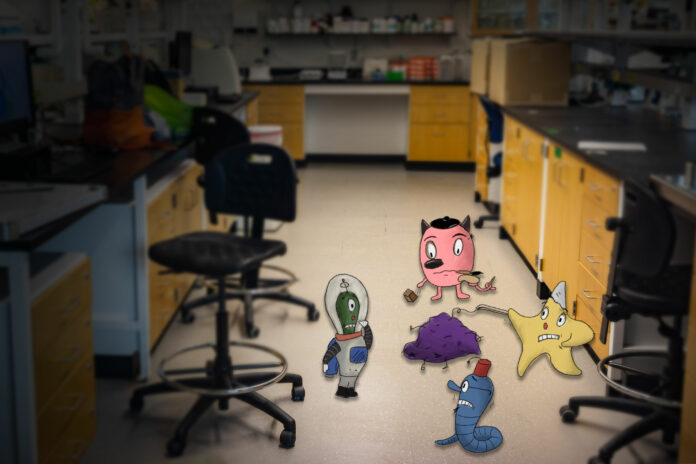
Photo of an SFU science lab with illustrations of the four Cranium characters (Word Worm, Creative Cat, Data Head, and Star Performer) on top to make it look like they’re in the lab. They are around a hairy purple lump of Cranium clay. Star Performer is using tweezers to remove the hairs from the clay.
IMAGE: Winnie Shen and Gudrun Wai-Gunnarsson / The Pawn

By: Yasmin Hassan, Board Game Psychology Reporter

A new study from the Institute of Board Game Psychology (IBGP) has identified the only personality classification that truly matters: whether or not a person is willing to touch the Cranium clay. Cranium allows players to show off their drawing and spelling skills, factual knowledge, and performing abilities. “For years, we thought the greatest human divide was nature versus nurture or introverts versus extroverts,” said Dr. Datahead, lead researcher. “But no, it turns out, all of humanity can be split into three categories: those who recognize the Cranium clay as a biohazard, those who fear its presence, and those who willingly interact with it.” The findings, published in The Journal of Recreational Neuroscience, have caused an uproar among psychologists, board game manufacturers, and people who just found out they’ve been unknowingly touching “mystery hair” for years.

In a controlled laboratory environment (which was really just a windowless basement stocked with decades-old board games), scientists recruited 500 participants and handed them a sealed tub of Cranium clay. Hidden cameras captured their reactions as they cracked open the lid and encountered the non-Newtonian substance in its natural state: either rock-hard, suspiciously damp, or possessing the elasticity of chewed gum.

The study’s findings categorized participants into three distinct reactions. The “fearful abstainers” were individuals who immediately recoiled, whispering things like, “Oh no, absolutely not” and “that looks like something you’d find in an abandoned nuclear fallout chamber.” Some wrapped their hands in napkins, others attempted to sculpt using utensils or telekinesis, and at least one person left the study altogether. The “poke-and-hopers” were participants who hesitantly prodded the clay, as if fearing it would lunge at them. Many attempted a single, weak sculpt before sighing and saying, “I don’t know, it’s a snake, I guess.” One subject requested gloves, and another asked for holy water. One subject pleaded to trade their task for charades. Lastly, the “master manipulators” exhibited no hesitation. They plunged their hands into the clay, even when it crumbled into dry dust or stretched in a way that defied physics. Some aggressively kneaded it, one individual tried to taste it (“For science,” he insisted), and a shocking number of participants described the clay as “having a nice mouthfeel.”

IBGP researchers claim the data reveals profound truths about human psychology. Avoiders are meticulous planners, tend to overpack for vacations, and Google restaurant health inspection scores. Poke-and-hopers struggle with commitment, often torn between anxiety and the desire to prove themselves. Statistically, they have the highest rate of failed sourdough starter attempts. The master manipulators have zero hesitation in life. They are the kind of people who would eat a grape at the grocery store without paying and claim it was “just a sample” or invest in cryptocurrency based on a “gut feeling.”

“Forget the Myers-Briggs,” co-researcher Dr. Wordworm declared. “The Cranium Clay Test is the only measure of human nature that matters.” However, critics argue that the study lacks scientific rigour. Dr. Simon Freud, a psychologist who has not forgiven Cranium for making him hum the Star Wars theme in front of his in-laws, remains skeptical. “If this is the future of personality testing, I fear for our society,” he said. “Frankly, the real mystery is why the clay never, ever has a normal texture.” 

Despite the controversy, IBGP researchers have already announced their next study: examining whether people who insist on being the banker in Monopoly exhibit “early dictator tendencies.”

Mattel CEO to fly to SFU to settle UNO card debate

0
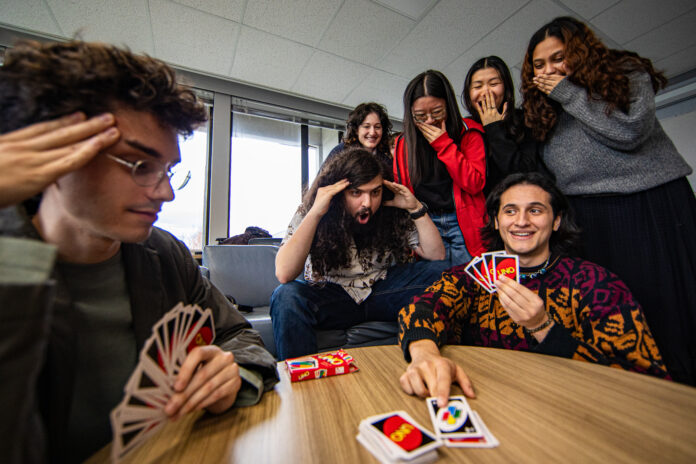
Photo depicting a professor and a student playing UNO against each other. The student is putting down a Wild Draw Four card. There are five other students behind them looking shocked. The professor holding significantly more cards than the student seems very focused.
PHOTO: Gudrun Wai-Gunnarsson / The Pawn

By: C Icart, President of the Superior Players Against Sore Losers Society

Four SFU students have found themselves in a peculiar situation — they need to win a game of UNO against their professor to pass their class. This unorthodox way of determining final grades was not without its flaws. The rules of the classic card game are known to divide friends, families, and nations. 

The world has not been the same since UNO’s Twitter account announced that, according to the official rules, stacking Draw Two Cards is not permitted. The Pawn interviewed a random person who stepped on our shoes on the SkyTrain about this affair, and they said, “Now, why did Lizzo open her mouth and ask for clarification about the rules? What we didn’t know did not hurt us.” 

Now, why are students challenging their professor to UNO in the first place? Noah Dea, one of the students involved, told us, “Bro, I won’t lie to you; we flopped hardcore on our group project. You know how there’s always one person who picks up the slack and saves everyone? We didn’t have that,” he said. “Our presentation looked and felt like we were playing that game where you have to present PowerPoint slides you’ve never seen before.”  

This resilient group persevered by challenging their professor to UNO. If they won, they’d all get an A. “They wouldn’t even be in this mess had they put half as much effort into the assignment, but I never get to have fun in my classroom anymore, so I agreed,” said professor Simon Chutney. “There are only so many ways to teach Tie the Knot: Introduction to Tie Tying.” 

The game took place in the Student Union Building and was livestreamed for maximum viewership. “I told my other students I’d give them extra credit if they smack-talked my opponents in the chat,” smirked professor Chutney. The game quickly got heated as they began stacking Draw Twos and Draw Fours. That was the one official rule they agreed to break “because it’s literally so ridiculous like be so for real.” (That was a quote from someone we happened to make eye contact with while washing our hands in one of the few washrooms that actually consistently has soap).   

An avalanche of Skips and Reverses hit the table as Dea, representing the students, charged towards victory. As he put down his second-to-last card (a blue Number Nine Card), all four students yelled “UNO” in unison. professor Chutney replied by putting down a Wild Park Reverse Neutral Drive Low card. “I had heard rumours of the mythical PRNDL card, but I didn’t think I’d ever see it in real life! It’s like seeing an alien; is it real or am I hallucinating?” whispered Bathroom Girl (we ran into her again by the sinks post-game; small bladders).  

The students immediately protested, calling into question the authenticity of the card. “Someone bring out the magnifying glass! Ref! I’m calling for a ref! I’m pretty sure this card was printed at Bennett Library. It feels like it cost 25 cents per side,” exclaimed Joshua Ginger as he rubbed and sniffed the card. This is notable because no one expected to see Ginger at the UNO card game, given that he had ghosted his groupmates for the presentation. 

They called Mattel’s CEO to come determine if the uber-rare card (that would require the students to use the already-played cards to build a lifesize car in 10 minutes or less) was a counterfeit. “He agreed, of course. CEOs don’t really do anything, so he’s got a ton of free time,” explained Professor Chutney. He is set to land directly on Burnaby Mountain with his private jet on April 1. Needless to say, his verdict is awaited with bated breath. 

This is a story The Pawn will continue to cover.