Home Blog Page 417

An amateur spin on DIY

0
Photo: Alex Masse / The Peak

By: Alex Masse, SFU Student

When I say I’m a creative, that means a lot of things. I write articles, I write a lot of prose and poetry, and I’m also a musician. So when an opportunity to be creative arises, I take it — which is exactly how this new hobby of mine formed from an art project. I was doing a mentorship with a local theatre company before everything became remote. The initial plan had been a giant puppet of some kind, but then COVID-19 happened and I lost access to the resources. I still wanted to submit something, so I made a costume out of old clothes, craft supplies, and things laying around my room. 

I tend to collect all things cute and quirky. My regular haunts were thrift stores and flea markets. I love figurines, vintage toys, and little knick-knacks. Maybe it’s my neurodivergence, but I’ve adored them for about a decade and they show no signs of going anywhere. All that’s really changed is I’m less embarrassed about them. Plus, I find them very inspiring, and as a creative, that’s really important.

Photo: Alex Masse / The Peak

I had maybe a bit too much fun. I took an old hat and gave it dangling pipe cleaner earths and covered it in shells and stones, bonding with my glue gun the whole time. After finishing that first project, I wanted to do more, and I realized there was a lot of stuff laying around my room I could use. 

To tell the truth, I’d always been anxious about DIY and crafty activities. I didn’t have any real experience, and everything others made looked so . . . polished. But I guess, in a way, I DIY’d DIY. 

My first crafts were experimental: they were made of random trinkets in my room — things that would’ve otherwise rotted in boxes forever. It was fulfilling in a strange way, gluing old knick-knacks together. Like I was giving them new life. They now rest faithfully on my bookshelves. 
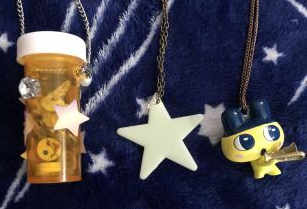
Photo: Alex Masse / The Peak

Inevitably, I moved beyond trinkets to put around my room. I made three necklaces: one out of an old Tamagotchi figurine, one out of a glow-in-the-dark star, and one out of my first antidepressants bottle. It was an interesting process; I used old scissors to make the holes for chains. 

It became a challenge: how many things could I transform? I hacked up an old t-shirt and put it up on my wall. I cut some tights that were too small into knee-high socks. I turned an old melatonin bottle into a case for earplugs, because being neurodivergent, sometimes the world is too loud. 
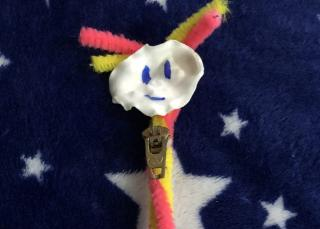
Photo: Alex Masse / The Peak

I know none of my projects look professional. They’re obviously the products of some sad teenager losing her mind to cabin fever. But that doesn’t take away from their value and charm. And honestly, I think we should embrace the aesthetic of imperfect crafts, especially now, when a lot of us don’t have access to more specialized resources. We’re breathing kitschy new life into old things! It’s nostalgic, it’s sort of recycling, and it’s a lot of fun. I haven’t spent a cent, either: everything was made with stuff around my house and never involved anything more complicated than tape, glue, or scissors. 

This quarantine, let go of the internalized standards of what looks tidy and professional. Do stuff for fun and let yourself mess up! I once tried gluing rubber bands to a tank top. It bombed horribly, but I had fun and learned something. 

Whether you’re the artsy type or not, it’s important to let that creative part of your mind cut loose and play sometimes. It’s healing and gets you thinking outside the box. I don’t think pre-COVID-19 me would’ve whittled a Tamagotchi toy into a necklace.

If you have the time, why not try it? See what you can make with stuff laying around your room. You might surprise yourself. 
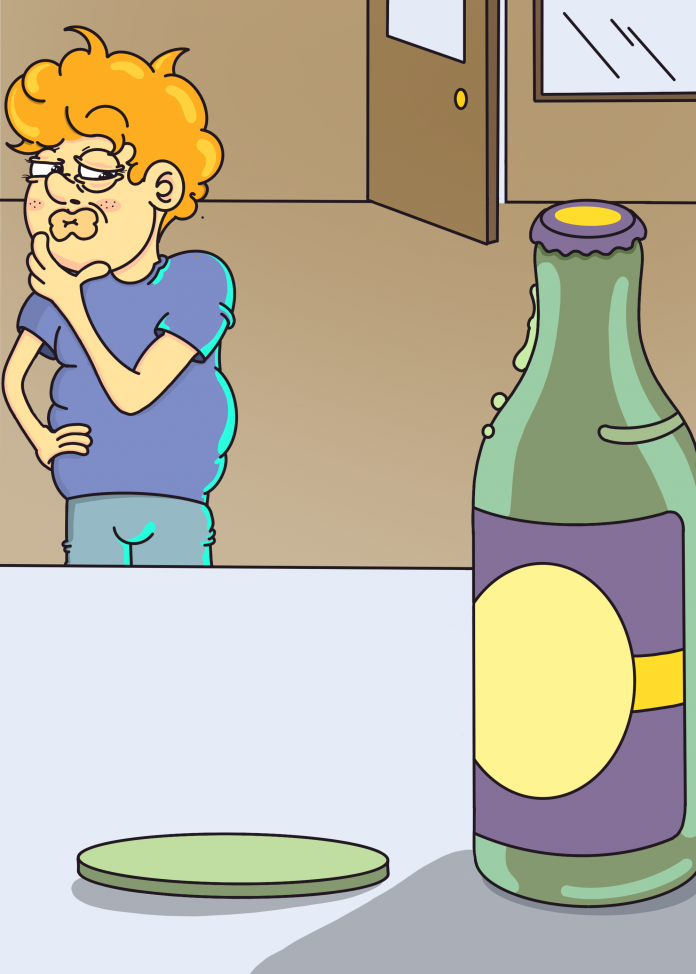
 

How I became less apprehensive about alcohol on my own time

0
Illustration: @RESLUS / The Peak

By: Madeleine Chan, Staff Writer

I had my first drink at 19. Not my first legal drink, no, my first drink ever. This may seem odd to the majority of regularly drinking university students. How could you not have tasted the sweet, numbing nectar of the brewing gods before that age? 

Let me take you back to a time of innocence and ignorance to explain why.

As a kid, alcohol wasn’t something that was around a lot. My parents only drank once in a blue moon, making the substance seem like some otherworldly, taboo thing that only non-Chans drank. Drinking also wasn’t something that was painted in the most positive light, either. The earliest instance of this was the mandatory D.A.R.E. (Drug Abuse Resistance Education) program in grade five. I remember my teacher taking slices of our day to ingrain the perils of drugs and alcohol in our minds. Lessons about permanent neurological impairments and death were filtered through the friendly face of the program’s lion mascot.

But I also remember commercials on television detailing the horrors of drunk driving, magazine ads showing the impacts of underage drinking, and television characters critically (and sometimes fatally) succumbing to the haze of alcohol. I remember finally understanding the sinister reason behind why women had to watch their drinks at bars.

Nothing associated with drinking seemed good. How could so many people in the world take pleasure in drinking when it: a. cost an unnecessary amount of money, b. seemed dangerous, and c. could potentially be fatal?

I guess that shit really hit me, because I was for sure afraid of alcohol by the time I entered high school. 

And, it just so happened that the pressure to drink was very present by then. People were sneaking drinks onto school property, talking about their favourite liqueurs and chasers, and spilling on how they stole from their parents’ stashes.

And the parties. There were always parties. Parties that I wasn’t always invited to, but ones that I knew people were just drinking the night away at — including people in my close friend circle.

Everyone has their own relationship with alcohol, some good and some bad. Peer pressure shouldn’t be what determines this relationship, especially when that thing has the potential to be so volatile.

By the time I was in grade twelve, the social pressure had definitely become more apparent, especially because of this one band trip we had to Squamish. I remember hearing my friends and almost all of the other grade twelve students in band chatting about what drinks they were going to bring and how they were going to hide them in their bags to evade the teacher’s eye. I felt it was a stupid and irrational idea, but didn’t say anything and let them do their thing, for fear of social ostricization. It was great that none of them pressured me into drinking with them either, but the feeling was still there, lurking in my lonely heart that just wanted to be included.

So when they got caught, I felt I had made the right choice. I was proud of my ability to resist, to stick to my morals, and to be on the “right” side. But when they got suspended for three days, named themselves the “sus squad,” and left me alone at school as one of two grade twelve students who didn’t rebel, I did not feel so great.

The first few years of university were even worse. The stereotypes from countless pop culture showing frat parties and people getting blackout drunk always lingered in my mind. Especially in first year, when I was in residence, seeing people with bottles of booze stashed away in their dorm rooms, and hearing floormates tell tales of getting drunk the night before exams as if it were just another regular Tuesday. My social anxiety had just started to really kick into high gear, too, and a pressure to drink became yet another thing to set my nerves ablaze. 

During this time before my first drink, I remember being so terrified of anything that could impair my ability to think, to process, to comprehend the world around me. I had relied so heavily on the idea that my mind was my self-worth, that it seemed like such a major potential impairment to my essential being. I didn’t trust myself to not do or say stupid things, to not be in control of myself and the world around me. I mean, there’s an age restriction on this stuff for a reason, right? This could be a detriment to my health, I justified.

I thought this to be true until one fateful night out with my friends from high school. We were at Cactus Club, of all places. I remember them all eagerly scanning the drink menu. I got nervous. A brew of anxious turmoil started within me as I contemplated whether I should get one or not. They reassured me that I didn’t have to get a drink, but their constant talk of different cocktails and the blatant fact that I would be left out, yet again, pushed me. I reached a point where I felt I really had to get one. I rationalized it in my head. What’s one drink with close, supportive friends? I’m legal, it’s time, I need to know what this substance tastes like, and what it does to me. 

And I got it. I finally understood why people liked it so much. It was the freeing feeling of laughing carelessly with my friends, stepping out into the cool night’s air, languishing loosely under the soft glow of the moon without thinking about your worries. Not to mention the taming of the fire in my nerves. 

I was free from my cerebral cage — my fears of being harmed, of being lesser, seemed like a faraway feeling.

But that doesn’t mean I drink all of the time now. I only really drink for concerts or parties — really any sort of social event where I can quell my anxiety. I quite like the occasional sensation of alcohol slowing my movements, my mind, my nerves. But I still don’t fully trust myself to consume more than a handful of beverages, and definitely not enough to get drunk. I don’t even know how many drinks will do that to me.

Ironically, I’m sipping on a drink as I write this. I don’t know if I need it to continue to spill my guts to the world or if I’m just trying to detox my nerves after another long week of classes, work, and responsibility. Probably a bit of both.

But this is what works for me. I recognize that there are probably many people my age with far different stories who don’t drink at all and many people who are struggling with drinking too much. All of those dangers that I previously talked about are still a concern as alcohol can be as much a prison as it is a release.

Everyone has their own relationship with alcohol, some good and some bad. Peer pressure shouldn’t be what determines this relationship, especially when that thing has the potential to be so volatile. If I’ve learned anything from this experience, it’s to stand firm in your beliefs without letting fear dictate your every move.


Trans Mountain pipeline construction continues during COVID-19 pandemic

1
Photo courtesy of Energi Media

Written by: Madeleine Chan, Staff Writer

Construction of the Trans Mountain Expansion Project (TMEP) is continuing in BC and Alberta during the COVID-19 pandemic. In BC, construction is currently underway in Kamloops and on Burnaby Mountain at the Burnaby and Westridge Marine and Terminals.

The Public Health Act implemented by the BC government, which limits gatherings of 50 or more people, does not apply to construction sites as they are considered essential services. However, provincial health officer Dr. Bonnie Henry has directed employers to take “all necessary precautions” with similar guidelines to the Public Health Act.

Ali Hounsell, Manager of Communications at Trans Mountain, told The Peak that they had to “adjust protocols quite quickly” to adhere to these guidelines. 

“Our office workers, like most people, switched to a work-from-home environment where possible.” 

Regarding construction workers, Hounsell stated that “each work site is unique” with the nature of some having workers already at distances. 

“We worked with our general contractors to ensure that we met all protocols and advice and requisitions by health authorities, and we’re able to do that using a number of measures.” 

According to their website, Trans Mountain has taken several measures that Trans Mountain in compliance with COVID-19-related guidelines. This includes, but is not limited to, enhanced cleaning and sanitation protocols, reduction in seats on transport buses, and staggering work shifts and breaks amongst other distancing and health protocols. 

There are currently no confirmed cases of COVID-19 in Trans Mountain’s workforce according to a quarterly report. Hounsell mentioned that they have one suspected case in Alberta.

“When we’ve had any suspected cases, there’s a whole self-reporting policy. Even I have to self-report on a weekly basis [ . . . ] On our worksites, people are temperature screened when they come to the site. They’re asked to self-declare — there’s a questionnaire they have to fill out. And so anyone who declared any symptoms or didn’t pass the temperature check were tested [for COVID-19].” 

When asked if workers are following the guidelines, Hounsell said that “it’s something [they] take really seriously.” 

“We’ve asked all of our contractors on the expansion project and all of our people at our facilities to ensure that things are being adhered to on a daily basis [and] on an hourly basis.”

“There are some cases with construction or the type of job you’re doing that you do need to have closer proximity. And in those cases there are special protocols that need to be taken, in terms of PPE and equipment, so where people can’t socially distance because of the type of work they are doing, which is a reality in some types of construction.”

Despite changes in protocol, Hounsell said that the project is on track to be completed in 2022.

Concerns about the continuation of construction have been raised from multiple parties, including the Mayor of Kamloops, since the beginning of COVID-19 restrictions in BC. Burnaby residents have also expressed concern by taking photos showing workers at the Burnaby Terminal not following social-distancing protocols.

Tiny House Warriors, an anti-pipeline group that builds and lives in houses along the TMEP route, said in a press release that the BC government deeming construction sites “essential services” is a “cynical attempt to take advantage of our impaired mobility to push the extractive industries onto our land.”

“By pushing them through our territories during a deadly pandemic, the resource company invasion is not only an ongoing violation of our jurisdiction, the contagious man camps they had set up on our land could be a death sentence for our people.”

The Supreme Court of Canada recently declined to hear an appeal by the Squamish, Tsleil-Waututh, and Coldwater First Nations that challenged the re-approval of the construction of the pipeline in February of this year. This is the second challenge to the Federal Court of Appeal among their eight years of opposition to the project.

Tsleil-Waututh Chief Leah George Wilson stated in a video reaction that the decision “is a setback for reconciliation” but that they have “vowed to explore all legal options to protect their rights, land, water, and climate.”

As construction of the Burnaby Terminal and Westridge Marine Terminal continue, preparations for the Tunnel Portal through Burnaby Mountain are also underway. According to the Canadian Energy Regulator, construction of the pipeline through Burnaby Mountain is expected to begin around fall or winter of this year and “take upwards of two years to complete.”

SFU has stated its opposition to the TMEP in the past and released a report in 2016 that details an “increased risk to SFU from the TMEP” from the potential environmental hazards and “blockage of the single evacuation route.” The City of Burnaby has also openly opposed the pipeline expansion since 2014, citing public safety and environmental concerns.

The Simon Fraser Student Society (SFSS) recently reaffirmed their opposition to the project “due to its environmental impacts and safety risk to the SFU Community.” SFSS President Osob Mohamed stated on their website that “the safety of SFU students and community members is our top priority.”

SFU announces new album, drops single “Petter Weather”

0
PHOTO EDIT: Maxwell Gawlick / The Peak

Written by Madeleine Chan, Staff Writer, and Paige Riding, News Writer

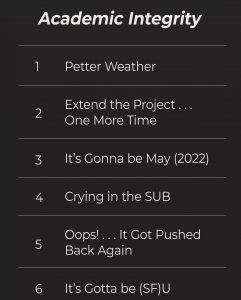
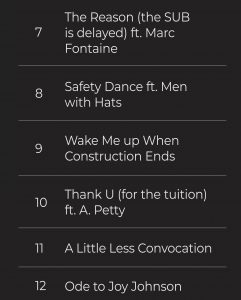
After four years of hard work on the SUB, SFU is releasing their first album Academic Integrity, out Fall 2020 via British Columbia Records. The group announced the project and played their lead single, “Petter Weather,” with an intimate concert for their fans in the unfinished building. 

Joss Illfuel, one of five attendees and CEO of Trans Canada Energy Corporation, told The Peak that that the song made him “tear up at the mere mention of it.”

“I was so overwhelmed with the quality and care that went into every detail of the song. It really drilled into my head just how great this mountain is at supporting students, and how lucky they are to attend SFU.”

Academic Integrity is being billed as the “most anticipated project at SFU” and a “masterpiece over seven years in the making” by the SFSS. Lead singer of the band Ken Struckshin told The Peak that the project grew out of their desire to “build something great” for the SFU community.

“We really wanted to give back to the students for all of the hard-earned money that they give us. It’s our way of saying thanks to past, current, and future SFU students for their monetary contributions to the school.”

When asked about the process of making the album, Struckshin said that it was “grueling.” 

“Freezing winters, staffing issues, and pandemic precautions all made it so hard to finish the album. One time we couldn’t even get into the studio because it was blocked by a bunch of students trying to get to their classes. It was a nightmare.”

Struckshin clarified that their studio is also located in the SUB.

“It has the best acoustics. We wanted to keep the inside bare and unfinished so that the tracks have that authentic SFU vibe. Empty promises, hollow words.”

Struckshin said that the group is currently planning for their upcoming Engaging the World Tour for when the pandemic “completely” ends and stated that the SUB will be completed “sometime after they get back.”

Academic Integrity is available for pre-order from the SFU Bookstore. “Petter Weather” can be streamed exclusively from the computers in the W.A.C. Bennett Library.

Alumnus “isn’t passionate” about current shampoo brand, regrets not switching it before graduating

0
Photo courtesy of Benigno Hoyuela via Unsplash

Written by Zach Siddiqui, Humour Editor

Recently, a Vancouver-based university graduate took to Facebook to describe his regrets about the life choices he pursued during his bachelor’s.

“I just graduated from SFU with honours, and after some heavy self-reflection, I know now that I have no passion for Head & Shoulders Anti Dandruff Shampoo and Conditioner,” says Linden Sightsieve, a recent alum. “I’ve thrown away nine years of my life washing my hair with liquid whitebread.”

According to Sightsieve, he kept using Head & Shoulders not because he truly enjoyed the product, but simply because it was easy for him.

“I’ve never had a hard time with hair, not like other people,” he shrugged, his blond curls dramatically falling and framing his forehead. “So I went for it. Part of me wanted to prove that I had what it takes to get through four years of Head & Shoulders, too.”

Now, however, Sightsieve feels “trapped” by his current shampoo brand.

“I’ve used so much of this bottle already, these past nine long years,” he sighed. “I might as well finish it, right?”

If he were given the chance to do things over, Sightsieve is unsure what he would have wanted to wash his hair with instead. However, he believes he would settle for anything that challenges his creativity while still cleansing his scalp of the stench of actually planning ahead for things.

Ultimately, Sightsieve offered some advice for anyone out there in his position, university students or otherwise.

“Don’t end up where I have, you guys,” he stressed. “Don’t waste your time building someone else’s vision of what a hair-care routine should look like. Don’t commit to a shampoo unless you’re truly invested in it. Just be your own inspiration, and love what you do. Also have enough generational wealth on your side to keep going to school indefinitely and, like, finding your shampoo self.”

Proctorio faces backlash after CEO breaches privacy of UBC student

6
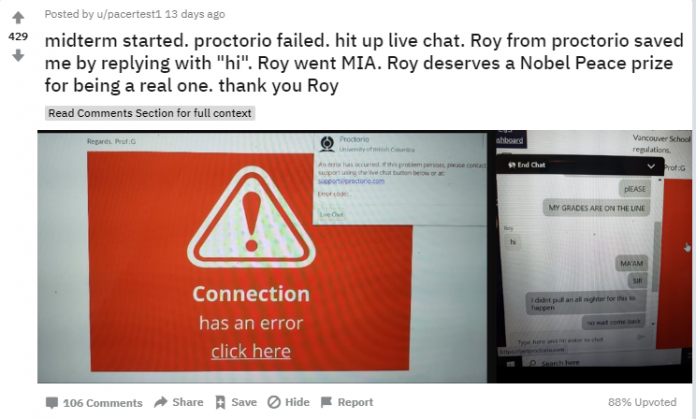
A screen capture of the Reddit post. Screenshot courtesy of Michelle Gomez via Reddit.

Written by: Paige Riding, News Writer

Online invigilation software company Proctorio sparked public privacy concerns when their CEO released chat logs between a student and a customer service representative. 

On June 26, a UBC student posted a portion of a chat log with a Proctorio support team member on Reddit, claiming that the representative “went MIA” when the Chrome extension crashed during an exam held on June 10. The photo of the chat log shows the agent responding “hi” to the student’s concerns, and nothing else. Proctorio CEO Mike Olsen later commented on the student’s post under the username u/artfulhacker with a transcript of the full conversation between the student and the agent, showing that the issue had been resolved. 

Olsen wrote, “If you’re gonna lie bro… don’t do it when the company clearly has an entire transcript of your conversation.” 

With remote learning in place at SFU, many professors are using software like Proctorio for examinations. Some SFU students have already raised privacy concerns over proctoring software. 

SEE MORE: Students raise concerns over use of proctoring software during remote exams

A Proctorio spokesperson provided the following statement to The Peak via email about the occurrence. 

“Normally, a transcript would be impossible to locate since our chat transcripts never include any personal information,” the statement began.

“However, since the student had already posted a portion of the chat transcript on Reddit, our team was able to locate the full transcript utilizing keywords found in the public screenshot the student provided. In the transcript, it was clear that the Support Agent did, in fact, respond to the student and assisted them with the technical issues they were facing.” 

The spokesperson said that Proctorio’s Social Media Team responded to the thread with a censored transcript of the conversation, only showing the agent’s responses and timestamps. It was around the time when Proctorio first responded when Olsen was tagged in the thread. 

According to the spokesperson, Olsen privately reached out to the student facing technical issues and was notified by the student that the issue was resolved directly with the professor. The response was then removed from Reddit. 

“The privacy of students is a top priority at Proctorio. Proctorio would never share any personally identifiable information, of any student, ever. Moreover, Proctorio cannot access any personally identifiable information from our servers, without student consent,” the spokesperson for Proctorio said.

The UBC student wrote in a follow-up Reddit comment that “the post was initially meant to [be] purely comedic and a display of how much I disliked using Proctorio. I am realizing now, my actions were immature and antagonistic, by proving Proctorio’s malfunction, I was also wrongfully framing Roy as incompetent, as my post was extremely misleading. Which I sincerely apologize on my behalf.”

“However, this also reveals a much deeper issue [ . . . ] Proctorio is notoriously known for being invasive, unnecessary, and as well appears to illegally violate our provincial laws on privacy,” the comment continued. 

UBC released a letter on July 3 noting that they will continue to allow professors to use Proctorio in their classes. SFU appears to continue to allow the use of the software. 

Black Hair in Focus offers a nuanced discussion on the power, politics, and beauty of Black hair

0
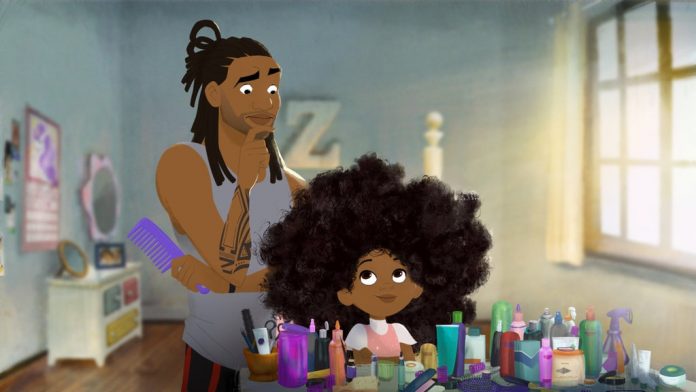
Award-winning short Hair Love was shown to kick off the discussion on Black hair. Courtesy of Sony Pictures Animation

By: Nicole Magas, Opinions Editor

On June 30, SFU Students of Caribbean & African Ancestry (SOCA) hosted Black Hair in Focus: The History and Politics of Black Hair, a live online discussion on how Black hair has been coded, stigmatized, and valued throughout history. As a silent observer in the discussion and someone who has never faced discrimination over, nor pressure to change the appearance of my hair, this discussion was incredibly informative and eye-opening. The histories and personal stories shared were both tragic and triumphant, and the inner socio-political complexities of something as benign as natural hair were laid bare in frank, honest discussion.

The conversation opened with the stated goal of using the space to embrace Black hair. In setting this tone, the workshop audience viewed the animated short film, Hair Love. The film is about a little girl’s foray into the care and styling of her Black hair on her own ahead of a visit to her mother in the hospital. The story gradually reveals just how important the success of this endeavor is to her, as she and her mother have a strong bond created through her mother’s hair-styling vlog. Though it takes effort, patience, and “a whole lot of love,” she and her father eventually pull off a successful style and go to the hospital. There, the viewer learns that the mother has lost her own hair, presumably due to cancer treatments. 

Even on the third viewing this short still makes me cry like a baby. But more than its emotional impact and gorgeous animations, the film subtly expresses some of the key issues Black hair — in particular, natural Black hair — has faced throughout history. The scenes where the hair comes to life and literally wrestles with the characters can be interpreted as a “wrestling” in double consciousness of physical characteristics and individual identity, against the external gaze and prejudices of society. Similarly, the shame, disappointment, and defeat expressed in the temporary decision to hide the messy hair under a cap represents having Black individuality and Black beauty subordinated, shamed, and devalued by white, Eurocentric standards of aesthetics and respectability. The decision to open the Black Hair in Focus event with this short was therefore brilliant in not only starting on a bright, colourful, and emotional note, but in setting the stage for the topics and conversation to follow.

Guiding the discussion was a slide presentation covering three overarching topics: history, resistance, and the Modern Natural Hair Movement. Interspersed between historical facts in each category were media clips and calls for reflective sharing of personal thoughts or stories, which made for an engaging delivery. 

Understandably, the event discussion dealt with the history of colonization and slavery, particularly how Black hair has always been positioned as a political focal point in the oppression, resistance, resurgence, and celebration of Black lives. Examples were given of how shaving Black hair was used as a means of cultural genocide, as well as how the thickness of hair was used to test racial purity. Discussions frequently centred around what sort of signals natural Black hair gives in societies where white values are coded into the desirability of some aesthetics over others. 

One participant shared, “I’m from Zimbabwe [where] the school system [ . . . ] follows the British school system and that includes rules, code of conducts, and how to wear your hair [ . . . ] I grew up thinking that my hair was sub-par and my true texture needs [sic] to be hidden.” Conversely, stories of solidarity, self-love, and empowerment in taking pride in one’s natural hair were also shared and celebrated.

Most striking to me was the discussion around what constituted “good” Black hair, and whether this entailed straightening it or letting it appear natural; whether it meant always having full, thick hair, loving the hair one has, or even augmenting hair. The general consensus of this discussion was that there is not “one” way to have or express “good hair.” The similarities of this idea with that of there being no one way of being a “good woman” in a feminist perspective really resonated with me, and made me feel more connected with the perspectives being expressed.

One thing not covered in this event was a more thorough discussion on how Black hair is cared for and maintained in its many presentations. Fortunately, SOCA is planning another event on this very topic, and I look forward to being an observer in that workshop as well.

Follow SOCA on Facebook at SFU Students of Caribbean & African Ancestry or on Instagram at @sfusoca for more information on upcoming events. A shortened recording of this event can be found on their Facebook page.


My coming-of-age soundtrack, the upgraded sequel

0
"Monday Music" in giant yellow block letters with a red background
Monday Music: your weekly themed playlist. Image courtesy of The Peak.

By: Marco Ovies, Editor-in-Chief

Fans of The Peak (or as I like to call them, Peaklings) will remember that I wrote a Monday Music about my coming-of-age soundtrack. It wasn’t until I saw it in print that I realized every single artist I had included was a white male. White men have been telling me for long enough what to do and quite honestly I’m not sure I want them controlling my coming-of-age soundtrack. So consider this my coming-of-age soundtrack 2.0.

“Nobody Cares” by Superorganism

Courtesy of Domino Recording Co Ltd

This is the song that I wish would have come out when I was in high school. It is the perfect song to play as you (the main character) rush out of bed in the morning late to school. The credits roll over as you alternate between slamming your alarm clock, brushing your teeth, grabbing your clothes, and grabbing that one slice of toast on your way out of the door. What makes Superorganism such a great band is their combination of really mundane sounds (like a bottle of soda, a bucket of water, an apple, and a toy car, to name a few) incorporated with heavy synths. If you get a chance to watch their NPR Tiny Desk Session I would highly recommend it. 


“Burnt Houses” by Sam Truth

Courtesy of 1146804 Records DK

This song is for the montage driving moment where you stick your hand out the car window and do that “Just girly things,” feeling-the-air-between-your-fingers thing from Tumblr (do people still use Tumblr?). You might be out driving with your friend, or maybe your crush. I always envision it as you driving home from a really good date with a person that the audience just knows is not good for you. They might scream and throw popcorn at the screen, but you don’t need to worry about that. No good coming-of-age movie breaks the fourth wall like that (and yes that includes Ferris Bueller’s Day Off, fight me).


“Floors (feat. Foster Cazz)” by Abhi the Nomad

Courtesy of Abhi The Nomad

This is the song that I should have put for the party scene that I mentioned in my previous Monday Music. Even though your coming-of-age movie got enough money for a sequel, the studio still can’t afford the rights to a Drake song. Don’t worry though, ‘cause all the cool kids in your high school definitely listened to alternative music and not the same three generic rap songs over and over again.


“Pluto” by Phum Viphurit

Courtesy of Rats Records

This song is for the slow dance with your crush where you finally kiss. You spent all of senior year stressing about how to ask them and here you are, dancing in the middle of the room. The camera zooms in close as you say something super cliché or reference something from the beginning of the movie that you know the audience will eat up. Meanwhile, at my high school prom I went stag and the closest thing to a slow song they played was Macklemore’s “Thrift Shop.” If anyone is looking to recreate that moment to this song my emails are always open.

We need to prepare for the psychological fallout of COVID-19 before it hits

0
Existing symptoms of anxiety and depression are worsening under COVID-19. Photo: Maxwell Gawlick/The Peak

By: Nicole Magas, Opinions Editor

A global pandemic is not a good time for anyone. Even those of us of the introvert persuasion are now looking at our four walls and wondering when it will be safe to have unrestricted interactions with friends and family again. And yet, as we start to settle into a “new normal” of face coverings, social distancing, and terrified Google searches at the onset of any cough or sore throat, it’s worth taking the time to shore up our emotional and structural defenses against the coming tsunami of mental health problems that is the inevitable result of this epoch of global upheaval.

Even as BC has seen a flattening of the COVID-19 curve, the pandemic continues to rage on elsewhere in Canada and around the world. The World Health Organization reported its single largest daily increase in cases on June 22 — a whopping 183,020 new reported infections. These new cases add to the strain already caused by the virus: the stress on healthcare systems, the loss of employment, economic stagnation, loss of social support systems and, of course, loss of life. Even the ever-growing number of questions around how the virus operates within the body is a source of continuing stress, with some patients experiencing debilitating symptoms months after the virus is undetectable in their systems.

All of these compounding stressors are a problem, not only in the immediate moment, but also in the long-term ramifications on collective and individual mental health. We are currently in the “active trauma” stage of this pandemic. We are focused on the immediate problems in front of us: how to keep ourselves and our loved ones safe, while also guarding against complete economic collapse and the inability to support ourselves. But dealing with trauma can only be pushed back so long. Eventually that bill is going to come due, and many, many people aren’t going to have the support they need to get through the coming crisis. 

Just before COVID-19 came to Canada, mental health care was still somewhat of a grey area in this nation. Data on wait times to receive care for mental health issues wasn’t available for many regions, making necessary funding initiatives difficult to assess and allocate nationally. Of the data that does exist, patients seeking care could expect to wait for over a year to have their specific needs addressed, depending on where they live.

These disparities and holes in data are worrying for the same reason that an unrestrained viral pandemic is worrying. If a huge number of people suddenly need mental health services to get through the onset of months of stress, anxiety, and depression, there is a very good chance that these needs will overwhelm our current mental health care capacity — especially where we don’t actually know what that capacity is. What this means is that people with existing mental health problems may find it more difficult to access services with increased strain on the system, while those who are experiencing a mental health crisis for the first time may not have access to the resources needed to identify, nor the counselling needed to address, these new conditions.

There is no doubt that while we are still wrestling with COVID-19, resources must be funnelled into helping our communities stay safe and healthy. However, as the immediate scramble to get a hold on the virus seems to be over (at least in Canada) now is a good time to start directing resources toward the future aftermath of the virus. In particular, both provincial and federal governments need to take steps to assess their current mental health care capacities, and the projected increase in care needs post-COVID. Additional resources need to be subsequently allocated into areas specializing in anxiety and depression counceling, as well as suicide prevention. 

The SFSS summary in “The COVID-19 Pandemic & the Student Experience” reports that nearly 50% of students have experienced worsening mental health as a result of the pandemic. It also states that only 10% of students have accessed the mental health supports available to them as SFU students, even though 75% know that they exist. While in the immediate moment these statistics show a worrying disparity between care needs and accessing care, at least we have an idea of where we can improve.

We won’t be completely done with COVID-19 once the virus itself leaves us. We need to start preparing now to deal with its aftermath so that we won’t be scrambling again to keep up with another emergency as it is unfolding.


Your weekly SFU horoscopes: July 13–19

0
An illustration of a girl with long flowing hair. Astrological signs and stars shine around her.
ILLUSTRATION: Marissa Ouyang / The Peak

Written by Paige Riding, News Writer

Aries: This week, try stretching your body each morning. Sure, stretching has countless health benefits, but I’m mostly telling you to do this because you only ever stretch yourself thin figuratively. Help your hamstrings.

Taurus: Don’t forget to wear sunscreen this summer. I know it leaves your skin feeling oily, but nothing is more painful than damaged skin, except the hurt you feel from Pokémon not announcing a Sinnoh remake this year.

Gemini: This week, try revamping that old t-shirt chilling in the back of your closet. Tie-dye? Too messy. Purposeful tearing or chopping? Too dangerous. An accidental soup staining? Tasteful. Innovative. Brilliant.

Cancer: Try drinking more lemon water this week, Cancer. It’s cloudy and leaves a sour taste in everyone’s mouth. Just like your sense of judgment.

Leo: If you’re touch-starved this week, just spend your time waiting for your leftovers right in front of the microwave. You’ll get a warm, fuzzy feeling inside as the radiation reaches your heart faster than any significant other ever could.

Virgo: This week, buy a Roomba. Your home will feel tidy, just how you like it. And even if the worst case scenario happens and the vacuum becomes self-aware, at least you’ll have a friend who actually knows how to pick up after itself.

Libra: When’s the last time you read for fun? Are all the young-adult books tastefully broken up by a few classics on your bookshelf getting dusty? It’s alright. You can read two pages of a class’s reading and call it a day. Maybe just dust off the Suzanne Collins for your own health.

Scorpio: When you zone out during your online lectures this week, try shifting your focus from your phone to the amount of dust on your keyboard. It wastes just as much time and makes you just as uncomfortable. But you’re your computer’s only subscriber, and it’s lonely.

Sagittarius: This week, try reading under a tree. You’re used to being a victim of things throwing shade. Grow up and turn it around to benefit you, just like grown-ups commodify every other life experience.

Capricorn: Why do people try calling you after you text them? You have places to go, people to see, the self-esteems of some water signs to destroy. It ain’t much, but it’s honest work.

Aquarius: What summer fashion trends are you rocking this year? I bet a practical yet stylish pair of pale Vans would look great with your constant scowl.

Pisces: If you still have it, go listen to your old music player from when you were younger. Replaying the classics from middle school will give you the best of both worlds: a recollection of every single embarrassing thing you said or did at that time and the exhausting cynicism you have today.