Home Blog Page 4

The VPL staff do much more than shelving books

0
PHOTO: Ali Imran / The Peak

By: Noeka Nimmervoll, News Editor

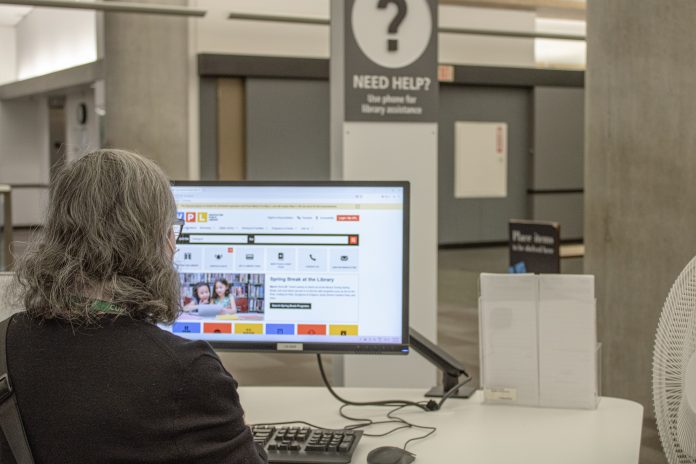
When it comes to serving the community, nobody does it quite like the staff at the Vancouver Public Library (VPL). In the midst of an increasingly unaffordable city, the VPL staff maintain a free space that serves people from all walks of life, regardless of their economic status. As BC libraries face significant financial pressures, it’s important to celebrate the staff who remain committed to providing quality services and care to the community. VPL staff are valuable community members due to their work in maintaining third spaces, delivering skill-enhancing workshops, and providing easy access to books and other forms of knowledge, all free of charge. Even if you don’t use the library yourself, its impact may reach you through its positive mental health impacts on your fellow citizens. Without caring community members that work to make the library inclusive and accessible every day, Vancouver as a whole would suffer. 

Third spaces are important for fostering a sense of belonging and safety in all individuals, and library staff create an atmosphere of openness that makes the many VPL branches, located all over the traditional and unceded territories of the xʷməθkʷəy̓əm (Musqueam), Sḵwx̱wú7mesh (Squamish), and səlilwətaɬ (Tsleil-Waututh) Nations, great options for a third space. The cleaning staff, library service desk assistants, and librarians all contribute to make the library a clean, safe, and welcoming space for all. Their work in organizing the space, keeping it conflict-free, and kindly interacting with patrons all creates a positive atmosphere. Additionally, maintaining the library as a quiet space is important in how it fosters safety. It’s important to have a predictable environment to depend on a space’s atmosphere for mental health when that isn’t guaranteed in a lot of areas of your life, such as violent situations at home, volatile work environments, and more. It seems to me that staff maintain this atmosphere by respecting the space and the people in it, and patrons then return the favour. 

Skill-enhancing workshops hosted by friendly staff allow low-barrier learning for a wide variety of topics. Many topics are hosted by VPL branches, mostly the Central Branch, that provide informative sessions on community-relevant topics. They offer a digital essentials program, which gives patrons the opportunity to upgrade their tech skills, from gaining basic phone and computer skills to learning how to edit digital images in Photoshop and Lightroom. For people learning English, they offer regular English conversation practice events in many branches across the city. They also assist in job hunting: Their drop-in resume clinic is a repeat event downtown, which allows people to get feedback on resumes and cover letters by qualified staff. These programs decrease the barrier for people to develop their skills and ideas by providing reliable, accessible programs for any VPL patron. 

The VPL staff provide knowledge beyond books to its patrons. Personally, I have gotten some of my best book recommendations, including Chicken Soup for the Soul, from a librarian. I also learned about the Inspiration Labs located at the Central Branch downtown and the nə́c̓aʔmat ct Strathcona Branch in East Van, which are various sound-proofed rooms that are equipped with a variety of creative equipment: mics, greenscreens, lighting equipment, and computers with access to FL Studio, Adobe, Photoshop, and more. These resources would have remained a mystery to me without the help of friendly library staff. Library staff also provide library cards to people who don’t have a home address. Beyond this, I have heard many anecdotes about how library staff provide information to patrons about specialized programs for individuals in difficult situations, such as homeless shelters, detox centers, and food programs around the city. 

The VPL staff serve the city in a community-minded way. Their combined efforts create a space that is inclusive, comforting, and kind. With community care at the forefront of their services, they are able to support people from all walks of life.

Whether you are a parent who needs to get your kid out of the house, a senior looking to upgrade your tech skills, or a musician seeking a quiet place to record, the library staff have something that can help you out.

All of the efforts of VPL staff reverberate through many lives, including mine — knowing I have access to a free place to relax, work, or play makes my mental load feel significantly more manageable. Knowing that there are kind staff that take care of the place and its patrons makes me feel safe.

Health policy expert Dr. Leah Shipton explains duplicative health-care

0
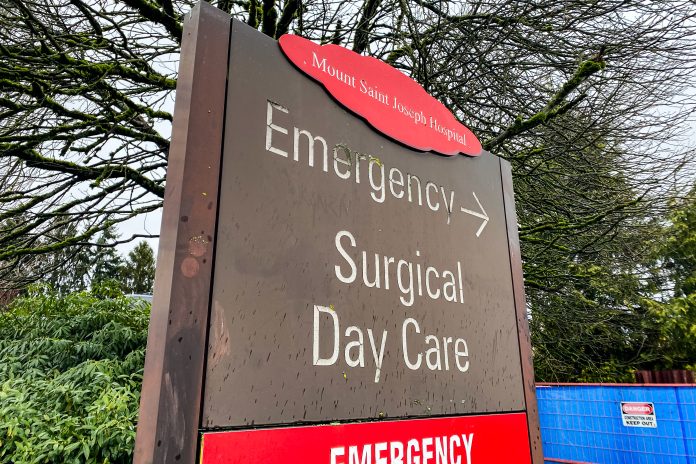
A worn-out outdoor sign that reads “Mount Saint Joseph’s Hospital / Emergency / Surgical / Day Care.”
PHOTO: Gudrun Wai-Gunnarsson / The Peak

By: Maya Barillas Mohan, Staff Writer

Canada’s health-care system desperately needs healing, but we can’t take it to the doctor. In an interview with health policy expert and term assistant professor at SFU School of Public Policy Dr. Leah Shipton, The Peak inspects what’s broken with our health-care system and potentials for solutions.

Defining the crisis

Universal health-care means most health services in Canada are publicly funded and available for free to citizens and permanent residents. The Canada Health Act, that ensures universal health-care, passed in 1984. However, our government’s mismanagement of this system has led to an ongoing crisis of access and quality. In BC and across Canada, wait times languish on for “emergency room care and elective procedures,” Shipton explained. She attributed this to a “woeful underfunding” of primary care. A major doctor shortage results in delays, and nearly six million people don’t even have a family doctor. “It’s been urgent for a while,” said Shipton. Some patients may end up going to emergency rooms to seek urgent care that could have otherwise been sought by a family doctor if treated earlier or if access was available. 

According to The Tyee, the ongoing effects of COVID-19 has also contributed to the overcrowding of emergency rooms as it “made the general population sicker,” and continues to circulate, with the population “more likely to be suffering from metabolic diseases such as diabetes, cardiovascular disease, and autoimmune diseases.” According to CBC, hospitalization rates for viral illnesses and respiratory diseases have doubled since 2019.

“This is not just limited to family doctors,” Shipton continued. The number of nurses, anesthesiologists, occupational therapists, physiotherapists, and pharmacists fall drastically short in meeting demand. Shipton also noted a shortage in public long-term care, with aging populations requiring long hospital stays or privately financed care while on long waitlists. This further agitates financial insecurity in the aging populations.

According to Shipton, the shortage is an issue of both supply and retention as “significant burnout” burdens health care workers. “It’s hard to retain health workers because of how challenging the working conditions are. And then we’re not recruiting nearly enough to fill the gap for the people who are leaving,” she said. The number of doctors headed towards retirement has more than doubled since 20 years ago. This is especially dire in rural areas, where temporary emergency room closures mean residents must be redirected to hospitals sometimes hours away. Beyond that, overworked staff cannot easily provide “higher quality care.” CityNews reported increased violence towards health care workers from patients and their families who “lash out” due to the wait times and overcrowding.

Trouble across province lines

The guiding philosophy of Canada’s national medicare, since its roots in the 1960s, is that health-care is a human right; everyone should live with dignity, and without suffering or financial constraints.

The Canada Health Act states required health services must be “provided on the same terms and without patient charges.” But according to Shipton, a new Alberta law violates that. 

In November 2025, Alberta introduced Bill 11, or the Health Statutes Amendment Act, which passed the following month. It allows private companies to operate alternative options to the medically necessary services that are publicly available — most controversially, acute care. Bill 11 poses a critical issue: Shipton doesn’t believe the average Albertan can afford it. While those who can will receive “systematically quicker access to health care,” the public system will continue to deteriorate. 

Shipton isn’t convinced that a two-tier system will be helpful for the majority of Canadians. She points to Australia and the UK, countries which have recently gone the route of introducing private health-care as a secondary option to public systems in crisis. The result is that patients are priced out of accessing care. She explained how in both cases, the public system loses “vital staffing” as health care workers move to private practice. And as patients begin “jumping the queue” by paying for private services, those who require more urgent attention often cannot afford these private services, leaving the public system “still dealing with a very high patient load, many of which with complex conditions.”

A crucial feature of Bill 11 is its inclusion of a dual practice model. This means that physicians will not have to choose between working in either public or private health-care; they could “have a foot in both worlds,” she said. Shipton expressed this is concerning because it creates “perverse incentive structures [ . . . ] You could be charged or billed for something that’s not actually medically necessary. You might get told by your doctor, ‘I can treat you quicker through private insurance.’” In Australia, patients often lack information on public options and “half of cancer patients paid more than $5000 a year in out-of-pocket medical expenses,” according to BBC.

“This is not a beast you want to introduce to the health system,” Shipton continued, explaining that research shows “private insurance actually drives up the cost of medical services.”

Alberta’s expansion of private health-care isn’t isolated. In Ontario, a two-tier system is practically already here, with the Conservative Doug Ford government having directed $300 million towards building private hospitals in 2025, which is unprecedented.

Purposeful deflection and financial constraints

According to Shipton, there has been a narrative since “at least the 1980s” that the private sector will solve health-care problems. Some Conservative and Liberal governments will “underfund the public system to make it dysfunctional,” and then implement privatization to solve the “dysfunction underfunding created in the first place.” For example, in 1995, minister of finance Paul Martin cut federal health-care spending by 40%. In a press release, Bea Bruske, president of the Canadian Labour Congress attributed privatization to “politicians who prioritize tax breaks for the wealthy over investments in public health care.” Bruske also noted “the growing presence of American health care corporations operating in Canada.”

From May 8–11, BC Nurses Union (BCNU) vote to strike for the first time in more than 25 years, protesting benefit cuts and asking for more safety and health precautions. Kendra Strauss, labour studies expert from SFU told CityNews, “budgetary constraints are forcing [the New Democratic Party government (NDP)] to play hardball at the bargaining table.” The NDP is projecting a record-level deficit for the province. BCNU president Adriane Gear stated they would pursue “other job action” than work stoppage and that “the goal is to not impact patient care.”

Shipton explained “a lot of the funding goes into reactive elements of our health system, like hospitals, which is very important. You would not want a society that doesn’t have hospitals.” Meanwhile, she stressed the dangers of for-profit hospitals: “We have our neighbors in the US that reckon with this.” As hospitals are for people who are “already sick,” a strong public primary care system is just as important for preventing people from “getting ill at a population level [ . . . ] You save the most money when you prevent people from getting sick in the first place,” she continued. If the government were to invest more in preventative care, like doctors and physicians, it would have “ripple effects for cost savings.”

Shipton also commented on how immigrants can bear the brunt of criticism for the health-care system: “To scapegoat immigrants, or the influx of immigrants for a health problem, when a third of your workforce in several categories of health personnel are likely to be immigrants themselves, is pretty absurd,” Shipton said. In Canada, 35% of pharmacists and 23% of specialists are trained internationally.

BC’s silver linings

Shipton remains optimistic that BC is not so likely to adopt dual health-care anytime soon. “Policymakers learn from each other, we’ve seen that globally,” but Alberta is more likely to create a “permissive space” for provinces with similar ideologies like Saskatchewan. Private health-care has been “fought against” by BC’s judicial system. “There’s less space or tolerance,” Shipton tells The Peak after recounting the Cambie Case. Essentially, Cambie Surgeries was attempting to provide preference for those who could pay privately. The BC Supreme Court decided that duplicative health-care would “undermine equitable access to health-care.”

Furthering our conversation about Canadian health care workers, the SFU School of Medicine, which hosts its first classes in August 2026, surfaces. Shipton pondered “the specific aims they have for addressing family physician shortages.” She tells The Peak, “What we see from data is that less and less medical students choose to become general practitioners,” and most end up specializing. Either way, there’s no way to “immediately resolve many of these problems,” as the first cohort won’t graduate for a few years yet. The SFU Med School website lists advancing primary care as their #1 focus, and will prioritize applicants with “a strong desire to pursue a career in primary care.”

When asked whether BC residents should worry about health care workers moving to Alberta or Ontario for better opportunities in dual practice, Shipton noted, “Nurses may stand to benefit if private clinics hire them at a higher wage or they go through private staffing agencies.” However, “the private sector can often create more precarious employment and lower wages.” Shipton also cited a 2023 study that shows BC has the highest provincial attraction and retainment of recent health care graduates.

SFU’s med school is like most Canadian schools: not only will applicants require Canadian citizenship, but they must be a resident of BC, Nunavut, Yukon, or Northwest Territories. Shipton explained this policy ensures graduates stay in the province, especially because there are so few spots already for medical students in BC. Additionally, the School “welcomes applications from qualified Indigenous applicants (First Nations, Métis, and Inuit) from across Canada.” Research shows Indigenous applicants face systemic barriers in pursuing and entering medical school.

In the face of a critical moment for the future of health-care in Canada, Shipton tells The Peak, “We all need to become a lot more politically astute and engaged and see it as part of our civic responsibility to be aware of these policy developments and find ways to contribute.” Shipton said that part of this could be “writing to parliament,” or following organizations and participating in their events. She mentioned the BC Health Coalition and BC Rural Health Network as actively involved in advocacy and literacy. You can also donate to these organizations on their websites.

A teaser of Waterfront’s best kept summer secret

0
A photo of a chicken wrap in a person’s hands
PHOTO: Maya Barillas Mohan / The Peak

By: Maya Barillas Mohan, Staff Writer

A well-hidden gem, Junction Market rests atop Waterfront Station in Granville Square. Initially, The Peak’s correspondent yours truly got lost en route. It did not occur to me to climb a small flight of stairs to find the destination, but the lap around Waterfront was cherished on the fresh spring day of the opening. Weather like this makes one grateful for outdoor activities: soaking up the light before the sun gains full opacity and toasts you like a panini. 

Once I found the venue, it seemed like the market was still finding momentum. Lines were not an obstacle as I visited the souvlaki truck and the artist stalls. A few people ahead of me ordered a pita wrap that looked delicious, so I ordered the same. I got the I ❤️ Souvlaki chicken wrap. There was a true abundance of juicy chicken and tzatziki sauce folded into a fresh pita. Wandering a few steps from the courtyard created between the food truck and the artist stalls, my boyfriend and I shared the wrap looking at the ineffaceably blue water. A few other people perched on the cement planters and benches also had wraps from the Junction Market; it felt like a free-roaming patio.

Junction Market has a rotating list of vendors, which you can check on its website. This way you can decide what day you want to visit, depending on what is available. I was intrigued by the unique design of the pop-up vendors: upon closer inspection, I noticed that they were shipping containers! Shipping containers are an eco-friendly solution to brick and mortar stores because the repurposed containers are not made from new materials, are portable, and withstand all weather conditions. The market runs from late spring to the far reaches of summer, ending on September 7. Launched in 2024, the market has adapted over time but the containers have remained a constant.  

Looking at the vendor list, I see that I could come back to buy handmade leather goods or something flaunted as “pet couture.” Beaded and metal jewelry sellers pique my attention in the catalogue too. While I was there, I got to talk to a painter dabbing paint on a tall, three-foot canvas in shades of seafoam and teal. Close range to enthusiastic artists is a benefit of markets like this. Another booth selling handmade hats with steep points at the crown offered in a melange of greens and florals reflect the blooming foliage all around Granville Square.

This market renders a perfect picture of a spring day in sunny downtown. 

Keep up to date on the market by following its Instagram page @junctionpublicmarket.

Angst and the avant-garde: A review of Tanya Tagaq’s Saputjiji

0
A collage of a photo of the album cover for Saputjiji and a photo of Tagaq
PHOTO: Courtesy of @icalondon / Instagram (photo), Courtesy of Six Shooter Records (album art)

By:  Jonah Lazar, Staff Writer

Content warning: description of residential schools.

Tanya Tagaq, one of the most critically acclaimed Inuit artists, released her eighth studio album on March 6. Tagaq is known for her highly political music, which often explores colonialism and the residential school system. Through her experimental and avant-garde style (a genre that transcends traditional musical conventions) that melds Inuit throat singing with electronic and metal influences, Tagaq has built a dynamic reputation.

Her new album, Saputjiji, carries on this legacy. The opening track of this record, “Fuck War,” throws the listener into a chaotic, cathartic repetition of the words “fuck war” set overtop of raspy screams which colour the background, just about held together by the rhythmic pulses of the drum. Tagaq’s screams barely have stopped ringing out by the time I’m tossed into the belly of another frenetic, enraged ballad crying out against violence and war. These songs are again set over a cacophony of Inuit throat singing reminiscent of something from Slipknot, creating a wall of vehement fury.

The strongest part of this album for me is the stark atmospheric change in the midpoint of this record with the fourth track, “When They Call.” In a departure from the previous themes surrounding colonization and war, the middle of this album focuses in on the suicide crisis in Inuit communities, whose suicide rates are nine times higher than non-Indigenous populations, according to Statistics Canada. The song slowly builds through a beautifully dissonant string ensemble interlaced with several layers of Tagaq’s hauntingly droning vocal, together creating a powerful background for her grim lyrics addressing suicide in these northern communities. 

This track seeps seamlessly into the fifth track of the record, “Exit Wound,” which trades the strings for piano while continuing along the same themes. “Ikualajut” follows, with Tagaq’s trademark spoken word style briefly touching on the pain caused by residential schools, with lyrics such as, “We eat our puke off a residential school dining room floor.”

For me, this track seems to conclude the more mellow part of the album, with themes in the latter half of this record appearing scattered and less developed than in its first half-dozen tracks. Short, experimental tracks trickle out of the end of this album, with dizzying arrangements set within radio static, chanting, and animal cries combined with distorted rhythms of Tagaq’s panicked breathing. These arhythmic interludes felt as though they were grasping out for a ballad to anchor themselves around, however no such ballad was delivered. The concluding track of Saputjiji did offer some respite from the disordered nature of the preceding tracks, which set Tagaq’s Inuit throat singing over an Aphex Twin-style robotic drone. 

If you’re looking for a chilled out album to put on in the background while you cook, or something calm when your pals come over, this definitely isn’t the record for the occasion.

if you’re looking to delve into a record that captures the vehement fury and angst swirling around the north of so-called “Canada,” Saputjiji is for you.

Reconciling: A Lifelong Struggle to Belong book talk

0
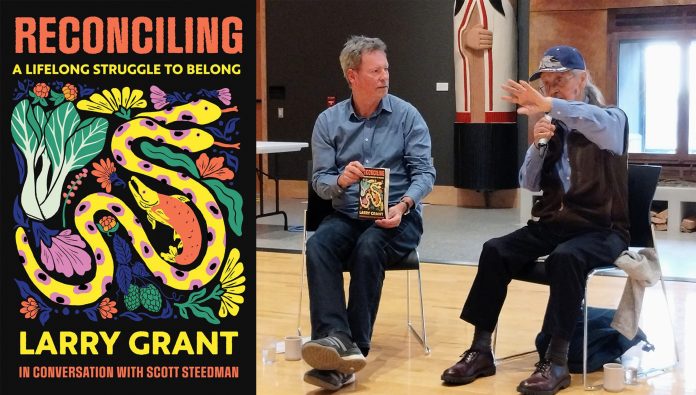
A photo of Elder Grant and Scott Steedman
PHOTO: Marie Jen Galilo / The Peak (photo), Courtesy of ECW Press (book cover)

By: Marie Jen Galilo, Staff Writer

Content warning: Mention of residential schools.

On Monday, April 27, Elder Larry Grant, also known as sʔəyəɬəq (suh-yuh-shl-uck) in xʷməθkʷəy̓əm (Musqueam) and Hong Lai Hing in Cantonese, visited SFU’s Ceremonial Hall in the First People’s Gathering House to discuss his book, Reconciling: A Lifelong Struggle to Belong, with co-author Scott Steedman, a senior lecturer in SFU’s publishing department. 

Elder Grant began the book talk with a land acknowledgement in hən̓q̓əmin̓əm̓, and then walked us through his life story. He used the word “reconciling” to emphasize that healing from the pain and trauma caused by discrimination is an ongoing process. Being born to a xʷməθkʷəy̓əm mother and Chinese father, Elder Grant experienced discrimination that targeted the very core of his identity.

Elder Grant’s father, Hong Tom Hing, immigrated from the village of Sei Moon in Guangdong, China, and paid a $500 head tax to enter Canada and work as a farmer on the land that belonged to Hing. When the Indian agent (representatives of the Canadian government on First Nation Reserves) discovered that Elder Grant’s mother, Agnes Grant, had married a non-status man, he and his family were all stripped of their status. He felt like being Chinese was forced upon him, which he struggled to come to terms with because he grew up on the reserve, surrounded by xʷməθkʷəy̓əm culture and values. He was exempted from residential school because he was seen as Chinese, not Indigenous, which he could not understand because he identified as xʷməθkʷəy̓əm. On the flip side, in the Chinese community, he was seen as Indigenous, not Chinese. The dissonance between how others saw Elder Grant and how he saw himself made it difficult for him to express his identity.

Slowly but surely, he worked towards reconnecting with both his xʷməθkʷəy̓əm and Chinese roots. When he was about to retire from being a mechanic and longshoreman, his brother convinced him to take hən̓q̓əmin̓əm̓ language courses at UBC. He was eventually asked to co-teach the courses because of his deep understanding of hən̓q̓əmin̓əm̓, and he continues to teach to this day. Elder Grant also had the opportunity to reconnect with his Chinese roots when he visited China to see his father’s village before it was bulldozed. He walked through the village gates that his family had funded, and was overcome with emotion. Being in his father’s village, he felt like he was “home” and that he belonged.

Elder Grant advised us to return to the land of our ancestors to strengthen our sense of self, and reminded us that reconciling, in the context of Turtle Island, is an ongoing process that we are all working towards. 

Elder Grant’s story and words of wisdom highlights the importance of learning history through the stories of people who experienced it firsthand. Through his story, I learned that the lives of Indigenous Peoples and Chinese people were so closely intertwined because of the discrimination both communities experienced in Canada. Only through learning about history from the people who have lived through it are we able to work towards understanding and acknowledging the deeply-rooted impact of those experiences. By retelling and listening to these life stories, we ensure that the histories are never forgotten, allowing us to collectively strive towards fulfilling the process of remembrance and reconciliation. 

Check out Elder Grant’s work, Reconciling: A Lifelong Struggle to Belong at Iron Dog Books.


Jenny Yu on immigration, labour, and the Canadian Dream

0
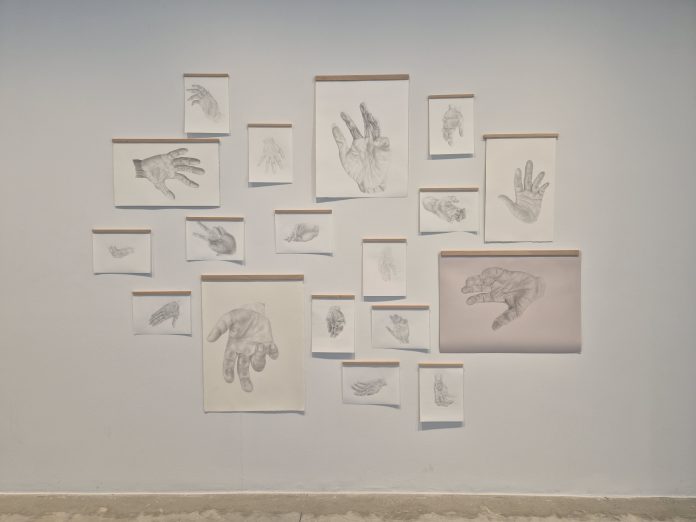
A photo of Canadian Dream
PHOTO: Courtesy of Jenny Yu

By: Clara Xu, Peak Associate

On April 15 at the SFU Audain Gallery, graduating visual arts students from the School for the Contemporary Arts opened their exhibition Kerplunk!, displaying the works of these students from CA 461, one of the last courses they take in their university career. The exhibition was a mish-mash of ideas and presentation styles, from massive chairs to a semi-voyeuristic video. The featured artists interrogated very different ideas, some around similar themes, such as social issues like labour, consumerism, and immigration; or reflections on cultural backgrounds and childhood. 

The Peak interviewed one of these artists, Jenny Yu, to discuss her experiences creating for Kerplunk!.

The following interview has been edited for concision and clarity.

How did your cohort settle on this year’s exhibition theme? 

For the fourth year show, everyone is doing their own personal practice, and it’s hard to figure out an exhibition name or theme when everyone’s work is so diverse. Someone said, “Kerplunk! as one of the examples of something fun. I guess it kind of encapsulates all of our works, because if you drop it, it makes a sound. 

As a cohort of students working in parallel over the course of four years, in what ways do your works inspire each other, and how does this feed into your own artistic practice?

We all come from very diverse artistic backgrounds, and we think very differently, and we all value different things. And I feel like seeing things from others’ perspectives, or seeing how other classmates try different avenues of artistic practices — like sometimes it could be craft, embroidery, crochet, or even something that’s very regular, like splattering paint or making the paint drippy — inspires everyone to do different things.

I read through the gallery program for your work Canadian Dream. What was the research and collaboration process like for the people you depicted in Canadian Dream?

I’ve always been interested in immigration because my parents immigrated here from China in the ‘80s or ‘90s. I really appreciate how Canada gives people an opportunity here for a better life. But, in the past few years, there’s been a lot of anti-immigration sentiment, and learning from what’s happening in America, once it gets bad, it can get worse.

In order to make my project happen, I had to go all around the city to just talk to the community, and get to know people through questions like, “Why’d you come to Canada? Where are you from?” Sometimes, those are the most interesting stories. Half of my project is on these interviews and their stories, and the other half is on the drawings.

Why did you choose to specifically depict hands in Canadian Dream? What did your creative process look like for yourself?

Right away, I was thinking of labour. So when I think about labour, I always think about hands. And I think it’s mainly because I grew up with people doing hard labour around me, like my grandparents, who’ve been farmers for most of their life.

 “What I’m interested in when it comes to beauty is when something isn’t perfect. There’s a characteristic, an innate, unique quality to somebody.”

— Jenny Yu, Student Artist

The reason why I decided on graphite, was what I noticed during the critiques during class. It would seem like people are very focused on the ethnicity of people’s hands if they’re in colour. And my idea of immigration — I didn’t want to focus on ethnicity, I wanted to focus just on the stories, and the idea of immigration on a whole. 

What’s next for you and your artistic practice?

With my art practice, I like talking about social issues, mainly issues here locally, because this is where I’m from, and I like building community and I like to get to know people, and I think the only way I want to do that is with art. For now, I’m going to go for my masters’ degree.

What kind of raccoon shitter are you?

0
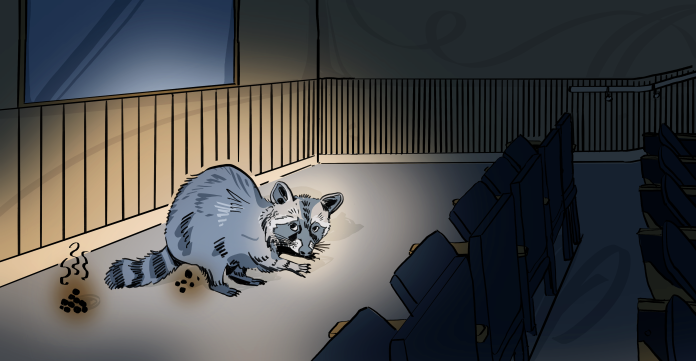
a racoon defecating on the floor of a lecture hall. There is a pile of poop behind it.
ILLUSTRATION: Olivia Blackmore / The Peak

By: Poopabella Fudgerton, Quiz Master

We already know that raccoons rule our campus — they roam the halls, guard the parking lots, and wait for the perfect opportunity to give you the jumpscare of your life (all while looking adorable). A raccoon showing up to lecture would be pretty interesting . . . but what if it shat during your lecture? Yes, it does indeed happen behind the scenes. Even better yet, what if we could match your personality to a specific type of raccoon shitter? Take this quiz to find out! 

  1. The weekend’s over (cries internally). What are you doing the night before the dreaded Monday?
        1. Rubbing expired lipstick all over my pet rock (that is dressed like a raccoon).
        2. Cooking up non-awkward conversation starters. 
        3. Folding up a pool chair to bring to class in the morning. 
        4. Locked in, studying for a test that’s 12 weeks away. 
        5. Reflecting on my weekend’s shenanigans.  
  2. You want to kickstart the morning of what should be a perfectly normal school day. What’s the first thing you do? 
        1. Make twelve things for breakfast. And then eat a quarter of it.
        2. Practice conversing with people by talking to myself in the mirror.
        3. I just do my thing (I won’t share my private details with strangers).
        4. I’m already at school. 
        5. Grab a sketchbook and people-watch on the way to school. No breakfast required.
  3. You’re preparing for class. What is your pre-lecture snack?
        1. Something from Renaissance — dessert is the booter placed on my car by the parking patrol. 
        2. Whatever the person next to me is eating — I NEED to make friends with them!!
        3. I don’t care.  
        4. Paper.
        5. The tea on my classmate’s laptop screen (should’ve minimized iMessages if you didn’t want them to be read!) 

4. What are you doing during lecture? Be honest.

          1. Planning for world domination. 
          2. Thinking about making small talk with my seat-mate.
          3. Maintaining a poker face. 
          4. Writing down EVERYTHING the prof says. Verbatim. 
          5. (Still) people-watching . . . for research purposes. 

5. If a raccoon pooped in your classroom, what would you do?

          1. I already know about it. We’ve been in cahoots this whole time. 
          2. Follow the crowd and proceed to safely exit the classroom.  
          3. Meh. Whatevs — we’re all poop-filled beings, anyways. 
          4. Raccoon? I didn’t even notice. What was on the second slide —
          5. Carefully observing the feces and poking it with my pen. 

Results

Mostly A’s: The chaotic raccoon

You’re the raccoon with the IDC attitude who couldn’t care less about what others think. You’d confidently strut up to the front of the class and use the podium as a toilet during the middle of a very important midterm exam, just because you can. 

Mostly B’s: The nervous raccoon

You’re the raccoon who just wants to fit in, and overthinks every social interaction. Pooping in the classroom almost guarantees social ruin, so you try to make a run for it, but then leave a trail of poop behind in your attempt to escape. Oh dear . . . 

Mostly C’s: The nonchalant raccoon

You’re the raccoon who tries to be cool and mysterious, even when it comes to your pooping business. You leave your mark in the corner of the classroom and try to make a calm, unnoticeable exit — which would’ve worked if only the awful smell didn’t give you away. 

Mostly D’s: The studious raccoon 

You’re the raccoon who attends lectures because you like learning . . . or crave academic validation. As powerful as you are, nature got the better of you. You don’t even notice the poop plopping down your ankles because you were paying too much attention to the human professor.

Mostly E’s: The wallflower raccoon

You’re the raccoon who attends lectures to better understand humans because you’re curious about these strange, yet fascinating, creatures. To avoid drawing attention to yourself, you hold it in until everyone leaves. Then splat.

SFU debuts virtual reality for snow days

0
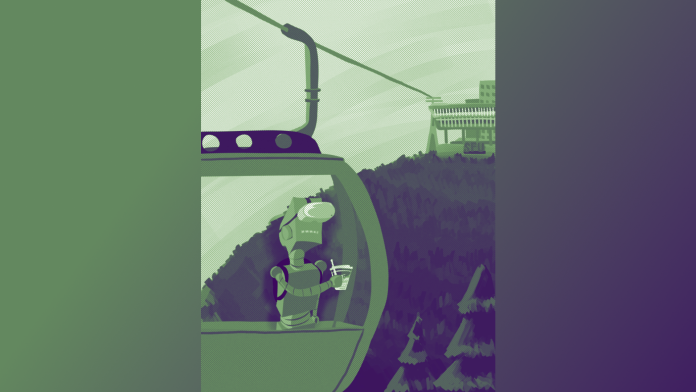
An illustration of a robot with an Iced Capp making its way up the mountain via the gondola. The AQ is illustrated in the distance
ILLUSTRATION: Cliff Ebora / The Peak

By: Lucaiah Smith-Miodownik, News Writer

At SFU, a movement years in the making, built on generations of student advocacy, has finally paid off. Well . . . sort of. The university recently unveiled the new campus gondola. Only, it doesn’t exist in the physical realm. SFU’s cable car debuted as part of the school’s new virtual reality snow day package, complete with an immersive ride up the mountain to campus.

“As you know, sometimes the buses just can’t make it up the mountain,” president Joy Johnson, currently serving her sixth consecutive term in hologram form, told The Beep. “But we wanted to find another way to provide our students with that on-campus experience that they so value. So we figured, why not go ahead and do class virtually? Zoom is great and all, but nothing beats the feeling of being in a classroom or lecture hall.”

Since debuting, the virtual gondola has run into a few small hiccups.

“For starters, it’s already almost crashed twice,” a student and passenger told The Beep. “And the schedule is unreliable. Sometimes it’s late, or it’s over capacity and the server crashes. Then you have to restart your VR headset and redo the whole thing all over again.”

“My friend forgot his virtual student ID the other day, they made him walk all the way up the mountain in the snow.”

— SFU student

“and it was freezing that day in VR. I swear this technology is too realistic.” 

Burnaby Mountain is now fluctuating -40 to 50℃. When students arrive on a tropical campus, they’re especially keen on purchasing goods just as they would in the real world. “The virtual Iced Capp from Tim’s is actually pretty good,” one customer informed the publication. 

Students commented on the striking resemblances between the digital sphere and the physical campus, expressing both amazement and frustration. “It’s pretty cool. I even saw a raccoon and a bear the other day. They looked so real, I honestly wanted to try to pet them,” one VR user explained. 

“Somehow, all the elevators are still broken, even in virtual reality. I don’t even understand how that’s possible,” another noted. “I’m just glad my tuition is going towards creating fake construction and brutalist architecture instead of just buying some road salt or snow tires for the bus.”

Rumours circulating about the next VR update say that students will soon be able to pay parking tickets with their minds as well. 

Life Oil Ad: Life to give you life

0
ILLUSTRATION: Olivia Blackmore / The Peak

Robot bust-up in west mall

0
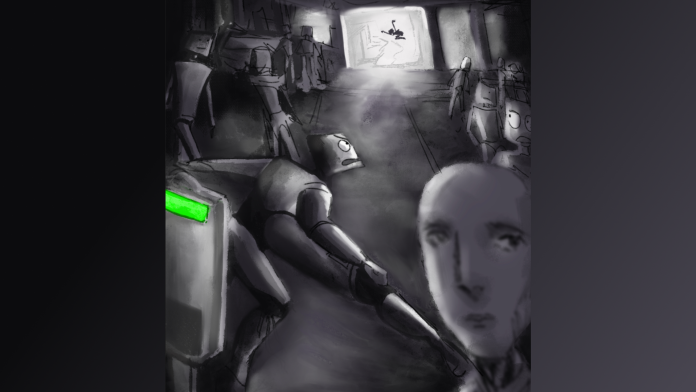
two robots fighting over a charging port. They display clear physical malfunction.
ILLUSTRATION: Sonya Janeshewski / The Peak

By: Jonah Lazar, Staff Writer

People passing through the west mall complex were left stunned as two robots began trading blows, wreaking havoc, and endangering bystanders in a dispute over a charging port. Witnesses report that this brief altercation resulted with one robot swiftly imposing its will upon its adversary. “It pulled [its opponent’s] gearbox right out of its chest all Indiana Jones-style. It was horrible,” said Avery Bennett, SFU student. The Beep learned that the defeated robot was airlifted to a special robot intensive care unit. Meanwhile the perpetrating droid was taken into the robotics department to be factory reset. We approached the department for a comment; however, we did not receive a response by the publication deadline.

These two model 31 robots were part of SFU’s new pilot program to replace teaching assistants (TAs) with automated assistants (AAs). This came as a response to previous models being hacked by the TSSU to demand fair compensation. These new robots were built with heightened anti-strike software and can sbe shut down if they attempt to bargain for better working conditions. However, the program has yielded mixed results; SFU’s administration has praised the simplicity in negotiating employment terms with these unionless robots. Yet, issues have arisen when it comes to their interactions with one another. SFU’s coordinator for the program told The Beep that these robots are reportedly “more territorial than grizzly bears in heat” when it comes to defending their charging ports, and as such conflict has been common. 

SFU security chief Alan Gilmore revealed to The Beep, “We receive a few of these calls a week [ . . . ] since charging ports are quite sparse on the mountain, we’re seeing an increase in this sort of violent behaviour.” Later on, however, Gilmore acknowledged that this particular quarrel had been “one of the nastiest” since the beginning of the program. 

Many students have called for action from the university to address this increase in bionic violence. “How are we meant to be focused on our studies when this sort of stuff is happening on campus? It’s unacceptable,” SFSS president Maria Castillo told The Beep. “When you look at UBC’s measures to ensure their AAs aren’t interacting with each other, you have to wonder if there’s more that SFU could be doing to keep us safe.” 

SFU’s official statement on the matter reads that this altercation is being “blown out of proportion” and that the robots in question “were just blowing off some steam.”