Home Blog Page 382

Top Ten ways to help lockdown go by quicker

0
Very calm, very cool. Nothing wrong here. Illustration: Siloam Yeung / The Peak

By: Juztin Bello, Copy Editor

  1. Hit up your ex

Since dating your ex ended up being a waste of time despite your initial thoughts, inserting yourself back into their life during lockdown truly lives up to the “unprecedented times” we’re currently in. You want “unprecedented?” Try giving the guy with poor morals and worldviews (and an even poorer hairline) who broke up with you over the phone another chance. Now that’s unprecedented. Just remember to cut things off once lockdown ends, because as self-inserted Presidential-elect Kanye West once said: “keep your love lockdown.” 

2. Maximize on sleeping

Parents may often warn you that by sleeping in ‘til noon, you’re “wasting the day” or “lazy” and “a total waste of human life, Jared. Also, when are you going to find a job so you can move out of this house, for Christ’s sake?” But don’t listen to them (unless you’re Jared). Sleeping is a perfect way to help time move by faster, since your unconsciousness inhibits you from noticing how slowly the days go by. All of those useless hours can instead be spent dreaming about a blissful, COVID-free life — or they can be an endless array of anxiety dreams triggered by your reluctance to confront problems with your mental health that you should really deal with and talk about. But that’s an awake you problem! Sweet dreams! 

3. Lay in bed and rotate through the same five apps, day in and day out

If this feels like a very specific callout, I’m here to tell you it is. As you’re reading this, you’ve just closed Instagram to look at Twitter, even though you just closed Twitter to look at Facebook and then went right to Instagram. I’m looking right at you, lying in the darkness on your side with a pillow between your legs and/or nestled between one arm and your head. Your iPhone screen and cheap lights you ordered because everyone on TikTok had them illuminate your face. Oh? Did your attention span just subside and you no longer want to look at Twitter? Close that app and go back to Instagram, you coloured-haired, validation-craving Tumblr dweeb.

4. Sell your soul to Chronos, God of Time

People who say you can’t buy your way out of a problem have clearly never considered how expensive a human soul is to beings who see humans as expendable. No, not your fabricated Tesla and Amazon capitalist overlords; I’m talking about actual gods. Take that expensive soul of yours and offer it up to Chronos, God of Time. Ask him to bestow onto us measly mortals the gift of moving forward to a time beyond lockdowns and plagues. Hopefully, if he’s kind, he will comply with your weak demands. And if he looks anything like his depiction on the hit Canadian cartoon Class of Titans, tell the God of Time that my soul and body are ready for him, anytime

5. Attempt time travel

Anyone who said you can’t learn anything from TV and movies is, frankly, a giant LOSER and probably a nerd — unlike you. Take some inspiration from the classic time-travel trope to fast forward right to when lockdown is over. You could try driving a car super fast to replicate Back to the Future, cryogenically freeze yourself like Fry in Futurama or Walt Disney (look it up), or pray that whoever is controlling the simulation decides to pull an Animal Crossing-style time travel. Just don’t make that stupid fucking “where are we, more like when are we” time travel joke when you eventually succeed — you don’t need need to travel forward in time to know the joke didn’t land. 

6. Run absurdly fast around the entire Earth

Not to get scientific on main, but technically the way we tell time is because of the Earth rotating, right? So who’s to say that if you run super fast around the world, you can’t help speed up rotation and thus make time go by faster? Just strap on those gym shoes unused during and before this quarantine began, stick your arms backwards Naruto-style for speed, and fucking book it. And before any of you flat Earthers come for me, maybe take that energy you use to argue about the shape of our literally proven-to-be-round planet and worry about flattening a different curve. 

7. Just like, start a hobby! 🙂 

TBQH, why try any of this other junk when you could just start a hobby! 🙂 It’s like, so cooky to get caught up in something like knitting and using it as a replacement for stitching together a personality 😀 Isn’t it so quirky to just get into arts and crafts, or like, baking just for fun?! :3 Oh, and then starting an Instagram account for your hobby because you think people actually care? :} Or is it, like, just actually super juvenile and an unrealistic practice that people who jerk it to 5 Minute Crafts on YouTube preach as being self-care because they think they’re better than you? :] Oh, and you should totally like, start an Etsy or advertise your stuff on Facebook Marketplace too, capitalism is sooooo cute right now. :*

8. Change the date on all of your devices

Let’s get honest for a second here: time is just a concept. You’re telling me that randomly twice throughout the year time moves backwards an hour and then miraculously an hour forwards? Why can’t we just pull the same shit with lockdown? That’s right, it’s because that’s what the man says. It’s all Big Business brainwashing us. Be complacent no longer! Just move your calendars forward to lockdown’s end, throw the first authority figure that classic middle finger, and light a cigarette as you kick-flip and ride your skateboard into the night. But then again . . . what does “night” even mean . . . 

9. Begin your character-development training arc to trigger a time-skip 

A classic anime trope, if you want to speed your story up a bit, just go off to train off-screen for an unspecified amount of time and come back when lockdown is over. Your muscles will be unrealistically bigger, your hair will be spikier, and your latent abilities that will help you defeat the forces of evil will be awakened. Also all of your friends’ will have grown at least three cup sizes — just roll with it, it’s for the fans. Just don’t be alarmed by your friends, allies, and enemies suddenly looking dramatically different — they changed illustrators between the lockdown and somehow expected you to accept it and not notice. 

10. Wear a fucking mask and stay inside

Alright, no more beating around the bush. You want this pandemic to end so you can go back to breathing down people’s necks on the bus while you refuse to put your backpack on the ground? You want to start catching people’s spit in your mouth while you dance to an over-saturated EDM song at The Pint? Try staying inside and actually following the rules, Khymberleigh. And if you absolutely must go outside (for valid reasons such as work or your education, not to hook up with Cradley AKA the guy who still visits his high school even though he graduated five years ago), wear a fucking mask.
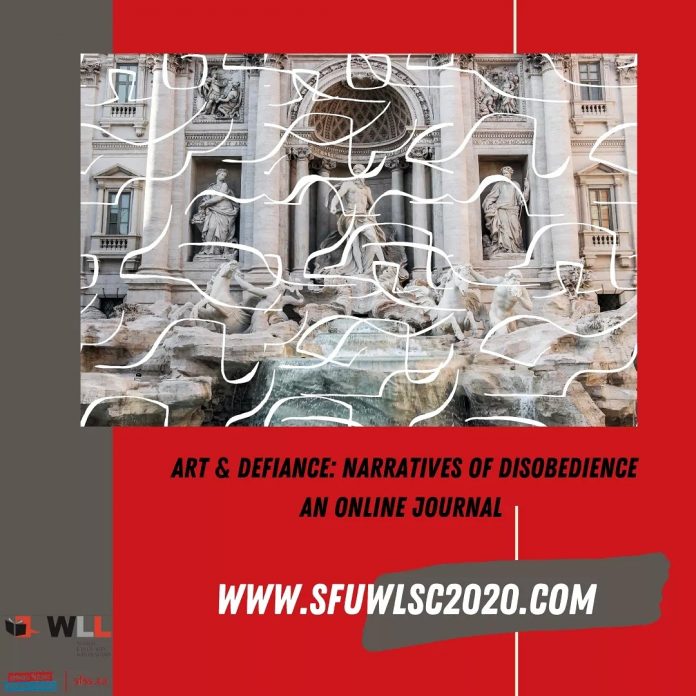
Art and Defiance: Narratives of Disobedience facilitates important dialogues around rebellious narratives

0
Interact with the Art and Defiance online journal and then attend the Q&A on November 20. Photo courtesy of the 2020 WLSC Communications & Design Team

By: Yelin Gemma Lee, Peak Associate

Editor’s note: Yelin Gemma Lee is involved with the 2020 WLSC as the Director of Communications and Design.

The World Languages and Literatures Student Union (WLLSU) presented the 6th annual World Literature Student Conference (WLSC) as an online journal, Art and Defiance: Narratives of Disobedience, on November 15. The conference, which typically occurs each spring, was postponed to the fall semester due to COVID-19, and then had to be reimagined through a virtual format. The WLSC team was dramatically reduced from over 40 members to 16 members, but this small but mighty team adamantly got back to work rebuilding the 2020 conference from the ground-up. 

Despite challenges such as these, the WLSC team decided on a dual-conference format that included the online journal, as well as a live Q&A over Zoom, set to occur on November 20 at 3:30 p.m. WLLSU president and 2020 conference producer Mizuki Giffin talked to The Peak about what this year’s experience has been like.

“We not only adapted to an online world, but we took the opportunity to thrive in this virtual environment,” explained Giffin. “We didn’t want to just transplant the in-person conference to Zoom, but rather to come up with a conference structure that was more exciting, interactive, and engaging for presenters and audience members alike.” 

The WLSC is known for offering students from all disciplines the opportunity to gain experience presenting their papers in a professional, academic setting — an experience that is invaluable on a resume or CV, but difficult to come by as an undergraduate student. The new virtual format, in addition to offering students the opportunity to be published academically, had the major benefit of opening submissions up to any virtual format including pre-recorded lectures, film shorts, poetry, photography, and more. 

“These were some of the best works we’ve seen because the presenters were really able to show[case] their creativity this year [ . . . ] The online journal [format] really allowed for such creativity,” said Giffin.

Art and Defiance: Narratives of Disobedience is both the name of the journal and its theme — a topic with as much relevance to current events as historical ones. The WLSC’s 19 published works are split into three sub-categories on the journal website: Resilient Voices, Media and Modernity, and Historical Defiance, each consisting of short films, short essays, narrated PowerPoints, poetry, and more that explore the subtopic.

This journal is a multimedia vortex of engaging niche discourse on how art propels narratives of disobedience, and explores what we consider “art” and the potential it has to act as sociocultural activism. Unlike a typical academic journal, the journal doesn’t read as block after block of text (as if any of us need any more of that right now), and is an innovative way to present student scholarship outside of the classroom setting. 

The dual-conference structure was created to make sure engagement with the material was a priority: the WLSC team didn’t want to lose this with the transition to a virtual event. The Q&A event is planned as a panel discussion, where audience members will have the opportunity to engage with the contents of the journal and the creators behind the work. Additionally, the contact section of the website also encourages any commentary and questions directed to the individual projects of the journal prior to and after the Q&A.

“It was both daunting and exciting to go off the script [ . . . ] The final 2020 conference is really the result of many students putting their ideas together and that’s what makes it so special,” Giffin says proudly.

The WLSC team, made up entirely of students, is showing event organizers transitioning into the virtual realm that there are ways to turn this obstacle into an opportunity to break new ground and try out new ways of engagement. 

The Q&A webinar requires registration through their Eventbrite page. Regular updates and details on the WLSC can be found through their Instagram @sfuwlsc. The 2021 WLSC is currently planned to progress in a similar format with a new call for submissions and call for volunteers in Spring 2021. 


Plot-heavy porn soars in popularity as the pandemic leaves population lonely

0
PHOTO: Charles Deluvio / Unsplash

By: Sarah Russo, SFU Student

VANCOUVER, BC — A wholly baseless study done by two horny dudes on Reddit revealed that their equally horny online friends recently started searching for porn with painfully lengthy intros “just to feel something” this past week.

u/gumcuzzler69 and u/asunamorelikeassuna teamed up to deliver this breaking news that no one asked for with a sample too cheap and unethical to pay for their porn, starting with a thread on the notorious social media site.

“yall what is it with the horrid acting at the start of this video that gets me off. there sitting on a couch breaking the 4th wall every 20 seconds by staring at the camera while talking to each other. ,, i miss talking to people” one friend wrote on the page.

“ya i feel u sometimes i watch videos with a girl in a laundry machine in the thumbnail not to watch them smash but just cause i know the two actors will prolong the agony with the ‘oH no I aM StUcK’ and then i think about my ex who did my laundry sometimes. and then i go, ‘maybe I should call her,’” replied another.

Seeing this trend, the two Reddit users asked around and discovered a correlation between the loneliness and the length of the porn videos watched. 

When they asked if live cams that involve watching and interacting with sex workers was on the table, a whopping 99.4% of respondants said “no” and that “bro those cost money idgaf.”

Instead, participants reported scouring free sites on Incognito mode, checking the length of the video for promising plotlines that promised some sort of lengthy introduction.

It’s fake, fabricated, false, but hell, it hits the spot. Yeah, twink, you struggle to open that pickle jar. I also struggle. It’s like I’ve found a new, relatable friend. The sex is a bonus or whatever, but those moments before when I hear someone talking . . . It’s like they’re talking to me,” wrote u/horndogcorndog22. 

It’s like that Rihanna lyric that says, “sticks and stones may break my bones, but discussions between BDSM actors in sweaty pleather surrounded by a nine-person crew in a poorly decorated staged home excite me.”

Listing gender on official documents is pointless

0
Bureaucratic practices are useless enough anyway. PHOTO: Sharon McCutcheon / Unsplash

by Madeleine Chan, Opinions Editor

If you’ve ever downloaded your advising transcript from goSFU, whether to help with advising or just to weep at the slow decline of your GPA, you may have noticed that it lists a gender. This is the same with any driver’s licence, passport, or other official document that may be used for identification. However, this facet of identification is not 100% accurate and shouldn’t be the standard to include on these files.

First, I don’t see how having one’s gender on SFU’s advising transcripts helps anyone. For starters, it is more difficult for non-cisgender people to be properly identified, as it cannot simply be changed with a few clicks on goSFU. It also insinuates that gender is of importance to a student’s value and assumes that it is important for advisors to consider in their evaluations. Other categories like projected academic level and total units accumulated that are specific to a student’s studies are necessary, but an arbitrary gender category is not one of them.

The same irrelevancy goes for identification issued by governments. Typically, citizens have only had the option to designate themselves male or female, if they have a choice at all. This enforces the idea that there are only two genders that exist. Though, in 2018, the BC government allowed an “X” designation to be allotted for driver’s licences and BC services cards instead of the standard “M” or “F.” While this was definitely a great step towards inclusion of non-cisgender people, it still recognises the gender binary as the norm, and all other gender identities as “other.” This isn’t an ideal way to include non-binary identites and it would be better if the category was abolished entirely.

Gender on identifying documents may be there to aid in confirming one’s identity, but it leaves out one very big point: that one’s gender identity does not necessarily correlate with one’s appearance or biology. For example, a person who identifies as female, but wears clothes that are typically thought to be “male” may not be recognizable as the “F” on their ID. In addition, someone who has not or cannot go through the arduous process of changing their ID could be stuck with the letter they were assigned at birth. Relying on attributes like height and eye colour that aren’t based on an outdated system of gendered perceptions would be more ideal for truly being able to confirm someone’s identity.

For some gender non-conforming people, having their true gender listed in an official way may be wholly validating, and I would not want to take away from that. However, eliminating the category of gender entirely in an official capacity makes it so that they are not listed as an incorrect gender from birth, and loosens the tight grip the gender binary has on the populace. If not for inclusion’s sake, then for accuracy of identification.

iDKHOW critiques convention with some good old-fashioned Razzmatazz

0
iDKHOW’s album will send you on an investigation of evil corporation Tellexx. Courtesy of Fearless Records

By: Madeleine Chan, Opinions Editor

Concept albums are one of my favourite things in the world. I think artists that put in the effort to create a cohesive story throughout an album should be praised more for their ingenuity. So imagine my delight when I discovered a whole ass concept band.

I DONT KNOW HOW BUT THEY FOUND ME (sometimes styled as iDKHOW) is a band composed of two former members of bands Panic! At the Disco and Falling in Reverse. As the narrative goes, iDKHOW is a band from “30 plus years ago that never got their big break” whose tapes were discovered in 2017 by someone with the screen name “_SRCHPRTY_”, who then began posting them online. The complete story is purposely unclear which has led to in-story conspiracies along with a heavy dose of speculation by fans.

Razzmatazz expands on the narrative by adding elements of potential time travel and mind control, broadening the world even further. The fictional governmental corporation Tellexx that surrounds the band’s mythology also plays a bigger role as the company that seemingly controls the band through these methods. Given that the band members arguably come from two big players in the music machine, the message is a clear outcome of their past experiences and serves as a metaphor for the bureaucracy and toxicity of the entertainment industry. Lead singer Dallon Weekes doesn’t deny his critique of entertainment culture and has even made it the topic of multiple songs.

Many of the songs in Razzmatazz contain thinly veiled criticisms of the music industry. Lead single “Leave Me Alone” does this most plainly in its chorus telling entertainment “big shots” to essentially fuck off through seething vocals. In one of my favourites, “Mad IQs,” the band sings sarcastically of controlling entities and willful ignorance through lyrics like “Watch your colonial tongue / I’ll watch you tighten the noose.” These are set against funky rhythms and melodies to create an infectious tune. “Lights Go Down” features a repetitive chorus that talks of endless dancing (like most party songs), but in the verses subtly pokes at celebrity culture and breaks from the on-beat choral pattern. Title track “Razzmatazz” finishes the album talking about the facetious “magic” of Hollywood with an equally magical saxophone solo to send us off.

The songs in the album aren’t all connected, but it doesn’t matter when sonically they match and flow together. The overall sound is the epitome of the alternative style, drawing from a myriad of eras of rock, pop, and jazz, yet still sounding new and modern. The choice of including synthesizers along with standard acoustic instruments also pulls from both the future and past simultaneously. In addition, the futuristic aesthetic found in their music videos and songs contrast so interestingly with the painful realities of the present day music industry.

What makes the world-building even better is that only the physical copy of the album has two bonus spoken-word interludes and extended cuts of the songs. This not only is reminiscent of times when you couldn’t just get everything online and had to seek out new music and bands in-person, but contributes to the narrative of discovering iDKHOW’s physical recordings. The interludes feature robotic Tellexx voices reminiscent of corporate PSA’s and in-flight greetings, with one at the beginning and end to perfectly immerse you into the story.

This type of care in crafting a multimedia narrative that is both engaging for listeners and defies expectation is so unique. While iDKHOW still operates within the music industry, they also cleverly critique it. Razzmatazz combines good music, an overarching narrative, sci-fi, and criticism of powers structures, all some of my favourite things, into one amazing piece of art. I don’t know how, but I may listen to them 24/7.


MAGPIE Research Group discuss research on COVID-19 data and models

0
IMAGE: United Nations COVID-19 Response / Unsplash

Written by: Karissa Ketter, News Writer

Dr. Caroline Colijn, Dr. Jessica Stockdale, and Dr. Paul Tupper from the MAGPIE Research Group featured as the guest speakers for the November 5, 2020 Cafe Scientifique hosted on Zoom. Dr. Colijn, Dr. Stockdale, and Dr. Tupper are researchers that work on “forecasting [COVID-19] cases, estimating how well distancing measures are working or not working, and how much change we need to make to get cases back in decline,” as introduced by moderator Cynthia Henson. During the event they focused on sharing their COVID-19 data extrapolations, models, and challenges they face in their field. The Peak previously had the chance to speak with Dr. Colijn, in which she spoke on projecting trends in COVID-19 using mathematical modelling.

READ MORE: “BC’s COVID-19 health policies are being informed by SFU professor’s research”

At this event, Dr. Colijn noted the importance of analyzing the extrapolations — which estimates the growth of cases assuming nothing else will change — of where BC’s COVID-19 cases will end up if public behaviour stays constant. They noted that they prefer to analyze their models as extrapolations instead of forecasts or predictions of what the future may hold. Dr. Stockdale said as estimating public behaviour is difficult, they don’t refer to their data as forecasting because of the many factors that could influence the movement of the curve, such as change in public policies, public health orders, or a change in public behaviour.

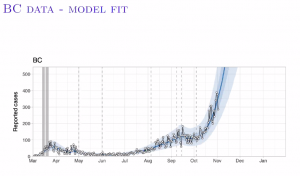
According to Dr. Colijn, BC worked hard to flatten the curve of cases when the pandemic began. As the cases started diminishing, BC started reopening: now their data shows an extreme second wave of cases that is larger than the original wave. Dr. Tupper noted that they can “predict things about the virus, but predicting policy maker’s behavior and public behavior [is] really hard to do.”

Image Courtesy of MAGPIE Research Group

Dr. Stockdale elaborated on some of the challenges they face when analyzing their data. Researchers need to “balance picking a model which is complicated enough that we think it’s really representing what’s happening in the real world, but also simple enough that we can be confident in our estimates and also that it’s interpretable” for the public or fellow researchers.  

During the question period, some asked about the danger of asymptomatic carriers. Nearly 2040% of adults and 40% of school-aged children are infected with COVID-19 and never develop symptoms, according to Dr. Colijn and Dr. Tupper. They added that it’s difficult to have concrete numbers, as they don’t know the rate of false-negatives. These carriers spread the virus to others in the community. Dr. Stockdale commented on the importance of physical distancing in these scenarios. She stated that “the people who are physical distancing are less likely to go out and see people, so they’re less likely to get infected [therefore] if a social distancing person does get infected, because they’re seeing others less, they’re less likely to pass on that infection.” Dr. Colijn also said that social bubbles of six people are extremely helpful in slowing the spread of the virus.

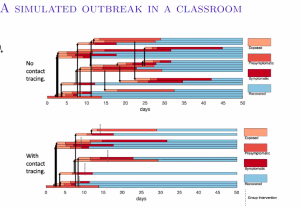
Discussion also took place around the COVID-19 cases in elementary schools. Dr. Tupper concluded that “it seems that ventilation is very important” alongside the wearing of masks and physical distancing to keep cases low. Dr. Tupper presented models that show lowered predicted COVID-19 cases when intervention and testing happens in the classroom compared to the natural flow of infection with intervention and testing. He stated the projections concluded that contact tracing and close monitoring “[reduces] the size of the cluster” by less than 50%. 


Image Courtesy of MAGPIE Research Group

Furthermore, Dr. Colijn elaborated on their future work in “[understanding] something about local transmission” and the diversity of the genome sequences found all over the globe. Her example was that if two colleague’s virus genome sequences are not similar enough then they can conclude that they haven’t infected each other. According to Dr. Colijn, they can use that data to “really improve the monitoring and control of transmission” by separating which strains are increasing and which are falling away. Dr. Colijn noted that the end idea “would be to [ . . . ] trigger action to look for strains that might be escaping a vaccine.” 

Dr. Colijn further explained that “as far as we know right now, the diversity of the virus isn’t suggesting that we need different vaccines for different places” or different strains and that COVID-19 is mutating at one-third the rate the flu does. 

Dr. Colijn concluded by noting that for more information she recommends watching the documentary Totally Under Control. She “found it to be like watching a very slow and fascinating trainwreck.”

Student swears by swimming in dense scholarly articles for quarantine workout

0
PHOTO: Nikko Macaspac / Unsplash

By: Paige Riding, Humour Editor

When this pandemic started, I really didn’t go out and move around as much as I used to. With half the population deciding to take up running or biking for the first time in their lives during this ample opportunity to spread their little spitties everywhere (why did so many people do that? Imagine voluntarily running at all, not to mention now?), I didn’t love the thought of going out. Now here I am, eight months later, and I’m absolutely shredded. Want to know how I did it?

By sitting on my ass. 

Desperately trying to get through a single sentence in my assigned article readings.

I should clarify; when I say shredded, I mean it. My eyes are destroyed from all this blue light I’m glaring at. Thanks to my professors opting for four times the amount of readings now that we’re online (makes sense to me), I can’t focus three feet in front of me. I don’t need to, though. All I need are the articles to keep me in tip-top shape. 

The process is simple. I open yet another photo-only PDF, sigh as my warm-up because that means no hunting for the answers to this assignment, then prepare to get lost. Totally lost. Wholly lost. Why-the-shit-are-the-sentences-so-long-and-complex lost. Then the blood really gets pumping. Or boiling. Or both.

Nothing hits like a sentence with more commas than my grade 10 papers when I just discovered what FANBOYS are and absolutely ran with them. Like a relay, the sentences will continue trudging along, heading in one way and then the next, so utterly and wholly bewildering you will find yourself hunting for the end of the sentence in preparation, then losing your spot because you didn’t put your fingertip on the right word or you swore you would remember but then got lost somewhere on line 14 and had to blink your sore eyeballs, and—

You get it.

It’s a foolproof way to exhaust any motivation you had to do well in the course — possibly even your life! The jargon forces you to leave the PDF to look up various definitions, adding a bit of spice in the mix. By the end of it, you’ll reach your fullest form. Having 23 articles to get through may be a temporary problem, but the knowledge you absolutely will not pick up from wasting your time trying to decipher these things lasts forever.

Why risk heading to a gym or the outside world when that one oddly specific multiple choice question from that one article you swear you read that one time makes you sweat enough? Are these sentences dizzying enough for you, yet? And this piece isn’t even peer-reviewed! Trust the scholars dedicating their lives to having their abstracts alone sourced by students because they saw the first main sentence and dipped. They know what they’re talking about. At least, I think they are?

The Bright-er Side: Greater understanding from professors has been amplified by the pandemic

0
ILLUSTRATION: Siloam Yeung / The Peak

by Meera Eragoda, Arts & Culture Editor

Remote learning has been good at times, but the transition has also been stressful at times. Many of my online classes now have discussions on Canvas which require an extra effort to formulate ideas that wouldn’t be present in in-person classes. This, on top of extra smaller assignments, a pandemic that doesn’t show any sign of abating, tumultuous politics in North America, and dealing with personal issues, is less than ideal.

These past two semesters, however, I’ve been lucky enough to have professors who are understanding of all of the above. The transition to online learning hasn’t been easy on many of them either, but their willingness to accommodate students’ struggles shows that the pandemic hasn’t hardened all instructors. 

When I talked to one of my history professors last semester about missing a couple of discussions, he not only told me not to worry about them, but also that I didn’t need to do the upcoming one. This semester, I asked my labour studies professor for a 24-hour extension for an assignment and was granted an extra week. This professor also told our entire class that he wouldn’t be taking marks off for late assignments and that people don’t need to stress about handing them in on the same day.

Many instructors have also amended their curriculum to include less stressful assignments (or at least not stressful in the same way). A class that I was going to take last semester had changed an assignment from a very research intensive paper to an account of life under COVID-19. This flexibility allowed for students to only recount their own experiences and not have to worry about having to source information from libraries and navigate archives virtually.

Even though some of these allowances are pretty minor things, having instructors be so flexible is beyond important for students’ well-being and I’m incredibly appreciative. As the talking point goes, “we are in unprecedented times.” For instructors not to recognize that and be a little less understanding when setting deadlines and assigning work adds more stress on students. I know it’s not always possible to be flexible but more professors should be trying where they can.

Podcasting Your Research paves a pathway to a new audience

0
The workshop emphasized the democratic aspect of podcasts and gave an overview of the technical skills needed to start one. PHOTO: OCV Photo / Unsplash

By: Emma Jean, Staff Writer

Academia and podcasting have a similar problem: unless you’re involved in them, they seem incredibly intimidating to get into. With academia that’s mostly true; a number of economic, systemic, and personal reasons make it inaccessible for a lot of people. With podcasts, however, that isn’t the case — to the same extent. If you have access to a recording device, editing software, and an internet connection, that’s all you need to share your work with the digital world. So what happens when you blend the two worlds together? According to SFU associate publishing professor and podcaster Dr. Hannah McGregor, you find a way to “mobilize knowledge” to a brand new audience. 

In McGregor’s online workshop, Unlock Your Research Impact: Podcasting Your Research, co-hosted with Lupin Battersby, she laid out the approaches that academics and enthusiasts take in creating podcasts, and a DIY plan for how to start one with no experience. As the host of Secret Feminist Agenda and Witch Please, Dr. McGregor’s experience as a podcaster is evident throughout the event, as is her enthusiasm. 

As she sees it, there are two main types of informative podcasts: radical amateurism — amateurs who research their passions and present that in a thought-provoking way — and nontraditional scholarship — academics who want to modernize their research and make it accessible to anyone who’s interested. If you think you could fall into one of those categories or even a blending of the two, McGregor had some DIY tips of what you could do to start a podcast tomorrow. 

As the workshop continued, McGregor created a step-by-step roadmap for aspiring podcasters. The first step is understanding the basics: podcasts are MP3 files that are uploaded to RSS feeds, or as she puts it, “a beautiful relic of an earlier internet.” She noted that, because of bare-bones minimum of the work and the non-algorithmic or corporate-driven platforms that they’re found on, podcasting remains a largely low-barrier medium where truly anyone could break through and find an audience. If you can understand those basics, you’re on your way to becoming a podcasting superstar. Pack it up, Joe Rogen. 

Next comes the technical part: understanding how to record a podcast. As McGregor puts it, learning how to podcast is like learning to play the guitar: you can learn the basic elements, play the top 40 hits and be just fine at podcasting, but mastering it takes a lifetime. Once you’ve chosen a format based on your topic and the labour you wish to put in, which she emphasizes varies wildly depending on which kind you choose, you can start writing, recruiting, researching, and producing the details you need to do it. 

The third part quickly turned into tech rundown as instructions on how to make a podcast took place. McGregor threw down pointers for how to make the best product you can:

  • Recording: 
    • A microphone — preferably analog for quality or USB for convenience (can be found for a low cost at electronics stores or online marketplaces like Facebook);
    • A quiet, sound-baffled space — blanket forts encouraged.
  • Editing:
    • For software, McGregor recommends Hindenberg as the best software and Garageband and SFU Library’s Adobe Audition as the best zero-to-low-cost options;
    • Back up all your audio files;
    • Create a distinct “audio palette” and style guide made up of the signature sounds, music and speech for your podcast that make you recognizable.
  • Publishing:
    •  RSS feeds will do the work for you, but find your best method.
  • Publicizing your work:
    • Find your audience and promote your podcast where they are.

With the rapid-fire advice, the workshop laid out a solid guide to hitting the digital airwaves. 

As McGregor spoke about podcasting as an often democratized, ground-up ecosystem, one that many people can access and contribute to, it seemed to offer an opportunity for the closed-off world of academic research to take notes. If greater access to information became possible, like it’s been through podcasting, that could lead to a more informed world. If you want to contribute to that, or if you’re just excited about what you’re learning and want to share it with the world, take McGregor’s advice and a microphone and go for it. 

An audio recording of the workshop is available on Soundcloud.

SFU Stadium Project delayed to early 2021 following initial delays

0
PHOTO: Gudrun Wai-Gunnarsson / The Peak

Written by: Mahdi Dialden, News Writer 

The previously anticipated SFU Stadium Project has been delayed after an update from senior director of Athletics & Recreation, Theresa Hanson. “We expect the stadium completion in early 2021,” Hanson said. The Peak had previously reported on the delay announcement in August 2020, in which it was anticipated the project would be ready by November 2020.

READ MORE: “SFU Stadium Project delayed to November 2020”

In an email interview with The Peak, Hanson said, “The SFU Stadium Project is well underway and progressing nicely. The unique, cantilevered roof canopy is in place, and is a beautiful feature of the stadium.” She added that “the seats will be arriving [on] campus shortly and are expected to be in place by end of November/early December.” The stadium will seat 1,800 spectators. The press box, football locker room, and other amenities are also being worked on as the project continues. 

Given the green light to begin construction in December 2018, the Stadium Project was most recently anticipated to be ready by November 2020, after a delay that urged the construction to be done by Summer 2020. Due to delays surrounding COVID-19, the project’s completion has been postponed again. The pandemic has “impacted the delivery of some materials, as well as the speed of work onsite,” Hanson said.  

The NCAA Division II fall championships sports of football, men’s and women’s soccer, volleyball, and cross country were cancelled in late August, and competitions across all varsity sports have been suspended until January 7, 2021. 

“At this time, the NCAA Division II winter championships sports of basketball, swimming, wrestling and indoor track and field are scheduled for March 2021, and we expect to make a decision regarding winter sports participation within our GNAC conference before the end of November.

“Football, soccer and track and field [teams] have been training on Terry Fox Field throughout the stadium construction,” Hanson explained. “For varsity competition, we are setting our sights on full stadium usage for the fall 2021 seasons, if the current public health situation allows for that.”

“We are exploring options to share a look inside the new stadium with our community in the New Year,” while adhering with physical distancing guidelines and limited attendance. 

To keep up with Terry Fox Field and the construction site, there is a live webcam on the SFU website that showcases the progress and is updated every 15 seconds for 30 minutes.