Home Blog Page 38

Tŝilhqot’in Nation calls for action around the toxic drug crisis on the global stage

0
This is a photo of the very tall United Nations Building in New York next to a body of water.
PHOTO: Nils Huenerfuerst / Unsplash

By: Zainab Salam, Staff Writer

On April 24, at the United Nations headquarters in New York City, a delegation from the Tŝilhqot’in Nation presented a plan to combat the toxic drug crisis within their six member communities. This initiative follows the Nation’s declaration of a local state of emergency in April 2024, prompted by a surge in overdose-related deaths. 

The First Nations Health Authority reported that in 2024, 427 First Nation members in BC died due to toxic drug overdoses. This figure represents an average death rate 6.7 times higher than that of other provincial residents, marking the largest disparity since the province declared a public health emergency over toxic drugs in 2016. Sierra William, Tŝilhqot’in Nation Youth ambassador, highlighted the crisis as a continuation of historical challenges faced by Indigenous Peoples, including the impacts of residential schools and past epidemics

In New York, the delegation emphasized the need for support from both the federal and provincial governments to “create Indigenous-led and culturally appropriate responses to the opioid crisis.” Chief Roger William of the Xeni Gwet’in First Nation — one of the Tŝilhqot’in communities — advocated for culturally centred programs, including on-the-land treatment processes and supportive recovery through equine therapy. Equine therapy is a “type of animal assisted therapy” using horses, which represent spiritual connection for First Nations.

He also addressed the challenges Tŝilhqot’in members face in healthcare settings, citing experiences of racism and discrimination. The First Nations Health Authority defines land-based treatment and healing as a return or reconnection “to the land while utilizing supports to relearn, revitalize, and reclaim our traditional wellness practices,” as “land is foundational to our Indigenous identity.” These practices are unlike traditional psychotherapy as they emphasize the importance of community and promote emotional and spiritual healing. It can involve “listening to Elders’ and Knowledge Carriers’ stories and guidance, sharing food/meals with family and community, and playing music with family and community.”

While the FNHA supports First Nations communities with harm reduction initiatives, such as take-home naloxone kits, safer use supplies, and opioid agonist therapy (medical treatment for opioid use disorder), gaps remain in these supports. Jenny Philbrick, executive director of the Tŝilhqot’in National Government, also noted that the Nation needs “‘more immediate resources,’ such as beds for people who are detoxing.”

The Peak reached out to the Ministry of Indigenous Relations and Reconciliation for a statement. We were redirected to the Ministry of Health, which acknowledged that the toxic drug crisis continues to disproportionately impact First Nations communities in BC, “in part due to the impacts of ongoing and intergenerational trauma from colonialism and racism.” Recognizing that Indigenous communities are best positioned to shape their own solutions, the province stated it supports the Tŝilhqot’in Nation in developing culturally grounded care. 

In 2023, the ministry “provided $455,000 to Tŝilhqot’in National Government to support two years of planning, engagement, and service model design for a Healing Centre.” This was followed by signing a letter of understanding — also often called a memorandum of understanding — with the Nation in September 2024 to formalize a partnership in developing the centre. A letter of understanding is “a document that contains a collection of tenets between two or more entities that intend to establish a relationship.” The Peak could not independently verify if the centre is currently being built or when construction will begin. This month, the ministry, Tŝilhqot’in leadership, and other partners met to explore ways to “strengthen the continuum of culturally informed and culture-based treatment, recovery, and aftercare services in the region.” 

The Nation is also advancing its local efforts. On May 21 and 22, they hosted “Reclaiming Our Indigenous Spirit,” bringing together members of the Dãkelh Dené, Northern Secwépemc, and Nuxalk Nations to engage in shared dialogue and strengthen culturally grounded responses to the toxic drug crisis. The Peak reached out to the Tŝilhqot’in Nation but did not receive a response by the publication deadline.

My hear me out cake

0
A cake with the following things on them: A block that says “Times New Roman size 12” on it, the Google Maps logo, the ChatGPT logo with a big X through it, and a picture of Venom.
COMPOSITE: Gudrun Wai-Gunnarsson / The Peak IMAGES: 1) Gudrun Wai-Gunnarsson / The Peak 2) Courtesy of Google 3) Courtesy of OpenAI 4) Courtesy of Walmart 5) Courtesy of Marvel

By: Sarah Sorochuk, Peak Associate

  1. Times New Roman (size 12)

This font has gyatt to be the original “hear me out.” With its classy formatting and fancy lowercase “a,” this is definitely the most bangable of the fonts. You cannot look at it and tell me you haven’t thought,dayammm, if only Times New Roman was a real person.” 

2. Google Maps

What is more smexy than something that knows how to navigate the way to your happy spot (it’s White Spot, you sick fuck)? And goddamn hearing a smart strong voice ordering you around. Just driving in a car, listening to Google Maps tell me what to do to get there is enough.

3. GPTZero

People being falsely accused of using AI is today’s version of the Salem Witch Trials. But unlike those alleged witches, us poor souls have a sexy superhero on our side. ChatGPT’s cousin — GPTZero. The powerful entity that can prove innocence and condemn the villains. All heroes have their kryptonite, and GPTZero might accidentally accuse you of being an AI (that’s OK — love-hate relationship). GPTZero is the brain and the brawn with power radiating off. 

4. The massive SFU Teddy from the pop-up Bookstore and Spirit Store

It’s (almost) cuffing season in Australia, so I definitely need a big boi. Big arms? Check. Warm and cuddly? Check. What is this big ole’ softy missing? Nothing. This fine shyt will surely get the job done and then stay with you all night long. You just have to walk yourself down to the SFU pop-up “Spirit” Store. 5,000% mark-up during convocation!!

5. Venom

I don’t know about y’all but my partners aren’t getting the job done right as of recently. So, this calls for some anti-hero-esque saving. Bring him in to have a first-hand view of  some mind blowing action and his long, luscious tongue will be the reward. You get it, girl. 😉

Peak Speaks: Answers from r/simonfraser!

0

By: Mason Mattu, Humour Editor

Q: If you had to marry a building on campus, which one would it be and why?

u/Matt_The_Slime: “Marry the library, wait for it to die from asbestos poisoning, take all its money after. EZ.”

u/manOmanytendies42: “The Lorne Davies Complex. I can fix her.”

u/Abscissaur: “I’d marry the AQ. I like my buildings how I like my partners: dark, sharp-edged, labyrinthine, and full of koi fish.”

u/AdWhole9935: “I’d marry the W.A.C. Bennett Library — because who wouldn’t want a partner that’s cold, confusing, constantly under construction, and full of information that no one wants to hear about? Nothing says ‘til death do us part’ like fluorescent lighting and the emotional warmth of a concrete bunker.”

A box of halwa and generational love

0
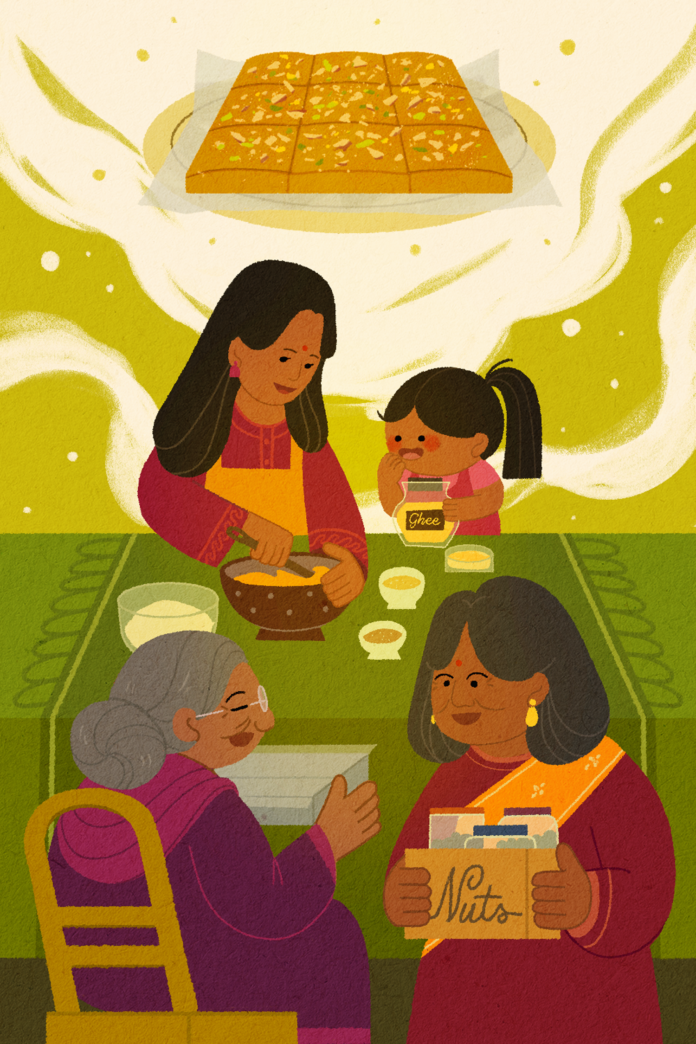
ILLUSTRATION: Four generations of women preparing candy. The piece is about a tradition of passing down a family candy recipe, so maybe like a cute and warm tone? The candy being made is Besan ki Barfi
ILLUSTRATION: Cassandra Nguyen / The Peak

By: Rusham Verma, SFU Student

It’s summer vacation. I’m only 12 years old and my maternal grandmother’s house is infused with the nostalgic smell of halwa made with atta — halwa is a smooth and velvety dessert, similar in consistency to a pudding, made by roasting atta (wheat flour), ghee, and sugar. I’m playing outside in the garden, surrounded by the beautiful flowers my grandmother has grown, taking in their fragrance with a hint of roasted flour from the kitchen. “Laddo, come here! It’s ready!” says my mom from the inside, and just as I open the door, the strong scent of roasted ghee and sugar hits me. I run towards the kitchen and see my grandma spreading the halwa evenly in a big box. 

“Yay! Thank you so much!” I say, hugging my grandma tightly. She kisses my forehead and pats my head. I take a bowl and transfer some of the halwa to it. My mom’s side of the family, being from the Sikh culture, has always had a rich cultural heritage. In our culture, we always go to a gurudwara to pray to god and as kada prasad (or “blessed food”), we get atte ka halwa — just like the one my grandmother makes. Kada prasad represents the “blessings of God.” Preparing and sharing it, like it’s done in a gurudwara, is meant to foster “unity, equality, and selfless service.” Selfless service: a principle of Sikhism known as “seva,” which my grandmother exemplifies so well. This halwa is a significant part of my life and culture, and gives me one more reason to cherish it when my grandmother makes it. I eat it hot, and it melts as soon as it touches my tongue, filling my mouth with so much sweetness. 

Never in my whole life has there been a time when I went to my grandmother’s house and did not eat atte ka halwa. It has become a comforting tradition that is not just upheld by me, but all my cousins. Every time any of us visits grandma, we do so knowing that the halwa will be ready upon our arrival; once, the day before a family event, my grandmother made halwa for all the cousins despite the amount of work needed. No matter, halwa is a way our grandmother shows love, so she even insists on making it all herself, no help allowed. So, every time, we just patiently watch her mix flour, ghee, and sugar while the mixture roasts and releases that distinctive sweet smell that brings me back to my childhood summers.

“This love gets passed on to the next generation as well. This recipe was taught to my grandmother by her mother, and then it was taught to my mother.”

Whenever I ask her to make the halwa, I always notice the crow’s feet beside her eyes and the twinkle in them, her lips turning into a big smile, and her feet moving on their own accord to the kitchen as if it’s second nature to her. Even though her recipe is similar to many, her love for us seeps through, making her halwa taste like none other. This is the love of my grandmother. This is just one of the ways she expresses her love for her grandchildren, and it’s perhaps the most treasured by us. 

This love gets passed on to the next generation as well. This recipe was taught to my grandmother by her mother, and then it was taught to my mother as well. So, this love is not just for the summer but for the whole year. My mom makes it with the same love that my grandmother does, and it tastes like it when eating. One random Saturday, I’ll ask my mom to teach me how to make it, just as she did with her mother. I already know the recipe, but learning it from my mom will give the experience a different meaning — it’s a tradition, a core memory that will last us forever. I feel extremely lucky to be a part of something so special. 

This generational love is what makes family worth cherishing. Getting halwa here in Canada, 11,500 km away from my grandmother, is not hard, I can always visit the nearest gurudwara and get some. However, it will never have the love she puts into making it. Halwa is not only a sweet treat, but a reminder of my grandmother’s love.

What Grinds Our Gears: Ignoring laundry etiquette

0
Photo of a person waiting at a laundromat
PHOTO: Mathias Reding / Unsplash

By: Michelle Young, Co-Editor-in-Chief

Last year, I wrote a piece about how shared laundry rooms grind my gears. Well, upon reflection — it is not the shared laundry rooms that bother me, but rather, the completely irrational and inconsiderate attitude that other people display in them. 

One day, I was going to do my laundry, when I noticed two giant IKEA bags topped to the brim with colourful bath mats sitting by the sink. The bath mats were spilling out of these bags onto the counter. I thought nothing of it at the time (though it is disgusting), and loaded my laundry into a free machine. When I returned to pick it up, I was horrified to find one of these nasty bath mats smothered on top of the machine I had loaded. Laying askew, glaring at me with filthy, dust-filled eyes, I took a deep breath and attempted to open the machine without touching it. 

When I came back later on, to pick up my clean sheets from the dryer, I was even more disturbed to find that these bath mats had been shoved into the drying machines with “HOT” and “HEAVY” written on the cycle. This is a fire hazard! While luckily my building did not burn down, I truly wish it wasn’t so much to ask that people do not stick an abundance of rubber into a steaming hot drying machine. And honestly, what are you doing with so many bath mats anyways? Why do you need 50 of them? Can’t you keep flammables away from the laundry room like the rest of us?

Introducing the fabricommons

0
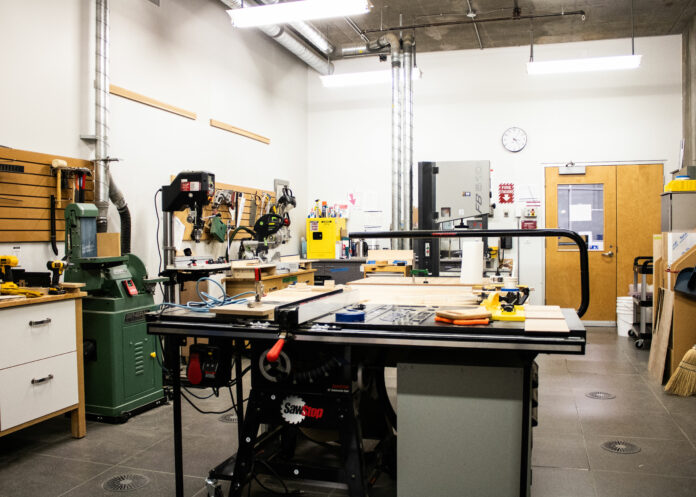
The photo shows the interior of the fabricommons at SFU Surrey at Fraser Library, including equipment such as sewing machines
PHOTO: Prerita Garg / The Peak

By: Rusham Verma, SFU Student and Phone Min Thant, Arts & Culture Editor

In February, SFU Surrey established the fabricommons at the Fraser Library in collaboration with the School of Interactive Arts and Technology (SIAT). Described as “a hands-on learning space,” it has numerous equipment for various creative and professional uses: 3D printers, sewing and embroidery machines, direct to film printers, heat presses, and many more. To learn more about the lab and its significance to the SFU community, I had a conversation with Leanna Jantzi, head of Fraser Library, Mikael Kriz, Makerspace librarian, and Thecla Schiphorst, associate director and professor at the SIAT.

The fabricommons were inspired by SFU Burnaby’s Media and Maker Commons. Kriz said, “Probably our number two biggest request since we opened the Media Maker Commons on the Burnaby campus in 2020 has been ‘Can you please open this space in Surrey?’” Its inception has also been motivated by concerns of community outreach, as Schiphorst explained how the commons would be of service to various demographics that are at the heart of Surrey. 

The commons aim to fill the gaps in equipment in Burnaby, as Kriz explained. “What we did not have a lot of in the Burnaby makerspace were textiles [ . . . ] With the growth and interest in studying and creating wearable technologies, it was really important for us to create a space that was very dedicated to this type of future project.” When asked about the potential to push the creative boundaries of artists, Schiphorst elaborated, “We teach design and we teach media art as well, so we are considering having workshops of artists and designers that do interactive fabrics to inspire students [ . . . ] It is an open space for things that are physical because the physical world is not going to go away. The physical world can help us consider our relationship to the digital world.”

“Accessibility feeds creativity. So by removing barriers, our hope is that it does invest and encourage creativity.” — Leanna Jantzi, head of Fraser Library

Accessibility remains the core tenet of the fabricommons. Jantzi added, “Not all of us can afford these pieces of equipment, not all of us know how to use these things so we need someone to show us so, by removing those barriers, the hope is that it does invests and encourages creativity just by [urging everyone] to come in and try it out without any fee.”

For students testing the boundaries of the new equipment, Jantzi suggested a process that may help them settle in. “First, make an appointment. All the information is on the website. As a first-time user, you would be making the appointment, doing a Canvas course specific to the piece of equipment that you are interested in. On your first appointment, you are going to be meeting up with a graduate facilitator in the space who will walk you through everything, and as you come back and get more familiar, you can engage more.”

As the commons gains traction, Jantzi is hopeful that more feedback from students will be helpful in improving not only their experiences using the room, but will also contribute towards better learning and creative opportunities. If you happen to have a class or simply are visiting SFU Surrey, make sure to give the fabricommons a visit and learn a new — and important — skill!

We Belong to the Land: Vital Signs at the Bill Reid Gallery

0

This is a photo of the Bill Reid Gallery central atrium including various Indigenous paintings and artifacts
PHOTO: Amirul Anirban / The Peak

By: Kyla Wane, SFU Student

Have you ever noticed how spokespersons at public events — SFU or otherwise — take a moment to recognize the unceded territories of the xʷməθkʷəy̓əm (Musqueam), Sḵwx̱wú7mesh (Squamish), and səlilwətaɬ (Tsleil-Waututh) and many other Indigenous communities? 

The more I heard land acknowledgments, the more I was compelled to learn about the land we stand on. Over the past decade, public recognition of the injustices faced by Indigenous Peoples has become more common. They are a step toward recognizing that this land was never surrendered, nor was there a treaty or any agreement to hand over these territories.   

Land isn’t something to own but rather something to preserve. Vital Signs, an art exhibition at the Bill Reid Gallery of Northwest Coast Art captures these ties. It’s one of two exhibitions currently on display at the gallery from May 14 to September 7. The exhibition features artworks from artists originated from Indigenous Nations and communities as wide ranging as Nlaka’pamux, Syilx Okanagan, Kaska Dena, Hupačasath, Leq’a:mel, Kwakiuł, Dzawada’enuwx, Sḵwx̱wú7mesh, and Tahltan. The exhibit title “refers to the measurement of the body’s most basic functions,” but also “how the land is essential to our being and is a living entity itself.”

Aliya Boubard (Sagkeeng Anicinabe) and Amelia Rea (Ts’iits G’itanee), co-curators of the exhibition, said that their aim is to “help others understand the love and care that Indigenous people have for our traditional territories, and how important it is for us to advocate for the land. Without the ability to hunt, fish, or gather plants and medicines, our communities would be lost. The land is simply not just one part of identities, it is the entire foundation of our cultures and way of life.” They also added that the climate crisis is harming Indigenous communities — “In BC alone, we have seen the impacts of drought, fire, as well as the scarcity of crucial animal, insect, and plant species due to the extreme weather patterns and resource extraction across the province.” 

The gallery, established in 2008, pays tribute to Bill Reid, a celebrated Haidan artist, writer, and activist. He was named Yaahl Sgwansung (“The Only Raven”), in 1986 and is known for his monumental works like the Killer Whale at the Vancouver Aquarium and the Spirit of Haida Gwaii at the Vancouver International Airport. The museum is divided into a permanent collection and three temporary exhibitions per year. 

Even if our traditions differ, we all share the responsibility of preserving this earth.

On Friday, May 16, I visited the gallery and was pleasantly surprised to learn that admission was free for SFU students. The space is split into two levels: the permanent collection downstairs, with works of Bill Reid and Christian White, and the upstairs gallery with the Vital Signs exhibition. 

The exhibition features six prominent Indigenous artists: Jade Baxter (Nlaka’pamux), Jasper Berehulke (Syilx Okanagan), Kali Spitzer (Kaska Dena), Kwiis Hamilton (Hupač̓asatḥ, Stó꞉lō), Rebecca Baker-Grenier (Kwakiuł, Dzawada’enuwx, Sḵwx̱wú7mesh), and Sage Nowak (Tahltan, Vuntut Gwitchin). Through their painting, photography, video, and poetry, each artist reflects on the impact of climate change on their traditional territories. Their art is a way for them to be recognized as creators, but also as a way to honour their roots and relationships with the land.

One artwork that stayed with me was by Kwiis Hamilton, titled “Sayaasim min Nismaqkin” (In the future we belong to the land), accompanied by a powerful poem. In the painting’s description, he explains that it captures the “physical representation of our connection to the land we come from,” and supports the idea of contrasting extremes: “Life and Death, Hurt and Healing, Walking and Dreaming.” He reminds us that in times of change and uncertainty, remembering our roots and our belongings allows us to move onward.

While the painting holds transformation and ancestral presence, the poem offers a voice that claims space and identity. The passage that resonated with me was: “Belonging doesn’t mean / fitting into a box / It means breaking that box open / Smashing it to bits / So we can share all of who we are / with our beloved community / with our family and friends.”

His work makes clear that belonging is not just an individual identity but a shared responsibility to each other as a community, and the land we depend on. It captures the essence of climate change, as not only an environmental but also cultural crisis.

Today the world grapples with the fact that climate change is a pressing issue. In addition to acknowledging that the land doesn’t belong to us, we also have to make sure that there is still land to live on. We all share the responsibility of preserving this earth. This exhibition has shown me that sustainability and resilience should be a collective concern. 

Summoning buses in the summer

0
PHOTOSHOP: of a dialogue text coming out of her mouth saying: "Thank heavens I have found a dial telephone! My diesel-drawn 143 Burquitlam carriage is merely hours away!" and then at the bottom add as a caption: "TransLink: reducing bus frequencies to piss off students since 1998."
PHOTO: Mason Mattu / The Peak EDIT: Gudrun Wai-Gunnarsson / The Peak

JOB AD: AQ Accident Control Officer

0
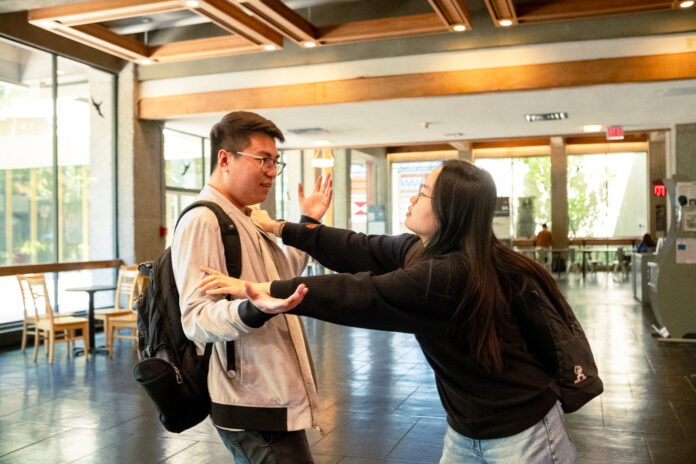
A man shoving a woman out of the way in the hallway of the Academic Quandrangle.
PHOTO: Emily Le / The Peak

By: Mason Mattu, Humour Editor and Sarah Sorochuk, Peak Associate

Feel an urge to make a difference in the world? Do you have big muscles and are built like a Greek god? Are you ready to block student hooligans who dare walk on the wrong side of the hallway? We have just the job for ya! 

AQ Accident Control Officer — A paid position starting at $2 every 3 hours (legal note: accident control officers will be officially labelled as freelancers to save us some big bucks. Attempts to unionize will result in banishment from the realm).

Seeking multiple students to work on each floor of the AQ in between classes (during peak travel time) to prevent further collisions and future lawsuits. Applicants must have a strong understanding of the violent situation at hand. Background information is provided below: 

A (BRIEF) BRIEF ON THE SITUATION: 

The AQ has been known for countless runovers and walking traffic incidents. Since the dawn of time, and everywhere on earth, people have walked on the right side of the hallway. Everywhere but SFU. This is causing some major emotional and physical damage, with 50 students being involved in “got run into by a person walking on the wrong side of the hallway-and run” encounters. Here is a victim’s testimony

“Last Monday, I was on my way to Classic Shakespearian Lit [ENGL 312] with an extra-large vegan cucumber coffee in one hand and my own personal copy of Romeo and Juliet (the smut edition) in the other. Out of nowhere, I was violently run into by a HOOLIGAN who was walking on MY side of the hall. It was a horrible attack on my life and the sanctity of the AQ. This ought to be ILLEGAL!” — Anonymous SFU arts student

MORE ABOUT YOUR JOB: 

As an officer with the AQ Accident Control, you will be tasked with enforcing the right way of the hallway rule for all students. We’ll provide you with a safety whistle, a vibrant safety vest, and a 2010 Blackberry with the latest ticketing software installed. Extra perks include receiving a get out of class earlypass for officers in lieu of benefits or dignity. 

Officers are not allowed to use force, and will instead imitate a common enemy of delinquent students: a 1,000 year old professor who refuses to give out A’s. 

You will also be in charge of providing students who have been run into by someone walking on the wrong side of the hallway with emotional support. Please do not refer them to our SFU counselling department if they’ve exceeded the three complimentary appointments for the year given to each student.   

Job requirements:

  • Must be a second or third year SFU/FIC student looking for an easy way to make some quick cash.
  • Have no social life and can work at all hours of the night.
  • Are happy to be the center of attention, by being loud and disruptive to the student body.
  • Have 2–3 years of acting or roleplaying experience. 
  • Come to work with a settled frown every day. 
  • Are willing to sign an NDA in case you decide to accuse us of labour violations. 
  • Look scary. Have a few piercings in your nose, belly button, and thumb. Make them believe you are an emo guard. Really make it feel like you’re gonna kick the shit outta them if they walk on the wrong side of this here hallway.

Apply by emailing: [email protected]. Deadline: 3 hours ago.

Concerns arise around controversial instructor’s past

0
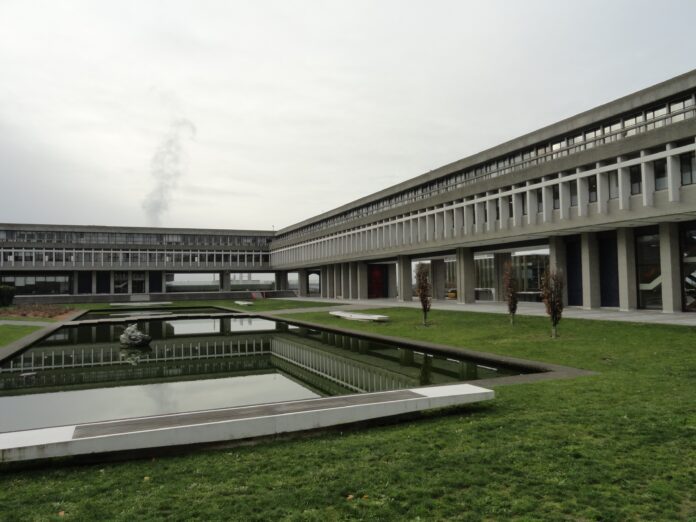
This is a photo of the outside of SFU Burnaby’s academic quadrangle on a gloomy day.
PHOTO: Puneet Aulakh / The Peak

By: Lucaiah Smith-Miodownik, News Writer

Content warning: mentions of sexual violence, misogyny, the death penalty, homophobia, and transphobia.

SFU has recently come under fire for its alleged decision to hire Gleb Glebov as a sessional instructor for the 2025 summer term. He is not currently on the summer calendar, where he was allegedly slated to teach EDUC 313. Taryn Lees, a student in the teacher education program, told The Peak that she noticed the instructor had been changed when she checked goSFU. Glebov was previously fired from Fraser International College (FIC), an affiliate of SFU located on the Burnaby campus, for a series of YouTube videos he posted. CBC reported he claimed rape allegations were made up justifications for abortion, advocated the death penalty for those “who have abortions and the doctors that perform them,” characterized both homosexuality and transgender identities as “garbage,” claimed all non-Christian gods to be “the antichrist or satan,” and more.

In November 2019, Glebov was a math instructor at FIC when the school received an anonymous tip regarding his videos. In the following weeks, after a meeting with FIC’s director and an investigation into the content of his recordings, he was fired. Glebov’s videos, which the director described as containing “potentially hate speech,” violated FIC’s “professional code of conduct for teachers” as well as the school’s “conflict of interest policy.” 

He alleged religious discrimination over the decision, claiming that “the videos were made in the context of a sermon.” In response, “FIC argued that, no matter how deeply Glebov believed in the things he said, he needed to prove [that] his freedom to practice his religion would be compromised if he couldn’t post these statements on YouTube.”

“Given that students in the program are expected to demonstrate program goals which include ‘an openness to worldviews’ and ‘celebrating diversity,’ it is unacceptable that they should pay to be educated by an instructor who so clearly violates them.” — Taryn Lees, petition starter, teacher education program student

Glebov brought his complaint to the BC Human Rights Tribunal, which ruled against him in January 2024 by finding he “failed to demonstrate a genuine religious belief requiring him to publicly share his views.” Glebov also left Capilano University in February 2024, with the university telling the Capilano Courier he was no longer “associated” with the institution. It is unclear if Glebov was fired from Capilano University.

A student petition against SFU’s alleged decision to hire Glebov began circulating in March, with over 450 supporters. EDUC 313 “is one of few options that teacher education students in the secondary stream can take to satisfy a graduation requirement,” Lees, who started the petition, wrote. “Given that students in the program are expected to demonstrate program goals which include ‘an openness to worldviews’ and ‘celebrating diversity,’ it is unacceptable that they should pay to be educated by an instructor who so clearly violates them.

“The integrity of the program and the safety of teacher education students — particularly women and 2SLGBTQIA+ students — is in jeopardy so long as Gleb Glebov remains a sessional instructor for our program,” the petition continued.

The Peak reached out to SFU Glebov’s employment status, who provided the following statement: “We take all allegations that contravene our values of inclusivity and belonging seriously, as well as our commitment to foster a safe work space. Due to privacy obligations, we cannot comment on specific employment matters for any employee, past or present.” SFU could not confirm whether Glebov had already taught at SFU in 2023. The Peak reached out to Glebov as well, but did not hear back by press time.