Home Blog Page 36

Which Metro Vancouver mayor are you?

0
Port Coquitlam mayor Brad West rocking a brown beard with his black hair. Once again, an abnormally large forehead.
ILLUSTRATION: Yan Ting Leung / The Peak

By: Acting Chief of Apologies and Lawn Signs

Metro Vancouver mayors are more than just civic leaders; they’re a cast of characters from a random political sitcom none of us asked to be a part of. Whether they’re beefing with the BC government, filing defamation lawsuits, or being paid in gold bars (probably), these leaders are here to provide solace, so you know you aren’t the only one making questionable life choices. 

Which Metro Van mayor are you most like? Take this quiz to find out. 

1. A scandal breaks out. How do you react? 

      1. File a defamation lawsuit, hold a conference, and remember to rep Bitcoin
      2. Dramatically clutch your foot (that you claim has been run over) before shaking it off and heading into Save-On-Foods. 
      3. Redirect the rage into censuring an innocent city councillor trying to save trees, and then proceed to rant about cell tower coverage
      4. Say nothing. Refuse follow-up questions. Vanish into a TransLink committee.
      5. Change your mind, then ask your popular friend to vouch for your integrity. 

2. How do you handle bad press? 

      1. Apologize with charm and nonchalance. After all, it’s the “imperfect systems.” 
      2. Lawyer up. Bill the $300,000 to the city. Run for another election and act surprised when you lose. 
      3. Ignore local issues and focus on the province — explain your extreme dissatisfaction about how the ones you call  “do nothing” people, have a voice and don’t want pipelines built in their back yard. 
      4. Refuse to comment on anything or shake anyone’s hand after all is said and done. 
      5. Pivot to community building and avoid $100K vacations, for now.

3. What is your relationship with money like? 

      1. You own shares in Ethereum, have rich friends, and want to replace Park Boards with spreadsheets. 
      2. You rely on the city to pay legal fees over your personal dramas. 
      3. You want to slash everyone’s pay but yours.
      4. You are paid by every board in existence. 
      5. You say no to bullying but yaaaaaaas to a total of $393K in compensation and salary. 

4. What issues get you fired up? 

      1. People who care about parks and hate crypto. 
      2. Cronyism, public mischief, and foot-related injuries
      3. Harm reduction and hard-working city councillors.  
      4. People questioning your salary. 
      5. American tariffs and non-disparagement pacts with Big Oil (that is totally not a gag order). 

Mostly A’s — you’re Vancouver’s mayor, Ken Sim

Vancouver mayor Ken Sims. He has an abnormally large forehead and a combover haircut.
ILLUSTRATION: Yan Ting Leung / The Peak

You can host TED Talks and participate in court hearings in the same week, and believe in bitcoin as your religion. Your mantra? Apologize like CEOs, with zero follow-through!

Mostly B’s — former Surrey mayor, Doug McCallum, is that you? 

Former Surrey mayor Doug McCallum. He has wrinkles all over his face and looks exhausted.
ILLUSTRATION: Yan Ting Leung / The Peak

You know exactly how to make yourself the main character of every story — down to grocery trips with alleged soft-tissue damage. Your personality quirk? You’ve never met a lawsuit you couldn’t expense. 

Mostly C’s — Port Coquitlam’s favourite dictator, Brad West

Port Coquitlam mayor Brad West rocking a brown beard with his black hair. Once again, an abnormally large forehead.
ILLUSTRATION: Yan Ting Leung / The Peak

You think the entirety of Metro Vancouver is too soft and you secretly love Big Oil. Your favourite things to do? Speaking to reporters, going on random podcasts to talk about issues that are literally irrelevant to your job as mayor, and pretending to be an NDP’er when you’re really a closeted conservative. 

Mostly D’s — a very rich hello to Richmond’s incumbent mayor, Malcolm Brodie 

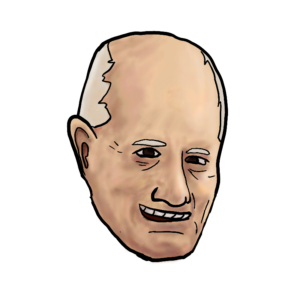
Richmond mayor Malcom Brodie. He has hair on the sides but not in the centre. He’s wearing glasses.
ILLUSTRATION: Yan Ting Leung / The Peak

You avoid eye-contact and accountability with ninja-like precision. Your super power? Being one of the highest-paid elected officials in BC. 

Mostly E’s — our very own, unchallenged, Burnaby mayor Mike Hurley 

Burnaby mayor Mike Hurley. He too has many wrinkles and looks very worn out/exhausted.
ILLUSTRATION: Yan Ting Leung / The Peak

You love to give “we’re all in this together” speeches and napping (real dad energy right there). Your talent? The ability to lose to the Trans Mountain pipeline project six times before letting them buy your silence.

My letter to the News Editor: It’s time to put the fake back in news

0
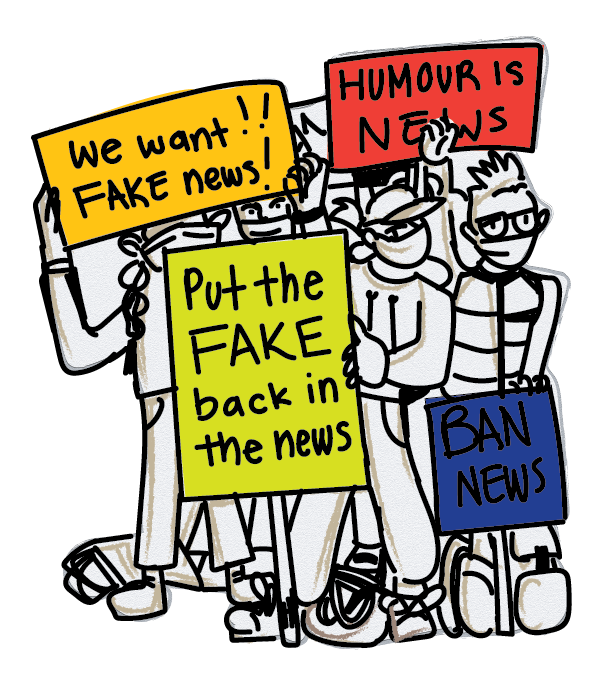
A group of students holding signs that read “We want fake news!” and “ban news!” and “put the fake back in news!” and “humour is news!”
ILLUSTRATION: Angela Shen / The Peak

By: Zainab Salam, Concerned Staff Writer

Dear Hannah (The Peak’s News Editor),

I write to you today as both a concerned member of the SFU student body and a staff writer for The Peak. With every passing day, I become more convinced that we must deviate from our current approach to journalism — fact-based, unbiased, legally sound — and find a more enthralling manner of sharing the news. Simply put, it is time to put the fake back in the news section of The Peak! If we have to trample over Canada’s libel laws to get there, so be it. 

I realize this may sound extreme. But ask yourself: When was the last time a meticulously accurate article about the Board of Governors moved you to tears? When did a careful summary of transit policy stir something deep in your soul? Yes, that’s right, NEVER! But imagine this headline: “SFU administration revealed to be a single wizard in a cloak: ‘Budget cuts are an illusion,’ says source.” Now that’s some cool shit. 

To me, news should be a gossip session. Spill the tea and meet no ramifications, or maybe do. Honestly, who cares? If the last paragraph doesn’t hit me with “xoxo, gossip peakie,” what are we even writing the article for? I need to end up more confused than I started. Don’t clarify, don’t expand — and if you have a source for your claim, don’t cite it. Make me work for it!   

To show that I am not alone in my yearning for fake news, I cornered a recovering News Writer, and present Humour Editor, Mason, while he was rushing to his Theoretical Physical Education course

Interview Transcript: 

Q: Mason, what are your thoughts on fake news? 

Mason: Honestly, I wish I had written more of it while working in news. I was bound by the ethical constraints of “journalistic integrity” and “laws,” but if I could go back, I would’ve made up at least 30 things a week in my pieces. 

Q: Do you regret not embracing libel? 

Mason: Every day. Libel is the only path to freedom. Real journalism has a spirit. Libel is how we thrive. 

Q: What advice would you give the News Editor? 

Mason: Free yourself. Ditch the fact-checking. Leave your ethical standards in a recycling bin behind Renaissance. Create chaos. Journalism should be dangerous, not accurate. It should be something you’re legally advised not to print. If your source says “no comment,” just make one up. Let lawyers fear us, loathe us, be annoyed by us! It’s time to take a stand and rebel. 

Mason’s wisdom is hard to ignore. He spoke with the conviction of a man who once tried to cite a Reddit comment as a primary source. 

I believe with the adoption of more baseless claims, we will be at the forefront of everyone’s minds. Imagine the joy, the confusion, the cease-and-desist letters! Imagine The Peak standing proudly as the province’s, nay, the nation’s most sued student paper. 

I thank you for your time, and I hope you’ll consider liberating student media from its fact-based cage. After all, if we don’t lie in the service of the truth, who will? 

Sincerely, 

Zainab Salam 
Staff Writer @ The Peak

Against climate realism: reclaiming climate futures

0
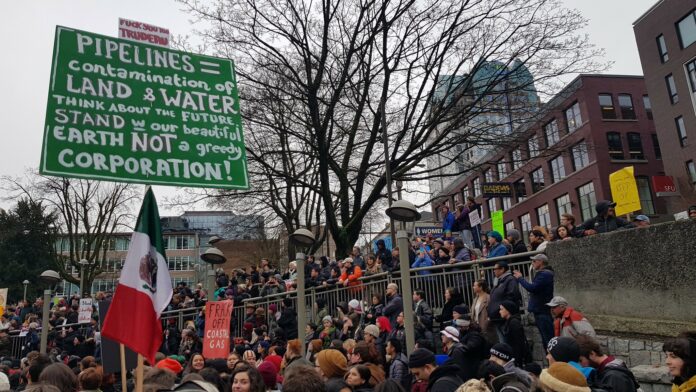
A protest against a pipeline in a city
PHOTO: Jen Castro / Flickr

By: Ashima Shukla, Staff Writer

In a recent article for the American think tank Council on Foreign Relations, senior fellow for energy and climate Varun Sivaram proposed a new doctrine for climate policy: climate realism. This seemingly pragmatic approach argues it’s impossible to avert climate change completely. Instead, it claims the US should favour more profitable and geopolitically strategic ways of managing climate consequences. 

In truth, climate realism is anything but realistic. This elitist discourse cloaks inaction, securitization, and racialized control.  For example, Sivaram weaves a story of how carbon emissions from “emerging and non-advanced economies” are threatening the survival of American society to justify penalizing countries in the Global South that use fossil fuels. Behind this facade lies an unsettling truth: climate realism is a luxury afforded only to those distant from disaster. For Indigenous communities around the world, this “climate apocalypse” is a long-lived reality. For many of us, the dystopia is now. 

But even on capitalism’s own terms, climate inaction is a losing game. In 2022 alone, climate-related disasters cost the global economy over $430 billion CAD in economic losses. Rising sea levels could add another $550–715 billion CAD per year by 2100, along with 250,000 more lives lost annually from 2030 to 2050

Yet, what this so-called realism sidelines holds our greatest hope: Indigenous communities across the world embody models of climate resilience based on reciprocity, relationality, and collective care. The Anishinaabe, for instance, find resilience in their heritage of fluid governance systems. These systems shift with seasons, mirror the dynamic rhythm of their ecosystems, and exist in conversation with the land, ancestors, and descendants

For Indigenous communities around the world, this “climate apocalypse” is a long-lived reality. For many of us, the dystopia is now.

The Menominee tradition similarly shifts our idea of space and identity, breaking down the human/non-human binary. When elder maple trees become our guardians, the forest is no longer a resource to be exploited. Confronted with settler colonialism, the Menominee ancestors chose kinship with the non-human, imagining sustainable harvesting practices that ensured the land’s long-term health. In doing so, they transformed the forest into a space of mutual learning, where Indigenous knowledge can be practiced alongside ecological science. The forest, then, is not only a source of economic sustenance but also a living, breathing archive of Menominee cultural endurance and wisdom. 

What might climate responsibility look like if we learned from such intergenerational accountability? If we followed environmental professor Robin Wall Kimmerer in integrating traditional ecological knowledges into conservation and began to ask not only “How do we return the gifts from our ancestors?” but also “How do we become good ancestors ourselves?” 

These are not just peripheral climate strategies but living embodiments of the 4Rs at the heart of many Indigenous knowledge systems: respect for all beings; relevance rooted in lived, localized experience; reciprocity as a fundamental ethic; and responsibility to care for what we inherit and leave behind. Climate realism, by contrast, is top-down, neocolonial, and ultimately nihilistic. And while despair, exhaustion, and grief are valid responses to a world built on organized greed, activist and prison abolitionist Mariame Kaba reminds us that “hope is a discipline.” It is a daily practice, a refusal to surrender, and a commitment to imagine otherwise. It is organizing, remembering, dreaming. 

Kimmerer, in her book Braiding Sweetgrass, explains that reciprocity is not a metaphor — it is a political imperative. We find ourselves in a profound contradiction where decay and delusion coexist with radical potential. We face stagnation and suffocation. And we also face a moment of rebirth: of resistance, of relational thinking, of decolonial worldmaking. The question isn’t whether alternatives exist, because they do. The question is whether we have the courage to learn from and live with them, for the world pulsing beneath our feet.

When the state kills, who is the enemy?

0
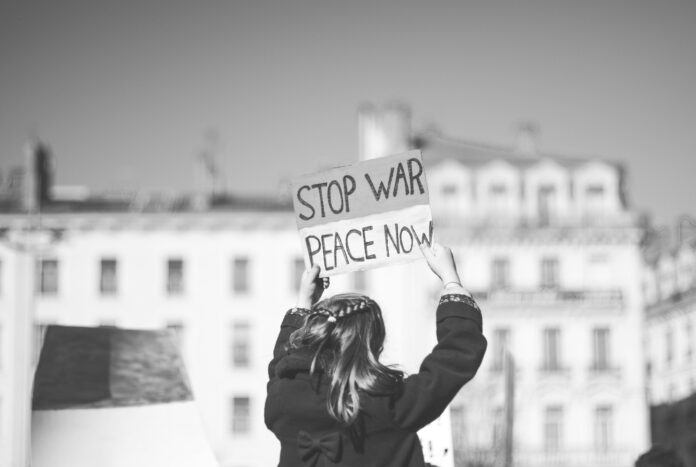
A person holding a sign that reads stop war, peace now
PHOTO: ev / Unsplash

By: Ashima Shukla, Staff Writer

Content warning: Mentions of war, violence, and death.

We are often told war can be justified. Our history textbooks glorify national victories. Our films wrap bloodshed in orchestral scores. Our news headlines echo political speeches about defending our honour and dignity. In all these stories nations tell about themselves, we are taught that under the right circumstances, violence is not only permissible, but a noble duty. Rooted in the Just War Theory — which stretches from Roman philosophers like Cicero and Augustine of Hippo to today’s Geneva Conventions and the United Nations Charter — war can be “fair” when declared by the proper authority, fought for a just cause, and with discretion. A morally palatable violence ready for society’s consumption. 

In reality, war refuses to stay within these boundaries. It burns through bodies, homes, histories. In all its chaos and brutality, can war be so easily justified? Can we — should we — accept any framework that permits organized violence against an “other” as a reasonable solution to conflict? This is not to romanticize non-violence. One should question who perpetuates the violence — a controlled enforced state or those resisting erasure? Across traditions to be explored here, thinkers have acknowledged that when confronted with annihilation, violence may be a necessary form of resistance. However, in asking if war is ever justified, what is needed is discernment: a reckoning with the difference between violence as survival and violence as ideology. If our goal is justice, we must begin by asking what kind of worlds we wish to inhabit and by having the radical hope to imagine other futures rooted in interdependence, not domination. 

Walter Benjamin, German philosopher and literary critic, in The Critique of Violence, explains how states hold a monopoly on violence, reserving the right to decide when force is justified in the name of preserving laws or creating new ones. What we are told is a “just” war, then, reflects not a universal morality but a project of state power — a story written by the hand that holds the gun, not those caught in its line of fire. If law itself is founded on violence — just as how several modern constitutions have been introduced as a result of revolutions, secessions, or colonial occupation — how can we trust it to regulate ethical violence? Can violence ever be ethical? Through the eyes of various philosophers, traditions, and critical theorists, let’s trace a different path. 

Confronting the absurd 

From an absurdist standpoint, war is not merely unjustifiable, it is a betrayal of human dignity. French philosopher Albert Camus shaped absurdist philosophy by arguing that the human condition is absurd because we seek meaning in a universe inherently devoid of it. In this light, war is an attempt to impose coherence through brute force rather than confronting the absurd with the conscious decision to live and act ethically despite the lack of a greater meaning. 

Following World War II, Camus reflected in one of his essays: “People like myself want not a world where murder no longer exists [ . . . ] but rather one in which murder is not legitimate.” 

His reflections reject this normalization of violence that imposes a false binary of force versus submission. Instead, he helps us realise that the choice is between force and solidarity. Writing from the ruins of war, he knew, as we must come to know, that the allure of righteous violence is just an illusion. In the promise of order and justice, what it actually delivers is grief and meaninglessness. He reminds us that we must preserve human dignity, that our longing for justice must not morph into a license to kill. Because there is no justice in death and destruction. 

Writing from the ruins of war, he knew, as we must come to know, that the allure of righteous violence is just an illusion. In the promise of order and justice, what it actually delivers is grief and meaninglessness.

The wisdom of non-contention 

Where absurdism teaches us to face the void with courage, Taoism invites us to dissolve the very self that clings to control, domination, and permanence. In Tao Te Ching, Laozi warns: 

Weapons are instruments of fear; they are not a wise man’s tools.

He uses them only when he has no choice.

Peace and quiet are dear to his heart,

And victory no cause for rejoicing.

If you rejoice in victory, then you delight in killing;

If you delight in killing, you cannot fulfill yourself. 

From a Taoist lens, then, war is not a necessary evil but a disruption to the natural order. When a nation exerts force to prove its greatness, it is already out of step with the Tao. To seek victory through domination is but a desperate attempt of the ego to preserve its attachment and delusion. Even when such a victory is achieved, the winner is spiritually diminished.

Similarly, in Buddhist philosophy, violence is born out of taṇhā (craving) and avidyā (ignorance). It arises when we attempt to impose fixed identities on what is transient: mine, yours, enemy, ally, nation, other. These labels are illusions of our separation that give rise to dukkha (suffering). In the core Buddhist text, The Dhammapada, it is said, “All tremble at violence; all fear death. Putting oneself in the place of another, one should not kill nor cause another to kill.” 

This ethic of non-harm is not about passivity but rooted in compassion and interdependence. When reality is understood as everchanging and impermanent, the self becomes fluid and relational, where harming another is no different than harming oneself. 

This idea of interdependence is one mirrored in many Indigenous traditions around the world. In The Dawn of Everything, scholars David Wengrow and David Graeber remind us that the idea of warfare as humanity’s default condition is a myth created by modern states to naturalize their own violence. Even when confronted with settler-colonialism, many Indigenous communities did not recognize war as an inevitable feature of human life. Instead, existence is understood as a web of relationships — between land, water, ancestors, spirits, animals, and fellow humans — where balance, reciprocity, and care are centred over domination or conquest. In this world view, violence can never be a solution because it ruptures this intricate web of being. 

Decolonial scholar Achille Mbembe argues that sovereignty today is not simply the power to rule, but the power to expose others to death. To decide whose lives are expendable, whose deaths are worth grief and memory. In the name of nationhood, or democracy, people are caged, bombed, starved. The military parade becomes a celebration of technological precision. This very logic of conquest — to penetrate, to dominate, to control — echoes every day gendered performances of dominance

Peace, then, cannot be built on the same scaffolding that upholds war. To move beyond the myth of a noble war it requires dismantling these deep roots of domination that frame conquest as justice. Across traditions, from Camus to Laozi, Buddhism to Indigenous thought, we find not just a rejection of war but a racial re-imagining of the world where care is not weakness, but a revolutionary force. As Anishinaabe scholar Leanne Betasamosake Simpson has argued, true resistance lies in returning to practices of care like storytelling and song that regenerate life without erasure. In rejecting righteous violence, we make space for a conception of justice that is rooted in our interconnectedness.


New study on cardiovascular disease takes alternative approach

0
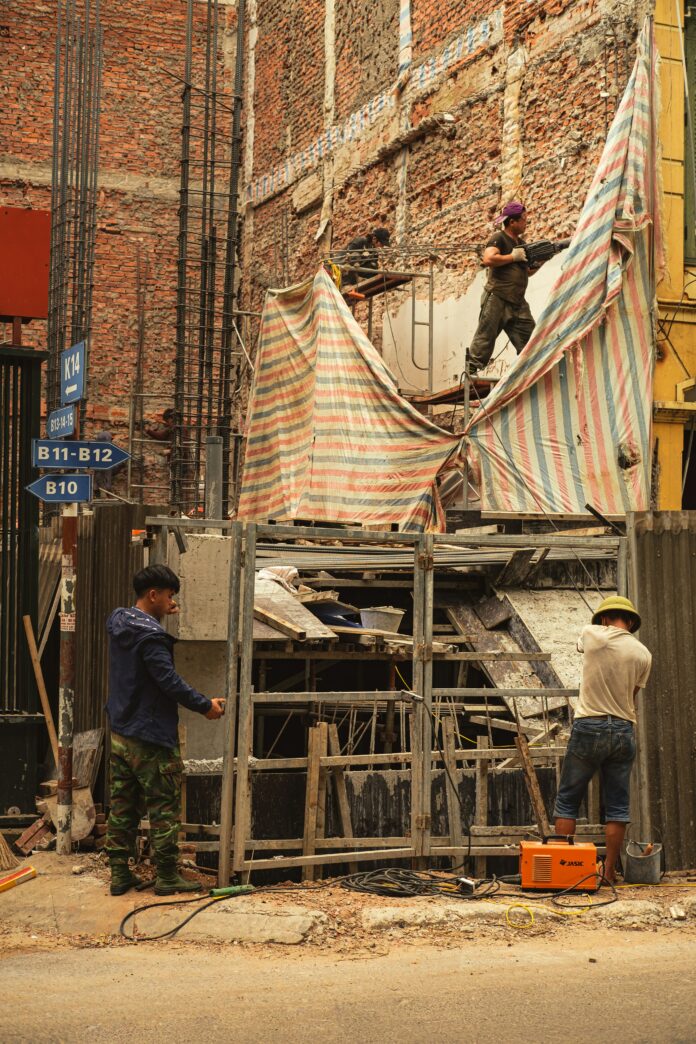
This is a photo of three men doing manual labour outside on metal scaffolding.
PHOTO: Nguyễn Hiệp / Unsplash

By: Lucaiah Smith-Miodownik, News Writer

Scott Lear is a professor of health sciences at SFU and the Pfizer/Heart and Stroke Foundation chair in Cardiovascular Prevention Research at St. Paul’s Hospital. He recently published a study with other researchers from around the world, examining determinants of cardiovascular disease (CVD). CVD (also known as heart disease) is related to atherosclerosis, which is the buildup of plaque in arteries, making it harder for blood to flow. Study findings offered new perspectives on combating CVD, while challenging the status quo on current global health guidelines for maintaining cardiovascular wellness.

Lear’s study was unique in examining CVD in low- and middle-income countries (LIC, MIC) rather than generalizing findings from high-income countries (HIC) to create universal guidelines. Prior to this research, much of the understanding regarding the effect of “environmental and social exposures and policies” on CVD came from sampling HICs only.

According to the study, LIC and MIC have “poorly funded health systems, poor access to prevention and treatment strategies,” and “a higher prevalence of chronic disease.” Worldwide, ischemic heart disease, a specific type of CVD, is the leading cause of death due to numerous individual and societal factors. From 2000 to 2021, the number of deaths climbed by 2.7 million to reach 9.1 million, per the World Health Organization. Other types of CVD include strokes, heart attacks, and more. According to an SFU press release on the new study, 80% of CVD deaths come from LIC and MIC. 

By using data from the Prospective Urban and Rural Epidemiological (PURE) study and related studies, Lear’s study was designed to shape “future policy and research recommendations” and  “accelerate the reduction of the global burden of CVD.” Specifically, his team highlighted findings from previous studies, which showed that individual biological and behavioural risk factors are influenced by social, environmental, and policy determinants, such as the walkability of one’s environment, tobacco price, and food accessibility. PURE conducts research about “CVD, diabetes, kidney and lung diseases, brain health, cancer, and more” internationally. The PURE study utilized data from 28 countries, with 87% of participants living in LIC or MIC. It includes statistics on various measures of health, including physical activity, diet, healthcare accessibility, social isolation and cohesion, and more. 

“We cannot assume that life is the same everywhere. The environments in which people live and the kind of work they do makes a huge difference to their health,” — Scott Lear, professor of health sciences and Pfizer/Heart and Stroke Foundation Chair in Cardiovascular Prevention Research

One takeaway from the PURE data was that “physical inactivity was the second strongest behavioural determinant of CVD after tobacco use.” However, while HIC residents spent more time partaking in recreational activities, those living in LICs reported higher rates of non-recreational activity, such as manual labour involving lifting things, walking to work, and doing household chores. Additionally, “only 4.4% of LIC participants reported sitting more than eight hours a day compared with 22.2% of HIC participants.” Lear’s team showed that measuring physical activity only by recreation omits significant context and details.

In terms of food, “while the absolute cost of fruits and vegetables was lowest in LIC, the cost relative to income was 50 times greater for fruits and 19 times greater for vegetables than in HIC.” Accordingly, HIC reported a greater mean consumption of fruits and vegetables than LIC. When we suggest that individuals “eat better” as a CVD guideline, the study recommends we must also recognize “the context of the local environment,” as well as “facilitators and barriers.”

Other recommendations include focusing more on “population-level measures to make healthy choices easier.” Additionally, the study emphasizes the importance of “enhancing collaborations between researchers with diverse backgrounds,” and “awareness of barriers to evidence-based health policies, including commercial determinants of health such as obstruction by vested interests.” 

The biggest takeaway? “Success can only come through engagement of multiple sectors and countries beyond HIC,” reports the study. “We cannot assume that life is the same everywhere,” Lear said in the SFU press release. “The environments in which people live and the kind of work they do makes a huge difference to their health.”

Tŝilhqot’in Nation calls for action around the toxic drug crisis on the global stage

0
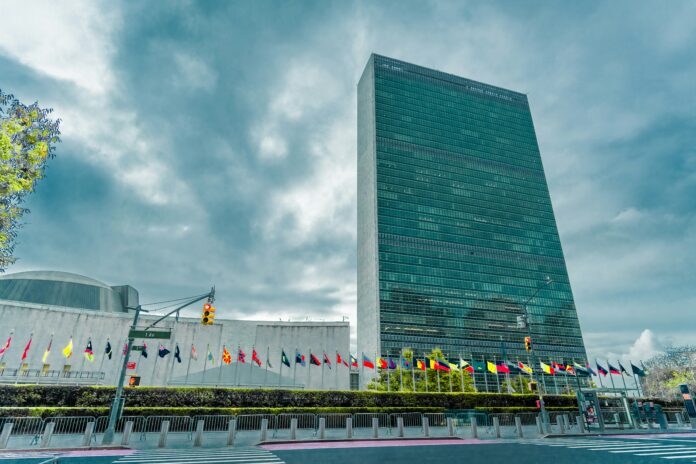
This is a photo of the very tall United Nations Building in New York next to a body of water.
PHOTO: Nils Huenerfuerst / Unsplash

By: Zainab Salam, Staff Writer

On April 24, at the United Nations headquarters in New York City, a delegation from the Tŝilhqot’in Nation presented a plan to combat the toxic drug crisis within their six member communities. This initiative follows the Nation’s declaration of a local state of emergency in April 2024, prompted by a surge in overdose-related deaths. 

The First Nations Health Authority reported that in 2024, 427 First Nation members in BC died due to toxic drug overdoses. This figure represents an average death rate 6.7 times higher than that of other provincial residents, marking the largest disparity since the province declared a public health emergency over toxic drugs in 2016. Sierra William, Tŝilhqot’in Nation Youth ambassador, highlighted the crisis as a continuation of historical challenges faced by Indigenous Peoples, including the impacts of residential schools and past epidemics

In New York, the delegation emphasized the need for support from both the federal and provincial governments to “create Indigenous-led and culturally appropriate responses to the opioid crisis.” Chief Roger William of the Xeni Gwet’in First Nation — one of the Tŝilhqot’in communities — advocated for culturally centred programs, including on-the-land treatment processes and supportive recovery through equine therapy. Equine therapy is a “type of animal assisted therapy” using horses, which represent spiritual connection for First Nations.

He also addressed the challenges Tŝilhqot’in members face in healthcare settings, citing experiences of racism and discrimination. The First Nations Health Authority defines land-based treatment and healing as a return or reconnection “to the land while utilizing supports to relearn, revitalize, and reclaim our traditional wellness practices,” as “land is foundational to our Indigenous identity.” These practices are unlike traditional psychotherapy as they emphasize the importance of community and promote emotional and spiritual healing. It can involve “listening to Elders’ and Knowledge Carriers’ stories and guidance, sharing food/meals with family and community, and playing music with family and community.”

While the FNHA supports First Nations communities with harm reduction initiatives, such as take-home naloxone kits, safer use supplies, and opioid agonist therapy (medical treatment for opioid use disorder), gaps remain in these supports. Jenny Philbrick, executive director of the Tŝilhqot’in National Government, also noted that the Nation needs “‘more immediate resources,’ such as beds for people who are detoxing.”

The Peak reached out to the Ministry of Indigenous Relations and Reconciliation for a statement. We were redirected to the Ministry of Health, which acknowledged that the toxic drug crisis continues to disproportionately impact First Nations communities in BC, “in part due to the impacts of ongoing and intergenerational trauma from colonialism and racism.” Recognizing that Indigenous communities are best positioned to shape their own solutions, the province stated it supports the Tŝilhqot’in Nation in developing culturally grounded care. 

In 2023, the ministry “provided $455,000 to Tŝilhqot’in National Government to support two years of planning, engagement, and service model design for a Healing Centre.” This was followed by signing a letter of understanding — also often called a memorandum of understanding — with the Nation in September 2024 to formalize a partnership in developing the centre. A letter of understanding is “a document that contains a collection of tenets between two or more entities that intend to establish a relationship.” The Peak could not independently verify if the centre is currently being built or when construction will begin. This month, the ministry, Tŝilhqot’in leadership, and other partners met to explore ways to “strengthen the continuum of culturally informed and culture-based treatment, recovery, and aftercare services in the region.” 

The Nation is also advancing its local efforts. On May 21 and 22, they hosted “Reclaiming Our Indigenous Spirit,” bringing together members of the Dãkelh Dené, Northern Secwépemc, and Nuxalk Nations to engage in shared dialogue and strengthen culturally grounded responses to the toxic drug crisis. The Peak reached out to the Tŝilhqot’in Nation but did not receive a response by the publication deadline.

My hear me out cake

0
A cake with the following things on them: A block that says “Times New Roman size 12” on it, the Google Maps logo, the ChatGPT logo with a big X through it, and a picture of Venom.
COMPOSITE: Gudrun Wai-Gunnarsson / The Peak IMAGES: 1) Gudrun Wai-Gunnarsson / The Peak 2) Courtesy of Google 3) Courtesy of OpenAI 4) Courtesy of Walmart 5) Courtesy of Marvel

By: Sarah Sorochuk, Peak Associate

  1. Times New Roman (size 12)

This font has gyatt to be the original “hear me out.” With its classy formatting and fancy lowercase “a,” this is definitely the most bangable of the fonts. You cannot look at it and tell me you haven’t thought,dayammm, if only Times New Roman was a real person.” 

2. Google Maps

What is more smexy than something that knows how to navigate the way to your happy spot (it’s White Spot, you sick fuck)? And goddamn hearing a smart strong voice ordering you around. Just driving in a car, listening to Google Maps tell me what to do to get there is enough.

3. GPTZero

People being falsely accused of using AI is today’s version of the Salem Witch Trials. But unlike those alleged witches, us poor souls have a sexy superhero on our side. ChatGPT’s cousin — GPTZero. The powerful entity that can prove innocence and condemn the villains. All heroes have their kryptonite, and GPTZero might accidentally accuse you of being an AI (that’s OK — love-hate relationship). GPTZero is the brain and the brawn with power radiating off. 

4. The massive SFU Teddy from the pop-up Bookstore and Spirit Store

It’s (almost) cuffing season in Australia, so I definitely need a big boi. Big arms? Check. Warm and cuddly? Check. What is this big ole’ softy missing? Nothing. This fine shyt will surely get the job done and then stay with you all night long. You just have to walk yourself down to the SFU pop-up “Spirit” Store. 5,000% mark-up during convocation!!

5. Venom

I don’t know about y’all but my partners aren’t getting the job done right as of recently. So, this calls for some anti-hero-esque saving. Bring him in to have a first-hand view of  some mind blowing action and his long, luscious tongue will be the reward. You get it, girl. 😉

Peak Speaks: Answers from r/simonfraser!

0

By: Mason Mattu, Humour Editor

Q: If you had to marry a building on campus, which one would it be and why?

u/Matt_The_Slime: “Marry the library, wait for it to die from asbestos poisoning, take all its money after. EZ.”

u/manOmanytendies42: “The Lorne Davies Complex. I can fix her.”

u/Abscissaur: “I’d marry the AQ. I like my buildings how I like my partners: dark, sharp-edged, labyrinthine, and full of koi fish.”

u/AdWhole9935: “I’d marry the W.A.C. Bennett Library — because who wouldn’t want a partner that’s cold, confusing, constantly under construction, and full of information that no one wants to hear about? Nothing says ‘til death do us part’ like fluorescent lighting and the emotional warmth of a concrete bunker.”

A box of halwa and generational love

0
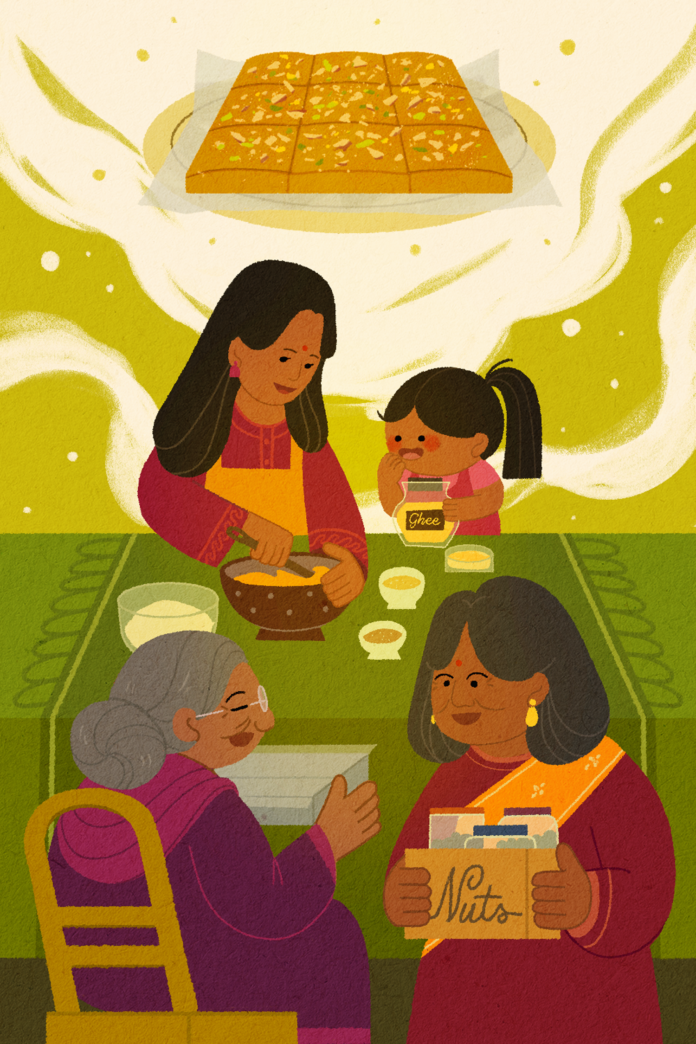
ILLUSTRATION: Four generations of women preparing candy. The piece is about a tradition of passing down a family candy recipe, so maybe like a cute and warm tone? The candy being made is Besan ki Barfi
ILLUSTRATION: Cassandra Nguyen / The Peak

By: Rusham Verma, SFU Student

It’s summer vacation. I’m only 12 years old and my maternal grandmother’s house is infused with the nostalgic smell of halwa made with atta — halwa is a smooth and velvety dessert, similar in consistency to a pudding, made by roasting atta (wheat flour), ghee, and sugar. I’m playing outside in the garden, surrounded by the beautiful flowers my grandmother has grown, taking in their fragrance with a hint of roasted flour from the kitchen. “Laddo, come here! It’s ready!” says my mom from the inside, and just as I open the door, the strong scent of roasted ghee and sugar hits me. I run towards the kitchen and see my grandma spreading the halwa evenly in a big box. 

“Yay! Thank you so much!” I say, hugging my grandma tightly. She kisses my forehead and pats my head. I take a bowl and transfer some of the halwa to it. My mom’s side of the family, being from the Sikh culture, has always had a rich cultural heritage. In our culture, we always go to a gurudwara to pray to god and as kada prasad (or “blessed food”), we get atte ka halwa — just like the one my grandmother makes. Kada prasad represents the “blessings of God.” Preparing and sharing it, like it’s done in a gurudwara, is meant to foster “unity, equality, and selfless service.” Selfless service: a principle of Sikhism known as “seva,” which my grandmother exemplifies so well. This halwa is a significant part of my life and culture, and gives me one more reason to cherish it when my grandmother makes it. I eat it hot, and it melts as soon as it touches my tongue, filling my mouth with so much sweetness. 

Never in my whole life has there been a time when I went to my grandmother’s house and did not eat atte ka halwa. It has become a comforting tradition that is not just upheld by me, but all my cousins. Every time any of us visits grandma, we do so knowing that the halwa will be ready upon our arrival; once, the day before a family event, my grandmother made halwa for all the cousins despite the amount of work needed. No matter, halwa is a way our grandmother shows love, so she even insists on making it all herself, no help allowed. So, every time, we just patiently watch her mix flour, ghee, and sugar while the mixture roasts and releases that distinctive sweet smell that brings me back to my childhood summers.

“This love gets passed on to the next generation as well. This recipe was taught to my grandmother by her mother, and then it was taught to my mother.”

Whenever I ask her to make the halwa, I always notice the crow’s feet beside her eyes and the twinkle in them, her lips turning into a big smile, and her feet moving on their own accord to the kitchen as if it’s second nature to her. Even though her recipe is similar to many, her love for us seeps through, making her halwa taste like none other. This is the love of my grandmother. This is just one of the ways she expresses her love for her grandchildren, and it’s perhaps the most treasured by us. 

This love gets passed on to the next generation as well. This recipe was taught to my grandmother by her mother, and then it was taught to my mother as well. So, this love is not just for the summer but for the whole year. My mom makes it with the same love that my grandmother does, and it tastes like it when eating. One random Saturday, I’ll ask my mom to teach me how to make it, just as she did with her mother. I already know the recipe, but learning it from my mom will give the experience a different meaning — it’s a tradition, a core memory that will last us forever. I feel extremely lucky to be a part of something so special. 

This generational love is what makes family worth cherishing. Getting halwa here in Canada, 11,500 km away from my grandmother, is not hard, I can always visit the nearest gurudwara and get some. However, it will never have the love she puts into making it. Halwa is not only a sweet treat, but a reminder of my grandmother’s love.

What Grinds Our Gears: Ignoring laundry etiquette

0
Photo of a person waiting at a laundromat
PHOTO: Mathias Reding / Unsplash

By: Michelle Young, Co-Editor-in-Chief

Last year, I wrote a piece about how shared laundry rooms grind my gears. Well, upon reflection — it is not the shared laundry rooms that bother me, but rather, the completely irrational and inconsiderate attitude that other people display in them. 

One day, I was going to do my laundry, when I noticed two giant IKEA bags topped to the brim with colourful bath mats sitting by the sink. The bath mats were spilling out of these bags onto the counter. I thought nothing of it at the time (though it is disgusting), and loaded my laundry into a free machine. When I returned to pick it up, I was horrified to find one of these nasty bath mats smothered on top of the machine I had loaded. Laying askew, glaring at me with filthy, dust-filled eyes, I took a deep breath and attempted to open the machine without touching it. 

When I came back later on, to pick up my clean sheets from the dryer, I was even more disturbed to find that these bath mats had been shoved into the drying machines with “HOT” and “HEAVY” written on the cycle. This is a fire hazard! While luckily my building did not burn down, I truly wish it wasn’t so much to ask that people do not stick an abundance of rubber into a steaming hot drying machine. And honestly, what are you doing with so many bath mats anyways? Why do you need 50 of them? Can’t you keep flammables away from the laundry room like the rest of us?