Home Blog Page 331

Senate Report: June 7, 2021

0
Photo from Peak archives

Written by: Karissa Ketter, News Writer

Content warning: mention of residential schools

Fall Return to campus

Student senator Serena Bains brought forth a question regarding the return to in-person classes for Fall 2021. They asked about accommodations for “international, disabled, BIPOC, and other marginalized communities.”

Vice president academic and provost Catherine Dauvergne said, “As planning progresses for the fall term, we’re really keen to ensure that students who cannot return to campus can be accommodated.”  

Dauvergne noted SFU has been working to increase the team in the Centre for Accessible Learning that handles student accommodation requests, as they expect an increase this fall. At a Council meeting on June 16, however, Bains said they were informed that accessibility will depend on individual professors. 

She added SFU is setting up a registration system for student course enrolment that prioritizes students who are “unable to return to campus.” They will have priority access to the 20% of courses that will be offered remotely. It was not specified which circumstances would qualify students to be considered “unable to return” for priority access. 

Return to campus measures include “encouraging students to stay away from campus  when they’re feeling unwell.” Davergne said SFU encourages professors to continue recording and uploading lectures, as well as not penalizing students for missing class.

Acknowledgement of residential schools 

President Joy Johnson announced on June 7, 2021 that SFU had lowered their flags to “honour the lives and memories of the children found at the burial site of the former Kamloops Indian Residential School.”

She noted SFU’s flags would remain lowered for nine days, starting on May 31, 2021. 

“SFU is standing in solidarity with Indigenous peoples as we grieve this enormous, unfathomable loss of life,” said Johnson. 

Johnson noted she recently met with the Aboriginal Steering Committee and “heard first-hand from members of that steering committee about the impact of this news.

“I think it’s really important for all of us to acknowledge the collective responsibility that we all have to develop a better system and move towards reconciliation.” 

Discussion on grading scheme 

Student senator Sarah Lord Ferguson asked Senate what SFU is doing “to increase grading transparency and better align our grading practices with other Canadian institutions.” This was in reference to a petition that has over 1,000 signatures from undergraduate students. 

“The issue I’m bringing forward has hurt students — including myself — for many, many years,” said Lord Ferguson.

The petition states that Canadian institutions such as UBC, KPU, and Capilano University all have the same grading scheme — students need between 90–100% to receive an A+ or 85–89% to receive an A. SFU’s grading scheme requires students to achieve between 95–100% for A+ and 90–94% for A. Other letter grades also require higher percentages. 

This makes it more difficult for SFU undergraduate students to achieve high letter grades, despite receiving the same percentage. Therefore, it is more challenging to be accepted into graduate programs for an SFU student, compared to a UBC student with the same percentage, according to Lord Ferguson.

“I’m optimistic that with this external pressure and bringing this concern directly to the floor of the Senate, we can expedite the process towards a solution,” said Lord Ferguson. 

Vice provost and associate vice president academic Wade Parkhouse responded, “We are aware of the petition circulating requesting a change to our undergraduate grading practices and transcripts. Proponents of the petition have been instructed to work with the registrar.

“A further analysis will be done to determine the impact of potential changes on current and former students, impact on the students’ records from a systems perspective, and wide consultations with students and faculty.” 

This consultation will take time, according to Parkhouse, but after the necessary information has been gathered, Senate will have a discussion regarding the current grading scheme. 

“I do wish to highlight institutional grading practices and students’ academic records are very important, and adjustments or changes to these are not made lightly due to the importance,” said Parkhouse.

A closer look at digital artist Beeple’s $69 million collage

1
This NFT marks a milestone in art history. Image courtesy of Beeple

By: Vrinda Kapadia, SFU Student

Everydays: the First 5000 Days is a series of drawings and images created by digital artist Mike Winklemann. Professionally known under the name Beeple, he began this project on May 1, 2007 and has been diligently posting a new drawing everyday for 14 and a half years now. Beeple made headlines in March 2021 when he sold an NFT of a digital collage of his project at the staggering price of $69 million. 

NFTs stand for non-fungible tokens, which are digital assets representing tangible and intangible commodities. These can include toilet paper, Nike sneakers called cryptokicks, art, virtual avatars, and more. The NFT market is established on a cryptocurrency blockchain, typically the Ethereum blockchain. A blockchain is a shared database that tracks the ownership of the content, while the transactions can be made using cryptocurrency or real money. While, technically, anyone can save, download, and copy the file for free, the real value of an NFT is in the ownership of the original file, which can be purchased and verified by a blockchain entry.

The NFT of Beeple’s art piece was auctioned at Christie’s and was advertised as the “first purely digital work of art ever offered by a major auction house.” 

Sifting through his collection, I am very impressed by the consistent quality of Beeple’s artwork. Some images may be dystopic or politically provocative, but overall, his work is very imaginative and captivating. I rummaged through his work from last year to find some satirical renderings of current events. 

Image courtesy of Beeple

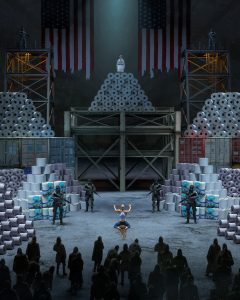
One is called United States of Toilet Paper from March 14, 2020. Right away, there is an irony portrayed by a confined man on his knees who has soiled his pants when there are mounds of white rolls behind his armed persecutors. The man is appealing to a figure in white attire overlooking him from atop a stacked white paper roll heap. There is a sense of ruthless apathy demonstrated by the armed officials and the man in power while the individual on his knees suffers from a dreadful mishap. This is an unsettling image because it uses the catastrophe of toilet paper scarcity amidst the pandemic to implicitly comment on the alarmingly disproportionate distribution of resources in America.

Image courtesy of Beeple

The second one is called 2020 Easter Bunny from April 12, 2020. This image portrays a shocking twist with its 2020 Easter representation. The subject of this illustration is a humongous, bloody, grubby white bunny reigning over a miniature playground and attacking children. This image seems to be a satirical response to the rollercoaster that the beginning of 2020 was. Beeple seems to forewarn everyone to prepare for their worst nightmares.

Image courtesy of Beeple

There’s also the one called Karen Attack from June 18, 2020. There are military police officers and S.W.A.T team members warding off five gigantic white women. The monstrously big women exude hostility with their audacious posture, dropped jaws, and accusatory finger-pointing. Their glossed-over, fiery yellow eyes indicate no opportunity to reason with them. This rendering is seemingly inspired by the growing popularity of the Karen stereotype, which is typically associated with a self-entitled, middle class white woman who displays aggressive behaviour incited by her privileged status. The exaggeration in the image serves as comic relief within an otherwise strenuous and difficult situation one may find themselves in when interacting with a Karen.

Beeple’s Everydays are introspective and amusing artistic renderings of day-to-day occurrences. Each illustration is a memento of an ideology or a significant event that enters the realm of our collective consciousness as North Americans. Despite their puzzling monetary worth of $69 million today, the project will certainly be more valuable for generations to come as a collection of 21st century relics.

Canadian banks reported to have invested $726 billion into oil and gas industries since 2015

0
PHOTO: Marcin Jozwiak / Unsplash

Written by: Harvin Bhathal, Peak Associate 

According to the latest Banking on Climate Chaos report, published in March 2021, Canada’s five largest banks have invested $726 billion CAD into the fossil fuel industry since the Paris Agreement — a legally binding international treaty regarding the climate crisis.

From 2016 to 2020, the breakdown of investments in CAD were:

  • RBC — $208 billion
  • TD —  $157 billion
  • Scotiabank — $148 billion
  • BMO — $126 billion
  • CIBC — $87 billion 

While these banks reduced their fossil fuel financing in the past few years, RBC and TD respectively rank 23rd and 25th in the world in terms of their total assets contributed to fossil fuel companies since 2016.

RBC was also the “top funder of tar sands oil in 2020,” with their Line 3 pipeline. The bank has financed existing facilities and pipelines; they have also invested $79 billion into companies actively expanding their fossil fuel production.

In February, RBC committed $500 billion to sustainable financing by 2025. TD, Scotiabank, BMO, and CIBC have also committed varying investments into sustainable financing. 

According to earth scientist David Hughes, the continued investment of RBC and other banks in the oil and gas sector will make Canada’s 2030 carbon emissions target difficult to reach. “A stark change in direction is needed,” he said in his Canada’s Energy Sector report.

In an interview with CBC, RBC discussed how its net-zero transition must be gradual and “done in an inclusive manner that brings all sectors and communities along or we won’t achieve the support we need to meet these goals.”

Stephanie Bertels, director of the Centre for Corporate Governance and Sustainability told The Peak, “A huge challenge right now is in articulating what would qualify as a sustainable asset.”

According to the Organization for Economic Co-operation and Development (OECD), sustainable assets range from those “that seek to do no harm” to “seeking positive impacts.” Impact-based investments are “the only form of financing that requires an actual assessment of positive impact.” A majority of investments are not defined as impact-based, meaning there is a “lack of transparency” in the process.

RBC’s most recent fossil fuel investment was issued the same month as their sustainability commitment: a $1 billion sustainability-linked loan for Enbridge’s Environmental, Social, and (Corporate) Governance (ESG) goals. ESG goals are criteria corporations must meet to make environmentally and socially conscious investments. 

However, the increase in loans linked to ESG has brought questions about their legitimacy as the criteria and standards are fragmented. They can differ from institution to institution as one may have different criteria or standards for what is sustainable than another.

Along with their commitment, RBC joined the Partnership for Carbon Accounting Financials (PCAF) and RMI’s Center for Climate-Aligned Finance. 

The PCAF “provides methodologies for financial institutions to measure the [carbon] emissions financed through loans and investments.” This can be seen in Vancity’s pilot carbon accounting work on residential mortgages and their associated emissions.

Bertels said the next challenge is creating universal frameworks for what constitutes sustainable financing.

Hughes found, “The oil and gas sector alone will cause Canada to exceed its Paris Agreement emissions target.” The agreement aims for an 80% reduction from Canada’s 2005 emission levels by 2050. The sector is an obstruction to Canada’s net-zero targets adopted in Bill C-12. ”

Currently, oil and gas production “account for 26[%] of Canada’s total” carbon emissions and Canada has “only reduced its emissions by 1.2[%] from 2005 levels,” according to the most recent data from 2019.

Bertels said banks have a civic responsibility to address the impacts of the climate crisis. 

“More importantly, they have a fiduciary responsibility to do so.”  

Bertels noted that this responsibility has been made “abundantly clear” through the work of the Task Force on Climate-related Financial Disclosures (TCFD) and the UN’s Net-Zero Banking Alliance. They are the two biggest actors “that have influenced financial institution behaviour with respect to climate change.”

The Banking on Climate Chaos report is a collaboration between Rainforest Action Network, Banktrack, Indigenous Environmental Network, Oil Change International, Reclaim Finance, and Sierra Club. More information on the fossil fuel financing of Canada’s banks can be in the Banking on Climate Chaos report.

Council Meeting — June 16, 2021

0

Written by: Jaymee Salisi, News Writer

Return-to-campus student accommodations discussion

Councillors of the Simon Fraser Student Society (SFSS) discussed their plans to accommodate COVID-19 safety protocols and learning accessibility in the fall when campus reopens

Chaired by SFSS president Gabe Liosis, the Student Union Building (SUB) reopening working group will prepare COVID-19 safety plans to eventually be approved by Council.  

Vice president (VP) equity and sustainability Marie Haddad said their plans will go through a two-level consultation process. They will first take recommendations from marginalized groups such as the Students of Caribbean and African Ancestry, First Nations Student Association, and the Disability Neurodiversity Alliance

The second level of consultation involves receiving recommendations from the general student body. Haddad said this is “a good way for us to figure out the needs of folks in terms of the SUB building.”

According to Haddad, SFU started their own working group last month.

“They weren’t centred around marginalized students — it was almost as if it was a last thought,” Haddad said. 

Disappointed with their initial lack of preparation, Haddad said she expects an update from them soon and hopes to see progress.

The SUB working group advised the university to “centre their working groups around specifically Black, Indigenous, and disabled students — especially international students.”

In regards to in-person classes, VP university and academic affairs Serena Bains said she was told learning accommodations will not be handled by the Centre for Accessible Learning (CAL), but will vary among professors. During the June Senate meeting, vice president academic and provost Catherine Dauvergne said CAL will work to address accommodation requests. 

Bains said this is concerning because “there’s not a lot of information about whether these things will be mandated or standardized.” 

She said the SFSS is considering the creation of a centralized space for students who might encounter learning accessibility barriers in the fall. She said the space would provide a “network of people who can rally around behind that student and then advocate for their needs.”

Haddad added professors should give students more leniency during the transition to in-person classes in the fall. Haddad and Liosis discussed a hybrid learning model and asked BC health officials in a separate meeting how they would “ensure the burden isn’t on the student to access accommodations, and prove they need them in the first place.”

The SUB working group was created by last year’s SFSS board. Recommendations from the group will be coming to Council for approval soon, according to Liosis.

Access For All campaign

On June 2, 2021, the SFSS created Access for All to draft letters to SFU and the province of BC. These letters advocate for student accessibility accommodations to be made during the transition back to in-person classes in Fall 2021.

Brought forward by Bains, this motion called for Council to approve and sign onto the drafted letters to be sent to SFU and the province of BC.

International studies student association representative Deanna Short suggested the calls to action be more demanding and specific. 

“From other advocacy work I’ve done, I’ve noticed that the province in particular doesn’t really like to take action, unless it’s clearly laid out for them,” she said. Short recommended they list distinct capacity limits and specifically indicate mask mandates.

Bains agreed to add the suggestions and work with Short on any further edits. Bains added they had been looking into COVID-19 emergency funding for ways to support students in need. 

“These lists are definitely not exhaustive and there is absolutely always more we can do in terms of our demands for SFU as an institution or the province, as well as what we can do internally as an organization,” Liosis added.

Bains invited Council members to send potential recommendations for further steps the working group should take as they continue to decide on official plans.

The motion was carried unanimously. 

SFU350 and Climate Justice UBC pressure universities to stop funding fossil fuel projects

0
Unsplash/Chris Leboutillier

Written by: Jaymee Salisi, News Writer

SFU350 is a student organization campaigning against climate change and working to realign SFU’s investments to reflect sustainability and integrity.

SFU350 and Climate Justice UBC (CJUBC) are partnering to launch the Community Reinvestment Campaign. They hope to push both universities to reinvest their funds into local climate solutions, centre the needs of marginalized communities, and give economic ownership back to local communities.

In an interview with The Peak, students from both groups elaborated on the campaign.  Community Reinvestment Campaign leaders Rachel Cheang and Sarah Salloum said, “As students of UBC and SFU, we share the same goal — for our universities to divest from fossil fuel and extractive industries and reinvest in solutions to build the world we want to live in.”

They added that a joint effort gives student groups a bigger opportunity to push for community reinvestments and show there is a high demand for change. “A collaboration between our universities’ climate justice advocacy groups provides a true model for partnership between our universities, rather than competition,” Cheang and Salloum said.

“Climate justice is both a term and movement that seeks to acknowledge and identify how climate change affects those made [disproportionately] marginalized,” SFU350 co-president Abigail Herd said.

“This campaign calls upon the university to divest its endowment fund from all companies that extract, process, and transport fossil fuels,” she said. SFU’s December 2020 endowment report showed investments into Enbridge, among other fossil fuel companies. 

As the group pushes SFU to be more transparent about their fossil fuel industry investments, they have been successful in convincing the SFU Board of Governors to increase their carbon footprint reduction target to 45% by 2025.

Aiming to benefit historically marginalized local communities, community reinvestment involves SFU350 and CJUBC pushing their respective universities to allocate 5% of their endowment funds into community development institutions. 

The institutions would include “credit unions, co-operatives, community bonds, and loan funds,” Cheang and Salloum said.

Community reinvestment would be a form of non-extractive financing, meaning it would benefit communities.

SFU has been “continuously increasing the carbon footprint reduction target of the endowment. This is by no means divestment and is in fact a false solution, as the methodology of carbon footprinting does not consider the full emissions of a product/company,” Herd and anti-Trans Mountain pipeline expansion (TMX) campaign organizer WeiChun Kua said. 

In addition, SFU350’s goals include raising awareness about the risks of the TMX pipeline expansion and the Coastal GasLink pipeline, and to push SFU to “declare a climate emergency.”

The group is asking to have SFU include SFU350’s and CJUBC’s demands in their climate emergency declaration letter.

SFU350 has been active in climate justice advocacy at the university since 2013. Kua and Herd said the student group organized the SFU community’s attendance in multiple climate strikes, including the 2019 Climate Strike in Vancouver.

In support of Indigenous rights and the sovereignty of the Wet’suwet’en First Nation, the group also arranged two student walkout marches in January 2020. Under the #StudentsAgainstTMX campaign, they organized rallies and informational sessions to take a stance against the TMX pipeline expansion.

SFU350 is currently looking for students to join their climate emergency declaration campaign. Those who are interested can contact [email protected] to get involved.

Courses SFU should introduce

0
PHOTO: Joshua J. Cotten / Unsplash

By: Kelly Chia, Staff Writer

Not needing parental validation | 48 credits (B-Soc)

Do you find yourself having to justify your degree and its “worth” to your parents? This short 16-semester-long course will be valuable as a FASS student. You’ll finally learn how to stop tearing up when you’re asked what minimum wage job you want. You will learn how to confidently tell your peers what you major in, even if it’s philosophy and you refer to yourself as a stoic. This course even provides a brief introductory overview of how to mentally prepare for the question, “What do you even plan to do with your life?” 


Just pet dogs | 5 Barkbox credits (B-Hum)

What does this university substitute for a functional and accessible mental health care system? 

Right, puppy therapy! So many puppies. Inspired by this counselling “alternative,” this course offers just a truckload of fluffy babies who can’t wait to snuggle up with you and take your exam worries away. Study pup-ular culture with these friends by your side. 

Dander allergy medicine not included. Bring your own leash.


Alternative physical education | 10 imaginary credits (B-Sci)

Are you tired of the barrage of staircases at our illustrious campus? Always pretending the trek between Saywell and AQ isn’t exhausting? Alternative physical education teaches you to ascend beyond your mortal body so you can astral project your way around classes. Astral projection is almost a completely safe way to travel*, leaving your body to focus on classes as it should be.

*Please be aware you may experience the sleep paralysis construction demon if you do not take the proper steps taught in the class to avoid them.


By: Marco Ovies, Features Editor 

Wildlife Handling | 4 credits and a Wildlife Warriors newsletter subscription (B-Sci)

Learn to deal with Burnaby Mountain’s wildlife! Brave the great outdoors with confidence (and by the outdoors, we don’t just mean hiking trails around the campus. Critters often appear inside classrooms). 

One SFU student (who asks to remain anonymous) proudly advocates for this new course. In an interview, they told us, “My professor had to stop because a raccoon had waddled right to the front of the classroom. A real-life raccoon. What shocked me was how calmly he tapped the raccoon with his foot and it turned around and walked away.” Upon reflection, this student thinks their professor’s calm demeanor in this situation means this was not an isolated incident. 

Additionally, security footage found that raccoons have discovered how to use the automatic sliding doors outside of West Mall Centre. Just like when the velociraptors learned how to use doors in Jurassic Park, the raccoons simply step on the mat outside the building and are granted full access.

Lesson plans include: “Do I actually play dead when I see a bear or is that a lie Hollywood has told me?” and “Is that a raccoon in line at Starbucks, or is it just your sleep-deprived friends needing a caffeine fix again?”

Internet addictions keep us from focusing on valuable experiences

1
The intentionally addictive structure of the internet can impact our mental well-being.  ILLUSTRATION: Alyssa Marie Umbal / The Peak

By: Jacob Mattie, Peak Associate 

The development of the internet was revolutionary, but don’t let its impact fool you. Internet traffic is routed through an increasingly narrow selection of websites and services and is owned by even fewer companies. Content favours ease of access over depth; it is designed to keep us glued to our screens, which pushes us away from other activities such as hobbies, projects, or studies. 

Not considering the streaming and gaming services which account for almost 70% of global internet usage by volume, the internet is largely dominated by three websites: Google, YouTube, and Facebook. These three sites together amass more monthly views than the following 47 most-visited websites combined (including other such giants as Twitter, Instagram, and Wikipedia), and their parent companies rank among the top 20 most profitable companies worldwide. 

Clearly, there is some financial clout in internet traffic. As online profit is driven by advertising, it is in the companies’ best interests to put tremendous amounts of resources into designing websites. This is intended to keep visitors as engaged as possible, for as long as possible which it certainly does

 The problems with this arise from our inherent diversity. People have a huge array of interests, forms of expression, social structures, and other quirks, which require an entire life’s worth of experiences and interactions to satisfy. The catch-all internet experience offered by the largest websites fails to do this. Regardless of the possibilities that the internet contains, these experiences are hardly achievable through a screen.

Internet use is inherently a solitary activity. Even in social situations, such as video calling a friend or posting on message boards, many of the cues that we would otherwise rely on (like eye contact or a shared environment) are lost. Simultaneously, the emphasis on online relationships serves to isolate us from people in the offline world. As we develop and engage further with online communities, it can become more difficult to break out of the habit of internet addiction as our support network.

In order to produce content that draws and maintains as wide an audience as possible, websites focus on a structure that prioritizes ease of access and curates content to mirror what we have liked. This is done instead of exposing us to new ideas. As we’re coerced into spending more and more time browsing and scrolling through the content specifically designed to catch and hold our attention, we lose time for other more enriching activities. As a result, we may find that being addicted to the internet impacts our well-being and quality of life. But by any definition of internet addiction, there is a reported correlation with a host of mental health issues; depression, anxiety, and ADHD are among the more prominent.  

The internet is harmful, not for what it is, but for what it takes away from us. We spend so much time captivated by endless scrolling, it keeps us from pursuing other, sometimes more enriching, activities. As we visit our favourite sites, soaking up bits of information, and as we ride the emotional roller coaster of a well-made piece of media, we need to consider them as the metaphorical golden handcuffs which are fantastic in the moment, but leave us with little to keep. 

You need to sit down and start giving music your full attention

2
Listening carefully will help you appreciate all the details in your favourite music. PHOTO: Ilias Chebbi / Unsplash

By: Sara Brinkac, Peak Associate

Our complete attention is invaluable, and in a world of infinite distractions and worries, rarely do we give one thing our undivided attention. Take how we listen to music, for example. It’s often through a streaming service with an almost infinite catalogue of music. Instead of fully paying attention to a song, we jump from playlist to playlist discovering new music. Or, we end up shuffling the same songs over and over again. But that doesn’t mean we don’t love music. So why don’t we give this truly precious part of the human experience more of our attention? 

It is important we practise mindful listening when appreciating music. Musicians tirelessly hone their craft just to play us a song. That song then goes through countless iterations with the utmost attention poured into each instrument, note, mixing level, and silence. But too often, we take for granted that commitment and attention and rarely give the artist our focus in return. 

Practicing mindful listening with music is the practice of sitting down without any distraction and concentrating on every aspect of a song. Listen to every instrument, every change of beat, every whisper from the left headphone, and each note from the right. We may already be familiar with this practice when we listen to our favourite song, but rarely do we listen mindfully for long periods of time. That is why we need to begin mindfully listening not only to individual songs, but to entire albums.

Just as a good song is carefully crafted to hold an artist’s soul, a good album is carefully curated to hold the same. A great album creates an enriching and fulfilling experience for the focused listener. The tracks are ordered with intention, to show range and emotion, to be a slow melodic breath of fresh air or a booming electric punch in the gut. Some songs flow effortlessly together, sweetly setting the tone for the next track, while others harshly juxtapose to create a surprising new direction. True care is marked by artists setting out to challenge the traditional album format, genre norms, and listener expectations. It is only fair we show the same care when listening. 

Not to get nihilistic in the middle of a student newspaper, but life is meaningless and our time is fleeting, so every moment we are present in both body and mind truly holds meaning. I’ll be the first to admit that being present is hugely difficult. I often find my mind being consumed with issues out of my control, or that I’m unable to wholeheartedly experience life with others. But the simple act of sitting down and giving an album my unadulterated attention is something that temporarily fills this meaningless existence with joy. So give it a shot; choose to give the precious gift of music your full attention.

Consider these albums to get you started:


Simon and Garfunkel – Bookends (1968)

Mood: “Did those guys just create psychedelic folk?”

Top Song: “America”


The Strokes – The New Abnormal (2020)

Mood: Turns out indie alt-rockers have an emotional side

Top Song: “Ode to the Mets”


Ron Gallo – PEACEMEAL (2021)

Mood: An indie-Buddhist-punk with a great sound and even better lyrics

Top Song: “All the Punks are Domesticated”*


Billy Joel – The Stranger (1977)

Mood: A haunting, rocking, melodic 42 minutes

Top Song: “Scenes from an Italian Restaurant” 


LCD Soundsystem – Sound of Silver (2007)

Mood: “I don’t really know what genre this is but I can’t stop my body from moving”

Top Song: “All My Friends”


Childish Gambino – Because the Internet (2013)

Mood: A joyously creative experience from beginning to end

Top Song: “Zealots of Stockholm”


Pink Floyd – Dark Side of the Moon (1973)

Mood: A visual landscape created purely by sound and helped by drugs

Top Song: “Time”

 *Please, just listen to this song. 

Better celebration alternatives for July 1st

0
PHOTO: Sanjoy Saha / Unsplash

By: Nancy La, Staff Writer

Are you still whipping out the maple leaf flag and proudly shooting fireworks to celebrate Canada Day? Honey, you have to wake up! Countries are not real. You’re technically living on stolen land! Instead of celebrating Canada Day, here are some different but equally befuddling holidays for your July 1st celebrations.


“Oops! . . . I Did It Again” Day

Ever need a day where you’re finally excused for doing the same problematic thing over and over again without acknowledging you’re hurting others? Look no further than “Oops! . . . I Did It Again” Day! Much like how the government continually contradicts itself with COVID-19 restrictions versus their practices, you too can do whatever the heck you want. Better yet, try shunning those who trust you to guide them through a pandemic while you’re at it! Bonus points if you play Britney Spears’ iconic anthem of the same name all day. Oh baby baby, how was I supposed to know?


Go Back On Your Word Day

Forget Canada Day and look forward to Go Back On Your Word Day. What better way to celebrate the nation than to remember its litany of broken promises to do better for Indigenous peoples? Think about Trudeau’s promise that the commission report on Missing and Murdered Indigenous Women and Girls “will not be placed on a shelf to collect dust,” only for two years of dust collection to happen before a national action plan on Indigenous crises is released. Keep in mind that, according to Indigenous advocates, the action plan is not enough to do much of anything. You do not need to look far to learn how to go back on your word here — and don’t forget to cry when someone calls you out for it.


Geese Hug Day

Instead of waving the flag around, why not celebrate this July 1st by giving this iconic animal a good ‘ole hug? Sure, they might honk quite angrily and potentially attack you, but that’s usually what happens when you violate animals’ living space — much like what this country wants to do with its pipeline plans! If you have ever wondered what it looks like for an animal to flee its own home after watching it be destroyed, try and hug a goose and see for yourself. 


Mask Wearing Appreciation Day

Enough attention has been paid to non-maskers and their rallies, so how about a holiday to celebrate those who actually have been following the rules for the past year and a half? There won’t be any violation of COVID-19 rules since mask wearers are (for the most part) reasonable people who would not stand less than two metres apart. Best part yet, the speakers to this event will not get caught violating COVID-19 rules! Hey, let’s all just stay at home, drink some $18 lukewarm champagne, and pass out on the couch by 10:14 p.m.

The tales of a stranded SFU student

0
Image: Chris Ho / The Peak. Stock courtesy of Global News

By: Paige Riding, Copy Editor

11:33 a.m.

If you’re reading this, it’s too late.

It appears I’m past the point of saving out here. The sun is beating down on me. This heatwave is proving worse than I ever imagined. I took a wrong turn walking to Cornerstone from my dorm, I think. It’s all been downhill from there. Literally. It’s such a steep descent. Sure hope I’m heading back to my house on top of the mountain.

Mom, if you’re reading this, I love you. Also, please don’t look through my nightstand drawer. You’ll only be overwhelmingly disappointed with what you find in there. 


1:41 p.m.

I kinda jumped the gun. It wasn’t too late two hours ago, but it might just be too late for me now.

Why? I just remembered I had a quiz due at noon, but I’m stuck out here with 20% battery and 3G. 3G?! You can’t ask me to do anything with that. Also, that battery is needed to send out this SOS on my private Snapchat Story and play “Photograph” by Nickelback seven more times. It’s in my head, OK? You’d do the same.

I have no idea where I am. I was confident that RapidBus I took was the one to send me to the Transportation Centre. I got off at the end like I thought I should, but this doesn’t feel quite right. It’s just too hot out here to focus.


3:22 p.m.

I thought there was an oasis, but it was a cruel trick of the eye. Someone turned off this natural concrete water fountain. Am I suffering from heat stroke, or did that goof have a hoodie on in this heat?! And a UBC one, at that!


3:38 p.m.

I’ve found a trail that looks just like the one that leads me to the Towers residence buildings. Off I go. You can’t get rid of me that easily! I’ll crawl if I have to.


4:57 p.m.

The last I checked, there was this steep hill I walked up. There are no signs of civilization anywhere. Good thing I found this carved wooden post with a metal sign to sit on for a while. I’m boiling.


5:05 p.m.

Hey, I didn’t know SFU’s campus had such a beautiful view of the ocean! I could take a quick dip, but it’s almost dinner time and my roommate is making soft tacos.


5:07 p.m.

That was the R5 I took . . . right?