Home Blog Page 30

Vancouver Police’s Task Force Barrage draws controversy from the community

0
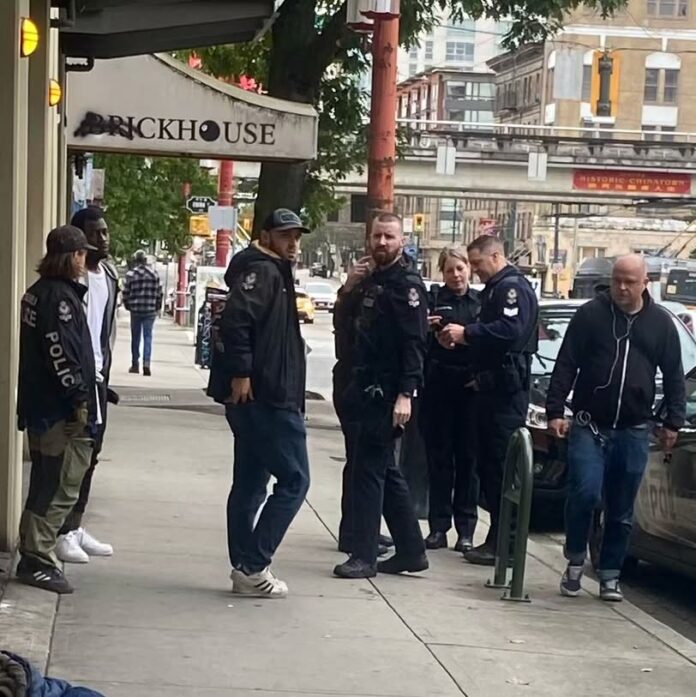
This is a photo of several police officers gathered together in a group in Vancouver’s Chinatown.
PHOTO: Courtesy of @vancouverpigs / Instagram

By: Lucaiah Smith-Miodownik, News Writer

A new initiative aimed at stopping crime on the Downtown Eastside (DTES) adds another layer to conversations about the Vancouver Police Department’s (VPD) purpose and policy. In February, the VPD and Vancouver mayor Ken Sim publicized Task Force Barrage, a “long-term operation to dismantle organized crime networks and target predatory criminals in the DTES.” Some community organizations have expressed concern over the initiative, including Police Oversight with Evidence and Research (POWER). The Peak corresponded with Tyson Singh Kelsall, researcher-member and PhD candidate in SFU’s faculty of health sciences, and Molly Beatrice, organizer-member and research assistant in the faculty of health sciences.

POWER “is a community-based research project formed in July 2024 as a collaboration between researchers in SFU’s faculty of health sciences, members of Western Aboriginal Harm Reduction Society, and the Vancouver Area Network of Drug Users.”

Task Force Barrage is the newest link “in a chain of law enforcement initiatives aimed at criminalizing people who rely on public space during what seem like endless housing and toxic drug supply crises,” Singh Kelsall told The Peak. This “does nothing to reduce the violence of these twinned crises, and, in fact, pushes people already struggling into more desperate situations that are difficult or impossible to survive.

“Under Barrage, we have seen an increase in police officers harassing people on the sidewalk, and an increase in police officers riding horseback through the neighbourhood,” he added. “Every dollar used on Barrage could be used instead on providing safety and inclusion through shelter, rent subsidies, respite for people experiencing gendered violence in the face of provincial cutbacks, overdose prevention services, and meaningful, low-barrier civic employment programs in the community.”

The Task Force comes with a price tag of $5 million, though the Vancouver Police Board was unaware the project was green-lit until it was announced to the media. The order of events also raised questions for some regarding who is behind the task force. While the VPD originally labelled it a “joint initiative” between the force and the mayor, Sim claimed it to be solely VPD-led, contributing to confusion and concern.

“This is colonial violence in the name of ‘public safety.’” — Molly Beatrice, POWER organizer, SFU research assistant

Concern regarding the Task Force has allegedly come from within the VPD as well. In April, POWER reported that a source identifying themself as a VPD officer emailed the office of the police complaint commissioner with claims that the VPD was setting quotas of “2–3 drug arrests and charges a day” in the DTES. The email also alleged that inspector Gary Hiar, a leader of the Task Force, “openly lied to get promoted to staff sergeant.” The VPD told The Peak “the allegation is untrue.”

In response to the whistleblower, the VPD conducted an internal investigation, which yielded “no evidence of arrest quotas in Task Force Barrage.” Matt Harty, a superintendent with the VPD who investigated the claims, classified the numbers as “performance measures,” according to the Vancouver Sun. Such a response did not appease all concerns. “Performance measures and quotas are essentially the same thing in policing,” said former VPD superintendent Kash Heed.

“Quota or no quota, VPD sees expanded budgets to meet every type of crisis with further criminalization,” Beatrice told The Peak. She spoke to both police and government criminalization of people “sheltering in public space, [relying] on a toxic drug supply, [relying] on inadequate payments of income assistance, disability support, and seniors’ pay,” noting that in all cases, “Indigenous, Black, and racialized communities” are excessively targeted. “This is colonial violence in the name of ‘public safety,’” Beatrice said.

The VPD maintains a different narrative. The Peak reached out for a statement, and the VPD directed us to a May press release where staff sergeant Gary Hiar stated, “While we’re making life harder for violent offenders and organized criminals, we’re also working with the community to improve safety and build relationships. This work will require a sustained effort and there’s still a long road ahead.” The statement included Task Force metrics from February 13 to May 13, including weapons and guns (real and replica) seized. The Peak could not independently verify this information.

“The real fight for truth, justice, and change is coming from the survivors of police violence and families of those we’ve lost to police violence, like Justice for Jared and mothers,” said Beatrice.
Streamlining infrastructure sidelines Indigenous rights

0
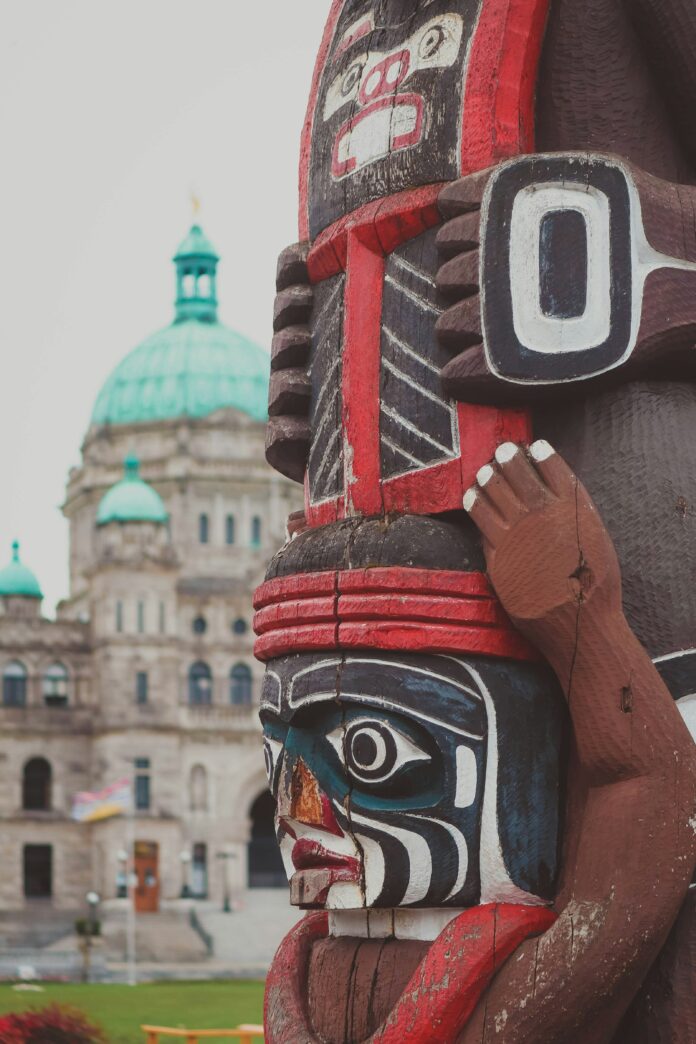
a photo of a Totem pole in Victoria, B.C., with the Legislative Assembly of British Columbia building in the background.
PHOTO: Julian Gentile / Unsplash

By: Corbett Gildersleve, News Writer

On May 28, the provincial government passed The Renewable Energy Projects Act (Bill 14) and The Infrastructure Projects Act (Bill 15), much to the dismay of many First Nations and municipalities. The stated goal of these acts was to streamline the approval process to speed up infrastructure and renewable projects. The two BC bills raised alarm bells with their significant concentration of power, with ministers and the government able to sideline Indigenous rights, municipal rights, and environmental regulation. These hastily written bills empower the government to dictate which projects can ignore environmental regulations and First Nations’ sovereignty. 

Bill 14 designates multiple existing projects to be streamlined, though it’s not clear what that means. These include the North Coast Transmission Line project and nine wind energy projects that were selected by the BC Hydro and Power Authority in 2025 and 2024, respectively. It also allows for the government to declare a project to be streamlined under this Act. The Act lays out three levels of projects but does not describe what each means. This lack of transparency highlights the nature of the harm that the bills bring forth.

“This bill gives cabinet the authority to override permitting and environmental assessments for projects they deem a priority. There are no clear limits. No binding safeguards. No commitment to co-governance with rights holders.” — Don Tom, Tsartlip Chief

Bill 15 brings concerns with the significant concentration of power given to the ministers and the government. Tsartlip Chief Don Tom aptly explains the harms of the bill: “This bill gives cabinet the authority to override permitting and environmental assessments for projects they deem a priority. There are no clear limits. No binding safeguards. No commitment to co-governance with rights holders.” Section 20 of Bill 15 makes it so the Act can’t ignore the Declaration on the Rights of Indigenous Peoples Act (DRIPA). This simply indicates that Indigenous Peoples have a right to traditionally occupied lands and its resources, and the state shall give legal recognition of that. However, through the passing of the bills, the government communicates that it does not actually view BC as the traditional unceded lands of Indigenous Peoples. This is fundamentally colonial thinking. Bill 14 and 15 essentially give the government the right to not consult with Indigenous communities which isn’t compatible with reconciliation. 

Under this Bill 15, if an infrastructure project has what the legislation calls a “constraint,” then a facilitator can be brought on to develop a solution. The solution is then reviewed and possibly approved to replace this constraint. If a solution can’t be reached through the consultation process, then the minister can create a solution and use that, or recommend the government use it. In some ways, this makes sense if the constraint is, for instance, that a hospital needs an expensive upgrade to their HVAC system. Then having the government expedite their needs is good. However, the definition of constraint is too broad, and the powers given to the government to push things through are ripe for abuse. A prolonged protest, such as those conducted by land defenders against fossil fuel pipelines, or a hospital strike would definitely impact the operations of a hospital.

Every land acknowledgement that I’ve heard recognizes that we’re on the unceded traditional lands of different Indigenous nations. As such, pretty much every infrastructure project in the province would fall under section 20 of Bill 15. These Acts, when viewed in the wider context of similar bills being passed in the federal government demonstrate that regardless of what work has been done towards truth and reconciliation, at the end of the day, only Canada’s interests matter.

Designing parks for social connection

0
Illustration of a park filled with young adults engaged in various activities. A stone amphitheater, an exercise area, and a rock wall can be seen in the background.
ILLUSTRATION: Abigail Streifel / The Peak

By: Noeka Nimmervoll, Staff Writer

One brutal awakening many young adults go through is the realization that leisure time is not a guaranteed part of the adult schedule. To me, it seems we are all busy with work, school, planning for the future, hoping to be happy, and filling in the gaps with entertainment. We’re told to enjoy our youth, but where are we supposed to do that? Vancouver is undoubtedly an expensive city, one where paying for rent alone can suck up half your income — a reality for 27% of renters, according to a report by LePage. With the remainder of income balanced on other living expenses such as utilities, groceries, and transportation, it leaves the wallet to wonder: where’s the budget for leisure? 

Thankfully, Vancouver is ripe with 250 parks open to the public, all year round. Although the city’s parks are designed for a variety of community needs, many parks — like Queen Elizabeth, Riley, and Hastings parks — are not ideal for young adults to congregate due to their lack of shelter, child-centered playground design, and general lack of appeal. Imagine a park, a playground, an outdoor community space — a place designed with young adults at the forefront. Imagine how glorious it could be. Perhaps this new era of park development in Vancouver is the perfect opportunity for the city to design one park with young adults as the target demographic. 

Enjoying activities you once loved as a child is a fulfilling and nourishing practice for any adult. Leisure time is incredibly beneficial to adults, improving creativity and problem-solving skills and promoting emotional well-being. Third places are described as spaces that aren’t living or working environments, and instead foster spending time with friends. However, many third places are businesses that place spending money at the forefront. Still, third places areimportant for bits of connection. Young adults need a hub — more than that, young adults need a fun place where problems are paused and not centred around consumption. 

“Imagine, for a second, that the government invested in its youth like it invests in the status quo. What could we make happen?”

Parks are the perfect environment to play outside, at no cost. However, playgrounds are predominantly built with children ages  5–12 in mind. Adults looking for spaces to use in parks are usually limited to exercise equipment and courts for different sports if they’re lucky enough. While great for promoting physical activity and some degree of social interactions, not everyone is looking for a sports gathering. In places like Charleston Park, benches and green spaces are available for adults, but the equipment doesn’t provide protection from the rain and there’s little else that would facilitate engaging in any other activity. For young working adults, it’s frustrating to constantly feel like we are not enjoying the benefits we pay for with our taxes. 

Imagine a playground for adults with a zipline, fireman’s pole, and climbing wall for adults to have their cheap thrills. A fireplace, to facilitate much-needed conversation between young people in an open and relaxed setting. A large undercover picnic area that allows you the option to venture outside in all months of Vancouver weather. An amphitheater, for local performances and art initiatives to host live outdoor shows, interactive events, and theatre like Victory Square. Places like Ambleside in West Vancouver achieve that on many points, by hosting events like the Harmony Arts Festival, weekly farmer’s markets, and having ample green space and parks for all ages to enjoy. Sθәqәlxenәm ts’exwts’áxwi7 (Rainbow Park) is another good example — in the heart of downtown on Smithe and Richards, it boasts an open walkway, lush greenery, a café plaza, and a kid’s water park. This vibrant space is exactly the type of community that can be used as a model when designing or remodeling parks suited specifically for young adults — parks that go beyond green spaces, but serve as community gathering spots. 

Creating more communities for young adults, where they can socialize and host events, would provide so much wealth to the lives of young people in a tumultuous and hard-to-navigate world. It would provide opportunity for those looking for creative outlets in a community space. Imagine, for a second, that the government invested in its youth like it invests in the status quo. What could we make happen?

FNMISA builds space for Indigenous students

0
a photo of FNMISA's space in SFU. Room 1440 in the Student Union Building
PHOTO: Daniel Salcedo / The Peak

By: Yildiz Subuk, Staff Writer

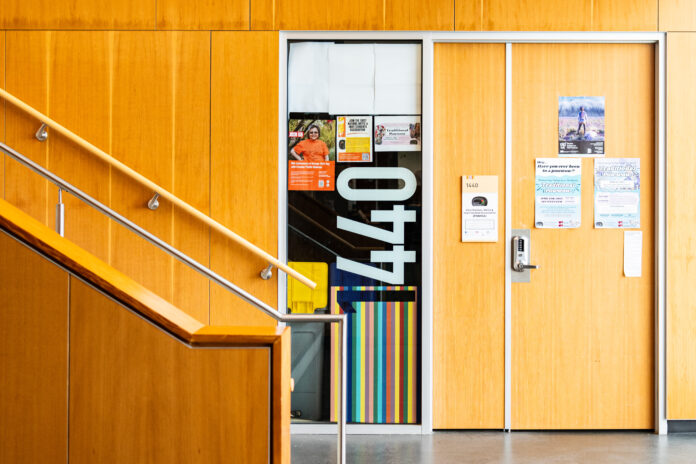
Room 1440 of the Student Union Building (SUB) is home to the First Nations, Métis and Inuit Student Association (FNMISA), a group that provides a space for Indigenous students to lounge, study, and create community. 

This wasn’t always the case. Before having this space, FNMISA was one of the original rotunda groups alongside Simon Fraser Public Interest Research Group (SFPIRG), CJSF 90.1 FM, the Women’s Centre, Out on Campus, and SFU Students of Caribbean and African Ancestry. For multiple years, alongside the rest of the rotunda groups, FNMISA fought for a space in the SUB and fair treatment by the SFSS — they won their current space in 2020. 

In November 2021, FNSA officially changed their name to FNMISA to ensure Métis and Inuit students knew they were also represented by the group. Today, FNMISA hosts plenty of events throughout the year focused on educating through cultural practices. The association also engages in advocacy, such as holding SFU accountable for its commitments to reconciliation. For example, FNMISA has repeatedly pronounced themselves against SFU’s lack of proper consultation with Indigenous students prior to the construction of SFU’s First Peoples Gathering House. 

Events and Socials

FNMISA has and continues to be a source of social events, activities, and activism for the community. FNMISA hosts the annual Indigenous Day events at SFU. “We have a really big community of Indigenous students here and we want to embrace [that] all Indigenous people are different,” said Matthew Provost, an event organizer during 2017’s annual Indigenous Day event at SFU. 2017’s Indigenous Day was intentionally meant to highlight women’s voices, with all headliners for the event being Indigenous women. 

During 2023, FNMISA organized the first inter-tribal Powwow at SFU. It was attended by 1,000 guests and had 40 vendors displaying Indigenous artworks. Powwows are a great way to engage with the Indigenous community as it is a celebration of culture. Those who attend Powwows choose to wear traditional handcrafted clothing, including beaded apparel. While this year’s Powwow event has already passed, there is always next year. Powwows are also open to the public, making them an ideal event to learn and experience Indigenous culture. The term “Powwow” originates from Algonquin tribes (whose traditional territory extends across so-called Quebec and Ontario), and fittingly refers to a healing ceremony. Powwows also have their roots in resistance, as many Indigenous gatherings were banned in Canada from 1884 to 1951. This was done to force assimilation onto Indigenous communities, yet many would still partake in the ceremonies. Powwows today signify reclamation of culture, a celebration of life and a collective engagement in spirituality.

Beyond major events, FNMISA regularly hosts other social gatherings such as, hosting a games night every other week from 6:30 p.m. to 10:00 p.m. in FNMISA’s room, dinner is also provided — the next event will take place on July 7. Other activities include “FNMISA Movie Nights,” movie viewing gathering at FNMISA’s room every other Friday, with pizza and snacks provided. FNMISA also promotes events such as the annual Skoden Indigenous Film Festival, which, this year coincided with FNMISA’s own third annual “Honouring Indigenous Students” Powwow. Apart from their regularly scheduled events, FNMISA also organizes beach days, camping trips, and other activities.

Bursaries, scholarships, and student support

Beyond social events, FNMISA assists students in learning and navigating through the many scholarships offered to Indigenous students. The BC Scholarship Society offers funding up to $5,000 per year, for any Indigenous student pursuing any form of education, whether it’s trades, a diploma, or a degree. The Ch’nook scholarships program, which contain $2,000 in funding, is catered to those studying business and anyone can apply and receive the award. These are just two of the many examples of financial aid listed on FNMISA’s website.

Another useful aspect to consider is the peer cousins mentorship program, which links newer students to older, more experienced students. Through this program Indigenous students not only get introduced to members of the community but also have a support system when it comes to navigating the daunting new space they enter for education. SFU can be confusing to navigate, but having someone else who is familiar can help ease new students into this environment. 

For those looking for financial aid, it is best to first consult with financial aid advising, which has both a remote and in-person option. Drop in appointments slots are available on Thursdays 1:00 p.m.–2:00 p.m. and Fridays 1:30 p.m.–2:30 p.m. Appointments can also be booked by contacting [email protected]

To join FMISA there are two requirements. You must first self-identify as Indigenous. This means students must indicate on their application that they are of Indigenous ethnicity, while also filling out a supplemental application. This application will also require a reference to verify. The second requirement is enrollment. You must be enrolled in a semester, or will be the following term they are granted access to FNMISA. Students who were enrolled a semester previously may also join, but no earlier than that. FNMISA is an important part of the SFU community, as it provides a safe space for many Indigenous students. It is a way in which many can get involved in cultural practices, and the organization offers a variety of engaging events all focused on the importance of community, while also providing Indigenous students the opportunity to have a comfortable transition into university life.

Monday Music: Songs for moving forward, healing, and letting go

0
This is an illustration of a young adult walking towards the abyss along a deserted road with their car doors open
ILLUSTRATION: Stella Laurino / The Peak

By: Lucaiah Smith-Miodownik, News Writer

19 by La Reezy

I told my older self to let me go.” With infectiously uplifting beats and vocals, La Reezy raps on what it means to become the person you want to be. Layered over a sample from Willie Hutch’s “I Choose You,” the artist flips Hutch’s melodic voice to the introspective, choosing himself. Doing so often requires confronting what ails us most, and La Reezy does exactly that. “To be the man I am, me and my demons they had to tussle.” Listen to this track, and you might just find yourself plotting your own come up. Just don’t forget where to start, that is, with “the man in the mirror.”

Healing by Rahill

Rahill’s voice doesn’t demand. Instead, it gently beckons your ears to listen. With comforting vocals and a cascading soundtrack, this song sounds almost familiar even to the first-time listener. Perhaps it’s because it reminds you of an old memory — a nostalgia — and you are seamlessly whisked back to a time of peace. “Healing” is a reminder that when you’re in the middle of moving forward, it can be hard to stop and look at how far you’ve come. Only when the lyrics give way to an interlude of dialogue, perhaps between mother and child, is your attention drawn back to the here and now.

Victory Lap by Valley Palace

I’m not in the backseat, now, I’m riding in the driver’s place.” Woven into Valley Palace’s lyrics is the sentiment of growth, of moving forward with both mind and body. The artist’s vocals offer a sound of serenity, but the message is clear: “I don’t need you chasing me around.” “Victory Lap” is a reminder that sometimes climbing to the front and taking position behind the wheel in life means showing others the car door, and that is OK. 

King Konquer by VNDRE

VNDRE is as much of a storyteller as he is an artist. His words, exuding confidence, flow straight off the tongue and into the listener’s veins. “I am worth more than any word that you’re speaking bout me,” he tells all. “King Konquer” emphasizes that if you’re sure of your path, then letting go of what others may think of you is the best thing you can do. “Don’t extend hands, germs be in the palms of those who can’t stand me, at least you could cough up truth.” VNDRE knows who he is, and in the face of doubt, that’s what matters most. At times, we could all use some self-conviction. Listen to this song when you need to borrow a little.

A call for revolution (and moving sidewalks) at blusson hall

0
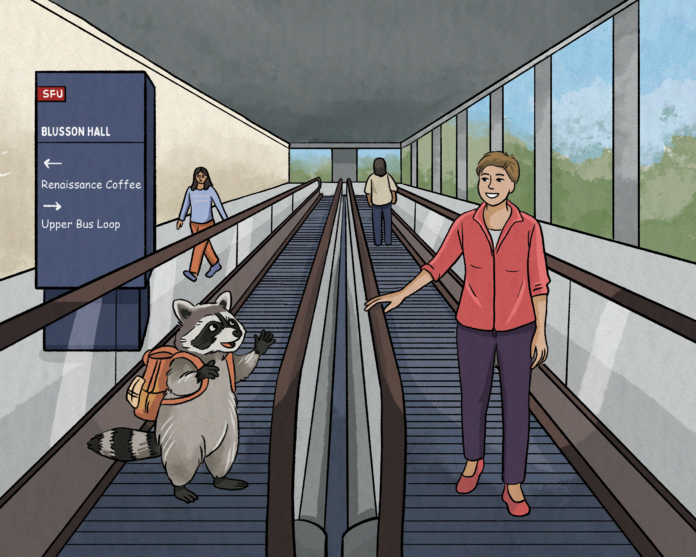
Joy Johnson and a raccoon thoroughly enjoying SFU’s newest installation of moving sidewalks inside of blusson hall. There are signs pointing to the upper bus loop and to Renaissance.
ILLUSTRATION: Bithi Sutradhar / The Peak

By: Katie Walkley, Peak Associate

HEAR YE, HEAR YE!

SFU storm bringers, we have gone on too long walking immeasurable distances from class to class. We are made to feel like hobbits trekking to Mount Doom when we should be trekking towards stable careers (unless you’re an English major . . . SIKE! English majors rule! Screw the haters). We cannot continue to operate under the control of our inhumanly planned architecture. It’s time to wake up and leave your NPC lives behind, sheeple!

I’m not the first free-thinker to awaken to the misery under our noses. A fringe, anti-traditionalist, anti-walking society has been scheming behind the scenes for generations. Now, they’re coming out of the shadows for their greatest heist yet, and we must join them. The plan? Implement moving sidewalks in blusson hall.

We need a hallway that works for us, not a hallway we have to work to get out of! The time we spend wandering around campus could be cut in half with a speedy track that sends us where we need to be, like groceries sliding towards the cashier. Do we not deserve to be treated equally, nay, better, than the Takis bags scooting oh so lavishly to their destination? 

Like you, I once thought this walk from the AQ to the upper bus loop was merely a mild inconvenience. During that dark time, my silly, ignorant mind couldn’t even comprehend the possible alternatives. Then, I escaped the matrix (took the summer semester off), and the unnoticed detriments to my well-being came to light. Let me tell you, the truth shines brighter than Edward Cullen’s sparkly jawline, except this time, instead of being hungry for blood, it’s hungry for justice.

Back when I braved the harshness of the Burnaby campus daily, I was forced to put my gains aside and skip leg day. I couldn’t risk getting injured from my alpha male workout routine. I feared that if my legs were too sore, I would collapse in that hall and never make it home. Now, all I have is eightpack abs with too much mass for my noodle legs to hold. I still skip leg day — I need a rest day from these memories. 

Even though I sacrificed any possibility of buff calves, my efforts did not protect me from the unstoppable pain that hall wreaks upon innocent students. Coming out of those three-hour psychology lectures in the Images Theatre, legs numb, about to crash out, blusson hall became a final test of worthiness where I did not want to be worthy. 

So, SFU nation, after sharing my story, I ask you to think of all the ways this tunnel of despair has wronged you. Once you find the rage within, you will be ready to join us at dusk on the first half moon after exam season. Together, we will figure out how airports make those moving sidewalks. We will control the means of production! After that, we will be unstoppable!

I’m forever haunted by Harbour Centre Mall

0
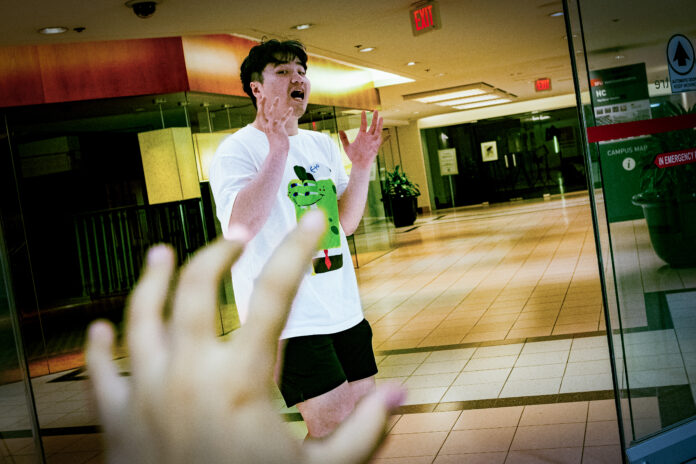
A picture of a man with a frightful face in front of the SFU Harbour Centre campus (inside of the mall). A hand is reaching towards him.
PHOTO: Emily Le / The Peak

By: Yulissa Huamani, Peak Associate

Look, there’s nothing better than waking up at the crack of dawn to attend a lecture. I don’t expect anything remotely interesting to happen at 8:00 a.m. as I commute and question my life decisions. Plus, I feel rejuvenated after a micro-nap on the SkyTrain. Slowly regaining consciousness, I have potentially 15 minutes of semi-functional brain activity left before facing my worst enemy — that damn mall. 

Do you know the small mall tucked under SFU’s Vancouver Harbour Centre Campus? The creepy place where haunted mall music (muzak) echoes through the deserted hallways and pension-receiving escalators plead for help like trapped souls trying to be released? Where looping muzak slowly increases its volume to combat the mournful sounds of lost souls?

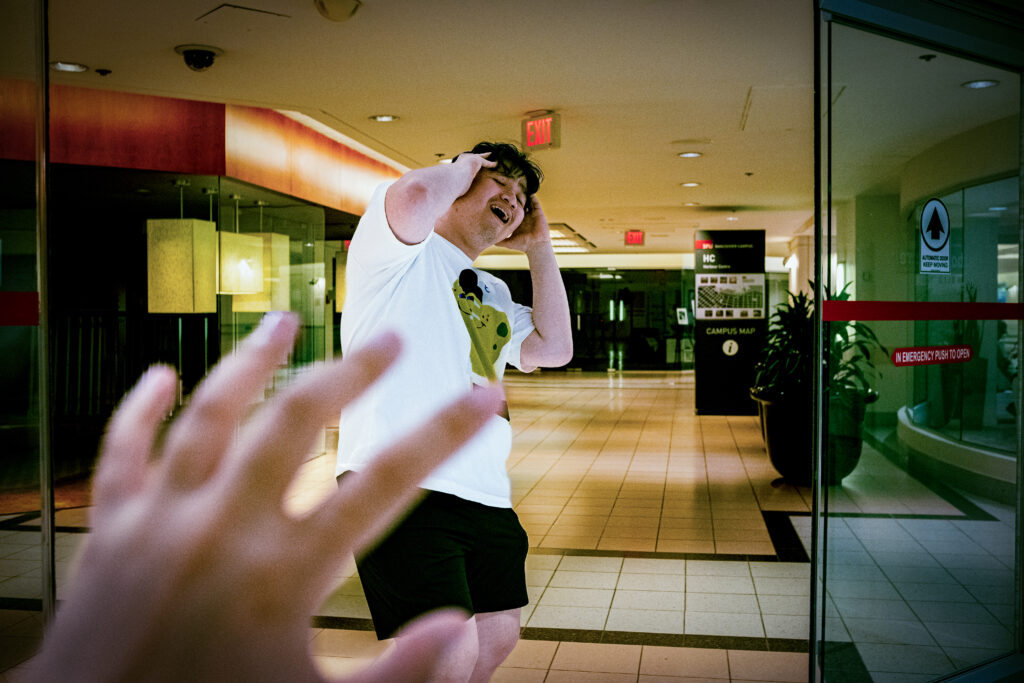
A picture of a man with a frightful face in front of the SFU Harbour Centre campus (inside of the mall). A hand is reaching towards him.
PHOTO: Emily Le / The Peak

Seriously, has anyone walked through the mall without feeling like they could potentially become a protagonist in the new Final Destination movie? I hold my breakfast like my LIFE depends on it. Sometimes I can feel a ghoulish hand reaching towards MY rice krispie squares — spooky shit. Every sound echoes louder than my intrusive thoughts. Even empty store mannequins scream for help, like the chilling screams you feel in your bones. As if the vibes of this place aren’t spooky enough on their own, I’m often confronted by the frightening muzak that’s probably chosen by the ghost of a middle-aged woman. I hear J.Lo screaming “LET’S GET LOUUUUUUUUD” as if it were a war cry to rally the ghosts of the mall. On the day of an exam, while you frantically flip through your Quizlet, you can enjoy 10 seconds of a dramatic piano ballad by Céline Dion so emotional that it felt like the Titanic was sinking again. All the while, you’re running like a desperate orangutan through the streets, praying to make it on time to the exam. And no, Jack, you don’t want to be saved to hear or see this.

I genuinely believe the mall is haunted. Are exorcisms on buildings even a thing? Just because the whole vibe feels like the opening of a horror movie where no one makes it past the first scene. And the music sets the tone. “Toxic” by Britney Spears can randomly start blasting through the speakers like the mall suddenly decided it was 2004. And the next song could either be “Conga” by Gloria Estefan or some random Christian pop hit. I either power walk to class or accidentally empower a ghost with some religiosity, which doesn’t seem to work as it still haunts me. Just like that one Canvas grade notification you avoid opening, you know you can run, you can escape, but it lingers patiently. In the shadows of your every thought, every step you take, the mall will find you. With no remorse.

On reading Dostoevsky

0
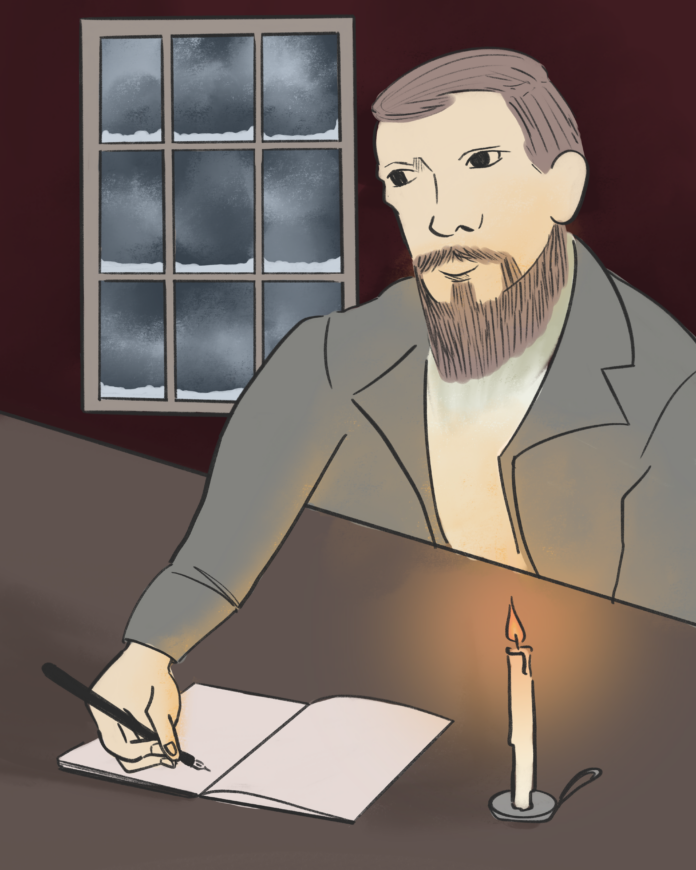
It is an illustration of a portrait of Fyodor Dostoevsky writing his book under a candle light in a dimly-lit room
ILLUSTRATION: Victoria Lo / The Peak

By: Yildiz Subuk, Staff Writer

I have read a significant amount of Fyodor Dostoevsky’s work and found myself both exhausted and enlightened. His book Notes from Underground (1864) is hailed as the first existentialist novel, exploring the depths of an ill man’s psyche as he loses his sense of purpose. Crime and Punishment (1866) tackled intertwining themes between social inequality and crime, while The Brothers Karamazov (1880) told the sprawling tale of one of the most dysfunctional families in literature. Dostoevsky, who was born in Moscow, Russia in 1821 lived till the age of 59. He was involved in an anti-government group, which led to his arrest and death sentence in 1849. Just before his execution, he was instead transferred to a Siberian Labour camp, until he got his release in 1854. The tone and subject matter of Dostoevsky’s work feel like a manifestation of his bleak life experience and an examination of his own existence throughout different periods of his life.

When I first began reading Dostoyevsky, I jumped straight into Crime and Punishment,  and as I began reading I knew I immediately made a mistake. While the premise, — focused on a young man who is driven to murder and theft by his socioeconomic condition — seemed captivating, I realized the book was too focused on the guilt and inner turmoil of the character rather than a plot. It felt more akin to a diary than a novel and I put it down. I ended up leaving it unfinished, and decided to read his shorter first novel, Notes from Underground — personally, I think this is the best place to start with his work. 

Due to its shorter length, Notes was more accessible. It is split into two parts, one focusing on the inner ramblings of a man whose health is declining, causing him to become increasingly bitter. The second part explores his past and how he reached his breaking point. This book familiarized me with Dostoevsky’s writing style and voice. Afterwards, I eventually returned to Crime and Punishment, and finished it. While I was more appreciative of this novel the second time around, and found the exploration between crime and poverty to be interesting, it was still a bit of an exhausting read due to it focusing primarily on Raskolnikov’s view of the world for too long of a length.

The Brothers Karamazov fixed the problem I initially had with Crime and Punishment. The Brothers is my favourite of his works. It is nearly a thousand pages, but constantly compelling. Instead of focusing on one character’s psyche we see the perspective of four main characters — four brothers —  and their relationship with their tyrannical father. It unveils the abuse they experienced, and how each one of the brothers develops a different conflicting sense of morality. When they are re-united after years of being apart, this dysfunctional dynamic reaches a crescendo. The brothers explore the decay of morality, while also challenging the reader’s beliefs on redemption. It poses the question,“Can the most morally depraved individuals have a chance to redeem themselves, not just in the eyes of society, but also in their own eyes?”

While Dostoevsky’s more notable work can feel challenging due to its length and its rant-like quality, it is rewarding to those who enjoy the style of unfiltered writing. Starting with his shorter fiction before delving into his lengthier works will give the reader better insight into whether they like his writing or not. Dostoevsky’s ability to convey emotions like bitterness, angst, hatred, through his writing while exploring social issues makes him a writer that has stood the test of time. This does not necessarily mean his work will floor every reader. His continued popularity is, however, a testament to how timeless his writing feels, and for those looking for books that keeps their minds engaged with the philosophical elements of the story, Dostoevsky’s work will leave the reader constantly grappling with their own world view.

CARTOON: The Trump and Musk breakup

0
Trump and Musk sitting on opposite sides of the frame. They are both shedding a tear as they look beyond. The sky is black.
By: Christine Aumueller

By: Christine Aumueller

Our Bodies, Our Health tackles 2SLGBTQIA+ sexual and reproductive health

0
This is a vibrant illustration of people of various genders, body types, and skin tones holding pencils and pieces of paper. Sexual and reproductive health symbols (like condoms, IUDs, birth control) are patterned in the backdrop.
ILLUSTRATION: Angela Shen / The Peak

By: Lucaiah Smith-Miodownik, News Writer

A new survey titled “Our Bodies, Our Health” wants to better understand the sexual and reproductive health needs of 2SLGBTQIA+ Canadians. The study is headed by the Community-Based Research Centre (CBRC), in partnership with the Health Initiative for Men (HIM) and Investigaytors, among other organizations. The Peak spoke with Kartik Arora, a team lead for HIM and Investigaytors, about the survey and what it means for the future.

Both CBRC and HIM focus on the health of gender and sexually diverse community members. CBRC is a research and project-based organization, while HIM focuses on the latter. Similarly, Investigaytors is “a national community-based research program,” Arora said. “Specifically in BC, it’s a community health leadership program for 2SLGBTQIA+ community members who are interested in health research.”

The survey results will help HIM “create interventions or programs” designed to “address those gaps that we find in the data,” Arora said. “A lot of queer folks, especially younger queer folks, might share a primary care provider with their parents or their family members. And so sometimes people can still be worried about confidentiality and information getting out,” he explained. “A lot of times what we see is queer communities often have to educate their own healthcare providers on their specific queer health needs and sexual health needs as well.” Since the survey is still ongoing and all the data is yet to be obtained, it’s difficult to predict what these programs might look like, Arora said. 

Beyond local implications, the data will be shared on the provincial and national levels and with the Canadian Institutes of Health Research, which helped fund the study. “Once the data is collected and compiled, we’d be able to inform on policies and practices and take this data to those bodies that inform regulations and pass legislations and policies about the lives of 2SLGBTQIA+ members in Canada.” Arora emphasized that “it’s one thing just to collect data, but if you don’t do much with it, or have reciprocal means of sharing the data as well, it can often look like you’re tokenizing a specific community, especially a marginalized community.”

Lack of access to the HPV vaccine, which defends against both genital warts and various cancers, represents another challenge for some members of the 2SLGBTQIA+ community. Arora explained that the shot is “only free in BC up to 26 years of age and younger, even though it is recommended for queer men that are older than 27.” 

“I love that this survey allows community to lead community.” — Kartik Arora, team lead at Health Initiative for Men, Investigaytors 

What makes this survey special is its “community-driven” roots, Arora said. “A lot of times when you have surveys about our communities, they’re often created by certain bodies in the silo,” he explained. In the case of “Our Bodies, Our Health,” Arora said “there’s been so many voices and input going into designing this survey.” 

Designing the questions did not come without challenges. “Narrowing down the scope,” while “making sure that we had questions in each of the areas that we wanted to focus on and prioritize,” was one obstacle, he explained. Ensuring the survey was “accessible and can be finished in a certain allotted time frame” was a challenge as well.

The study is special in that “in contrast to previous queer research surveys, this one also tackles on endeavors related to sexual and reproductive care, gender affirming care, and sex and pleasure, which are often overlooked.” Additionally, “each province that is administering the survey will have their own unique questions” within the survey, to provide a better glimpse into “what’s going on in local communities,” Arora explained.

For instance, “in BC, our healthcare system is split into multiple health authorities spread across the region,” so some questions may ask which region participants live in and where they access services. He explained that such an inquiry will provide an idea of whether individuals are looking for services outside of their regional authority.

“It really does take all parts of the community and different people at different places to come together to be able to do this kind of work,” Arora added. “I love that this survey allows community to lead community.”

The “Our Bodies, Our Health” survey will be available in person at Vancouver Pride from August 2–3. The survey is also open until mid-September online.