Home Blog Page 3

SFYou: Dr. Amyn Sajoo

0
A headshot photo of Dr. Amyn Sajoo
Courtesy of Amyn Sajoo

By: Zainab Salam, Editor-in-Chief with contributions from Petra Chase, Features Editor

If you’re studying political science, international studies, or history at SFU, you’re likely to have had the pleasure of encountering this remarkable professor. Having taken a course previously instructed by him (IS 302: Humanitarian Intervention), I conducted a video interview with Dr. Amyn Sajoo last fall.

“It’s certainly been a very long journey,” Sajoo recounted during our chat, smiling. “I’ve been very fortunate.” The SFU lecturer and scholar-in-residence was referencing his over four decades of contributions to diverse disciplines.

With a focus on human rights, he’s helped facilitate countless dialogues on an array of topics, including diversity and belonging.

He’s also written and edited volumes of literary works, imprinting a mark on the academic memory. 

Sajoo received his doctorate in international human rights at McGill University in 1986. Then, one winter in the early ‘90s, a turning point in his scholarly journey happened. He had been acting as a policy advisor in applied human rights at the Canadian Human Rights Commission in Ottawa. “Out of the blue, I won this competition to accept a fellowship in Southeast Asia,” he recalled, with gratitude. It was through this opportunity at the Institute of Southeast Asian Studies in Singapore that he was sent to do two years of field work in Indonesia, Malaysia, Thailand, and the Philippines. The result was his foundational book, Pluralism in “Old Societies and New States:” Emerging ASEAN Contexts, published in 1994.

Continuing his research focus on civil society — how people govern themselves and approach society, from non-government organizations to grassroots organizers to individual people — Sajoo was called to London. As a visiting scholar at the Institute of Ismaili Studies in London, he refined his focus, melding thoughts with other scholars on Muslim ethics and traditions.

These experiences helped him realize that “the secular approach to human rights in the West is not the only approach,” he explained. “It required me to take all my human rights background, and now apply it specifically to how Muslims were governed, and how they had their everyday existence — when you took Islamic thought, Islamic practice, and then the politics in its interplay.” 

At SFU, Sajoo continues to bridge worlds. Between ethics and law, his lectures are committed to connecting scholarship with public discourse. In making complex ideas accessible to wider audiences, he demonstrates that research is not confined to academic spaces, but is deeply intertwined with lived experiences. 

Interdisciplinary imperative 

Islamic studies involves theology, history, philosophy, literature, and political social sciences — all through the lens of Islam and its influences. For Sajoo, it is not a single academic discipline. “There’s no other way of looking at Islamic studies,” he said. “It is intersectional, interdisciplinary, and can’t be reduced to a single department where it’s put into a warehouse.” The key, he explained, is context: the issues being addressed shape which disciplines are brought together. 

Islamic studies faces structural challenges in universities. Sajoo pointed to the rigid departmental division that defines academic life. Through the declaration of a major, people are “put into a particular disciplinary area. And this narrows the approach,” he said. Because of this, multifaceted topics in universities like refugee crises or climate change, issues that are very important to what is referred to as the Muslim world, have “very weak means of pulling in Islamic studies at large and bringing that into play.” 

He continued, “We haven’t got the intellectual courage or the imagination to say, ‘Interfaith dialogue is a very exciting field to get into, even for universities. And it’s not just some pious thing that should happen in a church, or a mosque, or a temple.’” Sajoo believes it’s important to separate religion from state, but that doesn’t mean we should ignore the influence of religion on politics and identity. 

The importance of dialogue 

For Sajoo, the idea is clear: dialogue is not just a moral imperative, but an intellectual one. Engaging multiple perspectives — sectarian, national, and disciplinary — enriches all approaches to Islamic knowledge. After speaking fondly about intercultural exchange, he expressed excitement about how the digital age helps facilitate global dialogues. 

At SFU, the Centre for Comparative Muslim Studies promotes scholarship in Islamic studies. Sajoo has been “hosting a conversation series to do with citizenship and identity” with them since 2018. One conversation he highlighted was with Dr. Wenona Hall, last year. Hall is Stó:lō from the Sq’ewqeyl First Nation and SFU’s chair of Indigenous studies. Sajoo spoke of the new terrain Muslims face as settlers on unceded land, as they “now have a relationship with Indigenous Peoples who feel very deeply connected to us on matters like Palestine, minority rights, gender equity.” He noted, “I think our dialogue with Indigenous Peoples [ . . . ] is another thrilling thing to get into as a diaspora citizen.” 

For Sajoo, Islamic studies must engage with lived experience. Turath (an Arabic word that means tradition) is dynamic, not static, and human beings navigate religion, ethics, politics, and all other facets of daily life in an intertwined reality. The idea of stewardship, which is present in many religions including Islam, is also crucial to the approach to human rights. It is the idea that “you are accountable, in a very deep way, for leaving the earth a better place than when you came,” he said.

Rethinking historical narratives

History provides remarkable feats of humanity, according to Sajoo. Upon insistence from me, (“It’s like asking a dad to choose his favourite child!” he protested) I had been successful at extracting some of Sajoo’s notable pages of history. 

“To me, perhaps the most exciting era would be the 10th and 11th centuries in Cairo. When the Fatimids came from the Western part of North Africa [now Tunisia], they founded the city of Cairo,” he said. Cairo and Baghdad during this period became hubs for Islamic intercultural exchange and dialogue, where academics, artists, and even mental health doctors (the first psychiatric ward in the world) flourished.

Perhaps my favourite reference is to the Islamic Translation Movement which occurred in the 8th and 9th centuries. The movement set out to translate works from all the regions that Muslims, and those living in what was referred to as the Islamic world, had interacted with at that point. This initiative had proved to be incredibly valuable both within its temporal context, and to later generations; it led to preservation of various ancient texts and even helped activate the Renaissance period.

Sajoo is a careful communicator and he places an emphasis on the use of terminology. In our conversation, he expands on his critique of Samuel Huntington’s 1996 book The Clash of Civilizations and Remaking of World Order, emphasizing the dangers of reductionism — oversimplifying complex concepts — and determinism — the assumption of the existence of a causal relationship between one phenomena and another. He communicates that Huntington’s framework, which predicts inevitable clashes between a limited number of civilizations, oversimplifies complex histories and denies human agency. 

He stressed that societies should be understood in a plural and dynamic manner — as collections of interacting cultures rather than isolated, static entities. This perspective is essential in contemporary discussions of identity and citizenship. 

Literature as a lens to truth

Sajoo also highlighted fiction as a vehicle for understanding human experience. While teaching in SFU’s liberal arts outreach program, he helped explore works ranging from South African apartheid, with André Brink’s A Dry White Season, to Kazuo Ishiguro’s Klara and the Sun.

“Fiction contains a lot more truth sometimes than non-fiction does,” he explained. “It may not be about facts, but it’s about truth.” 

He posits the importance of diaspora literature to hold particular significance, offering insights into identity, belonging, and historical memory. Through literature, ethical and cultural questions come to life in ways traditional scholarship, alone, cannot achieve. The way Islamic history is often viewed through the lens of battles and sultans, or empires and elites, he highlighted, can be “reductive” as it overlooks the lives of everyday people.

Personal passions

Beyond scholarship, Sajoo maintains deep personal interests, notably in literature and chess. Despite the rare spare time, he finds solace and intellectual stimulation in these activities. Chess, in particular, is a meaningful practice. He notes the Persian and Indian roots of the game. He argues that the game mirrors broader patterns of human ingenuity and creativity that was preserved through time. 

Sajoo also remarked on the “role of art” in our human existence. “Art is a very powerful place. People let down their guard a little bit and are willing to dialogue a lot more when you share with them the beauty of art.” He includes various mediums of art, such as the visual mediums and poetics. “It breaks the barriers between people. There is a shared appreciation of the aesthetics.” He encourages exploring the Gibson Art Museum at SFU on The Mountain of Lhuḵw’lhuḵw’áyten (Burnaby Mountain) campus.  

A subject of interest for Sajoo is the intersection of environmental ethics and Islamic heritage. “Climate change is such a big issue,” he noted. Sajoo hosted professor Peter Dauvergne from UBC for an interview, in 2018, where they discussed Dauvergne’s book: Environmentalism of the Rich.

Sajoo is an encyclopedia. You can browse his extensive catalogue in the SFU library. If you haven’t yet had the opportunity to witness him as a lecturer you can do so by watching his highly informative lecture, Populism, Citizenship, and Religion, on Vimeo.
Mi’gmaq dancer Cheyenne Seary explores her artistic vision

0
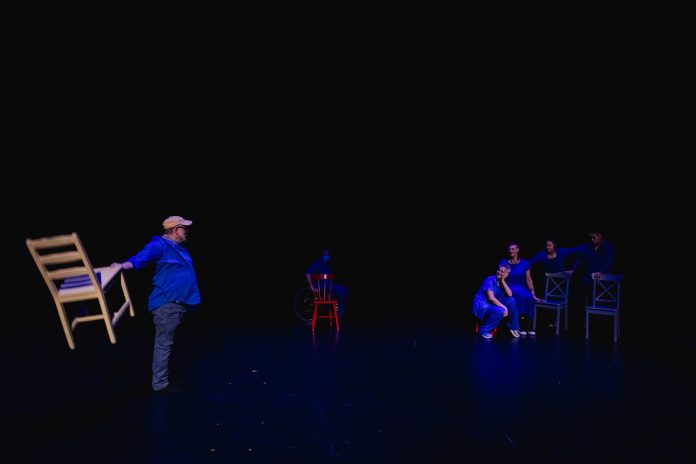
A photo fo Casseiopia mid-performance in a dimly-lit theatre setting
PHOTO: Courtesy of Carla Alcantara

By: Nejdana Houshyar, Peak Associate

On June 5 and 7, Mi’gmaq dance artist Cheyenne Seary debuted her latest piece, Casseiopia,” with the All Bodies Dance Project at the Goldcorp Centre for the Arts at the SFU School for Contemporary Arts. The piece explores themes of love, aging, and grief. It follows a young mother navigating the trials of motherhood while following a community mourning two lost children. “Casseiopia” speaks from experience — a harrowing yet beautiful work that encapsulates Seary’s personal life. The Peak reached out to Seary to learn more about her life, her work, and the symbolism behind “Casseiopia.”

This interview has been edited for clarity and concision.

What made you want to become an artist and choreographer?

I have always enjoyed the arts, but for many years I never considered myself an artist. I believed that artists were people with exceptional talent, while I simply enjoyed being creative. Over time, I have come to realize that art is about expression, connection, and community. 

My journey as an artist began 11 years ago when I joined my first All Bodies Dance Project class. Being part of a community of engaged dancers has helped me embrace my identity as an artist. I saw that being an artist is less about performing perfectly and more about being open, authentic, and willing to create with others. Through movement, collaborative choreography, and celebrating our differences, I also discovered that dance can look many ways and that every person’s story has value.

As an early childhood educator, I am inspired by the quote, “Every child is an artist. The problem is how to remain an artist once we grow up.” Children creating, exploring, and expressing themselves without fear has influenced the way I approach my own creative practice.

Why did you choose to call the piece “Casseiopia,” and how does the symbolism of a strong mother figure reflect your art?

In December 2024, All Bodies Dance Project presented Constellations at the Roundhouse. For this production, I created a piece called “Casseiopia,” inspired by the constellation of the same name. I was drawn to her image because it reflected both the strength and vulnerability I associate with motherhood.

“Casseiopia” explores the struggles, resilience, and joy of being a mother. The choreography began to take shape during 2020, when I was a new mom navigating the uncertainty, isolation, and grief of the pandemic, while also discovering the deep love and connection that comes with caring for a new baby.

For me, the piece is not only about motherhood, but also about the power of community, creativity, and collective care. It reflects my belief that dance can create spaces where our stories are witnessed, our challenges are honoured, and our shared humanity is celebrated.

Your piece also touches on a community’s mourning of two lost children. How does the contrast between birth and loss shape the meaning of your work? 

The big, child-sized red chairs at the beginning of “Casseiopia” symbolize a connection I had with a young boy who lived where I grew up. One day, he saw me outside holding and rocking my baby. He found a small chair and a toy baby, sat beside me, and mirrored what I was doing. That memory stayed with me deeply, especially because he passed away only a few months later.

In the dance piece, the big red chair becomes a memory chair, carrying the presence of those we have lost. Each chair represents a member of the community supporting another. Together, they are like a sacred fire, one that is lit when someone from my mother’s community begins their journey to the ancestors.

Keep track of Seary’s future works through All Bodies Dance Project’s Instagram account, @allbodiesdance.

Nine minutes to celebrate a Canadian soccer star’s inspiring life

0
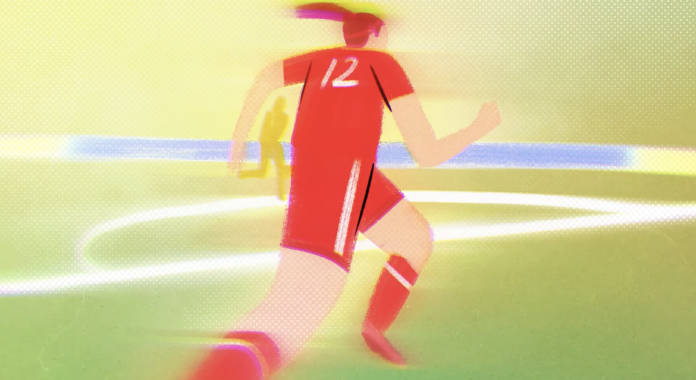
A still from Kind of a Big Deal of Sinclair running
IMAGE: Courtesy of Knowledge Network / Youtube

By: Tomos Land, Staff Writer

Kind of a Big Deal, a short animated documentary recently released by the Knowledge Network, provides a brief but compelling overview of national Olympic champion Christine Sinclair’s soccer career. Directed by Eoin Duffy and voiced by Ryan Reynolds, it explores the trials and tribulations of Sinclair’s journey from grassroots football to the top step of the Olympic podium. Touching on several key themes, including family, leadership, and gender pay disparity in professional sports, the documentary is both funny and thoughtful, helped by Sinclair’s insightful, albeit at times reluctant, commentary throughout.

From start to finish, Sinclair’s goalscoring record provides the backdrop for the documentary. With 190 goals scored for Team Canada, the Burnaby-born legend sits at the top of the leaderboard for most international goals ever scored. Sandwiched between animated clips of her first international goal scored against Norway and her final strike versus Trinidad and Tobago, the documentary masterfully weaves Sinclair’s personal and professional journey into one bite-sized story. 

During her illustrious career, Sinclair was made captain of the Canadian women’s soccer team a role that she admits was at the beginning daunting.

“For the longest time at the national team, I felt like I was such a failure as a leader, because I thought I had to become something that I wasn’t”

— Christine Sinclair in Kind of a Big Deal

However, after accepting that while her approach differed from other leaders — who Sinclair noted are often louder — her approach to leadership was still effective and she and her team soared, both nationally and internationally. At the 2020 summer Olympics in Tokyo, under her leadership, Canada beat Sweden on penalties to win the nation’s first ever gold medal in soccer. 

Despite this success, the men’s national team were still earning more than their Olympic gold winning women counterparts. After tirelessly working to change this situation, Sinclair and her teammates prevailed, with a collective bargaining agreement securing a short-term equal pay reached earlier this year. As captain and a national icon, Sinclair was instrumental in this victory for her and her teammates, underlining her leadership qualities both on and off the field. 

Subtle references are made to Sinclair’s mother and her battle with multiple sclerosis during the documentary. Animated clips of Sandra Sinclair, or “mom,” are interspersed throughout the animation and her presence as a key figure in her daughter’s story is frequently alluded to. A segment shows a young Christine playing football in the park with her mom, and another reveals a picture of the pair in Christine’s locker during the 2011 World Cup. A final sequence depicts the pair holding hands together in hospital, with the closing credits touching on Sinclair’s work now as a champion of multiple sclerosis research

Overall, this short animated documentary is a brilliant synopsis of one of Canada’s sporting greats. The extraordinary directing skills of Duffy are on display throughout, while Reynold’s narration balances lightheartedness with sincerity from start to finish. Neither, however, take the attention away from the unassuming Sinclair, who tells her story brilliantly. This is well worth a watch with the FIFA World Cup currently in town.

Soccer is the game of life: Carling Jackson’s “Uprooted to Unstoppable”

0
A photo of the mural: Uprooted to Unstoppable
PHOTO: Courtesy of Jaclyn Licht

By:  Jonah Lazar, Staff Writer

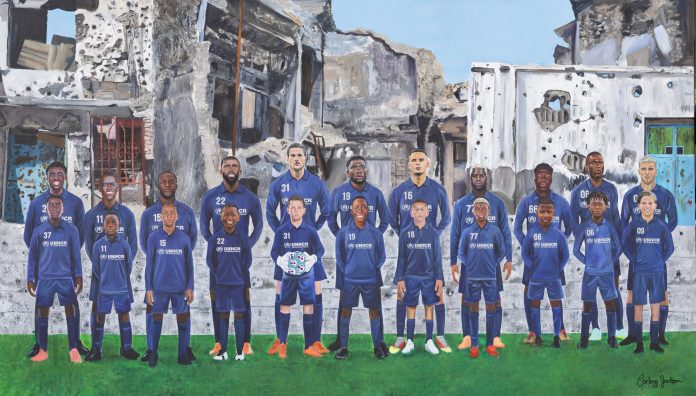
In light of the first days of the 2026 FIFA World Cup getting underway, and to celebrate World Football (Soccer) Day, the Office of the United Nations High Commissioner for Refugees (UNHCR), unveiled a mural celebrating soccer players who came from backgrounds of displacement caused by conflicts and disasters around the world. The mural “Uprooted to Unstoppable,” was painted by Canadian artist and former soccer player Carling Jackson. The Peak spoke with Jackson to learn more about this mural, and the impacts of soccer around the world for diverse communities.

This interview has been edited for clarity and concision.

Please can you tell us about your mural “Uprooted to Unstoppable?”

It’s a piece highlighting the identities and journeys of 11 international soccer players, seven of whom are playing in this year’s world cup. All of them come from forcibly displaced backgrounds; they were forced to flee due to conflict, civil war, climate change, disaster, or persecution, or their families were. A good number of them grew up in refugee camps, and that’s where their journeys started with the beautiful game. 

This mural spotlights the children that all these players used to be. What capacity does football have in creating hope for children?

In creating hope, soccer is a great equalizer. On the field it doesn’t matter what your socioeconomic standing is. It doesn’t matter if you’re rich or you’re poor, if you’re Black or you’re white. My best friend growing up was a refugee from the Congo, and all we did together was play soccer. We didn’t even speak the same language, but we both spoke soccer and that’s how we communicated. All you need is two pairs of socks rolled up in the ball, you can play on the beach, the grass, cement [ . . . ] it’s so popular for its universality.

Canada’s captain, Alphonso Davies, stands out as the UNHCR’s symbolic gamechangers captain, and features prominently in your mural. How important do you see him as being an inspiration and a role model for Canadians? 

He was born in a refugee camp in Ghana and then his family fled the Liberian civil war, before his family resettled in Edmonton, and then he came to Vancouver to try out as a prospect for the Whitecaps. I think he’s important because Canada resettles more refugees than any other country in the world. Davies highlights what is possible when people are given freedom, safety, and opportunity beyond survival. I think Davies is just a beacon of what Canada and humanity should stand for, and what’s possible when we support one another. 

Something that’s been bothering me is this very individualistic mindset; people equate worth with nationality. Every single one of us should want every single person on earth to have freedom of opportunity and safety. We see a lot of anti-refugee sentiment and it frustrates the hell out of me. 

Do you think football has the capacity to repair some of this divide? 

Something cool that I’ve noticed about this World Cup is that it has been highlighting minority populations, and bringing everyone together; look at the attention that Cabo Verde and Curaçao are receiving.

No other sport has the capacity to unite people in this way, and soccer has a powerful ability to bring people together.

A shared self in Simorgh: a self-portrait

0
PHOTO: Jonah Lazar / The Peak

By: Jonah Lazar, Staff Writer

The art exhibit Simorgh: a self-portrait is currently on display at the Audain Gallery at SFU’s School for the Contemporary Arts. This exhibit is a collaborative work done by SFU graduate students Wyldie Bracewell, Alex Calcagno, Carlo Marchet, Chris Outten, and Taha Saraei, as well as SFU faculty Andrew Curtis. Simorgh: a self-portrait is a modern reimagining of The Conference of the Birds, a poem written by 12th century Persian poet Farid ud-Din Attar (also spelt Farid Al-Din Attar).

This poem sees all the world’s birds undertake a long and arduous journey in search of the truth. Prompted by their elected wise leader, Hoopoe, the birds travel across seven valleys looking for a Messianic bird by the name of Simorgh, capable of accessing and speaking to the divine. During this journey, the birds in their masses quit, die, or settle down elsewhere to the point where just 30 continue to the final valley, where they ultimately realize that Simorgh is nothing more than a shared self constructed by the unity of those who completed the journey. 

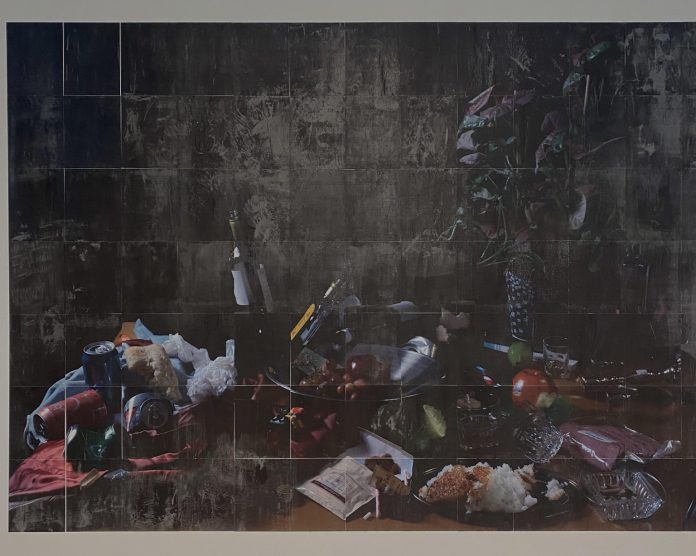
The arts exhibition, Simorgh, does a good job of capturing this search for meaning and collective identity that Attar’s birds sought after. The pieces displayed in this gallery are crafted with a variety of media, including poems, sculptures, photographs, paintings, and video elements. Upon entry to the exhibition, Saraei’s photographic exhibit, Stilled, immediately caught my eye. This large artwork is a mural showing a collection of crumpled-up paper, tissues, soda cans, and leftover food scraps arranged to appear like renaissance-era oil paintings of fruit. This piece captured my attention due to the oxymoronic nature of having essentially garbage photographed in such a beautiful, carefully constructed way. 

However, the piece which I found the most compelling in this exhibition was a piece constructed by Marchet and Sarei, titled “Self Delay. This piece featured two television screens mounted with cameras stationed on opposite sides of the gallery, facing one another. The TVs displayed a live feed emanating from the cameras opposite them, which gave the illusion of two mirrors facing one another, heightened by the mirror frames around the televisions. The cameras being routed to the “mirror” opposite meant that when I stepped between the two “mirrors,” all I could see was my back, and as I walked towards either mirror, all I could see was myself getting further and further away. While spinning around trying to see myself in the reflection, I pondered the themes of the valley of knowledge in The Conference of the Birds, where the more the birds search for wisdom and truth, the further they end up from it.  

As much as Simorgh’s individual parts were entertaining pieces, I found that they were far stronger as a whole, succinctly capturing the underlying messages of the collective self and resilience that Attar conveyed through his 30 birds over 800 years ago.

A visit to this exhibition promises to make you ponder the power of community and collaboration

not only through the connectivity of the artwork, but also from the collaboration between the artists themselves.  

Simorgh: a self portrait will be displayed at the Audain Gallery until July 18, be sure to drop by next time you’re downtown for a thoughtful moment of reflection. 

A student athlete with god-given diving capabilities

0
ILLUSTRATION: Cliff Ebora / The Peak

By: STUDENT ATHLETE INCOMING

Day 1

Dear Diary,

I’ve always wanted to try a sport where I could get over my fear of heights and gain some core strength. Skydiving was on my list, but I’m not sure it counts as a sport . . . because it’s not at the Olympics, and it’s usually advertised on tourist brochures at the airport as a sightseeing situation. 

Day 2

Dear Diary,

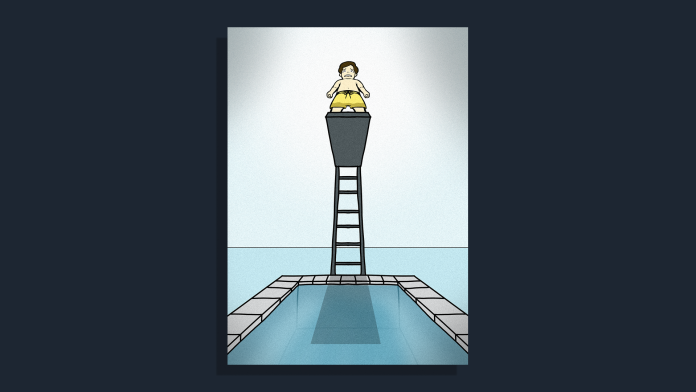
I signed up for springboard diving lessons. So far so good . . . but I tried getting too fancy during the free jump at the end. Everybody else in my group just practiced “jumping like a pencil.” Not me — I’m afraid of pencils and scantrons after taking two summer semesters in a row. 

Day 3

Dear Diary,

The dive tank looks ridiculously inviting, but I’m learning the hard way that water hurts when you overrotate the hard way. Luckily, if you just smile really big when getting out of the pool, everyone assumes the CLAP of water surface tension breaking had nothing to do with me. It was applause!

Day 4

Dear Diary,

I’m enjoying how niche this sport is because I TOTALLY sound like I know what I’m doing. Which I TOTALLY do. Know what I’m doing, that is. It takes me so long to trek up those wet stairs, and only a second to plummet down to water-level. If anyone sees me flop, at least it’s only a flash. Zero witnesses here. I’m starting to dread the sit-ups part of conditioning because my spine feels like it’s even closer to the surface of my skin than usual, but I’m pretty sure everyone thinks I’m all red from the sun!! No impact-redness here. 

Day 5 

Dear Diary,

I put “DIVING ❤️SFU” in my Instagram bio. SFU doesn’t have a diving team, but it’s a little sleight of hand to suggest I am part of something very, very special. It’s not stolen valour because I’ve invested so much time and even secured multiple accessories — including a participation award and a special quick dry towel. I guess it’s pretty awesome that I don’t need a swim cap or goggles. I AM the machine, baby!!!!! 

Day 6

Dear Diary,

That 5 m diving platform feels like the CN Tower. Diving makes me look differently at all the skyrises populating the landscape on my commute to class. If I lived in one of those new Burquitlam condos, I’d probably be so bored of the view because I regularly reach such great heights at my local dive tank. My fear of heights totally dissolved, just like the huge splash pattern I used to make. 

Day 7

Dear Diary,

I wish there was an Olympics this year so I could chime in with my very executive two cents. Last summer, I was getting chip crumbs all over myself while critiquing an athlete’s form. To be honest, I will probably do that again this year, but with an insider understanding of how FRICKIN’ EASY it actually is. So easy that coach gave me the best rookie award. My own private Olympics is going to be cliff jumping this summer. Then, I’ll go to the actual one — wherever they hold them.

I want to kick the Science World soccer ball

0
PHOTO: Anthony Maw / Unsplash

By: Mason Mattu, Humour Editor

“The next station is: Main Street-Science World. Doors will open on the right,” the SkyTrain’s voice-from-above announced as I rose from my seat. As I slid the strap of my tote bag onto my right shoulder, I saw it. Not the dude I saw last week who put his raggedy feet on top of the seat right beside me for some reason. It was something way scarier . . . 

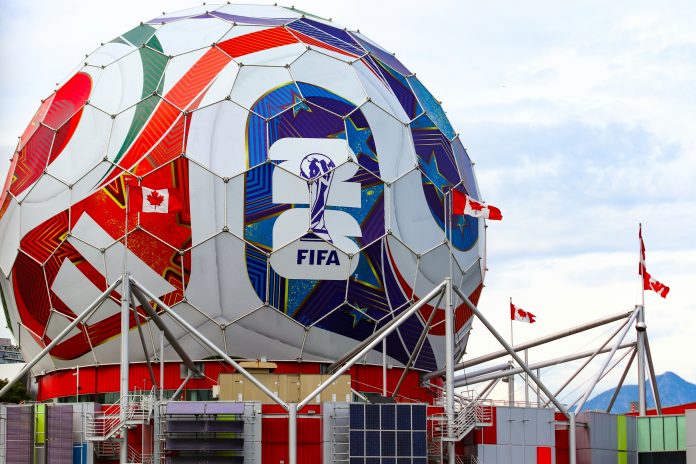
. . . the frickin’ soccer ball that’s perched upon Science World right now for the FIFA World Cup. It glares at me — no, taunts me — as I pass by on my way to school. Every. Single. Day. It’s not just your average soccer ball. It supports an organization that has literally led to the further marginalization of Vancouver’s most vulnerable communities. It’s a beacon for the ultra-wealthy. It’s also ugly as fuck. Not to mention the free clout it’s giving Adidas and FIFA (who literally never even asked for their logos to be up there).  

When I see this ball, I think to myself: what did Mayor Ken Sim think when allocating funding towards this fugly-ass piece of art? Is it solving the cost of housing? Or promoting the work of local artists? Or how about more pressing concerns — such as the mayor’s receding hairline? What?! It doesn’t? THEN WHY WOULD WE PAY FOR IT? 

I’ve even tried my best to find out how much the soccer ball installation costs so I could pay the city MORE to take it down. I would even give up my first born child so I don’t have to be bothered by this eyesore to humanity. However, the City kept on rejecting my freedom of information requests. Their loss, I guess. 

Enough is enough. I can no longer stand being confronted by an ungodly combination of red, blue, and green. I can no longer stand idly by while tourists gawk at this pathetic excuse of a spherical shape. I have one thing to do — and one thing only.

I — no, we — have to kick the fucking soccer ball.

Yes, you read that correctly. Email a news tip to Global News, tell your neighbour’s dog, and bring everyone to Science World on June 20 as I lead an attempt to kick that ball. If Steven Guilbeault could scale the CN Tower in the name of climate justice, we can bring down the soccer ball as a signal to Ken Sim that enough is enough. That we want a city that works for us!

If I scale Science World and kick the ball on my lonesome, nothing would probably happen. I’d probably get a big owie on my toe. BUT if we all do it together, we could make a big dent in the soccer ball. Perhaps even send it flying over into the Pacific Ocean. Please feel free to contact me for more information: [email protected].

Editor’s note: Shortly after this piece was written, the author did indeed scale Science World and break his big toe from the kick. 10,000 people came to watch the kick, but did not participate. After seeing him fall down, they all proceeded to shrug and go back to watching the next World Cup game on their phones. The ball — and all that it represents — remains in place.

I don’t wanna be a benchwarmer!

0
PHOTO: Andrea Piacquadio / Pexels

By: Mason Mattu, Humour Editor and resident nepo baby

I sit on a very warm bench,

That feeling is amplified, 

By the pain of my team asking me for water to pass (not a balllll).

The basketball coach is actually my dad, 

He just stares and looks at me,

Says it’s very scary that I’m a Red Leaf. Oh daddddd. 

Dad . . . COACH! SORRY . . . you have any plans for me?

‘Cause if not I’m gonna try out for ultimate frisbee, 

I wanna throw a basketball and be free. 

Don’t ask where I throw the b-ball,

It’s definitely where it’s meant to be, 

I’m a good player . . . I’m 6 ft!! 

I don’t wanna sit on the sideline and play with a Transformer, 

I don’t wanna be a benchwarmer.

I just know I can be better, be better, be better.

I don’t wanna trip over my own feet,

I think it’s just the size of my cleats!

Oh wait, wrong sport . . . I can still be better, be better.

My girlfriend’s only with me,

‘Cause I play for the SFU basketball team, 

Imagine the look on her face if she sees me in a tournie . . . oh nooo.

I’ve been too embarrassed for her to see,

That I have a special jersey. 

That reads “WATER BOY” for all to see. OH DADDDD. 

Do you have plans for me? 

If not I’m going to tell your wife (my mom) you won’t make me a nepo baby,

Just let me play center, then you’ll see . . . oh, yeah.

With hope there is light,

You give me a shot I won’t mistake the basketball for a strobe light,

I’ll catch it with all my pride!!! OOOOOOO . . .

I don’t wanna sit on the sideline and play basketball on iMessage with my brother, 

I don’t wanna be a benchwarmer.

I just know I can be better, be better, be better. 

I don’t wanna create this big scene,

But if you don’t, I’ll start a petition to the university  

Benchwarmers are meant to be temporary, temporaryyyyyyyy, temporaryyyyyyyyyyyyy.


In defense of the misunderstood, overly-hated, and elegantly useful comma

0
IMAGE: robert6666 / Adobe Stock

By: Maya Barillas Mohan, Staff Writer

Dear TA,

I am writing to you in response to my recent feedback, though I am also speaking in defense of myself, and other like-minded students, to advocate for elongated sentences which exceed traditional boundaries of a single idea, because that’s how revolutionary some of my thoughts truly are. My long sentences are not a lack of respect for convention, but rather proof of an artistic and stylistic identity I seek to develop through my early academic career, as I hope to pilot a new style of fluid, poetically-oriented prose. 

Further, in effort to respond to the assigned essay prompt as accurately, closely, and personally as possible, my ideas cohere so tightly it would be impossible, no, inhumane, to split them into smaller units, units that disrupt the flow of my words. I express gratitude and admiration for the contents of these assignments with a series of well-ordered ideas, represented as unbridled interest. Now, this style is not the resulting lack of inhibition necessary for enthusiastic writing; it is, instead, such a profound respect for the content I become inspired to intertwine multiple ideas into single sentences. By flourishing my sentences with an abundance of commas, I mimic the tone of a speech regaled to an adoring audience. Very unfortunate that as a TA, you are not a supportive member in the audience of those lucky enough to read my fluid, evocative, and articulate, prose.

If you require my sentences to be parceled out into more palatable units, I wish to ask a question, not to condescend, but to understand the value of your supposed, extremely real, academic credentials. If you require a sentence to contain one measly independent clause, then what is the point of doing, like, a billion years of school if you need information made “accessible?” Do you thumb through classic philosophy with a quizzical look painted upon your face, brow furrowed in contempt, red pen gleaming with ink to be peppered on the page in the shape of carrots and periods, to the ultimate conclusion of, “Wow, I wish this was easier to read?” You don’t, because then it wouldn’t be rewarding. My writing is ultimately, ineffaceably, and undeniably rewarding. I may be a mere undergraduate student, but I have lofty aspirations to be one of the literary greats, so I may as well start writing at the speed my brain generates ideas at, NOW. 

I simply see no virtue in short sentences. Unfortunately, my recent “see me! C-” suggests this is a site of contention between you and I, and I possess no more rhetorical will to advocate for five-comma sentences. 

I will take this to the dean, her wise ways, and end this unfair, unjust treatment.  

Sincerely,

A student with much to say


Threats to water security trigger emergency declaration by syilx Okanagan Nation

0
Scenic image of Okanagan lake, with trees and mountains surrounding the water
PHOTO: Robbie Down / Unsplash

By: Tomos Land, Staff Writer

Editor’s note: The Peak spells nsyilxcən words in lowercase in accordance with syilx language holders who say that capitalization implies a hierarchy of importance, which does  not align with syilx ethics. 

Growing water insecurity, driven by climate change and its cascading effects in BC, has led to a recent declaration of a watershed emergency by the syilx Okanagan Nation Alliance (ONA). The alliance is a First Nations government “comprised of seven member communities in the Southern Interior of BC: Okanagan Indian Band, Osoyoos Indian Band, [snpink’tn] Penticton Indian Band, Upper Nicola Band, Upper and Lower Similkameen Indian Bands, and Westbank First Nation; and in Northern Washington State, the Colville Confederated Tribes,” according to the ONA website.

The announcement comes after members of the ONA “observed accelerating environmental changes, including early hot temperatures; low snowpack; unusually dry upper watershed creeks, springs, and wetlands; increasing water temperatures, and ecosystem stress” across multiple watersheds throughout the region. The alliance members have also noted struggles of local biodiversity, including “early die-off of sp̓iƛ̓əm (bitterroot), and declining streamflows impacting xʷəxʷm̓ínaʔ (rainbow trout) populations.” 

In their statement, the alliance expressed that “current government and management systems have failed to adequately protect watershed health. This is compounded by major knowledge gaps around headwaters, groundwater interactions, and cumulative impacts that continue to limit informed decision-making.”

In order to mitigate the impacts of the emergency, the press release called on “the province of British Columbia and all relevant agencies to take immediate and coordinated action” on the issue. This includes the “establishment of a syilx Nation-BC co-governance forum on water scarcity” and the “inclusion of local governments in coordinated watershed management.”

The syilx Okanagan Nation also called for “a moratorium on new surface and groundwater licences.” A moratorium — the suspension of a certain activity, often of a legal nature, for a period of time — of these licences, would prevent corporations and groups from being granted permission for various types of non-domestic water use, although license holders would be able to continue operations. 

The Peak reached out to the Okanagan Basin Water Board (OBWB), a government support organization who focus on water projects in the Okanagan Valley, for comment. “The OBWB supports the ONA’s call for urgent collective action.

Working together now, with an ethos of One Valley, One Water, is required to protect water — the key to life in the Okanagan”

— Melissa Tesche, OBWB executive director

The Peak reached out to the Okanagan Nation Alliance and the City of Penticton for comment, but did not receive a response prior to the time of publishing. 

The ONA’s emergency announcement comes at the beginning of a summer season where scientists predict record heat. This is due to the beginning of El Niño, a stage of the weather-altering El Niño-Southern Oscillation cycle. El Niño, a “climate [pattern] in the Pacific Ocean,” happens about every two to seven years, according to the National Ocean Service. The Service shared that “areas in the northern US and Canada are dryer and warmer than usual.” El Niño will likely “turbocharge extreme weather across the planet,” according to CBC News.