Home Blog Page 28

Research Roundup: SFU joins ARTIC-2 and Dr. Amy Parent named UNESCO co-chair for Indigenous rights

0
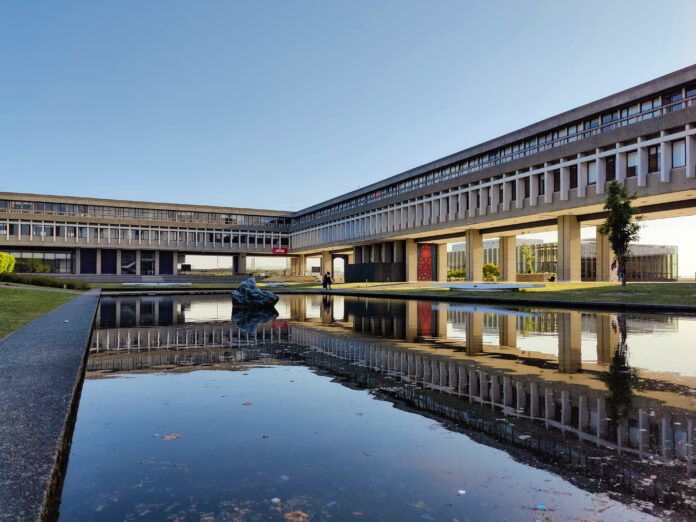
This is a photo of the academic quadrangle and pond on the SFU Burnaby campus on a sunny day.
PHOTO: Kriti Monga / The Peak

By: Corbett Gildersleve, News Writer

SFU researchers collaborate with international group to better track infectious diseases 

In May, an SFU team joined the ARTIC-2 project, a collaboration between the University of Birmingham, UK, and researchers in Kenya, Ghana, and the Republic of Congo, to develop low-cost genome sequencing procedures and equipment, and expand their use. Dr. Caroline Colijn, professor in the department of mathematics and Canada 150 research chair, is co-leading part of the project. Colijn told SFU News, “Genome sequencing was with us from the start of the pandemic, and it helped to inform public health policies and decisions as new variants were discovered.” 

The benefits of this project would allow laboratories and researchers to more easily sequence viruses and bacteria to track how they change and evolve. This can better inform public health officials and potentially spot outbreaks sooner. With low-cost equipment, this technique is more affordable for countries in the Global South, helping them respond to outbreaks more quickly. 

Dr. Amy Parent named UNESCO co-chair 

Dr. Amy Parent (Sigidimnak Nox̱s Ts’aawit) has been named UNESCO co-chair for transforming Indigenous knowledge research governance and rematriation. Parent is an associate professor in the faculty of education and inaugural associate director at the Cassidy Centre for Educational Justice — a research centre “to advance justice and an equitable, democratic society through education.” She is also Canada’s Research Chair (Tier II) in Indigenous governance and education.

The second UNESCO co-chair is Dr. Sonajharia Minz of the Oraon Tribal Peoples in New Delhi, India. According to SFU’s announcement, Indigenous knowledge research governance refers to the “self-determined, Indigenous-led processes, policies, and structures that guide and oversee research involving Indigenous Peoples, including rights, knowledges, languages, and lands.”

“We are committed to bringing forward the strength of our Nations and the integrity of our knowledge systems into spaces and places where they have long been excluded.” — Dr. Amy Parent, UNESCO co-chair, transforming Indigenous knowledge research governance and rematriation

Parent told SFU News, “Dr. Sonajharia Minz and I carry this joint appointment not only with deep honour, but with a profound sense of responsibility — to our Nations, our ancestors, and the generations to come. We are committed to bringing forward the strength of our Nations and the integrity of our knowledge systems into spaces and places where they have long been excluded.” 

New brain imaging technique aims to better understand Parkinson’s Disease drugs

A new study was published in the journal Movement Disorders on April 18 by Dr. Alex Wiesman, along with five others from the Karolinska Institute, Sweden. Wiesman is an assistant professor in the department of biomedical physiology and kinesiology as well as Canada’s Research Chair (II) in neurophysiology of aging and neurodegeneration. This study reviewed brain scans of Parkinson’s Disease patients who take dopamine replacement therapy drugs such as Levodopa to see why the treatment was less effective for them. 

Using magnetoencephalography technology to measure electric brain signals, the researchers tracked in real time how the drug affected their brain signals. Dr. Wiesman told SFU News he believes this new approach to brain imaging could help tailor a patient’s treatment by identifying how they uniquely respond to these medications. The study also concludes this approach “may be useful for data-driven contextualization of medication effects on cortical neurophysiology in future research and clinical applications.”

AI has changed the job market and its rules

0
job seeker with laptop sitting at a desk with AI reaper behind him
ILLUSTRATION: Yan Ting Leung / The Peak

By: Daniel Salcedo Rubio, Features Editor

I recently graduated from a master’s program at SFU. I’ve been casually swiping through positions on LinkedIn for a while now, not really looking for a serious commitment. This wasn’t my first time entering the job market. When I finished my undergraduate degree, I was in a similar position; however, back then, I was far more anxious and desperate to find the one.

I’m familiar with the dreadful hunt for a job. The tricks one has to do to get over HR’s screening bot, the tips to approach hiring managers through LinkedIn, the interview prep, and deciding the interview outfit the night before, all equally soaked in anxiety. This time, I felt far more at ease, having an advanced degree and a couple of years of industry experience, I felt safe. I was no longer the same man entering the waters of the job market from years ago — but as the saying goes, the job market didn’t remain the same river either. While a lot felt familiar,  a new factor had been creeping around for a while. Artificial intelligence was now shifting the waters. From the general fear of AI replacing human workers to interviews entirely conducted by an AI agent, I quickly realized just how unfamiliar certain things could become.

Let’s start with the obvious: AI will be replacing human workers, to some degree. I’m not trying to sound negative or ominous. I believe there’s a lot of work that AI will be more efficient at performing, like repetitive tasks in data entry. However, I also think that in the transition to finding the right position for AI to take in the workforce, a lot of us will be negatively affected. For example, Bloomberg Intelligence estimated 200,000 jobs in Wall Street banks will be lost in the next three to five years due to AI adoption, and about 92 million roles could disappear by 2030, according to a Future of Jobs report. Entry-level positions, which already have ridiculous qualification expectations, will be significantly harder as AI is expected to overtake most entry-level work

“Policymakers, companies, and developers need to ensure these technologies are implemented ethically — and more importantly, humanely.”

Data entry, customer service, and administrative jobs are already being replaced with AI chatbots, and positions in paralegal work, advertising, and graphic design, to name a few, will all likely be disrupted and to some extent automated by AI in the near future. In human resources, screening bots scan your documents, search for keywords, and either pass you to the next step or reject you within minutes of submitting your application. However, that report also estimates a net gain of 78 million new job opportunities. Service jobs, software and cybersecurity, farmers and related trade workers, project and operations managers, jobs in education, among others, are expected to grow by 2030. Not all is bleak; it’s just more and more complicated. As it’s always been the case, one has to remain up to date with emerging technologies, but AI’s fast development and improvements make it increasingly difficult to predict and adapt to the shifts it’s making. There are likely people right now studying and preparing for jobs that will no longer exist by the time they graduate. 

In some way, I had this as a mindset during my job hunt. I’ve been working as an editor for The Peak for about three years now, following a similar path alongside my science degree. I had considered a career in scientific writing — perhaps still am, just far more cautious and less hopeful. I can’t deny the capabilities of the language learning models in use today. I don’t believe that what I, or anyone else, is capable of doing is actually replaceable. For example, I don’t think AI can be as good a writer as I am. However, it can do it far faster and far cheaper than I do. It’s disheartening to scroll through job opening after job opening for some form of artificial intelligence trainer, fine-tune responses, or prompt developer — it felt like my only options were to train my replacement or apply to positions soon to be replaced. It’s hard to predict the changes AI will bring to the job market. Just six years ago, when I first started working, ChatGPT didn’t even exist yet, and now it’s getting university degrees. Even human resources aren’t safe of being replaced by artificial intelligence — AI is now also replacing interviewers. AI recruiters like Alex, have recently emerged, providing a fully automated interview process — ironic right? Human resources being replaced by AI. Not only have the waters changed, but the rate at which they change has increased as well.

Perhaps it’s just the cycle of life and I’m just starting my how-do-I-open-this-pdf-boomerera. I do see the benefits of incorporating AI into the job hunt. For example, on principle, that same recruiting AI bot Alex should be able to interview thousands of applicants for a position, something no single human would be able to feasibly do by themselves. Imagine a world where you’re guaranteed an interview and assessment of your abilities rather than being just one more electronic email from the digital pile. However, that world isn’t yet here and instead we have to navigate through AI recruiters glitching out and AI systems that just replicate the same biases they promised to eliminate. Right now, it seems as if we’re starting the very unpleasant transition into widespread incorporation of AI into different areas of the job market.

I sincerely hope AI brings change for the better, but I also hope those building these tools and those adopting them into their workforce will think about those dipping their toes for the first time. AI will continue to shape the currents of the workforce, and the job market, but the onus shouldn’t entirely be on the job seekers to keep adapting. Policymakers, companies, and developers need to ensure these technologies are implemented ethically and more importantly, humanely. That means transparent practices on data use and training sources, auditing and mitigating biases, and ensuring humans remain involved — AI should be a tool to support us rather than a replacement of us.

Despair and devotion: a review of Fairy Creek

0
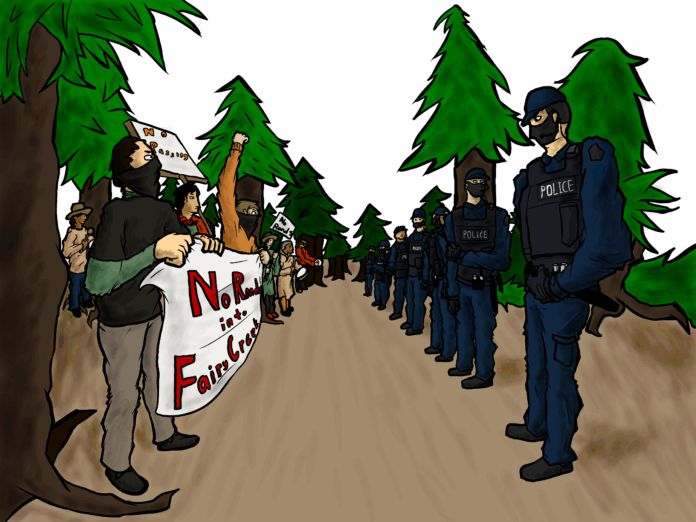
This is an illustration of the Fairy Creek protests showing protestors standing face to face against the police
ILLUSTRATION: Yan Ting Leung / The Peak

By: Ashima Shukla, Staff Writer

The year is 2025, and the world is in chaos: marked by economic instability, growing authoritarianism, ecological collapse, and an ongoing global erosion of human rights. In this moment, Fairy Creek arrives not just as a documentary but as an urgent cultural intervention and a powerful reminder that resistance is still alive. Like water seeping through stone, it moves steadily. Shaping. Persisting. Refusing to disappear. 

Directed by Jen Muranetz, this powerful film tells the story of Ada’itsx (Fairy Creek valley), one of the last remaining old-growth forests on Vancouver Island. In what became the largest act of civil disobedience in Canadian history, activists, land defenders, and community members came together to set up blockades on Pacheedaht First Nation territory against logging operations by the Teal-Jones lumber corporation. Nearly 1,200 demonstrators were forcefully detained by the RCMP until the Supreme Court eventually rejected an extension on further legal action taken against the protestors, and old-growth logging was deferred for two years

This film breathes with the spirit of the land and the people protecting it, and Muranetz offers a meditation on complexity, contradiction, and care. Opening with aerial shots of the forest, it invites viewers in, as light gently sifts through the ancient branches and birds chirp in distant conversation. There is something reverent in the cinematography; it speaks to our souls. But then, a rupture. The piercing growl of machinery disrupts the stillness, and we become witness to grief unfolding in real time. 

Among its many strengths, what I find most admirable is its commitment to complexity. It doesn’t flatten this resistance into a binary of heroes and villains. Instead, we are invited into its complicated and sometimes contradictory emotional terrain. We see people in all their multitudes: angry, exhausted, crying, building barricades, making tea. There is rage but also laughter, vulnerability, and moments of surprising tenderness. This, the film reminds us, is the texture of real movements: messy, tender, full of both hope and heartbreak. 

Yet there is also a kind of reverence for what cannot be saved but must still be honoured. In one unforgettable scene, the forest becomes the central voice. As the injunction is passed and protestors are removed, we see a tree being cut. Then another. Then another. And another. We wait for the silence, but it doesn’t come. Instead, we hear and watch a world unravel. And in that act of witness, we partake in a world remembering itself. With each fallen tree, the tension rises, becoming unbearable. In these moments, the film becomes a form of mourning. It claims our presence, and we know we cannot leave untouched. 

Admittedly, the film doesn’t unpack the full weight of the political and economic forces that enable logging in these territories. But it doesn’t need to. Its purpose isn’t to explain everything, but to offer an emotional and ethical intervention. In a world where information overload often numbs us, Fairy Creek reaches out to our feelings, and sows seeds of solidarity. 

These glimpses from the film remind us that resistance is not only a political act, but a deeply human one. When movements are too busy mobilizing to archive themselves, films like Fairy Creek fill the gap: preserving memory and shaping possibilities for better futures.

To me, this film is a love letter. To the land and all who came together to protect it. To the quiet but determined hope that a better world is still possible if we collectively work for it. Yes, it’s about saving old-growth trees but it’s also about saving our capacity to care. Even though the battle at Ada’itsx continues, what this film leaves us with is not despair. It is devotion. A call to protect what remains. To mourn what is gone, but at the same time, to embrace our capacity for awe, persistence, and solidarity. Fairy Creek is the type of film that doesn’t offer closure. It asks long-lasting questions. And becomes a lifelong companion.

Vancouver Tenants Union discusses disability justice

0
This is a photo of a bunch of folks gathered around smiling for the camera with a sign behind them that says “Defend Tenants / Stop Broadway Eviction.”
PHOTO: Brandon Jacoby / Unsplash

By: Lucaiah Smith-Miodownik, News Writer

On the final Saturday of last month, the Vancouver Tenants Union (VTU) hosted their June general meeting. With over 2,500 members, the group advocates and organizes for “rent control, meaningful eviction protections, more affordable housing,” and “better incomes for all.” These gatherings are designed for members to “learn, strategize, and discuss what impacts tenants in the city.” The June meeting focused specifically on disability justice and accessibility, with a variety of topics discussed and motions voted on. Masks were mandatory, and the VTU also provided the option to attend online. The Peak attended the meeting for more information.

The VTU describes disability justice as “a political framework developed in 2009 in the US by queer disabled people, largely women of colour.” They explain how “it was thought of and articulated to address the overwhelming whiteness of the existing disability rights movement, and to challenge the very idea of rights-based organizing,” and instead, focus on “justice-based organizing.” The VTU describes rights as “what people in power can give you” in the form of laws, while justice is “what can’t be taken away — values, identity, defined allies, access.” 

After a land acknowledgement and small group discussion on experiences in the union, the meeting turned to a series of motions to be voted on in pursuit of greater accessibility. The first was a statement of solidarity in support of the Migrant Rights Network. The VTU voted yes to endorse “the joint group statement written by Migrant Rights Network calling for the withdrawal of Bill C-2.” Notably, this bill would make the acquisition of refugee status more difficult for those seeking it in Canada.

“Disability justice is inseparable from housing justice, as disabled folks are disproportionately impacted by the housing crisis, particularly those living at the intersection of other marginalized identities.” — Vancouver Tenants Union

Next, the VTU voted yes to join the steering committee of the National Tenant Organizing Fund, “a new national fund that supports tenant organizing across Canada.” Specifically, the steering committee “makes decisions about how the money is shared between unions.” The motion passed with the option to part ways if the VTU deemed the endeavour to be at odds with the organization’s values at any point.

The final proposal, titled “Motion to Adopt Accessibility Standards for the VTU,” aimed to make the union open and approachable for all. The broad focus was to honour that “disability justice is inseparable from housing justice, as disabled folks are disproportionately impacted by the housing crisis, particularly those living at the intersection of other marginalized identities who face compounded barriers in accessing housing that meets their needs.” The motion incurred several edits, including an amendment to one point and a removal of two others, before passing. Ultimately, the amendment stated that the group “will continue to develop an Accessibility and Disability Justice Standards and mandate.”

For more information or to join your local VTU chapter, visit vancouvertenantsunion.ca

SFPIRG’s Organizer School builds grassroots power through political education

0
This is a shot of a row of people’s laps. Several people are holding a notebook and taking notes, while one person in the back is holding their phone.
PHOTO: The Climate Reality Project / Unsplash

By: Ashima Shukla, Staff Writer

Simon Fraser Public Interest Research Group (SFPIRG) is currently hosting Organizer School, a 10-week political education program that focuses “on the theory and practice of political organizing and mass movement building.” The program takes place weekly at the SFPIRG lounge and is open to all participants regardless of prior experience with organizing. 

SFPIRG’s “mission is to engage students and community in social and environmental justice.” Their Organizer School is designed as a participatory alternative to political education, inspired by Mass Movement and Struggle School from United in Struggle and Embark Sustainability’s Organizer Bootcamp. In an interview with The Peak, facilitators Hannah Ghaderi and Noëll Cousins said the program aims to address what they see as a gap in political education available to students and community members. “SFU really underserves its students in the kind of education it provides,” Cousins explained. “It’s very disconnected from people’s concrete problems and their real experiences.” 

In response to SFU’s institutional structure, the Organizer School prioritizes group discussions, reflection, and the exchange of lived experiences. Its content and format emerged from extensive syllabus development, “starting with how to really study the society and how to look at it scientifically, and then going from there, and thinking of all these texts that can help us navigate that.” 

Early sessions examine topics such as dialectical materialism and the roots of oppression, while later sessions focus on developing organizing strategies, movement building, and leadership. The curriculum draws on a wide range of historical and contemporary thinkers, including Karl Marx, Vladimir Lenin, the Combahee River Collective, and Paulo Freire. In choosing these materials, Ghaderi and Cousins intentionally included texts presenting differing or even conflicting perspectives. “Something that’s really important to us is to not censor or delete some parts of the conversation just for the sake of them fitting together,” Ghaderi said. “They’re like debates in a specific way, and that’s instructive,” Cousins added.

The program also includes practical activities to help participants apply theoretical concepts. One session involved a mock trial centred on Galileo’s historical conflict with the Catholic Church. The trial was used as a way to introduce class analysis and examine power dynamics. “It showed how attuned they are,” Ghaderi said, noting how participants were able to identify the murderer within the time limit set. 

Cousins shared that this emphasis on participation is partly inspired by Theatre of the Oppressed. Developed by Augusto Boal, this approach positions participatory theatre as a means of revolution, confronting injustice through role-play and collective problem-solving. Cousins noted how it’s a “safe and fun and playful” space to practice how to give speeches and criticism.

“There’s a little revolutionary living in all of us.” — Noëll Cousins, Organizer School facilitator

Organizer School is also shaped by a pedagogical stance: the facilitators reject the idea of expertise as a prerequisite and encourage collective learning that is accessible to all. One of their community agreements is “nobody knows everything, but together we know a lot.” 

The facilitators highlighted “an openness to learn new ideas and a desire to win, be victorious,” Cousins added. The facilitators also noted how the program is designed to be flexible, allowing the participants to engage even if they cannot complete all the assigned readings. 

Ghaderi, who taught for 10 years in Iran before immigrating to Canada, said this approach is rooted in creating space for participants to contribute their own knowledge and experiences. The Peak attended a session on June 23, where participants collaboratively analyzed mock data to establish the mass line

Looking ahead, Ghaderi and Cousins envision participants becoming facilitators themselves. Their long-term goal is to build a network of organizers who can carry the work forward. As Cousins said, “There’s a little revolutionary living in all of us.” 

Ghaderi further reflected, “We’re open to holding that space for each other — no matter what, no matter about what topic.” This care for others, she emphasized, is also political work. 

Organizer School is expected to run every semester. The current cohort meets Mondays from 6:00–9:00 p.m., with the final session scheduled for July 21. Applications for future semesters are accepted through SFPIRG.

Hot takes are killing our capacity to think

0
An illustration of a person standing on a stage with a microphone in hand. Four arms reach out to grab the microphone from them.
ILLUSTRATION: Victoria Lo / The Peak

By: Ashima Shukla, Staff Writer and Zainab Salam, Opinions Editor

There is a genre of content that only grows louder with time: a viral clip where someone argues against abortion, climate change, or immigration issues — with the knowledge of a poorly summarized Wikipedia page and unearned confidence. The audience laughs, groans, or aggressively types a rebuttal, but many click. In a media ecosystem designed to reward attention over thoughtfulness, we risk trading depth for reaction. The result is a culture where complexity becomes inconvenient, misinformation thrives, and our capacity for accountable thinking erodes. We need to resist the logic of virality and build a culture rooted in curiosity, revision, and collective understanding. 

As media scholar Wendy Chun argues, authenticity loses all meaning in a system designed to convert attention into profit. The call to be one’s self becomes a directive to become legible to social media algorithms — sortable, marketable, and brandable. Authenticity becomes algorithmic. When pushed towards outrage or confessions, everything becomes entertainment. This media logic doesn’t just distort what we see, it changes how we think, and what we think is worth thinking about.

Feeds become echo chambers recycling ideas — those ideas are not only shaped by our biases but also by algorithms that amplify them. Content is served to mirror an existing worldview or present the most extreme opposition to it, not to foster understanding.  

In such a system, entrenchment often replaces revolution. The practice of inquiry is supplanted by repetition: louder answers, rehearsed, and regurgitated. Opinion, trauma, and rage are performed; not to deepen understanding but to remain visible. To participate. And when that is the metric, complexity becomes inconvenient. Empathy becomes inefficient. Accountability becomes irrelevant. 

The path forward isn’t certainty — it’s the willingness to reject the myth of objectivity in favour of shared, collective truth-seeking. 

The invincible ignorance fallacy (and several studies) tell us that the least informed are often the most confident in their opinions — precisely because they don’t know how much they don’t know. Even well-intentioned people falter. Fearing the backlash of cancel culture or accusations of bias, media outlets default to a false sense of balance. Every issue is treated as a two-sided debate, even when one side is factually incoherent or ethically indefensible. Case in point? The New York Times’ coverage of trans health continues to platform inaccurate information. 

So how do we begin to challenge this system and move toward better thinking? We shouldn’t be neutral. We need to be honest. To resist the manipulations of a media environment that thrives on our worst impulses: our desire to be right, our fear of exclusion, and our discomfort with complexity. The challenge is to build a culture that can hold truth, even when it implicates us. 

This is where we can learn from science. As history of science scholar Naomi Oreskes reminds us, the strength of science is not found in the infallibility of individuals or in the myth of objectivity. It lies in its social fabric — in peer review, in replication, in the collective effort to get it more correct over time. It succeeds when it accounts for bias and makes objectivity a shared process, not an individual characteristic. The way we did in rebuilding the ozone layer, despite opposition. 

The goal is to create a culture where curiosity, revision, and errors are celebrated. To acknowledge that our thinking is inevitably shaped by our biases, values, backgrounds and to create systems of accountability where we can learn to move beyond hot takes towards nuanced discussions. In a culture overrun by algorithmic outrage, curiosity is radical. The path forward isn’t certainty — it’s the willingness to reject the myth of objectivity in favour of shared, collective truth-seeking.

Bill C-5 cuts red tape in service of capitalism

0
cartoon of a blond man uncovering another individual with a mask while money falls out
ILLUSTRATION: Angela Shen / The Peak

By: Yildiz Subuk, Staff Writer

In recent years, Canada has experienced record-breaking wildfires and heat waves. Climate change has caused global temperatures to rise and ecological disasters of grave magnitude. Wildfires heavily impact communities, with large property damage, poor air quality, and forced migrations as immediate outcomes. Just a month ago, 100 properties in Squamish were set under evacuation alert due to a wildfire. The June 2023 Donnie Creek wildfire resulted in enough land burned that it was comparable in size to Prince Edward Island, making it the largest fire ever recorded in BC. Our health, well-being, and our environment are on the line. The Canadian government must take environmental protection seriously. 

However, the government has taken a step backward. Prime Minister Mark Carney recently announced Bill C-5 (also known as the One Canadian Economy Act), which prioritizes economic interests while pushing aside Indigenous sovereignty and regard for the environment. It allows the government to fast-track any project deemed to be of “national interest,” causing major concerns about who this bill truly benefits. 

Bill C-5 has two parts. The first part of the bill disguises the negative, undemocratic nature of the second part. Part one focuses on removing interprovincial trade barriers. These trade barriers typically consist of regulations that restrict provinces from trading. For example, different licensing standards can discourage professionals from relocating from one province to another. As consumers, these trade barriers can be felt when purchasing alcohol from other provinces. Conservative party leader Pierre Poillivere has been a proponent of lifting these trade barriers, claiming they harm the Canadian economy. Economics professor Trevor Tombe published a paper claiming up to $200 billion is being cut from the Canadian economy due to the regulations. However, the Canadian Centre for Policy Alternatives reports these numbers are based on faulty methodology, which “overstates costs due to several unrealistic assumptions about interprovincial trade.”

There is no certainty that lifting interprovincial trade barriers will benefit the average person. The Policy Alternative claims the main factors that will be impacted are the transportation of alcohol across provinces and truckers’ mobility. This part of the bill seems like an attempt to reinforce, in the public eye, the government’s focus on economic prosperity more than actually helping anyone out.

The second part of the bill is more sinister; it allows governments to fast track any project that qualifies as being of “national interest.” These projects can include building pipelines which ultimately help the fossil fuel industry. According to The Tyee, the “fast tracking” in this scenario includes overriding preexisting laws including: “Fisheries Act, Indian Act, Canada Marine Act, Species at Risk Act, and the Impact Assessment Act.” These are all important pieces of legislation that ensure environmental safety and Indigenous sovereignty. 

Despite the focus on building, this bill has put more of a strain on relations between the Canadian government and Indigenous people.”

Politicians use the term “cutting red tape” when explaining why this bill passing will be beneficial. The red tape is framed as frustrating bureaucracy, barricading Canada’s economic progress; in reality, that red tape is regulations which prohibit projects from violating Indigenous rights and causing further environmental damage. This terminology is misleading, yet also crucial in selling the bill. According to Prime Minister Carney, Canada is facing an economic crisis and to combat it the government must relay urgency in taking action — seemingly, even if it means doing more harm than good.

Indigenous leaders have criticized the bill, along with Amnesty International, claiming it can violate Indigenous people’s right to informed consent. Confederacy of Treaty Six First Nations, an Indigenous non-profit group, stated this bill will not fast track anything but rather create conflict as “The Confederacy of Treaty No. 6 First Nations will stand together to defend our rights and lands.” This bill pushes Indigenous Peoples out from debating and contesting projects being built. Despite the focus on building, this bill has put more of a strain on relations between the Canadian government and Indigenous Peoples. There’s also a reason why Indigenous communities are so opposed to such projects: sustainability.

This bill’s focus on fastracking economically beneficial projects poses serious threats to the environment. Canada’s oilsands produce some of the deadliest pollution, while actively downplaying its effects. The pollution is staggering — enough to cause sickness and other diseases, affecting air quality. The oilsands need pipelines to transport oil, so this bill is not only removing important regulation but essentially investing more into the most damaging industry in Canada. Fossil fuels, which include oil, have been the largest contributor to global warming. Global warming can manifest through wildfires, as hotter temperatures can result in wildfires worsening. 

This legislation is regressive. The oil industry does not provide long-term progress, but serves its own self interest. Those that benefit the most from pipelines are the producers and transporters, while there has been no tangible evidence that pipelines provide any proper economic relief for the working class. 

The Liberals clearly wanted to get this bill passed as quickly as possible. All members of the Conservative party also voted in favour of the bill. Meanwhile, the Bloc, NDP, and Green parties have all opposed it. The Bloc also proposed the bill should be split into two — free trade and labour being one part and fast-tracking projects the other — and each part be individually assessed by a committee. The proposal was vetoed by the Liberals. The eagerness to pass the bill is concerning, the message is deliberate as well. The way this bill is presented makes it seem like it’s a massive leap forward for nation building. The bill vaguely states it is looking to “enhance Canada’s prosperity, national security, economic security, national defence and national autonomy by ensuring that projects that are in the national interest are advanced through an accelerated process.” It strategically uses language associated with economic prosperity, to hide its hidden agenda.

The legitimacy of this bill is also validated by US president Donald Trump’s tariff threats, which aimed to economically back Canada into a corner. The bill acts as a response, indicating to the public that the Canadian government must do anything necessary to fight back. But, is an investment in fossil fuels and infringement on Indigenous rights truly serving the nation’s best interest? Or is it just a way to reinforce neoliberal policy that mainly benefits capitalism while being disguised as economic unity?

The return of the Eastside Arts Festival

0
This is an illustration of the Eastside Arts Festival, with rows of tents of vendors selling crafts and artistic goods while some festival-goers paint on a canvas
ILLUSTRATION: Stella Laurino / The Peak

By: Katie Walkley, Peak Associate

Sometimes, walking along downtown Vancouver makes me feel like a tourist in my own city, especially as I pass by the many interesting shops, artistic expressions, and the general beauty of the city all around. From July 18 to 27, you can experience that wonderful feeling tenfold at the Eastside Arts Festival at a multitude of Eastside Arts District studios. The variety of workshops, walking tours, and live performances all represent niche aspects of the connection between art, the environment, and Vancouver’s history.

Most workshops vary from an hour and a half to two hours. All of them are beginner-friendly and include activities that you have probably never had the chance to try before. For example, in the “Fun With Fusing” workshop, you can learn glass cutting and pattern formation to make your own tile with the help of an instructor who will fire the kiln for you. Other lessons, such as urban sketching and eco printing, celebrate our city’s relationship with nature. Overall, you will find that every artist leading these workshops is deeply dedicated to their craft while you share in the fun!

If you prefer to observe rather than create, you can find three unique walking tours. The Hogan’s Alley tour is also available as a virtual tour for those who would prefer to learn from the comfort of their home. On the “Not Your Heritage Tour-Whose Streets? Whose Stories?” tour, you will be invited to ask how Vancouver’s nuanced heritage and history live in the present. It emphasizes the experience of culture in daily life while taking a relaxing stroll with other like-minded participants.

The variety of workshops, walking tours, and live performances all represent niche aspects of the connection between art, the environment, and Vancouver’s history.

Along with these experiences, there will also be live entertainment, including The Dance Deck by the contemporary dance company Belle Spirale Dance Projects, with tickets by donation. A violinist, cellist, and vocalist will accompany the dancers as the production brings together upcoming artists and established creators.

For those who want the most fulfilling experience without hurting their wallet, you can check out a free six-hour outdoor concert at Maclean Park. Vancouver-born musicians performing span genres from cowpunk to surf rock. Meanwhile, you can also explore art activities and refuel at the food trucks showcasing Vancouver’s artistic flair, such as Midnight Joe’s, a vintage-style truck with neon signs serving sloppy joes and cherry pies.

Altogether, every moment of this festival will be a rich immersion into Vancouver’s artistic culture and heritage, as well as a chance to connect with its community. The Eastside Arts Festival will surely reinvigorate your pride for this city.

SFU vs. UBC: The renewed rivalry

0
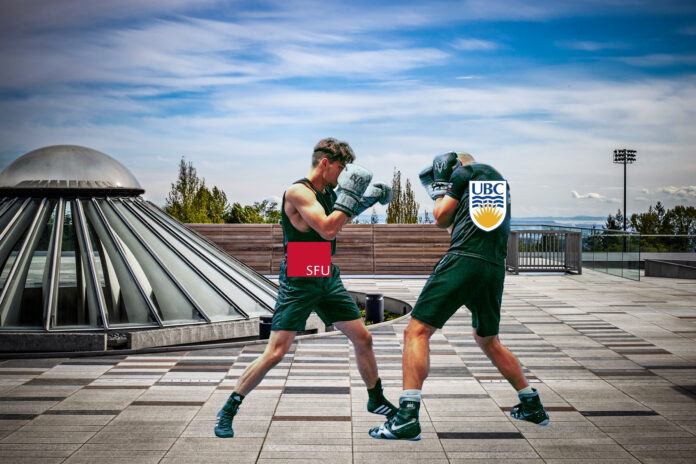
Two boxers representing SFU and UBC beefing it out on an sfu rooftop
IMAGE: Gudrun Wai-Gunnarsson / The Peak

By: Katie Walkley, Peak Associate

It was still light out at 8:32 p.m., and I felt unstoppable. I’m not proud of what I did, but it had to be done. 

I revived the rivalry between SFU and UBC. 

I’d been missing SFU dearly over my summer break. Not enough to visit and pay for parking, but enough to reignite an ancient feud as a show of my love and solidarity from afar. So, I typed UBC into my Maps and put my neighbour’s electric scooter into sport mode to tear off into the night. Dan, if you’re reading this, don’t worry about it. Go take care of your kids.

My hunger for retribution began when I met some actual UBC students, and they weren’t even as God tier as their reputation leads us to believe. I was like, “Do you even Beedie, bro?”

We should have seen it coming . . . Their disgusting vintage architecture is a façade.

For weeks, I stewed on my newfound knowledge. It filled me with regret for how we had given up so easily on our rivalry against UBC. Many of our peers have even joined their side to make jokes at our expense, highlighting our constant construction and lack of social life. We’re not strong enough to handle all this friendly fire, people. Someone has to believe in us or else we’ll end up like CapU. To save us from that kind of downfall, I had to hit them where it hurts.

To honour the loner ideals of our school, I started this revolutionary war by myself. I almost made a Reddit post (the only way to connect with fellow students at SFU), but then I got distracted by reading about people deciding on classes to take and started wondering if I should change my major. By then, time was running out, and these geezers were wasting my precious daylight hours!

With a devil’s smile on my way to enemy territory, I scootered over the toes of neighbourhood parents gossiping about how “poor Stacey’s nephew didn’t get accepted into UBC — now he has to go up to that sequestered mountain school with all the bagpipes.” Boo fucking hoo, lady. It could be a lot worse. You could end up at UBC, where students major in either abstract exhibitionism or Wreck Beach-ology. I channelled the energy of 1,000 SFU commuters ferociously darting home to Maple Ridge to carry me past the haters. 

Upon arrival, I circled the UBC frat houses with one target in mind. I listened anxiously for the joyful holler of my mark’s catch phrase: “Let’s accelerate.”

Enemy spotted. My vision turned SFU-logo-red as I intercepted the UBC legend of my nightmares on his way to pick up his next partygoer. Scooter Dom, the Instagram-famous figurehead of our rivals, toppled instantly under the sheer power of my concrete-infused bones. Before anyone, including me, could process what had happened, I had kidnapped him, duct taped his loud mouth, and stashed him at an undisclosed location. Now it’s time for UBC to pay off their ransom . . . hand over your prestigious vibes and you can have your boy back.

Or don’t, we don’t care. We’re Canada’s most comprehensive university, beotch. We’re catching up!

Now that war has been waged, we need to be on defence. Protect Freaky Frank at all costs! SFU students, this war has just begun. Let us defend what we hold dear — let us defend SFU.

SFU’s cheery campus renovation hoax

0
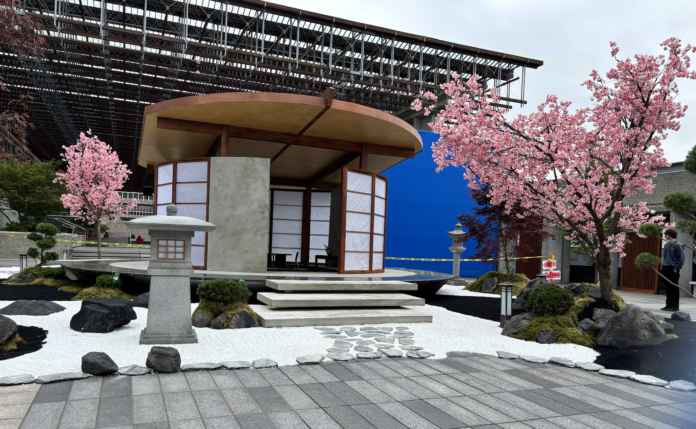
A photo of a scenic garden film set at Burnaby campus with cherry blossom trees and a quaint cabin.
PHOTO: Mason Mattu / The Peak

By: Sarah Sorochuk, Peak Associate

SFU’s summer semester has been absolutely thrilling. From the koi pond being evacuated, sucked dry, and refilled to loitering chairs from convocation, to even an abundance of high school graduations, there is never a dull moment. 

With convocation came the regular maintenance and the sudden beautification of the campus to impress the incoming guests and persuade them to send their kin here. The event called for nothing but order and elegance. Keeping things neat and tidy for the graduates’ important day. We saw this coming. 

But what came as a shock was a random post-convocation bloom. The campus suddenly sprang to life, with gorgeous cherry blossom trees filling the area around the fountain in convocation mall. The entrance to the university next to the lower bus loop had doors instead of wet concrete stairs. It was like the happiness of summer ran over the campus — leaving a trail of trees in its midst. 

But then, not even six hours later, the entirety of SFU receives an email stating that the trees are for a movie set. Essentially saying our campus did not change for the better. The next day, the entrance to convocation mall was blocked off due to filming, forcing students to walk all the way up the sketchy stairs next to the parkade. Why can’t we have nice things? The gloom went to bloom and now it’s 50% back to doom. At least we have the cherry blossom trees near the fountain still . . . And yet there continue to be depressing undertones as the movie being filmed is a thriller. 

Actor Cynthia Erivo has been spotted on-site for filming. I just hope somebody warned her about the inconvenient detours on campus . . . Nevermind — she’s part of the problem and has a broomstick, so why would she even care?

When we got the message here at The Peak, the news spread like wildfire, crushing the souls of everyone at our publication. Prior to receiving the alert email about the movie set, we (as a team) thought someone was revamping our campus. The Peak began plans to adopt a “cherry blossom” theme to our print publication in the fall — a very costly endeavour that was supposed to meet the excitement of SFU’s apparent rebrand. But after learning the truth; the joy (not Johnson, unfortunately), colour, and ideas all faded away with the happiness of the cherry blossoms.

Now we are stuck looping old ways like SFU is doing itself. The colour was a nice change-up and gave us temporary relief out of the summer depression we have due to taking those pesky little summer courses. The memory of the cherry blossoms expose how we use our time to study and write for the paper when we could be out celebrating life and our free summer one peach bellini at the time instead. I will always remember the cherry blossoms and the memories they instilled in me. 

The painstaking knowledge of the beautiful trees not being permanent was enough to break the hearts of countless SFU students, while simultaneously ruining the vibes of the writers at The Peak. How are we supposed to write anything cheery in the humour section if the campus has returned to its original gloomy state?