Home Blog Page 272

English Student Union and Poetry Club host sentimental open mic night

0
An orange envelope with “confessional” written in cursive across it. The envelope is surrounded by a bunch of hearts.
Pour your heart out post-Valentine’s Day. ILLUSTRATION: Marissa Ouyang / The Peak

By: Petra Chase, SFU Student

Just in time for Valentine’s week, SFU Poetry Club and the English Student Union held 2 Sappy 2 Stories, a virtual love-themed open mic night. 2 Sappy 2 Stories was a sequel to the ESU’s event last year, Sappy Stories, which was a group story writing workshop. This year’s theme expanded the scope from stories to poetry and music, and the outcome was a night full of nimble wordplay, expressive vocals, and personal anecdotes on the ups and downs of love.

The event kicked off with a guided meditation, welcoming introductions, and a writing workshop featuring festive love-themed prompts like writing about a “Bad Romance (Ra Ra Ra Ra)” and “What is Love? (Baby Don’t Hurt Me).” After a writing session backed by ambient instrumental music, students opened up on the virtual floor by sharing spoken word poetry, short stories, and even original songs. The event also included a giveaway to Iron Dog Books, a local Indigenous-owned bookstore.

“We’d like to broaden the horizons of what people think poetry can be,” SFU Poetry Club president Anita Shen shared with The Peak. “Poetry can be anything. It doesn’t have to be literary. We really welcome writing in different languages. There’s some folks who write hip-hop lyrics. Stuff like that.

“I’ve got a huge passion for literature and social justice.”

After organizing and conducting writing workshops for sex workers, Shen brings their care and passion for facilitating social justice events to the club. They guaranteed everyone had a chance to share their accessibility needs and prompted them to set an intention for the evening.

As someone who wrote poetry throughout high school, I can testify that writing is not only a creative outlet, but a way to process emotions and thoughts. To be able to be vulnerable and share your innermost feelings in a safe and inclusive environment is a crucial resource for students’ mental health.

It is no easy feat to share something so personal with a room of people, but the outgoing and encouraging attitude of the audience at 2 Sappy 2 Stories broke the ice and made it comfortable. Every performance was unique and expressive followed by an outpouring of compliments and heart reactions in the chat.

Poetry club is always looking for new members! Whether you’d like to enter their upcoming contests, find out more about events, or simply join a supportive community of poets, you can follow them on Instagram, @sfu_poetry, or join their Discord.


The Porter celebrates the lives of Black Canadian railway workers

0
Image of Black train porters waiting at a station platform.
The series spotlights the fight for working rights of train porters. PHOTO: Courtesy of Winston Ma / CBC

By: Tamanna T., Staff Writer

As of late, historical television shows are being made for a very niche audience, and most shows lack diverse representation. But there’s a new historical drama on the block, and this time it commemorates a part of history that doesn’t get talked about enough — Black Canadian lives in the 1920s, after the abolition of slavery in Canada. 

The Porter, which premiered on February 21, is set in Montreal and follows the lives of Black train porters and their families during the unionization movement. Historically, these porters faced exploitation and discrimination from passengers and employers. So the Black porters formed the Order of Sleeping Car Porters, which successfully lobbied for salary increases, better on-the-job sleeping conditions, and more. Inspired by these real-life events, the show commemorates the love, heartbreak, and struggles of these porters. With vibrant shots, visually appealing scenes, and bone-chilling dialogue, I have no doubt The Porter is on its way to become a revered and critically acclaimed series. 

The show takes its viewers on a ride through the lives of porters Junior Massey and Zeke Garrett, played by Aml Ameen and Ronnie Rowe Jr. respectively, as they battle systemic racism while trying to unionize. This series is meant to reframe history by showcasing the full extent of the Black diaspora’s influence.

In an interview with The Peak, Vancouver-based actor Luc Roderique, who plays Winchester Barnes — a porter with a dark and mysterious past — talked about the celebration of Black lives offered by the show and its importance in history. He also discussed his character’s struggles throughout the show.

He began by noting “there is a wealth of incredible stories” related to Canadian marginalized communities we should be showcasing. Calling The Porter incredibly unique, Roderique shared he has “never seen a story like this told on Canadian television” and that the show was a joy to work on. 

“It was the experience that I’ve been waiting for through my career thus far. It’s going to be hard to top this, to be completely honest. To have the opportunity to play a character like this and also to feel such support, freedom, and safety on set to be able to explore these characters,” Roderique said. “We, for once, were being seen and telling our story.”

Discussing Winchester Barnes, Roderique talked about how the character is running from his dark past and fighting for his present and future as a porter. “He’s also a man dealing with some pretty big trauma,” said Roderique. “Personal traumas that we see in the first episode, and wider societal traumas. This is a man who suffers from anxiety and depression.” Consisting of such characters, The Porter has the potential to become a show that viewers will watch eagerly. They depict not only larger movements for labour rights and Black resurgence, but also daily life we can all relate to.

The show also connects to Vancouver in many ways. “In pretty much every metropolitan area in all of Canada, there was a Black community or a Black neighbourhood,” Roderique said. This includes BC’s Hogan’s Alley, “which was a thriving Black community because of its proximity to the train station,” Roderique continued. There was a sense of connection among Black communities across the nation because of the porters working and traveling via train stations, which generated brotherhood.

The Porter will also invite viewers to ponder what life was like in the 1920s for Black Canadians. An important line in the trailer is, “The force of our oppression is the truest measure of our power,” which stuck with me. Talking about how The Porter achieves this measure of power, Roderique said that “simply in telling this story, it achieves that. 

“It’s really incredible to feel like we are continuing the legacy of visibility and equity that these men started,” he said.

The Porter airs Mondays at 9:00 p.m. on CBC TV and will be available to stream on CBC Gem.

Don’t focus too hard on your grades

0
An angry-looking person, ostensibly a professor, is throwing a “C-” at someone. The person is distracted, looking at some flowers, and does not seem bothered by the grade bouncing off their head.
Grades can have huge impacts on the way we perceive ourselves, but is it warranted? Illustration: Maple Sukontasukkul / The Peak

By: Ira Rishi, SFU Student

Albert Einstein, the physicist widely regarded for his scientific and philosophical contributions, is quoted to have said: “Try not to be a man of success, but rather try to become a man of value.” This has been a critical lesson I’ve learnt throughout my degree. Importantly, it distinguishes between success and value. While success can be defined as achievement by others’ standards, it is not always identical to value; the achievement of one’s own standards.

Taking classes at a university, finishing a degree, and staying on top of it all by having great grades is a sign of a successful student. It follows that people tend to associate success with self-worth and their value in society. In all, it’s a very unfortunate comparison that we as a society have learned to make. Though measuring ourselves by a university’s metric of success can be easy, it is not necessarily the most constructive way to develop ourselves.

Straight-A high school students come into university programs with a reasonable expectation of dominating their classes like they’re used to, but it’s common that we fail to live up to our own expectations. When I see I’ve earned a bad grade on an exam, it shakes me to my core. The way I’ve been conditioned is that a poor grade means I’m not successful, which in turn lowers my self-worth. Lowered confidence, from whatever cause, is a source of decreased academic performance — and this risks a self-destructive feedback loop. When we fall into this downward cycle, we tend to forget that grades are simply a result of a particular moment in time and space. They’re not constant and they don’t determine your worth.

Sure, having passable grades is essential to graduate, and a high GPA can open avenues for other opportunities like admission into different programs. But in no way do these markers determine how successful you’re going to be outside of academia.

Academic validation meant a lot to me during my initial years at university and I ended up getting so roped into it that I paid no attention to the realities of what I was learning. For many of us, one of the most important things about being in university is getting ready for the real world — a life with more meticulous responsibilities and far less structure. And you get ready for the real world not by simply studying for and taking exams, but by putting yourself out there! It takes experimentation, and so much failure — something disallowed under university’s grading schemes.

So don’t be afraid to take that step and move beyond your studies, because growth happens outside our comfort zones. Explore what drives you and motivates you to give your best. Volunteering is typically a great place to start and you can build your way to gaining the skills and experience that might not fit into a class’ traditional curriculum.

If there’s anything I’ve learned in the four years I’ve spent here is that you shouldn’t just work on your grades — it’s important that you also work on yourself.

Professors should be more compassionate towards working students

0
A pile of folders and papers are stacked up for the entirety of the photo. Some of the papers are folded, and the pile looks in disarray. The folders are brightly coloured and stand out.
All this work would be manageable if I just had an extra day or two. PHOTO: Sharon McCutcheon / Unsplash

By: Tamanna T., Staff Writer

As students are getting burnt out by life in and outside the classroom, professors need to realize that — pandemic or not — not everyone has the privilege to only focus on academia throughout their degree. Though professors themselves are subject to massive workloads with their own deadlines, empathy towards students’ responsibilities can make a difference. Until the structure and expectations inherent in university can be revised, consideration from professors is much needed.

Noticing a suffering student and lending a helping hand wherever possible can aid a student more than one thinks. Offering support can pave the way for the students to not only learn in a better way — which is a part of a professor’s role — but also feel more comfortable in dealing with their life situations.

Some students have to work a full time job while studying to support themselves through school. Finding the motivation to simply get through the day can be a challenge, because one day can include many hours of work, classes, and then coming back home to study. By being flexible with deadlines, holding extra office hours, or even occasionally being a source of encouragement, professors can ease their students’ academic burdens. These behaviours are huge in helping students remain motivated and also get some well-deserved time to relax.

Professors can further support students by offering a safe space for non-academic discussions. Many of my professors in the English department have office hours for their classes, but students often use this time to share personal issues and build dialogue that helps them feel more comfortable — and maybe even a bit light-hearted. Of course, while these discussions are helpful, they are neither the purpose or responsibility of a professor’s office hours. If you find yourself feeling overwhelmed, SFU Health and Counseling Services has dedicated counselors and psychiatrists to help students deal with stress and anxiety.

When balancing a full course-load and a full time job, there are sometimes no days off in a week. On certain days, I’ve had to do my homework in the skytrain on my way to work. Other times I’ve had to ask for extensions because I had to stay later at work. By suspending judgment and being understanding, professors can bolster a struggling student’s life by simply saying “yes” to an extension, or showing support for a student’s efforts. Trusting students to do their assigned task within the extension they have asked for without penalty can remove stress and improve the quality of the work. It also helps students have a clear head before approaching (or re-approaching) a subject, which will help them retain and understand information better.

Professors should really be considerate to those busting their backs to get through school. I have heard of many instances where a student will be struggling through life and academically, and instead of being kind, professors have strictly said no to helping out in even the most minor ways possible. By helping students prepare for exams, offering some guidance in papers, or in a willingness to revisit lecture materials professors can make a huge difference.

If I didn’t have some of my professors’ help and support when I was struggling, I never would have continued my degree. Sometimes, a kind gesture — like extending a deadline — can make or break a course for students. So, it’s important for professors to know their students and know that they can truly make a difference.

HorizonTrack offers holistic support for SFU Track team and new runners

0
Four members of HorizonTrack posing on grey bleachers.
HorizonTrack hosts monthly community runs for runners of all stripes. Krystal Chan / The Peak

By: Luke Faulks, Staff Writer 

How do we get Canadians more invested in track and field? In April of 2021, lifelong runner and SFU track member Jose Castro founded running club, HorizonTrack, with alumni Carlos Vargas. The duo wanted to help SFU track runners get exposure by running on behalf of HorizonTrack during the offseason. This helps them gain practice at a high level outside of SFU.

The club’s first task was to tackle what Castro sees as a recurring issue for Canadian runners: a lack of support, both in terms of finances and year-round camaraderie.

“A lot of runners don’t get advertised even when they are doing well,” said Castro. “After your school season is over, you still run races, but you have to run as unattached [without any affiliation] so you don’t have any team.” 

Castro points to the recent successes of SFU students and alumni at the 2021 Olympic trials. While former SFU student Cameron Proceviat placed second in the 1500m, and current SFU runners Aaron Ahl and Charlie Dannatt placing third and fourth, Castro believes they didn’t get the kind of marketing or media attention they deserved, which could hamper their chances to attend meets in the future. 

HorizonTrack aims to fix the void in athlete marketing for SFU runners by posting photos and workout videos, sharing athletes’ stories, and selling HorizonTrack gear to raise money for the travel costs of student athletes. 

After initially selling Horizon merchandise to friends and families and over social media, HorizonTrack partnered with FitFirst Footwear. Thanks to the store’s proximity to one of SFU’s primary training spots, Burnaby Lake, the store has had a long relationship with the school and has been extremely supportive, revealed Castro. HorizonTrack have their own dedicated booth stocked exclusively with HorizonTrack flags, stickers, and mannequins. Members are even given discounts on some items in store. 

All this isn’t to say that professional athletes are the sole beneficiaries of HorizonTrack. The club hosts a monthly 5km community run, partnered with Fit First footwear and North Burnaby Runners, on the last Wednesday of each month. As is the case for SFU track team, the go-to spot for these runs is Burnaby Lake.

To new runners potentially feeling daunted by running alongside SFU track team members, Castro noted it’s not about competition; everyone is welcome. “It doesn’t really matter where you’re coming from or how you look or who you are. If you want to run, you can run.”

Community runners can even expect some guidance on healthy running habits. “We usually have one or two of our runners leading the warm-up, showing people how to do proper warm-ups.” 

Looking ahead, Castro intends to expand HorizonTrack’s scope. The group will continue elevating runners’ stories through a podcast from SFU track students. “We have all these runners, Canadian runners, who come up and just like talk about their experience, their season, who they are.” 

Highlighting runners’ stories will be a throughline for HorizonTrack. The group is also expecting to launch a website later this year. At horizontrackclub.com, interested parties can sign up for a newsletter, highlighting athletes’ stories and personal bests. The newsletter will also advertise the group’s monthly community runs. 

The next steps for HorizonTrack won’t be easy. The team behind it is still small, but Castro says he enjoys building from the ground up. “That’s the fun part. We honestly love just doing something on the side and creating a community with it.

“When you just step on the track and you really hit your limits, there’s something that’s special in that. Where you know you’ve given it everything. No one can take that away from you. With Horizon, we want to have another outlet where we put in all that we can and showcase who are, as runners and as people.”

HorizonTrack posts about its athletes and merchandise on Instagram, and publishes its podcasts on YouTube and Spotify, and, shortly, Apple Podcasts. Go to horizontrackclub.com to sign up for the HorizonTrack newsletter, and stay tuned for a website update!

The Rundown

0
SFU swimmer Jayden Cole pictured in the water performing a backstroke.
We have a couple of candidates for February player of the month. Paul Yates Photography

By: Isabella Urbani, Sports Editor 

The women’s basketball team drop their second highest points total of this year! They beat Northwest Nazarene on the road 96–86. 

Date: February 12, 2022

SFU takes a win in the high jump and triple jump courtesy of Sydney Kania and Kennedy Primrose. 

Date: February 12, 2022

Trailblazers (fire emoji): Callum Robinson clocks in with the fastest 200m in Greater Northwest Athletic Conference (GNAC) history with a time of 21.40 seconds. The previous time was held by SFU’s own Jeremiah Lauzon! 

Date: February 12, 2022

Another track race, another (W emoji): Maire-Éloïse Leclair wins the 200m with a time of 24.75 — eighth fastest in GNAC history. Emily Lindsay wins the 400m, and our favourite (kiwi emoji) Alison-Andrews Paul wins the 800m.

Date: February 12, 2022

It’s a good day for a personal best: congratulations to track athletes Paul Buckingham and Tomas Chapman. 

Date: February 12, 2022  

Making a (splash emoji): the women’s 400m relay team and individuals Rafik Jiwa and Channah Yip notch a spot in the NCAA Championship. Jiwa won the 200 fly at the latest swim meet, and Yip took the 800 free.

Date: February 13, 2022

(alert emoji) NEW RECORD (alert emoji) Isabelle Roth breaks the 20 year 100m breaststroke record and Jayden Cole beats the nine year 50m backstroke record. 

Date: February 13, 2022

Easy work (muscle emoji): swimmer Collyn Gagne wins the 200m butterfly and breaststroke.

Date: February 13, 2022

Final stretch: the men’s and women’s wrestling team face off at the NCAA Championship starting February 20! Stay tuned for the results. 

Date: February 14, 2022

Small bump in the road: men’s basketball drops their second straight game in a home loss against Alaska Anchorage 75–70 with the GNAC Championship less than a month away (wide eye emoji).

Date: February 14, 2022

There’s no better time than the present to join a student community

0
A minimalistic illustration. A few lines and colours are draped from the top of the image, reminiscent of ropes of flags. The center of the photo reads: “Simon Fraser Student Society” and “Clubs Days”
What better way to find people with similar interests to you? Illustration courtesy of the SFSS

By: Luke Faulks, Staff Writer

Every university publishes a page for first years on why it’s important for students to join a campus group. These articles suggest clubs, organizations, and other groups provide everything from community to engagement, as well as experience to pad your resumé. There is, however, a question that often goes unanswered: when’s the best time to join a student community?

The answer is easy: “as soon as you can.” Whether you’re in your first, second, third, fourth year, or even later — don’t wait.

In your first year, before you’ve even fully gotten your feet underneath you as a student, join a group. Joining early provides students with a group of senior students who can be a resource to those learning how to navigate higher education.

With anywhere from 22% to 58% of students changing their major during their undergraduate career, signing on to a community early can streamline the process by helping you figure out what you like to do. Whether you’re drawn to activism, technical projects, or anything more leisurely, there are a number of groups that allow you to explore your interests in a (relatively) pressure-free space. And you can always try out different groups if the first doesn’t work for you.

The social aspect of student communities can also make university a more pleasant experience — student groups are filled with students who empathize, and will, more often than not, be supportive of your struggles. Having a social group that exists independently of classmates can make a huge difference in how you enjoy your time at university.

If, like me, you waited a little longer to get involved, don’t worry about it. Failing to join early during your academic career doesn’t prevent you from engaging with student organizations later on. I found that the critical thinking and communication skills I developed in my early academic years gave me more meaningful ways to contribute. In my fourth year, a fellow political science student convinced me to join the editorial team of Gadfly, a student-run political science journal. It was through the journal’s staff that I then found out about my current position as a Peak staff writer.

A final item to note on the “don’t wait” checklist is to not hold out for Clubs Day. The name is somewhat of a misnomer, as Clubs Day is also filled with sports teams, student unions, and organizations. Pre-pandemic, this event consisted of booths throughout Saywell Hall and the AQ. Over the course of a week, students had the chance to pick up contact info and chat with members. There’s no need to wait for an event like this to reach out; it’s entirely unnecessary for clubs or student unions. For those other groups, you can get your foot in the door for the next semester, while learning about how they work. It takes some courage to reach out to a group, but it’s often worth the effort.

Join a group of like-minded people who will support you through the hard times and help you find your passions at SFU, academic or otherwise.

This week at SFU

0
A photo of an opponent swinging on a pitch with an SFU catcher in the background trying to grab the ball.
Come support the SFU basketball and softball team at home this week! Paul Yates Photography

By: Isabella Urbani, Sports Editor 

Home Games 

Saturday, February 26: women’s basketball vs Western Washington at 5:15 p.m. (West Gym)

  • Senior night and whiteout T-shirt giveaway 

Saturday, February 26: men’s basketball vs Western Washington at 7:30 p.m. (West Gym) 

  • Senior night and whiteout T-shirt giveaway 

Saturday, February 26: women’s softball vs Central Washington at 12:00 p.m. (Beedie Field)

  • First home game of the season 
  • Game one of doubleheader 

Saturday, February 26: women’s softball vs Central Washington at 2:00 p.m. (Beedie Field)

  • Game two of doubleheader 

Sunday, February 27: women’s softball vs Saint Martin’s at 12:00 p.m. (Beedie Field)

  • Game one of doubleheader 

Sunday, February 27: women’s softball vs Saint Martin’s at 2:00 p.m. (Beedie Field)

  • Game two of doubleheader 

Away Games 

Monday, February 21: men’s golf at the Joust vs California Baptist University (all day)

Monday, February 21: track and field GNAC Championship (all day)

Tuesday, February 22: men’s golf at the Joust vs California Baptist University (all day)

Tuesday, February 22: track and field GNAC Championship (all day) 

Tuesday, February 22: women’s basketball vs Alaska at 5:00 p.m.

Tuesday, February 22: men’s basketball vs Northwest Nazarene at 6:00 p.m.

Tuesday, February 22: women’s softball vs California State San Marcos at 12:00 p.m. 

  • Game one of doubleheader 

Tuesday, February 22: women’s softball vs California State San Marcos at 2:00 p.m. 

  • Game two of doubleheader

Wednesday, February 23: women’s softball vs California State San Marcos at 12:00 p.m.

Saturday, February 26: track and field vs Seattle Pacific 

  • Last chance to qualify for NCAA Championship on March 11 and 12

Saturday, February 26: men’s wrestling NCAA Super Region 6 Championship (all day)


SFU sisters tear up the softball pitch together

0
Georgia Ogg and Alex Ogg, two sisters on the SFU softball team, sit side by side with their legs out on the field, and a glove on either side of them.
After playing softball for most of their lives, 2022 will be Alex (right) and Georgia (left) Ogg’s last year on the SFU team. Krystal Chan / The Peak

By: Luke Faulks, Staff Writer

The Oggs both started playing softball around the age of five. Alex as a third baseman, and Georgia as catcher and outfielder. Now, they’re knocking it out of the park on SFU’s softball team. The Peak was able to interview the sibling duo on the unique dynamics of taking the field together. 

Despite not always playing on the same team, and even playing against each other, younger sister Georgia would often get called up to play with her sister in tournaments or crucial games. As a result of their one-year age difference, the duo shared there’s never been any real sense of competition on the field between them. 

“Our positions are very different, so we rarely compete for play time,” said Alex. 

Their positions reflect their strengths as players. “Alex is extremely strong offensively as a lead off hitter, whereas my strength lies on the defensive side as a catcher,” said Georgia. 

Off the field is a different story. “There is a natural sibling rivalry to push each other, especially in the weight room, or to keep motivating one another to work hard,” said Alex, who made it very clear that when it comes to training outside of regular scheduled practices, they operate alone.

“We both have very different lives in the summer and often part ways which makes training together nearly impossible. We often train by ourselves or with our other teammates.”

When they do work together with the rest of the team, however, they’re always looking out for one another. “We definitely critique and perfect one another whenever we get the chance to,” said Alex.

For both Ogg sisters, softball is a lifelong passion — and one that keeps providing them with exciting challenges. “We both have a passion and enjoy learning about the mental and strategic side of softball,” said Georgia. “We’re always looking to create unique plays, get lead runners, or do the unexpected.”

They find having a sibling on the team helps provide support. “We both rely on each other a lot; probably more than we would like to admit at times,” said Georgia. “We’re very lucky to confide in each other about the struggles we are experiencing and know that we’re both able to understand each other as we are going through the same experiences.” 

In addition to being able to rely on a sister as a support system, they’re able to lean on each other as teammates. Alex said, “[Georgia] is able to fully understand and help me with some of the struggles that I face on a day to day basis within my sport.”

It’s that relationship Georgia says helps the two overcome any obstacles that come their way. “We have both faced a lot of adversity within and outside of our sport which I think has made us closer and lean on each other in times of need. We have created a good relationship that allows for open communication but also keeps each other honest.” 

They also believe they use their sisterly bond work to extend “a sense of family connection among other girls on the team.” They added, “Our teammates are also massive support systems to both of us and we are extremely lucky to be surrounded by this group of girls!”

This is the Ogg sisters’ senior year, and potentially their last year of playing together. “We both are trying really hard to just to stay present and enjoy the moments we have together right now.

“Playing with your sibling is a unique experience [on] its own, with this being both of our last season we definitely are keeping each other in check and pushing for a great season to end on,” remarked Alex. “We couldn’t ask for a better group of girls to end our careers at SFU with and are excited to see what the program has to offer in years to come!”

What Grinds Our gears: Campus vending machines

0
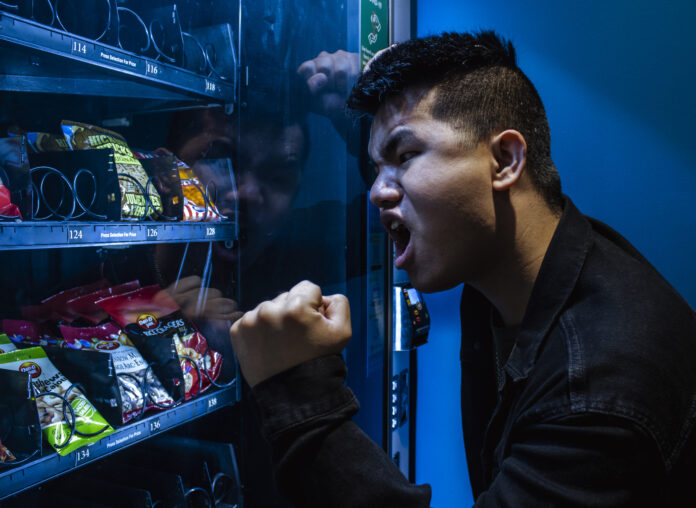
A man is yelling at a vending machine. The heel of his fist is against the glass, and he is leaning against the side of the machine. On his face is a look of pure outrage.

By Craig Allan, Peak Associate

Much ado has been made about the lackluster food offerings available on campus, but one area that does not receive its share of criticism are SFU’s vending machines.

Too often I go to the vending machines as my last hope, only to find they never work. After making a choice, I tap my card, only to read that the machine is cash only. Why have a card option if it will only take cash? Luckily, I do carry change with me . . . only to have the machine return it. Or in some cases, take the change and give nothing in return. I don’t want to walk all the way to security to complain about this — and they probably won’t even be able to do something about it — so I just have to accept that my change is gone.

This is an issue at both Burnaby and Surrey campuses, and it’s worsened because after about 7:00 p.m., most food offerings at SFU are closed. I don’t want to walk to UniverCity, and Central City Mall at SFU Surrey is usually closed at this time. SFU could fix this by getting newer vending machines that actually take payment by card, and by stocking the machines more frequently. There is no reason why this can’t be done in 2022.

A salad robot vending machine and a vending machine drug store are cool and everything, but they don’t really help when I’m just looking for a quick, cheap bite to eat between studying.