You’d be hard-pressed to find a time when Jahmal Wright wasn’t playing basketball. He started shooting hoops at the age of four, and signed up to play competitively when he turned nine. Despite playing a host of other sports, he always came back to basketball. “Basketball was my first love, so I was kinda drawn to it from the beginning,” said Wright.
After high school, he got a basketball scholarship to go to Miami Dade College for a two-year degree. He then transferred to University of Maryland Eastern Shore where he graduated with a Bachelor of Sociology. Now, he’s at SFU for a Masters in Liberal Studies while playing ball.
Wright felt some culture shock studying in the United States as a Canadian. “Maryland was actually a [historically] Black college but still a culture shock because [ . . . ] there were no other Canadians there,” he said. “There’s a lot more African Americans on the basketball team, so we kind of stuck together at both schools I was at and became a family.”
Wright has been able to get into game action this year, after missing the last two seasons due to COVID-19. “It has been a rollercoaster. Especially this season, we’ve had a couple cancelled games [ . . . ] and we ended up having to play three games in three different cities in five days.
“It was really equivalent to an NBA schedule some weeks,” he remarked. “It was a good experience. There was definitely some adversity with growing pains and chemistry, but overall, it was a really fun time.”
In those difficult moments, Wright said he relied on his mom, who lives in Ontario. “I talk to my mom pretty much every day,” he said. “If I have a bad game, she’s the first person to criticize me, but she’s also the first person to tell me [ . . . ] there’s always going to be another game.”
Wright credits his mom with helping get his basketball career off the ground. “She is the hardest worker that I’ve ever encountered. There’s been times where she’s worked two or three jobs just so that she could pay for me to play basketball,” he noted.
“That is fuel.”
His mom isn’t his sole source of support. “I’ve got my coaches,” he said. “Those guys they’re very big on staying positive, especially off the court.” He also gave a shout out to his teammates, specifically center Julian Roche.
“He’s my roommate on most trips and the conversations that we’ve had have definitely gotten me through some mental blocks that I had during the season,” said Wright. “He’s definitely helped me improve my game and improve my mental [health].”
Wright has one more year of college basketball eligibility, which he’ll be using at SFU. He envisions a full year ahead, including “the GNAC championship in [2023] and just getting better day by day, on and off the court.
“After I’m done my Masters, I want to play professionally overseas,” revealed Wright. He has ambitions beyond that, too. “My dream job besides being a professional athlete, of course, would be to be a broadcaster or sports journalist, so hopefully, all goes according to plan.”
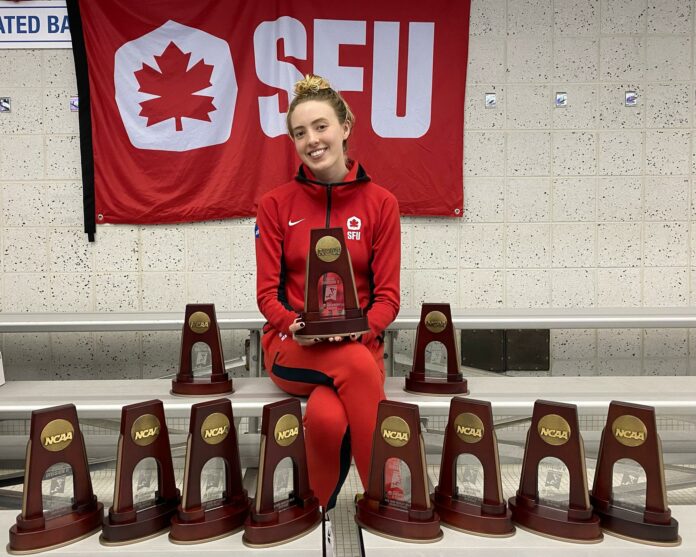
SFU walks away with a few national titles under their belt. Photo: SFU Athletics
By: Greg Makarov, Sports Writer
Women’s wrestling
The women’s wrestling team has taken an exceptional step this season, winning multiple individual national titles from seniors Karla Godinez-Gonzalez and Alex Hedrick (pictured). The biggest haul of trophies came from their Regional Championship win, where SFU came first in six out of 10 weight classes and had an astonishing 11 wrestlers qualify for nationals. The team finished the season undefeated in team competition.
Men’s wrestling
The men’s team had another promising season, stringing together a series of wins and only a handful of losses. However, when it came time for the National Collegiate Athletic Association (NCAA) Super Region 6 Championships, the team was unable to place within the top six to send them to nationals. The biggest highlight of the season has been sophomore Taniela Feliciano-Takafua(pictured)finishing the season with a blistering 30–1 record — one of only six SFU wrestlers to reach the mark.
Hockey
This season has been one for the ages — SFU tore through the BC Intercollegiate League and won all their regular season games. They continued to press on and won the Championship in a tightly contested final against Vancouver Island University, after heading to the final period of the semi finals down two goals. Freshman Garret Hilton was second in the league points and led his team in the playoffs with six points in two games. Goaltenders Cale Dolan and Michael Lenko also finished within the top five in the league for save percentage.
Men’s basketball
The men’s team finished the year with a 12–13 record in a memorable season full of exciting comeback victories and a winning senior send off. The most important shot of the season came from sophomore David Penney (pictured), whose fantastic spinning three pointer in the final seconds of the game sent SFU to overtime. Unfortunately, it wasn’t enough, and their ultimate loss ended their season just shy of the NCAA Championship.
Women’s basketball
The women’s basketball team advanced as the sixth seed in the Great Northwest Athletic Conference (GNAC) quarter finals after posting a 12–14 record. In a high scoring bout, they were bested by Central Washington University. The game was marked by an impressive solo effort from Jessica Wisotzki(pictured), who scored a game leading 29 points.
Swimming
The swim team has been historically successful this year. In a season alone, junior Collyn Gagne shattered multiple school records including the 200-yard breaststroke. Gagne also won a national record in the 400m individual medley, and two medals at the 2021 Toyota US Open Championship. Senior Kaleigh Sharkey (pictured) also made waves, becoming SFU’s most decorated NCAA woman swimmer with her 11thAll American award.
Indoor track and field
The track team, and most notably national champion Alison Andrews-Paul, is breaking a myriad of records. Andrews-Paul set multiple record times, including the second fastest 800m in GNAC history. Two best-ever team achievements came this season as the women’s track and field team won the indoor track and field banner while the men’s team finished second thanks to West Region Athlete of the Year, Aaron Ahl.
Play the ultimate game of focus, precision, and strategy. Photo: Lino Lakes/ Unsplash
By: Vanshita Sethi, SFU Student
A carrom board can often be found in a dusty, old corner in Indian households waiting to be pulled out on special family occasions. Some historians believe the game to have first been enjoyed leisurely by the Maharajas of India. Since then,carrom remains relevant in many parts of India to this day.
Carrom consists of 19 wooden coins (carrommen), a striker (a bigger disk used to try to pocket the other pieces), and powder (for glidability). It’s typically a game for four players with pairs of two seated across from each other. The 19 carrommen are divided into two distinct colours, black and white, with a queen placed right in the middle of the board. Similar to billiards, the goal is to pocket the carrom men of the chosen colour as fast as possible, along with the queen — the most valuable piece. Whichever player pockets their pieces first wins the game and receives a point for each of their opponent’s pieces still left on the board. If said winner pockets the queen, they will also receive five bonus points.
Over the last century, various Carrom organizations have been established to bring “uniformity in the specifications of equipment and rules of the game.” The All-Indian Carrom Federation was the first to be established on March 4, 1956.In 2012, Carrom Canada was introduced by Francis D’Costa and now has more than150 members.During the pandemic, carrom saw a resurgence among players in Canada, and D’Costa considered opening the federation up to prospective players who wanted to learn before the pandemic.
It might sound elaborate and intense, however, the “strike and pocket” game might just be your next favourite pastime while stuck at home, and can be bought at the following link.
First year SFU student Jerry Falogie has recently made a substantial impact on student discourse this March. While a campus-wide demand of course restructuring is in motion, not many are aware of what sparked it. The Peak sat down with student Jerry Falogie to learn how a non-refundable misunderstanding became the leading topic of SFU senate proceedings.
“I was so excited for my history of rap class,” stated Falogie to The Peak. His classes were all picked, his books all ready, and Falogie was so eager to get to the campus. “I thought I was gonna learn about Kanye West, Kendrick Lamar, and maybe even ancient players like Drake, and Cardi B.” However, Falogie was dealt a devastating beat when he found out that the class he signed up for was not History of Rap but History of Rhapsode,a class about ancient Greek performers.
“I wanted to learn about rappers and now all I am learning about is how Ion performed retellings of Plato’s work,” Falogie said in frustration “I guess me and Socrates have one thing in common . . . We both think it was totally worthless!” When asked why he didn’t realise he was in a non-rapping class when assigned books on Hesiod and Archilochus at the bookstore, Falogie thought those were just “cool new rappers” he had never heard of.
This frustration prompted Falogie to create a petition demanding SFU make lecture material clear to potential students in order to avoid misunderstanding. In his petition, Falogie accuses the university of “just using catchy click-bait titles that trick innocent students into taking boring classes.” At time of writing, the petition has amassed over 1,000 signatures, with overwhelming support from many students.
While Falogie’s actions have gained popularity throughout campus, there remain detractors of the cause. Many argue that the core of this issue was not the university “tricking students,” but instead Falogie’s ability to properly understand what he was signing up for. However, Falogie refuses to acknowledge any assertions that he needs to “read things good.”
“Look, I’m just a guy tryna get by,” rhymed Falogie. “All I want is to learn the things I thought I was going to learn.” Due to the recent amount of support, Falogie revealed to The Peak he would be starting yet another petition. This time demanding SFU provide students with an actual history of rap class because that would be “fuckin’ dope.”
Before the interview ended, Falogie asked to wish all his supporters on campus “the blessing of a harmonious life.” However, Falogie became immediately vexed and discontent after stating this. “Crap! That’s from Homer’s Odyssey! I’m actually learning stuff in this class!” He immediately packed up his stuff and grumbled something about needing to go listen to Future to “clear his head.”
It seems like by the end of this semester, Jerry Falogie’s “rhap” game will be thicker than Greek yogurt, and maybe we can all be thankful for that.
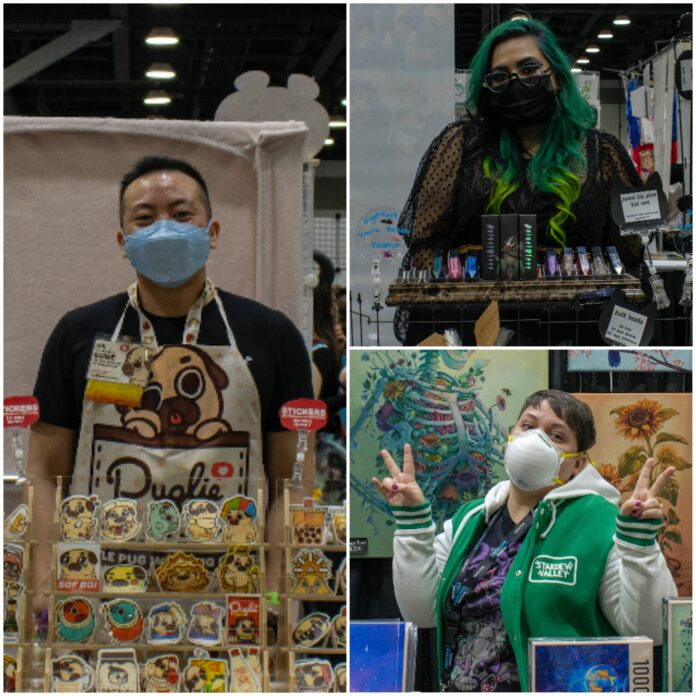
Learn what inspires Ashi Reddy, Euge Leung, and Lisa LaRose. Collage: Sara Wong / The Peak, with photos courtesy of Krystal Chan
By: Krystal Chan, SFU Student
Editor’s note: Answers have been edited for concision and clarity.
Last month, Vancouver hosted its first Fan Expo since the COVID-19 pandemic began. Arguably, one of the most affected industries has been arts and entertainment. As we continue to support small businesses during this time, The Peak sat down with three local artists who tabled at the 2022 convention to learn more about them and their craft.
Reddy makes lip glosses and various accessories. Photo: Krystal Chan / The Peak
The Peak: Can you tell us about your journey as a creative? What inspires your art?
Reddy: I had been going to conventions for years and had helped out friends previously with their artist tables, so I was always around that community. When I started, I was a hairstylist making clay hair accessories. That eventually led to resin accessories, which then led to other resin pieces. The cosmetics come from a longtime interest in makeup, and noticing a definite lack of POC alternatives in mainstream cosmetics.
A lot of my inspiration comes from French gothic architecture and Victorian romance, which are very in line with my personal tastes. I like the look of things that are less bright in colour. And if there’s a particular video game or show that I’m interested in, I also like to make things based on those.
P: Are there any special meanings behind your art? What are your goals with your art overall?
R: I don’t have too many sentimental meanings behind my pieces. They definitely reflect the kind of aesthetic I enjoy, which is usually a little different than others. People into goth fashion tend to connect with the pieces I make. That sort of ties into my goals with my art.
P: What pieces are you most proud of?
R: Right now I am most proud of my large, resin daggers. I’ve always wanted to make a decorative display dagger, and during the last convention people were extremely interested in them!
Leung, creator and CEO of Puglie. Photo: Krystal Chan / The Peak
P: How did you start your journey as an artist? Where do you get inspiration from?
Leung: I graduated Emily Carr with very little hard skills in industry standard programs, and needed to continue growing as an illustrator. I resented my time in university for what felt like a lack of education, so I used that anger to fuel my own studying of illustration and graphic design by practicing anatomy, drawing objects, admiring brand design and figuring out what it is I love about it, and so on.
P: Does your art come with any sentimental stories? What goals do you have with your art? Is there a particular piece you’re proud of?
L: At some point in my journey of becoming an illustrator, I fell into a deep and debilitating art block. It’s easy to see a lot of great art online and begin doubting your own abilities — why can’t you draw a hand, why are faces weird, how come you can’t paint like that? Eventually the art block gave me depression, and I either didn’t create anything for days, or I’d create something and despise it. This lasted for about a month, until I finally asked myself, ‘Euge, what do you want to draw?’ I gravitated towards stout, silly things; and food.
Turns out the “stout silly thing” was a pug — nicknamed Puglie — and “food” was a doughnut, because I kept having this idea of something stuck in a doughnut hole and not being able to touch the ground.
When I truly gave myself no expectations on good anatomy, proper perspective or form, a compelling concept, or whatever is considered a good illustration — and just allowed myself to have fun — it finally freed me. After I drew Puglie in a doughnut, I zoomed out of the illustration in Photoshop and for the first time in my life, I laughed and felt this joy in my art.
I continue to draw him because he continues to make me happy. And I have the honour and privilege of making other people happy with him. My goal with Puglie is to let more people experience him — via merchandise, or experiences like themed cafés (hopefully one day) or pop up shops or galleries. As much as I need to make a living, I’d just love for Puglie to be able to brighten peoples’ days.
Lisa LaRose | @lisalaroseart “on all the internet places”
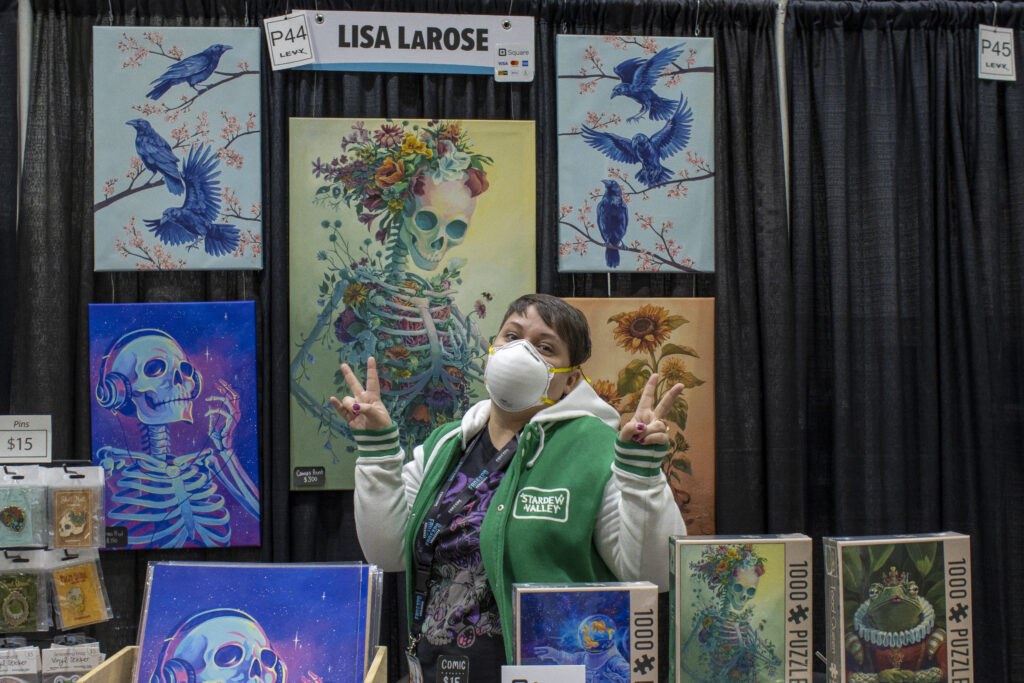
LaRose finds inspiration through emotion and colours. Photo: Krystal Chan / The Peak
P: How did your creative journey begin? How do you come up with ideas for your art?
LaRose: I started my professional artist journey by going to school for video game art and working in the gaming industry from 2009–2014 in Edmonton, Alberta (mainly at smaller studios on mobile titles). I got to a point where I had accomplished many of my goals and wondered “what’s next?”
I thought it would be moving up to a larger studio and focusing on character modeling, but I realized I was more passionate about illustration. I decided to quit my studio gig in order to pursue a new path.
I still did video game art, but also looked at other industries (children’s literature, board games, comics, etc.) and tried new ways to make money as an artist. In 2015, I started selling prints at conventions/art markets. In 2016, I made a painting, Star Fish, which quickly sold better than my other illustrations and fan art. By 2019, I was focused solely on my own art and selling it. During the pandemic, since I didn’t have shows to go to, I spent my time making a published comic book (Ghoster Heights), printing my own line of puzzles, and trying out live streaming.
P: What do you hope to convey with your art? Is there a special or sentimental story behind it?
LR: I make art for all sorts of reasons. Sometimes I have an emotion or feeling I’m trying to capture, and I use different images/colours together to try and build that feeling. Breathe is a painting about my anxiety (trying to keep calm and let go, even when I feel like I am deep underwater). Some of my work was made for a certain project: Ebb & Flow was made for a powerbox in Vancouver (the fish tile around the box — koi fish swimming one way and fish bones swimming the other way). And sometimes I just make things I think would look really cool or because I think it’s hilarious.
P: Which pieces are you most proud of?
LR: Life — it’s one of my strongest pieces and it’s very popular. I have the original on my wall and I still really enjoy seeing it every day.
Another student with a great life, thanks to Peakie.
By: Kelly Chia, Staff Writer and All Knowing
Dear Peakie,
My roommate keeps eating my eggs, but when I confront them they completely deny it! They say either I have a bad memory or someone else is eating them. We’re the only two people living together! Please help.
Lost,
Cracked in Coquitlam
Dear Cracked in Coquitlam,
Oh dear. It sounds like you’re being gaslit by a roommate who would rather fry your eggs than understand your eggs. Well, here’s what I would suggest to get crackin’ on: disguise yourself as a giant ostrich egg and teach your roommate a valuable lesson about stealing. See, upon observing an ostrich egg in the home your roommate will be naturally intrigued by the mythos of that golden yolk of truth. They will be unable to resist trying to eat you. The key word here is try, as you are not actually an egg. Instead, Cracked, you are a diviner of truth. When your roommate discovers what they’re whisking is you, scramble their emotions like they have scrambled yours!
Sincerely,
Peakie
Dear Peakie,
I’m having a tough time choosing which major to declare in my third year. I have done a lot of philosophy classes and really enjoyed them but I also have a passion for biology! I don’t know what careers I could pursue in either, though, so if you could help me figure out my life that would be great.
Sincerely,
Indecisive in West Mall
Dear Indecisive in West Mall,
Unfortunately, I can not guide you through all of life, but I suppose I can help you with this chapter . . . Here is what I would advise you to do: don’t confine yourself to a mortal timeline, darling. Why can you not be both a biologist and a philosopher? Experimentation means flavour, and flavour means dazzle — the two fundamental tenets of Biology and Philosophy. Why pressure yourself with the labels when you can just be, honey?
Anyways, that will be $12,000 dollars per annum for the next 15 years, please. You can send e-transfers to [email protected] the first of every May.
Believe in yourself,
Peakie
Dear Peakie,
I work for the IT services of a major university and my job is really stressful. I spend most of my days working hard to make sure the data of the university is kept safe, but anytime I can’t fend off a major attack, I’m blamed! It feels like everyone hates me or is waiting for me to screw up. Even when I offer solutions, they say I’m doing too much or not enough. How do I stop myself from uncontrollably sobbing and communicate to everyone that I’m a much better person than they think I am?
Thanks,
Stressed in an Undisclosed, Generic Location
Dear Stressed in an Undisclosed, Generic Location,
Have you tried turning your self-image on and off again?
Let’s try to reroute some of these problems and link to the main issue — your reputation. Instead of IT services, I would consider renaming yourself TMB services: “Trying My Best.” That way, when a certain student bodies try to be mean to you about your job, you have protection!
And don’t forget, Stressed in an Undisclosed, Generic Location — you have all the power in this situation. They have problems communicating nicely with you? Cut off their communication lines! No surveys, no internet, and you can guarantee, no complaints! Don’t worry about the moral implications, students are used to poor communication anyways, they will adapt perfectly.
Refresh your life with these simple style recommendations. ILLUSTRATION: Kitty Cheung / The Peak
By: Tamanna T., Staff Writer
Spring is the most confusing time of the year for me, because I never know when the weather will change. I constantly check the weather app before leaving my room, yet I still manage to be too hot or too cold. On some occasions I leave without an umbrella only for it to be pouring 10 minutes later. These bewildering changes make it essential to think about layering clothes, so you can stay on top of the weather chaos and adjust accordingly. As someone who has worked in the fashion retail industry for almost four years, here are my top tips for layering.
1. Gather the basics: T-shirts
Basic tees can make or break any outfit, and you most likely have some in your closet already. Having a simple T-shirt in multiple colours increases variety while still keeping your outfits versatile. Pair one with some faded blue jeans and a faux leather shacket for a fit that’s cozy and fly with minimal effort! If feeling hot, you can take off the shacket and you’re still left with a solid outfit. It’s a win-win either way! Simple half-sleeve T-shirts also work well with sweater vests, or underneath oversized hoodies. Both are very on trend right now, especially for those with the fashion mindset of “more is more.”
Have at least one graphic T-shirt. It’ll add a little sassiness and character to any layered outfit. Mintage is a great vintage store that has amazing graphic tees and their clothing is hand-selected. They have a location on Commercial Drive and another on Main Street.
2. The one true pair (of pants)
Bottom essentials really only include a sturdy pair of jeans and a good pair of leggings. You can mix and match pants with a lightweight crop top and vintage faux leather jacket for stylish flair. Layering is all about looking after your body’s comfort no matter the weather, and good quality bottoms are crucial. You want your outfit to look fire, but you shouldn’t actually burn up at the same time.
For those who don’t like the feel of standard jeans or don’t own many, check out KOTN. They’re an ethical and sustainable clothing brand that has high quality denim and other comfortable bottoms for everyone.
3. Jackets ftw!
A jacket is likely the first thing someone will notice about your outfit, so make sure to spend some time on this selection. I personally like Uniqlo jackets, blazers, and parkas because of their great quality. They’re also relatively budget-friendly, which is always a plus in my book. If you don’t want to crowd your closet, choosing a couple pieces that can suit multiple seasons should have you covered for most of the year! These can be layered on top of any clothing item — jeans, leggings, dresses, skirts, and even jumpsuits!
If the weather appears particularly confusing, opt for a water-resistant jacket with a hood. I promise you’ll never be disappointed.
Layering is quite a lot of fun when you get used to it. Making up outfits in your head, trying them on, and figuring out which combination fits your mood the best is an amusing activity. The key to layering, however, is your own comfort level and how expressive you want to be with your clothing. You can opt for an all-black layered outfit, a monochromatic beige fit, or play around with different colours. At the end of the day, clothes are meant to fit and represent you, not the other way around.
Kalinga explores the sacrifices caregivers make. Image: Aimer Films Inc.
By: Charlene Aviles, Staff Writer
When I first watched Kent Donguines’ Kalinga (Care) at Sliced Mango Collective’s movie screening, it felt like reading a series of long-lost journals. The first-person narration of Filipina caregiver stories beautifully captured the sacrifices, heartbreak, and resilience of these mothers. Inspired by his mother’s experiences as a caregiver in Canada, Donguines sheds light on the Live-In Caregiver Program’s effects on Filipino families. While this documentary is educational, it only scratches the surface of this program’s complexities.
Through Canada’s Live-In Caregiver Program, which ended in 2019, families could hire temporary foreign workers to take care of their children or elderly family members. The documentary discusses the stressful working conditions the program’s largely FIlipino applicants endure in hopes of getting permanent resident status.
Kalinga features the stories of Mary Ann Dumaguing, Maria Facundo-Lilly, and Esther Tabujara — Filipina caregivers living in Metro Vancouver. After moving to Canada, they coped with years of homesickness in hopes of financially supporting their families and eventually sponsoring them to immigrate to Canada. What grabbed my attention the most is these women’s unconditional love for their families.
While Kalinga is full of touching memories, it also has its heartbreaking moments as the mothers sacrifice time with their own children to be able to provide for them.
I initially thought this documentary would be a highlight reel of the accomplishments of caregivers in Canada. But I was pleasantly surprised with Donguines’ approach to include the women’s raw confessions of their trials. It added a personal touch to the documentary because you learn about the women’s stories at different stages of their careers.
Tabujara’s outspoken nature stood out to me the most. Her need to be honest with the audience was comforting. She expressed her frustration with people’s misconceptions about caregivers. According to her, caregivers juggle multiple roles that are often overlooked.
“Caregivers manage the whole house. You’ll be the nurse when the kids get hurt. When the kids get lonely, you are a mother,” said Tabujara.
While caregivers provide essential labour to Canadian families, they continue to be undervalued. “We have a labour shortage across the board, particularly around domestic work or health care,” said Vancouver-Kensington MLA Mable Elmore. “The Philippines has a labour export policy where they actually export workers.”
The stories in Kalinga are heartbreaking, but they’re needed to address the underlying problem: the lack of legal protections for temporary foreign workers. While the featured stories mention friendly employers, it’s also important to shed light on other workers who are susceptible to exploitation from their employers.
According to Elmore, “We are creating with this program a whole underclass of workers. Hundreds of thousands of workers who do not have permanent residency.”
Kalinga made me reflect on my upbringing with immigrant parents. Hearing about temporary foreign workers’ struggles made me respect and appreciate their sacrifices even more. These matriarchs embody the most important value in Filipino culture: family.
Watch Kalinga (Care)’s trailer on YouTube. To stay updated with Donguines’ future projects, follow him on Instagram.
Refresh your life with these simple style recommendations. ILLUSTRATION: Kitty Cheung / The Peak
By: Hannah Kazemi, Peak Associate
As we start to see warmer temperatures again, there’s no better way to spend your time than in the sun. Here are my favourite items for the perfect picnic — get outside and soak in that Vitamin D!
Tote bags
Do as the cool kids do and get yourself a tote bag (or four). They come in so many colours and patterns, depending on where you buy them from. A tote bag is the perfect addition to any outfit, especially now that farmer’s markets are starting up again — they match the aesthetic perfectly. Vancouver-based brand Tentree has a couple for $25, and each purchase plants 10 trees. What more could you ask for?
A light jacket à la Miss Congeniality
Hang up your Super Puff, friends. Spring weather calls for light layers. Opt for something thin to layer on top of a T-shirt or light sweater, and maybe consider something waterproof as well — we do live in Raincouver after all. I love a lighter colour for spring, so keep an eye out for neutrals like beige or cream to incorporate some brightness into your outfit. Thrift stores are great places to look for pieces like this. The options are endless!
Reusable water bottle
Hydrate, hydrate, hydrate! I bring a water bottle with me everywhere, especially as the weather starts to heat up. When I have my tote bag with me, it’s so easy to throw it in there and go — that way you’re always prepared and don’t have to keep spending money on bottled water. I’m obsessed with the one from local brand Okay To Rest. It’s currently sold out, but be on the lookout for its return. The best part about reusable water bottles like these is that they last forever!
Snacks!
Whether you’re catching up with friends or studying outdoors, snacks are required, especially when you’re spending all day in the sun. My favourite is an apple with chocolate peanut butter from Vancouver-based company Mumgry. Or, if you want an even sweeter treat, check out BAK’D Cookies at a farmer’s market or pop-up around Metro Vancouver. While you’re at it, grab drinks from a local coffee shop! The iced Hawaiian latté from Honolulu Coffee has been my go-to lately.
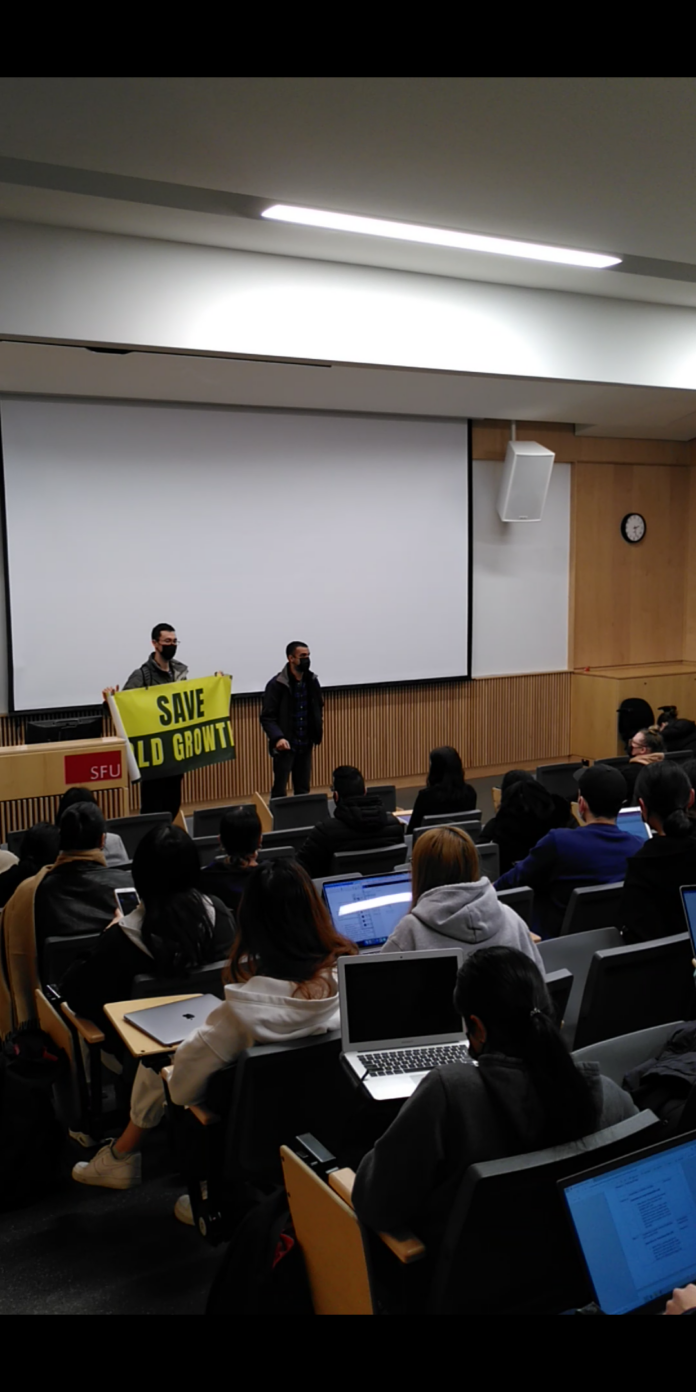
Save Old Growth activists target environmental science classes for their interruptions. PHOTO: Zain Haq / Save Old Growth
By: Yelin Gemma Lee, News Writer
Since the beginning of March, Save Old Growth has been interrupting classes at SFU and UBC once a week to raise awareness for their environmental activism campaign. The campaign aims to stop old-growth logging in BC by blocking the Trans-Canada Highway. Although there are some classes selected at random, they’ve been aiming to interrupt forestry classes at UBC and environmental science classes at SFU.
The Peak spoke to Save Old Growth founding member Zain Haq to learn more about these interruptions. He explained each interruption involves four activists: one to speak to the class for 30 seconds to a minute, one to hold up the Save Old Growth banner, and two to hand out leaflets with details to their next civil disobedience talk. According to Haq, these interruptions have resulted in one to five students in these classrooms coming out to their talks.
“The first step is to go and ask for permission, if the professor says yes, great, they’re on the right side of history, and if they say no, we respectfully disagree and make the announcement,” said Haq. “If the professors get physical, the person making the announcement kneels down, and continues to make the announcement. At least one professor has gotten physical to the point of becoming violent.”
Haq said although reactions and responses were mixed between classrooms, there wasn’t much variance within a single classroom.
“In some classes, we get applauded, in others, we get booed,” said Haq. He said the group focuses on those who seemed interested in the campaign and not those who opposed the class disruptions.
Nicole Kirigin, incoming SFSS vice-president university and academic affairs, recorded and posted a video of Save Old Growth’s disruption on YouTube and the video was found circulating on other online channels such as Reddit. The Peak reached out to Kirigin for comments but did not receive a response by publication deadline.
The video shows students laughing or murmuring amongst themselves, while the professor appears concerned while calling someone.
The Peak reached out to Dr. Gordon Rose, whose class was disrupted in the video for comment, but did not receive a response before publication deadline.
Haq explains why his group chose this method of reaching out. “If you hand out someone a leaflet in the hallway, it’s easy to ignore, but you can’t ignore people who are non-violently interrupting classes and telling the truth about the climate emergency.
“The climate emergency (floods, fires, storms) don’t ask for permission before occurring, they happen as an act of nature. Those who are transgressively telling the truth, are acting on behalf of nature because nature will kill us if we don’t act now.”
To learn more about Save Old Growth and updates on their initiative, visit their website or their Instagram page.