Home Blog Page 260

SFUnexplained: Joy Johnson is the Editor-in-Chief of The Peak

0
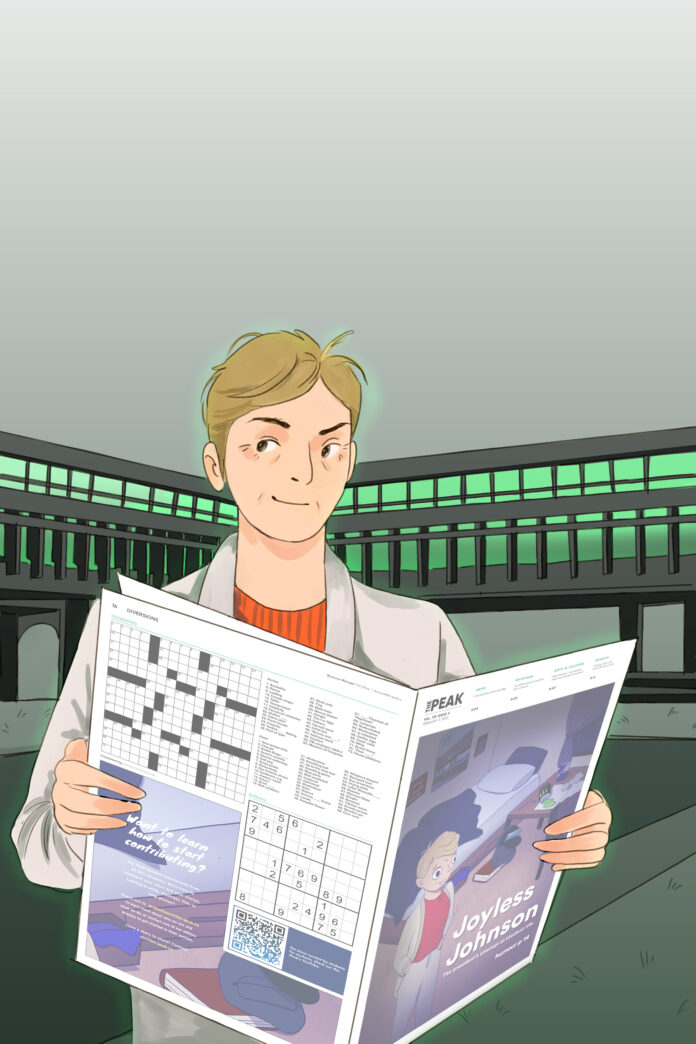
Illustration of Joy Johnson smirking as she reads a cover of The Peak, with an illustration of Joy Johnson on it.
ILLUSTRATION: Shaheen Virk / The Peak

By: Yasmin Vejs Simsek, Staff Writer

Joy Johnson is the president of Simon Fraser University. Or is she? I’ve given this a ton of thought and at this point, there is not a doubt in my mind that Joy Johnson is actually Editor-in-Chief at The Peak. 

Okay, hear me out! First of all, Joy Johnson is like the most powerful person at SFU. I bet you she has people at her beck and call to do whatever she asks. Want a 3:00 a.m. bagel? She’ll probably have it within the hour. Fancy a private whale-watching tour in pouring rain? She’s definitely got a guy on call for that. So, if she wanted to be the boss of the coolest newspaper in town, she could easily take over and completely forget about the yearly hiring process for the Editor-in-Chief. She’s. Got. The. Power.

Second of all, have you ever seen the Editor-in-Chief and Joy Johnson in the same room at the same time? No? Because they are the same person! Joy Johnson might be powerful, but she does not have magical powers and therefore can’t be two people at once. Think about that next time you are in the room with Johnson and the Editor-in-Chief of The Peak isn’t there. Suspicious? I think so.

And don’t even get me started on the amount of jokes The Peak makes about Joy Johnson or past SFU presidents. This is giving me some serious Gossip Girl vibes, where you know, Gossip Girl actually had to gossip about themselves to make sure people will never suspect it is you. And what better way to make sure people talk about you than to make sure the topic is always on you?

Speaking of which, most of the articles The Peak publishes on Joy Johnson are always poking fun of her and who better to make fun of someone, if not themselves? Self-deprecating humour, you guys! Why else would The Peak publish a humor article titled, “SFU gets rid of professors to save president’s salary,” if not to deflect from the fact that it was all true! I’m telling you, it’s all a ruse to throw us off the scent. You see? It all makes sense.

Listen, everyone here at The Peak is so confused. I have never actually met the Editor-in-Chief, the so-called Michelle Young in person. That’s OBVIOUSLY somehow an anagram for Joy Johnson. And like COVID-19 is basically over (another obvious hoax), so why are we still meeting on Zoom? We’re all vaccinated, and it’s not like COVID-19 is rapidly mutating to be more transmissible or anything. EVERYONE else is back in-person (except those people with the worst “seasonal summer colds” of their life) and yet here we are at The Peak stuck in front of our laptops. I bet she’s using a green screen because our Editor-in-Chief does not want to be found out for who she really is! We need to expose her, so please spread the word you guys. I was only able to get this piece through to the Humour editor with fairly little resistance! I wonder why . . .

Sincerely,

A desperate Staff Writer

 

Comics

0
ILLUSTRATION: Sara Brinkac / The Peak

By: Olivia Visser, Staff Writer
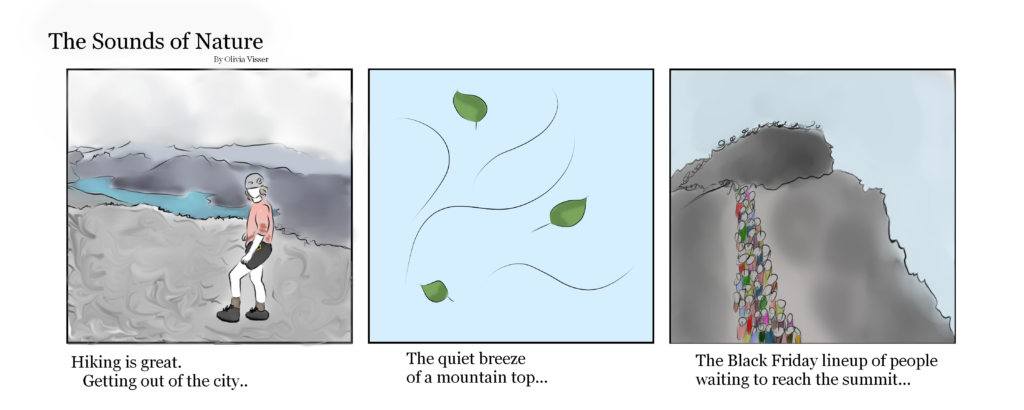
Panel 1: A person stands on a grey rocky mountaintop overlooking a mountainous lake. Beneath the panel is text that reads "Hiking is great. Getting out of the city..." Panel 2: Three green leaves are seen atop a blue sky, indicating a breeze. Beneath the panel reads "The quiet breeze of a mountain top..." Panel 3: A large crowd of people trails from the bottom to the top of a grey rocky mountain, seen from behind. The text beneath reads "The Black Friday lineup of people waiting to reach the summit..."


The monster under my bed won’t pay rent

0
A close-up photo of a green plushy monster staring into the camera
PHOTO: Pixabay

By: Yasmin Vejs Simsek, Staff Writer

Dear Mrs. Goldblum of Goldblum and Sons,

I am writing to seek legal advice. I have this monster under my bed, like I am sure many of your clients have had. While I do not wish to evict him, I do need him to pay rent. My utilities have basically gone through the roof since he moved in, and I cannot carry the financial burden for the both of us, especially not in this economy. It’s quite difficult to communicate with him since he only grunts. Not to mention the cultural barrier of someone who prefers hiding under the bed over having a house meeting.

I have attempted to write up a rental agreement that I would appreciate you looking through and advising me on the next step.

Name: Monster*

Address: 666 Godzilla Avenue, Loch Ness, BC

*Note: I am unsure of Monster’s name, as they simply blurt out unearthly horrors every time I ask.

This is a legally binding agreement between Landlord and Renter. The latter will hereby be referred to as Monster. This contract will outline the rent Monster shall pay Landlord as a fee for moving in under their bed. The contract will be in effect for a month once signed, with the possibility of renewal if Monster agrees to never scare Landlord on purpose and adheres to the following:

Monster agrees to pay Landlord the sum of $1,000 on a monthly basis for their comfortable living quarters under the bed. This includes utilities, water, gas, but not Wi-Fi. Access to Wi-Fi will be an additional $50 a month, considering how many hours Monster spends on Facetime with Big Foot. This can be negotiated if Monster chooses to take said calls at a nearby café and/or agrees to read Landlord a bedtime story every Monday night. Moreover, the rent will include access to Landlord’s Netflix account, so long as Monster promises to only use their own profile and not interfere with Landlord’s algorithm. Landlord is a scaredy cat.

Monster is allowed to have friends over once a week, with the exception of the Boogieman, with whom Landlord has beef. Additionally, Monster shall pay Landlord a security deposit in the amount of $800, in case of any damages Monster might cause with their large presence. The deposit will be returned as long as the premises are returned in the same condition as accepted, including the return of each individual dust bunny. No pets will be allowed, as Monster is technically considered a pet under Canadian law, but a renter under this contract.

Thanks, Ms. Goldblum, I hope you have a terrific—

No, stop Monster. STOP! You can’t eat this letter, it’s official business!


Roe v. Wade: Your religion should not police my body

0
pro-choice protestors at Supreme Court
Anti-abortionists are the result of inconsistent religious moralizing on bodily autonomy. PHOTO: Gayatri Malhotra, Unsplash

By Yasmin Vejs Simsek, Staff Writer

Content warning: Mentions of sexual assault and anti-abortion sentiments

The US Supreme Court has overturned Roe v. Wade. The decision undermines the bodily autonomy of just over half the country’s population. The original 1973 ruling guaranteed people a constitutional right to have an abortion. Flash forward to June 24, 2022 and the Supreme Court has now rewound the clocks by 50 years in an infuriating ruling that takes bodily autonomy away under the disgusting pretense of religious piety.

Zechariah 7:10 says: “Do not oppress the widow or the fatherless, the foreigner, or the poor. Do not plot evil against each other.” God wants his worshippers to take care of the vulnerable, especially children. But the pro-life (anti-abortion) faithful have no interest in actually securing a good life for potential babies, as is evident from the lack of health care, parental leave, daycare, and decent education in the US. Thanks in part to those social failures, maternal mortality is over twice as high in the US compared to the next highest developed country — 17.4 women in every 100,000 in the US die at some point during the childbirth process, compared to 8.7 in France. The failure of American post-natal care extends to the country’s atrocious foster care system. But no calls to address those terrible failures make anti-abortionists’ chants. It’s clear that religious anti-abortionists are not loving their neighbor, nor are they acting as good samaritans by working to help the fetuses they forced birth upon.  

The hypocrisy of failing to care for babies after they’re born is multiplied by the religious hypocrisy that’s shown over the course of the pregnancy. Genesis 2:7 preaches: “Then the Lord God formed man of dust from the ground, and breathed into his nostrils the breath of life; and man became a living being.” You don’t have to have a major in theology to understand that this passage refers to life starting at first breath, but here’s one anyway. Judaism is even clearer — according to the Talmud, the ancient rabbis saw the fetus as part of the mother until birth. Life begins, for them, at the moment of birth. But, as a result of the Supreme Court decision, people who accept this Jewish take on life have their religious freedom undermined. To turn the expression “life begins at conception” into law, is a violation of the freedom of those who say it begins at “first breath.”

Many anti-abortionists will use the phrase, “It is God’s will,” to support their argument. Pregnancies, they’ll say, are the result of divine intervention — whether they’re unplanned, the result of incest, or whether the baby won’t be able to survive in the real world. That argument generates a range of problematic questions. Impotence, for instance, is just as much God’s will as pregnancy, where is the ban on Viagra? Infertility, rape, murder, cancer — are these all God’s will? Absolutely not. Further, it is believed among Christians that an angel came down to ask Mary whether she wanted to carry baby Jesus. Key word, ask. God didn’t just force her to carry a child — He gave her the choice to carry one.

Of course, moralizing on religious thought isn’t the most important thing here. The US is technically a secular nation, which means it constitutionally separates the church and the state. The US should therefore not be able to make laws based on religious teachings, especially when 59% of Christians in the country and 89% of religiously-unaffiliated people did not want to see Roe v. Wade overturned. The freedom of belief stands as it should, but the freedom to not believe is also a constitutional right. If someone tried to impose Islam on Americans, the situation would be pretty different, I’m sure — as has been argued in light of another recent religious-based Supreme Court decision. No one, no Christian, no Muslim, no Jewish person, should impose their religion on someone else’s body.

A country that can now dole out harsher punishments for aborting a pregnancy that occurred as a result of rape, than for the crime itself, is a country that is at war with people who have uteruses.

And that’s the point. 

Religion is being used as a pretext for misogynistic policymaking. It’s a smokescreen for a desire to see pregnant Americans as tools for birthing, rather than people. It’s a way to punish people for their sexuality. That’s why the very same court that just overturned Roe is now setting its sights on the right to contraception. The goal is to reduce agency from the moment of conception to childbirth to when the child reaches adulthood. Don’t be fooled by false displays of religious piety. The end of Roe is the result of a misogynistic push to reduce people to their reproductive organs and ability to give birth. 

We need to keep an eye out for anti-abortionists in Canada. While our population is generally more agreeable towards abortion, we have a weak legal infrastructure that upholds the right to bodily autonomy that leaves us open to restrictions. We need to check those who would use religion as a pretext for reducing our rights. We deserve the choice over our own bodies. It’s an essential part of healthcare, and an essential part of living as a free citizen.

Bright-er Side: At some point, Wikipedia became a partially-reliable website

0
Wikipedia globe sitting on papers
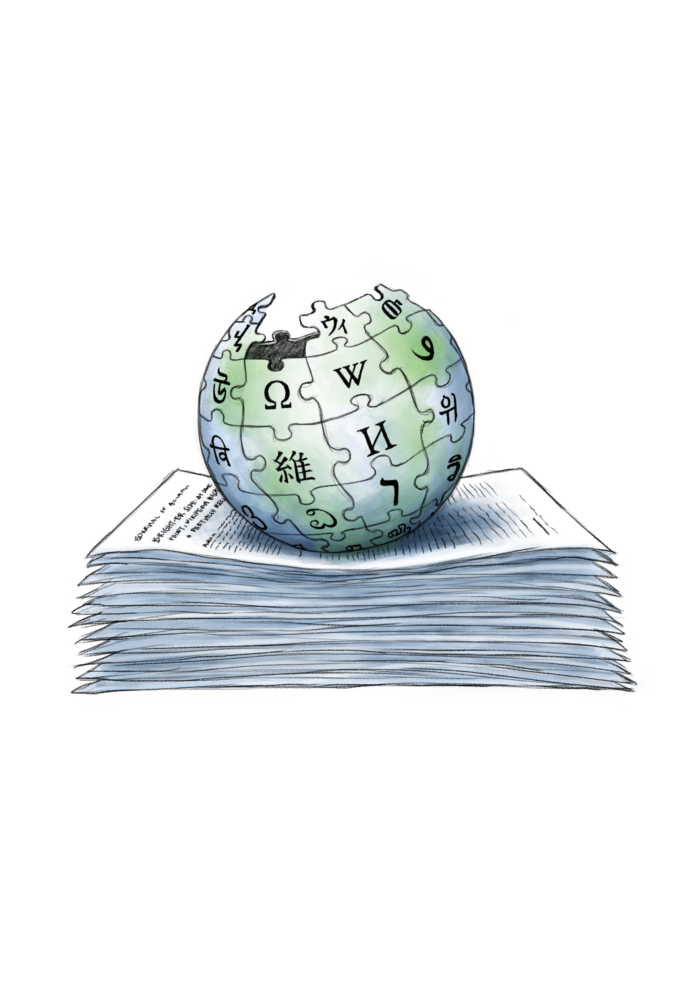
We can cautiously poke it for answers. ILLUSTRATION: Lori Jiang / The Peak

By Bhavana Kaushik, SFU Student

We’ve all heard the warning: “Wikipedia can’t be trusted.” At every level elementary, middle, high, and university we’re warned to stay away from the free online encyclopedia. And so we’ve sadly been slow to learn that, at some point, the site became a partially reliable source. 

Wikipedia is the first click. Not just in terms of Google results, but as a stepping-off point for further research. When you’re curious about any issue (literally, any issue), using hyperlinks to travel through an endless web of curiosity is a fantastic way to spend your time. 

Better yet, the list of references at the bottom of any Wikipedia page. When statements on the site are backed up by academic journals or government documents, it lends credibility to the page on two fronts: first, it assures the reader there’s a good source of information for statements on the site; second, it makes the site useful by providing the reader with a virtual cornucopia of valid virtual sources through which they can search. This is the greatest value that Wikipedia has to offer: aggregating legitimate sources on any given topic under one wiki. 

Now, granted, “anyone in the world can write anything they want about any subject,” so sometimes you’re going to get ridiculous stuff. If you, for example, trawl through the edit history on the “First Law of Thermodynamics” page, you’ll find a 2012 entry that changed the page’s first line to “the [first law of thermodynamics] is do not talk about thermodynamics.” And while I’m inclined to agree because of my hateful relationship with chemistry, the incident underscores the general success of edits to the site. The riff on Fight Club was fixed within a minute!

That’s not to say that the site is a perfect source. Contributors and editors have not prioritized pages about accomplishments by women. The same can be said of other underrepresented groups, including “people of color, people with disabilities, LGBTQ people, [and] Indigenous communities.” It just goes to show that while Wikipedia has made strides in legitimacy, it’s still fundamentally a place to start researching, but not the end. 

However, Wikipedia does offer more in-depth, readable, and widely accessible articles than Encyclopedia Britannica. We need to remain cautious, but we also need to stop utterly dismissing the site as a repository of information and sources. Don’t just take my word for it . . . take a look at the Wikipedia article on the reliability of Wikipedia!

All about drama: SFU needs a theatre club

0
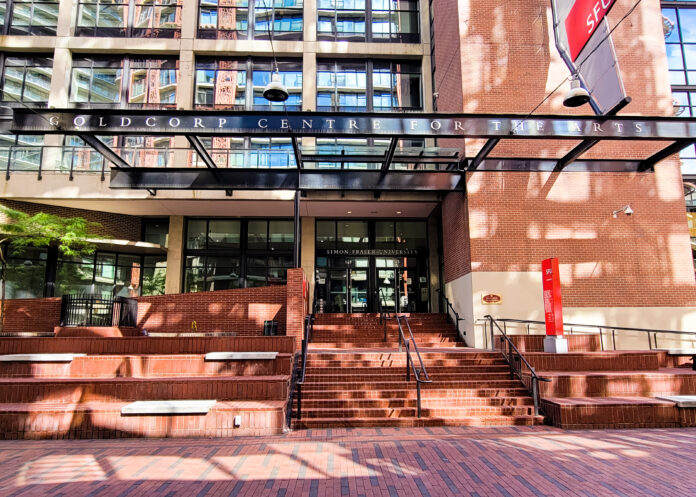
SFU Goldcorp Centre for the Arts
We need more drama! PHOTO: Amirul Anirban / The Peak

By Swagi Desai, SFU Student 

Shakespeare once wrote, “All the world’s a stage, and all the men and women merely players.” But for most SFU students, that line can’t literally be the case. Our school is an outlier in the academic community, hosting no all-major, all-inclusive, no experience needed, judgment-free drama club at any campus. And that’s a shame! 

Now, SFU does have an extensive and excellent list of academic theater programs at the School of Contemporary Arts in Vancouver, but it doesn’t have a widely accessible, all-inclusive, all-major drama club. The University of Waterloo, the University of Toronto, and the University of Victoria all have drama clubs. Why not SFU? To be fair, a few years back, some like-minded individuals started up the SFU Improv Club. But, unfortunately, the group shut down in late 2019. Now, though, as folks have gotten vaccinated, and we can implement the safety plans up our sleeves, students are looking to try out new things!  

Small groups of people from different departments could meet to play theatre games or assemble small productions! They could play their favorite characters or recite their favorite stories. Common interests could be found and friendships could be formed. Original stories could be built by those who have stories to tell. Diverse tales from the participants’ cultures could be showcased. Resourceful participants could throw together makeshift costumes and props. Funny behind-the-scenes stories could make for such wonderful memories. 

The club could help students in non-drama fields, too. Members could get to tackle their stage fear. We could add public speaking to our resumes. All the organizing, scheduling, and managing of affairs could provide several opportunities to improve one’s team-building and leadership skills. 

And as a final call to action, our lack of an inclusive drama club means that we’re falling behind UBC. The UBC Players Club has been in action since 1915. Their club website set out the mission, including their resolve to be a safe, inclusive, and accessible place for students from all majors. Instead of falling short of UBC’s program, we need to kick things up a notch and put together our own drama club! And if not now, then when!? 

The Sylvia Platters unpacks complicated cultural upbringings in Youth Without Virtue

0
photograph of four band members crouched down together at a sidewalk.
The band bonded over their lived experiences of growing up in conservative religious households. Photo Courtesy of Megan Lambert.

By: Yelin Gemma Lee, Arts & Culture Editor

If you were looking for a short and sweet EP to listen to during coffee breaks on your sunlit patio this summer, I’ve got just the remedy for you. The Sylvia Platters (TSP), an indie-rock band from BC’s Fraser Valley, released their melancholic EP titled Youth Without Virtue on June 24. The album was created throughout the pandemic and the quiet moments of reflection it allowed.

The Peak interviewed TSP bassist, Stephen Carl O’Shea, to learn more about the band and their creative direction. He explained the album explores the clash between conservative cultural upbringings and one’s own adopted values as an adult.

“There exists the world your parents raised you in, and then there is the world you interpret to be authentic and real. Social conditioning within tightly controlled conservative communities employs fear-based tactics to ensure the community’s boundaries are established and held,” said O’Shea. “For each of us, we chose to unpack these complicated histories of upbringings and channel them through energetic expressions of upbeats, downbeats, and vocal harmonies.”

O’Shea said the band bonded over their shared lived experiences of this dissonance between the values they were raised on and the values they ultimately chose for themselves.

“Each of us knew the strict sense of rules and performative social presentation that were required by elders within the community. As we found this commonality amongst our lived experiences, the themes of the album galvanized as cathartic healing through the pandemic’s isolation.”

As someone who navigates the treacherous effects of religious trauma, Youth Without Virtue played a special role during my loneliest moments. The lyrics and upbeat instrumentals felt like a breath of fresh air and sunlight pouring through a dark room at the same time. Rather than being a sorrowful reflection, it’s a resounding soundtrack for hope and healing.

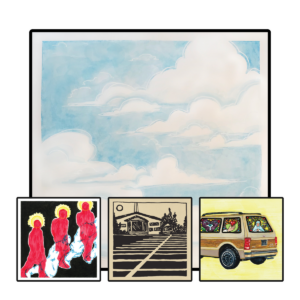
illustrated album cover of Youth Without Virtue
Youth Without Virtue album cover. Photo Courtesy of The Sylvia Platters.

I love listening to the EP on loop because it seamlessly flows into the next track and the EP’s poetic imagery is on theme but not repetitive. Some of my favourite lyrics are found in “Doldrums:” “Dredging up some old sins / So bored of this insurrection / With no unearned affection.” But my ultimate favourite song has to be the title track, which has an upbeat industrial production that clears away for the lyrics of the verses to shine through. The lyrics resonated with me deeply, especially when they croon, “When the guilt starts getting the best of you / And your faithless friends are falling through / Listen to your sister / Take her word for scripture,” and the bridge: “You’re never enough / You’re never alright / You kill what you love / It burns you alive.”

Youth Without Virtue was released physically as a cassette. When asked why, O’Shea explained it felt like the best option in terms of time, cost, and sustainability.

“In this world of intangible releases, another digital EP felt incredibly underwhelming. We desperately wanted to embrace something tactile that TSP fans could hold in their hands,” said O’Shea. “We landed on cassettes as the perfect format as it connected to our upbringing of long family road trips in Chrysler Voyager minivans and their stock cassette decks. For good measure, we got exactly 66 cassettes made up to suit the thematic elements of Youth Without Virtue.”

O’Shea revealed that Youth Without Virtue is a part of a Youth Without… series of EP releases, with plans for the second one being drafted up.

“All of us in TSP are very passionate about our artistic endeavours as an expression of our lived experiences. The band remains an outlet for creative expression and cathartic release,” said O’Shea.

To learn more about The Sylvia Platters, visit their bandcamp page and follow their Instagram page. You can listen to Youth Without Virtue on all major streaming platforms. 


Hybridity highlights the collectivity of Asian Canadian diasporic experience and local Asian Canadian artists

0
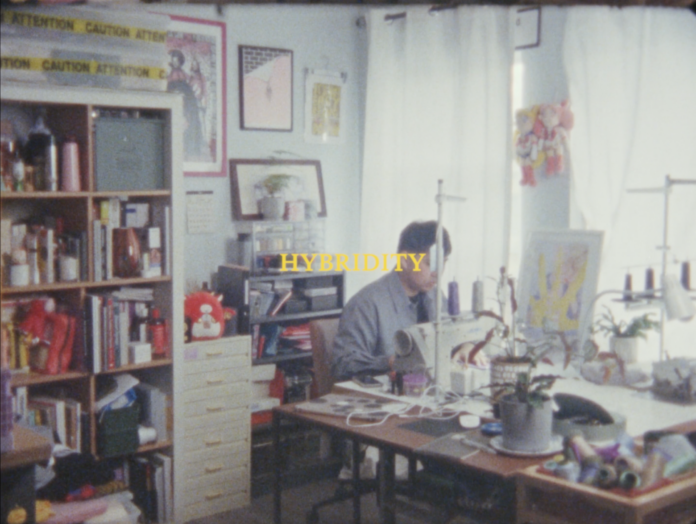
Fashion designer Alex S. Yu working at his workspace on his sewing machine
Hybridity celebrates local Asian Canadian artists in their various disciplines. Photo Courtesy of Kevin Kim / Hybridity.

By: Yelin Gemma Lee, Arts & Culture Editor

Hybridity begins with an introduction by multiple voices from featured artists overlapping each other — the hybridity of united voices. It’s almost as though they finish each other’s sentences but their voices overlap enough to be noticeably disruptive. I felt immediately pulled into the creative direction of the film by this compelling introduction. It encompassed the solidarity between these local artists and the Asian Canadian community through filmography.

What began as a passion project between like-minded SFU film students sparked into a beautiful short documentary that captivates you under its spell. Being under four minutes, Hybridity leaves you wanting more. The film showcases masterful creative direction and cinematography.

The Peak interviewed Kevin Kim, director of Hybridity, to learn more about his thoughts behind the project. He noted the ideas around it began to take form in early April, where they were in reflective anticipation of Asian Heritage Month.

“I was born in Korea but I moved to Canada at a young age, and so oftentimes I feel like I’m in a limbo between both worlds,” said Kim. “However, I knew that there were so many more people like me, immigrants who can’t place themselves in either world. We either don’t think about it or feel at a loss when we do.”

Kim explained the project originated as an idea to reach out to people around him to ask for their diasporic perspectives, but then it settled to taking the opportunity to celebrate local AAPI artists who were also first or second generation immigrants.

“I wanted to showcase impactful, local artists in their spaces to show other multicultural artists that there is a vibrant community of Asian Canadian artists here in Vancouver,” said Kim. “There are a lot of expectations set in the industry on who we are and what we create. It’s important that together we are breaking said norms collectively, creating a supportive and safe environment where we can express ourselves freely without judgement and maintaining the pride of being both the Eastern and Western worlds.”

Being an Asian Canadian artist and an immigrant myself, Hybridity created an anthem of some of my innermost feelings and formative memories. Although I felt relatability and solidarity through everything that was expressed by these artists, my favorite line was when Jace Junggyu Kim said, “I was good at drawing and I didn’t have to really speak. My art was sort of a language to communicate with other people.”

The way the dialogue between five different artists was so seamlessly integrated together was very impactful. The flow of their lines drifted from person to the next as though they were speaking as one voice, nurturing a collective narrative that bloomed and spilled over. The film switched between clear footage and footage that looked like it was old-film, which seemed to represent the shifting nature of diaspora over time. The footage of the artists working their respective disciplines in their spaces was peaceful and inspiring to watch.

“It’s important that we give space for Asian Canadians to share their work so that we can share our stories without fearing judgement or prejudice, and not let our stories be twisted by the perspective of others,” said Kim. “Our goal with the film is for the audience to understand that they are not alone [ . . . ] they can feel supported and proud of who they are as multicultural artists. We also hope to show those who aren’t in the said demographic what it is like to be a culturally hybrid artist and to raise the voices of our community to the public.”

Food for Thought: Butter Chicken

0
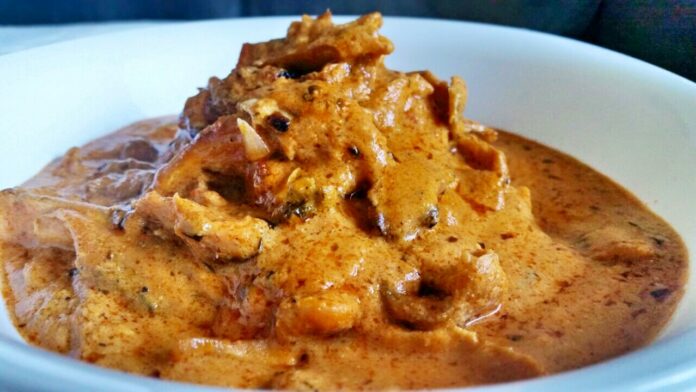
close-up shot of butter chicken piled on top of rice
Butter Chicken has come a long way since its humble beginnings. Photo Courtesy of Affaf Ali / Wikimedia

By: Roshi Chadha, SFU Student

Being from Punjab, Northern India, I have many childhood memories of eating my favourite dish, butter chicken curry, with my parents. This luscious curry, paired with scented jeera rice or naan, always lifted my mood. This meal is not only famous in India but in many other parts of the world. The smell of butter and tender chicken pieces mixed in warm tomato-flavoured sauce is mouth watering. Since moving to Canada three years ago, I have tried this dish at many different places around Vancouver but none have measured up to the dish made by my mom. I think the secret ingredient for my mom’s recipe is definitely the authentic curry leaves, known as sweet neem, that add more rich flavour to the dish.

Butter chicken was developed by Kundan Lal Jaggia and Kundan Lal Gurjal, who began their culinary journey operating a small road-side eatery in Peshawar, Pakistan. After partition in 1947, both the owners resettled in India where they created murgh makhani (butter chicken) in their restaurant, Moti Mahal. It was a common practice at the time to throw out leftovers right away to avoid the risk of eating spoiled food. However, the owners of this restaurant began using their infamous leftover tandoori chicken pieces to make into a sweet-savoury sauce with lots of butter and cream. This is how butter chicken originated — as a creative and delicious way to combat excess food waste.

It is surprising to see the humble dish, made in a small roadside restaurant, make its way to different states in India. Since its beginnings, the butter chicken recipe spread throughout the world with its first introduction in Manhattan. It first appeared there through a print in the newspaper in 1975 highlighting the butter chicken dish served at Gaylord Indian restaurant. Additionally, Indian families who migrated to Canada and other parts of the world began to open their own restaurants and serving this traditional dish.

Butter chicken is a dish that seems complicated to cook but in reality only requires a few main ingredients like butter, chicken, Indian spices such as turmeric and cumin, and staple vegetables like tomatoes and onions. It doesn’t take too long to make and is a hearty and delightful meal after a tiring day. Butter chicken is usually cooked in North India on many special occasions such as Diwali and Holi as it is a traditional comfort food and a staple in our culture.

In current western society, this butter chicken curry is also used separately as fillings for wraps, burgers, pizzas, and pot pies. Although it makes me feel a little bit anguished knowing the dish is getting further from the traditional recipe, it’s been interesting to see the popularity and different interpretations of butter chicken in the western world. If you are curious to try this dish, some of my favourite restaurants to order butter chicken from are Sula Indian restaurant and Tasty Indian Bistro.

Pride history exhibit opens in Surrey

0
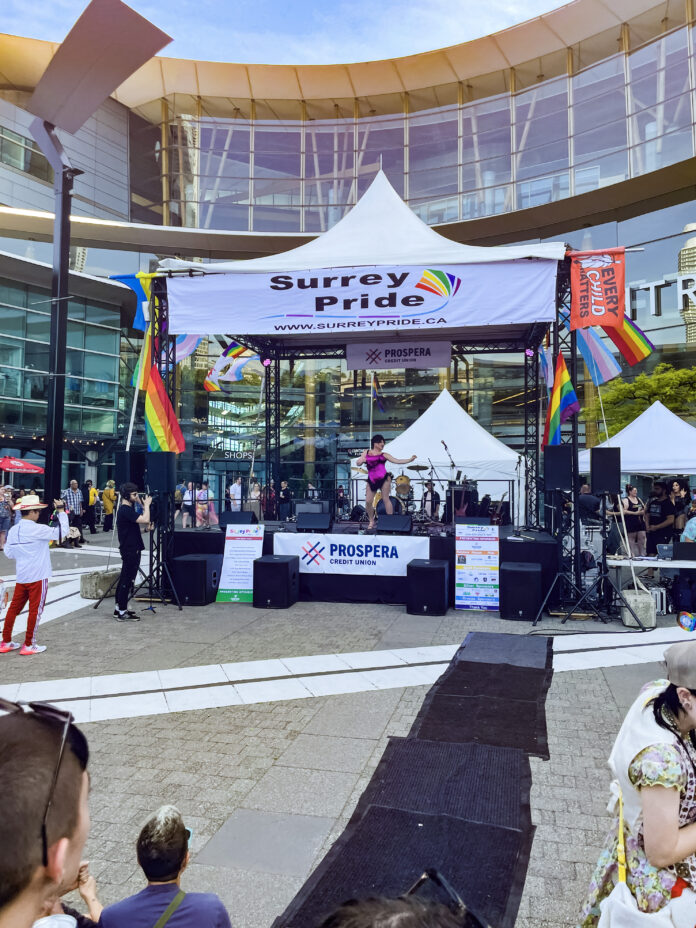
The photo is of the outdoor Surrey Pride Festival. A drag performer is on an outdoor stage as the crowd watches.
This year’s Surrey Pride events included live music and drag shows. PHOTO: Yasmin Simsek / The Peak

By: Yasmin Vejs Simsek, Staff Writer

Dr. Jen Marchbank from SFU’s gender, sexuality and women’s studies department has curated the first LGBTQIA2S+ exhibit at the Museum of Surrey. This comes as part of the museum’s Show and Share displays with elements from the LGBTQIAS2+ community’s history in the city. The exhibit is currently on and will be open to view until September 4. It consists of elements from Marchbank’s personal archives, news articles from the Surrey archives, as well as donations from SHER and other organizations. 

2024 will be the 25th anniversary of Pride in Surrey, and Marchbank is planning on making this exhibit permanent at the Museum of Surrey before then. The Peak interviewed Marchbank to learn more about Surrey Pride.  

Surrey Pride Society has existed since 2001, when it was called Out in Surrey Rainbow Cultural Society. Four years prior to the society’s establishment, three LGBTQIA2S+ books were banned by the Surrey School Board due to parental complains. The complaint began when James Chamberlain, a teacher, submitted the books to the school board for approval prior to teaching them in class. This turned into a legal battle and made its way to the Supreme Court of Canada, where the decision was overturned. At the time, Chief Justice Beverly McLachlin said, “Tolerance is always age-appropriate, children cannot learn unless they are exposed to views that differ from those they are taught at home.” 

The three specific books can be seen at the Museum of Surrey: Belinda’s Bouquet, Asha’s Mums, and One Dad, Two Dads, Brown Dads, Blue Dads. On her search to find them, Marchbank said, “They are not anywhere in the library system of Surrey. So I’ll be making a request.” 

In June 1999, president of Surrey Pride Society, Martin Rooney, was dared to put on Surrey’s first queer dance as a fundraiser to fight the people who were in support of the book ban. To that, Marchbank’s wife, Sylvia Traphan, said, “So what the bigots actually achieved was they started the whole movement in Surrey.”  

The Surrey museum’s exhibit told the story of Rooney, who has a long history with LGBTQIA2S+ activism. From 1993 to 2010, the US had a travel ban on people who were HIV positive. Rooney was going to the US in 2007 to buy a turkey when he was stopped because of his HIV positive status. He was interrogated for three hours, accused of having false papers, his photo was run through the FBI’s most wanted list, and was turned back to Canada. 

Rooney ensured this story reached the media and held a rally to get the US Senate to lift the ban. Because of Rooney’s hard work, Marchbank stated, “It made the American government change the law.” When the ban was lifted over two years later on January 4, 2010, Rooney then went to the US to purchase his turkey.  

During the beginning of the pandemic, Surrey Pride Society had a virtual festival, which is being screened at the Museum of Surrey as part of the exhibit. The festival was filmed in “a grotty little bar with a green screen. The floor space for the whole bar was about this size,” Marchbank said while gesturing to an area of no more than 10 square metres.

This year, Surrey Pride Society held events throughout June, many of them specifically for certain groups within the LGBTQIA2S+ community. It culminated in the annual Pride festival which took place on June 25 at Surrey Central City Plaza. 

The attendance was estimated to be similar to the success of 2019 and community members of all ages came out to celebrate Pride. There were free popsicles, merchandise from the vendors, numerous live music acts, and drag shows being performed in 28-degree heat. The show was finished off with a rendition of “Sweet Caroline” by Rooney.