Home Blog Page 181

BCGEU donates $200,000 to TSSU Strike Fund

0
This is a photo of the picket line at SFU Harbour Centre. Members are holding a large banner in front of the doors that reads ON STRIKE
PHOTO: Olivia Sherman / The Peak

By: Olivia Sherman, News Writer

On June 29, the Teaching Support Staff Union (TSSU) held a picket line outside SFU’s Harbour Centre. Paul Finch, the treasurer of the British Columbia General Employees’ Union (BCGEU), was present at the demonstration, where he announced the BCGEU was donating $200,000 toward the TSSU strike fund. 

TSSU chair Kayla Hilstob stated the BCGEU’s donation is for the TSSU’s strike fund, with the most of it funding strike pay for union members. “When we go on picket lines and stop working to put pressure on the employer, they may stop paying us for that time. But the strike fund ensures that TSSU members get paid and can still pay our bills in that case. 

Hilstob said the SFU administration offered a 0.01% increase to their wages. In response, she exclaimed, “I’m tired of this administration running this place of learning like a business!” 

“This powerful act of solidarity means that we can sustain picket lines to keep the pressure up,” said Hilstob. “Paul Finch from BCGEU unequivocally delivered a message that BCGEU would not allow the university admin to starve out TSSU.” According to Hilstob, SFU is aware of BCGEU’s new funding and has not responded. 

Finch said the SFU administration’s lack of support for workers is “a political decision by the university,” and that the BCGEU is “not going to let the university pursue a strategy” of refusing “very reasonable strike demands.” 

According to Finch, it is within the power of the SFU board of directors to improve the working conditions for staff at SFU. “If they say they don’t have that power, they are lying to you,” he continued. 

Derek Sahota, the TSSU’s member advocate, stated that in the last fiscal year, SFU made a $25 million dollar surplus, and “they take that money for whatever they want, and leave our members starving [ . . . ] we have a union-buster in charge of the second-largest public university in BC.” 

Sahota elaborated in a correspondence with The Peak, providing figures from SFU’s financial publications: “TSSU’s position isn’t that wages should be doubled, but it’s very clear there’s room in the budget to make life a lot better for our members who do a large amount of the teaching work on campus.” 

This is an ongoing story. For more information on the ongoing strike, visit the TSSU website: https://www.tssu.ca/

Shared drives: the ultimate setup for a disaster in a group assignment

0
Someone holding a map, standing in front of numerous Google Drive folders
ILLUSTRATION: Raissa Sourabh / The Peak

By: Hana Hoffman, Peak Associate

Hey friends. I hope I’m not the only person struggling with this, but I seriously cant think of any more ways to keep folders and documents organized. Folders are supposed to make life EASIER, not harder. So, why are these shared drives so hard to navigate, and when will Dora The Explorer’s map come and help me find the locations of the drive I need to get to??? It would probably take less time for me to drive to California than to find my group’s second draft of the body section of our project.

When I need to find a document in the shared folder, I really don’t want to bother my group and ask them for the link for the fifth time. What if they think I’m a bad student? What if they get annoyed and unfollow me on Instagram?

The only way to avoid these interactions is by doing the impossible: finding it myself. You may be thinking: Why not just stay more organized from now on? Why don’t you star the email or bookmark the link? Honestly, I don’t want to hear it. I don’t even blame myself for not being able to find anything. First of all, why are we using so many different websites to collaborate on the project? There’s Google Docs, Microsoft Word Online, Google Jamboard . . . On top of that we’re using my groupmate’s physical notebook that we can’t even access because they keep forgetting to send us pictures of our notes from brainstorming in class. 

Second of all, no one should expect someone to memorize where everything is, especially while managing multiple email addresses. I’ve got my SFU email, personal email, professional email, spam account email, work email, and fan account email. There are too many drives where links and folders could be sitting!

At the end of the day, I think the best solution would be for SFU to ban group projects from the curriculum. But since I know that’ll never happen, my other solution is to tell my group that I am old-fashioned and do not use modern technology for communication. This means I don’t have an email address, a social media account, or any means of contact other than the telephone at my house. As a result, the rest of the group is only left with two options: gather in-person to do the project with me, or collaborate online and finish the project without me. Either way, I’m cool with it. As long as I don’t have to dig deep to find files in the confusing and frustrating shared drive, I’m satisfied.

Opinions in Dialogue: How Christian institutions can traumatize

0
A statue of the Virgin Mary
PHOTO: Jonathan Dick / Unsplash

By: Fern Ridley, SFU Student and Valeria Gomez, SFU Student

Content warning: mentions of child sexualization, rape culture, abortion, purity culture, and queerphobia.

Fern: The extent of my religious trauma wasn’t apparent to me until a few years after my high school graduation. I went to a Christian school from kindergarten to grade 12 — and as you can probably imagine, it took a toll on me. My school was obsessed with preserving purity among its student body, and often meddled in students’ personal lives. We were frequently subjected to speeches, lessons, and one-on-one conversations about “honourable” Christian lifestyles. Growing up as a closeted queer girl in this environment was challenging, to put it simply. Years after entering what my school called “the real world,” I realized many of my private school experiences were harmful, and sometimes violating. Why were my teachers, who were often men in their ‘50s, speaking to me about “tempting” children and adults by wearing a bathing suit? Why were they so preoccupied with preserving the presumed innocence of young girls, while letting the boys do whatever they wanted? 

Valeria: This is something I struggled with going to religious schools as well. It felt like the teachers and staff were obsessed with making sure girls’ uniform skirts were low enough on the knee, but boys who would come to school shirtless on non-uniform days, or wearing short shorts, were allowed to do so. All the discussions around modesty focused on “not showing your shoulders,” and “not tempting men” — it made me feel disgusting in my body and took so many years to unlearn. Schools should be teaching young boys to be respectful, not telling girls to cover up. In my memory, we never once had a formal discussion about what “consent” means. I learned more on the internet about consent than what they taught at school, and that’s very dangerous. 

Fern: I also had this experience it really is devastating what it does to your sense of self. I actually once had a teacher approach me explaining that another staff member told her my skirt was too short, and wanted her to let me know “as a woman.” My first thought was: great, some old man was probably staring up my skirt as I walked upstairs. Of course he didn’t want to confront me himself — it’s creepy! You’re also right that consent was rarely taught in religious schools when we grew up. Instead, we endured conversations upholding rape culture under the guise of caring for students. Phrases like “men are visual creatures,” and “they can’t help themselves,” were used to guilt young girls into feeling ashamed of their bodies. We internalized these ideas as if they held real value to ourselves as women. 

Valeria: Modesty is something people can choose for themselves if they’d like to, but I despise how this is being forced on women and girls in so many religious institutions. It sends the message that women are not worthy of respect unless they are “modest,” and even then, purity culture is so harmful to sex education. The entirety of my sex ed in school was abstinence-only education — I was never taught about birth control, their alternative uses (like hormone regulation), or even the basics around ovulation. We were even told that partners shouldn’t use condoms between one another because it’s “against God’s will,” even if your partner has a known transmissible disease. I promise “God’s will” isn’t about infecting loved ones. 

Fern: I always found it disturbing how religious institutions can use the concept of “God’s will” to manipulate and indoctrinate young people. Often, their perception of “God’s will” is closer to right-wing political values than Biblical text. For example, abortion is never mentioned in the Bible, and in fact, Judaism holds the pro-choice view that a fetus attains personhood after being born. Despite this, today’s Christian culture generally stands against bodily autonomy when it comes to abortion. In my school, abortion was a taboo topic, and was often compared to murder. I can’t begin to describe the shame and confusion young girls in this environment feel — with a sex ed system that revolves around protecting their “purity” while offering no resources for staying safe. It felt like my school didn’t care about our safety as much as they did our ability to get married and raise Christian children. Even in marriage, you need to know about things like contraceptives, consent, and abortion. It took a long time for me to realize religious trauma is very real — I still live with uncontrollable guilt around engaging in sexual activity, using drugs or alcohol, and being queer. 

Valeria: Very true. In schools they always talk about how Jesus judges no one but then they turn around and judge everyone for their “sins.” The Old Testament also punishes women who are victims of sexual violence, and moralizes how they react to it, rather than punishing the men who commit the crime. While my high school teachers were accepting of the 2SLBGTQIA+ community, too many religious people — the Pope included — view same-sex attraction as a “sin.” How can it be a sin to love? It took me years to unlearn the shame I felt for myself. I never understood what was supposed to be so terrible about being gay, but I quickly understood that other people did not like it. Upon rumors spread about me being a lesbian in elementary school, I didn’t understand what the big deal was. However, for weeks people harassed me, called me slurs, and said disgusting things about queer people. At first, the institution did not care and wouldn’t protect me against harassment unless I wasn’t queer. It made me fearful of identifying as anything other than straight, and took me years to even consider the possibility of being queer, and longer to accept myself. 

The whole idea around virginity is harmful because “you can’t tell if someone has had sex by looking at their genitalia — the shape and size of the vagina doesn’t change size with penetrative sex, nor does the hymen change from penis-in-vagina sex.” Tampons were moralized, horseback riding was moralized — all for a ridiculous construct around “purity.” The obsession with a young girl’s “purity” to begin with is disgusting. I shouldn’t have been made to feel like a sexual being at 13 or 14, just because adults around me were obsessed with girls’ purity. I should have been allowed to be me without shame of my body or paranoia around whether what I was wearing was “too revealing.”  

Fern: The least harmful advice about sexuality we were told in my school was to love queer people because we were also “sinners” ourselves — but that’s still such a backwards way of thinking, and it still moralizes people’s sexualities. It took me a while to recognize that the popularity of these ideas is rooted in the Christian church’s institutional power, and not necessarily truth. This goes for many religions, but my personal experience is with Christianity. Whether or not you’re still religious, you don’t need to follow in the footsteps of your pastor or fellow church-goers to live an honourable life — whatever that means to you. Instead of cherry-picking values from scripture and church, why not focus on being a genuinely kind and charitable human being? I think that’s often forgotten about in Christian circles, or it’s used as an excuse to judge others. 

The shame around our bodies and sexuality lingers long after we leave religious school, and has a strong effect on women and queer people especially. Talking about these experiences with peers has been one of the most cathartic forms of relief for me, but the issue persists. Private schools have too many protections around what they’re allowed to teach students and how they operate — especially private schools that are also religious institutions. These schools have the ability to operate outside the Ministry’s secular curriculum, which allows them to skirt around regulations and do things that would get a public school in deep trouble, such as rejecting applicants who have queer parents. Children shouldn’t be subjected to moralistic conversations about their bodies and sexuality in school — that isn’t a teacher’s place and it should be illegal.

2SLGBTQIA+ panel discusses the past, present, and future of queer communities in Canada

0
This is a photo of a pride parade. There are multiple people walking under a large rainbow flag. The camera is behind the people, so only their backs are visible.
PHOTO: Mercedes Mehling / Unsplash

By: Eden Chipperfield, News Writer

Content warning: mentions of transphobia, queerphobia, and conversion therapy.

As Pride month ends for 2023, discussions regarding the future of the 2SLGBTQIA+ community have come into mainstream conversation. The conversation is especially aggravated by the increasing anti-sexual orientation and gender identity education protests in BC. The US is also seeing increasing anti-trans legislation, including requirements that anyone who wishes to use the bathroom must use the restroom that represents the sex of the person assigned at birth, rather than the gender they present as. 

On June 29, the Sexual Violence Support and Prevention office at SFU held a panel conversation at SFU Burnaby’s Halpern Centre. Speakers discussed timely topics around the past, present, and future of 2SLGBTQIA+ rights in Canada. The panel featured barbara findlay, a human rights lawyer with over 50 years of experience in disrupting societal norms. In June, findlay was awarded an honorary degree by SFU for outstanding work and exceptional contributions to the public good. The panel was also joined by the director of the Sexual Violence Support and Prevention office, C.J. Rowe, who offered accounts of their experience as a queer trans person and their insight on where Canada is heading concerning 2SLGBTQIA+ groups and rights. 

The event’s discussion was split into three conversation sections: the past, the present, and the future of 2SLGBTQIA+ rights in Canadian history. Each portion of the timeline was approached with what had happened in the two speakers’ lives during those times, their experiences as a part of the queer community, and how they envision the future. 

In the “past” portion of the conversation, findlay described her experience of coming out as a lesbian in 1968. “What they did with the gays in those days was [put] them in psychiatric hospitals, and that’s what they did to me at the age of 17. Because the goal was to make me into a ‘normal.’” findlay detailed how being identified as gay was seemingly taboo. The majority of families would ask their queer children to hide their partners away, especially in events such as weddings or funerals where photos taken could out them as gay and bring shame to the family. findlay also discussed the privilege of being white and queer compared to the experience of queer people of colour: “White queers had a better time than queers of colour.” findlay explained this is because white queer people could gather in community spaces, but the Black 2SLGBTQIA+ community struggled because society did not recognize their identities. 

During the conversation about the past, a court case involving a trans person was brought up that both findlay and Rowe had legally worked on and engaged with: the Kimberly Nixon v. Vancouver Rape Relief Society case in 2007. The case addressed how Nixon, a trans woman, was discriminated against and was prevented from working at the Vancouver Rape Relief Society (RRS) in 1995 because she was not born a cis woman. Nixon filed a human rights complaint against the organization. They addressed the Nixon case to discuss the mistreatment and discrimination against trans people in working environments that findlay had been fighting for most of her career. In 2007, the Supreme Court of Canada dismissed her appeal as it was seen that the RRS was protected under the Human Rights Code. The case is an important reminder to recognize trans rights and the lack of visibility in the Canadian Charter of Rights. 

The “nowportion of the event discussed the ongoing treatment of trans-identifying people and rising queerphobia in the United States, which has been creeping into Canada. findlay discussed a recent anti-queer attack at the University of Waterloo motivated by hate toward gender expression and gender identity, as it took place during a gender studies lecture. The topic of trans-exclusionary radical feminists was also in discussion about excluding trans women from feminist spaces. “I think I would say trans-exclusionary feminists shaped my life in ways where it took me much longer to come out as trans,” added Rowe, discussing their experience as a trans person in the present. 

The last part of the lecture, the future” portion, discussed the direction we as a society may be headed toward based on the ongoing political tensions 2SLGBTQIA+ people are experiencing today. They addressed how queer people and allies should be ready to deal with the constant hate that is occurring more often in Canada. In May 2023, the Government of Canada stated that “all people, including [2SLGBTQIA+] individuals, are entitled to enjoy the protection provided by international human rights law, which is based on equality and non-discrimination” in the Universal Declaration of Rights. 

The lecture concluded with findlay encouraging all those that attended to read up and become educated on 2SLGBTQIA+ history, and to be aware of what is occurring in the world. findlay also said to be mindful of all experiences from those who are out and those who may be still in the closet. Standing up for 2SLGBTQIA+ movement is vital in a political environment like the present. 

Horoscopes July 10 – 16

0
An illustration of a girl with long flowing hair. Astrological signs and stars shine around her.
ILLUSTRATION: Marissa Ouyang / The Peak

By: C Icart, Humour Editor

Aries: You, my friend, are going to have a dream about a flawed ostrich that knows how to fly. It insists on teaching fellow ostriches about the magic of flight, but it’s not working. The dream will end with your head turning into an ostrich egg. 

Taurus: Hi! The ancestors of the ant you accidentally stepped on yesterday are angry, and will communicate that to you in your dreams tonight. Take all the precautions necessary, including working on your conflict resolution skills, to prepare for a heated discussion. 

Gemini: You know those shorts in the back of your closet that you bought in middle school but sometimes sleep in when all your pyjamas are in the wash? Yeah, well, you’ll be wearing them in your dream tonight as you defend your kingdom against an alien invasion. 

Cancer: Ummmm, yeah . . . you’re not dreaming tonight. You’ll spend all night staring at the back of your eyelids. Dreams are like little movies directed by our brains, but similar to the Writer’s Guild of America, the writers in your head are on strike. 

Leo: Do you hear wedding bells? Neither do I. Anyways, don’t forget to fasten your seatbelt tonight, as you’ll be zooming across the country in your dreams. In real life, you can barely tell the difference between the brake and the gas, but as soon as the sun sets, you’ll be living your F1 fantasy. 

Virgo: The Tooth Fairy is coming tonight to take your younger sibling’s tooth, but she will definitely underpay for it. So there’s only one thing left to do: guerrilla warfare. Oh wait, someone just told me that guerrilla warfare doesn’t involve gorillas. Well, I don’t know. Just make sure she’s paying the appropriate amount for that tooth.

Libra: The special someone you’ll dream about tonight will also be dreaming about you. I’m just kidding. I have no way of knowing that, but wouldn’t it be cute? Like a little frolic in a field moment, or sharing ice cream in front of a stunning view. Ooh, maybe I’m not seeing your future dreams right now, but your future daydreams. That makes more sense. 

Scorpio: Do you play soccer? Because you will be scoring the winning goal in your dream tonight. As a result, you will become team captain, and they’ll rename FIFA after you. But the fame will become too much, and you’ll trade your athletic talents for a mango. Terrible choice, by the way. 

Sagittarius: Do you even understand how exhausting predicting dreams is? I am so tired right now. And for what? Your ungrateful ass? I expect fresh cookies to be delivered to The Peak’s office as compensation. Also, Teletubbies, you’ll be dreaming about the Teletubbies. 

Capricorn: Happy half-birthday! You know, because it’s six months since your birthday. You know that awkward feeling when your family tells the waiter it’s your birthday, so the restaurant staff breaks out into a Cirque du Soleil performance, and all the other restaurant patrons turn into goats? Well, you’ll feel it tonight when that happens in your dream. 

Aquarius: I’m pretty confident you won’t dream tonight because you won’t sleep at all. That new show you’re streaming will suck you in, and you’re about to click “continue watching” every three episodes until the sun rises. I hope the season finale will be worth it!

Pisces: Please stretch your wrists before bed tonight; you’ll be playing hella piano in your dreams. You won’t be any good at it, but hey, if you’re having fun, that’s all that matters. Eventually, you’ll become insatiable and eat the whole piano but don’t worry, you’ll wake up before finding out what that would do to your next bowel movement.  

This Place is a tender exploration of “home”

0
In dark, shadowy purple lighting, an intimate film still featuring a closeup of Kawenniióhstha gazing into Malai’s eyes with one hand on Malai’s chin. Both have long dark hair.
PHOTO: Courtesy of Toronto International Film Festival

By: Michelle Young, Opinions Editor

This Place (2022), directed by v.t. nayani and written by women of colour, weaves together the stories of two women as they find themselves and one another. We are first introduced to Kawenniióhstha (Devery Jacobs), who is of Kanien’kehá:ka (Mohawk) and Iranian descent, and on a journey to connect with her father. Then, we meet Malai (Priya Guns), who is Tamil, and struggling to come to terms with her father’s declining health. 

The protagonists are fully fleshed-out individuals who want to ground and find themselves. They hold a beautiful romantic tension, while simultaneously portraying a deep sense of grief. Though the film is presented as a queer love story, it’s that and so much more. Kawenniióhstha and Malai confront difficult conversations about colonialism, identity, and their own biases. Their stories and identities are juxtaposed against one another to grapple with how “this country has given and taken so much.” 

While Kawenniióhstha was “rooted” to her land by her mother, Malai’s parents fled the civil war in Sri Lanka. Against the backdrop of the 1990 Kanesatake Resistance — where a “proposed expansion” was built on Kanien’kehá:ka burial ground — Kanien’kehá:ka people had to fight for their land, while Malai’s family found solace in Aterón:to (Toronto). 

My family immigrated to Canada, too, so I deeply related to Malai’s conversations around home and being unable to return home. Conversely, This Place also tackles the wounds Canada has imposed on Indigenous peoples, and Kanien’kehá:ka people, specifically. The grief these women hold while trying to come to terms with how their parents failed them and protected them was intricately beautiful, because I could understand how this grief came to be, too. 

The majority of the film moves its plot with dialogue, and while the pacing improves near the latter end of the movie, I would have preferred more moments of silent action. The dialogue was stiff at times, so moments where the characters found one another by stolen glances and quiet affection were the times when the actors shined best.

I appreciated that Kawenniióhstha and Malai were unapologetically queer — from the moment they laid eyes on one another, you knew they had it bad. It was refreshing to watch their relationship unfold and take its course without the hurdles of internalized homophobia. When the world was crashing around them, they found solace in one another. 

This Place is a wonderful conversation around positionality, immigration, and racialization in Canada. It pokes at the audience to examine what it means to be an immigrant on stolen lands and an Indigenous person on land that’s been colonized. A hidden gem in the world of film, the story hits the heart and is bound to resonate with many. 

This Place had its theatrical release in Vancouver on July 7. Watch it at a select cinema near you.

Meet the Pets of The Peak. Part 1

0
A dog with a black, white, and brown fur pattern lay in the grass alongside a grey cat with black stripes, in the background a forest.
PHOTO: Andrew S / Unsplash

By: The Peak staff

She’s a ten, but she pees when new people see her: Pancetta – Isabella Urbani, Staff Writer

A close-up photo of a dog's face.

Pancetta’s (also known as Pumpkin Pie Girl, and Pan of the Cetta) name means “bacon” in Italian — quite an appropriate name for a “meaty girl” as described by Isabella — and is about to turn two years old with her upcoming birthday on July 15. She starts her days waking up very early, usually on Isabella’s bed, then she makes her way to her Nonna’s house, where she plays with the water hose, and finally she ends it with belly scratches and the very important task of snoring Isabella to sleep.

Pancetta is quite the fearless doggo —she only barks when there’s a valid reason, such as someone arriving home — never at the vacuum, nor at the sight of a bath — although she sometimes gets anxious and pees when meeting new people. Pancetta’s attitude can be described as laid-back and affectionate. She rarely causes trouble and remains calm unless genuinely bothered. She doesn’t bark at other dogs or mind sharing her personal space with them — she only wants food and scratchies behind her eyes to be happy.


The old gal and the dynamic brothers: Nasha, Pinto, and Chacón – Michelle Young, Opinions Editor

A photo of two dogs, apparent Chihuaha race, one standing on their hind legs, the other one on all fours. Both are looking towards the camera.

Michelle has three puppies, and Nasha, oldest of the gang, has a daily routine centred around sleeping, eating, and mischievously avoiding taking her medication. Nasha is a clever gal: she either eats everything on her plate besides her pills, or she just spits them out later. Despite her occasional grumpiness, Nasha is a gentle and protective pup with a love for food, especially bananas, pumpkin, and blueberries. If Nasha had a TikTok account, it would undoubtedly be a foodie account, showcasing her culinary taste.

Next up are the five year old pups, Pinto and Chacón, both named after flamenco artists. The pair of dogs like to spend their days exploring outside and snuggling with each other under the sun. Pinto may act tough, but deep down, he’s a baby who craves cuddles and affection. On the other hand, Chacón seems to be a bit more chill, sticking his tongue out when relaxed and having a passion for hiding under blankets. According to Michelle, Chacón might have a thing for sensing ghosts, as he’s sometimes caught barking at the air. Pinto is a bit more mischievous, as he often runs off and chews on things he shouldn’t, and, according to Michelle, if you call for him, he’ll likely look at you and decide to ignore you. If the two brothers were to have a TikTok account, they would probably record their joint adventures exploring the natural world, maybe with some paranormal twist thanks to Chacón’s supernatural abilities.

Spotlight chaser and Grammy award winning artist: Phoenix – Kelly Chia, Editor-in-Chief and Phoenix’s Mother

A photo of a white dog, staring directly into the camera with their tongue sticking outThis six-year-old companion is named after Phoenix Wright, the video game attorney, and the mythical bird. He has been Kelly’s loyal friend since her first year of university. His daily routine consists of morning and evening walks, indulging in naps throughout the day, and interrupting Kelly’s meetings to ensure he doesn’t miss out on the spotlight. He’s also a Grammy-award winning artist, expressing his disapproval in the songs of his people whenever he’s left behind while Kelly goes out. 

Phoenix is a bundle of nerves! He gets spooked by various things, including linoleum floors, fireworks, and any unfamiliar noises. Despite being an anxious little man, he still loves to approach everyone, and will get mad — and express it in a very loud manner — if said approach is not reciprocated. Bravely, he is only mildly perturbed by the household Roomba. Like Chacón, Phoenix may also have a knack at spotting the supernatural, but will understandably choose to hide rather than bark. If Phoenix were to have a TikTok account, he would grumble about the heat, criticize the quality of his treats, and would occasionally just sniff at the camera, just for funsies. 

Is it a bird? Is it a plane? . . . It’s Kal the superdog! – Jaymee, Promotions and Social Media Coordinator

A beige dog lying in what appears to be a bed staring into the cameraKal’s name, short for Kal-el, Superman’s Kryptonian name, came from a compromise between Jaymee’s dad, who originally wanted to name him Superman, and the rest of the family who didn’t want to name him Superman. Kal has been a part of the family since he was eight weeks old. Now, eight years later, he’s still an integral member. Kal follows a well-structured daily routine that starts with waking up, going to the bathroom, and enjoying breakfast. He then takes a nap, goes for a walk, has playtime, and eagerly waits for everyone to return home. In the evening, he either heads to the dog park or goes for another walk, followed by dinner and a bathroom break before settling down for sleep.

One of Kal’s endearing quirks is his love for howling, which his family affectionately describes as being talkative. Although generally fearless, Kal, like a lot of dogs, fears the vacuum cleaner and dogs that are much bigger and fluffier than him. If Kal had a TikTok account, he would surely share content on how to convince owners to provide more treats to their pets. He’s so friendly, Jaymee is convinced that if someone were to break into their home, Kal would befriend them rather than attack them.

Have a break, play with KitKat the cat – Nancy La, On-Call News Editor

A brown and orange striped cat lying in a gray couchFinally, our first cat: Kitkat! This six-year-old cat already had his name when Nancy adopted him 18 months ago — she has the suspicion it’s likely because his fur resembles the popular chocolate bar. He enjoys having breakfast at 7 a.m. then ventures outside to hide in the bush in front of their house until noon. After lunch, he hides again, possibly in a different bush, until it’s dinner time. In the evening, he either continues his hideout in a bush or spends time with his feline best friend from the neighborhood.

Kitkat weighs 20lbs so Nancy requires both arms to pick him up, kinda like playing a claw machine game. He’s very friendly, and has already made a couple of kitty friends in the neighbourhood, but, despite him being friendly and an outdoor cat, Kitkat dislikes cars and other motor vehicles. His TikTok account would mostly be POV videos of him hiding in the bushes and engaging in playful moments with his best friend from the neighborhood.

I am Groot: Otis Groot Jassal – Saije Rusimovici, Staff Writer

A brown dog sitting on a chairSaije found her love for dogs after spending so much time with Otis Groot Jassal, her three-year-old canine. Otis has a laid-back daily routine that revolves around pure relaxation. After enjoying his breakfast, he spends most of his time lounging around the house. Whether it’s in his cozy bed or basking in the warm sun on the patio, his main goal will always be comfort, and popcorn — Otis loves popcorn. While Otis may not be a fan of walks, Saije suspects he’s only picky about the location as he had an hour-long adventure at White Rock. 

Saije would only change Otis’ dislike for wearing clothes, as she would love to dress him up in cute costumes. Like many dogs, Otis dislikes firecrackers, although his curiosity sometimes overrides his fear, leading him to investigate the source of the noise. If Otis had a TikTok account, it would be full of the fun days he spends with his aunty. Otis is truly a distinguished pup who knows how to be pampered and make his desires known, especially when he isn’t a happy puppy in the moment.


 

SFU needs more online course options

0
A computer screen
PHOTO: Annie Spratt / Unsplash

By: Hailey Miller, SFU Student

SFU needs to reimplement more online courses into the academic calendar. The majority of courses shifted to an online delivery mode at the start of the pandemic, allowing for flexibility with course schedules. Virtual courses provide students with better time management and reduced accessibility barriers. That’s not to mention the stress of having to commute to campus on a regular basis, wasting gas, or transit fares. I would know these things, as I’m one of those students who thrives when it comes to distance education and online courses. 

There are many pros to having an abundant selection of online courses to choose from. Online courses give students more options when planning course schedules. This eliminates time commuting between campuses, which reduces course conflicts and time gaps between classes. It’s nice to have more academic flexibility and the freedom to choose your courses without the added barrier of scheduling conflicts.  

Regarding accessibility, some students have difficulty manoeuvring around campus, especially during extreme weather conditions. Online courses eliminate this barrier, along with any potential struggles accessing transit. Some students also have medical priorities outside of their studies. These are often difficult to schedule around classes, especially when appointment times are limited. Attending to health matters such as chronic pain and medical conditions can make course scheduling, completion, and regular in-person attendance quite arduous. Online courses allow for more flexibility around these priorities.

When it comes to the online environment, I enjoy asynchronous courses the most, as this mode allows studies and assignments to be completed on my own time. I also enjoy the flexibility of not having to chalk out a designated time to get my work done. 

Having more options is always the better idea — at least when it comes to course scheduling, planning, and availability. Obviously, taking online courses isn’t for everyone, and that’s OK! I have to admit, I like taking in-person courses, too. The socialization factor plays a role in this — I don’t want to be a student hermit all the time. That said, the above-listed limitations with in-person courses are still problematic. Having more distance education options available on a regular basis — occurring each semester — is non-negotiable.

Some courses might work better in an online environment than others, and there are many courses and programs that work seamlessly when given online options. When it comes to some laboratory or studio formats, online delivery might be more challenging, but it’s certainly not impossible, as we’ve seen from our previous online endeavours. The university already has the technological resources to run more online courses. Courses that are heavily lecture-based (like arts, social sciences, and communication) can easily be shifted to an online format. 

Course scheduling is difficult enough. Having more available online courses allows for better flexibility, greater academic successes, and hopefully, a more positive university experience. I, for one, would very much appreciate a significant increase in available online course options, and I know many other students would, too.

TSSU hosts BBQ in solidarity with strike

0
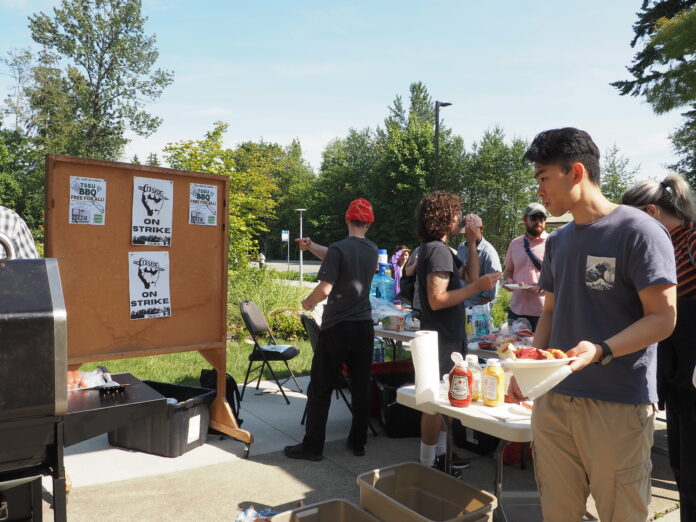
This is a photo taken at the barbeque. People are getting hotdogs from a table. Behind them, there is a cork board that has TSSU signs.
PHOTO: Olivia Sherman / The Peak

By: Olivia Sherman, News Writer

On a sunny Friday afternoon, Teaching Support Staff Union (TSSU) members and supporters held a barbeque at SFU. While many TSSU members were grilling hotdogs on June 23, many outside the union showed support and solidarity with the ongoing strike, engaging in conversation and dialogue with union members and organizers. 

Since the strike officially started on June 12, TSSU chair Kayla Hilstob noticed many SFU administration members, including president Joy Johnson, seemed “rattled.” She noted Johnson herself has been largely unresponsive for comment on the strike and since has gone on vacation. The “timing is not a coincidence,” Hilstob said, pointing out that Johnson and others are “noticing our actions.” 

Amal Vincent is the chief steward of the TSSU and a member of the TSSU’s bargaining committee. In an interview with The Peak, Vincent discussed teaching assistant (TA) wages and scholarships — two ways that TAs are paid. While wages are taxed, scholarships are non-taxable. “Now the employer is proposing to fold this scholarship portion into wages making that taxable as well,” Vincent said, describing this action as “essentially a wage cut.”

“Workers are still working, but the work is unpaid,” he continued. Vincent highlighted many other causes for the TA strike, including larger class sizes, unequal compensation in lab and tutorial sessions, and the integration of hybrid and remote sessions. TAs have not been compensated for this extra workload. 

Despite the SFU administration stating their core beliefs in EDI, or “equity, diversity, and inclusion,” Vincent said their “actions speak otherwise.” He discussed how the administration has threatened to strip healthcare coverage, including the International Student Health Fee (ISHF) and extended health and dental benefits, “which would disproportionately affect international student workers and people of colour.”

Vincent said this “proves that all the talk about equity, diversity, inclusion is a farce.” 

Vincent also noted that “people are angry” over the unfolding benefit cuts SFU has inflicted, leading to more union support. On whether he believes the strike will lead to success for the union, Vincent said, “We’ve done it before in the past, we’ll do it again.” 

This is an ongoing story. For more information on the TSSU, bargaining priorities, and the continuing strike, check out the TSSU’s website: www.tssu.ca/

Tips for the Beedie Kids

0
In photo, Des'ree Isibor in a blue graduation gown and red details holding a diploma
From a Beedie kid to a Beedie grad

by: Des’ree Isibor

POV: You are a 16-year-old international student from Lagos, Nigeria, who just started her first semester at SFU studying business. There is a lot to take in: the constant rain and the way people casually walk under it unbothered, the few people who look and sound like you, the task of making new friends, and, of course, making sure you get your participation marks and beat the curve!

Four years later, a lot has changed, yet so many things are the same. If I could have a conversation with my freshman self and any new Beedie kid, here’s what I’d say:


Don’t let the titles of student club positions and competitions scare you

Before the giant TV screens in West Mall, there used to be photos of the executive teams of all the Beedie clubs on the second floor. Each frame had students dressed up in suits, looking so poised and confident. “Wow, they look so cool, I have to be on here someday,” I thought to myself. I thought their titles sounded so professional — vice president of marketing, president, director of operations, and so on. I began to view these leadership roles in student clubs as being so lofty and unattainable because I needed to have specific skills and prior professional or volunteer experience to qualify for them. It took me a while to realize that no one has it all figured out. We are all just Beedie students learning, developing skills, and making great memories along the way! Having “experience” should not be the sole determining factor. If an opportunity seems interesting, go for it — take on a coordinator role first and climb up the ladder.

Be open-minded and pace yourself
Beedie is a faculty filled with endless opportunities, which can both be exciting and overwhelming. When I joined the Business Administration Student Society in my first year, my mentor told me, “First and second-year is the best time to volunteer and be active. School gets really busy in your third and fourth year.” Now I’m under a time crunch to be an “engaged” student, as Beedie profs like to say. Time does become a luxury as you near the end of your university degree, so you must be intentional about doing more apart from attending lectures and tutorials. I was privileged to be a part of the SFU Management Information Systems Association, Student Marketing Association, and TEDxSFU, and those experiences have stuck with me. Pay attention to the weekly newsletters from the Student Engagement and Development Office! I know there is a stereotype that Beedie kids do “too much,” and we can be a part of five clubs at the same time. It’s important for you to take on only what you can manage, have a good school-life balance, and keep classes a priority.

Get used to networking

Here’s where all the introverts will likely stop reading. There will be tons of events that will take you out of your comfort zone and push you to connect with people. The BASS Mentorship Program certainly did that for me — especially the signature Pitch-Off event. You shouldn’t wait until you’re in your final year looking for a job to start building a network. Build a community of friends at SFU and a network of industry professionals — it does take a long time to master the art of networking, but you should get started early!

Do at least one co-op work term
This might possibly be the most obvious tip here. Co-op is so worth it.  You have the possibility to learn so much more than what your profs teach you — you can figure out what piques your interest and build connections! Your first seeking period will be rough, but it gets better as you go! Got dream companies? Even if you don’t, start researching top companies you’d like to work at.

Utilize Beedie resources
I felt burnt-out quite often throughout university, especially in my final year, but there’s always support available for your academic success, and your personal and professional development. Many Beedie students don’t tap into the plentiful resources available. There are resources in the form of career guidance, programs, workshops, networking opportunities, and even a free LinkedIn headshot. It doesn’t take much time to browse through the Beedie community and our faculty website to learn about all the resources available!

Ultimately, I encourage you to enjoy the journey and be purposeful about every semester. Plan ahead, not just with your courses, but with the opportunities you want to be a part of. Spread your wings and take flight.

Rooting for you always,
Des’ree Isibor