Home Blog Page 159

Serpents and gargoyles and bears, oh my!

0
People eating at a 50s-themed diner.
PHOTO: Lorenzo Nafissi / Unsplash

By: Saije Rusimovici, Staff Writer

I don’t know what’s harder to believe — the fact that the first episode of Riverdale aired in 2017 (grade 10 me is screaming) or that it continued for six more years. The plots have gotten wilder and more unbelievable than anyone ever thought possible. For all of the former or secretly-still-watching viewers of the infamous mystery/horror/comedy/drama, here is a compilation of the most epic highs and lows ever derived from the Netflix original. 

  1. 16-year-old Veronica Lodge running her own speakeasy 

In what world is this legal? I get the fact that her dad had tons of money (what his business was other than running trafficking illegal substances, I’ll never know), but there had to have been some sort of regulations. Mind you, a lot of things went unnoticed in the town of Riverdale. Did law enforcement simply not exist or did they just overlook every single crime until they decided Archie should go to prison? Not that 17-year-old me didn’t aspire to be like Veronica one day — who wouldn’t want a lavish, fully stocked bar to hang out with your friends after cheerleading practice? Sometimes we just have to girlboss, illegally. Did I mention one of the best-looking, underage football players would be running the bar? I mean, I guess it’s fine considering the actor is closer to 30 than he is 16 . . .

2. “Alternate universe” fanfiction 

Because apparently not enough was going down in the small town, a crack opened up in the multiverse. Most of these alternate universes set the scene for steamy moments between Betty and Jughead, including a photographer-model dynamic, a college meet-cute (at least the cast would look closer to their age), and the iconic friends to lovers trope. As long as they don’t decide to give the characters super powers, they don’t sound half bad. 

3. The one where the show decides to steal from Endgame

Oh, you know: this is a regular high school drama, with regular people deciding that they can look through a million different timelines à la Doctor Strange. At this point in the show, you’re used to Riverdale’s shenanigans, but are we ever really used to it? Maybe I’ll find out in a different universe . . .

  1. Jughead and Veronica fanfics

Okay, this subgenre may just be a little bit of a guilty pleasure of mine. Not only because I wanted to be Veronica Lodge, but because Jughead was so completely my type in high school. At 16, I may or may not have debated buying a replica of a Southside Serpent’s jacket. There’s something about the moody beanie boy getting together with a pearl-strung rich girl that reminds me of the plot of a John Hughes movie. Sometimes all we need is a little opposites attract romance.

  1. Archie getting mauled by a bear

Just plain unnecessary. I’m convinced this was just another excuse for Archie to be shirtless on screen (not that I’m complaining), because this little detail added absolutely nothing to the plot itself. Trying to give him a hero complex? I think the fact that he pleaded guilty to a crime he didn’t commit was enough to make him a good guy, don’t you think?

  1. The Gargoyle King

A part of me was actually terrified of watching this season because this costume was so freaking scary I could barely watch the show during the day, let alone at night. The other part of me wanted to laugh because this was such a ridiculous addition to the show, I began to question why I was still watching. When they finally unmasked him to reveal a Dave Franco lookalike, I was utterly astounded.

Bright Futures is a time capsule of Bill Reid’s legacy

0
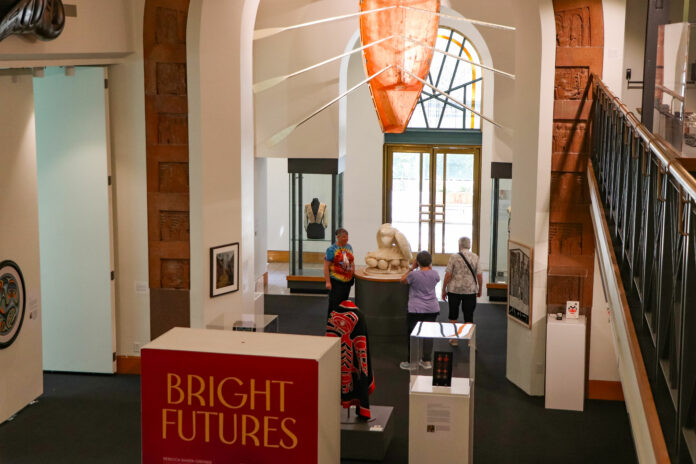
A photo taken from the mezzanine of a portion of the interior of the Bill Reid Gallery below. There is a bright salmon-coloured canoe with rows hanging from the ceiling, illuminated by sunlight through the windows. A large board in the middle of the space that read “Bright Futures.” There are various artworks behind glass and people are walking around, looking.
PHOTO: Aria Amirmoini / The Peak

By: Petra Chase, Arts & Culture Editor

You probably know Bill Reid (1920–1998) for his grand jade sculpture at the YVR airport, an image which was also printed on Canadian 20-dollar bills in 2004: The Spirit of Haida Gwaii depicts a man surrounded by animals, rowing on a canoe, a prime example of the artist’s connection to the “beautiful beasts and heroes of Haida mythology.” Reid wrote in 1990 about this final major work, saying the man in the middle may represent “the spirit of Haida Gwaii, leading us, for we are all in the same boat.”

25 years after his death, the Bright Futures exhibit at the Bill Reid Gallery of Northwest Coast Art, on until January 2024, puts 14 budding Indigenous artists side-by-side with Reid’s work. Reid was an “acclaimed master goldsmith, sculptor, writer, mentor, and community activist.” Haida visual artist Gwaai Edenshaw remarked, “Almost every artist working today on the Northwest Coast can trace a line back to [him].” Bright Futures commemorates how he passed the torch to the next generation, and the ways in which new generations continue to push boundaries.

The gallery’s permanent collection is a panorama of Reid’s artistic life; the Bright Futures collection overlaps the space like contemporary annotations of the phases of his practice. From intricate metalwork miniatures to large totem poles, paintings, and wearable art, there’s an invigorating spectrum of art.

Coast Salish artist, Maynard Johnny Jr., masters traditional formline design, a distinctive two-dimensional technique. His print piece, Protector, depicts a killer whale saving a child using clean-cut principles, elegantly curved within a circular canvas. Johnny Jr. describes it as “a reminder of us as Indigenous people protecting our youth and culture so that future generations will prosper.”

Storytelling and mythology continues to influence artists of the Northwest Coast, and it was interesting to read about the stories behind the fantastical images. Haida artist Keith Kerrigan commemorated Reid’s spirit animal, the “trickster” raven, in a sterling silver casting. Reid famously retold the Haida creation story in his Raven and the First Men, a sculpture he made in various sizes and materials. Building on this, Kerrigan wrote, “I see the Raven as a catalyst for change, having seen the world as it was and knowing what it could be.” His miniature raven embodies Reid’s inquisitive spirit.

Wearable art was also a significant portion of the exhibit. Nuxalk artist Latham Mack’s Grizzly Bear Frontlet was made from traditional materials, like rabbit fur, cedar wood, and abalone. The figure exudes strength and resilience, topped with a fittingly regal crown of sea lion whiskers.

According to Gitxsan nation fashion designer Yolonda Skelton (Sugiit Lukxs), whose bold dress is on display, the term “wearable art,” is more than fashion, denoting the significance of becoming “an educator and storyteller to all who ask what you’re wearing.”

Artists like Cody Lecoy (Syilx and Lekwungen ancestry) follow Reid’s ability to pursue new ideas while inspired by tradition. Lecoy’s abstract dreamscape, Against the Current, is based on Reid’s The Spirit of Haida Gwaii.

According to the exhibit’s description, “The Haida expression ‘deeply carved’ refers to an object that is well-made but also speaks to one’s emotions.” Bright Futures carries on traditional knowledge and radiates what Reid calls the “joy of making.” With free admission for SFU students, and located a few blocks away from SFU Harbour Centre, the exhibit is well worth the visit.

Application approved to hire 15 Black faculty members at SFU

0
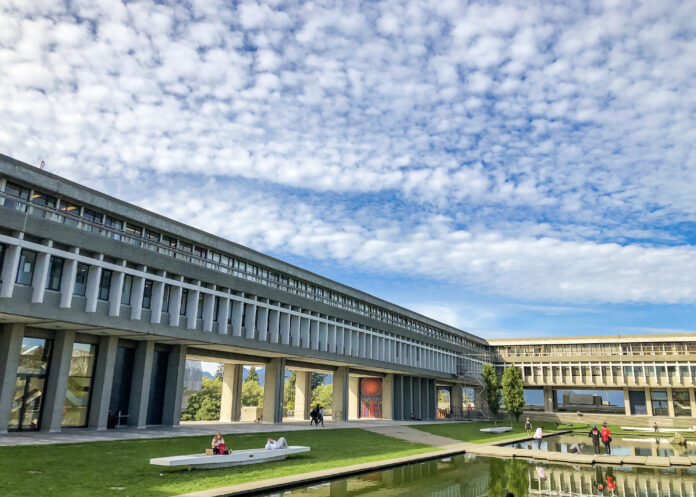
This is a photo of the SFU Burnaby Campus’s reflection pond and the academic quadrangle building surrounding it.
PHOTO: Allyson Klassen / The Peak

By: Olivia Sherman, News Writer

On July 18, the BC Human Rights Commissioner endorsed two special approval applications, which gave SFU the approval to hire 15 new Black faculty members. According to the university, this decision is a step toward supporting the Black community at SFU and upholding promises made in the Scarborough Charter of Anti-Black Racism, which SFU signed in 2021

The endorsement of these special approval applications is significant, as they are part of a greater effort to promote equity within the SFU community. These new faculty members are being chosen under “limited and preferential hiring,” with aims to remove the systemic barriers many Black academics face. Preferential hiring gives minority candidates preferential treatment in hiring. 

Black students and faculty alike face many unique difficulties that make being a minority in scholarly circles feel isolating. Microaggressions and ostracizing behaviours, the burden of educational discussions about race, lack of representation, and discrimination, can all make Black academics feel burnt-out and bullied. By providing support and dialogue opportunities for Black academics, these issues can be lessened. 

The decision to hire these 15 new Black faculty members at SFU aligns with the principles of The Scarborough Charter of Anti-Black Racism, which over 50 academic institutions across Canada have signed. The charter signing campaign is part of an effort to promote an “equitable and inclusive university community” for SFU’s Black members, including faculty, students, and staff. 

The student activism leading up to this motion is also significant. In 2021, former SFSS presidents Gabe Liosis and Osob Mohamed brought forward a motion at SFU’s senate meeting, advocating for Black students and staff, Black History Month, and the hiring initiative for 15 new Black faculty members. The motion was passed “unanimously.” The Students of Caribbean and African Ancestry (SOCA) have been avid supporters of this decision, and have been advocating for support systems for Black students and faculty since their official founding in 1997

Dr. June Francis has been a tireless advocate for these changes as well. Francis is an associate professor of marketing in the Beedie School of Business, and is also special advisor to the president on anti-racism. 

In a past statement to The Peak, Francis said, “By voting in favour of this motion, the Senate of SFU is finally responding to what decades of Black students, staff, and faculty have been calling for — a university where Black intellectual lives matter.”

A heartfelt letter from SFU’s one and only

0
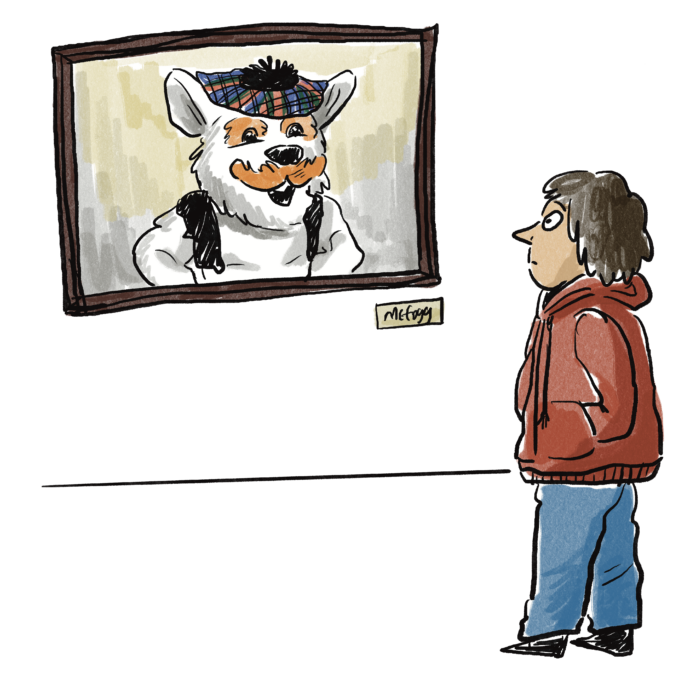
Person looking at a portrait of McFogg.
ILLUSTRATION: Andrea Choi / The Peak

By: Kelly Chia, Editor-in-Chief

Dear SFU,

Why have you Mc-Forsaken me? I’ve been nothing but loyal to you . . . and in return, students no longer know who I am: my brawny arms and swaggy, athletic body, left to wade in the darkness of this concrete prison. No one will even sing me softly to rest, as I hide in a closet, waiting for my next opportunity to be featured by a Peak publication, if I do say so myself. Did you know that they wrote fanfiction about me, SFU? Did you know that I’m apparently the Editor-in-Chief? News to me! I’m writing a new cover piece, and it will expose our torrid relationship. I’ve given everything to you: I’ve hidden the ~quirkier~ parts of your institution with my face alone. I am SFU culture. So I ask you, SFU, who just abandons a school mascot without saying anything?! 

I guess I shouldn’t be surprised that you don’t know the difference between a star — me — and a dud. But at least have the class to give me a proper send off! Don’t I deserve to graduate, too? Maybe not —  no one can get into the classes they need without a virtual battle royale taking place. That’s just a rumour I heard, though. Here are the facts: when students approach the Trottier observatory, I should be the only constellation they see. When they hear a random bark in RCB hall, they should assume it’s me and my giant white paws stomping around. I mean, I served you for over two decades . . . yet, you’ve completely disengaged from me. How contradictory.

Well, let’s not dwell on our harder chapters, SFU. We play pretend so well together! Oh, I especially adore the game you’re playing right now, where we pretend student workers aren’t workers. It’s oh-so-fun to encourage some unity and community in this “commuter campus.” See? We both know how to draw crowds! That will show the other schools what we’re all about! 

Come on, don’t you think students miss a fun little guy? I can be the Mc-Ken to the students’ Barbie. Just give me one more chance.

With love, and awoos,

McFogg

Nimona shows rebellion and heart

0
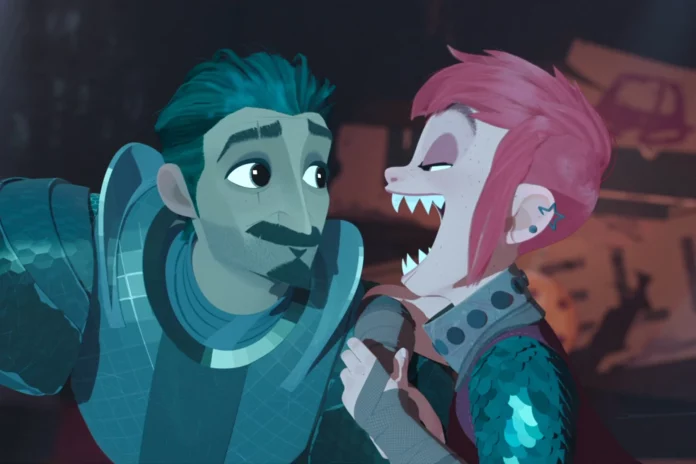
An animation from Nimona featuring Nimona and Ballister. Nimona, with short red hair and a star earring on the top of her ear, is grinning wide with shark-like teeth, looking at Ballister. Ballister, who has short black hair, a mustache, and bear, is looking proudly at Nimona. They are both wearing armor.
PHOTO: Courtesy of Netflix

By: Kelly Chia, Editor-in-Chief

Based on its premise alone, I knew the movie Nimona would have my heart; anyone who knows me, knows I adore a good found family story. The titular character, Nimona (voiced by Chloë Grace Moretz), and Ballister Boldheart (Riz Ahmed), team up as the kingdom’s antiheroes as they attempt to right the wrongs carried out by a kingdom set to antagonize them. This already sets up the archetypical hero-and-sidekick duo in a cute childhood fantasy film, but to my pleasure, I found so much more to love about the film. 

Firstly, Nimona is truly breathtaking: it features gorgeously rendered rolling hills against futuristic automobiles, and tall stone castles with widescreen holograms. It is all at once, a world set in the future, but stuck in the past. And with the past comes overarching themes of prejudice the characters face together. 

When I heard this movie featured queer themes and characters, I was nervous: the film’s primary demographic is younger children. How might that affect the portrayal of queer romance? To my pleasant surprise, although the characters do battle prejudice, it’s never quite central to their growth and stories. Instead, Nimona proudly features its queer leads with all of their complexities: Ballister’s relationship with his boyfriend, the hilariously named Ambrosius Goldenloin (Eugene Lee Yang), is pretty immediately established to the viewers. Admittedly, I was somewhat concerned that Yang’s presence in the film was a way to pull a queer actor into the film as a minor character. Instead, Ahmed and Yang portray a tender relationship, and their character arcs refreshingly show nuances true to their backstories, rather than their queerness alone. 

Seeing them reminded me of how important it was to see queer leads be complex and joyous, and grow to become adults in happy relationships, and this film has plenty of this. Yes, the two struggle in their journeys, but it was hugely important for me to see their queerness authentically folded into their personhood and experiences. I was used to seeing queer characters used as a cheap plot point or an accessory to illustrate a main character’s empathy in mainstream media growing up. 

This pride and confidence was something I saw in Nimona, too! She was a delight: an eccentric shapeshifter hoping to morph herself into the position of Ballister’s friend and wicked sidekick. I found her quips charming without being obnoxious, and as I learned more about her, I was drawn more into her story. 

At one point, she openly declares that she is simply “Nimona,” refuting Ballister’s request for her to just be a “normal little girl.” It made me grin widely looking at her rebellious, shark-like grin. This simple, yet firm statement was one of several moments that felt affirmative: Nimona was simply, well, Nimona. She did not need to conform to anyone’s definition of who she could be, or what she could do. 

The resonation of Nimona’s affirmation with queer themes is no coincidence: the author of the original comic book, J.D. Stevenson — who also created queer series like She-Ra and the Princesses of Power — confirmed that Nimona was a gender-nonconforming character, having created her when he was “a not-yet-out teenager” wrestling with gender concepts. I knew some child would see Nimona in all her glory, and maybe feel a bit more affirmation in themselves and their own identity.

But to me, the most incredible part about Nimona is its production. Its very existence on streaming platforms took a team who knew how important the story would be, and as I described, the fact that this many people worked hard to push this story is truly admirable. Walt Disney shut down Blue Sky Studios in 2021, effectively ending Nimona’s production, which was slated to release on January 14, 2022. According to some staff from Blue Sky, the studio faced pushback from Disney regarding Ballister and Ambrosius sharing an on-screen kiss. A former staffer said, “When the biggest entertainment company in the world creates content for children and systematically censors queer content, they are pushing queer children to dark places.” 

Nimona was happily picked up by Netflix on April 11, 2022, after Blue Sky executives collaborated with production company Annapurna to finish the film. I’m glad that in this process, the film kept themes and scenes that are going to be important to so many queer children. Consider how many queer characters and moments in Disney films have been presented as queer representation, only for them to be reduced as a “blink-and-you’ll-miss-it” cameo. It’s a miracle that this queer story got to live, after almost being extinguished. But like a phoenix, Nimona took off with Blue Sky, and I’m so glad it did. Children deserve seeing queer characters proudly be the emotional, fully fleshed out, joyful heroes of the story, fighting the injustices of their world as one community

Bright-er Side: My music playlist

0
a cup of coffee on a table, next to a pair of headphones
ILLUSTRATION: Hailey Gil / The Peak

By: Gurneet Lohcham, SFU Student

When you’re stuck and feel like you may need a break, what is the bright-er part of your life that makes you feel better? I can think of plenty for myself, but the most important one is music!

It doesn’t matter if I fell asleep when I should’ve been studying for the exam — it doesn’t even matter that I spilled my morning coffee or that I didn’t get my dream job. My morning playlist is more than just music; the songs’ melodies are a soft embrace that hold me when I’m feeling sad. Their rhythms keep me moving even if there’s a little bump in the road. Every note is the wind blowing in my hair on a warm sunny day.

The harmony in every beat is what fills my soul with energy. Music is so much more than just words, and you can choose whatever tune for your needs. Need a little energy? How about “Eye of the Tiger” by Survivor? Feeling in love? Listen to “Adore You” by Harry Styles. Feeling angry? There’s always “So What” by P!nk.

Whatever you need, music’s got you covered. Even if I’m in the most terrible mood, I tune out the world with my airpods, and in about 10 minutes, everything feels alright. And I can promise you if you haven’t tried it, just do it and thank me later.

TEDxSFU reveals their theme for the 2023 conference

0
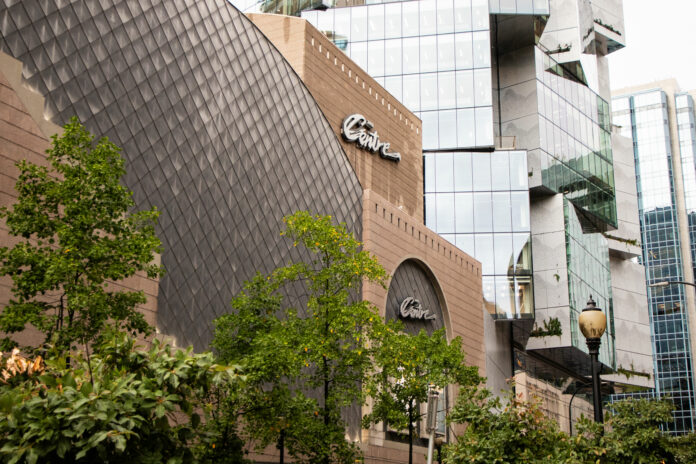
This is a photo of the outside of the Centre for Preforming Arts in Vancouver, where the TEDxSFU event will be held.
PHOTO: Aria Amirmoini / The Peak

By: Eden Chipperfield, News Writer

Editor’s note: The Peak would like to acknowledge that Josh Ralla, one of our staff members, is an executive director of TEDxSFU, but had no involvement in writing this article. 

On July 10, TEDxSFU unveiled its new theme for the 2023 event. This year, they are platforming emerging and established voices from the SFU, Metro Vancouver, and Pacific Northwest communities. The 2023 theme, Unmask the Magic, refers to unmasking the potential of individuals and unmasking the world, from institutions to scientific discoveries in space. 

TEDx is known globally for inspiring talks and lectures on YouTube. TEDx events are independently organized, such as TEDxSFU, which platforms local voices. 

The Peak interviewed Paul Falkowski, the content development director for TEDxSFU. “TEDxSFU started off as an SFSS club called Conversations Worth Starting. The TEDx brand allowed us to take conversations we had started and spread them globally through the TEDx brand,” said Falkowski. “We have 12 years of TEDXSFUs behind us.” 

Falkowski described how the 2023 TEDxSFU conference will highlight individuals from all walks of life, including Parmida Beigi, SFU graduate alumni. Beigi’s lecture will demystify artificial intelligence (AI) for the public. Chris Wilson, pulling from 14 years of experience as a helicopter pilot, will discuss career coaching for non-traditional career paths. Former registered psychiatric nurse, Janice Bannister, uses comedy to discuss 20 years of experience working as a nurse. Poet Sumaiya Tufail will discuss resistance and advocacy in poetry. 

Governor general award-winning multidisciplinary artist, Vladimir Kanic, will discuss his oxygen-producing sculptures where the audience’s breaths grow the sculptures. His works of art creatively navigate the trials of climate change. 

“Each person brings a unique lens to the work so that we always operate at our highest level. At the latest board meeting, when we asked, ‘What is it about TEDxSFU that you continue to love being involved in?’ we had answers like the ‘production value and the drive,’” Falkowski said. 

“TEDxSFU ignites possibility in our spectator’s imagination. It unmasks previously unseen paths,” said Falkowski. “We have diverse voices in every level of the educational journey. Whether someone is in their 20s or their 70s, whether someone is just starting in the Lower Mainland [or] thinking of switching their direction mid-career,” everyone can find something to learn at TEDx, said Falkowski. “We are crafting an experience that touches the intellect, the creativity, the imagination, and the heart of our students in whatever pursuits or goals that they see for themselves.” 

TEDxSFU has made SFU a global point of interest, as these conversations are now being spread globally by the speakers and team behind its production. “TEDxSFU isn’t just about the speakers. It’s about the team that puts it on. Our team is interfaculty and multidisciplinary: from SFU’s Beedie School of Business, the faculty of communications, arts and technology, the faculty of arts and social sciences, and even the master of education program, to name a few,” said Falkowski.

TEDxSFU Unmask the Magic will occur on November 11, 2023, at The Centre for Performing Arts in Vancouver. For more information, visit their website at https://tedxsfu.com/. 

Stomach Bugs

0
Person holding their grumbling stomach.
ILLUSTRATION: Andrea Choi / The Peak

By: Izzy Cheung, Staff Writer

Psst. Hey. It’s me. You know, your friendly neighbourhood stomach. Or well, not neighbourhood, because I am inside of you, but whatever.

So, what’s up? Why haven’t you fed us properly today? No, that small slice of toasted white bread with a little splat of Nutella on it doesn’t count — we gobbled that up in seconds. I’m talking about a big, healthy, sustainable breakfast. Give us some eggs, some protein, a smoothie bowl — you know what, I’d even go for a tiny morsel of tofu at this point.

Oh, that? The thunder down under? That’s what you get for drinking coffee this morning, hon. I tell you everyday that the bean juice doesn’t do well with us. Come on. We just woke up. It was seven in the morning. Coffee doesn’t work the same way for us as it does you. Coffee wakes you up, but it makes us feel crappy. (Get it?)

Huh? What do you mean we won’t get to eat for another two hours? Hon, it’s nine in the morning, what else do you have to do today? Go grab us something fulfilling. Pancakes. A breakfast wrap. A sandwich. Anything, at this point. I don’t care if your professor says there’s two hours left in your lecture, we’ve been waiting to eat something big since last night.

MORE coffee? Oh, come on. You know we don’t like it as much as you do. Do you WANT me to yell at you again? I know you don’t like it, but I will.

Oh my — you put cream in your coffee? YOU KNOW THAT WE’RE LACTOSE INTOLERANT. WHAT ARE YOU DOING? You like whipped cream? I don’t know if you could tell, hon, but WE DON’T. LOOK AT US. SMALL INTESTINE IS CRYING BECAUSE OF YOU. THAT ONE DOLLOP OF WHIPPED CREAM SCARED THEM.

You know what — that’s it. We’ve had enough. You don’t drink enough water to replenish us, you stuff us full of caffeine and Nutella, and you sit and force us to cry while you’re typing away about capitalism instead of letting us relieve ourselves. Well, guess what? You’re about to let your entire class know how we feel about you. Good thing your professor is about to have a very brief water break, making the class as quiet as can be —

Oh? What’s that? WATER? Oh my goodness, finally. About time. Come on everyone, let’s get this water to small intestine, they’ve had a rough morning. We all have. Let’s take a breather —

. . . Is that more coffee?

Monday Music: Soulful gems

0
“Monday Music” in orange block text on a yellow rectangular background with rounded corners and an orange border.
Monday Music: your weekly themed playlist. Image courtesy of The Peak.

By: Hailey Miller, Peak Associate

Colors by Black Pumas
Photo credit: ATO Records / Fontana North

Black Pumas is a rock-soul band from Austin, Texas who bring contemporary twists to the genre. “Colors” is full of rhythm and groove, from the strike of the first chord to the fade out. The song features flawless guitar licks, walking bass lines, an upbeat tempo, harmonious vocals, and jazzy keys alongside a lively organ. With a message about celebrating diversity, my favourite lyric is “my sisters and my brothers / see ‘em like no other.” This single is perfect for bringing out cheerful vibes and transcending through colourful lyrics describing a positive outlook on the world. Side note: their live studio version is even tastier.

Thinking ‘Bout Love” by Wild Rivers
Photo credit: Nettwerk Music Group

Wild Rivers is a Canadian folk trio from Toronto. Their mellow approach to skillful songwriting and expert artistry combines simplistic chording with flawless harmonies. “Thinking ‘Bout Love” houses a soft groove and rhythmic chord structure, with fluctuating vocal ranges and instrumentation that perfectly complement one another. The vocal trade-off creates a seamless duet that accentuates their smooth folk style and the most prominent lyrics on the track: “we could ride it out / I know the ride’s rough / but try us.” This song is easy on the ears and will put you in a chill mood. Check out the stripped-down version on YouTube.

Honey” by Ruby Waters
Photo credit: Ruby Waters

Ruby Waters is a Métis independent artist from Ontario. Her raspy tone pairs perfectly with her aptitude for guitar. Waters’ jazz-filled, soulful idiosyncrasies include vocal embellishments, horn trills, and steady tempos that make her one of a kind. Along with a dynamic horn section that adds depth and rhythm, the lyric “honey’s got a brain that’ll make you trip” complements the sax solos. Waters’ vocal phrasings beautifully accentuate the obvious jazzy nuances of the track. This song is the absolute bluesy groove. Check out her amazing solo set at Whistlers Mountain, Jasper National Park on YouTube.

Not Afraid” by Victoria Canal
Photo credit: Victoria Canal

Victoria Canal is a German-born Spanish-American singer-songwriter and musician with effortless vocals and a soft instrumental style. Canal’s works showcase her artistry on top of life as a professional musician with a physical disability. “Not Afraid” incorporates perfect rhythmic and bluesy piano sections alongside jazz influences, and soft yet soulful vocal runs, paired with lyrics full of love, loss, and longing. Check out her live solo version on YouTube.

Red Flags by Andra Day
Photo credit: Warner Records / Buskin

Andra Day is best known for her soulful R&B tracks and powerhouse vocals. Her works (like her album, Cheers to the Fall) are proof of natural talent, and “Red Flags” is no exception. Packed with rhythm and jazzy riffs, Day will make you feel her purposeful groove. You can feel the emotion that radiates between her voice and the musical accompaniments, all the way through your speakers. Prepare to cascade through all levels of rhythm and soul. Check out the Austin City Limits seamless mashup on YouTube.

Listen to the full playlist on The Peak’s Spotify profile.

The ABCs of tipping in an expensive city

0
ILLUSTRATION: Alyssa Umbal / The Peak

By: Izzy Cheung, Staff Writer

A few weeks ago, I went out with a couple friends for dinner at a newer restaurant in our neighbourhood. The food was great, and service was amazing, but what surprised me the most was the numbers we saw on the bill. Prices for everything in Vancouver are through the roof nowadays, but shrinkflation wasn’t the reason for my shock. Before we paid, they made sure to inform us we didn’t need to add a tip to our bills. This was something I’d never seen before at a sit-down restaurant, and it comes to mind now that I’m hearing more conversations about getting rid of tipping system all together. 

Having worked in customer service, I’m all for tipping. It can be really difficult working in an industry that deals with all sorts of people during all occasions, for example, baristas working in the mall during Christmas. The amount of times I tried to work while someone was yelling in my ear about how their coffee wasn’t a specific temperature right to the degree truly made me wonder why I was even working as a barista . . .  although, those weekly tip bonuses made things worth it. The money I made off tips put me at a higher hourly wage drawing fun little designs in peoples’ coffees than what I now make working two salaried jobs.

That being said, tipping systems can be pretty unfair to servers, and with recent inflation, to the general public as well. Tipping doesn’t take different working conditions into consideration. For example, servers, kitchen staff, and delivery drivers all might heavily rely on tips, yet their work conditions vary significantly — servers are required to directly interact with customers, kitchen staff are heavily responsible for food safety and quality, and delivery drivers might brave challenging weather conditions or unsafe roads. These differences in work type might make the final total compensation from tips feel unjust to some workers. This isn’t just unfair to workers, but the expectation to tip when you yourself have a low income might feel like an additional punch to your finances. 

A: Are we always supposed to tip service workers?  

There’s no specific rulebook for tipping a certain percentage at certain establishments — all of that is based on your own decisions. Most don’t tip fast-food workers, but what about baristas? You might tip your Uber driver, but do you tip your tattoo artist? Despite there being no rules, for many service workers, tips make the difference between paying rent or not

When a service worker heavily relies on tips to get a livable income, then yes, gratuity is kind of expected. While tipping is seen as an optional gesture of appreciation, in the case of workers who depend on tips to make ends meet, a tip becomes a vital means of support — if your finances allow it, it’s highly encouraged that you tip them. A tip is typically given to workers who perform a service, such as bartending, hairdressing, or serving. Following societal customs, most people tip on bills at sit-down restaurants, at your hairdresser’s, or after getting a ride from an Uber — but other circumstances can be difficult to gauge, which takes me to my next point.

B: But who counts as a service worker? 

It’s hard to define who a service worker is without relying on using those same words in their description, but in essence, that’s what service workers are those who provide you with a service. This includes food service (waitstaff or delivery), transportation services (uber or taxi drivers), or beauty and aesthetic stylists (hairdressers, nail technicians, tattoo artists, etc.). But as of recent, tipping has been creeping into other type of services beyond the conventional scope of a service worker. Gilbert Mofleh, a mechanic from Ottawa, and Tudor Liquor Store in Surrey, are commerces where tipping isn’t usually expected. Both have the tipping option enabled on their card payment machines, though neither expect people to tip. 

C: Can you NOT tip at a restaurant? 

Realistically, no one can force you to tip when eating at a sit-down restaurant — but you’ll probably be treated to some glares on your way out. However, outside of gratuities, many service workers barely get paid a living wage, which is why some have suggested scrapping the tipping system for higher wages. This shifts the responsibility of providing a living wage from consumers to employers. 

D: Different ways of splitting tips among workers

For an individual service worker, a high tip-income often reflects excellent customer service. However, each establishment’s breakdown of gratuities is different. While I was working at a coffee shop, tips weren’t recorded for each individual worker; instead, we tallied up the total amounts tipped per week, calculated how many hours were worked in total (combining the hours of all employees), and split the money based on the average amount that was tipped per hour. So, if we made $500 in one week, the total amount of hours worked by all employees was 100, and I worked 10 of those, then the hourly tip count would be $5 — meaning that I would have made $50 that week. One of my friends, who works at a restaurant, does things differently; their establishment splits gratuities based on each day — part of the gratuities go to the kitchen staff, and the servers split the rest evenly based on their hours. Each place does things differently, but the gratuity system doesn’t have to be this complicated. 

E: Every area tips differently 

When it comes to tipping, different countries have different social expectations. Some countries don’t tip, while others tip around 10%. Canada falls around 15–20%, which is one of the higher values compared to the rest of the world. Québec, in particular, is infamous for having high tipping expectations, with the expected percentage ranging from 18–20%. 

F: Fast food = take-out? 

Is tipping on takeout orders a thing? You’re not directly being served, but the kitchen staff still have to make your order, and servers still have to package it — so really, even though it sounds different, it’s logistically not much different from fast food. Despite this, a survey by Research Co. shows that 53% of Canadians never tip whenever they take their food to go. This action might be slightly contradictory with other answers in that same survey, where 70% agreed that “Food servers cannot get by on their salaries alone — it’s important to tip them.”

G: Generalization kills the system   

Our gratuity “system” bases a lot of its factors on generalization. I’ve even been generalizing in this piece — it’s hard to go in-depth into every single customer service experience. Because of this, there are many things tipping doesn’t take into consideration. For instance, if two servers work a busy shift, but one of them does takeout, chances are they’ll take tips from the person who did most of the dine-in serving. In a similar vein, if you get excellent customer service at a fast food establishment, would you tip there? Most fast food places don’t offer tipping options on their machines, so you’d likely have to offer cash. And if you did, how would an establishment track that? If a server gives great service but has their tip physically stolen (which has happened to me before), then the server takes the financial brunt despite providing their labour. Tipping is an intricate, complex system that really has no specific rules — which brings me to the final letter of this condensed alphabet. 

H: Higher wages for service workers 

Tipping can be made simpler by increasing the wages of customer service workers. In fact, many have expressed a desire for higher wages instead of sticking to current tipping models due to inflation on food and menu items at restaurants. Scrapping the tipping system and implementing higher wages would make things easier for individuals who need a service done for them. Having the expectation to always provide a tip also puts other low-income people in an economic strain. At the same time, some might think tipping can act as a motivator for service workers to provide better service, but even if that were the case, it shouldn’t replace higher wages and should only be supplementary to a living salary.