Home Blog Page 158

Discussing BC’s new drug decriminalization bill

0
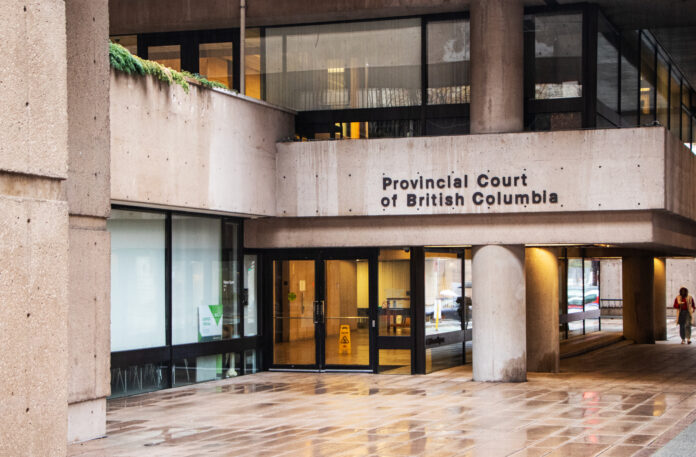
This is a photo of the outside of the Provincial Court of British Columbia. The plain concrete building has a large sign with the name outside.
PHOTO: Aria Amirmoini / The Peak

By: Eden Chipperfield, News Writer

Content warning: mentions of substance-use and related deaths.  

In January of this year, Health Canada announced an exemption to the Controlled Drugs and Substances Act. The Controlled Drugs and Substances Act aims to address the ongoing epidemic of toxic drug deaths within BC and reduce stigma around substance use. The exemption ruled that adults in BC will not be criminally charged if they are found in possession of specific quantities (up to a combined total of 2.5 grams or less) of illegal drugs, such as fentanyl, heroin, cocaine, methamphetamine, and ecstasy. This exemption will be in place until January 2026 and is meant to help aid drug decriminalization. 

Bill 34 was proposed this October, 10 months after the BC government announced the original exemption. The newly proposed legislation is called the Restructuring Public Consumption of Illegal Substances Act, and restricts the consumption of drugs in many public spaces. The bill was read by public safety minister Mike Farnworth. The proposal is that Bill 34 will aid BC residents with the “want to feel safe as they move around their communities and to use and enjoy recreational spaces free from drug use.” The concern around the proposal is that those who use substances within public areas such as parks will have less space to use narcotics and other substances safely. 

To further understand concerns around Bill 34, The Peak reached out to Michael Crawford, president of the BC Association of Social Workers (BCASW). 

“We expressed concerns leading up to the introduction of decriminalization regarding the 2.5 gram possession limit,” said Crawford. He explained, “Some users use considerably more than 2.5 grams per day and the limit meant they either needed to carry more than the limit, putting them at risk for arrest, or make multiple drug purchases daily, which increases the threat of receiving potentially toxically laced drugs.” 

“BC requested a 4.5 gram limit. However, the federal government only granted the 2.5 gram exemption,” said Crawford. 

Crawford expressed that the BCASW has concerns with the exemption and its limitations, as it did not include a strategy for “providing users with a safe supply of drugs” nor a “plan to significantly increase services such as safe injection/inhalation sites, overdose prevention sites, detox beds, treatment follow up, support programs, and secure housing.

“We accurately predicted that decriminalization would not reduce the number of poison drug deaths. Safe supply and increased services are essential components of a harm-reduction approach,” according to Crawford.

The primary concern BCASW has with the introduction of Bill 34 is how it symbolizes the government’s lack of commitment to serving people who use drugs. The goal of the original act was to cease arresting and charging those who use drugs in public spaces. At the same time, Bill 34 reverses that responsibility, authorizing arrests without the need for a warrant for those above the allotted quantities. 

“The BC government committed to reducing stigma, and Bill 34, by significantly reducing public space where drug use is permitted, will drive users into dark lanes, riverbanks, and into private residences where users are more likely to use alone, without someone available to respond to an overdose or poisoning,” said Crawford. Though the BC government has attempted to position themselves as finding resources to address the public health issue, the introduction of Bill 34 juxtaposes the intent by “increasing stigma, criminalization, and death.” 

BC chief coroner Lisa Lapointe has stated that access to a safe supply of drugs is essential to save lives throughout the health emergency the province is experiencing. From January to August this year, over 1,455 overdose deaths occurred due to illicit drugs containing deadly substances. 

In response to the government’s Bill 34 debut, Crawford has expressed that the message is “politically expedient” rather than based on research. “There is divisive political posturing with increased pressure on progressive governments to step back from harm-reduction approaches. The federal Conservative leader has called for stopping the funding for safe supply programs, including a motion to that effect in the House of Commons.” Crawford put forth an excerpt from his work for the BCASW: “We appreciate that it takes political courage to stay the course on harm-reduction. However, there is growing evidence that safe supply ‘reduces accidental drug toxicity deaths, decreases emergency department visits and hospital admissions, and improves health and well-being.’” 

The BCSAW has presented their research and solutions to the Select Standing Committee on Health, which discussed addiction and the BC government’s response. The organization has also expressed their thoughts and ideas with the minister of mental health and addiction and the senior direction of decriminalization at the BC ministry. 
Q&A with SFU soccer and volleyball teams

0
photo of an SFU player rushing up the field with the ball.
PHOTO: SFU Athletics

By: Hailey Miller, Staff Writer

Editor’s Note: Some responses have been edited for clarity. 

The Peak asked members of SFU’s women’s volleyball team and men’s soccer team to share their thoughts on the highs and lows of games, and how their outcomes impact both individual and team mindsets.

Q: What impact does a loss have on your team’s confidence, and how do you and your teammates learn from this and go into the next game more prepared?

A: It’s definitely a challenge not to let a loss have an impact on our team’s confidence. The rule on our team is we can all take one full day to be upset, but after 24 hours, we have to move forward together. We discuss together with our coaches what went wrong and what we will do differently next time, and this helps us start preparing for our next game.

Brooke Dexter, women’s volleyball 

A: A loss can have a positive impact but also a negative impact on individuals, and as a collective. Personally, I tend to use losses as fuel for the next game because it is something that I want to prevent from happening in a game. For preparation, we’re always ready for our opponents. Our coaching staff does a great job at having us mentally and physically ready for every match.

Devin O’Hea, men’s soccer 

Q: How frustrating is it when things don’t go as planned and you still want to turn things around for future games?

A: It’s incredibly frustrating when things don’t go to plan, but it happens every year. Things are always going to happen that are out of our control — injuries, the way our opponents play. The best thing we can do is stay patient and keep working hard. At this point in the season, it’s absolutely vital that we channel our frustration into training harder rather than burning out. Our conference is always competitive, but this year is especially unpredictable. Every team is strong and wants a win, so we have to make sure we’re working harder than everyone else, both in practice and in games.

Brooke Dexter, women’s volleyball 

A: It can be extremely frustrating but once a plan comes together, it’s worth all the hard work.

— Devin O’Hea, men’s soccer 

Q: Does losing a game you should’ve won take away from the team’s accomplishments?

A: No, losing a game we should have won does not take away from the team’s accomplishments. One loss does not make a season. In the conference we are in, we have many strong teams and we know that the game can go either way. We have to show up the most prepared and ready as we can possibly be every single game, no matter who we play. We can have a good or bad day, but any loss does not take away from our accomplishments. We learn and become stronger over obstacles we face, including losses.

Jocelyn Sherman, women’s volleyball 

A: I wouldn’t say it takes away from our goals, but it does sting knowing that a game you thought you should’ve won doesn’t go your way. But, that’s sports sometimes.

— Devin O’Hea, men’s soccer 

Q: In what ways do you feel the team could better prepare for games after a loss?

A: Every person handles a loss differently. As a team, it’s important to acknowledge our losses, examine them, discuss them, and most importantly, learn from them to change things as quickly as possible for the next game.

— Jocelyn Sherman, women’s volleyball 

A: Don’t dwell on the past too much. Most importantly, use a loss as fuel to better prepare to stay mentally and physically focused on the next opponent, so you can do everything in your power to win the next one.

— Devin O’Hea, men’s soccer 

SFU hockey’s new two-team sports model

0
photo of a hockey clipboard laying on top of a jersey on the bench.
PHOTO: Chris Robert / Unsplash

By: Kaja Antic, Sports Writer

Entering the 2023–24 season, SFU hockey announced the introduction of a separate non-conference roster in addition to their roster that plays in the BC Intercollegiate Hockey League (BCIHL). 

The non-conference roster competes in exhibition games against teams in various collegiate leagues in Canada and the US beyond the BCHIL, including UBC (USports), and the University of Michigan (NCAA). The BCIHL roster plays against the other four BCIHL teams in 20 regular season games, along with pre-season and playoff action within the province. 

This separate team comes after years of one SFU roster playing both the BCIHL regular season, as well as exhibition games against other collegiate league teams. Prior to the beginning of the 2022–23 BCIHL season, the Red Leafs travelled to Alaska on September 24, 2022, and earned the program’s first win against an NCAA team, defeating the University of Alaska, Anchorage 1–0, with a late goal in the third period.

“The biggest difference is the competition level,” the team’s coach, Mark Coletta, said in an interview. “It’s a different animal.”

The exhibition series for SFU hockey’s newest team began on September 8, with a 5–3 loss against UBC. Coletta’s group earned their first win in this new era,  5–1, on September 22 against Briercrest College, before defeating them again, 3–2, the next day.

“We’re always trying to elevate and give our student-athletes the best opportunity and best competition,” Coletta remarked about creating the two-roster system. “Instead of doing two or three exhibition games, why not do close to 20 and elevate the talent pool?” Coletta suggests giving players tougher competition for more games will push them to find a new standard to play to. 

The BCIHL team system remains the same, playing games against the UVIC Vikes, the VIU Mariners, the Okanagan Lakers, and the Logan Lake Miners. Coletta touched on the importance of keeping the BCIHL team along with the program’s new addition. “We didn’t want to give players a non-option. We felt that there are some players that are at the BCIHL level, and taking a team away would give them no place to play.”

SFU hockey differs from a lot of the other sports teams at SFU, as it’s completely separate from the overall athletics program that has the NCAA affiliation. The program is privately funded and supported by donors and alumni. The two teams now run parallel, with two separate rosters and two separate coaching staff, funded by the independent SFU hockey support system.

“It just seemed like it was the right thing to do,” Coletta explained. “The talent pool here is definitely there for us to compete. It’s just a matter of growing and building that and getting to where we want to be.”

The Red Leafs non-conference team faced off against one of NCAA’s most formidable forces, the University of Michigan Wolverines. Current Vancouver Canucks captain Quinn Hughes played for the team prior to arriving in Vancouver, and the current Wolverines roster boasts many potential NHL draftees. The Red Leafs fell to the Wolverines 8–1, with Coletta speaking of the victors. “All their sports are top notch [ . . . ] When you’re at that level, everything becomes a mini-pro kind of atmosphere. 

“There’s a definite jump in the standard of play and everything they do on and off the ice.”

So what’s coming in the future for the program? “We’re just trying to push the envelope and give our student-athletes a competitive playground to play at. And who knows where it can go.” 

Coletta added that he wasn’t “sure if teams in a conference or teams already in a league would jump out and do what [SFU’s] doing this year with this hybrid kind of schedule.” However, “just knowing that [SFU] can attract talent and quality people into the administration and hockey program is a pretty unique kind of thing.”

Nutritious Nibbles: Chai cookies (Tian’s Version)

0
An illustration of a person with baking mitts holding a tray of cookies that are steaming.
ILLUSTRATION: Alyssa Umbal / The Peak

By: Tian Davidson, SFU Student

In celebration of the release of 1989 (Taylor’s Version), I decided to make Taylor Swift’s viral chai cookies, an old recipe she shared on Instagram and Tumblr that fans revived from the vault. I wanted to put my own spin on them by changing the dough ingredients to be slightly more chewy by using more butter and less oil. True to Taylor’s Version, this recipe involves the iconic frosting and masala chai bags. So cozy up, get into your cardigans and your gowns shaped like pastries, and get baking while listening to the new record. 

Prep time: 30 minutes
Bake time: 10 minutes
Total time: 40 minutes
Yields: 18 cookies

Ingredients:

For the cookie dough:  
1 cup unsalted room-temp butter
1 cup brown sugar
1 cup granulated sugar
2 eggs
2 tsp vanilla extract
1 tsp baking soda
½ tsp salt
4 cups all-purpose flour
2 masala chai tea bags

For the glaze:
1 ½ cups powdered sugar
3 tbsp milk
¼ tsp nutmeg

Optional: You can substitute the milk for eggnog or dairy-free milk, and add cinnamon instead of nutmeg.

Equipment:

Oven
Baking pan
Mixing bowls
Parchment paper
Stand mixer or hand mixer*

*Optional, but makes creaming the butter easier.

Instructions:

      1. Preheat the oven to 350 °F.
      2. In a large mixing bowl or standmixer, cream softened butter for about 5 minutes or until fluffy.
      3. Stop mixing when fluffy, then add brown sugar and granulated sugar. Continue creaming for 5 more minutes, or until fully incorporated.
      4. Add 2 eggs to butter and sugar mixture, and mix until fully incorporated, then add vanilla extract.
      5. In a separate bowl, add flour, baking powder, and salt and mix.
      6. Take 2 tea bags, cut open, crush them into a fine powder, and pour the contents into the flour mixture.
      7. Mix dry mixture with wet until fully incorporated.
      8. Roll cookie dough into 1.5 inch balls and bake for 10 minutes. Let cookies cool before adding glaze.
      9. For the glaze, mix all the ingredients in a bowl and add onto cooled cookies. 
      10. Enjoy!

Vancouver high schooler leads community upcycling event

0
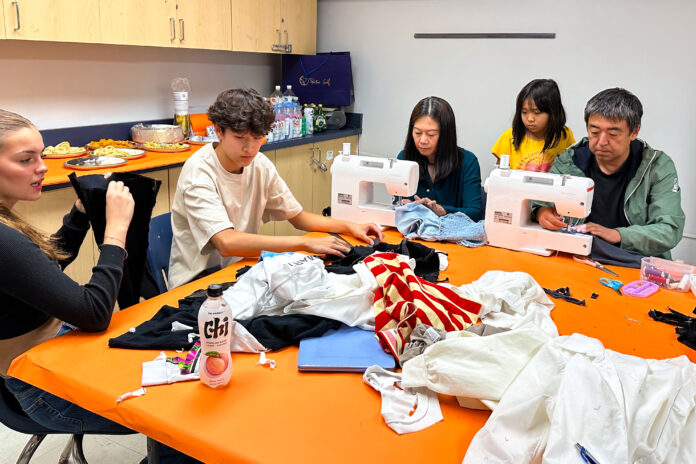
People sitting at a table cutting fabric in front of sewing machines.
PHOTO: Courtesy of Ivy Huang

By: Petra Chase, Arts & Culture Editor

Ivy Huang is a 16-year-old from Vancouver with a passion for sustainable fashion. She started EcoChic Threads with a mentor to engage her community, specifically other teenagers, in upcycling. Their first event, which took place on September 15 at Kerrisdale Community Centre, brought a group of like-minded teens and adults together to talk about their shared interests in sustainable fashion, and upcycle together.

EcoChic Threads was created for “repurposing and extending the life of garments” in a way that’s financially accessible for teenagers. Their aim is to provide online upcycling classes, upcycling services for customers, and organize events like their successful workshop and networking event last month. They’re hoping to plan more events, including speaking events. While the team is still constructing their website and expanding their team, they’ve been eager to start making a difference. 

Equipped with sewing machines, Huang led the workshop in transforming T-shirts or jeans, which participants brought from home, into handbags. “As each participant has different skills, artistic taste, and clothes material, we encourage them to try out,” Huang said. They learned various techniques like “adding embellishments” and “exploring sustainable dyeing methods.” The goal was for people to leave with skills they can apply to continue to repurpose their clothing. People also brought pre-loved clothing for a clothing swap, and anything not taken was donated to local charities.

Huang’s interest in fashion began in grade 2, when she joined a club about the basics of clothing sketching and sewing. Her grandmother also taught her how to fix clothes for her family members. In middle school, she took a visual arts class and incorporated sewing and threading in her project. As a teenager, Huang started looking into the production process of clothing brands like H&M and Zara and learned about fast fashion. That’s when she was inspired to take action.

Huang shared some staggering statistics: according to theroundup.org, up to 100 billion new garments are produced globally every year. 87% of this material will end up in incinerators or landfills. “Only 1% of clothes will be recycled into new garments.”

There are a slew of ethical and environmental concerns along the fast fashion supply chain, from the toxic contamination of water from textile dyes, to the energy-intensive processes draining the earth’s finite materials, and the atrocious conditions for underpaid workers, who are often children or forced workers, just to keep production costs low.

She touched on the phenomenon of “wardrobe panic”: the feeling of not knowing what to wear. According to a study by Trunk Club, 28% “of the items in the average person’s closet have never been worn or have gone untouched for over a year.”

“Fast fashion pushes people to keep buying new clothing, but its value is short,” Huang said. “Even going through the recycling process is harmful to the environment. Reuse is the only solution that allows customers to have the freedom of not only following the fashion trends, but also to make their own style and new fashion.”

Ecochic Threads are “instigators of sustainable dialogues and facilitators of interactions amongst individuals with shared ecological and creative passions.”

Find out more about Ecochic Threads at their website, ivyhh1689.wixsite.com/ecochic-threads. For inquiries or to get involved, email Ivy at [email protected]

Food for Thought: Tabbouleh

0
A plate of tabbouleh.
PHOTO: Amirul Anirban / The Peak

By: Omar Nsouli

Tabbouleh is a magical salad. No, I’m not talking about the kind with cucumber and quinoa. I’m talking about a fresh and summery salad usually shared over a warm moment with our loved ones. Tabbouleh is the kind of salad that makes you knock your fists on the table in euphoria or start dancing around your house. The tasty appetizer is commonly known to be from Lebanon and Syria and is usually made with parsley, mint, tomato, and onion. It’s perfectly garnished with fresh lemon juice, salt, olive oil, and bulgur (cracked wheat) in the perfect marriage of flavours. 

My family is from Beirut, the energetic capital of Lebanon, where locals find the poetry within the pandemonium. Car horns and wholesome balcony banter are the soundtracks of our day-to-day routines. Family and food are core values. In Lebanese culture, everyone cherishes a lovely meal with family. 

In my family, the dish never had a concrete recipe with distinct measurements, therefore the one who could eyeball it the best on the first try is considered to be unrivaled in the kitchen. I would like to highlight two resilient and strong women in my family who stepped up to the tabbouleh plate and succeeded. They are my grandmother, Amina, as well as my older sister, Mina, whose salad reflects them and their personalities precisely. 

Amina Fathallah, the teacher

When my grandmother was young, she debated whether she wanted to be a school teacher in a small village or go back to the buzzing Beirut and start a family. After some thought, she eventually chose the latter. Later in life, she always wondered what could’ve been. She was always an educator to our family. She was an excellent cooking teacher, giving handmade recipe cards to each of her children to bestow upon the coming generations. Her kitchen, stuck in a quaint ‘60s timewarp, was her classroom, and like many teachers, she provided care, attention, and love to her students. Her tabbouleh truly reflected her personality with the effort and love she invested into all of our relationships amid many hardships in her life like war, loss, and illness. 

Amina “Mina” Nsouli, the fashionista

My sister is multifaceted; a woman with many talents. She is an exceptional accountant, stylist, and meticulous cleaner. However, I personally believe she’s the new culinary genius in the family tree. Sorry mum and dad, but the culinary gene seems to skip a generation. Born in Calgary, but has lived all over the world, Mina’s well-traveled taste is highly reflected in her cuisine. She mirrors her impeccable fashion sense in her cooking with her attention to detail. From intricate sushi rolls to a spaghetti bolognese copycat of a five-star restaurant dish, she pulls from the latest trends with creative juxtapositions. Mina takes a ‘90s Calvin Klein approach to Lebanese food keeping it chic yet minimal, acknowledging the traditions of the past. Her tabbouleh is a masterclass in salads; she buys everything with an organic stamp of approval for the highest quality, giving her the title of the “modern classic” chef of our family. 

Though both Aminas may be different, they both have taught me something through their love of cooking. They taught me that it’s indispensable to show love and generosity. In return, I shall receive it back through the many delicious dishes they have made. They have also taught me to stay dedicated to my passions no matter the external circumstances that may be in the way, just like they did with their elevated cooking surmounting many hardships. In retrospect, I acknowledge these two strong and courageous Arab women who’ve inspired me with their wisdom, care, and ingenuity. 

What Grinds Our Gears: Stepping on leaves that don’t crunch

0
Autumn leaves on the ground
PHOTO: Jonadan Cheun / The Peak

By: Sam Wong, SFU Student

It’s fall: the season of dying leaves and see-saw temperatures. I’m already running late to my class before I see a leaf, brown and all curled up. The perfect leaf. I expect it to be crispy, to crumble like fresh toast. But no. It just flattens under my foot without a single sound. Not even a small crinkle. My day is ruined.

First of all, I’m already freezing my ass off out here in this six-degree weather for this. My lips are chapped. My fingers are numb. Yet, I go out of my way and risk getting hypothermia to experience a satisfying leaf crunch. But instead of leaving with a sense of satisfaction, I leave with the sense that I’ve wasted my precious time on nothing. Now I’m cold, disappointed, and still late for class.

Second of all, I’m upset that I’ve been deceived by the leaf’s appearance. It’s decaying, rolled up, and has cracks in it. It looks like it’s been roasted in an oven. You’d be pissed off too if you took a bite of golden-brown fries that turned out to be soggy. If it looks crunchy, it should sound crunchy. It should even taste crunchy (but I wouldn’t try that with sidewalk leaves).

Point is, I’m tired of soggy leaves. How hard is it to just get a simple, satisfying crackle from stepping on a leaf? I don’t care if it’s dry or wet outside. I just want it to crunch.

We shouldn’t punish calls for ceasefires

0
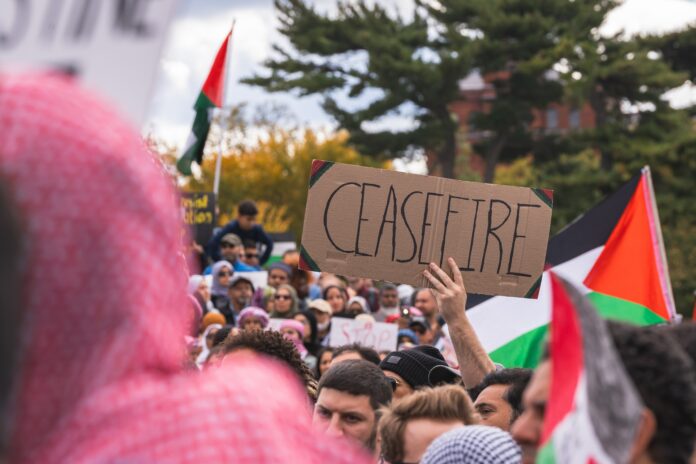
A pro-Palestine protest, where a sign reads “ceasefire”
PHOTO: Gayatri Malhotra / Unsplash

By: Kelly Chia, Editor-in-Chief

Content warning: mentions of bombings, genocide, racism.

On October 24, member of provincial parliament (MPP) Sarah Jama was censured. This means Jama will not be recognized by the Speaker of the House. She made a statement on October 7 calling for de-escalation from the Israeli government and ceasefire in occupied Palestine. Her statement was criticized for not condemning Hamas’ attacks on Israel, though she condemned “Hamas’ terrorism on thousands of Israeli citizens” in a later apology. Jama’s defense of civilian Palestinian lives isn’t equivalent to condoning violence toward Israeli and Jewish civilians, and it should have never been portrayed as such. 

Ontario New Democratic Party (ONDP) leader, Marit Stiles, had the gall to censure Jama for advocating for peace in Palestine before reiterating her statement for a ceasefire days later. She is calling for the same thing Jama did — she just waited until it was politically acceptable. If there were any heart to Stiles’ call, she would reinstate Jama and apologize. Jama did what our government continues to shy away from: speaking up on behalf of over 9,000 people, at least 3,195 of whom are children and have been killed in the bombardments.

Jama’s censure for speaking up for Palestinians came at a time when they were met with little sympathy from western media and governments. This is an unjust punishment toward an MPP who is advocating for the humanity of Palestinians. However, punishment for speaking on behalf of Palestine seems to be in line with western sentiment

Many critics seem to interpret calls for freeing Palestine — which at its heart is a call to end the decades of Israeli occupation on Palestinian land — as dismissive of Hamas’ attacks on October 7. In reality, the Israeli military have not just attacked in retaliation, but have escalated their decades-long occupation. International law condemns the Israeli occupation on the Gaza strip and West Bank as apartheid — referring to systemic segregation toward Palestinians — among many other violent atrocities. This has been ongoing for the past 75 years. It’s far from the only time Israeli military forces have attacked Palestine, but now they have the western world’s approval and unconditional sympathy. 

Though left-leaning parties like the NDP have recently made lukewarm calls for a ceasefire, showing solidarity with Palestine has put many at risk of their careers. Numerous people, expressing only solidarity with Palestine, have been let go from publications, government bodies, and more. In the last month, the NDP, like many political parties in Canada, insinuated that Palestinian rallies and Palestinian solidarity is antisemitic. However, the idea that supporting Palestine is antisemitic equates criticisms of the Israeli nation state with criticisms of Judaism and Jewish people. Former NDP MP and Toronto mayor Olivia Chow, for example, characterized a pro-Palestine rally as a glorification of Hamas attacks. As Israeli journalist Abraham Gutman writes, this “conflates a diverse religion with the politics and policies of a single country.” As antisemitic incidents rise, it’s important to remember calls for ceasefire and condemnation of Israel’s actions are not calls to endanger Jewish people, or dismiss those who lost their lives as a result of the conflict. Many Jewish organizations have gathered at Palestine rallies to show their support for ending Israel’s occupation.  

Jama is an ONDP MPP who has always advocated for marginalized people. She has openly spoken on accessibility in medical care and ending boil water advisories in Indigenous communities. At the time she was removed, Jama said her team was cut off from documents and data that would have assisted community members in navigating the Ontario Disability Support Program. ONDP leader Marit Stiles claimed in a statement on Jama’s censure that she had “contributed to unsafe work environments for staff.” Stiles perpetuates the racist belief of Black women being aggressive just for speaking up. Jama’s expulsion from caucus shows how afraid a supposed left-leaning party is of actual progressive ideals. Jama is a Black and disabled MPP, identities that intersect in her work. If progressiveness is what the ONDP claims as one of its principles, why haven’t they accounted for the people who need a MPP like Jama? The ONDP may flaunt its progressiveness, but their abandonment of Jama is insidious. 

As the Toronto-St. Paul’s NDP wrote in a statement, Jama “echoed positions held by the United Nations, International Court of Justice, and numerous human rights organizations whose only goals are toward peace.” Her censure reflects the hypocrisy toward calls to support peace in Palestine, which are treated not only punitively, but with much more scrutiny than calls for peace in Israel. Attacks on civilians should be unequivocally condemned. But there are double standards in our governments’ and media corporations’ attitudes towards Israel’s “self-defense.” This self-defense has extended to genocidal violence toward Palestinians. Despite the increasing death toll and horrific footage coming from Gaza, calling for peace and ceasefire suddenly becomes “complicated” when discussing the rights of Palestinians. Where is that same immediate condemnation of violence now? 

What I’d like to ask all these critics is how much they truly believe removing clean water, fuel, and electricity from millions of people could constitute self-defense. So many media networks categorize Israel’s attacks, which largely impact Palestinian citizens, as a war against Hamas. How could this be a war against Hamas when the attacks target millions of Palestinian civilians in the Gaza strip? Israel drones have striked the West Bank, which aren’t governed by Hamas. They have also striked Lebanon and Syria, committing serious international crimes. Where have the calls for justice been for them?

The safe zones Palestinians are told to flee to have also been bombed, and they have nowhere else to go. Hospitals in Gaza continue to receive bomb threats while half of the 2.2 million Palestinian citizens have been displaced by strikes destroying their homes. Do critics truly believe every life matters, or do they just not care that nearly 50 families — entire generations — have been wiped from registries as a result of these attacks? 

It is not difficult to name what we are witnessing as a genocide, which develops in multiple steps. We have already gone through classification, discrimination, and so much more. As there have been reports of mass killings using internationally outlawed white phosphorus on civilians in Gaza, we are rapidly approaching the end stages of genocide. Yet, we continue to punish politicians like Jama for calling on Canada to intervene.

On October 27, 120 countries passed a motion for a ceasefire in Palestine. It is notably a motion that Canada abstained from. The silence in the face of this much violence is palpable, and severely disappointing. 

Calls for ceasefire and peace should not be punished. It should not be controversial to call for the immediate restoration of water, electricity, fuel — basic human needs — for Palestine. It is only recently that western sentiment has shifted, as more and more MPs call on Trudeau to advocate for a ceasefire.

In the face of so much grief, horror, and despair, Palestinians continue to protest against their oppressors in the West Bank. Jewish communities are gathering all over the world, chanting, “not in our name,” in solidarity. Even as they risk legal punishment, activists in Israel are standing on behalf of Palestine. Hundreds and thousands of people protest around the world, like Sarah Jama, despite institutional suppression from their universities and their jobs, standing up for Palestine’s liberation and freedom. 

Palestinians have experienced decades of military attacks and an oppressive regime. Media was so quick to condemn Hamas’ violent attack, but where was that condemnation when Palestinians have been killed for decades? We need to be more wary of the narrative that this is “complicated,” because making the choice to not learn more at this critical time means being complicit in watching a genocide unfold. This is why it’s also important for us to continue to call out our institutions when they are punishing their workers for speaking up. They are not wrong for calling on our governments to intervene. By speaking up, we empower our MPs to demand an end to Israel’s persecution of Palestine.  

E-4949 is a petition to the Prime Minister calling to demand a ceasefire. To learn more about Palestinian history and the Israeli occupation, visit Decolonize Palestine. They are an independent website run by two Palestinians, curating resources, reading lists, and historical timelines. B’Tselem, the Israeli Information Center for Human Rights in the Occupied Territories, is an Israeli organization dedicated to documenting and collecting statistics on the Israeli occupation and human rights violations on their website. 

The Walrus panellists discuss Canada’s housing crisis

0
This is a photo of the suburbs in Burnaby, Canada. This is a large aerial shot, where suburbian houses and trees spread as far as can be seen.
PHOTO: Roshan Raj / Unsplash

By: Olivia Sherman

Content warning: brief mention of colonial violence. 

On October 26, Canadian magazine The Walrus hosted a series of speakers, ranging from experts to activists, to discuss equitable housing. The seven speakers each had seven minutes to present a different angle on Canada’s housing crisis. The Peak attended the event to hear more about the diverse problems facing Vancouver’s housing markets. 

Kishone Roy: 
Kishone Roy is an author and the executive director of the Federation of Community Social Services of BC. “Housing, for the first time I can remember, is the number one issue in the nation,” they said. Although Pacific Canada’s housing rates have always been high, Roy noted this issue is not limited to the West Coast anymore and has become a nationwide issue. “Not one province, city, First Nation, or regional district can solve this alone.” They theorize younger generations are being bought out of the towns and cities they grew up in and no longer own their own homes, due to sheer unavailability in the housing market. Young people “look around, and there are no affordable housing options for them [ . . . ] most of what has been built over the past 30 years are mansions and penthouses.” Roy refers to this as “generational gentrification.” Gentrification is the process of rapidly changing an urban area into a wealthier one by attracting people of a higher socioeconomic class with new buildings and businesses, usually leaving the original inhabitants displaced and underrepresented. Generational gentrification then occurs when young people are forced to move out of their home communities when looking for housing as their neighborhoods have increased in value over time.

Djaka Blais: 
Djaka Blais is the executive director of the Hogan’s Alley Society, a Vancouver non-profit aiming to revive and support Vancouver’s Black population. “Our mission is to improve the lives of Black people through inclusive housing, cultural programs, and community spaces.” Blais announced the society is launching a community-based, Black-led land trust in Vancouver. Throughout the 1900s, Hogan’s Alley was a cultural hub for Vancouver’s largest Black community and neighbourhood. Through destructive city planning in the 1970s and the building of the Georgia and Dunsmuir viaducts, Hogan’s Alley and its once vibrant population were displaced, and “the heart of the Black community was lost,” Blais explained. “Our mission is to make sure that Black communities are not only remembered, but also provided with the spaces and housing we need to foster a more inclusive and equitable city.” 

Samantha Eby: 
Samantha Eby is a Toronto-based architect, researcher, and educator. Eby’s research with ReHousing focuses on how people can convert single-family homes into multi-purpose housings. She concluded that the people who build and plan housing significantly affect the way we live today. She uses professional development services as an example: housing development companies often have “investors in mind, rather than users,” which leads to a “housing stock that increasingly does not reflect the needs of our communities.” Eby’s research suggests users and owners should have more leverage over how their homes are designed. Citizen-designers have a variety of needs they can work toward addressing such as those wanting to age-in-place, multi-generational households, and community land trust. “With the right tools and knowledge, we believe these citizen-developers can take on their own projects and start to diversify both who is building and the type of housing within our cities.” 

Lisa Rupert: 
Lisa Rupert is the vice-president of housing and violence protection at the Young Women’s Christian Association (YWCA), an organization aiming to support women, mothers, families, Two-Spirit, and gender-diverse people during tumultuous times. Rupert explained the gendered aspect of houselessness, and cited escaping abusive relationships as a common cause of houselessness. She said rates of gender-based violence and homicides have increased alongside rental costs, as more and more women are “economically forced to return to their abuser.” The YWCA advocates for affordable housing, especially for women leaving abusive households. They also campaign for a “national definition of homelessness that reflects the unique causes, conditions, and experiences of homelessness for women and gender-diverse peoples. You can’t fix a problem if you don’t name it and properly understand it.” 

Stephanie Allen: 
Non-profit real estate developer and corporate strategist, Stephanie Allen, has a different take on the housing crisis. “After decades in this work and having in-depth conversations with people who range from policy-makers and CEOs to disability justice experts and homeless people, and engaging with leading equity theorists, it’s occurred to me that the most important solution we haven’t fully tried yet, is love.” Allen said we must make policies and decisions based around compassion, care, community, and mutuality. She calls on society to believe in the “inherent dignity of all people, and in sharing our global village equitably and sustainably.” She said we must “fully interrogate” the belief that “we can only be safe and secure if we have more than the next person.” 

Tim Richter: 
Homelessness is “our choice to solve it or not,” said Tim Richter, the CEO and president of the Canadian Alliance Against Homelessness. “Homelessness is a housing problem. It is caused by high rent and low vacancy. It is not, I repeat, it is not, caused by mental illness, addiction, poverty, poor choices, or any other personal fault or failing,” he stated. He compared the housing market to a game of musical chairs: the stronger or faster the child, the more likely they are to gain a chair. It isn’t the fault of the child with a sprained ankle that they were unable to get a chair at the end of the round. “At the end, a fast, big, confident boy sits victorious in the last available seat. Now, the kids who lost: did they lose because of a disability? Because of a lack of physical strength? Did they make poor choices in the game? Or were there not enough chairs?” Richter noted that all 77,000 displaced victims of the 2013 Calgary flooding and the 75,000 evacuated people from Fort McMurray’s wildfires were able to get housing. “But in most cities, when we’re responding to the unnatural disaster that is homelessness [ . . . ] we put little to no focus on housing.”  

Sxwixwtn (Wilson Williams): 
Sxwixwtn, elected councillor and Spokesperson for the Sḵwx̱wú7mesh Úxwumixw (Squamish Nation) discussed the upcoming units of affordable housing on Sen̓áḵw lands, now known as Kits Point in Kitsilano. Before colonization, the area was a central hub for many residing Indigenous communities for trading, commerce, social relations, and cultural practices. In the early 1900s, the BC government forced them to surrender the village before burning it down, sending an exodus of people from Sen̓áḵw to what is now North Vancouver. In 2003, the Federal government returned a portion of the land back to the Sḵwx̱wú7mesh Úxwumixw. “Sen̓áḵw has the potential to partially right historic injustice,” noted Sxwixwtn. The development will be the largest First Nations land development in Canadian history, with 6,000 rental units. They will be able to house up to 9,000 people, with 20% of these units designated for affordable housing. “One of our main goals, at the Sḵwx̱wú7mesh Úxwumixw, is to help address the housing crisis.”

Teach-in event at SFU sheds light on Gaza crisis

0
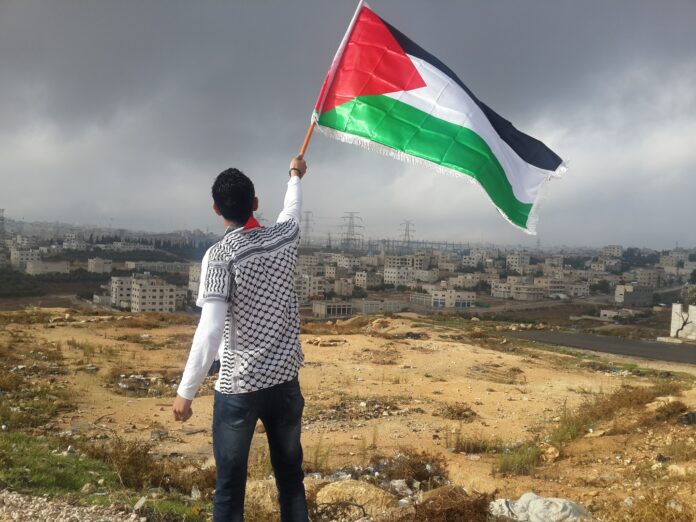
This is a photo of a man standing above a city in Palestine, on a large hill. He is waving a Palestinian flag, red green, and black.
PHOTO: Ahmed Abu Hameeda / Unsplash

By: Sude Guvendik, Staff Writer

Content warning: mentions of violence and genocide.

In an effort to provide historical, legal, and humanitarian context to the ongoing crisis in Gaza, the Centre for Comparative Muslim Studies (CCMS) at SFU co-organized an online Teach-In event titled “Decolonise Palestine Teach-In: The Legalities and Illegalities of the Occupation of Palestine.” 

The event was co-hosted by the Third World Approaches to International Law Review, Racialized Academics & Advocates Centering Equity and Solidarity, and the Social Justice Centre at Kwantlen Polytechnic University. It featured a panel of world-leading experts on Palestine, like Nimmi Gowrinathan, the founder and director of sexual violence initiative for the Colin Powell Center for Global and Civic Leadership, and Dania Majid, the co-founder and president of the Arab-Canadian Lawyers Association. Together, the panellists delved into the complexities of the situation.

Maya Mikdashi cautioned against viewing the crisis from a settler timeframe. “One of the challenges when adhering to a settler notion of time is deciding where to commence. Anyone who starts their analysis on October 7 is inevitably operating within the settler epistemology of time and temporality,” she said. 

Noura Erakat began by scrutinizing the legal frameworks used to justify land dispossession and the seizure of Palestinian property. Laws like the Absentees Property Law and Man Acquisition Law, enacted in the early 1950s, played pivotal roles in merging vast areas of land under Israeli control, undermining the right of return for Palestinian refugees. 

The Nakba, which translates to “catastrophe” in Arabic, was a pivotal event in Palestinian history that resulted in the widespread displacement and dispossession of Palestinians. The Nakba occurred primarily due to the founding of Israel and the actions taken to secure a Jewish-majority state. 

Between 1947 and 1949, a staggering 750,000 Palestinians, from their population of 1.9 million, were forcibly uprooted from their homes and pushed beyond the borders of the newly formed state of Israel. This involved confiscating over 78% of historic Palestinian land, the systematic destruction of around 530 Palestinian cities, and over 70 massacres creating a loss of over 15,000 Palestinian lives. The Nakba was a complex outcome of historical, political, and social forces that shaped the region. It left a deep and enduring mark on the Palestinian people, defining their ongoing struggle for justice and the right to return to their homeland.

The systematic application of these laws resulted in an overwhelming 93% of land in Israel coming under their state Jewish national ownership, a vital aspect of the broader strategy of achieving Israeli territorial domination.

Rana Barakat highlighted the continued influence of Zionist organizations, which have been deeply involved in colonizing Palestine since well before the establishment of the state of “Israel.” These organizations, acting as semi-governmental units, continue to shape settlement policies and maintain a system of segregation between Israelis and Palestinians. 

Various administrative mechanisms, laws, and frameworks were identified as instrumental in perpetuating this division. Local authorities and towns in Israel, primarily categorized as either Jewish or Palestinian, were effectively preserving the separation. The Teach-In emphasized the need to engage with these complex historical and legal aspects to understand the ongoing crisis in Gaza and the apartheid regime. Adel Iskander from SFU CCMS highlighted the media’s obsession with presentism. “The frame keeps shifting to another present or future present, so the temporalities of the present are shifting, depending on who happens to be seen conveniently as the victim.”

During the event, presenters made thought-provoking comments that highlighted similarities between Israel’s land policies and the international legal framework that deals with apartheid. The Convention for the Prohibition of Apartheid was referenced to highlight that one of the severe violations under this convention is the denial of the right to nationality and entry to one’s own land. The convention defines apartheid as a crime against humanity and outlines various acts, including land-related policies, that can constitute apartheid when they are committed with the intent of maintaining ethnic domination. 

The Teach-In also discussed the 2018 “Marches of Return” in Gaza, describing them as non-violent demonstrations aimed at asserting the right to return and lifting the Gaza siege. These marches represented a form of civil disobedience. The “Israeli” land regime, where 93% of lands are controlled by the Israeli state and quasi-governmental Jewish institutions, effectively excludes Palestinian citizens of Israel from accessing these lands.

The event also touched on how the Israeli land regime restricts Palestinian movement. Israeli legislation excludes the Indigenous Palestinian population from settlers’ land, including areas in the West Bank and Gaza, but it does not prevent settlers from encroaching upon the remaining 7% of land owned by Palestinians inside Israel.

One panellist ended the conversation by noting, “I think there is some really urgent kind of conversation that has to be had about the nature of the complicity of the Palestinian authority with the Israeli apartheid regime. How there’s a layer of a capitalist class that is incorporated into that.”