Home Blog Page 145

2023 — A Year in Review

0
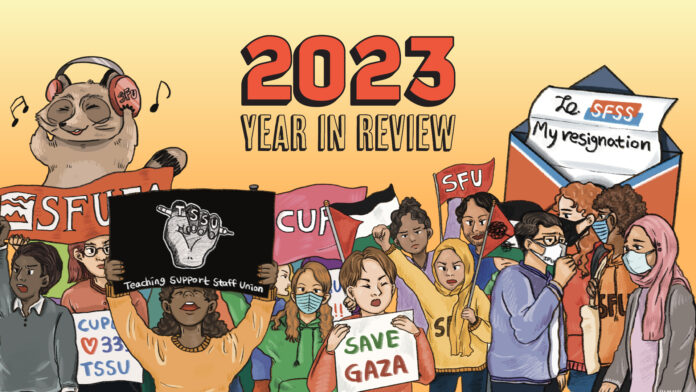
This is an illustration of SFU students engaging in protest. Many are holding signs in support of Palestine and TSSU. Some are wearing masks.
ILLUSTRATION: Andrea Choi / The Peak

By: Eden Chipperfield & Olivia Sherman

  1. TSSU Strikes for improving working conditions, June–October

Learn more:

Beginning in June 2023, teaching assistants (TAs) at SFU engaged in a strike following the expiration of their collective agreement with SFU and worsening working conditions. TAs were asking for an increase in wages to keep up with the ever-growing cost of living, as well as updated compensation policies to account for oversized classes. While the strike officially started in June, it wasn’t until early July that strike actions took place. Actions included a full work stoppage and picketing at all three SFU campuses. The Peak spoke with Teaching Support Staff Union (TSSU) member and spokesperson Dalton Kamish on a number of occasions over the course of the job action. “We have seen some minor, but not insignificant [ . . . ] movements since we began strike and job actions, like picketing,” they said. 

Starting on September 28, SFU hired a private investigation firm, Lion’s Gate Risk Management (LGRM), to survey and monitor picketers at all SFU campuses. Kelvin Gawley, a TSSU organizer, spoke about this surveillance: “This is how they choose to treat members of their own community, who have the audacity to demand a fair contract. I don’t think that’s something any of us will ever forget.”

After public backlash, SFU retracted their contract with LGRM on October 11. By October 19, the work stoppage and strike officially ended. A tentative agreement was signed between the university and the employees, and the 2022–2025 collective agreement was renewed. 

  1. SFU community shows loud support for Palestine amidst ongoing genocide, November 28

Learn more: 

In a letter to SFU, staff and faculty from the university called for a public condemnation of Israel’s actions in the ongoing crisis, which many have described as a genocidal bombardment of civilians in Palestine. The SFU community urges the university to uphold the tenets of anti-racism, anti-oppression, and equality by committing to actions stated in the letter. Actions include affirming support for free speech and academic freedom for those who choose to “speak out against the Israeli apartheid, the occupation of Palestine, and the genocide in Gaza,” to immediately divest from war contractors and financial relationships with Israeli companies, and to “not be silent about genocide.” 

Over 20 student groups and over 700 student advocates signed an open letter to SFU, calling for an “end to SFU’s silence on the ongoing genocide of Palestinians in Gaza and the West Bank, and to call for an immediate ceasefire and termination of the siege on Gaza.” The letter was published by SFU Students for Justice Palestine, Palestinian Youth Movement, Independent Jewish Voices Youth Bloc, and other aligned groups. Up to 150 people attended a protest in response to SFU’s silence on the conflict, and a vigil in recognition for Palestinian civilian lives lost. 

  1. SFSS councillors resign en masse, citing workplace harassment, January 30 

Learn more:

Early 2023 saw many Simon Fraser Student Society (SFSS) members resigning en masse, including former president Helen Sofia Pahou, former vice-president Judit Nagy, vice president university and academic affairs Nicole Kirigin, and both executive officers. 

The replacement process for the vacant seats was by nomination. At the time, the acting vice president university and academic affairs Chloë Arneson noted the “election was a surprise.” After Pahou resigned, former vice president finance and services Abhishek Parmar took over as acting president, serving until March 18. “As you can probably tell from the historically quick turnover rate, this job is far from easy,” Arneson continued. 

The mass resignations were reportedly caused by numerous internal issues within the SFSS, such as severe burnout from members, overworking, and a culture of bullying. On her resignation, former vice president, Judit Nagy, told The Peak, “at the SFSS, rules don’t apply uniformly to everyone, so had I said half of what others did, I would have gotten into serious trouble — I expect I still will.”

Nagy voiced concerns over her replacement vice president, Peter Hance, who she described as “unqualified and untrained.” Hance refuted these allegations, saying Nagy has refused to contact him to engage in the on-boarding process, “The previous vice-president was very uncooperative with me. I tried multiple times to contact them in-person, they kind of walked away.

“These kinds of things hurt the entire student society and student body as a whole,” said Hance. 

Since the mass resignations, the new SFSS council for 2023–2024 was elected in February. 

  1. Vancouver’s drug policies still not doing enough, February 21 

Learn more: 

To combat the ongoing drug crisis in Vancouver, BC made plans to decriminalize the possession of illegal drugs from January 31, 2023–January 31, 2026. The exemption allows adults in BC to carry a certain amount of illegal substances for personal use without facing criminal charges, confiscation, or arrests. The drugs permitted in this three-year long exception include powdered cocaine, methamphetamine (meth), MDMA (ecstasy), crack cocaine, and opioids such as heroin, morphine, and fentanyl. The total amount a person can carry without confiscation and criminal charge is 2.5 grams. 

In February, The Peak spoke with David Hamm, a member of the Board of Directors for the Vancouver Area Network of Drug Users (VANDU), an organization of current and former drug users fighting against stigma for drug users. Hamm said the amount a person can carry in this new exemption is inadequate, and a limit of 4.5 grams would be more effective than the current 2.5 grams. “The reason people have larger amounts on them is because they only want to go out as little as possible to get their substances and also because [ . . . ] if you get more of it, then you get a better price on it,” he said. VANDU continues to work toward improving drug policies and stigma against people who use drugs. 

  1. Community supports SOGI 123 curriculum and 2SLGBTQIA+ community, October 24

Learn more: 

Many people watched as an extensive crowd of protestors flooded the streets of Vancouver throughout September, protesting against the progressive SOGI 123 (Sexual Orientation and Gender Identity) curriculum that is implemented in public high schools. 

The 1 Million March 4 Children is backed by far-right and controversial groups such as the Freedom Convoy, who protest teaching young people about gender expression and sexual orientation in schools. The goals of SOGI 123 teachings are to encourage further conversations and education around gender and sexuality, explain diverse family structures, and to support those who are transitioning. Ultimately, they aim to create space for children to ask questions and become educated allies for the 2SLGBTQIA+ community. 

The anti-SOGI protesters were met with a robust response from those who support the curriculum’s implementation, the 2SLGBTQIA+ community, and local allies. The support for diversifying education has been fierce and continues to push back against the harmful rhetoric of the 1 Million March crowd. 

  1. COVID-19 Measures in 2023, ongoing

Advocacy group DoNoHarmBC made their voices heard by organizing a protest outside Minister of Health Adrian Dix’s office. Calls to action from DoNoHarmBC included reinstating universal mask protections in healthcare environments. This came after BC announced masks would no longer be required in healthcare settings as of April 2023. Alongside those who attended the rally, thousands of postcards were sent to Dix’s office to support the campaign and share the stories of those affected by the lack of masks in healthcare. Dr. Sanjiv Gandhi, a former pediatrician and heart and lung surgeon at BC Children’s Hospital, criticized the government’s pandemic response and the lack of education provided to the public. Dr. Gandhi’s central message is that COVID-19 is ongoing and needs to be addressed with evidence-based measures. In September, Dr. Bonnie Henry, BC’s provincial health officer, and Adrian Dix announced that masking would once again become mandatory and re-established in healthcare environments beginning in October. The push for the return to masking is credited to individuals like Dr. Gandhi and advocacy groups like DoNoHarmBC and ProtectOurProvince with their push for increased safety measures in healthcare. 

  1. City of Burnaby calls for ceasefire in Gaza, November 28

Learn more: 

On November 6, Burnaby became the first municipality in Canada to officially call for a ceasefire for the ongoing genocide in Gaza. As of December 2023, over 21,000 Palestinian civilians have been killed, and 1,200 Israeli civilians have been killed. Mike Hurley, mayor of Burnaby, and the Burnaby Council, wrote a letter to Prime Minister Justin Trudeau in condemnation of Canada’s inactions and insufficient support for the people of Gaza, who are under Israeli occupation. Hurley and the Council of Burnaby have also publicly condemned acts of anti-Semitism, Islamophobia, and anti-Palestinian racism. These acts of prejudice have increased globally since the conflict attacks on October 7. 

Burnaby Councillor Daniel Tetrault, who is of Jewish descent, introduced the motion to call for a ceasefire. Tetrault expressed his personal condemnation of the violent acts toward the civilians of Gaza, which have been described as genocidal. “When my grandparents spoke of this time as survivors of concentration camps, they always said, ‘Never again. Never again can we allow this to happen to anyone,’” Tetrault said. 

Despite a $60 million fund for humanitarian aid for Gaza, Canada has also sold hundreds of military weapons to Israel. 

  1. Student Funding Crisis and Increasing Financial Hardships, January 23 

Learn more: 

In 2022, a partnership between SFU’s Graduate Student Society (GSS) and the TSSU arose in response to the funding crisis many students attending post-secondary education in North America face. Graduate students rely heavily on income from teaching positions or department scholarships. SFU physics grad student, Sina Falakian, described how the pressure of the funding crisis is demoralizing and difficult. The cost of living in North America is skyrocketing, making life increasingly stressful. Statistics Canada reported that about half of graduate students will be saddled with debt as they cross the stage to graduate.

Falakian also called out SFU, saying the university needs to be aiding graduate students and addressing the increasing cost of living for students in the Metro Vancouver area. A North American study found that 76% of graduate students found the living crisis the most difficult part of their studies. Students must often take extra work alongside their research to afford the cost of living. GradCOLA demands that the cap on student income should be removed and that more work should equal more pay. 

Angela Wilson, SFU’s senior director of media relations and public affairs, encouraged students who may relate to the crisis due to financial stress and pressure to contact the SFU Financial Aid and Awards office to discuss their options. 

  1. SFU Alumni Association is Dissolved, February 20 

Learn more: 

A decisive vote occurred on February 15 to determine if the SFU Alumni Association would remain a legally separate council or be merged into an internal SFU presence, including appointing Council members. Voters included all registered Alumni Association members to approve or disapprove of the changes. The vote concluded that the independent Alumni Association would dissolve. SFU president Joy Johnson will appoint Alumni Council members. The Alumni Council members will take the place of the dissolved Alumni Association. 

A statement made by the director of media relations and public affairs for SFU, Braden McMillan, announced that the vote was to “align SFU’s alumni program with industry best practices and modernize the governance model, which remained largely unchanged since its inception in 1969.” According to McMillan, only about 10% of SFU’s alums are registered members of the SFU Alumni Association. Before the dissolution, the Alumni Association had to finalize their funds, event organization, and more. In an interview with The Peak, an anonymous alumni believed the vote was a way for SFU to “handpick alumni” that the university wants to represent them, rather than care about alumni engagement as a whole.

  1. SFU350’s Divestment Campaign, ongoing

Learn more: 

SFU350 partnered with Climate Justice UBC Vancouver and independent UBC Okanagan students to end RBC’s presence on campus. The Banking on Climate Chaos report, published in April, outlined how RBC sits at the top of the list of global banks that finance fossil fuel companies. RBC reportedly gave $38.1 billion USD to fossil fuels investments in 2022. Some of RBC’s practices include violating Indigenous land rights and funding projects which increase biodiversity loss. Currently, one RBC ATM is located on the SFU Lhuḵw’lhuḵw’áyten (Burnaby Mountain) Campus in the AQ on the 3000 level. 

Natasha Ivkov, an organizer with SFU350, discussed the Halloween campaign the club initiated to educate SFU students on who they may be banking with and the investments they make. The petition hopes to garner student support to get RBC off campus, explained Ivkov. The SFSS has been involved with SFU350’s mission and has created a list of demands for the future of banking on SFU campuses. The demands include not having an RBC on-campus branch and ending SFU’s relationship with Scotiabank, another large fossil fuel financer. It also includes refusing to have the top five Canadian banks hosting, co-hosting, or sponsoring student union events. SFU’s response to the protest against RBC stated that SFU is committed to sustainable practices and “is targeting full divestment of all endowed and non-endowed funds by 2025.”


20 Things I Wish I Learned Before My 20’s

0

I bet you thought this would be a hairytale

0
Man getting his hair dyed at a salon.
PHOTO: John Diez / Pexels

By: Mahla Rae, SFU student

You only remember me when you want a bright new hair colour to make you feel cool, or a touchup to your contrasting roots to hide your true look. I know what you think of me. The labels you all put on me — “temporary,” “one-use,” and “hair-dye.” I notice how you treat me, shoving me in the dark of your medicine cabinets until you decide I’m useful. You live your life until one day, you have an exam to study for, and suddenly you just need to change something, so you decide to take me out. You allow whatever sudden burst of boredom that comes along to dictate what happens to me. 

You think you can just use me when you want to, and throw me away when you’re done — that my sole purpose is your personal gain. I exist only to enhance your appearance. Well, I know two things you’ve never thought of: I won’t dye without a fight, and this red looks terrible with your cool undertones.

If you think you can just use me and wash me away with ease, then you’re living in black and white, and I vow to fill in the colour. You may choose to put me in your hair and watch me fade down the drain, but I will not be so “semi-permanent.” Anything your hair touches, I touch, and I will never let go. I will get my revenge if it is the only thing I do. 

You will never forget me. I will haunt you until you can afford new sheets. Become part of everything you own. Colour your towels, tint your bathtub, and dye your shirts. You want to use me so badly, so I will make myself useful. If you want your hair to look like me, then so will your fingernails, robe, and pillows. Let me fall on the floor or spill me in the sink, and I will become your new interior decor. I may be temporary in your hair, but I will be permanent in your life. Everywhere you look, you will think of me and remember your decision and how bad it looks on you. 

No matter how hard you try to use me, your true colours will always show through. You can wash me out of your hair, leaving yourself with unfortunate spotty, bleached, faded split-ends, but you cannot wash me out of your life. Your friends may lie and say you look good, “cool,” “unique,” or “alt,” but I will stay here forever to remind you that this colour never complemented you.

Winter 2024 sports power rankings

0
SFU women’s wrestler Victoria Seal with the upper hand against her opponent.
PHOTO: Paul Yates / SFU Athletics

By: Kaja Antic, Sports Writer

1 – Women’s wrestling

Record: 6–1
Trajectory: national champions; top-three finish 

The women’s team has started their season in the driver’s seat, breezing by competition with a handful of heavy-handed victories. Among their six wins, SFU has outscored their opponents by 175 points. The women’s team only suffered their first loss, by a single point, less than a month ago to the No. 1-ranked team in all of Div. II wrestling, Iowa. Despite the loss, with the next best team in the Rocky Mountain Athletic Conference (RMAC) two conference wins short of SFU, with only one conference match remaining — the women’s wrestling team was named the regular season champions in their first year since moving from the Great Northwest Athletic Conference (GNAC) to the RMAC. If SFU is only losing to the toughest collegiate team by one point, not only do their odds of winning a national title look promising, they look near guaranteed. 

2 – Men’s golf

Results: 1st, 1st, 6th, 8th
Trajectory: GNAC Champions; top-five NCAA championship finish 

The men’s golf team made program history to start the season, winning two consecutive invitationals for the first time ever. Since then, the team has cooled off, with their highest finish since being a tie for sixth. It’s no reason to expect any less from the team, who posted similar numbers around this time last season, and still went on to win the GNAC Championship, and place eighth at the NCAA championship. As a team this season, SFU has the best scoring average, with two-time Player of the Week Denby Carswell sitting in first, senior Michael Crisologo in fourth, and the brother duo of Bailey and Justin Bjornson in seventh and ninth, respectively. The team certainly has the talent to push for another conference championship and then some.

3 – Women’s golf

Results: 4th, 3rd, 8th, 7th
Trajectory: GNAC Champions; top-10 NCAA championship finish 

The women’s golf team is also looking to claim the GNAC Championship for the second year in a row, and better their 12th place finish at the NCAA championship. Last season, SFU head coach Matthew Steinbach was named GNAC Women’s Golf Coach of the Year, while rising star Meera Minhas won Freshman of the Year. This season, Minhas has continued to be impressive, earning the first GNAC Player of the Week, and being tied for second in conference scoring average. Leading the conference scoring average is this year’s newest exciting addition to the Red Leafs, freshman Dana Smith, who received GNAC Player of the Week honours twice in October. Results have varied for the team this season. While they finished four places higher this season at the same tournament they had their worst result at last year, SFU, on average, is finishing four spots lower than they did through the first four invitationals last year. 

4 – Track and Field

Trajectory: W-2nd  indoors, 3rd outdoors (GNAC Championship)
                 M-5th indoors, 3rd outdoors (GNAC Championship)

With just days until the track and field season is set to begin, SFU students can rest assured that if last year’s performance is any indication, they’re in for a show headlined by significant athletic achievements. Last year’s indoor competition saw the women place third and the men place fifth in the conference championship, with the women’s team finishing 29th out of 50 schools during the indoor championships. In outdoor competition, the SFU women’s squad placed third out of nine schools in the GNAC Championship, while the men’s group placed sixth. 

Then-sophomore Marie-Éloïse Leclair was the recipient of said significant athletic achievements, breaking numerous records during both the indoor and outdoor competition seasons. During the indoor season, Leclair shattered conference records, becoming the record holder for the fastest women’s indoor 400m runner in GNAC history. She capped off the indoor season by becoming the first SFU woman to gain NCAA All-American honours for sprinting. Months later during the outdoor championships, Leclair outdid her indoor accomplishments by doubling up on her number of All-American trophies. All these record breaking runs helped Leclair claim six individual women’s titles at the end of the season  the most of all other GNAC participants. The only difference between this season and last is if Leclair breaks any more records, they’ll likely already be her own. 

5 – Men’s swimming

Record and results: 3–2, 1st, 1st
Trajectory: 3rd at the RMAC Championship 

After losing three out of five individual meets to begin the season, the Red Leafs won both invitationals they participated in before the winter break. SFU swimmers placed first in seven events at the La Verne Winter Invitational and won twelve events at the Loger Invitational, including four relays and eight individual events. The 100-yard breaststroke in both tournaments had Hayden Visscher — one of the squad’s nine freshmen — breaking a long-standing SFU record twice. The men have three individual meets remaining before the conference championship: their first look at the RMAC postseason in their inaugural year. 

6 – Men’s wrestling

Record: 3–2
Trajectory: 11th at regional championship 

The 2023 postseason was short-lived but saw a first for longtime Red Leaf Taniela Feliciano-Takafua. Then a junior, Feliciano-Takafua made his national debut, going 1–2 in three matches at the NCAA championships. Though the team did not have much overall success, these postseason milestones propelled the Red Leafs into a strong 2023–24 start. The team began their first season in the RMAC with a dominant 50–0 victory. Newcomer Sam Pereira has shown up spectacularly, going undefeated in December’s Minnesota State Cactus Duals, and earning SFU’s only point against Minnesota State. The team looks to match their 11th-place finish at the regional championship once more, and has potential to send more than just one wrestler to nationals.

7– Hockey

Record: 4–3–1
Trajectory: first-round playoff elimination 

Despite coming into the season with back-to-back league championships, the Red Leafs hockey team is not off to as strong of a start. In eight games, the team already has triple the losses they faced last season, with a league-leading 19–1–0 record. This slow start comes after major changes in the offseason to the hockey program, including the innovative separation of rosters — one for league competition and one for exhibition games against other collegiate teams. With twelve matches planned for 2024, SFU will need to finish the regular season in fourth place or better, out of five teams, to advance to the playoffs. They’re currently sitting in fourth. 

8 – Women’s basketball

Record: 8–6
Trajectory: first-round playoff elimination

The women’s basketball team went on a recent seven-game winning streak against non-conference opponents in November, which was much needed after opening the season on a three-game losing streak. SFU is led by senior Jessica Wisotzki — last season’s GNAC first team selection and this season’s third-best scorer in the conference. She’s joined by her sister, junior Sophia Wisotzki, who’s five spots behind her in eighth. With multiple freshmen added to the roster, including Rachel Loukes, who leads the team’s freshmen in all but two categories, the team is on pace to finish sixth for the third year in a row. 

9 – Women’s swimming

Record and results: 5–2, 5th, 1st
Trajectory: 6th at the RMAC Championship 

Despite starting the season losing five straight swim meets, the Red Leafs women’s swim team has begun to turn their year around heading into 2024. After placing fifth out of 16 schools at the La Verne Winter Invitational, the team won the Logger Invitational alongside the men’s team — holding a 460-point lead over second-place, Alaska Fairbanks. Junior Tori Meklensek collected eight wins, factoring into all five of the women’s relay wins.

10 – Softball

Trajectory: miss playoffs 

Despite leading the conference  in runs scored per game and ranking second in batting average, the softball team came last, missing the postseason. Though the team had strong offensive capabilities — with Megan Duclos and Abby McGlynn earning two of the top five conference batting averages — defence was another story. With an earned run average of 5.96, the team’s pitching ranked last in the conference. 

11 – Men’s basketball

Record: 2–10
Trajectory: miss playoffs 

Disappointing is one word to characterize the basketball team’s 2022–23 season. SFU finished last in the GNAC standings with a 6–22 record — beating only one conference opponent. This season, the roster is virtually the same as last, and so too, unsurprisingly, are the results. SFU has the league’s lowest scoring margin at -11.2. It will take a massive turnaround for a playoff push to even be of consideration. Until then, for the foreseeable future, it’ll just be more growing pains for the team. 

Gen V: brutal, unhinged, inescapable entertainment

0
A still from the series Gen V featuring a woman looking up, holding out her hands with blood spurting up into the air.
PHOTO: Courtesy of Amazon Prime Video

By: Gyu Min Jang, SFU Student

Content warning: descriptions of violence, death, and blood.

What are the odds that not even a month into my new life at SFU, the newest internet-famous superhero show would take place primarily at a university campus? How exciting, I thought when I heard about the show, getting to see characters my age explore their identities and further their education goals while I was in the real world doing the same. If written well, I would get a relatable show with superhero elements and edge-of-your-seat action — sign me up.

If this sounds up your alley, I hate to break it to you, but the following review of Gen V is about to get a lot more disturbing and downright dreadful. Modern Hollywood’s take on superhero media and culture has made us numb to the idea of how real people would act if we lived in a society with superpowers as a norm. Challenging the likes of modern Marvel and DC is what makes the universe of Gen V so intriguing. 

It takes a second for viewers to see Godolkin University isn’t what it seems. Everyone at Godolkin has the potential to be a superhero, as long as they have the determination and willingness to work hard. For Marie Moreau (Jaz Sinclair), who has the power to manipulate and control blood, Godolkin is her way to finally have some control over her life — think Marvel’s Magneto, but with blood. Yes, it gets as disgusting as you think. If she becomes the top student at Godolkin, she can finally use her powers for good without fear of misusing them. With a motivation set in place for our protagonist, we enter into this campus life with eyes gleaming, hopes high, and no preparation for what’s to come. 

This show is not for the faint of heart. Explicit and gory depictions of death are in every episode. If there is a will (a superpower), there is a way (a superpower finding some way to disturb you). In terms of balls-to-the-wall action, Gen V will not disappoint, from one jaw-dropping scene to the next. The show goes to some extremes that made me lose faith in our species, but it’s exactly that unhinged ideology that makes Gen V so wildly entertaining.

But the show isn’t just known for its mental whiplash; beyond the violent exterior, there are compelling narratives woven into each character. The teen drama elements shine just as bright as the action. Each character’s superpower tackles the challenges of their identity through their powers. For instance, Jordan Li’s (London Thor and Derek Luh) gender fluidity is represented in their ability to switch sexes. Their father pressures them to “choose” one gender, but Jordan insists that they have always been both. The characters in Gen V are complex enough to be a strong medium to drive home the overarching plot. 

The dialogue in Gen V is also something to marvel at. Every scene comes to life in a natural progression that harmonizes with each actor’s performance. The frequent, unexpected jokes are enough for you to be hooked without feeling fatigued. Big-name corporations focused solely on merchandising, the influence of social media gurus on campus, and the political divide between students and government are all topics I didn’t think were required in this show, but their inclusion felt salient. 

As someone new to the world of university, this show couldn’t have come at a better time. Despite joking about it at the very beginning, Gen V really does have the heart and spirit behind its characters and setting to sell this world as one similar to our own. Although some characters get reduced to single quirks by the end of the series, I still feel as though every portrayal of life as a young adult in university is relevant, and more importantly, relatable. Too many shows  choose to under or oversell the characteristics of our age demographic, so Gen V stands out for its unique approach of transparency. 

Gen V provides a complete escape from reality through its gruesome action and profanity-filled dialogue, while still subtly injecting its social commentary on media, privilege, power, and societal pressures. It’s a show that feels in-tune with how our perception of consuming has evolved in the 21st century, and it isn’t afraid to take the risks of giving the audience what every other show will try to hide. It’s a show I didn’t know could exist, let alone one that I would want, and yet it has captured the attention of audiences for what it has done right: the superpower of sheer entertainment. 

All eight episodes of Gen V are now streaming on Amazon Prime Video.

New Music: tripleS is a girl group with a twist

0
Album cover of EVOLution.
PHOTO: Courtesy of Modhaus

By: Tian Davidson, SFU Student

tripleS, the newest, up-and-coming K-pop girl group released their newest mini album, ⟡(Mujuk). It’s the first album from their subunit, EVOLution, which consists of eight selected members of the mega-group. tripleS’ music has so much variety, from EVOLution’s EDM sound to another subgroup of tripleS, LOVElution’s pop sound. However, tripleS offers more than what meets the ear. Ever since their debut in October 2022, tripleS has become a more prominent group in the K-pop scene, and for good reason: they’re doing things never before seen in the K-pop realm

What makes them stand out is their voting system, in which fans can vote for directions for the group to go in. This includes which members go into which subunits, the primary singles for an album based on teasers, and which photo concept should be released first for each subunit. Fans can vote by buying an album and scanning the QR code on an objekt, the photocard of each member provided in the album, and registering it into the Cosmo app. With this method, they’ll vote on a monthly basis. The other method, which only allows you to vote once, involves buying digital objekts from the Cosmo app store. When you buy objekts from the app, the group members receive income on top of their current paycheck.

One concern that fans of tripleS have is that the objekts are NFTs, and thus have an environmental impact. Objekts use the Polygon Blockchain, which is allegedly carbon neutral. Along with this, no cryptocurrency is involved, as votes cannot be transferred anywhere else other than the Cosmo app. However, carbon neutrality has been criticized for relying on offsetting carbon rather than making real environmental progress.

Another concern fans have is the large number of members in the group. They think it’ll be hard to memorize each member, since there are 20 announced so far and the company plans on having 24 members in total. However, some also think the large amount benefits everyone, as MODHAUS (tripleS’ management company) rotates the idols in subunits to not overwork each member. Every member so far has offered a unique addition to the group.

tripleS not only has a system set up to give their members fair treatment, but also gives us some really good bops. Some of my recommendations from tripleS would be “Access,” “Beam,” and my favourite, “Girls’ Capitalism,” about how girls want ‘more.’ Not more money, but more love and better compliments; pretty isn’t good enough, they sing, “call me beauty.”

Dehumanization from the past to the present

0
Photograph of a street post with a poster in it saying “Every Human has rights”
PHOTO: Markus Spiske / Unsplash

By: Sude Guvendik, Staff Writer

Content Warning: Mentions of genocide, violence, eugenics, and rape.

Dehumanization is a concept that justifies treating a group of people as inhuman, portraying them as “less than,” or even a criminal based on defined characteristics such as gender, ideology, skin colour, ethnicity, religion, or age. It erases moral concerns when committing crimes against humanity, and as such, has been a tool used to “justify” violence against those dehumanized. At the heart of discussions about marginalization, we must talk about how easily dehumanization occurs. Historical colonial powers employed dehumanizing narratives to justify their actions, creating stereotypes that reduce entire communities. This dehumanization often permeated literature, art, media, and even the sciences, reinforcing a hierarchy that prioritizes colonialism. It may seem straightforward to recognize this and condemn it, but in reality, it’s much more insidious and can be difficult to spot.

Throughout history, oppressive regimes have used dehumanization as a way to justify their actions. The Holocaust serves as a chilling example, where Nazis labeled Jews as “Untermenschen,” equating them with subhuman entities. Similar patterns were seen in the Rwanda genocide, where the Hutu dehumanized the Tutsi by referring to them as “cockroaches,” or the genocide of Muslim Bosnians, where Serbians referred to them as “aliens.” Media portrayals of Indigenous people are another example of colonialism acting as a mode of dehumanization. From cartoons to Hollywood, these portrayals have favoured the narratives of European colonizers and reduced Indigenous communities to mere stereotypes, minimizing their complex histories through the colonial lens. Degrading language and imagery has been used to justify atrocities by painting communities as less than human, including the depiction of Indigenous people as “savages” and the characterization of Bosnians as “aliens.”

In the contemporary world, where media plays a central role in shaping public opinion, the impact of representation cannot be overlooked. Western media often perpetuates historical prejudices, hindering a genuine understanding of the humanity of colonized communities. The ongoing racist depiction of Palestinians at the hand of Israeli officials and western media is another example of dehumanization. Right-wing media outlets have referred to Palestinians as “barbarian pigs,” or suggested Muslims have a “medieval” worldview. It is imperative to scrutinize and challenge these representations to break free from the notions of deep-seated racism.

Another way dehumanization affects all branches of life is in the sciences. Scientific racism has played significant roles in perpetuating stereotypes, and further stigmatizing marginalized communities. 

A well known example of scientific racism is eugenics, a pseudoscience which claims to “improve” the human population through selective breeding. Indigenous, Black, and Puerto Rican women were disproportionately impacted by eugenics laws and compulsory sterilization in the United States. In BC, the sexual sterilization act, which gave the BC Eugenics Board the right to sterilize people in government-run institutions, was only repealed in the 1970s. However, Amnesty International reports that coerced sterilization continues to impact Indigenous women in Canada, as we still see cases of Indigenous women who are forcibly sterilized to this day. Disguising blatant racism as scientific progress has intergenerational consequences that are well documented; as extreme as these examples may seem, dehumanization is much more prevalent than we might expect. 

Acknowledging our susceptibility to the gradual and insidious practice of dehumanization is crucial. The reality is that anyone can be influenced by dehumanizing narratives: consider the rise of Islamophobic sentiment after media reports of 9/11, or the sinophobia that many experienced as COVID-19 cases spiked in 2020. We must be more wary of how easy it is for our institutions to dehumanize people, as though it were everyday news, because the cost of hate crimes that arise from dehumanizing narratives is much too high. 

Authentic conversations about colonization challenges us to move beyond the “default” colonizer gaze. This involves amplifying the voices of marginalized people and allowing them to articulate their experiences, struggles, and aspirations, thereby humanizing them. By doing so, we dismantle the rigid narratives imposed by colonial powers, fostering a more nuanced understanding of diverse cultures and histories. As civil rights activist Audre Lorde said, “the master’s tools will never dismantle the master’s house.” 

Challenging structures of power is a significant challenge, but it’s one that we must undertake every day if we are to reverse dehumanizing narratives. The crux of the issue is that the humanity of the colonized is often filtered through the perspective of the colonizers. To address this, it’s crucial we adopt the perspective of Jean-Paul Sartre, who, in his introduction to Frantz Fanon’s work, “The Wretched of the Earth,” argues for the colonized to reclaim their humanity on their terms. This involves challenging the dominant narratives imposed by colonial powers and fostering a discourse that emerges from the lived experiences of the colonized. Frantz Fanon’s perspective sheds light on the interconnected nature of dehumanization within the colonial system. He contends that both the colonized and the colonizer experience systematic dehumanization. To break free from this cycle, Fanon proposes a radical and continuous transformation of the colonial system, emphasizing the need for decolonization as a means of liberating both sides.

Breaking out of dehumanizing narratives requires a collective effort to challenge them and dismantle power dynamics inherent in colonial histories. By amplifying the voices of the colonized, fostering genuine discourse, and embracing a structural liberation model, we can work towards a world where humanity is valued and protected.

Bright-er side: Facebook Marketplace

0
Photo of the Facebook App
PHOTO: Joshua Hoehne / Unsplash

By: Cynthia Piña, Peak Associate

Did I just complain about having to pick things up due to chronic illness? Yes, but that’s when I’m asking and paying for delivery. With Facebook Marketplace, I know what I’m getting into, and plan accordingly. I know I’ll have to go somewhere to pick it up. The conversation to arrange a pick-up time is often tedious, and sometimes people live in far-away locations. I may reshuffle my whole day to accommodate a marketplace purchase. However, the hunt can be very rewarding. I have found countless cheap, hidden gems for myself on Facebook Marketplace. 

I’ve found rare out-of-print manga for dirt cheap, pre-loved clothes, and miscellaneous goods that might otherwise be hard to find. These are all things I may not have been able to own. I have so many treasures from Facebook Marketplace, despite its (deserved) reputation of being a pain. With an eye on the prize and some patience, you could discover some great things. 

We need more supports for dealing with COVID-19

0
A photo of a COVID-19 antigen test and a KN95 mask.
PHOTO: Waldemar / Unsplash

By: Michelle Young, Opinions Editor

Recently, Global News reported that BTNX, “a small rapid test supplier based outside Toronto, deleted dozens of specimens, or samples, from a study it submitted to Health Canada.” In turn, this meant these tests were more likely than originally reported to produce a false negative — meaning you could still be positive and infectious with COVID-19, despite a negative result. While BTNX has refuted these claims, this isn’t necessarily a new problem — COVID-19 tests have become increasingly unreliable at detecting new variants. Further, testing at the wrong point during your infection can also yield unreliable results. The problem points to a larger issue in the pandemic response: a lack of accountability from the government and a strong emphasis on individualism. 

There is very little support from the provincial and federal government for people who test positive for COVID-19. What effectively happened with the removal of pandemic precautions is the government put the burden of testing and masking on individuals, and ignored any steps that would prevent infection. Vaccination does not prevent infection, and people have been left to fend for themselves after testing positive. How is anyone expected to “live with COVID-19” when there is insufficient paid sick leave, a lack of access to Paxlovid (which can help reduce severe illness), and little to no protections for those who test positive?

A few years ago, a positive COVID-19 test meant you needed to isolate yourself, take time away from school or work, and gave you the opportunity to rest during the course of your infection. Fast forward a few years, and people are being forced to come back to work or school while positive. 

This is bad for everyone involved — both the person who is sick and those they interact with. It’s been reported that insufficient rest during your COVID-19 infection can increase the risk of Long COVID. Even a mild infection in a healthy person can cause severe long-term illness, damaging the immune system, nervous system, and the reproductive system. Want erectile dysfunction? Didn’t think so. The chances of these adverse effects multiply with each infection, so it’s in your best interest to get sick as little as possible.

A positive test should mean concrete next steps for students and workers to receive care or accommodations. This is non-existent in BC. The push toward forcing everyone to return to work or school has also come with ignoring the need to rest. Just a few weeks ago, Bernie Sanders tested positive for COVID-19 and claimed his symptoms were minimal, and therefore would continue working from home. Sanders has historically positioned himself as pro-worker. While working from home in and of itself is a good alternative to working in-person, people should not feel the need or be pressured to work while sick. Sanders’ rhetoric feeds into the fallacy that we should be working while ill. However, what happens when someone doesn’t feel well enough to do so? Further, what about those who can’t work from home?

COVID-19 is a labour issue. The pandemic provided an opportunity to expand sick leave and create more accessible workplaces. Instead, even in leftist spaces, worker strikes continue to be inaccessible, unions ignored demands related to remote work, and this is all happening during “all-time high workplace absences due to illness” and while “an increasing number of people are becoming disabled.” Workplaces are seemingly comfortable forcing employees to take off their masks, when that’s one of the only effective ways left to protect yourself. Long COVID is increasingly keeping people out of the workforce and contributing to a labour shortage. This should also be concerning given that the BC government has not committed to pandemic budgeting for 2024. If the province insists on forcing people into the path of infection, it should rationally follow that those who get sick have the tools and care they need available to them. However, it is evident the best strategy is to avoid infection to begin with. 

The tools are supposed to be testing, vaccination, Paxlovid, and masks. However, in BC, none of these tools are being adequately used. Testing is unreliable with no apparent plans to improve. Vaccination is slow with few people getting the reformulated shots. Paxlovid is limited and difficult to access, and a poor mask policy isn’t nearly enough to reduce COVID-19 cases.

While some rightfully continue to test, relying on tests alone has never been enough to ensure no COVID-19 transmission. However, when those who believe they’ve done their due diligence by testing negative then go out into the world maskless, they can still spread illness to others unknowingly. We continue to put the burden to mask on individuals if they want to protect themselves, despite knowing that universal masking is most effective

If we are going to create a sustainable pandemic response, it needs to move away from individualism. It needs to stop relying on outdated tools, and stop shying away from new strategies — like ventilation. Most of all, it requires solidarity, because COVID-19 continues to disproportionately affect women, racialized communities, frontline workers like cashiers and bus drivers, lower-income, and disabled people

Healing lodges have strayed from their decolonial intent

0
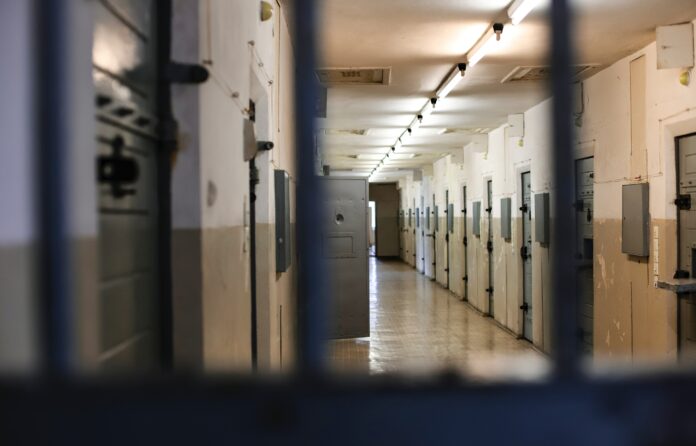
Photo of a prison
PHOTO: Matthew Ansley / Unsplash

By: Saije Rusimovici, Staff Writer

Content warning: mentions of colonialism and suicidal behaviour.

It’s no secret that Indigenous people are vastly overrepresented in the criminal justice system as a result of colonialism — nearly one third of the Canadian prison population is made up of Indigenous individuals. The treatment of Indigenous people inside correctional institutions continues to be an issue. They are more likely to be sent to maximum security institutions and subject to dehumanizing segregation practices. As a result, incarcerated Indigenous people are more likely to engage in suicidal behaviour. 

Healing lodges have been offered as an alternative treatment method to prison. These facilities were proposed by Indigenous people to provide inmates the opportunity to serve part of their sentences “in a culturally enriched environment on Indigenous land, with support from their Elders, families, and communities.” These institutions aim to provide resources for issues like substance use.

It may appear as though a solution has been found in healing lodges for decades of injustices against Indigenous people. But let’s put it into perspective — the Corrections and Conditional Release Act that grants for alternative sentencing for Indigenous people was enacted nearly 30 years ago, yet “most Indigenous inmates will remain in traditional prisons for the foreseeable future.” 

Healing lodges were “designed as a way to decolonize the justice system” with Indigenous programming, spiritual circles and ceremonies.” However, Kim Beaudin, the vice-chief of the Congress of Aboriginal Peoples and an advocate for prisoners, said the implementation of this concept has changed dramatically since their inception. Beaudin notes that more “non-Indigenous people” are involved in management and decision-making. These staff often lack knowledge or experience in healing methods.

Senator Kim Pate, a “prison reform advocate,” noted these lodges are “not driven by an Indigenous worldview, per se.” This is a huge problem. Colonial versions of healing lodges won’t address systemic injustice. Nearly half of these lodges are led by Corrections Canada, with the others “co-managed” by Indigenous communities. The lodges under Corrections Canada also receive significantly more funding. Decolonizing the process is an essential component to address the overrepresentation of Indigenous people in the criminal justice system. Using healing lodges isn’t truly decolonizing the criminal justice system if they’re not led by Indigenous Peoples. By structuring them with the Canadian justice system as a blueprint, they make no meaningful changes to a deeply systemic issue.  

First Nations/Indigenous courts use restorative justice approaches for anyone who is found or pleads guilty, and identifies as Aboriginal or Indigenous. Restorative justice approaches are rooted in holding offenders accountable in a meaningful way through alternative sentences that may not involve prison, and working to heal and address the victims’ needs. These courts aim to create a healing plan in consultation with Elders and community members. They can also involve sentencing circles — which are typically available as an alternative for sentences with less than two years — and are “a community-based process” to collaborate on a sentence “everyone is satisfied with.” This usually includes “the accused, an Elder, judge, Crown, and lawyer. The circle might also include an Indigenous court worker, police or court officers, and members of the accused’s family, and the victim and their family.” 

There are only a few of these courts across Canada, and plans to expand them may be a better solution than current colonial healing lodges.

The overrepresentation of Indigenous people in the criminal justice system is already a systemic issue, built upon intergenerational trauma, socioeconomic impacts of residential schools, and poverty. Racism also contributes to the overrepresentation of Indigenous people in prison, due to bias and stereotypes. Correctional investigator Ivan Zinger said in a 2022 conference that Indigenous people were more likely to be “placed in maximum security and labelled as gang members.”

The 1999 Gladue case recognized that the impacts of colonialism are more likely to result in Indigenous people being sent to jail, and the Gladue principles were implemented to address these problems. However, Indigenous women are still incarcerated at a rate 15.4 times higher than non-Indigenous women as of 2020/2021. It’s clear we must do more work to implement alternative approaches: traditional incarceration only worsens systemic dynamics. This doesn’t just have an impact on the offender, but on their families and communities as a whole.

Beaudin also argues that the overrepresentation of innocent Indigenous people continues to perpetuate distrust in the government, which serves no justice to Indigenous people. The criminal justice system must change their approach to handling the complexities of Indigenous justice by properly implementing Gladue and restorative approaches in criminal cases. Only then will we see true changes to the Canadian justice system with respect to Indigenous justice.