Home Blog Page 1389

Clan softball falters against Saints

0

By Adam Ovenell-Carter

Just when it looked like the Clan were going to keep their strong play going, they began to falter. Coming into their four-game series against Saint Martin’s University, the Clan were hot, winning four straight against Northwest Nazarene and outscoring the Crusaders 24–3 in the process. The team crushed the SMU Saints in their first matchup 9–0, but the bats quickly dried up. Three consecutive losses dropped the team into third in the conference.

Last week, Clan ace Cara Lukawesky pitched her first career no-hitter and was named GNAC pitcher of the week for the second time this season. She continued her impressive run by pitching six shutout innings in the first match, helping the Clan mercy the Saints.

However, the Clan could do no right in game two of the first doubleheader, as the Saints rebounded with an 8–0, five-inning victory. Textbook double plays went awry, the team couldn’t hit the ball — it was an all around write-off for the Clan. Knowing that, Lukawesky and the Clan were ready to put it behind them and move on.

“We weren’t focused in the second game,” she said. “We need to rebound quickly and come back with a vengeance.” Unfortunately, they didn’t.

Looking to bounce back, they instead struggled in two straight losses. Just as they had in game two, the Clan struggled to put their bats to the ball in games three and four, losing the two by a combined 12–4 score. Lukawesky, normally a rock on the mound, also struggled, allowing seven runs (four earned) en route to an 8–2 loss.  While it was only her third loss of the season — compared to nine wins — it was nonetheless an uncharacteristic performance from one of the best pitchers in the conference. However, if her performance from the week prior is any indication, she has a knack for bouncing back in a big way, and that will be key as the Clan figure out their batting problem.

The final game of the series started the same way game three ended, with the Saints’ bats hitting hard. They scored two runs in the opening inning, and while the Clan bounced back in the second, it took just until the third inning for the Saints to go up for good. Much like Lukawesky in the previous game, Hawkins struggled in the matchup, allowing three runs (all of which were earned), and lasted just three innings. The main concern, however, remains the batting issues.

“We had a lot of opportunities, but we couldn’t capitalize,” said junior infielder Lauren Mew. “We’re just not stringing together hits right now.” However, it’s not lost on the team that they need to play better in all facets of the game.

“We need to be good in all parts of the game to really be successful,” added Mew.

For the second time this season, the Clan dropped three out of four matchups in a single series. However, the last time they did, they rebounded with five straight victories. They have the experienced personnel and coaching staff to turn the ship around before it starts to sink. The team is still in third in the GNAC, so the iceberg is pretty far away, but it doesn’t hurt to change course before it hits.

Clan recruit four more

0

By Adam Ovenell-Carter

After the Clan finished their 2011 season ranked as the best team in the NCAA Division II, the team set out to improve their already talented roster. Having already recruited four local products last month, the Clan inked four more talents, and dipped into the international pool to do so.

The four new recruits are Alex Rowley and Jason Van Blerk, both B.C. products, as well as Glendale’s Colby Liston and Brazil’s Renan Rebelatto.

Rowley and Van Blerk both participated in the Vancouver Whitecaps residency program, preparing the duo brilliantly for elite collegiate soccer. Rowley comes to SFU with the reputation of being a tenacious, persistent midfielder, and brings quite a resume with him: he was an integral member of the B.C. provincial program between 2006 and 2009.

“Alex is a blue-collar midfielder. He is willing to do a lot of the dirty work to help the players around him, but he also has the finesse to get us playing,” said head coach Alan Koch. And as key as Rowley will be on the offensive side of the ball, his Whitecaps teammate will look to be a rock on the defensive end moving forward.

“Jason is a versatile defender who can play centrally or as a full-back,” added Koch. “He is a tough, uncompromising defender that has the size, speed, and strength to be a major player in the NCAA.”

With these two joining the four earlier recruits, the Clan will have a distinct British Columbian feel in the coming seasons, but that’s not to take away from the international talent the team has recruited this year.

Liston was the captain of his Phoenix College team last season, and the big forward potted 14 goals along the way, earning all-conference honours in the process.

“[He’s] a big intimidating striker,” said Koch of Liston. “Not only does he have the physical attributes, but he scores goals and has the ability to play other players in. He is a similar type of player to Carlo Basso and I look forward to seeing them compete and feed off of each other.”

His international counterpart Rebelatto, while a defender, is very offense-oriented as well. The left back, the now-former captain of Western Texas College, scored four goals last season en route to being named the local defender of the year.

“Renan is an attack-minded full-back,” said Koch. “He is technically sound, has a tenacious spirit, and already has two years of college soccer under his belt.” The Clan have graduated just four seniors this year, but with a bunch of new faces, hat collegiate experience shared by both Liston and Rebelatto will prove invaluable when more players move on from the program. With any luck, the two will have their success rub off on the newcomers. They won’t be the only ones relied on for that however, as they will take some adjusting themselves. That said, the Clan have the pieces in place right now to be successful short term and are clearly on the right track to maintaining that reputation. That said, these four recruits will likely be given every opportunity to be part of that success right off the hop.

“We have truly strengthened this recruiting class with these four young lads,” said Koch. “All of them are able to come in and compete for playing time immediately. We have addressed some positional needs and added some much needed competition for certain positions.”

Any time you can improve upon an already deep and talented roster can’t be seen as anything but a positive.

Around the school

0

By Adam Ovenell-Carter

The sports never stop at SFU. You’re busy, and it’s hard to keep up with all that’s going on. In that regard, here’s a quick update on everything else that happened in the world of Clan athletics this past week.

Wrestling

The Clan wrestlers continued their strong season, performing well at the Canadian Wrestling
National Championships in Ontario. Their strong showing
was the clear continuation of what’s been a strong program for a long time — the Clan’s success at the event was only surpassed by that of a couple of SFU alumni.

Justina Distasio led the way for the women’s side, competing in both junior and senior events, in the 72-kilogram weight class. She won gold in the junior competition, and bronze in the senior. The rest of the junior competitors performed strongly as well, as Ashley Topnik and Darby Huckle both won gold medals in the 59-kilogram and 44-kilogram classes, respectively.

The senior 48-kilogram bout was a clash between two SFU alumni in Ashley KcKilligan and Carol Huynh. Unsurprisingly, it was the Olympic gold-medalist Huynh who won that bout, while two more SFU alumni, Danielle Lappage and Stacie Anaka, also medalled.

On the men’s side, sophomore Jessy Sahota was the only Clan athlete to earn a medal. He took home a silver medal in the 120-kilogram class, but was defeated by fellow SFU student Sunny Dhinsa — an independent wrestler who more than once has taken out his schoolmates.

It’s becoming commonplace for the Clan to bring home
a handful of medals, but it speaks even louder volumes about the program when a number of SFU alumni are leading the way in the senior divisions.

Golf

Three members of the men’s golf team finished in the top-10 at the Cavalier Classic in Washington, earning the team a third-place finish. Meanwhile, the women’s side finished an equally impressive fourth.

Michael Belle was the most consistent golfer for the men, and his three-round score of 224 (eight over par) earned him a tie for seventh place. Not far behind was John Milikotic, who shot a final round of 73 (just one over par), and moved himself into a tie for ninth overall with a total score of 226. Just two strokes behind Milikotic was Calum Miller, who rounded out the top-10. No one from the women’s side was able to crack the top-10 however, though Nicole Jordan led the way with an 11th-place finish.

It was one of the Clan’s best outings of the year, and
one they’ll no doubt hope to improve on moving forward.

Graham James’ sentence as awful as his crimes

1

By Adam Ovenell-Carter

After sentencing former minor-league hockey coach Graham James to two years in prison, Manitoba provincial court judge Catherine Carlson said, “There is no sentence this court can impose that will give back to Mr. Holt and Mr. Fleury that which was taken by Mr. James.” Although she may be right, isn’t it worth a shot?

Retired NHLer Theo Fleury and his cousin Todd Holt fell victim to hundreds of acts of sexual abuse by James, his actions robbing two trusting teenagers (as they then were) of their youth and their innocence. It almost goes without saying that the assault goes well beyond the physical aspect, and deep into the emotional and mental ones; Fleury has battled alcoholism his entire life, which eventually forced him out of the NHL.

James was sentenced to three-and-a-half years in prison for a similar case of sexual abuse, again against two young hockey-playing boys, including former NHLer Sheldon Kennedy. The assaults ran into the hundreds, but the punishment was brief: of the 42 months he was sentenced to, James served only 18 of them.

This time however, for the countless cases of serial abuse, he was sentenced to just two years.

In other words, his crimes are apparently worth no more than a slap on the wrist.

To be fair to judge Carlson, she seems to appreciate the gravity of James’ crimes. “Mr. James could essentially do what he wanted to do to [his victims], and could rely on their compliance and silence, because he controlled whether they would get the chance at what they really wanted,” she said. “He could make or break them. He told them that.” If that doesn’t twist your stomach into knots, not much can. But, you can’t blame the judge for the paltry sentence; it’s how the Canadian justice system works, and perhaps that’s the real crime here. After the first six months of his sentence, he’s eligible for passes and day parole, and full parole after eight months.

Given that two of his victims went on to become NHL stars, this case has become one of the most notorious and most publicized sexual abuse cases in Canadian history. If that’s not enough for Canadian courts to take this case seriously, it’s hard to imagine what it would take. Clearly, they didn’t and handed out a laughable sentence.

Holt called the punishment a “national travesty” upon hearing the verdict, and in many ways it is. This is bigger than Fleury and Holt, and easily transcends the hockey world.

“This is not about me anymore,” Fleury, the former Calgary Flame star, said just hours after the verdict came in. “This is about doing our utmost to eliminate the biggest epidemic we have on the planet . . . I have kids. What’s important is that not one more kid has to go through what I did. What Sheldon [Kennedy] did. What Todd [Holt] did.”

Does a two-year sentence accomplish that? Not even close.

James’s own lawyer said he felt his client was treated “fairly and with respect”, during the trial, ironic given that his client felt no need to show the same to his young players. The Graham James of the world can take solace in the fact that they will be looked after better than their victims. And that is just as wrong as the crimes themselves.

2012 SFSS Executive Election Candidate Interviews

0

The following are interviews with various executive candidates running in the 2012 SFSS election. Only the candidates that allowed themselves to be interview have links to their section in the video.
Click on the links beside the names to skip to specific sections throughout the video.

PRESIDENT
Lorenz Yeung
Ashleigh Kolla – IntroJob DescriptionPlatformWeirdnessVote For Me
Kayode Fatoba – IntroJob DescriptionPlatformVote For Me

EXTERNAL RELATIONS OFFICER
Meaghan Wilson – IntroJob DescriptionPlatformWeirdnessVote For Me
Nate Larsen – IntroJob DescriptionPlatformWeirdnessVote For Me
James Hankinson – IntroJob DescriptionPlatformWeirdnessVote For Me
Stephanie Boulding

TREASURER
Michael McDonell
Kevin Zhang – IntroJob DescriptionPlatformWeirdnessVote For Me

MEMBER SERVICES OFFICER
Humza Khan – IntroJob DescriptionPlatformWeirdnessVote For Me

MEMBER AT-LARGE
Linda Chen – IntroJob DescriptionPlatformWeirdnessVote For Me
Arian Noei Aghaei
Ashleigh Girodat
Michael H. Hejazi
Karanvir Singh Thiara

UNIVERSITY RELATIONS OFFICER
Jeff McCann
Aleks Besan

INTERNAL RELATIONS OFFICER
Craig Pavelich

The Peak has no candidate affiliation and therefore does not endorse any one specific candidate in this election.

Don’t sink the SUB, just this one

0

By Kim Burgess

When I started at SFU in January 2009, there were whispers of a student union building — undefined, and uncertain, but the possibility did exist. It was something that the student society was thinking about, but nothing was anywhere near to a decision. Then three weeks ago, seemingly out of nowhere, comes the Build SFU initiative, with architectural plans, a funding outline, and a stadium all set up and in place. The news of a SUB for SFU is not unwelcome, however I have two major problems with the Build SFU project as it stands now: a lack of student consultation and the stadium.

The list of documents on the Build SFU website would lead you to believe that a comprehensive study has previously been conducted by the SFSS in regards to a new building. A review of these documents shows that this is not the case. The 2008 student consultation by past president Joe Paling spoke to approximately six students and asked the single question of (and I quote) “What kind of stuff do y’all want to see in a SUB?”

The 2009 food services consultation focused exclusively on a SUB building placed in Convo Mall, not in the athletics building, and this holds true again for the preliminary architectural sketches from Bing Thom Associates. Space committee meeting minutes from 2008 to 2010 are linked online, but have restricted access (something that doesn’t fill one with confidence for a transparent process). The consultation that was supposedly conducted by the current board has never been released.

Finally, the Build SFU site does provide a link to a comprehensive consultation process — one used by UBC’s Alma Mater Society.

The UBC process involved a student advisory committee to oversee consultation, a preliminary consultation of over 1,000 students, and more than a month of themed consultations as to what should go into the space — before any architectural drawings were created. It is easy to see how the current board has drawn inspiration from the UBC plan — the referendum and the tiered funding structure. The giant piece of the puzzle that the SFSS is missing is student consultation.

Build SFU is not a consultation process — it is about creating buy-in for the project as it stands now. Students are being asked what they would like to see included in the building, sure, but are not being asked what their priorities are. The current process will only generate a list for organizers to pick and choose from. A web survey that visitors to the Think Tank are being encourage to fill out, called “What do YOU want in your student union building”, contains nine questions — five of which are focused on collecting demographic data. Of the remaining four, three ask specifically about your interactions with the Build SFU brand — have you gone into the Think Tank and visited the website?  What did you think?  The final question gets around to asking your opinion: “Any comments? Ideas?  Suggestions?  Jokes?”  The SFSS may have been talking about the project for long time, but they haven’t been talking to students. For anyone to say that they ‘just know’ what students need is paternalism at its worst.

The major thing missing from this review of past SUB documents has been any mention whatsoever of a stadium. The stadium does make a brief appearance in the 2010 Burnaby Mountain Development Plan — prepared for the university, not the student society. This brings up the major question of why the student society is planning to pay for the building of a new sports stadium instead of the university?  A brief search through the student society website shows that clubs centering around sports and recreation are not administered through the student society at all — they are specifically directed to the SFU recreation department.

Call it SFU federalism if you will, but the separation of power between the university and the student society is very specific. The SFSS covers all matters wherein students govern themselves: clubs, department student unions, issues, and advocacy. The university governs everything else. While students do have input into university governance, final decisions and responsibilities lie with the university. This is the case with athletics and recreation — funding, facilities, teams, and equipment.

Having the student society build a new stadium creates a dangerous precedent at SFU by making students responsible for the construction of amenities. The student society didn’t pay to have the track refurbished last year and they didn’t pay to redo the Southwest AQ washrooms. What happens when there is a need for more space in the library?  Will the SFSS fund that too?

I have decided to vote ‘no’ on the Build SFU referendum question. This does not make me a scrooge, or a Debbie Downer; this is not the equivalent of me taking my ball and going home. I support the idea of a student union building — more space for study and for clubs is something that I believe is needed at SFU. But without consultation, and without the removal of the stadium I cannot support moving forward at this time. The SFSS executive should take a cue from the university in this matter and seek to engage the student body in a meaningful way.

Voting ‘no’ on this referendum will not kill the SUB. Voting ‘no’ will send the message that SFU students deserve to be consulted extensively before we hand over $65 million for a project that is outside the scope of the SFSS’s responsibilities. This referendum is the first time that SFU students have been asked how they feel about the SUB — and I am voting ‘no’ to show the executive that I deserve a proper consultation.

First-years excluded from SFSS political ecosystem

0

By Benedict Reiners

The SFSS is having its elections this week, with voting taking place online from March 20 to 22, and by now, most candidates are in the swing of their campaigns, telling everyone they support this or oppose that. However, despite this fervor in campaigning, many first-years are left asking what good it is to know someone’s platform when one doesn’t know the actual roles of the positions which each is aiming to fill?

The entire electoral system in the SFSS seems oriented to those who already know the workings of the SFSS and its operations, or in other words, not first-years. Though candidates have been quick enough to point out their platforms, however vague, there has been very little effort to inform each student of the roles that will be taken on by each position, no matter who gets elected to them.

Though one can find the job description of each role online, if one looks for a while on either the SFSS website or the site for the SFSS elections, the SFSS and those running for office therein have not partaken in any significant endeavor to make these known, with candidates instead focusing their attentions to making posters to put all over campus, or videos on YouTube.

This forces first-year students to look at each candidate’s platforms without the aid of contextual knowledge of each race’s position. This is something that should be seen as detrimental to the operations of the SFSS, and would be in its own best interest to address.

In fact, this is particularly the case because it not only creates first-years who don’t know the process in which they are participating, but creates a new series of second-years who won’t know the process next year. If we want to make sure that more students are voting in the future, the SFSS needs to make better efforts in the future to engage first-years. One way in which this can be done is by addressing more issues currently pertinent to first years.

One example of how this is not being done is the current debates over the finances of the Highland Pub. Although the finances of the SFSS are relevant to all students, the fact that the debates are centering over those of the pub largely excludes many first years from any significant interest, as most are still underage. This means that any changes that are made to the operation of the pub will not have an immediate effect on many first years, a significant limit to any enthusiasm they could muster towards the matter.

Furthermore, a fairly small amount of attention seems to have been paid to informing students on the impact that the student union building (SUB) and its related costs will have on those of us still in our first year here at SFU. The project will add significant costs to tuition for students at SFU, something which will be most pronounced for first-years, who, of current students, will be forced to pay the most. However, most attention seems to have been paid towards selling the project to students, rather than educating, which was admittedly mildly predictable, with the information sessions being put on by the SFSS, the organization responsible for the project. The SFSS should commit to not only listening to students, but also to ensuring that they are fully informed on the issue in order to formulate educated opinions, based in knowledge of what the project will mean for both them and for SFU.

It’s time that the candidates recognize that student elections are only truly open when people voting know the implications of their votes, and that comes with education. Let’s hope the candidates we elect this week recognize the difference between education and handing out campaign posters.

Don’t vote for Renew SFU

1

By Juan Tolentino

I thought I would have been content observing this year’s SFSS election cycle from the sidelines, satisfied that the general tenor of the campaign would be beneficial to the student community as a whole. However, recent developments have prompted me to speak out about an alarming entity that has burst into the political scene, like a beast lying in wait in the fog.

Most of you by now have seen the posters of a new slate called Renew SFU, which serves out ready-made slogans about “diversity” and “going to the students”. Such sloganeering would not be so bad (and in fact pretty standard) if they didn’t paper over some very ugly aspects of what it is they really stand for: a reversion to the outdated left-wing politics of the previous decades that has so hampered our society’s ability to function the past.

Renew SFU claims to value diversity of opinion. That’s a very strange claim to make when one comprises a slate, the very existence of which implies some kind of coherence (dare I say, unity) of views and ideology. Furthermore, if Renew were really as diverse as it claims to be, it would draw on students from many different sectors of the university.

In reality, it seems that most of their political base is found within the Sociology and Anthropology Student Union and the Labour Studies Student Union, which, if SFU’s data is up to date, represent less than 300 declared majors (In contrast, the student unions who support Build SFU, a favourite target of Renew, represent over 4,000 declared majors).

Renew SFU says that the Build SFU project was forced upon students from the top down by an unaccountable board of directors. My first reaction to this is to wonder whether they are talking about the actual SFSS or merely a fantasy version they have concocted in their minds. The board of directors is, in fact, the most accountable governing body in the whole SFSS, since the entire undergraduate student population elects them. Certainly, they are more accountable than 11th-year undergrads like the labour studies forum representative who, by the very nature of his appointment, only serves the particular interests of a small portion of the larger student community.

In fact, if you actually bother to read the SFSS constitution (which I have, several times), you will note that the board is, by law and by fact, the sole representative of the interests of all SFU undergraduates. Perhaps Renew’s ‘progressive’ ideals are too rarefied to be committed to a legal document.

Renew SFU claims that it will rebuild trust in our student institutions. I wonder how they are supposed to do that, given who they are and what they represent. Renew SFU is not representative of the members of the SFSS but are, in fact, a small clique of activists with homogenous views that are unhappy with the daring, bold trend of having regular, apolitical students (which comprise the vast majority of undergrads) take charge of an institution in which they, the privileged “progressive” class, have long had a stranglehold.

They believe that experience in radical activism that the vast majority of students do not care about counts as solid credentials in university relations. They don’t seem to bother with standards concerning conflict of interest: witness how their IRO candidate proudly declares his previous employment with Out on Campus, which is run by the SFSS. Somehow I don’t think having an employer representative with such blatantly close ties to his employees is going to work out too well for student interests.

They don’t even seem keen on basic logic: their treasurer candidate cleverly puts forward his arts education and commitment to “avoid blaming workers” as being superior to “business-minded” approaches, since apparently cow-towing to union interests is so much more important than making sure students as getting the most from their fees.

Despite first impressions, I have no particular delight in penning such a negative screed about a particular group of people, but I feel that it is necessary given what is at stake: independent, capable, ideology-free governance in a form of government that sees so little of it.

So, I say again: don’t vote for radical politics. Don’t vote for false ‘progressivism’ as opposed to the real progress we have made in the past few years. Don’t vote for Renew, and keep the SFSS yours.

The rise of financial masochism

1

By Ryan McLaughlin

I generally agree that, as Trudeau famously proclaimed, “There’s no place for the state in the bedrooms of the nation.” Most know this simple rule as ‘different strokes for different folks’. After all, what right do we have to tell people with unusual desires what is fine for them to do in the privacy of their own homes?  With that being said, even I am sometimes aghast at what some sickos get up to.

Increasingly, an unusual fetish has become popular among students at SFU and elsewhere called financial masochism. This is where students get some sort of inexplicable sexual kick out of arguing that tuition fees are at the right level. Much like Goldilocks, these twisted individuals derive pleasure out of a middle ground where tuition fees are not too high and not too low, but just right. Some even go so far as to say that tuition fees aren’t high enough. I am aware that it is the style of the day to argue against your own economic interest, but I think it’s clear that this has gone too far. Someone needs to tell these folks just how dangerous their lifestyle choices really are — they might actually convince someone of something.

Imagine a great big Venn diagram — you know, the one that looks like boobs. On the left boob you have “Things that are good for society.” In this category you have stuff like building a giant Slip ‘n Slide through downtown Vancouver, mandating a 20-hour work week, or adding the right of a weekly visit to Happy Time Exotic Massage down on Hastings in the Canadian Charter of Rights and Freedoms. On the right boob you have “Things that are good for the economy”. In there is stuff like outlawing recycling (punishable by death), mandating an 80-hour work week, and turning the elderly into Soylent Green to feed the 12-year-old Guatemalan labourers in our Nike factories. Then, right in the middle where the boobs overlap, there is a special place where all kinds of wonderful things exist. This is that location where things are miraculously both good for society and good for economy. In that cleavage lays the prize: reduced tuition fees. Society benefits from lower tuition because people who deserve to get an education can. The economy benefits from the existence of skilled doctors and lawyers and astro-physicists and people who got an arts degree.

Unfortunately, over the last few decades, we’ve been doing not that. While public funding accounted for 84 per cent of university operating budgets in 1977, it now accounts for just 57 per cent. Over the same period, tuition fees have risen from 14 per cent of operating funding for colleges and universities to over 34 per cent. It’s hard to believe, but there was once a time when student fees were simply an afterthought to Canadian students.

As fees for university have increased, the necessity of university has as well. Sympathizers for high tuition fees often claim that it is only the government’s job to ensure a basic education from kindergarten through grade 12, but this promise used to mean a lot more than it does now. Being educated to grade 12 was once all that a person needed to exist in society, but this is simply not the case anymore. The promise of a ‘basic’ education, quite frankly, is no longer fulfilled only with a high school diploma; it probably includes a largely unfunded bachelor’s degree as well.

No one is saying everyone should get to go to university, after all, someone has to cook my McNuggets. However, the test for who should get to go to university shouldn’t be how wealthy your parents are, it should be, well, a test. If you get good enough grades, you should get to go to university no matter what. If you do poorly on your exams, it shouldn’t matter how much money you have, you should not be allowed in the doors of any Canadian institution lest you infect the intellectual purity of the place with your stupid.

What young financial masochists fail to realize is that if students don’t fight for their share of the pie in society, someone else will take it. Students could learn a lot from the old, for example. The government recently flirted with the idea of raising the retirement age and every old person’s head simultaneously exploded. Maybe if students made a bit more of a fuss about stuff, we could get some wealth redistributed in our direction for once.

The sad story of student apathy, and how we can fix it

0

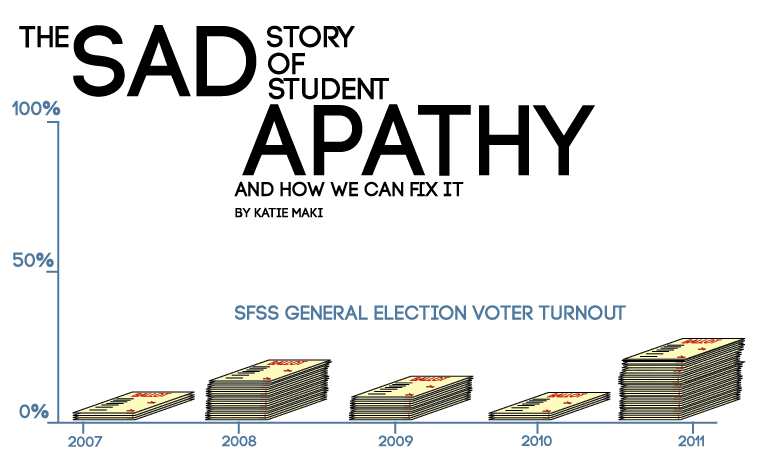
By Katie Maki

Bold posters have recently lined every square inch of the walls around SFU. Those smiling faces have looked back at you, promising integrity and experience, and you have wondered what it’s all for. Based on what the walls of the school look like, you would think that everyone is buzzing about the SFSS general election — but barely anyone gives a damn. Is it the students’ fault? Not entirely. The SFSS is largely to blame for the lack of enthusiasm surrounding politics here at SFU. With better communication and distribution of information on the part of the SFSS and its candidates, student excitement over the election might actually begin to reflect the frenzy of posters.

Politics influence every aspect of a person’s life, but student politics can be somewhat of a challenge to explain. Although it may not sway what you eat for lunch or what route you take there, the SFSS is a multi-million dollar organization that is funded with student money. Its leaders have the power to influence anything from the pub menu to the health and dental plan coverage. Furthermore, the SFSS represents student interests to university administration, potentially contributing to what SFU spends its money on.

If student politics influence students’ lives in so many ways, it may come as a shock to know that only a very small number of students vote in these elections. SFU’s commuter school reputation could be at fault for this lack of interest. However, students have lost sight of the bigger picture. If the voter turnout for an election is only a marginal portion of the student population, then students that have been elected to the SFSS are not really speaking for the majority. Things that affect your everyday student life are reflected by who you choose to represent you, and it can all change with a simple check beside ‘yes’ or ‘no’ — why would you ever choose not to vote?

However, there is a small population of students that stay really informed and up-to-date on the issues. Not surprisingly, this number of informed students often increases with election issues that students really care about. Last year, for instance, the U-Pass campaign helped produced a voter turnout approximately four times higher than the year before. It has been speculated that the SUB might have a similar effect of boosting voter turnout this year as well. However, such a temporary increase in student engagement doesn’t solve the overall problem with students getting informed.

This problem of being uninvolved has somehow been woven into the mind students at universities all over. Arry Dhillon, a current at-large representative for the SFSS who has been involved in 10 elections, spoke about his experience at Selkirk College. “Nobody knew about the student society at all
. . . Students didn’t know what they were voting for — they just knew me. That’s why they just wanted to vote,” he said. “That’s how I see a lot of [elections] going.”

This lack of involvement and knowledge could be a symptom of a dominant student attitude towards university nowadays. “People are more focused on their studies — which is a good thing, it is what they’re here for,” Dhillon said. “And so they don’t really care to get too informed. It’s not that they don’t care, it’s just that nobody has approached them to care.”

Dhillon suggests that a major problem for involvement is how student politicians approach students. But how would the SFSS go about informing the student body? “[Information on the SFSS positions] is somewhat hard to find for an average student. You see a poster on the wall that says ‘election coming up, get informed’,” Dhillon said. “But how many people actually go on that website at the bottom of the poster and get informed?” Although posters with detailed information sound appealing, he also explains the dilemma behind too much information. “At the same time, to fully explain what each of the 16 positions do, you would need a poster the size of a wall,” he said, laughing. “I don’t know if anyone would read that anyways.” Emails and posters seem to be how the SFSS distributes information, but how many people actually read every email they receive, or poster they see? “Students get emails from the SFSS and SFU all the time. Nobody is going to check them,” Dhillon said. Throughout Dhillon’s experience with student politics, he believes a person-to-person approach to communicating campaign platforms, issues, and ideas to students can go a long way to getting them interested and informed.

What about the election this week? There are only three candidates from the current board running for election — a number which Dhillon regards as “kind of low” — indicating that students may already be headed in the right direction in getting interested and involved in student politics. Although the general population may lack the knowledge of the system, more new faces are seemingly getting involved, which could really help in changing the dynamics of the SFSS.

Community seems to be SFU’s main issue. With President Petter’s recent motto swap, to “engaging the world”, students in this election have begun to step up to the challenge. But why don’t we take it a step further? If the small chunk of people that are informed could expand into a larger group, SFU might be able to get a sense of community back. Currently, community is lacking because there are so many different faculties and because SFU is strewn out across three campuses. Every student is going in a different direction. If all students could come together by having one united vision, such as for Build SFU, we could have a large number of students from different faculties all working together. If more students began to vote and get their opinions out there, the election results could represent a wider audience.  Involvement could change the role student politics currently play.

The overall question is whether or not student politics can get to where it should be, despite where it is now. It all rests upon the shoulders of the student body and who is elected. If this year’s votes turn out like the year before, we may see a big change in the dynamics of student politics at SFU and a community may begin to form. That is, if those elected will try and change their strategy. With only a day remaining for campaigning, it’s time for those candidates to really step it up. “If [a candidate] actually goes up to [students] and talks to them about [the election] and puts a face to what everything is, then they get way more interested and involved.” So what’s the solution to SFU’s lack of student involvement with the SFSS? Put a face on politics.