Home Blog Page 1105

BCTF strike raises post-secondary questions

0
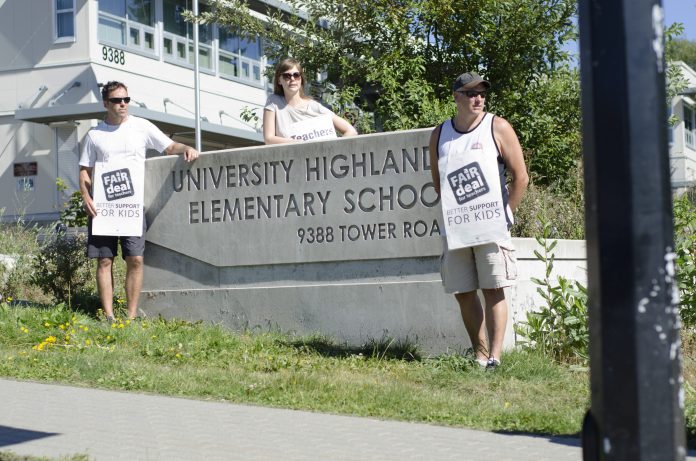
SFU students marched from Burnaby campus to University Highlands Elementary School on Sep. 12 to support BCTF members.

As the BCTF strike keeps students out of the classroom for the third week this fall, the concern now shifts to whether current high school students will encounter difficulties when applying to post-secondary institutions for the 2015 academic year.

A resolution to the dispute between BC teachers and the provincial government remains elusive. The worry is that post-secondary application timelines could be disrupted, potentially leaving BC grade 12 students at a disadvantage relative to their out-of-province peers.

Despite this, Mark Walker, registrar and executive director of student enrolment at Simon Fraser University, has made it clear that BC students will be accommodated.

“Where we are right now in the calendar, it is not really going to cause too much of a problem,” said Walker. “Our application date for next year is October 1, and students can apply whether they are in school or out of school.”

When asked whether the strike might interrupt the submission of grades, Walker responded, “It will become tricky in mid-December when self-reporting of grades would occur. Right now, because we’re in September, it is sort of a wait-and-see [situation]. But if this continues into October, every university will begin thinking about solutions. Depending on what happens, we can deal with deadlines and move things to accommodate the students.”

Dan Laitsch, associate professor of the Faculty of Education at SFU, echoed this sentiment. When asked whether the time spent away from school would negatively impact students’ grades, he told The Peak that the time off will most likely result in a negligible impact.

“In general, I would guess you’re not going to find a particularly substantial impact on students,” said Laitsch. “These [senior] students have had 12 years of schooling; you are not going to lose all that because of a few weeks off.”

He continued, “Yes, it will create a challenge. But at the same time, once the strike is resolved, students will be back in class focused on their work, and the system will accommodate their running needs.”

In response to the question of whether the strike will affect students’ university enrolment, Laitsch said, “I think it will have a bigger impact on the university than it will on the students applying. The universities might have to adjust their timeframes for admissions and such.”

As for what students can do with their current spare time, Walker advised, “You have this time now to really research the universities that you might be interested in going to. Take the time, get on the tours and call the advisors. Tell them you want to talk about your careers, and about programs.”

Similarly, he advised parents to keep their children focused on next year. “Really, there is nothing [the parents] can do about this situation. They can go out and voice their support. But if they are really thinking about their children’s next year, they will start planning right now.”
Board Shorts

0

Convocation Mall renovations

Professor of criminology Ehor Boyanowsky approached the board on Wednesday to discuss the possibility of making renovations to the open space in Convocation Mall. Referencing Burnaby campus’ lack of light during the fall and spring semesters and its potential negative impacts on those with Seasonal Affective Disorder (SAD), Boyanowsky explained how the space could better serve students in the winter months. Improvements could include glass doors which would section off parts of Convocation Mall, along with better lighting, heating, and seating for students.

Open letter on Pearson presentation

The board issued an “Open Letter to the Students of Simon Fraser University” regarding a presentation made by Pearson Publishing Company on July 29 to the SFSS advocacy committee.

During the presentation, Pearson explained that the four largest textbook publishers in the industry were willing to work together to standardize the e-book format to offer students full access to all course material at a lower cost, provided every student pay an automatic fee to the service.

While the board was interested in the possibility of providing a more extensive selection of electronic courseware to SFU students, they ultimately found the proposal lacking due to four factors: it was based on an opt-out rather than an opt-in model; BC already provides free electronic courseware through the BC Open Textbook Program; the program may unduly favour certain publishers over others; and Canvas may make some of the program’s tools redundant.

Concerns arise over empty RHA board

0
The RHA holds elections every March, with the new board taking over on May 1.

Concerns have arisen regarding the current state of the Residence Hall Association (RHA) electoral process and the upcoming bi-elections this fall.

Following the RHA elections last spring, only one candidate was ratified to the RHA board of directors: Brett Payne, Townhouses representative. The remaining nine seats, including that of the president, remain vacant.

According to Payne, both presidential candidates were disqualified after violating RHA bylaws. The only other candidate, who ran unopposed, did not receive the percentage of ‘yes’ votes — 70 per cent — necessary to be elected.

The RHA is a body of students who represent residents living in campus housing. It is responsible for social programming in residences and serves as a link between students and university administration. The board of directors is elected every March by residents, with elected board members holding their positions from May 1 to April 30 of the following year.

Nicholas Page, a student from McTaggart-Cowan Hall, expressed his concerns about the spring election results to The Peak. According to Page, Residence and Housing refused to disclose the results from the last elections; he alleges that they first claimed that these results were private, and later that they did not exist.

When he contacted Zoe Woods, associate director, residence life at SFU, Page said, “She wouldn’t release any of the details on the infractions, saying that candidates had a right to privacy and it would emotionally hurt them, which I think is completely ridiculous. When you run for public office, that’s what you trade off.”

“I’m not asking for what’s in their fridge, I just want to know if they cheated,” Page continued. “The public has a right to know so that they can make the right decisions.”

Woods declined to comment on the issue, but suggested that students with concerns email ResLife.

Page brought his worries to the Simon Fraser Student Society (SFSS) in hopes that the society would aid in conducting the RHA’s next election; in particular, he recommended that the chief electoral officer oversee RHA bi-election proceedings. The board tasked education representative and RHA liaison Katie Bell to speak with the association about the potential for collaboration.

Although the SFSS has no formal ties to the RHA, VP finance Adam Potvin expressed that this is still a student society issue: “I feel like it’s our duty as the SFSS to make sure that no matter where on the school grounds, that elections are being done properly and fairly.”

In his initial email to The Peak, Potvin said, “From what Mr. Page has told me, it seems as if SFU’s tentacles may be engulfing democracy.”

Payne, the sole sitting RHA board member, explained that Bell put him in contact with a previous SFSS electoral officer, whom he hopes will work with the RHA’s new elections coordinator this fall to ensure that all candidates abide by the election bylaws.

“We’re trying to make sure that the election is going be fair and that people won’t be skeptical about how it’s done or who has been helping in it,” said Payne.

With the appointment of an elections coordinator, Payne expects to open the nomination period for the bi-elections sometime during the next few weeks.

Sleater-Kinney: the best band you’ve never heard

0

Never mind the Sex Pistols; forget the Ramones. When it comes to punk rock, there never was a better band than Sleater-Kinney1.

Two guitars and a drum set is all it took for three women from the rainy Pacific Northwest to take the world by storm, one killer guitar lick and passionate, no-holds-barred vocal at a time. Before Carrie got famous as one half of the Portlandia team, before Janet did triple time drumming for Bright Eyes, Stephen Malkmus, and Quasi, before Corin had two kids and went solo — before all of that, we were blessed with just over a decade of music from the greatest band you’ve never heard.

It’s true, Sleater-Kinney came from the same riot grrrl roots as groups like Bratmobile and Bikini Kill. They held true to the DIY ethos and punk spirit of those groups long after they’d graduated those ranks and made it to the big leagues, but the trio always had too much to say to be tied down to any one movement. They could claim fans among all disciplines — metalheads, punk rockers, indie kids and bearded folksters — and they borrowed from all genres in turn, making for a sound that was peerless then and hasn’t been matched since.

It wasn’t just about sending a message and making noise doing so, though Sleater-Kinney were pretty much unmatched on both those fronts. There was also plenty of tenderness there, a beating heart behind all the steel wool. “One More Hour,” maybe their best track (maybe), is the ultimate breakup anthem sung from both sides at once, hinting at a brief romance between singer Corin Tucker and guitarist Carrie Brownstein.

Tucker’s impassioned vocal delivery, one of the band’s signatures (that voice!), kept their approach unique in its raw emotionality, and Brownstein and Weiss’ uncommon rhythm section never let up once.

Of course, it doesn’t hurt that the band never overstayed its welcome. That Sleater-Kinney’s career was short and sweet only adds to their legend; it’s no hyperbole to say they never made a bad record. Seriously. Trying to argue over their best LP with a fellow fan is next to impossible — I mean, how do you choose between the gnawing punk of Dig Me Out and the savage Bush-era indictment of One Beat? What about the messy pre-Weiss assault of Call the Doctor, or that noisy behemoth of an epilogue, The Woods?

In flagrant disobedience of the punk rock rulebook, Sleater-Kinney’s sound only got louder and more immediate with each record — all of their records are great, but none are laid so bare as their final one, and the career-ending tour that accompanied The Woods is still the zenith of Sleater-Kinney’s already astronomical achievements. This is a group that went out on top, unwilling to see themselves fall into anything close to obscurity or mediocrity.

Maybe that’s why their music still hits so hard today. Listening to these records now — and surely again, once Sub Pop re-releases them in the recently-announced remasters due in early October — the aural assaults packed into every vinyl groove are still felt as palpably as they were a decade ago or more. Some bands live on trying to recapture their glory days, and others fizzle out before they’re really able to make a mark.

Very seldom has a band like Sleater-Kinney come around, and for them to have left us such a wealth of amazing, pulse-pounding, fucking life-affirming music is only a testament to how well they still deliver, almost 10 years after their untimely demise.


1 Okay, except for maybe The Clash. But they shouldn’t count, anyway.

MFA Students show off their final projects at the Audain Gallery

0

Enjoy an evening of art, cheese, wine, and mingling with our MFA Graduate students during their opening reception of Lossless on September 10 in the Audain Gallery at the Woodward’s campus!

Lossless is an exhibition featuring final projects by the 2014 MFA graduating candidates at SFU’s School for the Contemporary Arts; the featured candidates are Deborah Edmeades, Jeffrey Langille, Avery Nabata, Nathaniel Wong, and Luciana D’Anunciacao. Video, sculpture, performance, and installation projects by this year’s graduates share a number of related themes, while formulating distinct frameworks for individual investigation.

This exhibition is truly a culmination of the candidates’ studies. After investing long hours of research and late evenings assembling the projects, the exhibition showcases their individual artistic expressions and their personal perceptions on the concept of Lossless.

The word “lossless” is based on the term “lossless compression.” “It is the idea that nothing is lost from an idea,” says Wong. For example, it is the act of articulating a perception of the world, where nothing is lost in the articulation, and the perception is identical to what was perceived.

With his work, “On the Validity of Illusion,” Edmeades explores the question of illusion through video, within which there are elements of object making, works on paper, performance, and elements of Walter Benjamin’s “theory of experience” and reverse method acting technique.

“How is it that there is always something new?” Lagille’s moving image landscape work, draws witness to a landscape that is not a surface — not topography — but a vital process.

With “Growth, Endlessness, Blocks,” Nabata observes buildings, as “precarious structures left on the edge of regrowth or destruction.” They are “blocks of time and type; structures on the edge of change;” simultaneously ending and beginning.

Within “Thus Spoke Death and Transfiguration,” Wong’s videos are embedded into sculptures, there is music and moving images, and within something quite humourous there is also something quite serious. “Of course, something is lost, but maybe things aren’t just lost, but other things are gained that we didn’t know,” Wong says of the idea of Lossless.

Lastly, D’Anunciacao explores the notion of displacement within the dual nature of installation and performance. “When will my hands become roots?” is in between a gallery piece and a performance piece. The room is left in the same configuration; as it shifts between one state and the other, the space becomes a place that belongs to neither one nor the other.

Lossless runs from September 4 to 27, with works from Edmaedes, Lagilles,Nabata, and Wong presented in the Audain Gallery, and D’Anunciacao’s work presented in Studio T. D’Anunciacao’s installation includes an evening performance from September 11 to 13. For more information visit: sfu.ca/galleries.html.

Album review: The New Pornographers – Brill Bruisers

0

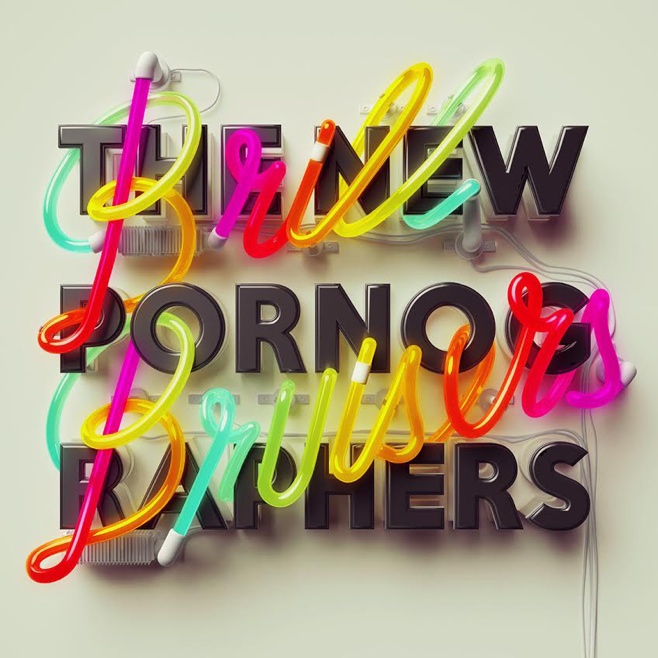
Brill Bruisers, The New Pornographers’ sixth studio album and first in four years, is simultaneously an impressive return to form and a progression of the band’s sound. The album stands among the Vancouver collective’s best earlier works Twin Cinema and The Electric Version, as focused, intelligently written pop music.

Yet, rather than just existing as a retread of these past glories, Brill Bruisers manages to expand the band’s sound in unpredictable new directions. Chiefly, there is a newfound focus on synth textures that serves to enhance and distinguish their already impressive songwriting.

This progression seems like a necessary step for the band, after stalling slightly with their relatively mellow previous record Together. Brill Bruisers is all energy, it’s a fighter of an album that proves that the band has more than a little life in it.

The title track opens the proceedings, immediately pulling the listener in with its deceptively simple “ba-ba-ba” refrain and propulsive beat. It bores its way into your head like the best pop songs do and soon, without your knowledge or consent, you’ll find yourself humming along.

While the title track could easily fit on one of the band’s earlier, more traditional rock releases, much of the rest of the album serves to move the band forward into a more synth indebted direction. That is not to say that electronic instrumentation overwhelms the album, rather the tasteful synths of “Champions of Red Wine” or “Backstairs” subtly reinforce the celebratory mood of the songs.

Instead of feeling like a forced attempt to keep up with the times or a drastic makeover, this electronic progression of the band feels quite organic. The New Pornographers have existed as a group for fifteen years and are all accomplished musicians in their own right, so this comes as no surprise.

Although they work as a cohesive unit throughout the album, the eight member band’s greatest strength has always been the diversity of their sound. The New Pornographers’s three lead vocalists, alt country legend Neko Case, AC Newman, and Dan Bejar, all have distinct voices and often a lyrical focus. While Newman is the primary songwriter and sings lead most often, Case’s voice serves as his powerful, melancholy foil while Bejar’s spoken-word style musings further diversify the album.

Somehow The New Pornographers have always made this eclectic mix work. While they have slipped into a formula in the past, Brill Bruisers succeeds in furthering their sound while being firmly grounded in their sophisticated pop songwriting.

While the album begins with the title track’s callback to the band’s power-pop roots, the finale of “You Tell Me Where” exists as something entirely new. Newman and Case trade lines over a minimal synth and bass line that eventually explodes into a cathartic, celebratory climax. It’s a perfect closer that couldn’t have existed on any of their previous records, a reminder that even after 15 years the New Pornographers are nowhere near complacency.

Cloudy, with a chance of face

0

Since his debut at Music Waste in 2011, Cloudface (aka David Reynolds) has become a figure of local music folklore. With only a handful of releases under the moniker and Vancouver shows a rarity these days, Cloudface’s set at the upcoming New Forms Festival is the perfect chance to remind people why the electronic producer is a Vancouver mainstay.

Though Cloudface is only a couple of years old, Reynolds has been making and experimenting with electronic music for nearly two decades. Originally under the name Eagleroad, Reynolds saw the name change as a chance for a clean slate.

“I was just feeling like it was time to change. I kind of intended to keep both [music projects] going but then never really did [. . .] I just wanted to have a fresh start. I’d been playing shows around town as Eagleroad for a couple years at that point and I wasn’t very proactive with it. Whereas I wanted to start something new and actually be more dedicated towards it.”

For one main difference between Eagleroad and Cloudface, look no further than their discographies. While Reynolds never officially released anything under Eagleroad, Cloudface has enjoyed multiple releases, including one earlier this year. Untitled, a 12-inch from UK sub-label Black Opal, came out in June and was Cloudface’s longest release — a project in the making since 2012.

The resulting seven tracks on Untitled are a fluid groove-train, with Reynolds seamlessly combining ambient sounds with infectious beats keeping time. A perfect soundtrack for any scenario, whether you’re at an after-hours party or in your room trying to finish a paper.

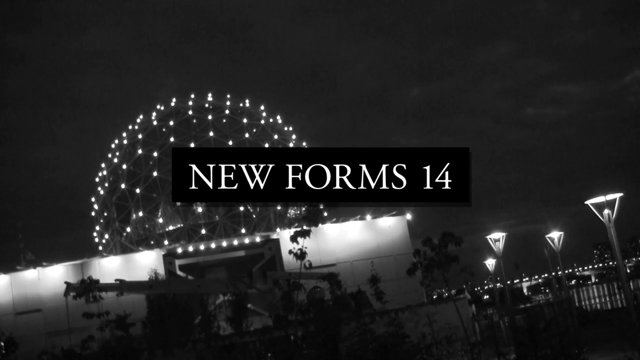
While previous years have found the festivities taking place across the city, 2014 finds all of New Forms Festival taking place under one roof — or should I say dome? “It’s definitely in line with the whole aesthetic of electronic music,” says Reynolds, about the decision to hold this year’s New Forms inside of Science World. “It’s this big geodesic dome, which looks so rad. It’s an icon of the Vancouver skyline, but it also looks super techno, like a spaceship. I’m excited to see how it turns out.”

Being able to read and react accordingly to a crowd is something Reynolds finds very important. With increased recognition and larger venues, Reynolds has found himself on stages almost completely removed from the crowd. One recent example had him 30 feet away from the closest person, something that doesn’t match well with Cloudface’s intimate beats.

“For the kind of music I make, it relies heavily on the connection with the crowd and just getting really deep into whatever vibe of the night is appropriate. You can’t do that if you’re in the middle of a big stage.”

If the music doesn’t speak for itself, consider this: Reynolds is playing his third New Forms Festival in four years — an uncommon feat considering the festival’s tendency to avoid repetition.

“As far as Vancouver music festivals go, [New Forms] is my favourite. They do such a good job and it’s just a good weekend — being a part of it is even more fun than just attending.”

Cloudface performs on September 19 at Science World as part of this year’s New Forms Festival which runs September 18 to 21.

The Terrors of terrorism

0

What do you think when you hear the word jihad? Is it a brown-skinned, long-bearded man screaming “allahu akbar” with a bomb strapped to his chest, out to kill the infidels? There is also another jihad: the struggle that burns inside Little Terrors’ young protagonist Sahmi as he wrestles to connect Islam’s teachings with the radical actions of the terrorist group that has drafted him. The genius of Canada’s Maninder Chana in his directorial debut brings these two jihads together.

Little Terrors attempts to bridge Western and Middle Eastern cultures with a message that is both an outcry to stop generalizing, and a sermon preaching against the reasoning of evil men who twist religion to brainwash and manipulate vulnerable, unstable minds. There are compassionate Muslims and radical ones, kind Americans and those who are rudely ignorant. These characters are judged as respectable or deplorable based on their actions, not their religions.

To demonstrate that the radical jihadist groups have manipulated the Koran, the director contrasts the terrorists’ actions with epigraphs quoting Mohamed between each episode of the movie. It’s an emotionally convincing approach, but one that doesn’t resonate intellectually — one must wonder if he is also taking these excerpts out of context, or if they conflict with other passages in the Koran.

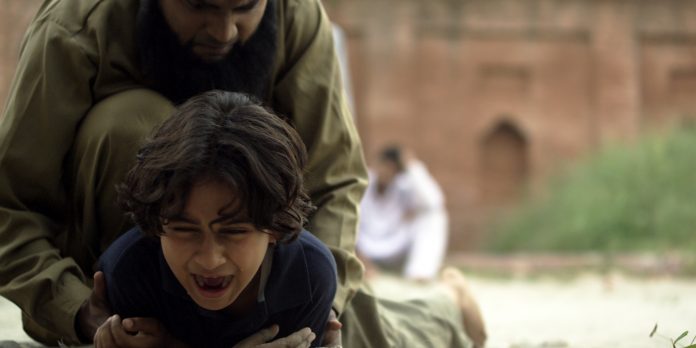
Luckily Chana isn’t making a documentary on the subject; his ambitions lay elsewhere — to tell the plausible and raw story of a boy chosen by Islamic fundamentalists to join a terrorist cell with plans to bomb an American embassy in Delhi. He is taken to a training camp where he is brainwashed and trained to fight a holy war against a people that sadistically kill and control their brothers in Palestine and Iraq. These half-truths and one-sided stories manipulate the vulnerable boy.

As Sahmi’s training progresses you see his worldview shift from natural compassion to deep hatred and a closing of the mind to everyone around him. When an American journalist enters the story he ignites an inner jihad in Sahmi, for he brings a new perspective.

This man isn’t the evil monster that the leaders of the terrorist group have made him out to be. The journalist has done nothing deserving of torture, except to be American and not Muslim. In a touching and poignant scene, the broken and bruised journalist pleads with Sahmi to recognize the evils of what they have done to him by explaining the allegorical elements in Star Wars. In this elucidating scene, the journalist treats the boy like a boy in contrast to the jihadists who brutally dehumanized the boy.

What a genuinely moving and affecting movie this is! If it weren’t all so relevant, so true, so convincingly acted, so beautifully realized from a production standpoint, so restrained in its depiction of brutality, so meticulous in the developments of Sahmi as a character, and in the end so resolute and haunting in the bitter simplicity and profundity of the concluding sacrifice, then we could dismiss it as some twisted form of manipulation where brutal acts are shown for the sake of showing brutal acts. Instead there is a piercing authenticity that breaks our hearts and infuriates our consciences.

Little Terrors isn’t based on a true story, but it contains more truth than most fact based films out there.

Life After Beth: a zom-rom-com that lacks depth

0

Life After Beth`s overblown tone is as forced and unbearable as trying to urinate kidney stones. The movie’s central pitfall is analogical to an uncoordinated idiot who attempts to spin plates on sticks while riding a unicycle, and juggling chainsaws.

This is an aggravating experience because the film attempts to juggle far too many things at once while not doing any of them well: a romantic comedy with an uninteresting relationship, a dark drama that studies a cipher, and a zombie movie that brings nothing original to the well-explored lore. It makes the mistake of having too many dark moments coincide with unfunny running gags.

None of the one-dimensional characters are interesting and the storytelling merely plods along to the predictable and inevitable conclusion. Yet all of the performances are played at an exasperatingly exaggerated tone.

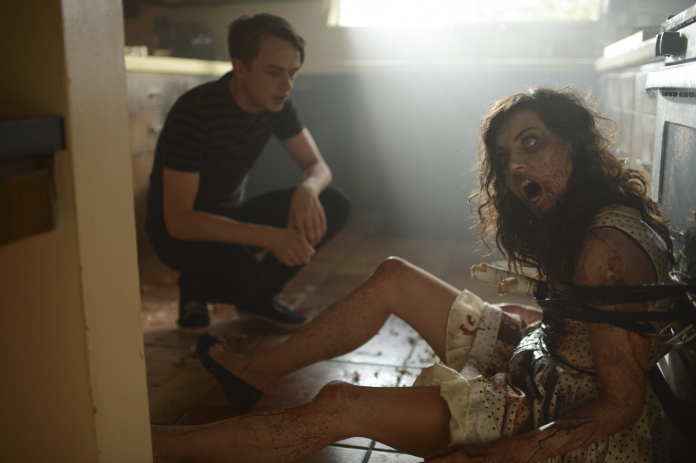
Jeff Baena’s directorial debut follows Zach Orfman (Dane Dehaan in his typecast role of a disturbed teenager) as he grieves the tragic death of his girlfriend, Beth Slocum. When Beth miraculously returns in an odd alternate form where her appearance is intact while gaps exist in her short term memory, Zach is overjoyed but slowly realizes that this is not the girl with whom he fell in love.

The characters are all tedious caricatures designed to brew as many laughs as possible; yet, these poorly conceived personae are the same ones for whom we are to empathize. Caricatures work for comedy not tragedy: or in this case, neither.

Beth’s parents are overbearing and like to yell at the same time, so we can`t understand what they are saying; Zach’s brother is a security guard who has a power complex; and Beth is a nymphomaniacal zombie chasing Zach.

Zach is meant to ground the film and offer it heart as he learns to let go and not live in the lie that is his new relationship with zombie Beth; however, this depth is neglected in order to exploit the ensemble of the surrounding caricatures.

If you don`t leave decapitated by the chainsaws, finally passing the kidney stone will kill you.

Life After Beth’s run at the Rio theatre from September 5 to 8 coincides with the 2014 Vancouver Zombie Walk on September 6. For more information, visit riotheatre.ca.


Five films to help you find your silver lining

2

As we all know, the right kind of movie can give us feelings of hope that rekindle the strength to reach our highest potential in life; it can encourage us to create, inspire, and dream about what we are able to do with the power we possess as human beings.

The following films are among many masterpieces that push us toward a positive outlook, helping us to reach a state of optimism and to find our own silver lining.

The Perks of Being a Wallflower

A high school student named Charlie experiences the highs and lows of his young life as he starts to discover friendships he’s never known and changes in life that he could never have anticipated. Even though Charlie is going through these new challenges, the support he receives from his new-found friends encourages him to look to the future with the highest positive mentality and find hope.

Begin Again

An aspiring singer named Gretta goes through her own journey after a producer named Dan makes it a point to help her create an album that will be accepted, not only by Dan’s music company, but also by the general public. Like any other artist, Gretta experiences personal difficulty (such as her strained relationship with her ex-boyfriend), but she is able to move past this, see the break in the clouds, and reach success with Dan’s support.

Warm Bodies

A zombie simply named R falls for a young woman named Julie who is still living as a human being. As a zombie, R lives a life that has no direction; in meeting Julie, he discovers a sense of humanity that is still left inside him, allowing him to strive for a more positive sense of purpose and see the light at the end of the tunnel.

(500) Days of Summer

An aspiring architect named Tom is in a relationship with a girl named Summer which spans over 500 days and is presented over the course of the film. Like in many movies centering on a relationship, the two eventually part ways. Despite this circumstance, I strongly regard this movie as one that can lead us to find the bright side in our lives, as Tom is eventually able to find the strength and positive mentality to move forward in his life.

Silver Linings Playbook

A man named Pat struggles with his own mental health as he attempts to live the rest of his life in a more positive light. This film carries its own significance, not only in capturing the common theme of these five films so directly, but also due to how Pat’s mental struggle influences his encouragement to view the aspects of his life with a positive perception rather than a negative one.