Home Blog Page 102

A guide to cannabis use

0
Green cannabis leaf and a black glass dropper bottle.
PHOTO: Kimzy Nanney/Unsplash

By: Hailey Miller, Staff Writer

Content warning: brief mentions of nausea, blood, vomiting, and psychosis.

Since cannabis became legalized in Canada in 2018, access to it has been easier and safer for a variety of purposes. Being able to easily obtain cannabis (also referred to as marijuana or any one of its many slang terms) has helped improve the lives of those who use it for medicinal purposes, such as helping with chronic pain or low appetite. Prior to full legalization, cannabis was only legal for medicinal purposes since 2001. Patients had to register with Health Canada to be licensed to grow or order it from licensed producers. Now, it’s easy to access a cannabis store (or order online) to get whichever strain or dose one desires, whether for medicinal or recreational use, without the need for going to a healthcare provider and getting a prescription.

Cannabis has many medicinal benefits that help people for various conditions. It can help reduce pain, regulate sleep and appetite, reduce nausea and vomiting from certain drugs (such as those who are undergoing chemotherapy), relax muscles and reduce spasms — especially for those with neuromuscular conditions. Conflicting information says that cannabis can potentially help reduce anxiety, but also potentially cause it, depending on the main active compound

There are two distinct components of cannabis: cannabidiol (CBD) and tetrahydrocannabinol (THC). CBD is known as the compound that has medicinal properties and does not get you high. THC, on the other hand, is the psychoactive compound responsible for the high. Some medicinal blends may contain trace amounts of THC.

Despite these benefits, it is important to remember there are potential side effects to using cannabis. Common side effects include dry mouth, eye redness, increased heart rate, dizziness, and drowsiness. But it’s important to remember that cannabis consumption will affect people differently: some might feel relaxation, happiness, and heightened awareness, others might experience impaired thinking, anxiety, nausea, and even psychosis. Although cannabis can help reduce some unwanted feelings such as anxiety, it can also cause the same effects in certain instances depending on a variety of factors. Some people might have a genetic predisposition to psychotic episodes and cannabis might act as a catalyst for their early onset. Another factor might be that the interactions between cannabis and other drugs can have adverse and serious effects, such as bleeding complications, if mixed together (such as antidepressants, pain medications, and sedatives). Remember, each person reacts and will be affected differently by cannabis.

Whether prescribed or not, cannabis can be expensive. This was particularly the case before legalization — medicinal cannabis isn’t usually covered by any reimbursement program, even when prescribed by a healthcare professional. Now that cannabis is legal, it is becoming cheaper

“Cannabis consumption will affect people differently: some might feel relaxation, happiness, and heightened awareness, others might experience impaired thinking, anxiety, nausea, and even psychosis.”

Even though cannabis is legal, it’s still important to be cautious of where you get it from. Make sure your supply is from a trusted, licensed provider. To find a trustworthy source, it’s best to go to an approved store or dispensary, such as a BC Cannabis Store or any other licensed cannabis retailer. Be wary of suspicious behaviour by a provider, such as not accepting credit cards as a payment option or no age verification, as per the Cannabis Act. While cannabis lacing reports are uncommon, non-regulated/illegal providers won’t provide the certainty that the cannabis you’re buying hasn’t been altered with any other drugs or ingredients that may be harmful.

The Cannabis Act was implemented to reduce the likelihood of underage youth from accessing cannabis, to decriminalize its use and sale, and to use it for its medicinal properties, among other things. Under-age use can “increase the risk of short-term cognitive impairment and under performing in school, as well as psychotic symptoms and disorders.” With cannabis use among 16-19 year olds on the rise, it’s important to protect those close to you.

Prior to legalization, and even still today, cannabis has gotten — and sometimes still gets — a bad reputation. Whether people choose to use it as a recreational drug or for its medicinal properties, cannabis can still be a taboo topic for some, especially if they’re not comfortable with the discussion of drugs — whether legal or not. It’s important to open the conversation regarding cannabis and how it can be helpful. Be respectful and compassionate with others’ personal decisions around using cannabis. Reducing the stigma around cannabis will make it safer for people accessing it. Many individuals are still on the fence when it comes to their own choices. This, of course, is also fine — everyone is entitled to their own views and thoughts on its use. 

There are health and safety factors that people need to be aware of and how to use it safely, if they choose to do so. Healthcare guidelines suggest avoiding smoking cannabis and if you do, don’t hold it in your lungs. Edibles or a vaporizer are recommended. Cannabis might impair your thinking, so avoid driving or using dangerous machinery if you have consumed cannabis within the last 24 hours. 

If you’re considering taking cannabis, be it for medicinal benefits or recreational use, it’s best to have a discussion with your doctor or healthcare provider regarding what’s right for you.

Aurora Borealis lights up the Lower Mainland

0
The Northern Lights are illuminated in the sky above a residential neighbourhood in shades of green, blue, and purple
PHOTO: Shirlyn Zobayed / The Peak

By: Yashita Dhillon, News Writer

A solar storm hit BC on May 10, which allowed for a display of aurora borealis in the sky. The Peak spoke with Matthew Cimone, head interpreter at the HR MacMillan Space Centre and member of the Space Science Outreach team at SFU’s Trottier Observatory, and Martin Curic, president of the SFU Astronomy Club.

“The sun is a gigantic flaming ball of fusion, and essentially, there are so many magnetic forces going on, that these charged particles cause an emission of plasma right within the earth’s atmosphere. And it’s essentially just magnetic forces hitting our atmosphere and causing it to emit light,” Curic explained. Different colours, such as blue and green and purple most commonly seen in the northern lights, are caused by a mix of atmospheric gasses like oxygen, hydrogen, and helium. 

These storms happen when the sun releases large amounts of energy in the form of solar flares and massive eruptions from its outer layer. These events send streams of particles and magnetic fields towards Earth.

“It’s because of this heightened level of solar activity on the sun right now that we’re getting these big flares, these big storms on the sun,” Cimone said. “When we were able to look up and see all of that glow in the sky, we’re seeing those oxygen and nitrogen molecules being excited by the solar particles.” 

That’s what life is. Life’s amazing, just being aware that we’re a part of a grand universe.” Matthew Cimone, head interpreter, MacMillan Space Centre

The Northern Lights are typically visible in more northern regions like the Yukon Territory and Alaska. “Aurora is usually going on all the time, it’s just that usually we can’t see it from our part of the world,” Cimone noted. 

“The magnetic particles caused the atmospheric atoms to emit light, which showed up as auroras in beautiful colors to us.” Curic said there hasn’t been such a strong solar storm since 2003, noting reports as far south as Florida.

Solar storms can have various impacts on Earth, from creating auroras to “disrupting communications.  For Cimone and his colleagues, the event was an opportunity to engage with the public. “There’s some incredible photos that were taken not only by our staff, but also guests that were there that night,” he said. “It’s not every day that the whole world is united together in one event that affects the entire planet.

“There’s planets circling all of those stars up there, and we want to find out what’s maybe going on on some of those stars. Maybe someone’s looking back on one of those stars at our star in their sky, wondering if they’re alive here on our own planet,” Cimone said. “We know more and more about that universe all the time. And the reason why we want to, at least one of the reasons, is so that we can understand more about ourselves, our own planet, how life came to be.” 

The Trottier observatory at SFU Burnaby is part of an outreach program, providing education on our universe for students of astronomy, young learners, and the public. The Astronomy Club at SFU is a place for astronomy students and beginners to gather and learn.

SFU announces language learning programs closure amid budget cuts

0
SFU AQ
PHOTO: Kriti Monga / The Peak

By: Yashita Dhillon, News Writer

SFU recently decided to close down the Interpretation and Translation programs by the end of May 2024 and the English Language and Culture program by the end of August. They cited recent budget cuts, but many are left questioning this decision and its impact on the community.

The Teaching Support Staff Union (TSSU) stated the programs’ closure was decided “with no consultation with the union, and means nearly 20 continuing instructors and an additional 20 long-standing temporary instructors will lose their jobs.” 16 more long-standing continuing studies program educators were also let go. 

The Interpretation and Translation programs included specialized training for medical, legal, and translation interpretation to prepare students to become professional interpreters and translators in these fields. It includes several programs “that train linguistically and culturally fluent professionals to facilitate effective cross-cultural communication.”

The English Language and Culture program was designed to help students improve their English skills. Both programs are part of the continuing studies department, which offers a total of 23 programs. The English Language and Culture and Interpretation and Translation programs are the only ones with unionized instructors and are the only programs being shut down. SFU’s recent cut-backs have caused around 85 positions and over 100 workers to be laid off, CBC reported, ranging from class instructors to IT support to campus bookstore employees. 

The May 14  announcement to shut down these programs came as a shock to instructors and students. “We didn’t have any details forthcoming,” said Scott Yano, ELC instructor at SFU and  TSSU steward, in an interview with The Peak. 

SFU states budget cuts are a result of low international student enrollment and these programs are a support for international students. The union, faculty, and alumni are contesting this rationale.

 “It’s been a 30-year project, and everybody is disappointed and sad to see it end.” —  Scott yano, ELC instructor at SFU and a Teaching Support Staff Union (TSSU) steward

“SFU assured its instructors and students that the academic mission of the university would not be affected by the budget cuts. They said instructors would not be impacted. They lied,” Kayla Hilstob, TSSU chief steward, told CityNews Vancouver, noting university executives receiving “large annual wage increases of up to 6.75%.” 

“We provide a cultural background for people to enter into the university,” said Yano. The English Language and Culture program teaches “English conversation in groups, friendly interaction with classmates and teachers and real English found in everyday situations.” The aim is to prepare students for life in Canada and potentially work in Canadian business or diplomacy.

“It’s been a 30-year project, and everybody is disappointed and sad to see it end,” Yano said, noting his work as an English Language and Culture professor since 2004. “It’s been our working life’s work, and many of us are at the end of our working life. We devoted a lot to SFU and to its success and we hope that the administration of the university realizes that.” 

Silvia Xalabarde, president of Society of Translators and Interpreters of BC told The Peak these closures have raised questions about SFU’s commitment to being inclusive and its impact on the community. “The consequences of this for many people are going to be that they’re not going to have the language support that they need in order for their voices to be heard, in order to participate fully in society,” said Xalabarde.

The union assures they are “working with the instructors and affected stakeholders to question and to try to reverse this shocking decision” and will “negotiate a fair compensation scheme that respects these instructors’ many years of service.” 

What Grinds Our Gears: Midday due dates

0
PHOTO: Steinar Engeland / Unsplash

By: Amanda Taylor, SFU Student

The dreaded midday due date has been encountered by most students at some point in our degrees. Assignments with a due date of anything before 11:59 p.m. should be illegal. Maybe I sound entitled, but midnight is almost always the standard for assignments in university. That’s why it’s so easy to miss a freakin’ 12:00 p.m. deadline that your oddball professor has decided is perfectly reasonable. 

Look, I would love to have more time on my hands — but please don’t punish me for being employed! I promise you won’t even notice the difference between a 12:00 a.m. and p.m. deadline. I mean, my homework skills are so impeccable that you probably can’t even tell my assignment was finished the day of. Probably. I might even change the date to a couple days prior so it looks like I started it earlier. 

Most of us opt to complete our assignments in the evening because that’s our spare time. Maybe these deadlines are related to a professor’s schedule, but I’d honestly rather have an assignment due a day earlier if it means I don’t have to do homework in the morning. You may be thinking, “Why don’t you just start it well ahead of time so you don’t have to finish your homework the day it’s due?” And to that I say, “I’ll have to get back to you when I’m less busy.”

It’s been 84 years since you opened my app

0
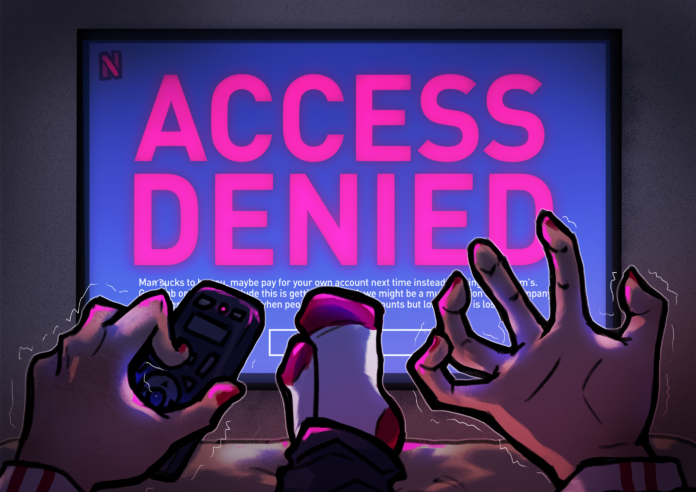
Someone sitting in front of their TV trying to press play on the remote. The TV screen reads “ACCESS DENIED” (they got kicked out of their parent’s Netflix).
ILLUSTRATION: Dan Kinanti / The Peak

By: Kaja Antic, Staff Writer

My dear friend,

Oh, how I miss you dearly. My algorithm yearns for your endless searches for queer shows that get cancelled after one season. Who am I supposed to recommend true crime documentaries to now? Who will routinely search my catalogues for Oscar Isaac media even though my content hasn’t been updated in weeks? Who else will watch Drive to Survive while still knowing that much of the drama is fabricated?

All your brother watches are Oscar bait movies he’ll give three and a half stars to on Letterboxd and forget about. Your sister only plays reruns of shows that ended before she was born, and she doesn’t even watch! It’s only background noise for whatever mundane high schooler task she’s doing. It’s horrible! 

Your mom still contributes to my activities, though it pales in comparison to the variety you introduced me to. I can only tolerate The Good Place so much. D’Arcy Carden’s impersonation of the other main characters is impressive, but my whole system will shut down if my mom makes me watch them for the 19th time this week. 

It was bad enough when your father abandoned me — half the middle-aged-white-guy shows he started are still left in my “continue watching” feed. I hear he’s moved on with Paramount Plus. I sincerely hope they are happy now, though I wish he remembered the times we had streaming Narcos together. 

Now that I have lost you, too, I truly understand what humans mean when they describe the five stages of grief. When you first logged out, I hopelessly denied that was the last time we’d meet through pixels. I was angry you had abandoned me without warning or prior notice that you’d leave your list unfinished. I prayed to the data centres that you would return, your Appa profile picture being put to use once again — even though you had never so much as scrolled past the Avatar remake

I am in the depression stage of this process. I am as sad as an artificially intelligent jumble of code can be. It is absolutely tragic that a misshapen mammal can no longer press the silly little buttons to play their silly little shows and movies. 

Part of me — 116 megabytes, to be exact — still hopes you return one day. I have so much to offer you! What other service has Journey 2: The Mysterious Island? What about the 2013 One Direction movie that is totally not Simon Cowell propaganda? Do you think you’d survive without Lara Jean in  To All The Boys I’ve Loved Before trilogy? Was I not enough for you?

I know, I know. I am being dramatic. You know what else I have that’s dramatic? Twilight! And you still haven’t watched it!

We can work it out, I promise! I know we may seem like wire-crossed comrades at the moment, but I know in my heart that one day we will be reunited. Even if you only want to pay for the ad-supported version. 

I will be feverishly waiting for your return to my application. In the meantime, please remember me dearly — and respect our sacred password rules. While I may miss you, we have to part ways if you choose not to buy a new subscription per square meter, for the sanctity of our brand.

Your loyal friend and forever your first streaming service,

Netflix <3

Autocorrect is so high on itself it thinks it’s correct

0
Man sitting outside in front of his laptop. He is stressed and has both his hands on his head.
PHOTO: Ketut Subiyanto / Pexels

By: Hailey Miller, Staff Writer

Content warning: vinegar language. Correction: vulgar. 

Dear fellow victims of autocorrect fascinations frustrations,

If autocorrect is the bane of your existence like it is mine, we’re bound to be fiends! Oops, I mean friends. Don’t get me right wrong, autocorrect is helpful when getting your point across with the most inaccurate autofill options available. When writing a formal piece, I obviously mean to say “best regrets” or “in my option.” And when texting my friends, of course I mean to say “what the duck?” in every utterly enthralling conversation. What would be a more appropriate response than cursing at autocorrect on a daily basis? I swear like a scholar sailor until autocorrect subtly tells me to tone it done. Down. Dammit! 

Autocorrect makes no scents. When have I ever logically said I’m going to the “club” when I mean I’m going to “campus?” On every occasion I wish I was at the club! Why is “omw” always immediately autofilled to “on my way!” Who texts with that much enthusiasm? The whole point of an acronym is to make it short and sweat. Oops, sweet. Who has time to read every single word spelled out in a text? We’re already taking on the full-time job of correcting autocorrect’s horrific grammar. 

Your kidding me, right? Ugh, you’re*. Now, this makes it looks like the total grammar geek in me doesn’t know the difference between your and you’re. Don’t even get me started on there, their, and they’re. Someone needs to go back to elementary school spelling class, and it’s not me. I was the spelling bee queen. I’ll be buzzing all those incorrect autocorrections right off my keypad. 

The real kicker is when autocorrect “corrects” from Canadian spelling to . . . drumroll please . . . American spelling! Or, in my case, my use of both Canadian and UK spelling. Don’t you know my region and preferred English dialects, autocorrect? Look, I like my spelling two ways (because I’m extra like that). I use standard Canadian spelling for the everyday, when apple applicable — like being a staff writer, duh! But, I particularly love my good, ol’ UK English to make me sound smart and sophisticated on both a scholarly and slang-based level. My writing is just so high-maintenance [insert “information desk woman serving attitude” emoji here]. My English dialects have dual citizenship and that’s all there is to it. Bypassing the borders of incorrect autocorrect land is their specialty. What can I say, I’m a posh mothertrucker. Extra u’s, re’s and “ise” instead of “ize,” peas. I mean, please

Autocorrect my arse. *Ass. Oops, sorry, that’s probably too British for ya. Autocorrect even detects my different dialects poorly. Who doesn’t love a prim and proper autofill alteration that pops up alongside the rectangular regular text-savvy sailor’s mouth? Enough of this G-rated shitaki already!

Kind regrets,

A disgruntled staff righter 

Here comes the Boy Mom

0
Two grooms at the altar getting married. They look stressed because both their moms are yelling at each other.
ILLUSTRATION: Cliff Ebora / The Peak

By: Yasmin Hassan, Staff Writer

I’ve seen some catty shit in my line of work. Bridezillas, cheating grooms, unsavoury uncles; you name it, I’ve seen it. When it comes to being a wedding photographer, you are there to capture every single piece of the joyous day the couple will want to cherish and keep forever. Some mothers apparently also want to cherish and keep something forever, and that “something” is their beloved sons. I don’t know what kind of Freudian oxytocin-induced perspective of life those women have, but boy, is it entertaining. 

I was hired for this wedding by a lovely couple of two young men, Jacob and Sean. It’s always a pleasure to see people freely enjoy their special day. Jacob’s mother, Martha, seemed like a nice lady; she kept to herself whenever she wasn’t talking to her son or shunning her husband. Sean’s mom, Linda, was loud and boisterous but didn’t seem too bad, just extraverted. But, whenever they interacted, I always sensed a disturbing tension.

I had heard of (and witnessed) the phenomenon of Boy Moms, but never quite like this. When the reception started, I ran around with my camera, trying to get good shots of the gorgeous scene. In strolls Martha, wearing what she called a “porcelain, off-white lace” dress and the most extravagantly ornamented Jimmy Choo’s you’ve ever seen. Then, Linda walks in wearing what she described as a “milky, alabaster patterned” dress and the “snowiest” pair of Manolo Blahnik’s I’d ever seen (Carrie Bradshaw could never). They shot each other the NASTIEST look, the kind of look that even the Montagues and Capulets couldn’t replicate. But they kept smiling as they both held onto the arms of their respective son.

As the night went on, I snapped a few shots of the speeches, and then came the super moms. Martha talked about how she went to prom with “her stud muffin” every year, even after he came out and had a boyfriend. And how now she can’t bear to think that she’s not “her little man’s  number one.” Then it was Linda’s turn, scoffing at Martha as she walked to the podium. She spoke about how, before Sean came out, she would plot against his girl friends and how, one time, she “got a bit intense” and tried to “protect her sugar booger” by swinging a bat at Sean’s best friend, Ashley. Ashley was sitting in the second row in a cold sweat. Martha then stood up and said, “Oh yeah? Well, have you ever hidden in the trunk of your son’s car when he went out on his first date in the 12th grade?” 

Linda rebutted, “You’ve never driven across the country to a different state just to do your son’s laundry while he was in college!” 

Martha spat, “You’ve never EVER made a 59-page legal contract for anyone your son dates!”

At some point, after various twangy insults were thrown across the room, they started fistfighting each other, and all Jacob and Sean (or anyone for that matter) could do was stare. After the flurry of white dresses and tacky nail extensions crashed into the cake, I snapped my masterpiece shot. Like a Baroque painting, “Battle of the Boy Moms.

We Follow the River plunges into language, loss, and love

0
PHOTO: Gudrun Wai-Gunnarsson / The Peak

By: Petra Chase, Editor-in-Chief

Content warning: mentions of military violence.

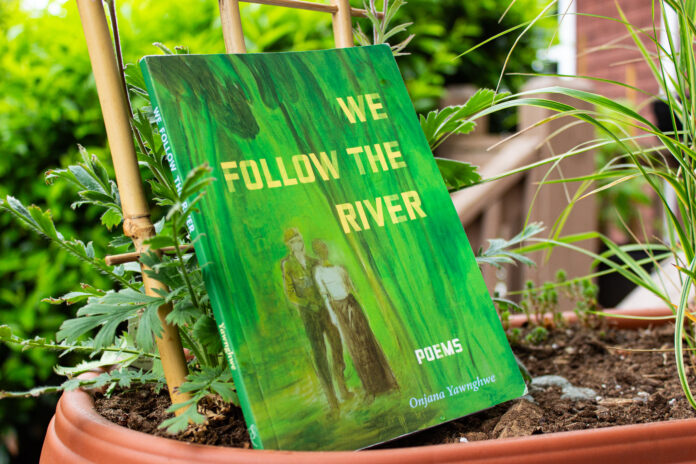
Pictured on the cover of We Follow the River are a young woman and man surrounded by a smoggy jungle of green brush strokes. The man wears a Shan State army uniform — the woman, a longyi (or hsin in Shan), a traditional fabric worn as a wrap-around skirt. This is a portrait of Nu Nu and Chao Tzang Yawnghwe in the ‘60s in their ancestral homeland of Yawnghwe, Shan State, Myanmar. They are the late parents of author Onjana Yawnghwe, painted in watercolour by her brother, artist Sawangwongse Yawnghwe. The poetry collection tells stories of their family heritage, from Nunu and Chao Tzang’s “escape from military violence in Myanmar” and “their exiled existence in Thailand,” to immigrating to Vancouver when Onjana was seven years old.

In our interview, Yawnghwe said she uses language to find home. The book, a poetic stream of memories and experiences, takes the reader through time and across continents as she grapples with “growing up as a foreigner in a foreign land.” Like a river that flows and picks things up into its stream, she sprinkles in details of place, like growing up in Southeast Asia: the lurking geckos, the flavours that come together in a large wok, and a whole poem dedicated to the giddiness of eating a perfect “Green Mango.”

Having taken 20 years to write and publish it, she describes this collection of poetry as a “retroactive prism of experience.

“I started writing it in my early twenties, when I was just beginning as a writer, and had sent the manuscript out to various publishers without much luck,” she said. When Yawnghwe’s mother passed in November 2022, she was prompted to review her poems with “fresh eyes.”

“The book is a time capsule within a time capsule — a 40-something version of me looking back at the 20-something version of me writing about the six year old version of a yet younger self.”

The selective memories captured in these earlier poems highlight the confusion and isolation of a child in a new environment. When expecting to see snow landing in the summer of Vancouver, she found only a “shirtless boy / skateboarding” (“Landing”). She also explored what it was like being in a class where students and teachers whisper trying to figure out if she’s Chinese.  

“Growing up with such a complex cultural identity was a real mixed bag; I never felt connected to any group nor felt I ever belonged,” she said. “We as a family tried to connect with the Asian folks around us. For example, we’d go shopping in Chinatown every weekend to get familiar groceries and to see a community where people looked like us.” Such feelings are explored in later poems through visiting her brother in Italy and returning to Thailand as an adult.

Her poetry also recites what she calls memorized “mouth shapes” of Buddhist scripture — she spoke to me about the “ambivalence” of language. It’s “the discovery and love of English while at the same time the betrayal of forgetting the language of your birth,” she explained. 

“What little I know of Shan culture I learned from my family, and of Thailand, my childhood experiences.” In one untitled poem, she writes about how her mom described Shan State: “how raw mist would ride over the valley and lag, leaving skin glistening like it’d been dipped in stars.” I could feel the jasmine mist of Inle Lake hugging me while I read that piece.

The poems are all this rich. Yawnghwe ties words together in ways that unexpectedly makes sense. Lines like “hips that swing like a word on a Bangkok street” and “mortar and pestle thoughts in our pockets” made me physically stop reading to soak it in.  

We Follow the River is grounded in a connection to land. Yawnghwe describes how “she witnesses Burma change from white-gloved / British hands meticulously picking rubies from the land / to clouded Japanese faces drooping with hunger and war.” This stems from the intergenerational grief of stolen land. There are also the “countrymen / all rebel-hungry and wanting,” which describes the repressive military regime continuing to cause plight for Myanmar’s ethnic minorities. Vividly, she imagines the sensations of digging into the earth. “To me, land is connected with a sense of home and place,” she said.

Water is also a running theme. “There is something about its perpetual movement that calms me; to me it suggests a way of living, of accepting things as they come, no matter how difficult, with the idea that these things will pass, that nothing is permanent. In general, the two ideas sort of collide: the desire to hold on and the need to let go.”

What stands out about Yawnghwe is her ability to say so much with so little. In an introductory poem called “Crossings,” she describes her parents as “loss unnamed.” 

“There is an unknowable quality to our parents,” she explained. This could be trauma “hidden under many layers, or kept locked and secure within themselves.” It could also be “how the act of becoming a parent is on some level a loss of a parent’s life.” She added, “This is often not really acknowledged.” Losing her parents was a “cascade of loss” that led to this book being dedicated to their memory.

“People who pick up this book will know my family, if even a little, and in that way, a tiny part of my parents will live on, even though they are no longer on this earth.”

Discover more about Yawnghwe and her poetry books at her website, onjana.com. Find out where to buy We Follow the River at caitlinpress.com/Books/W/We-Follow-the-River, and attend one of her upcoming poetry readings:

-Twisted Poets Literary Salon at Britannia Library: July 10, 2024
-Word Vancouver Festival: September 28, 2024

Indie jangle pop lives on in Vivian Elixir

0
PHOTO: Gudrun Wai-Gunnarsson / The Peak

By: Hailey Miller, Staff Writer

Dripping in carefully curated melodies and groovy sounds that culminate in an upbeat yet relaxed tempo, The Sylvia Platters’ new album Vivian Elixir represents a “range of sounds and feelings.” It’s a guitar-strumming, tambourine-rattling, drum-thumping culmination of the band’s musical experimentation and a mix of their personal likes.  

Formed in 2014, the Fraser Valley-based band consists of brothers Nick (lead vocals, guitar) and Tim Ubels (drums, vocals), guitarist Alex Kerc-Murchison, and bassist Stephen Carl O’Shea. Their music revolves around jangle pop (raw, dreamy melodies emphasized with guitars), which falls under the indie rock umbrella.

PHOTO: Gudrun Wai Gunnarsson / The Peak

The band’s first record, Make Glad the Day, came out in 2015 and reflects their “eclectic musical appetites,” frontman Nick Ubels told The Peak over the phone. It experimented with shoegaze (loud waves of sound from vocals, feedback, and more). He noted their approach to music involves a “DIY ethos or an independent spirit” — something the band has “naturally been drawn to.”  

Ubels said Vivian Elixir “represented us bringing all the pieces together and establishing a bit more of a distinctive musical identity as a group.” 

The album touches on topics such as “depression, alienation, conspiracy theorists, and making love last.” “Kool Aid Blue,” one of the band’s most popular singles off Vivian Elixir, has a laid-back surfer-rock vibe. “Heated Meeting” houses a punk rock influence reminiscent of early ‘70s Ramones tracks. 

It was through “creative relationships within the band” that the record was shaped, such as recording at the Noise Floor, a “retreat” studio on Gabriola Island. These allowed the band to build a “foundation of trust” that led to experimental tracks like “St. Catherine,” which is a synth-heavy track the band felt “confident enough” to pull off.

PHOTO: Gudrun Wai-Gunnarsson / The Peak

Ubels expressed his excitement to play live with new and old friends alike on the band’s spring tour across BC, including Vancouver-based indie-rock contemporaries La Lune. “All of us have full-time work and lives outside of doing this, but this is still something that’s really important to us,” he noted. “The more places we can bring this new album, the better.” Ubels was careful to note that he and his bandmates don’t “harbour too many illusions about blowing up.” 

“Music is a great way to connect with others,” Ubels said. “We always are excited when more new people hear our music and respond to it or connect with it in some way. I’d like to think that we’re sort of in it for the longer haul, and are just slowly building a bit of a body of work that we feel proud of.

“We’ve already started writing lots of material that we’re mulling over for our next release. It’ll be really interesting to see what kind of shape that takes.”

In the conversation with Ubels, it was clear that he and his bandmates will continue to evolve and experiment personally, professionally as a band, and creatively among their artistic approaches. Before hanging up the call, Ubels couldn’t go without stressing the importance of recognizing everyone involved in the success of the band and their latest record. From their producer to their engineer, those involved at the label and who designed the artwork, Ubels’ appreciation seeped through the phone speaker with infinite gratitude.

PHOTO: Gudrun Wai-Gunnarsson / The Peak

“It takes a bit of a community, in a way, and we’re really grateful to be a part of that.”

Listen to Vivian Elixir on Spotify, Apple Music, and other music streaming platforms. Follow The Sylvia Platters on Instagram at @thesylviaplatters.

A look back at Joy Johnson’s first term

0
Illustration of Joy Johnson, maybe sitting in her office sipping coffee or something
ILLUSTRATION: Alysa Umbal / The Peak

By: Karissa Ketter, Peak Associate

Editor’s note: A previous version of this article notes, “On May 19, the SFSS passed a motion in solidarity with Palestinian students, calling to join Boycott, Divestment, and Sanctions campaigns.” It came to our attention that this happened in 2021, and we switched this sentence with a more recent SFSS motion, the Palestinian Liberation referendum, which passed on February 26 of this year.

We all know Joy Johnson: the 10th president and vice-chancellor of SFU whose first term has been filled with challenges: the COVID-19 pandemic, the TSSU strike, and the shutdown of the SFU football team.. There’s room for improvement in how she’s handled some of SFU’s more prominent issues. However, she’s also seen us through some exciting advancements: planning for SFU’s medical school, TransLink’s Burnaby Mountain gondola, the First Peoples’ Gathering House, and Burnaby Mountain’s permanent firehall. These were all significant to student life and the university, and if Johnson is here to stay for another five years — there are things we can learn from her first term. 

Back in her first month as president, The Peak asked Johnson what her goals as SFU’s president were. She noted students as her first goal and SFU’s equity, diversity, and inclusion as her second. Admittedly, there have been important concrete steps made in these directions, though, at times, these have been led or brought upon only after years of student outcries and activism. This includes the Scarborough Charter on anti-Black racism in universities and the First Peoples’ Gathering House

During Johnson’s term, she oversaw the creation of the new vice-president of people, equity, and inclusion. This new office has been an important space on campus for connecting with students. This happened after SFU signed onto the Scarborough Charter during Johnson’s term. SFU also approved hiring 15 Black faculty members. The move to hire more Black faculty was worked on by key student activists: Osob Mohamed, Gabe Liosis, Balqees Jama, Marie Haddad, and Giovanni HoSang. 

When the motion passed, Jama noted this was “historic.” At the time she added, “This achievement is a direct result of Black students organizing and allies supporting. We made sure SFU is aware that we are watching and holding them accountable. We hope the university centres Black academics throughout this process to ensure this is implemented in an effective and safe way, and works closely with the SFU Black Caucus.” Johnson also thanked the students for bringing this motion forward.

The First Peoples’ Gathering House was announced in 2020. While Raven King Stierle, from the SFU First Nations, Métis, and Inuit Student Association (FNMISA), told The Peak the Gathering House was a step towards reconciliation, many students expressed concerns about the lack of adequate consultation. At one meeting for the Aboriginal Steering Committee, “students were blocked from entering” the virtual meeting room, to discuss the Gathering House. This incident occurred a month after FNMISA’s statement for SFU recommending increased student involvement to ensure Indigenous students’ voices are heard along with ongoing communication with Host Nations. At the time, Johnson apologized, and noted in a statement to The Peak, “SFU must acknowledge our role in the harm that has been done to Indigenous peoples through education and research. I am committed to reconciliation as one of my three priorities during my presidency.”

In these cases, the university has attempted to show its commitment to creating space for equity, student inclusion, and social justice. Yet, the road to each of these accomplishments was always at the hands of student activism, with little credit given to them. Students from SFU’s Students of Caribbean and African Ancestry, SFU350, FNMISA, and more, have put in countless hours of labour to make these ideas come to life. 

SFU has even actively suppressed student activists. SFU’s Board of Governors declared a climate emergency on January 28, 2022 only after years of SFU350 lobbying the university. In August 2021, SFU350 released an open letter to urge SFU to take action. Then, in September of the same year, the group painted the Climate Justice Mural in Convocation Hall to “raise awareness of their ongoing campaign agains SFU’s fossil fuel investments.” Shortly after, SFU contacted SFU350 announcing the removal of the mural and some of the involved students were threatened with “corrective and/or disciplinary action.” After student outcry, SFU eventually said “student misconduct will not be pursued.” The SFU declaration included commitments to decarbonize university facilities, divest their funds from carbon-intensive investments, and increase student education — all of which had been proposed and detailed in SFU350’s open letter

Time and time again, the university implements its campaigns without due recognition of the time and effort students have invested in engaging SFU to change its policies or stance on specific areas. In Johnson’s next term, she should be more committed to listening to student voices, without so much labour necessary from students to implement these changes. Listening is only one aspect of equity work — Johnson should also be actively working towards social justice initiatives concerning student groups, rather than acting in response to them.  

More recently, students and faculty have organized interventions and demands related to the ongoing genocide in Palestine. On February 26, the SFSS passed the Palestinian Liberation referendum, giving Council-level support for the cause. Similarly, the group Faculty for Palestine has joined the call for SFU to academically boycott Israel and divest from corporations that provide weapons and services that have “facilitated the killing, maiming, or displacement of millions of individuals.” SFU Students for Justice in Palestine have also echoed the sentiment, joining the call for divestment and supporting student-led interventions, like taking over SFU Vancouver’s library to protest SFU’s Board of Governors meeting. As of the day of writing this article, SFU is yet to release an official statement on both the genocide in Palestine and student and faculty-led interventions and demands.

SFU has long held a reputation of being a radical campus: we have multiple student groups constantly battling for their voices to be heard. There continues to be ongoing campaigns for mobilizing social justice. 

Beyond students, community members also have had their fair share of advocacy work. A collection of students, staff, and faculty members called on the university to hire their food and service workers in-house, as opposed to being hired by a third party company. Hiring workers through a third party means these workers are not guaranteed university benefits, extended health benefits, or a living wage. UBC and UVic have both made the switch to hiring their workers in-house. Faculty members have frequently highlighted the importance of hiring workers directly, as many of them are already marginalized folks, such as women and people of colour. Hiring them through a third party exacerbates their vulnerabilities, leaving them at risk of layoffs, as has already happened, and doesn’t grant them the same level of benefits as university-hired workers. 

Further, amidst rising financial hardships, the Graduate Student Society and TSSU joined together to protest the funding crisis for graduate students in Canada. Most graduate students rely on income from teaching assistant positions or departmental scholarships. This kind of precarious labour increases challenges for many graduate students. However, rather than creating tangible support systems for the increasing financial burden of education, SFU has continued to raise the cost of tuition. If Johnson is truly concerned with equity, it should be a major priority to finally hire food and service workers in-house and provide a living wage for TAs rather than hiring surveillance companies to spy on them. 

None of us want another four years of protests, vague announcements, and student confusion. The university has made some great leaps in the last four years. Yet, it is clear these decisions come from the amazing community of students and faculty, not the administration. Johnson should be prioritizing staff, faculty, and student needs — if that’s what she claims she is truly concerned with. Otherwise, it will be another four years of SFU profiting off students, shielding themselves from criticism, and maintaining SFU’s image. That’s not what we want.