
Threats to water security trigger emergency declaration by syilx Okanagan Nation
By: Tomos Land, Staff Writer
Editor’s note: The Peak spells nsyilxcən words in lowercase in accordance with syilx language holders who say that capitalization implies a hierarchy of importance, which does not align with syilx ethics.
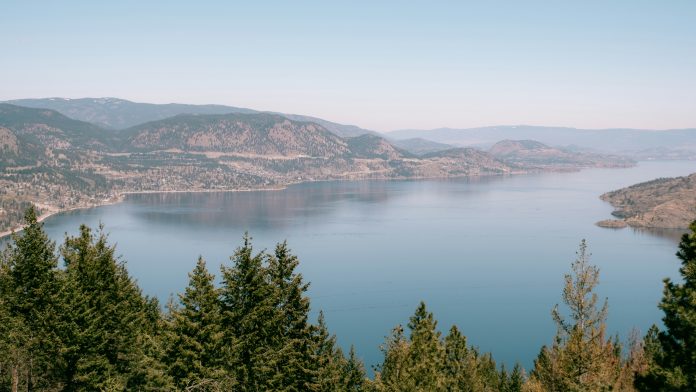
Growing water insecurity, driven by climate change and its cascading effects in BC, has led to a recent declaration of a watershed emergency by the syilx Okanagan Nation Alliance (ONA). The alliance is a First Nations government “comprised of seven member communities in the Southern Interior of BC: Okanagan Indian Band, Osoyoos Indian Band, [snpink’tn] Penticton Indian Band, Upper Nicola Band, Upper and Lower Similkameen Indian Bands, and Westbank First Nation; and in Northern Washington State, the Colville Confederated Tribes,” according to the ONA website.
The announcement comes after members of the ONA “observed accelerating environmental changes, including early hot temperatures; low snowpack; unusually dry upper watershed creeks, springs, and wetlands; increasing water temperatures, and ecosystem stress” across multiple watersheds throughout the region. The alliance members have also noted struggles of local biodiversity, including “early die-off of sp̓iƛ̓əm (bitterroot), and declining streamflows impacting xʷəxʷm̓ínaʔ (rainbow trout) populations.”
In their statement, the alliance expressed that “current government and management systems have failed to adequately protect watershed health. This is compounded by major knowledge gaps around headwaters, groundwater interactions, and cumulative impacts that continue to limit informed decision-making.”
In order to mitigate the impacts of the emergency, the press release called on “the province of British Columbia and all relevant agencies to take immediate and coordinated action” on the issue. This includes the “establishment of a syilx Nation-BC co-governance forum on water scarcity” and the “inclusion of local governments in coordinated watershed management.”
The syilx Okanagan Nation also called for “a moratorium on new surface and groundwater licences.” A moratorium — the suspension of a certain activity, often of a legal nature, for a period of time — of these licences, would prevent corporations and groups from being granted permission for various types of non-domestic water use, although license holders would be able to continue operations.
The Peak reached out to the Okanagan Basin Water Board (OBWB), a government support organization who focus on water projects in the Okanagan Valley, for comment. “The OBWB supports the ONA’s call for urgent collective action.
“Working together now, with an ethos of One Valley, One Water, is required to protect water — the key to life in the Okanagan”
— Melissa Tesche, OBWB executive director
The Peak reached out to the Okanagan Nation Alliance and the City of Penticton for comment, but did not receive a response prior to the time of publishing.
The ONA’s emergency announcement comes at the beginning of a summer season where scientists predict record heat. This is due to the beginning of El Niño, a stage of the weather-altering El Niño-Southern Oscillation cycle. El Niño, a “climate [pattern] in the Pacific Ocean,” happens about every two to seven years, according to the National Ocean Service. The Service shared that “areas in the northern US and Canada are dryer and warmer than usual.” El Niño will likely “turbocharge extreme weather across the planet,” according to CBC News.
Thomus Donaghy overdose prevention site faces third closure in three years
By: Maya Barillas Mohan, Staff Writer
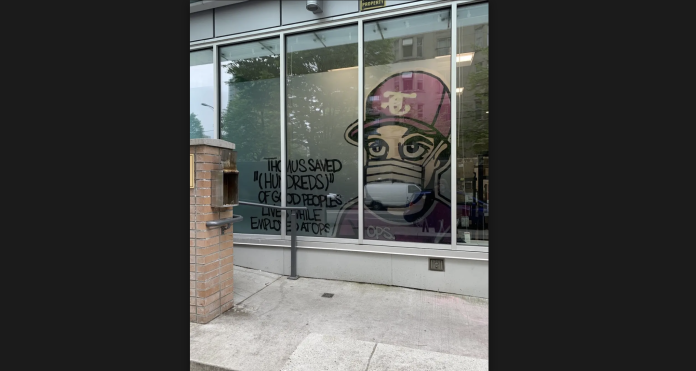
The Thomus Donaghy overdose prevention site (OPS) has experienced a series of relocations since its opening in 2021. Most recently, its planned reopening on June 1 was cancelled by the City Council.
The OPS, which was named after an OPS peer worker who was tragically killed, is a supervised space that allows drug consumption without risk of criminal persecution, instead focused on providing drug testing or other support services if necessary. According to the Vancouver Coastal Health (VCH) website, OPSs “help save lives by responding to overdoses quickly,” “prevent the transmission of infectious diseases,” and connect “people to health services.” Further, they “bring stability to the community by [ . . . ] reducing consumption taking place on the street.”
The past Thomus Donaghy locations have been the Seymour street location, which closed in 2024, and the Howe street facility, which was closed January 2026. These sites were reportedly shut at the request of building owners, according to CBC and VCH. By early May, a new location on Helmcken was secured by VCH for the Thomus Donaghy OPS.
However, the relocation was stopped in its tracks by mayor Ken Sim. According to Daily Hive, complaints have been made by business owners about “worsening street disorder, untreated mental health challenges, addiction, public safety, and the growing strain on downtown businesses.” Further, Daily Hive shared that business leaders expressed there was “not enough consultation” on the new OPS location.
On May 27, minister of health Josie Osborne released a statement saying that VCH “will not proceed with the overdose-prevention site at 900 Helmcken St. at this time, and there is currently no planned date for opening.”
According to CTV News, mayor Ken Sim proposed a motion to “use all tools available” to prevent the opening of the Thomus Donaghy OPS. CTV News reported, “The motion passed by Council on Tuesday directs city staff to conduct a ‘comprehensive review’ of permits and approvals to make sure they comply with city bylaws and rules, telling staff to consider revoking permits or licences for the facility if ‘legally supportable.’”
The Peak reached out to the City of Vancouver and VCH for a statement, but did not receive a response prior to the publication date. At the time, it is unclear what tools the Council used to prevent the OPS opening.
The Peak also reached out to the BC Centre for Substance Use (BCCSU) for a statement, and was directed to BCCSU research scientist and interim director of research, Dr. M-J Milloy. He stated, “Evidence also shows that [OPSs] work best when located within areas with high rates of drug harms, such as the local health area around the Donaghy OPS, which has the second-highest rate of fatal overdose in BC.”
Milloy expressed that OPSs are “linked to lower risks of fatal overdose, infection with blood-borne pathogens, and higher rates of uptake of medical care, including treatment for substance use disorders.” He shared that “although they are not meant to resolve drug-related disorder — such as public drug use, drug-related litter, and crime — nine studies from around the world, including Vancouver [ . . . ] found [little to] no increases in crime in the wake of the opening of OPS there.
“By not worsening drug crime but improving important measures of public health, I believe OPS contribute to their communities.”
— Dr. M-J Milloy, BCCSU research scientist and interim director of research
Without the Thomus Donaghy centre, there are only 11 centres to respond to a far-reaching crisis. “Vancouver City Centre Local Health Area [records] the second highest rate of overdose deaths in the VCH region, and the second highest number of calls to BC Emergency Health Services,” according to VCH. As of May 5, VCH shared that the Thomus Donaghy OPS had received almost 150,000 visits and responded to nearly 500 overdoses. Without this OPS, no overdose support is provided to users in the downtown core.
SFU study tracks chemical exposure for juvenile Chinook salmon
By: Lucaiah Smith-Miodownik, News Writer
The diet of a juvenile Chinook salmon doesn’t normally contain cocaine.
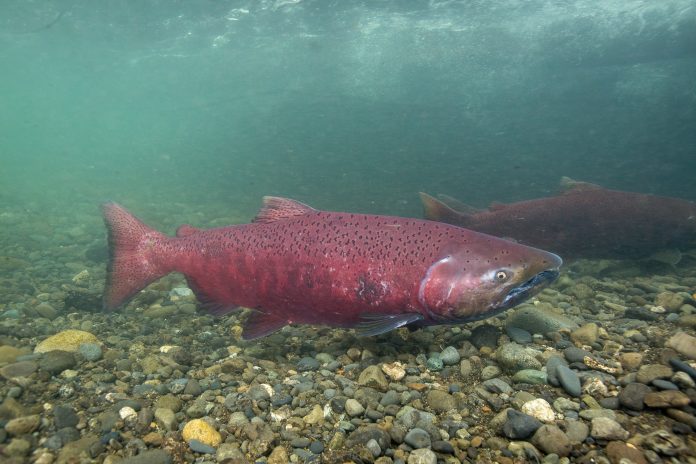
But in the Lower Fraser River, these fish are being exposed to a myriad of chemicals, toxins, and substances such as cocaine, alongside other “pharmaceuticals and personal care products, [as well as] pesticides, polycyclic aromatic hydrocarbons, flame retardants, and polychlorinated biphenyls.” For humans and salmon alike, these substances are linked to potential harms to growth and disease.
According to a recent study headed by SFU doctoral student Bonnie Lo, Harrison Chinook salmon tested for upwards of 368 organic contaminants, 16 of which are considered “priority” for their “potential for adverse effects” for “aquatic life,” an indicator of high risk level for those studying the salmon.
The Peak corresponded with Bob (Galagame’) Chamberlin, founder and chair of the First Nation Wild Salmon Alliance, for more information.
“This science paper’s outcomes can hardly be called a surprise,” Chamberlin told The Peak. “The list of impacts and stressors to the health and abundance of wild salmon continues to grow as this science outcome clearly demonstrates.”
Still, more information is needed in order to better understand exactly how this mix of chemicals impacts the salmon. “Toxicity data is mostly based on single-chemical exposures, but these fish are being exposed to hundreds of chemicals at once,” said senior study author Tanya Brown to SFU News. “We simply don’t yet understand the additive effects of this chemical cocktail.”
In an SFU press release, salmon biologist and co-author of the SFU study Dave Scott noted that the young salmon “depend heavily on these [river] habitats for growth prior to entering the ocean.” The study highlights that their environment, the Lower Fraser River, has been impacted by “activities including, but not limited to, forestry, mining, pulp and paper, wood preservation, chemical manufacturing, runoff (e.g. stormwater, agriculture) and wastewater (sewage) treatment.”
Researchers noted that “these past and current activities have contributed to the presence of a [wide] range of organic contaminants, including legacy contaminants and contaminants of emerging concern in the river.” Contaminants are labeled “legacy” when scientists have gathered “a firmly established body of research spanning decades on aspects relating to their prevalence, transport, and transformation in the environment,” according to Cornell University.
Serious vulnerability for the Chinook salmon is not new, with “15/17 of assessed populations classified as ‘endangered’ or ‘threatened.’” A lack of salmon affects the food chain in many ways. Endangered Southern Resident killer whales rely on the fish for up to 90% of their diet during summer months, and the low numbers of Chinook salmon are a major reason for these killer whales’ endangerment. Additionally, Chamberlin shared, “Chinook salmon play an integral part to Food Security for First Nations across British Columbia. As do all species of pacific salmon.”
Whether for humans or whales, “salmon is far beyond a food staple or menu choice,” Chamberlin added. These fish “are foundational to traditions and culture. And not just for First Nations but many British Columbians both coastal and interior,” he added.
“They form an integral component of First Nations ties to their traditional lands and waters and stewardship responsibilities handed down through generations.”
— Bob (Galagame’) Chamberlin of Kwikwasut’inuxw Haxwa’mis First Nation, founder and chair of the First Nation Wild Salmon Alliance
“Wild salmon need to be cared for beyond the four year cycle of federal and provincial elections. Protecting and rebuilding salmon runs and associated habitats must be elevated to that of a Nation Building Project for them to have any measure of returning to what once was.” A Nation Building Project is a project supported by the federal government that is mutually beneficial to Canada’s economic and sustainability goals, alongside goals of Indigenous Nations.
The project was solidified into a resolution by the BC Assembly of First Nations (BCAFN) on May 5, titled, “Rebuilding Wild Salmon as a Nation Building Project.” It included resolutions to call “upon the Government of Canada and the province of British Columbia to formally recognize wild salmon recovery as a core Nation-to-Nation priority, requiring coordinated, long-term, and First Nations-led action” across multiple government and habitat efforts. Since this resolution, a letter has been sent to the Government of Canada, in part by the BCAFN, furthering the conversation around this project.
New wildfire detection system opens on Burnaby Mountain and beyond
By: Niveja Assalaarachchi, News Writer
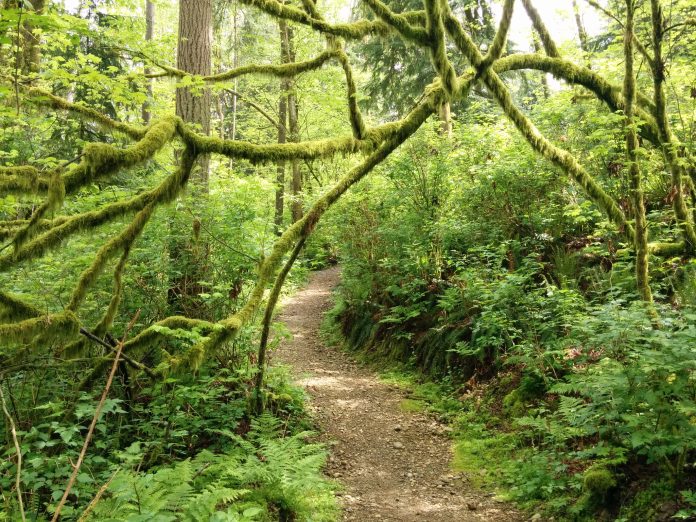
Ahead of the expected wildfire season, the City of Burnaby has opened a new wildfire detection system across different points of the city, including on Lhuḵw’lhuḵw’áyten (Burnaby Mountain). The system includes new technology such as “ground-based sensors and strategically placed smoke detection cameras to identify early signs of wildfire, such as heat and smoke, in near real time,” according to an announcement from the City. The project, which is funded via an agreement with Trans Mountain, comes a year before the city’s planned full-scale emergency exercise which will use the new system.
In a statement to The Peak, the City of Burnaby said the new technology would aid emergency services to “respond quickly, helping to contain small fires before they grow and protecting nearby neighbourhoods, critical infrastructure, and forested areas.”
The City noted that Lhuḵw’lhuḵw’áyten is one of the municipality’s richly forested areas, and the technology would add a “layer of protection in this area, while supporting broader wildfire readiness efforts across the city.” The City also shared in a document that the mountain is “unceded land of the hən̓q̓əmin̓əm̓ and Sḵwxwú7mesh sníchim speaking peoples,” and today is a city-designated conservation area.
The Peak reached out to Sarah Thompson, director of emergency management and business continuity at SFU, to learn more about the detection system and SFU’s role in the 2027 emergency exercise.
She highlighted that the new wildfire system is innovative: the cameras are designed to only detect anomalies in the environment. “The idea is that it does 360 degree scanning of the environment via a live feed, but it blurs any items that could be buildings, things like that,” shared Thompson. “It’s designed to look at forests and the horizon so that it can detect patterns, or rather anomalies to the patterns, like smoke plumes. It also does not record, so the privacy of our community was paramount in this initiative.”
According to the City of Burnaby’s website, the 2027 full-scale city-wide emergency exercise is a “multi-agency, multi-jurisdictional, multi-discipline exercise designed to evaluate the operational capability of interdependent emergency management systems” in the municipality. The city shared that the test, which may occur in 2027, will aim to simulate “the high stress environments that unfold during actual response conditions.” Although no details about the type of emergency this exercise plans to simulate, it will involve “multiple City departments, engagement of First Nation Host Communities, neighbouring municipalities, government and regulatory agencies, non-government stakeholders and community response partners.”
Thompson added, the exercise is planned to “test our decision making capabilities at our Safety and Risk Services Emergency Management Program,” SFU’s leadership program that “looks at the community needs and how we’re supporting large-scale disasters.” Additionally, the team has an emergency shelter that can host 125 people. According to SFU, there are almost 29,000 undergraduates alone that attend SFU, many of whom attend classes on the mountain.
The Burnaby tank farm expansion adds more tanks between the existing ones, meaning that “buffer space that was built originally to prevent the spreading of a potential fire from one tank to another will be compromised.” Following the expansion, there have been concerns raised by SFU leaders, the City of Burnaby, and community members about the heightened risk of a fire, and the potential entrapment of the people on Burnaby Mountain in the case of a tank farm explosion.
To help SFU community members stay safe this summer, Thompson stressed, “it’s really important to think about [emergency planning] ahead of time.” She highlighted how your commute to campus could be impacted in the event of a disaster and carrying emergency provisions or resources “would better prepare you if something unexpected happened.”
Thompson also identified support systems as being key in the event of a disaster. “What is your network in the local community?” She urged individuals to talk “about disasters with that network beforehand to think through what you might do with friends, with family, with loved ones.”
Download the SFU Safe app, which has access to campus services in the event of a natural disaster and/or other disturbances on campus.
Bright-er side: Journaling is a time machine

By: Marie Jen Galilo, Staff Writer
Some journalers have their own “ecosystems” — a collection of journals that serve different purposes. My journal ecosystem consists of a junk journal, a tea journal, a random thoughts journal, and what I call my “plain writing” journal. My junk journal is a gallery of mementos and random objects that all match an aesthetic theme, while my tea journal contains envelopes of teas I’ve tried, and my random thoughts journal houses spontaneous thoughts. I like decorating my junk and tea journals with patterned papers, pictures, stickers, and other keepsakes, but these journals can be difficult to maintain. Aesthetics should not impede you from experiencing the benefits of journaling, which is why plain writing journals exist and a good place to start.
There’s so much power in written words — in conversations, you don’t always have the time to choose your words. When you write, you can take as much time as you need to craft sentences that reflect your sentiments.
Journals are time machines in the palm of your hands that let you look back and reflect on your growth. When something memorable happens, I write about it as soon as possible to capture how I felt in that exact moment. How the writing looks shows a state of being that exists in that moment. When my thoughts are rushing out, it looks messier and fluid. When I’m calm, the writing looks neater, with consistently shaped letters that are evenly spaced out. Reading vivid descriptions in past journal entries lets me relive those memorable moments.
If you’ve ever thought about journaling but don’t know where to start, I encourage you to just write. Your life is a story worth writing about, and the pages of a journal are waiting to hold it.
Google’s march towards AI Search risks further monopolizing content control and cuts out small creators

By: Tomos Land, Staff Writer
Last month, Google unveiled its new artificial intelligence (AI) model, Gemini 3.5 Flash, which allows users to conduct multi-step tasks. This latest iteration of Google’s AI model promises greater latitude for users who are eager to engage with an AI agent from the start of their query all the way until the end. However, this newest advancement in the company’s artificial intelligence push threatens to further monopolize the internet by giving Google the ability to wield even more power over companies and individuals who rely on the search engine for much of their business traffic.
Initially expected to become the default setting after its unveiling, this now-scrapped idea still removes users from the process of searching, filtering, and exploring the results page that has become synonymous with Google. This latest development to Search, even if not rolled out more extensively in the future, pushes more people towards using the feature. Already, entire industries have poured millions of dollars into search engine optimization (SEO) to tweak website titles, web addresses, and backend development to rank as highly as possible on search engines results page. Now, companies who have already spent a substantial amount of resources contorting themselves to adapt to new core updates, could find themselves back at square one.
Everyone is impacted by including AI in the search process.
Small businesses and creators don’t have the disposable income needed to hire an in-house SEO specialist and are reliant on the whims of Google’s search engine rankings to reach new customer bases.
In addition, Google’s AI Mode has shown itself to be susceptible to being easily manipulated to spread misinformation making it harder to find accurate information. The move to double down on a technology that lacks transparency and can produce substantially varying results raises questions about the search engine’s future role in shaping commerce. Search is one of the company’s most reliable revenue streams, making up about 56% of its revenue in the last three years.
In the context of the capitalist economy, the tech behemoth’s investment in AI makes perfect sense. Google’s parent company, Alphabet, who lost a groundbreaking antitrust case in 2024, knows better than most the power monopolization brings. They will be watching the imminent Initial Public Offerings, where companies list and sell their shares publicly, of AI-companies such as OpenAI and Anthropic with a mix of envy and fear in the coming months. Alphabet, valued at more than $4 trillion, are well aware that a failure to adapt to the AI-age will leave them susceptible to the predatory tactics they used to reach their lofty valuation in the first place.
Trillion dollar valuations aside, the companies and creators whose profit margins are perilously impacted by the smallest drop in internet traffic will suffer most from Google’s double down on AI. The cascading impacts of this change may drive more businesses to cheaper advertising alternatives, such as social media channels, including Alphabet-owned YouTube. In any case, small business owners and individual creators will continue to be at the mercy of international conglomerates chasing even greater dividends.
The only energy superpower Canada should become is green
By: Jonah Lazar, Staff Writer
Canada’s attempts to balance economic growth in the oil sector while limiting the ecological damage seem to be failing.
With the new emissions and pipeline deal with Alberta, and natural gas pipeline approved for northern BC, Canada is expanding its fossil fuel infrastructure. The recent spike in the price of oil due to the war on Iran and the closure of the Strait of Hormuz increased revenue for the government and fossil fuel companies, at the continued expense of the environment. But fossil fuels shouldn’t be the way forward for Canada’s energy industries.
Geothermal power is a renewable energy source that stems from volcanic activity and subterranean heat stemming from the earth’s mantle. Pipes circulating water are sent deep below the surface, which is then boiled by the warmth trapped underground before returning to the surface to power a turbine to produce electricity. Canada holds vast amounts of renewable geothermal energy, particularly in the western territories and provinces, with BC considered one of the most promising areas for development.
Many sites in Western Canada, such as Mount Meager near Pemberton, BC, boast enough geothermic activity for electricity to be produced. Others, such as the Western Canada Sedimentary Basin, which ranges from parts of BC to Manitoba, have enough potential to heat homes. According to Statistics Canada, 51.5% of all energy consumption in Canadian homes is natural gas and it is the most common energy source for heating. Natural gas is not renewable, is extracted similarly to oil, and is also dependent on pipelines for transportation. A pivot towards heating our homes with geothermal energy would greatly reduce our dependence on fossil fuels, and would be accessible for much of the west of Canada.
Geothermal energy could produce 5,000 megawatts per hour of energy, which translates to roughly 43.8 million megawatts per year. Nationally, fossil fuels were burned to create roughly 224 million megawatts of electricity in 2024, meaning that geothermal energy could replace almost 20% of our electrical grid’s fossil fuel dependence. Yet, we have hardly started to develop this sustainable energy source. Currently, the Swan Hills geothermal plant in Alberta, is the only active plant in Canada. This plant repurposed an existing oil field to co-produce geothermal and natural gas. No new land needed to be developed and much of the existing drilling and extracting infrastructure was repurposed for geothermal activity, greatly cutting down on costs and future emissions.
Long term volatility in the oil market has led to Canadian companies focusing on short-term profits and automation, resulting in a 17% decline in domestic employment from 2012 to 2023. Even the Trans Mountain pipeline, bought and expanded upon by the federal government, will be expected to sell at a deficit potentially in the billions, due to ballooning construction costs, leaving taxpayers to foot a monstrous $34 billion construction bill.
The economic tide is turning against fossil fuel production in Canada — reduced profit margins have created a dependency on increased production and exportation, which has been dependent on costly and unpopular pipeline projects. Geothermal energy could reduce much of our domestic need for fossil fuels like natural gas, and evidence from the Swan Hill plant shows that older plants can be repurposed. Canada needs to invest in stable, long term green power that will diversify our energy industry and geothermal fill that need.
Reimagining the outdoors as more inclusive and accessible spaces
By: Heidi Kwok, Peak Associate
Pristine towering snow-capped mountains, old-growth forests, and majestic coastal fjords are just a few of the natural wonders we have here on Turtle Island. Outdoor activities are now synonymous with the province’s identity. Summers are for overnight camping trips in the remote BC wilderness, while winters offer skiing or snowboarding in local mountains and resort towns.
Vancouver’s culture is tied to its natural landscapes, landscapes we owe to the caretaking from Indigenous Peoples — and yet, only a subset of the region’s multiracial population is adequately represented in using these outdoor recreational spaces.
The fact that the outdoors remain overwhelmingly white in representation brings us to question: where are all the BIPOC nature enthusiasts?
It’s undeniable that racialized folks are heavily underrepresented in the North American outdoors. In BC, for instance, a 2023 BC Parks visitor satisfaction survey found that an overwhelming 84% of respondents identified as white/Caucasian, while less than 0.1% and 1.1% identified as Black and Indigenous, respectively. These statistics are not exaggerated but experienced tangibly in real-life. As a person of colour, I can’t help but feel alienated in a sea of white people when frequenting Vancouver’s natural spaces. There are deeper reasons for this lack of representation which can be traced back to colonial portrayals of untouched wilderness: an oxymoron which has shaped an outdoors-oriented recreational culture that excludes participation from racialized and low-income folks.
Protected areas and national parks in both Canada and the US are sites of green colonialism, an ongoing form of land grabbing that depends upon the forceful removal and displacement of Indigenous Peoples from their traditional territories in the name of wilderness and ecosystem conservation. Since the establishment of Yellowstone National Park in 1872, national parks were marketed as leisurely retreats and playgrounds which were politically marketed to wealthy white settlers. When recreation became the only acceptable form of use on managed lands that have been reduced to sites of tourism, Indigenous Peoples were then prohibited from living, hunting, and reconnecting with their ancestral spaces. These colonial and state-sanctioned acts of violence continue to reverberate on current generations, as the erasure of Indigenous cultures combined with intergenerational trauma adds to a further detachment from the land. A CBC article summarizes this succinctly by commenting how a “lack of minority representation means some people feel unwelcome in the outdoors,” which adds to further reluctance towards heading out onto the trails.
Paradoxically, the expectations of living in Vancouver are tied to the assumption that nature is right on our doorsteps, free and accessible to all within a blink of an eye — which is not untrue for the most part — the city alone has more than 250 parks. The real issue here are the financial barriers that prevent meaningful engagement with the outdoors. Gear is incredibly expensive. Provincial parks in the Lower Mainland such as Cypress and Mount Seymour Park are both inaccessible by public transit, instead requiring travellers to pay for a private shuttle bus service. Don’t even get me started on winter sports. Ski tickets cost $199 for a two day sky card at Cypress Mountain and $152 at Whistler for a day pass. Local nature spots are either privatized or run like they are, and catered to tourists or people with the means. The Grouse Grind may be a free hike but the gondola down costs $20. Even as a student, the Capilano Suspension Bridge entrance fee still costs between $48–$64, depending if it’s a day or evening visit. As a low-income student without a personal vehicle, the outdoors is simply out of reach.
Outdoor recreation doesn’t just exclude BIPOC and low-income individuals but also people with disabilities. The experience of connecting with nature should be a right that all humans are able to enjoy, however, a lack of accessibility in the built environment of trails means that people with mobility challenges get left behind in the face of expensive specialized gear, lack of information on accessibility features, and steep or poorly maintained trails.
Living in a city with a place identity strongly associated with the outdoors, we must consider how these spaces can be transformed to become more inclusive and accessible for all of its inhabitants.
Indigenous place names in so-called Greater Vancouver
By: Ella Pendlington, SFU Student
The phrase “Beautiful British Columbia,” the slogan stamped on all BC license plates, is often used to describe BC. From the Pacific Coast to the Rocky Mountains, the landscapes here are no doubt stunning. What is now known as BC exists on unceded land that has been cared for by Indigenous Peoples since time immemorial. Greater Vancouver is located on the Coast Salish territories of the Skwxwú7mesh (Squamish), xʷməθkʷəy̓əm (Musqueam), səlilwətaɬ (Tsleil-Waututh), kʷikʷəƛ̓əm (Kwikwetlem), qʼʷa:n̓ƛʼən̓ (Kwantlen), q̓ic̓əy̓ (Katzie), Qayqayt, Semiahmoo, sc̓əwaθən məsteyəxʷ (Tsawwassen), and Stó:lō Peoples. But overwhelmingly, regions and landmarks in BC are known by colonial names, rather than their Indigenous ones.
The importance of decolonization
Colonialism in Canada has brought prejudicial legislation and continues to threaten Indigenous ways of being. The genocide against Indigenous Peoples contributed to targeted acts of Indigenous linguistic erasure, from the Indian Act’s prohibition of Indigenous dance and ceremonies, to residential schools, in addition to the false notion that English and the written word were superior .
Oral history involves the passing of history and knowledge to new generations through speech. In many Indigenous traditions, this is often done by highly respected individuals in communities like Elders and knowledge keepers. Land acknowledgements, for example, are a practice in oral history. They teach recognition and respect of land occupancy, Indigenous history, and cultures, which allows for deeper connection to place and home.
For settlers, decolonization can begin with learning more about this connection, and taking steps to amplify Indigenous voices, storytelling, and languages. One way is to replace colonial language used in daily life, by actively learning and incorporating Indigenous perspectives in their place. The First Peoples Map of BC is a resource that allows people to learn more about Indigenous Nations, place names, and their pronunciations. SFU also has a Host Nation Pronunciation Guide, and the ímesh mobile app, developed by the Bill Reid Centre. The app includes a Coast Salish place names walk and an Indigenous art walk of SFU’s Burnaby campus.
Indigenous languages are alive
As documented by the Canadian Language Museum, there are eight Indigenous language families in Canada, which are distinct languages that descend from a common language. They are: Inuit-Yupik-Unangan, Na-Dené, Algonquian, Iroquoian, Siouan, Salishan, Wakashan, and Tsimshian. There are also three unclassified languages (those which are isolated) — Haida, Ktunaxa, and Beothuk. Salishan, Wakashan, and Tsimshian make up the three families of the Pacific Northwest.
While some languages have large speaker counts — like Cree (around 96,750) and Inuit languages (around 40,000), many Indigenous languages may no longer have many speakers or be frequently spoken. However, it is a misconception that Indigenous languages are no longer alive. “Linguists consider a language to be extinct when it no longer has fluent native speakers. This does not mean that all traces of the language have disappeared,” writes the Canadian Language Museum. Beothuk is one such language. “There may still be people who can passively understand the language or people who are trying to learn to speak it. Fragments of the language may also be preserved in songs or fixed phrases such as greetings.” The term “sleeping” has been suggested in place of extinction because it “acknowledges the potential for the language to be revived.”
Indigenous place names celebrate the connection between Indigenous Peoples and the natural world that is rooted in respect and reciprocity. In the hən̓q̓əmin̓əm̓ language (pronounced HUN-kuh-MEE-num), Musqueam, spelt xʷməθkʷəy̓əm, translates roughly to “place where the məθkʷəy̓ grows.” məθkʷəy̓ is a type of flowering plant, pronounced muth-kwey. Squamish, spelt Sḵwx̱wú7mesh in the Sḵwx̱wú7mesh sníchim (Squamish language, pronounced SNAY-chim), translates roughly to “mother of the wind” and “people of the sacred water.” Tsleil-Waututh is spelt səlilwətaɬ. In hən̓q̓əmin̓əm̓, səlilwətaɬ translates roughly to “People of the Inlet.”
Both hən̓q̓əmin̓əm̓ and Sḵwx̱wú7mesh sníchim are in the Salishan language family. These are historically oral, and writing systems were only recently introduced using the North American Phonetic Alphabet, which is adapted from the Latin alphabet. Special characters and accents are used to accommodate distinct sounds, such as the glottal stop. Others, like Inuit languages, have their own writing systems.
The following list presents Indigenous names and histories of five locations in the Lower Mainland. It’s important to note that many areas may have different names to different Nations, as many Peoples have historically relocated according to season and environmental changes, so any given land could have multiple distinct histories and Indigenous connections.
Lhuḵw’lhuḵw’áyten, meaning “where the bark gets peeled in spring” (Barnet Marine Park and Burnaby Mountain)
Pronounced: Thluk-Thluk-Way-Tun
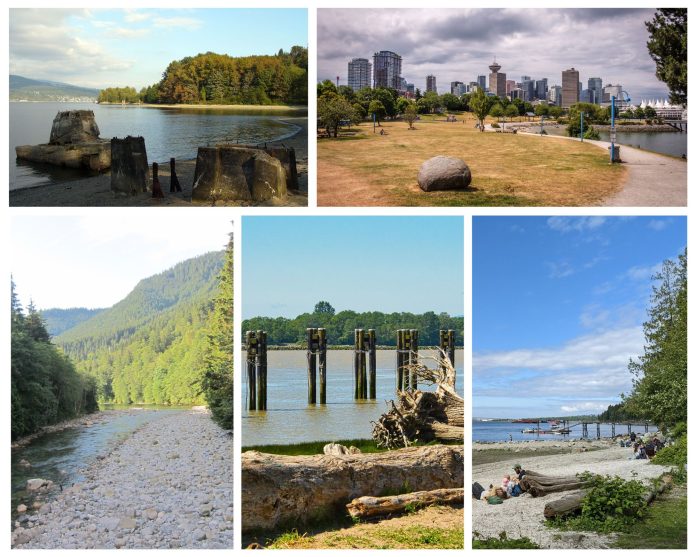
Barnet Marine Park, located at the foot of Burnaby Mountain, is known as Lhuḵw’lhuḵw’áyten by the Sḵwx̱wú7mesh Úxwumixw (meaning village, community, or Nation). Sḵwx̱wú7mesh and other Coast Salish Peoples have long harvested bark from the lhulhuḵw’ay (arbutus) tree to use, for instance, medicinally, to treat colds and tuberculosis by chewing on the leaves. Lhulhuḵw’ay means “always peeling tree,” and is derived from lhuḵw’, meaning “peel.”
Skwxwú7mesh Úxwumixw councillor, Khelsilem, told Vancouver is Awesome, “One of the things about our place-naming culture historically is that a lot of the place names are based off of sightlines from the water.” Therefore, Burnaby Mountain, where SFU’s Burnaby campus is located, is known as the mountain of Lhuḵw’lhuḵw’áyten in Skwxwú7mesh sníchim.
Leḵ’leḵ’í, meaning “many leaves dropping” or “leaves falling to the ground” in Sḵwx̱wú7mesh sníchim (CRAB Park at Portside)
Pronounced: LEK-Lek-eye
What is now known as CRAB Park at Portside is located along the south waterfront of səl̓ilw̓ət (pronounced suh-ley-l-wut, meaning Burrard Inlet in hən̓q̓əmin̓əm̓). For thousands of years, Coast Salish Peoples fished, clammed, and hunted along səl̓ilw̓ət, travelling by canoe and gathering seasonally.
In 1886, there was a fire that began on the downtown peninsula, where settlers were beginning to build their new city on Indigenous territory. Sḵwx̱wú7mesh people came to rescue many of the settlers in their canoes, and brought them to the north shore, saving their lives. A descendant of one of these first responders, Kristen Rivers, told CBC about the friendships formed with the settlers: “During holidays, they would have dinners with them or the families would bring treats like cakes and all of that sort of stuff to my great-great-grandmother.” The details of this event are preserved in Sḵwx̱wú7mesh songs and storytelling.
Create a Real Available Beach (CRAB) was the name of the committee that advocated to make CRAB Park in the 1980s “to establish a Downtown Eastside waterfront park on a vacant site owned by the federal government,” according to advocate Don Larson. In July 1987, the park was officially established. Anishinaabe Elder Veronica is an advocate and member of CRAB. “I have always found the sense and feeling of home,” shared Elder Veronica, “with so much Indigenous community that are there.”
Xwmélch’sten, meaning “fast moving water of fish” or “the place of rolling at the mouth” (Capilano River and Capilano Indian Reserve No. 5)
Pronounced: Homulchesan
What’s now known as the Capilano River is located on Sḵwx̱wú7mesh territory. Xwmélch’sten (Capilano Indian Reserve No. 5) is located at the northern shore of səl̓ilw̓ət at the mouth of the river. Skwxwú7mesh Úxwumixw know the river as “The Place of Rolling at the Mouth” due to the many salmon that swam up the mouth. “Capilano” comes from the name of Skwxwú7mesh
Chief Kiapalánexw, whose successor S7ápelek (Chief Joe Capilano) is remembered for advocating for Canada’s recognition of Indigenous rights and title. In 1906, S7ápelek led a group of BC Chiefs to Britain to discuss their fishing and hunting rights in front of King Edward VII. His advocacy had an influence on consequent Indigenous leaders, including S7ápelek’s great-grandson, Chief Joseph Mathias. S7ápelek is also known as a Warrior Chief, who “travelled up the Xwmélch’sten river to capture Smaỳlilh (Sasquatch) in order to gain its power,” according to Skwxwú7mesh stories. Oral storytelling about Sasquatch, or Big Foot, originated from different Nations across the Northwest Coast, each with their own interpretations of his role and teachings.
Whey-ah-wichen, meaning “facing the wind” in hən̓q̓əmin̓əm̓ (Cates Park)
Located in North Vancouver, along the səl̓ilw̓ət, what’s now known as Whey-ah-wichen/Cates Park is east of the Iron Workers Bridge and south of Deep Cove. The village was used in the spring and summer months by the səlilwətaɬ to hunt and gather. səlilwətaɬ people could access much of the səl̓ilw̓ət, North Vancouver, North Coquitlam, and North Burnaby by canoe and trail systems from the site. Found in the ground were “rockfish, salmon, goldeneye and mallard ducks, harbour seal, and mussels, urchins, and clams.” Also hunted were “beaver, black bear, wapiti (elk), and mountain goat,” according to the ímesh mobile app.
səlilwətaɬ culture is kept alive today at the park. Tayaka Tours, owned and operated by the səlilwətaɬ, and Deep Cove Kayak Centre, co-manage Cates Park Paddling Centre. They offer canoe tours, where groups go out in traditional canoes and learn from guides about local Indigenous history. Since 2001, the park has been co-managed by the District of North Vancouver and the səlilwətaɬ.
stal̕əw̓ (Fraser River and Steveston)
Pronounced: STALL-oh
Much of xʷməθkʷəy̓əm territory is located in the Fraser River estuary. “Many of our members live on a small portion of our traditional territory, known as the Musqueam Indian Reserve, located south of Marine Drive near the mouth of the Fraser River,” reads the xʷməθkʷəy̓əm website. “Our ancestors had many villages and moved throughout our territory, but their main winter village was always located at the mouth of the Fraser River. Nine thousand years ago, that village was səw̓q̓ʷeqsən (Glenrose).”
The Fraser River is “one of the largest salmon-producing areas in the world” with five species — “st̕ᶿaqʷəy̓ (spring), kʷəxʷəθ (coho), hu:n̓ (pink), sθəqəy̓ (sockeye), and k̓ʷal̕əxʷ (chum)” — harvested, according to the xʷməθkʷəy̓əm First Nation. The south arm of stal̕əw̓ (now known as Steveston, located in Richmond) is particularly rich in xʷməθkʷəy̓əm history. Jason Woolman, manager of Musqueam Archives shared with Richmond News: “As sediment was carried downriver and the delta grew, the location of the river mouth shifted westward and Musqueam moved with it, establishing an extensive village network covering nearly 145,000 hectares that included sites in Terra Nova, Steveston and Garry Point, among others.”
As settlers began building cannaries in Steveston, the once local xʷməθkʷəy̓əm fishing region became an industry, which displaced many xʷməθkʷəy̓əm people and altered their ways of life. Now needing to obtain fishing licenses, and forced into hard and underpaid labour, Indigenous fishers helped teach Chinese and Japanese labourers their “knowledge of millennia on the river,” Woolman told Richmond News.
In 1984, under the Federal Fisheries Act, xʷməθkʷəy̓əm man Ronald Edward Sparrow was arrested for fishing with a net longer than his license allowed. Sparrow later took his case to the Supreme Court of Canada and in 1990, his ancestral right to fish was cleared by the Supreme Court. This was a monumental decision as it affirmed Section 35 of the Constitution Act, which validates Treaty rights.
Today, the Britannia Shipyards National Historic Site aims to tell the stories of the Indigenous, Chinese, and Japanese people who lived and worked in Steveston over the years.
Searching for identity amid ongoing reconciliation
By: Diya Brar, SFU Student
Content warning: mention of residential schools.
Directed by Iranian Canadian filmmaker Hossein Martin Fazeli, I Am Gitxsan was screened at the Vancouver Public Library on June 4 alongside a post-film Q&A. The documentary follows Phoenix Apperloo, a 17-year-old, who travels to Hazelton, BC, in a quest to find a more concrete connection to his ancestral land and Gitxsan heritage. During this time, he notes down diverse stories of residential school survivors, learns from community members, and gains a greater understanding of the culture, as well as the trials and tribulations that have shaped his People. Motivated by his knowledge and experiences, Apperloo wrote a letter to former prime minister Justin Trudeau in 2023, calling for an honest conversation about the ongoing impacts of colonization and the limitations of reconciliation efforts that stop short of meaningful change.
One of the documentary’s most compelling qualities is its visual storytelling. It opens with sweeping shots of rivers, fish, forests, and mountains accompanied by reflection on the Gitxsan relationship with the land. These calm, immersive images are sharply contrasted with footage of environmental destruction, residential school realities, and modern industrial development. The score expertly follows a similar pattern, shifting from quiet natural soundscapes to more dissonant and unsettling tones during discussions of colonial violence. This juxtaposition never feels forced; instead, it reinforces I Am Gitxsan’s central concern: the consequences of disconnection from the land, culture, and community.
The documentary is equally strengthened by the range of voices it incorporates. Perspectives from Chiefs, Elders, family members, survivors, and experts lend both emotional weight and historical depth to the narrative. Particularly powerful are the discussions of residential schools and their lasting effects on families and communities. Rather than relying solely on archival footage, the film combines survivor testimony with stark animated imagery to convey the loss of language, identity, and belonging imposed through these institutions. These sequences are difficult to watch, but they are among the documentary’s most important moments.
Despite its heavy subject matter, I Am Gitxsan is never consumed by despair alone. Moments of humour, communal connection, and scenes of fishing traditions and storytelling emphasize continuity rather than solely loss. At the same time, the film challenges audiences to think critically about reconciliation efforts in Canada, arguing that apologies alone cannot meaningfully address ongoing inequalities.
This message was reinforced during the Q&A, where Fazeli emphasizes that the project was “about trying to create real change,” not simply collecting awards or festival recognition. He expressed hope that the documentary would only be the beginning and would inspire others to tell their stories, stating,
“We’re a small island in this ocean of physical and social justice, and we’ve got to come together and make it a big island.”
— Hossein Martin Fazeli, Director of I am Gitxsan
By balancing difficult truths with a powerful sense of perseverance, I Am Gitxsan offers a thoughtful and necessary contribution to conversations surrounding Indigenous history, culture, and justice. It also brutally showcases the realities of colonialism and intergenerational trauma in the Gitxsan community, while simultaneously highlighting its cultural resilience and continued resistance.

