

By: Manisha Sharma, SFU Student
The Midnight Gospel is the brainchild of actor and comedian, Duncan Trussell, and creator of Adventure Time, Pendleton Ward. Found on Netflix, The Midnight Gospel was created as a visual alternative to Trussell’s podcast, Duncan Trussell Family Hour. Both the podcast and show offer an insightful examination of topics such as existentialism, spiritualism, and death, with some of the show’s episodes containing excerpts from Trussell’s podcast.
However, the show offers what the podcast cannot in the way of graphics that are weird, wacky, colourful, and a visual paradise to anyone who admires art. The protagonist in the show is a pink, no-nosed, googly-eyed boy named Clancy, who wears a wizard hat over his shaggy hair. Clancy, voiced by Trussell, travels to different universes through a multiverse machine and interviews different beings for his “spacecast” (the space equivalent of a podcast). In one episode, he is seen interviewing a six-legged, dog-looking hippo creature with reindeer horns while he himself is morphed into a bird-headed being with snakes for legs.
Clancy delves into discussions with multiple characters throughout the series, each offering individualistic views on the topics presented. One of whom, Clancy’s mother, offers a calm, accepting view on death in contrast to the usual fearful take on that subject. Clancy’s voice is strangely soothing and gives his character a certain humility. Despite the topics discussed in each episode being heavy, Clancy delivers it all with light-hearted humour.
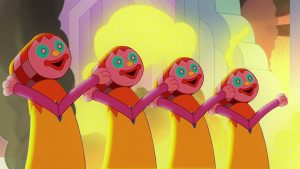
It’s no surprise that Trussell’s own life is incorporated into that of Clancy’s, given that The Midnight Gospel is based on Duncan Trussell’s Family Hour, integrates excerpts from interviews done on the podcast, and has Trussell himself voicing the protagonist. This is made clear in the last episode of The Midnight Gospel where Clancy and Trussell’s worlds clash. The episode incorporates an excerpt from an interview with Trussell’s late mother. Throughout the show, Clancy is referred to as Duncan but always reiterates that his name is Clancy. However, in this particular episode, when his mother calls him Duncan, Clancy doesn’t stop her. It seems as if Clancy is an alternate version of Trussell but in an alternate universe.
I will admit that it can sometimes be hard to focus on what Clancy is discussing with the almost overwhelmingly stimulating visuals and graphics of the show. Each episode has so much going on that it may be hard to take in all at once. In one scene, Clancy and the president of the world he has travelled to are discussing drugs and meditation, while simultaneously fighting off zombies. This is definitely a show that you will want to watch again to learn a little more and see a little more than you did the first time.
The whole show is cleverly beautiful in its construction. If you’re looking for a show that is mind-bending and has an incredibly equivocal take on life, yet is therapeutic, then I recommend this show. Although, I would recommend this show to anyone. It will make you feel like you have been on a soul-searching journey and have come out of it a completely new version of yourself. The Midnight Gospel is available to watch on Netflix and is a show that will leave a lasting impression on you just like it did on me.


