Home Blog Page 93

How my goalkeeping dreams began

0
a pink soccer ball sitting in green grass. In the corner, the frame of a soccer net can be seen.
PHOTO: Joshua Hoehne / Unsplash

By: Tam Nguyen, Staff Writer

I have a low tolerance for pain and hardship. Somehow, I managed to become the sole goalkeeper on my high school’s girl’s soccer team, the only position that I was half decent at. I took a few balls straight into my face, and ended up with a bloody nose on my first match and broken glasses on my second one. After that, I quit, bruises and all, but at least I had an honourable reason as to why I joined in the first place. 

Back in high school, my friend and I went to My Dinh National Stadium in Hanoi, Vietnam, to watch a women’s soccer game. The two competing teams were mainly trying to train their rookies. There wasn’t much of an audience compared to the men’s soccer game, as people in Vietnam didn’t take women’s sports very seriously. 

As the game progressed, a golden haze lit over the stadium. Soft laughter floated here and there, as people were more absorbed in their thoughts than the game. The background was a blur. Spending the night with my friend and enjoying the fall breeze was all that mattered, until the referee blew the whistle aggressively, the sound a sharp “tweet!” signaling something exciting was happening. The goalkeeper successfully saved a very dangerous, upper-corner shot from the striker on the left wing. It pulled the audience out of their heads, drawing their attention back to the field. It was a badass moment saturated by her outfit — a bright yellow uniform and short hairstyle. I liked the way the audience seemed to awaken from sleep to catch the euphoric moment where they didn’t know if she could save it or not. 

I didn’t even know this goalkeeper’s name, but it was enough to spark a curiosity in me to try out something new — something that, over time, has turned out positively for me. As a goalkeeper, I had good moments with my coach and team, and I was especially fond of my neon catching glove and the late evening dinners. Admittedly, the coach knew I was a lost cause since the tryout, but there weren’t enough girls signed up to the team, so he decided I could become the goalkeeper. It was a very fun experience to me, and the cardio and skill activities were very beneficial to my training

I guess this is a thank-you letter to the goalkeeper that night. Even though I didn’t become the next Alisson Becker, at least I tried something new (and I looked good with those soccer-sustained bruises on my face). I hope you are still playing and becoming famous, and I look forward to seeing you one day when Vietnam Women’s Soccer competes in the FIFA World Cup.

Horoscopes October 21–27

0
An illustration of a girl, stars and astrological signs strewn in her hair.
ILLUSTRATION: Marissa Ouyang / The Peak

By: Hana Hoffman, Peak Associate

Aries
March 21–April 19

It’s not easy to find a matching top and bottom of a swimsuit when you wake up 10 minutes before you have to leave. Summertime is when you have daily outings and no time to reorganize your drawers. It’s just like how sometimes people come to school with two different socks. So don’t worry about what you came wearing today; the two different colours and patterns are as spectacular as beautiful multi-coloured fish in the sea!

Taurus
April 20–May 20

You will thank me for what I’m about to say. A gigantic umbrella should always be on your checklist when going to the beach. If it’s too hot, that’ll be your shade; if it’s raining, it’ll keep you dry. If it’s raining meatballs, they’ll bounce off the umbrella and keep you safe. But most importantly, if you get bored, you can be Mary Poppins.

Gemini 
May 21–June 20

If I could give you any advice, it would be to never trust the weather forecast. The predicted sunny days keep getting sudden cloudiness and rain, and sometimes, when it’s supposed to rain, the sun starts to show. However, I don’t blame the weather for feeling under the weather sometimes, and the temperature also has its ups and downs. A beach day is just one of those things you can’t plan in advance. You must look out the window, call your friends, and go immediately!

Cancer
June 21–July 22

Please fill in the blanks of these song lyrics with whatever words you like.
I got that summertime, summertime _______. All I need, is a beauty and a ______  , who can make my life complete. I don’t know if I could ever go without, ______ sugar, high
Real Cancers answered “mango” for all three. Don’t argue with me. I don’t make the rules; the stars do. 

Leo
July 23–August 22

Take this quiz to find out what you should do today!

  1. Do you like the sound of waves?
  2. Do you like collecting shells?
  3. Do you want some natural Vitamin D?

If you answered mostly “yes,” it’s your sign to go to the beach. If you answered mostly “kind of,” it’s still your sign to go to the beach because it means you don’t mind it. If you answered mostly “no,” too bad, I’m already parked on your street so I can drive you to the beach!

Virgo
August 23–September 22

I want to know, in your opinion, which of these is the worst thing to experience at the beach?

  1. When there’s always sand in your socks and in between your toes
  2. Accidentally swallowing salt water while swimming
  3. Accidentally stepping on a rock with barnacles
  4. Running after an ice cream truck, and then they say they’re sold out

Didn’t mean to be all cold and list these downpours, but at the same time these situations make me feel nostalgic about summer.

Libra
September 23–October 22

Sand castles are the most underrated thing in youth culture. SFU students rarely build sandcastles at the beach, so even little five-year-olds are better architects than them. Libra, you will be the first to build an outstanding sand castle and prove to everyone at the beach that university students are just as talented as kids. Thank you in advance.

Scorpio
October 23–November 21

Your friend drove you for 45 minutes to the beach! But then, while you and your friends are swimming, you suddenly realize you forgot to bring a towel. What will you do now? I have some ideas: get out of the water and pass the beach ball until you dry. Go to the public washroom and use the air dryer. You can’t go back in your friend’s car and leave a wet spot on the car seat!

Sagittarius
November 22–December 21

You’re a brave one for saying “yes” to sun tanning with your buds . . . because, in case you don’t know, there are many cases of bird poop incidents annually. Ugh, what a pain it is when you’re having the most relaxing time lying on your towel on the soft sand, and suddenly you hear a splat on your leg. Well actually, I heard getting pooped on by a bird means good luck, so I guess there’s a positive on both outcomes.

Capricorn
December 22–January 19

It’s your first time surfing and your uncle is teaching you. You’re a bit wobbly but getting the hang of it. Then all of a sudden you see a school of small fish do little jumps out of the water and a beautiful dive back in. What a cute occurrence and I think it would also mean good luck!

Aquarius
January 20–February 18 

Snorkeling season is the best season! A break from land creatures for once. I’m tired of being chased down by dogs, spied on by crows, and bitten by mosquitos. I can’t wait to get underwater by the colourful coral and greet the beautiful lionfish, parrotfish, flagtail. . . wait, I forgot I’m in Vancouver and not on vacation in Miami :’(

Pisces
February 19–March 20

I have a serious question for you, Pisces, and I think it would be helpful to have already made your decision before a situation like this occurs so you can act fast. Picture this: you’re playing beach volleyball in the middle of the last round which determines the winner because the teams are currently tied. Suddenly you see an eagle snatching snacks out of your backpack! Would you rather stay in the game and save your team from losing or run after the eagle to save your snacks? I already know the answer of course. But I wanted to test how well you know yourself.

Affordable housing — where it all went wrong

0
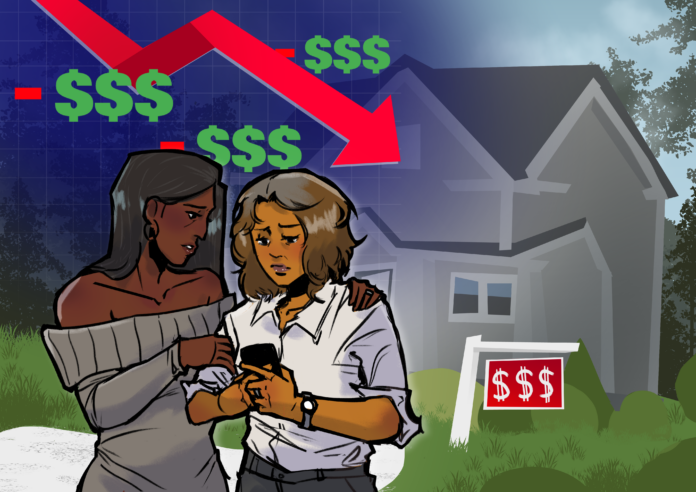
Two women looking at a phone with a worrisome expression on their faces. A house on the background with the illustration of a an arrow plummeting downwards overimposed
ILLUSTRATION: Den Kinanti / The Peak

By: Yildiz Subuk, Staff Writer

Housing as a necessity

In 1976, Canada agreed to recognize housing as a human right, adhering to the Universal Declaration of Human Rights (1948) drafted by the United Nations. A right to housing does not necessarily entail that the government has to provide every single person with housing, but it does mean the government must uphold proper policies that allow citizens to have an adequate place to live. Some rules governments must abide by are: ensuring marginalized groups do not face barriers regarding access to housing, having access to services such as water, electricity, schools, and employment, as well as not having to worry about bad-faith evictions or displacements from residence.

According to Canada Mortgage and Housing Corporation (CMHC), housing that is affordable should take up less than 30% of a household’s monthly income. A recent report by Royal LePage finds that nearly 53% of Canadian households will spend more than that 30% standard on housing. 33% of Canadians specifically spend over 40% of their income on housing. Housing is clearly no longer affordable. 

Current social housing programs help ensure that people have affordable housing. Social housing provides low-income individuals with housing options that are below current market price. In Canada, social housing is provided by provincial governments and non-profit organizations, however before 1996, the federal government was in charge of the housing sector. The Canadian government during the ‘90s had already begun to allow private investors, including real estate investment trusts (REITS) and landlords, to have more freedom over the housing market. With the cut of the co-op housing program in 1992, the start of a worsening issue was set in motion.

A historical overview of housing policies

Before the ‘90s, Canada had a couple different plans put in place to help lower to upper middle income citizens with housing needs. The 1930s brought government assisted aid for housing to Canada. It all started with the 1935 Dominion Housing Act, which mainly provided $20 million in housing loans to Canadians. The Federal Home Improvement Plan of 1937 helped finance interest rates on homes. In 1938, the National Housing Act (NHA) was introduced, and it allowed for the construction of lowrent housing units. The root of social housing can be traced back to the NHA, as it marked the beginning of the Canadian government prioritizing housing for low-income people.

Gregory Suttor, housing research consultant and lecturer in UofT, outlined the changes in housing policies from the ‘60s to the ‘90s in section 5.4 of his PhD thesis “Canadian Social Housing: Policy Evolution and Impacts on the Housing System and Urban Space.” During the ‘60s, the goal of social housing was to expand the range of the program to help a diverse range of Candains. The ‘70s and ‘80s saw the growth of government involvement in the housing sector.

Three temporary federal programs were introduced in the ‘80s to help Canadians with housing affordability. The Canadian Homeownership Stimulation Program offered grants to homebuyers. The Canada Mortgage Renewal Plan helped cover part of mortgage and property tax costs when renewal rates high. The Graduate Payment Mortgage Plan reduced monthly mortgage payments. The Canadian government stepped up when housing affordability reached a point of exhaustion. There were plans put in place to ensure housing cost does not exceed 30% of a household’s monthly income, so what changed after the ‘80s? Why did the Canadian government deprioritize housing affordability? The answer lies in neoliberalism infiltrating Canadian thinking.

Housing as capital gains

During the ‘90s, there was a clear shift in how the Canadian government viewed housing — before this period, housing was viewed as a necessity. The government had policies put in place that helped Canadians buy houses at an affordable rate, and provided forms of aid for lower-income Canadians, such as grants for homeowners and an emphasis on social housing programs.  

“It took the severe [recession] of the mid-1990s and the global triumph of neoliberal ideas rippling across Canada to end the social housing era,” writes Suttor in his thesis.

Neoliberalism is the belief that the government should not interfere in the economy, promoting a focus on individualism. It follows the argument of “if you are poor, it’s your fault,” as if people are free to move up in society through hard-work alone. Neoliberalist thinking has been critiqued for its ignorance of social inequity, as it does not account for the fact marginalized groups tend to have barriers that disadvantage them significantly compared to others. 

In 1992, Conservative leader Brian Mulroney announced that the co-operative housing program, which had built 60,000 homes for lower to middle income families, was to be cut. This decision provided short-term economic growth, but a long-term problem. Providing affordable housing, a basic necessity, was no longer the concern of the federal government. During the ‘90s, REITs were introduced. REITS, which were created in the ‘60s by US President Dwight Eisenhower, combine the finances of multiple investors to buy out different properties. This is done so investors can generate income from properties, without having to do the work of managing the property itself. 

Due to the recession of the ‘90s, the federal government decreased its interventions from the housing sector, allowing private investors to buy large amounts of housing units in Canada. REITs began renovating housing units, driving up the property value significantly as well as the amount to rent the properties. A lot of landlords began benefiting from policies that made rent laws less strict. The “1991 Loophole” was a policy introduced in 1997, which omitted rent control on any houses built after 1991. The plan was to not place constraints on new developers looking to build more rental units, but this plan backfired as more units were not built, and instead the developers set the rent prices high. This loophole indicated how housing had shifted from being a necessity to becoming more of an investment during the ‘90s.

The shift in government policy, as well as the introduction of REITs — which have collectively over nine companies, generated $39 billion in capital — has indicated that the government does not view affordable housing as a priority. Instead, housing has become focused on providing actors such as REITs and landlords with assets. Shifting focus from providing housing for everyone to making it a hot commodity has had a long-term impact on many Canadians, one that’s increasingly worse today.

Steps forward

There are solutions to fixing the current housing affordability issue. With better government regulations, more stringent laws protecting tenants such as rent increase regulations, as well as not allowing private investors the ability to buy up so much of the housing sector, the government can provide many Canadians with better housing. The Canadian government has the solutions right in front of them, but they still allow greedy private investors to occupy such a large portion of the housing sector. This negligent decision has proved to be reckless — actively depriving many Canadians from access to affordable housing.


Centrism isn’t as neutral as you may think

0
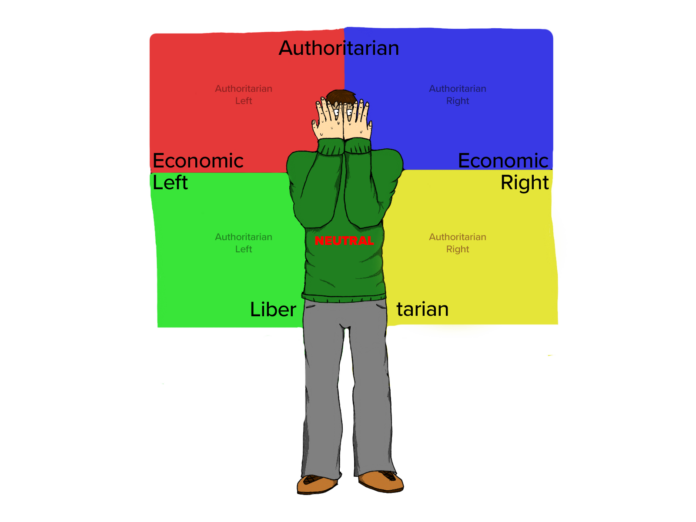
Illustration. A political axis graph in the background and a person centered in the foreground covering their face with a nervous expression
ILLUSTRATION: Yan Ting Leung / The Peak

By: Yildiz Subuk, Staff Writer

Content warning: brief mentions of genocide, residential school graves, and police brutality.

Two years ago, I had a conversation with an Uber driver on the way home from Kendrick Lamar’s concert. “While I like Kendrick, I think his music is too political now to the point where it alienates some of his audience,” he said. While this comment may appear naïve or out of touch, it’s rooted in privilege. The desire to be apolitical or centrist is one that’s grown in recent years. People who have historically been discriminated against or under-represented don’t have the luxury of neutrality, and it’s even more concerning to see centrist ideas bleed into government policies.  

Centrism is a political belief that emphasizes incorporating both leftist and right-wing ideas. In everyday life, centrists tend to criticize so-called extremist ideologies from both ends of the political spectrum, and insist that being “balanced” is the most rational approach to politics. While this “both sides” approach may seem rational, it doesn’t account for the fact that there are major social issues that neutrality can’t fix. Those without the privilege to stay neutral on political issues are often the ones that are harmed the most by political decisions. 

Being a centrist about issues involving oppression and human rights injustices suggests we should value the oppressor as much as the oppressed. Debating a topic like whether Israel has a “right to defend itself” is incredibly problematic, especially when considering the United Nations has issued reports condemning the state for its war crimes. Israel has murdered Palestinians at an exponentially high rate. In news media, centrism often appears as a subtle downplaying of events through language choices. For example, many news publications have vaguely framed the genocide in occupied Palestinian territories as a “conflict” or “war.” Similar rhetoric appears in news articles that refer to residential school graves as “anomalies,” or downplay the extent of police brutality in Canada by comparing numbers to the US. We must stop treating centrism as a harmless difference of opinion. There is no middle ground when it comes to injustice.

Centrism is even more damaging when it appears at a governmental level, as it often does in Canadian politics. This is evident when we look at how Canada and 25 other countries abstained from voting on a decision that would allow Palestinians to be represented in the United Nations. Refraining from commenting or condemning “both sides” is not a neutral act. This vote of abstinence was made by the Canadian government because they didn’t want to choose a side, but it effectively denied Palestinians the right to self-representation. 

Centrism can also take the form of pandering to both sides of the political aisle to garner as much public support as possible. According to a Maclean’s  article, the federal Liberal Party has placed an emphasis on reconciliation with Indigenous communities across Canada over the years. This may come across as the Liberals breaking away from centrism, but the party’s performatism shows how neutral they are about truly acting on reconciliation. Currently, no policy changes have been made that allow Indigenous communities to protect their lands and resources.

Centrism can only be rational in a world without social inequity. Staying neutral has less to do with rationality, and more to do with comfort. When people stay neutral, it can be a form of hidden apathy toward injustices that are often the reality for many marginalized groups. Being a centrist is a privileged stance, and those who are suffering from social injustice need a more urgent approach to ensuring their rights — something that can often be a matter of life or death.

Black Colombian refugee fatally shot by Surrey RCMP

0
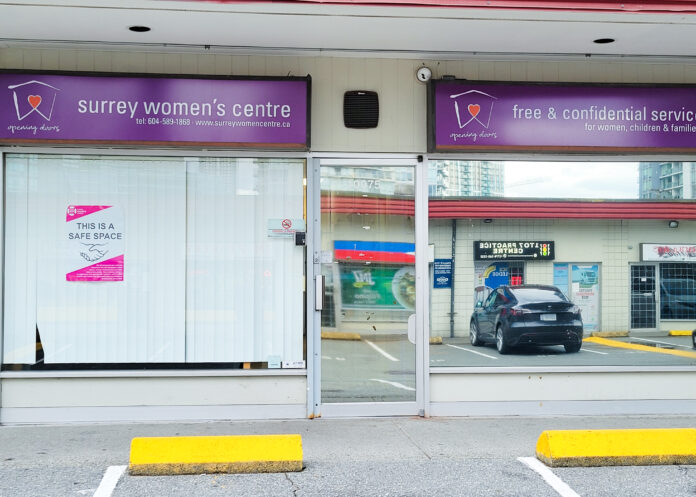
This is a photo of the exterior of the Surrey Women's Centre.
PHOTO: Amirul Anirban / The Peak

By: Sofia Chassomeris, News Writer

Content warning: mentions of death, police violence, racism, and domestic abuse.

On September 19, Vanessa Rentería Valencia, a Black Colombian refugee and mother, was killed in her Surrey home by BC Royal Canadian Mounted Police (RCMP). One week later, several organizations, including the Battered Women’s Support Services (BWSS), formed a coalition to host a press conference and demand a full investigation for Rentería Valencia. Since 1979, the BWSS has worked to advocate and provide support for women experiencing abuse, with the goal of ending violence against women and girls. 

The Independent Investigations Office of BC (IIO) is investigating the incident in which Rentería Valencia, who was 37, was fatally shot three times on the morning of September 19. Her church circle said police arrived at her home around 4:40 a.m. in response to a call from Rentería Valencia’s husband. Surrey RCMP said officers learned Rentería Valencia had locked herself in a room with her toddler and was “reportedly holding a weapon.” Despite Emergency Health Services’ immediate medical attention, Rentería Valencia “died at the scene.” Her child did not have any injuries.

The press conference took place at the City Centre Branch of Surrey Public Library. It was held by a coalition of organizations including the BWSS, Surrey Women’s Centre, BC Community Alliance, BC Civil Liberties Association, BC General Employees’ Union, and the Parents Support Services Society. The Solidarity Committee for Renería Valencia was also present, along with her inner circle attending via Zoom. The coalition is calling for transparency in the ongoing investigation of her death, accountability for the officers involved, and justice for her daughter.

Rosa Elena Arteaga, director of clinical practice and direct service at the BWSS, spoke at the press conference. Peace Arch News reported that organizations “gathered to expose how the system failed Rentería Valencia on multiple fronts before that fatal confrontation.” 

Prior to her death, Rentería Valencia had been accessing outreach programs in her community to learn English and stayed at a shelter with her daughter for two months. CBC News said she had been “hoping to find housing of her own after leaving an abusive relationship.” Unable to do so, Rentería Valencia recently moved back with her husband and brother-in-law.

It is alleged that Rentería Valencia told a friend she wanted to leave home due to safety concerns the week she died. On the night of September 18, Rentería Valencia was with this friend and later went to collect some belongings back home. When she didn’t return to her friend’s house, her friend called the police to check on her. Peace Arch News tried to confirm if police had visited Rentería Valencia before her death, but “both the RCMP and the IIO have refused further comment since the matter is now under investigation.” BWSS notes that “the most dangerous time for a survivor/victim is when she leaves the abusive partner” and “77% of domestic violence-related homicides occur upon separation.”

“She did everything that we asked women to do when they are not safe at home, we tell them to leave,” said Arteaga. 

The Peak reached out to Angela Marie MacDougall, executive director of the BWSS, for an interview, but did not receive a response by the publication deadline. MacDougall also spoke at the conference, highlighting the phrasing of the RCMP’s report. The report stated that Rentería Valencia was barricaded in her room, allegedly holding “a weapon next to a young child.” MacDougall said the RCMP’s statement was “playing into well-worn narratives” used against refugees and women of colour by implying Rentería Valencia was dangerous. 

“We know that women living in abusive situations retreat to bedrooms, spare rooms, bathrooms with their children to establish a physical boundary between themselves and those they believe could do harm to them,” said MacDougall.

BWSS also stated, “This is not an isolated incident, but part of a larger pattern of violence and discrimination faced by Black, Indigenous, racialized, and immigrant communities.” Rentería Valencia’s death has raised many questions within her community. Advocates wonder whether the RCMP spoke or gave commands to Rentería Valencia in English — a language she was not proficient in. They also ask whether she “even [knew] they were police and what they were doing there.”

“We do not know if RCMP attempted any type of de-escalation,” said MacDougall. “Witnesses on the scene told us they did not.” 

While Rentería Valencia’s community awaits further answers from the ongoing IIO investigation, close friends have started a GoFundMe page to fundraise for her daughter and family members abroad.

This is a developing story that The Peak will continue to cover in future issues.

Over 2,000 people killed in Lebanon

0
This is a photo of a Lebanon flag in the distance.
PHOTO: AHMAD BADER / Unsplash

By: Sofia Chassomeris, News Writer

Since September 23, escalating Israeli airstrikes targeting the Lebanese armed group Hezbollah have killed nearly 2,000 people in Lebanon and displaced over one million at the time of writing this article. These attacks, which included the killing of Hezbollah’s former leader Hassan Nasrallah on September 27, indicate the “serious risk” that an all-out war between both countries could be on the horizon.

Hezbollah is a Lebanese armed group with significant political influence in Lebanon. The group was formed in 1982 with Iranian support to combat Israeli invasion and occupation of Southern Lebanon. Hassan Nasrallah, who served the group since 1992, led the party into parliamentary politics. Since then, they have grown in size and political power in Lebanon with backing from Iran.

Within the past two months, violence there has significantly increased; the Center for Strategic & International Studies, a “non-profit policy research organization,” reported that this year, “Israel struck Lebanon more than 300 times in the week of September 15 and more than 700 times in the week of September 22.” Israel’s Prime Minister Benjamin Netanyahu has warned that there will be “destruction like Gaza,” referring to Israel’s ongoing genocide in occupied Palestinian territory. 

Attacks between Israel and Hezbollah are not a recent development. After the Palestinian armed group Hamas attacked Israel on October 7, 2023, and Israel retaliated, Hezbollah “launched a rocket campaign on Israel in support of Gaza.” 

According to the Armed Conflict Location and Event Data, at least 8,313 attacks “were carried out by Israel” between October 2023 and September 2024. Attacks by Israel made up 81% of the attacks exchanged between Israel, Hezbollah, and other armed groups, “which killed at least 752 people in Lebanon.” Conversely, “Hezbollah and other armed groups were responsible for [an additional] 1,901 attacks that killed at least 33 Israelis.” 

Daad and Hussein Tabaja, a Lebanese Canadian couple, were both killed by Israeli strikes in Southern Lebanon. “I don’t need to say that this is not humane. This is not humanity. This is not justice,” said their son Jamal Tabaja in a Global News interview. Global News reported that Jamal, who had been living in Beirut, called his parents the night they died to tell them to evacuate, but the couple were not able to make it out.

On September 29, a demonstration in solidarity with Lebanon and Palestine was held in Vancouver. Another demonstration at the Vancouver Art Gallery on October 5 was held, where one banner read, “HANDS OFF LEBANON.”

The United Nations Interim Force in Lebanon (UNIFIL) peacekeepers, who have their headquarters in Southern Lebanon, said they were struck by explosions twice, injuring two peacekeepers. The explosions occurred close to a UNIFIL observation tower. The UN stated that “any deliberate attack on peacekeepers is a grave violation of international humanitarian law.” The Israeli military claimed the peacekeepers were hurt “inadvertently.”  

“Israel is essentially now undermining [not only] the United Nations and the United Nations peacekeeping force, but the very rules-based international order, and it needs to step back,” Irish foreign minister Micheál Martin told CBC.

Recent Israeli strikes on Beirut, Lebanon’s capital, have killed at least 22 people and injured 117, including healthcare and rescue workers.

Quiz: Which Moo Deng are you?

0
An illustration of Moo Deng, the pygmy hippo, she is calmly lying on some grass.
ILLUSTRATION: Cliff Ebora / The Peak

By: Michelle Young, Copy Editor

  1. Your Blenz order (warm milk) is wrong. You:
  1. Spit it out immediately. 
  2. Despite the barista’s apology and offer to remake your drink, you insist on talking to the manager and lecture them about how you can tell there are one too many syrup pumps in there. You can literally only drink milk, after all. 
  3. Sip it and walk out. 
  1. A rando is throwing small objects at you. You:
  1. Run (or bounce) away.
  2. Attempt to bite them. To your dismay, you can’t reach.
  3. Relocate your nap. You know they will be sued and fined — as they should be! 
  1. You finish doing your business on the toilet, but are shocked to feel a splash of water hitting your butt. You: 
  1. Scream and burst out of the stall in horror. 
  2. Report it immediately and complain about the potential bacterial risks of using a public bidet. 
  3. Allow the bidet to do its job, and curiously examine it afterwards. 
  1. You’re scrolling on Instagram and notice that @simonfraseru has posted about you without your consent. You: 
  1. Instantly drop your phone on the ground. 
  2. Report the account and post a story about the importance of asking for permission before posting pictures of other people (and hippos) online. There needs to be boundaries.
  3. Read the comments before using your toes to keep scrolling on your feed. 

If you answered mostly A’s, you are alarmed Moo Deng. You are always alarmed and who can blame you? The world is full of overstimulating chaos: getting wet and being picked up is scary and unpleasant. Just keep screaming.  

If you answered mostly B’s, you are angry Moo Deng. You want to bite everyone you come into contact with, and whether you do this out of love or not is debatable. You hold petty grudges and run away at minor inconveniences. I would say that you need to learn to express yourself better before you become a menace to society, but I don’t think that’s realistic. Chomp. 

If you answered mostly C’s, you are calm Moo Deng. You are at peace. No one can derail your stay-at-home-for-the-week plans because you won’t let them. You love to lay around and pretend to eat grass. You are always moisturized and ready to show off those gorgeous pink cheeks. Go get ‘em.

Red Leafs track and field star Marie-Éloïse Leclair on her Olympic experiences

0
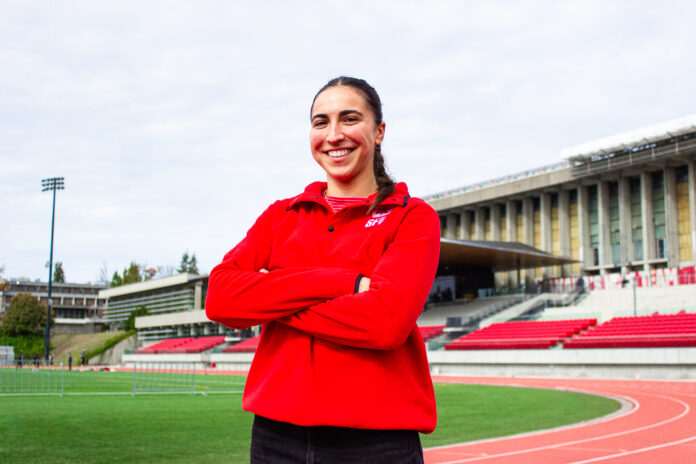
A girl with brown hair tied back smiles at the camera. She wears a red sweatshirt with “SFU” in the top right corner. Behind her is a set of bleachers.
PHOTO: Gudrun Wai-Gunnarsson / The Peak

By: Kaja Antic, Sports Writer

Some of us take the summer semester off, preferring to work or go on vacation. Others take classes to fill the time, sweating the whole way to campus. If you’re Marie-Éloïse Leclair, you go to the Olympic Summer Games.

The Red Leafs track and field star experienced her first Olympiad as part of Team Canada’s women’s 4x100m relay team, competing at the Stade de France in Paris. 

“It was the first time I went to a competition with other sports because I’ve only been in big track events, not multi sports,” Leclair said in an interview with The Peak. “It was 10 out of 10 for sure.”

Though her main focus was on her scholastic season, Leclair attended a Team Canada camp between indoor and outdoor competitions with SFU. 

“They invited me for a camp at the end of March that was in Florida,” she explained. “Unfortunately, I got a tiny injury when I went there so that kind of set me back.”

Despite the injury, Leclair was “just happy to be invited.” 

Leclair described how training with SFU was not all that different from training with Team Canada, albeit in a setting more focused on the relay portion — which Leclair also competes in with SFU in both the women’s 4x100m and 4x400m relay teams.

“We had a two week training camp in Barcelona [before the Olympics] where we solely focused on the relay, so that was a lot of relay practices.”

Leclair described the relay training as more “specific” with Team Canada rather than with the Red Leafs, but chalked it up to the event being the “main focus” and participants having more experience in the relay specifically. 

“We can really go into the nitty-gritty and these super specific details, but it’s pretty similar. I mean, the main ingredient of really any race is being fast, right?

“At SFU, we’re really lucky because we get so many opportunities,” Leclair noted, discussing how being a Red Leaf prepared her for the Paris games. “The opportunities we get here made a big difference in being familiar in the environment that are international meets.”

During the Great Northwest Athletic Conference Outdoor Track & Field Championships in May, Leclair won the individual 100m and 200m women’s sprint events, along with a second place 4x100m relay finish and a first place 4x400m relay finish with the Red Leafs. A month later, she was preparing for the flurry of athletic competition before the Olympic Games with a Diamond League meet in London, and the aforementioned training camp in Barcelona.

While Leclair was not able to fully participate in the Paris festivities due to her event taking place near the end of the competition, she was able to try one of the hot topics in the dining hall: the mythical, TikTok-viral chocolate muffins.

“They were good. I’m not a big cake person so I was like, ‘I feel like it’s gonna be too much,’ but no, it was super good.” She also got to meet the popular “muffin man,” Norwegian swimmer Henrik Christiansen. “It’s funny because everyone’s like, ‘did you see celebrities?’ And I’m like, ‘the muffin man? Does that count?’”

Education wise, Leclair is working on graduating, taking five courses this semester along with her training regimen. Now heading into her final year with the Red Leafs, she looks forward to building on her record-breaking performances in NCAA competition. 

“I just really want to make the most of it, and like I said, leave my mark,” Leclair described the impact of her final year on the Red Leafs track. “I feel like I already have in a way, but there’s always more to do so if I can go to championships and break my own records, break other records, and place higher than I have in the past.”

Catching up on the 2024–25 Vancouver Canucks

0
Two men in blue jerseys with a green stripe on the sleeve and blue helmets hug as they look to the side. Behind them are the boards and glass of a hockey rink. Cheering fans are visible through the glass.
PHOTO: Courtesy of @canucks on Instagram

By: Izzy Cheung, Sports Editor

The Vancouver Canucks stunned their fans at multiple points last season, from starting their season with an 8–1 win against a division rival in the Edmonton Oilers, to winning the Pacific Division at the end of the year. Now, with a couple of departures and a few key additions, the Canucks’ audiences have been left wondering what kind of performance they can expect from their team this year. Keep reading to see who, and what, the Canucks will bring to the ice this year. 

By the end of the 2023–24 regular season, the Canucks had a goal differential of +56, as per ESPN and NHL.com. This stat is calculated by taking a team’s goals-for count, and subtracting the amount of goals scored against them. A high goal differential typically signifies lots of goals being scored, and lots being kept out of the team’s own net. 

An issue that arose during the Canucks’ playoff run, and towards the end of their regular season, was their offence. The team scored a season-high 56 goals in November 2023, permeated by a 10–1 victory against the San Jose Sharks. However, as February, March, and April came along, their total goals-for dropped to 36, 33, and 24 respectively. Star players such as Elias Pettersson were criticized for their lack of production in the postseason. 

To remedy these offensive woes, Canucks management made four key offensive signings. They brought in former Boston Bruin Jake DeBrusk, who scored five goals in 13 playoff games this past postseason. Also arriving from Boston is BC-born Danton Heinen, a swiss-army knife who can put up 30–40 points and kill penalties. Former adversary Kiefer Sherwood has switched his colours from Nashville Predators yellow-and-white, to Canucks blue-and-green. He’s best known for his aggressive forecheck and backcheck, and his hard-hitting tenacity to separate opponents from the puck. Rounding out Vancouver’s offensive acquisitions is Daniel Sprong, a consistent 40-point, near 20-goal producer. 

Vancouver also saw some shifts in their defensive core, as fan-favourite Nikita Zadorov was picked up by the Boston Bruins in free agency. As well, the team moved on from defenceman Ian Cole, who signed a deal with Utah Hockey Club. Taking these places are another former Bruin in Derek Forbort, and ex-Oiler Vincent Desharnais. Forbort brings a heavy physical presence to Vancouver’s blueline and isn’t afraid to jostle with the opposing team, making the Canucks that much harder to play against. Desharnais brings size to the lineup with his towering 6’7 stature, as well as a right-handed shot — something that’s of utmost value in the NHL. The team also acquired Erik Brännström from the Colorado Avalanche in a trade completed on October 6. 

Currently, five of the Canucks’ top-six defencemen stand above 6 ft, with Forbort, Desharnais, Carson Soucy, and Tyler Myers measuring above 6 ft and 4 inches. From these signings, it’s clear that Vancouver sought to size-up their defensive-core. Bringing in bigger players who are more willing to throw their body around will make them tougher to play against, especially come playoff time. Being able to execute a good hit can turn the puck into the favour of the team committing the hit, resulting in an uptick in possession. It’s also important to keep hits timely, as making a hit at the wrong time can also cause turnovers, leading to goals against. 

For the most part, Vancouver fans will be seeing a lot of familiar faces returning to Rogers Arena. With their new additions, they can also expect to see more offensive firepower and even more defensive checks. 

Afrorack rocks repurposed materials

0
A man tinkers with an electronic device set up with outlets. Around him are various cords, wires, batteries, and other electronic supplies.
PHOTO: Courtesy of Ben Roberts Photography

By: Hailey Miller, Staff Writer

Ugandan sound artist Brian Bamanya — better known by his stage name, Afrorack — brought his modular synth performance to Vancouver New Music on September 27 and the Red Gate Arts Society on September 28 following a seminar presentation with SFU’s music and sound department on September 26. Bamanya performed in Vancouver as part of his Canadian tour, which also included stops in Montréal, Saskatoon, and Edmonton from the end of September through early October.

Afrorack’s résumé includes inventing Africa’s first homemade modular synth, creating electro instruments such as a velocity-sensitive electronic drum kit, and showcasing his expertise in electro-mechanical music. Each of his instruments are made from a variety of recycled materials including old wires, metal, pipes, and wood. The modular synth is a massive DIY synthesizer made from a collection of metal knobs, copper wires, switches, and effect pedals. Effect pedals are electronic pedals that are connected to a pedal board and used by musicians to create different sounds, change frequencies, and add dynamics to a song or performance.

As an interdisciplinary artist with a background in sound art and electronic music, Afrorack has vast experience in building electrical circuits, rigging handmade electronic instruments, and keeping sustainability and renewable energy in mind. Bamanya is a master of his craft in music creation and instrument making, and in his performances, passion flows through his veins.

During the seminar with the SFU music department, Bamanya presented a demonstration of his work with his modular synth. As music and sound majors, we analyzed his work and watched an in-depth performance of DIY sounds and effects. Having taken place in the main music room at Goldcorp Centre for the Arts, Bamanya’s lively presentation was followed by a Q&A session as music majors listened in awe of his creations.

Plugging in to the outlets and revving up his synth rig, Bamanya took us through a full two hours of sound art and music making. With stuttering resonances, intentional feedback, and effects typically only made by a wah-wah pedal — Bamanya curated these sounds via pedals and wires inside of a rubber storage container — the performance was packed with electro and experimental sound. 

Bamanya’s velocity-sensitive electronic drum kit also came about from recycled and reused materials, formulating an instrument that functions off of high velocity pedal inputs as the name states. Although we didn’t get to see his performance with the kit, prior to the seminar, SFU music majors got a taste of his work via compositions and videos of the creative process. 

Afrorack rocked the roof off the music room as the walls vibrated with electronic frequencies and experimental effects. His performance was a combination of rehearsed and improvised as he curated various elements in the spotlight of the Thursday morning seminar. From sounds sweet like flowing waterfalls, to the screech of squeaky wires rigged through pedals working in harmony to enhance the effects, and the rhythms of what could only be the backbeat of a night at the club, Afrorack showed us that making any sound is possible from any ordinary object. As we were left in awe by the sounds modulated from the amplifiers and through our ear canals, it was clear that Afrorack is here to put the rock in electronic roll as the soundwaves pump life back into repurposed materials.

Follow Bamanya @afrorck on Instagram to keep up with his creations.