
Home Blog Page 919

The five stages of grief Conservatives went through after hearing the election results

0
Photo by Lisa Dimyadi

‘Twas October 19, and I was watching what every other campus Conservative was: the Antiques Roadshow marathon. Sure, the election was happening, but I wasn’t worried about the result, as I was confident Harper would get another majority. What’s not to love about a leader with the charisma, social skills, and looks of an accountant?

I interrupted the riveting analysis of a Tennessee bookshelf, and turned to CBC’s Peter Mansbridge make the election call. I prepared myself to be serenaded by good ol’ Peter announcing another Conservative government; instead, I was ambushed with this: “Trudeau has beaten Stephen Harper.” My jaw/heart/Molson Canadian dropped, and the five stages of Conservative grief began.

Denial: Oh, silly Peter, please read the teleprompter correctly. There’s no way Canadians would pick a handsome, likeable, positive person as prime minister. That’s just unpatriotic, borderline communist behaviour. [Flips to CTV] What, you guys are also saying Harper lost? Well, you’re communists anyways, you probably read the results wrong. [Flips to CNN] You guys messed the results up too? That’s weird. Well, Anderson Cooper’s a commie, so that makes sense. [Flips to CPAC] Hey, it’s Stephen Harper admitting the Conservatives lost. Well, he doesn’t know what he’s talking about, the bloody communist. . . Wait, what?

Anger: Damn it Peter, I thought I could trust you! I thought we were friends. I just finished getting my tattoo of your face with the caption “Thug Lyfe,” and this is how you treat me?! And to the Canadian voters: you want someone young and good-looking lying to you for the next four years, rather than a jaded, grey-haired politico? Rookie mistake, guys. High expectations lead to nothing but sadness, despair, and Stanley Cup riots.

Bargaining: Okay, Peter, hear me out: I’ll do anything. I swear to you. Just make the result change. Please? Pretty please, with a cherry on top? You don’t like cherries? Fine, I’ll give you a pineapple, or a potato, whatever your heart desires. My signed Stephen Harper poster? Yours. The limited-edition Brian Mulroney autobiography on VHS and Betamax? Take it. Just please, oh noble wizard, use your magic to change people’s minds.

Depression: Dear Peter: I have been in the fetal position for the past 72 hours, with no end in sight. The only thing keeping me going is the four-litre bucket of Costco vanilla ice cream, and three extra-large Costco pizzas. Actually, I’ve been inside a Costco for the past three days, hidden inside a bouncy castle; security suspects nothing so far. Also, I’ve listened to “Chasing Cars” by Snow Patrol 17 times. I worry that if I move on to The Fray, I’ll never get out of here.

Acceptance: You know what, Mr. Mansbridge? After looking into your deep, thoughtful eyes for a couple of hours, I’ve realized that it’s all going to be okay. Stephen Harper might be gone, but we’ll always have you and your oh-so-melodious voice to guide us Canadians. The Conservatives might be down now, but we’ll pick someone new, someone fresh, someone else with a weird affinity for sweater vests. And though the times may be tough for the boys in blue now, at least we have those magic herbs from Justin’s garden to get us through the next four years.

HUMOUR: American lawmakers cut out middleman, introduce guns directioly to mental wards

0
Illustration by Zach Chan

After roughly 300 mass shootings in 2015 alone, the United States government believe they have found a solution: arm patients in mental wards.

“Stay with me here,” began Jr. Senator Pistol Pete III, while polishing a Colt M16 assault rifle. “We all know that these killings are being perpetrated by madmen. That’s a fact — even the president said so. Now since there’s nothing we can do to actually stop them, we thought we should at least be more efficient.

“It’s our hope, and really all any of us can do [. . .] is hope that the good mental patients with guns will be there when the bad mental patients with guns try anything.”

With a maniacal grin, Representative Sessions concluded, “We’re calling it the Fight Firearms with Firearms/Righteous Lighting/Holy-Water Tsunami/Head ‘Em Off At the Pass Act.”

The NRA’s executive director of lobbying, Trigger Terry, added while holding two silver-plated handguns: “Lots of people who own guns in this country are crazy. Of course we oppose giving the mentally ill guns, and if it were possible to stop them from getting them we’d support laws that made that happen, but it’s not. So, we think this is a great plan.

“Think of it this way,” he said, spinning the pistols around like a wild-eyed frontier sheriff from the old west, “if I was to kill you right here and now, which obviously I could, would you rather me shoot you in the gut and watch you bleed out slow, or would you rather I put a bullet in your head nice and quick? Obviously the head, right? That’s why efficiency is so important. We don’t want to prolong the inevitable anymore. We want to shoot the country in the head, not in the gut.”

Republican presidential candidate Guhn Hapi was vocal in his support of the legislation while on the campaign trail, comparing it to his call to arm elementary schools and stating that the Act was, “Badass.”

Hapi added, “I’ve already said we should be introducing guns into environments where young people learn and grow, so obviously I support this legislation.”

The endorsement hasn’t surprised political analysts, who pointed out that the two ideas really aren’t that different. Both suggest putting guns within reach of those who are just learning or relearning how to operate in society; those who are emotional, irrational and prone to outbursts of rage, sadness, and occasionally violence; and those who sometimes cannot fathom the repercussions of their actions. Hapi concluded by saying, “Seems like a good idea to me.”

When asked for comment on the legislation, democratic representative Cutty Ought from California, who helped author the now expired Federal Assault Weapons Ban in 1994, pinched the bridge of her nose with her forefinger and thumb, shook her head and said: “They want to let who have guns?

“You know what? Fuck it, sure. It’s literally no fucking different than what we’re doing now.”

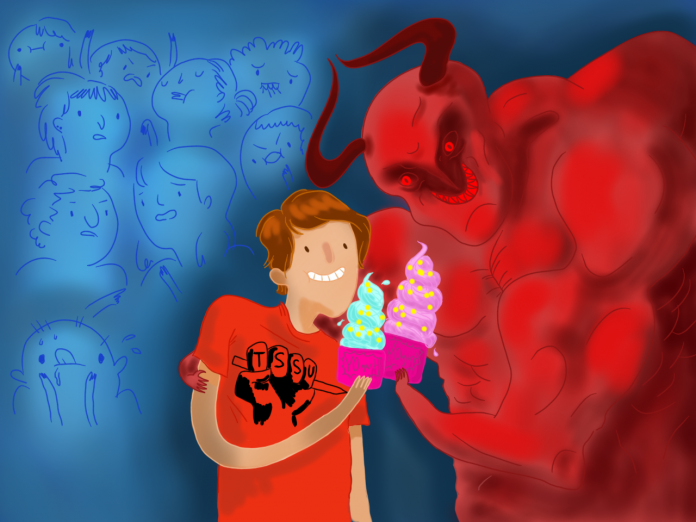
HUMOUR: TSSU aligns with Prince of Darkness to settle university dispute

0
Illustration by Christina Kruger

With the recent loss of their health benefits, SFU’s Teaching Support Staff Union (TSSU) has stepped up their game like never before against Andrew Petter: starting October 31, a partnership between the TSSU and Satan will add further pressure on the university to negotiate for a new contract.

The partnership is the result of a meeting held last week at Yeti Yogurt, where members of the TSSU met with the Lord of Darkness to ask for help with the long-standing wage dispute. Over Bigfoot on the Beach smoothies, the two parties reportedly negotiated all through the night before being kicked out by nauseated Yeti staff 19 minutes after closing time.

While no formal agreement was made on the spot, the TSSU confirmed via Facebook that a contract was, “hot and ready to move forward.” The Peak caught up with the TSSU to learn more about the controversial decision and what it could mean for students and staff at the university.

“Oh yeah, it’s true. We met with Satan over some froyo and explained our situation with the university,” said Lucy Strauss, a political science TA and TSSU member. “He was very receptive to our concerns and offered us some really good suggestions on how to move forward. We were pleasantly surprised by the cost of his terms too. Turns out the Devil isn’t interested in souls anymore; all he asked from us was our self-respect and dignity, and to sacrifice an A+ arts student.”

As soon as the Devil’s contract is signed, the TSSU expects the long-standing university conflict to be resolved with absolutely no foreseeable consequences whatsoever.

Regarding the controversial pact, SFU Administration seemed unconcerned by the announcement when asked to comment:

“If they think that’s going to make any difference, they’re sniffing glue,” cited one Board member. “They might as well go back to drawing chalk on the walkways and shouting at our workspace from a megaphone. Besides, we took precautions just in case Mr. Satan ever decided to intervene. We don’t get the big bucks for not thinking these sort of things through, y’know.

“During the summer semester, we opted to power wash all of Strand Hall with holy water just in case someone tried to catch us with our occultist pants down. Turns out it was a rather cheap expense.”

Arguably more inattentive to the devilish announcement are the students themselves, fatigued by the squabbling and caterwauling by both parties.

“At this point, I’ve practically ODed on my prescription of Fuckitol,” said English student Tanya Nyrobi. “Having my grades held is what’s really getting me down. How am I supposed to continue doing the least-acceptable amount of work if I don’t even know what kind of marks it’s getting me?

The Peak did what it could to contact Satan for a comment but was unsuccessful, as the gates of the underworld were closed for a Luau taking place in the third circle of Hell, hosted by renowned foodie Cerberus.

HUMOUR: How to avoid offending anyone with your Halloween costume this year

1
Photo courtesy of Infrogmation (Wikipedia)

Let’s face it: we’re not celebrating your grandparents’ Halloween, when bottles of Coke cost a nickel and Sun-Maid raisins were the hot new item to find in your trick-or-treating bag. This holiday’s done a lot of growing over the years, and society in general is more aware of historical atrocities and appropriations than ever before. Here are a few pointers to help you avoid the offensive tropes our previous generations championed on All Hallows’ Eve.

Avoid gendering your costume: Even in 2015, the gender divide in many career fields is still problematic, so do your best to avoid strengthening these labels. Don’t be a sexy mailman, but rather a sexy mailperson; that sexy boogeyman costume could just as easily be a sexy boogeyhuman costume, though even the definition of human is difficult because of the “man” part. Just dress as androgynously as possible and whenever someone asks you what you’re supposed to be, defuse the situation by asking them not to assume your gender.

Don’t reinforce harmful stereotypes: Generalizing the work of terrible directors like Michael Bay or M. Night Shyamalan is great, but generalizing someone else’s culture or walk-of-life isn’t. People often use the excuse of, “Oh, this is just a costume” to justify casual racism, but that doesn’t make it any better. A good rule of thumb to follow is if it was okay on a ‘90s television show, then it’s not okay now.

Stay away from dressing up as copyrighted characters: Films are being leaked online before they even hit theatres; television ratings have plummeted thanks to everyone illegally downloading or streaming their favourite shows; and you still think taking someone else’s idea and tailoring it to your own needs is a victimless crime?  Now you’re going to dress up as a character from a movie you didn’t even pay to see, and get a bunch of compliments and positive reinforcement for something you didn’t even create yourself? Get your head out of your ass — you’re getting shit all over someone else’s copyrighted creation.

And you can just forget about scantily-clad outfits too: Feminism’s making some grand strides in helping people stop shaming women, so this rule isn’t about policing female bodies — it’s just because slutty costumes are too formulaic and boring. Forget what I said earlier about the sexy mailperson costume; just because Channing Tatum gets to dance around with his package hanging out doesn’t mean you can, too.

Nothing speciesist either: oh, you think dressing up in a panda costume is cute? You know what isn’t cute? The grim reality most pandas are facing. There are less than an estimated 2,000 giant pandas left in the entire world, and in the time it took for you to apply makeup to mimic panda eyes, a hundred square hectacres of panda habitat were lost due to human activity. So try to consider the global biosphere before dressing up like an endangered animal for Halloween, you monster.

Don’t even think about using colours for your costume: Three words for you, bucko: colourblind people. Someone at a party asks what you’re supposed to be, and you reply, “The colour red!” while proudly self-examining your red T-shirt, red corduroys, and matching red Converse. Unfortunately for you, the person you’re talking to is colourblind, and you’ve just offended them by having a non-inclusive costume. Only dress in black and varying shades of black, or run the risk of being an enormous jerk-face.

And there you have it: a few simple tips and tricks to having your most inclusive Halloween yet. Of course, there’s no foolproof way to avoid offending people with your costume, so my only advice would be to stay home on Halloween night and hide out under your bed covers. Sufferers of agoraphobia may argue you’re appropriating a mental disorder, but hey, you can’t please everyone, right? Right?!

Justin Trudeau: “He’s got to prove himself”

0
Justin is the second Trudeau to lead Canada’s government. - Photo courtesy of The Canadian Press

Canadians turned out to the polls last Monday in the highest numbers since 1993, and voted in a Liberal majority government. Newly elected Prime Minister-designate Justin Trudeau said in his acceptance speech that Canadians had sent the message, “It’s time for change, real change.”

SFU set the stage for multiple political events throughout the campaign as candidates battled it out for the newly formed riding of Burnaby North-Seymour. With 36.2 per cent of votes, SFU adjunct professor Terry Beech of the Liberal Party came out on top; The Green Party’s candidate, SFU professor Lynne Quarmby, placed fourth with 5.2 per cent.

The Peak sat down with SFU Political Science and Women’s Studies professor Marjorie Griffin Cohen soon afterwards to see if the political science department was as surprised as the rest of us at the results of the election.

“We had a little betting pool [in the department], and these are professionals,” Cohen said. “Nobody got it right.”

The election was followed by a social media storm of some Canadians celebrating the departure of a Conservative government, with others bemoaning the newly elected Prime Minister’s lack of experience and his party’s history of failing to keep promises.

Cohen acknowledged that in the past the Liberal Party has campaigned from the political left, but governed from the political right. However, things may be different this time around.

“I think he knows people are onto the Liberals about that,” Cohen said, “He’s got to prove himself.”

A Liberal campaign promise particularly relevant to SFU is the pledge to revamp the National Energy Board (NEB)’s approval process for pipelines. In late 2014, Burnaby Mountain became the focus of national media attention when protesters blocked the surveying work in preparation for the Kinder Morgan Trans Mountain Pipeline expansion. The NEB had given Trans Mountain access to the surveying site, which is an environmentally protected area.

The Liberal party has taken a case-by-case stance on pipelines, so even with a reformed NEB, the Trans Mountain Pipeline may still be built. Cohen spoke to that possibility, saying “it would be very disappointing. I don’t think you’ll get a Liberal elected again in BC.” She added that due to the fact that the bitumen transported by the pipeline would not be refined in province, “there’s only disadvantages for BC.”

Uncertainty about campaign promises aside, there are signs that politics in Canada and the rest of the world have changed in the past decades.

Cohen said that the world is “teeming with people with more progressive ideas both in the UK and the US [that have] some kind of following now,” while in the past, they would have been in the margins.

However, Cohen warned that bringing those changes to bear isn’t for the faint of heart. “If somebody really does want to make a change, they have to be bold and they have to have courage.”

I’m tired of being ogled at while taking the SkyTrain

1

I’ve always had a big thing for public connection; catching a passerby’s eye in the habitual bustle, maybe offering a nod or — heaven forbid — a quick “good morning.” There’s something worthwhile in mustering the effort to reach out and acknowledge people. It’s important, savouring the subtle details that are so easy to dismiss but, at the end of the day, it gives you that extra little something. Cheesy, yes, but unmistakably true; to be connected is essentially to be human.

But then I became a SkyTrain commuter, and everything changed.

Put bluntly, people are perverts.

Okay, I can’t just say that. It’s unfair and a total generalization. But I will say this: in one week alone, I’ve become fed-up with accidentally snagging eye contact with someone who, in return, behaves intrusively and downright grossly. All too quickly, the encounter becomes a sexualized episode between the 18-year-old girl and the somehow-entitled man. Pardon me, sir, but I absentmindedly glanced at your face. I didn’t invite you to imagine me naked.

Confused? Allow me to give an example: I’m gazing through a bus window, my attention grazing over the wonders of Surrey Central and all its glory (sarcasm intended). I spot a man strolling by and, in the second I notice him, he notices me. He abruptly halts and, with his eyes fastened to mine, he smirks. But it wasn’t just any ol’ smirk; this smirk was slow and unforgiving. It was the most suggestive smirk I’d ever seen, and I had never felt so violated.

Believe it or not, the next day was a similar case. Except this particular man was sitting cross-legged on the sidewalk and slowly wiggled his fingers at me.

Pardon me, sir, but I absentmindedly glanced at your face. I didn’t invite you to imagine me naked.

And my last case (yes, there’s a third) involves a man who dedicated the ten minute skytrain ride to staring fixedly at my face. I went as far to change seats, but he either failed to decode the hint or couldn’t have cared less.

Upon telling this tale to a friend, they settled on a simple solution: “Just don’t look at people.”

Um.

I’m left grappling with these words, as they contradict the human communication spiel I’ve always held dear to my heart. Because of these few disrespectful commuters, must I sacrifice my values of public connection in order to feel safe and comfortable? I think we all know the commuters wouldn’t have acted like this if I’d been a middle-aged man. The fact that I was a young, unaccompanied girl made all the difference. So at what expense am I to make room for their absurd behaviour?

It doesn’t seem fair that, as a young woman, I ought to divert my eyes to the ground in order to avoid the smirking, staring, and wiggling fingers. I should be allowed to look at people, incidentally or not, without feeling degraded afterwards. And that’s that.

As I grapple with this, it’s understood that these sort of situations are not about to just evaporate. To all you women who put up with the same problems, I’d say learning to handle them with dignity and grace — that is, to keep your chin up high and to remember that you’re far superior to their weird sexualization game — is the decent, if not best way to approach this situation. To hold yourself to higher ground must count for something!

But get this. Just yesterday, someone tapped me on the shoulder at Production Way Station. A man held my Compass Card in his hand. I’d dropped it moments before. My guard automatically flew up, but I smiled nonetheless. And then he gave me a quick nod, wished me well and ambled away.

Suddenly, I remembered why I’d bothered smiling in the first place.

Decorative contact lenses have potential to cause infection

0
Many opt to wear decorative lenses as an addition to their Halloween costume. - Photo by Alfred Zhang

Having spiderwebs for irises eyes may seem like an easy and cheap way to give your Halloween costume some edge, but if you’re not careful about where you buy them and how you use them, those decorative lenses could cause serious damage.

“The eye is an extremely sensitive organ and can be damaged very easily,” explained Sureen Bachra, co-owner and chief optometrist at Lifetime Eyecare in New Westminster.

Contact lenses need to be properly fitted to the shape of your eye, and many decorative lenses don’t provide a lot of options in that regard. However, that is not the only trouble with these lenses. Bachra shared that “the biggest problem is improper insertion technique and care.” For these reasons, buying over-the-counter decorative lenses risks scratches to the cornea, infection, or in extreme cases, decreased vision or blindness.

All forms of contact lenses, including decorative and prescription lenses, are medical devices according to the US Food and Drug Administration (FDA); Health Canada will be implementing similar regulations into effect in July. However, Bachra clarified that “federally, they are considered to be medical devices, but unfortunately, the province of British Columbia deregulated the purchasing and selling of contact lenses.”

Therefore, anywhere that sells them in the United States or elsewhere in Canada as cosmetic devices is breaking the law; this includes street vendors, novelty stores, and boutiques. The U.S. Immigration and Customs Enforcement (ICE) is actively trying to stop them. An investigation called Operation Double Vision, which is now in its third year, and has seized over 20,000 pairs of counterfeit and decorative lenses in 2014 alone.

Optometrist’s studies have shown that 11 per cent of consumers have worn decorative lenses, with most of them purchased from sources selling their wares illegally. Nearly 60 per cent of individuals using contact lenses admit to wearing them longer than recommended, according to the ICE.

The FDA recommends only purchasing lenses only from sellers that ask you to provide your prescription; they should also provide you directions for cleaning, disinfection, and lens usage. If you are using decorative lenses and experience any discomfort, redness, or decrease in vision, you are encouraged to contact an eye care professional as soon as possible.

In order to purchase decorative lenses safely this holiday season, Bachra advised, “Go see your eye care professional first,” regardless of whether you think you have perfect vision. “What you actually need is a professional to check and see if your eyes are healthy and they can tolerate a contact lens, and that they are they are actually fit by a professional — that’s the difference.”

SFU Vancouver showcases community engagement at Open House

0
Photo by Samaah Jaffer

SFU Vancouver opened its doors to the public at Harbour Centre last Wednesday as part of SFU’s 50th anniversary celebrations.

Nearly 800 people attended the event, which featured over 37 exhibitors representing various departments, programs, and offices from all five buildings that comprise the Vancouver campus.

The opening ceremony featured an address by President Andrew Petter, performances by the Woodward’s Community Singers, SFU Pipe Band, and William Lindsay from the Office for Aboriginal Peoples, the latter of which recently opened a First Peoples gathering space at the campus.

Event coordinator Kamilah Charters-Gabanek noted the performances were one of the highlights of the night. “The Woodward’s Community singers is a group out of Woodward’s that is open to anyone in the public, to come into the university space, [. . .] feel welcome into the institution, and make connections here to the community.

“[SFU Vancouver] is a pretty unique place concentrated in several blocks of the downtown core that has so many different groups of people,” Charters-Gabanek continued. “All of the programs that participated and everyone who came out and helped make the Open House a success did a great job of showcasing the types of community engagement that we offer here.”   

Attendees were also able to join a guided tour of the Harbour Centre campus, as well as participate in over ten free workshops that were offered throughout the evening. The tours included a visit to a brand new 24,000-square-foot incubator space for the VentureLabs business accelerator on the 12th floor.

The workshops are normally offered with a fee; however, Charters-Gabanek explained that “because of our community engagement mandate, we wanted to offer them to everyone at no cost.

“We had workshops from Career and Volunteer Services on the relationship between a degree and a career,” said Charters-Gabanek. “We also had two of our Beedie professors from the downtown Segal Graduate School of Business, David Hannah and Ian McCarthy, host two workshops. One was on the fundamentals of effective negotiation, and the other was on learning from creative consumers.”

The rest of the workshops were hosted by SFU Continuing Studies, which was the original group of programs based in Vancouver when the campus opened 25 years ago. Altogether, Charters-Gabanek explained, the workshops gave people a sense of the variety of programs and courses offered at the Vancouver campus.

Laurie Anderson, Executive Director of SFU Vancouver, commented, “By any measure, the SFU Vancouver Open House was a successful evening: positive vibe, lots of interest at the program information tables, good attendance at the workshops and many people mingling until close.”

Said Charters-Gabanek, “I think we did a really good job of showcasing the variety of not only what we offer at our campus, but how we offer it, too — that people can come into the university in so many different capacities, whether they’re an undergraduate student, a graduate student, a lifelong learner, a mid-career professional, or honestly just anyone from the community, [they] could come in and connect.”

SFU students create fish-sitting system

0
When the owner's away, the fish will play. - Illustration by Ariel Mitchell

Five SFU students who joined Tech Entrepreneurship@SFU are making waves with their new fish tank monitor.

Leonie Tharratt, Kyle Tharratt, Spencer Arbour, Kevin Cruz, and Ivan Shchukin joined the program that helped them get their product started.

“This program was invaluable in enabling us to develop our own idea by providing support and funding to us and allowing us to maintain ownership of the idea,” Tharratt said in an email interview with The Peak.

At this phase in development, the device will be able to monitor temperature, ammonia levels, and water temperature. The team plans to develop it to monitor pH, nitrite, and TDS (total dissolved solids).

Tharratt added, “From there we can use an algorithm on the back-end to determine GH & KH trends. All this information is sent to the user’s app and will provide alerts when they exceed the specified acceptable ranges for each parameter.”

The team of students saw a need for this type of monitoring system both from first-hand experience with their own fish and from the experiences of others. Tharratt mentioned a situation in which an aquarium fish appeared healthy, but there was a problem with the water in the tank.

Said Tharratt, “I went to buy a few fish from someone and it turned out that he had none for sale because when he was on vacation his heater malfunctioned and killed everything in the tank. [That] cost him about $1000 in juvenile fish that he was planning to sell.”

Although the team is still in the prototyping and development phase of their project, they are expecting the cost of making their technology a reality to be between $300 and $400. Funding is their last hurdle towards selling their device on the wider market.