Home Blog Page 918

Aliens and zombies on the streets of Vancouver

0

Director Andy Thompson talks about the Virtual Stage’s latest interactive theatre experience

The Virtual Stage’s Alien Contagion: Rise of the Zombie Syndrome, directed by Andy Thompson, is a not your average theatrical production. It’s an interactive show that actually takes place on the streets of Vancouver. Instead of merely watching characters being chased by a horde of zombies, you get to be the bait. This is the fourth year for the zombie-themed series, and having attended last year, I was eager to compare this new installment.  

Participants are assembled into a ‘expert’ team in a high-stakes mission, and the mystery location of the show is only disclosed to participants a day before their respective mission. Zombies prowled the area, lurking in the shadows and dark corners and lurching towards us when we least expected it. This year, the production centres on aliens that crash-land on earth. Anyone that tries to find the mysterious aliens returns as zombies. Fun fact: there are more zombies this year than last. Double the scare.

Having done these zombie productions for three years already, Thompson had to up the ante for the fourth season. This is the first time Thompson’s roped another monster into his play, and the inspiration for that actually came from his stepson Finn. They were just hanging out, watching an alien movie, when Finn suggested, “Maybe the aliens can make the zombies?” And that was the story of how nine-year-old Finn began his career as a writer.

Thompson absolutely loved the idea. “So, it’s like Earth’s calling out for help because humans are destroying it, and the aliens are answering the call. Okay, so what if they’re doing that by killing off the humans and turning them into zombies? That’s why we have the line in the play: ‘You eat the earth, and now it’s eating you. Poetic justice.’”

Thompson’s zombie productions aren’t solely for the Halloween scares and frights. As an artist, Thompson wants his work to have more substance. “One of the challenges I’ve given myself is to explore a zombie subculture every year.” Last year, Thompson explored the world of drug addiction through his zombies. “Looking at this year, I just completely abandoned any need to stick to any previous narrative. I just want to stick with zombies, and explore the world of zombies from different angles.”

As you might suspect, it’s not easy putting on a production like this, and on such a scale. There are so many factors to consider — the budget, the safety of the actors, participants, and passers-by, the props, licenses, and so on. “So many artistic decisions are derived by finances, sadly,” Thompson remarked. “The zombies are [high school students] on work experience.”


Actress Eva Butterly shares her experience performing in this unique show

Miranda MacFarlane the pleasure of co-interviewing up-and-coming actress Eva Butterfly on her play Alien Contagion: Rise of the Zombie Syndrome on air on the CJSF Arts Magazine Show. She and Jacob Gradowski discussed interactive theatre, aliens, and zombies with the Irish actress.

Miranda MacFarlane, The Peak: Can you tell us a bit about Alien Contagion: Rise of the Zombie Syndrome?

Eve Butterly: It’s basically a quite specific, highly interactive, alien/zombie-themed theatrical scavenger hunt. It’s in its fourth year running now — it’s a different kind of theme every year — so this year we’re doing zombies and aliens and the whole idea of UFO abductions.

MM: What can tell us about your character, Lucy?

EB: Yeah, Lucy Peterson. She is a very paranoid alien/UFO enthusiast. She claims that she’s been abducted many times by aliens, and she kind of has a post-traumatic stress disorder over this whole ordeal. And so she runs a website called aliencontagion.com, which offers support to people who have been abducted by UFOs. There’s various things on there; for instance, there’s a tonic you can make for after you’ve been probed by an alien.

So yeah, she’s a pretty wacky character. I’m really enjoying playing her.

MM: What prompted you to get involved with Alien Contagion?

EB: Well, I’d done the show in 2013, and I got into it through Andy Thompson, the creator of the show. I was in a college course that Andy was teaching. We became friends, and I’m glad to be collaborating with him again this year.

Jacob Gradowski, CJSF: This play touches upon my childhood fears. Eva, I was wondering what are some of your childhood fears?

EB: Well in Ireland, there is this thing called the wooden spoon. There used to be this thing when you were a kid, if you were being bold, you’d get a whack from the wooden spoon. So that was every Irish kid’s greatest fear — their mammy coming after them with a wooden spoon.

JG: Zombies and aliens have a been a thing in pop culture for the last couple years, and going way beyond that, going back to the 1960s. I’m just wondering how do you think the whole zombie thing manages to stay fresh?

EB: I think, as you were saying, it is so prevalent in pop culture, and I think one of the reasons for that is it’s an escapism of sorts for people. There’s so much atrocity around the world happening and we see so much of these zombies, these adverse situations, such as apocalyptic, nuclear warfare, all this mad stuff. I think that zombies for people is a way of expressing these things in a creative way.

JG: Do you get any moments in this play to scare any of the attendees?

EB: Well if you count the personality flaws in my character scary then, yeah. I’m not playing a zombie this year so. . . you might just be freaked out by my aura, who knows.

JG: What was the transition like from contemporary theatre, where there’s no interactivity, to an interactive-style production?

EB: It’s completely different, and it’s probably a bit harder, and more rewarding in a sense in interactive stuff because you’re battling with the elements. It’s all outdoors, you don’t have the comfort of being on a stage in a theatre. It’s the same with the audience — you’re up close and personal with them, and you have to jive off what they give you. So it does test you to the limits of improvisation, and every group is different.

We’ve got like five different groups a night, and you’re giving five different performances basically. That’s very exciting as a performer.

JG: You have to perform Alien Contagion five times a day, for almost a month. How do you keep that up?

EB: Thankfully I do not work during the day, so I sleep in, get up and eat good food, do a bit of exercise, then I’m usually good to go. But I remember when I was doing the show in 2013, I was working full-time, and that was absolutely the most hectic time of my life, I would say. I was so surprised I got through that.

JG: Are there a lot of ways that the interactive nature with the attendees changes the way the play progresses?

EB: At the end there are a few different possibilities of the outcome, but pretty much through the story it is just the characters finding out clues […] Andy figured if you had that at the start of the show where they’re choosing things that could happen, by the end of the show there’d be hundreds of different possibilities and it would just be too hard.


Take a walk with the Lost Souls of Vancouver

0

Forbidden Vancouver’s Lost Souls of Gastown tour offers a unique experience, immersing patrons in the ominous past of early Vancouver. They offer student rates and enough knowledge of the area to brag to your friends about next time you go for a pint in the neighbourhood.

The bells chimed ominously in the night as we met the group in Cathedral Square, setting the mood for an eerie evening. Mark Turpin, a Simon Fraser alumnus who graduated in theatrical arts, boisterously led the group in character as George, a gold miner from Jackson, Tennessee with an accent to boot. George is friends and acquaintances with some of Vancouver’s most notorious and controversial figures of the old days, including a brothel owner, Queen of the Yukon, and the first pub owner in Gastown.

The use of the oral storytelling technique was refreshing, entertaining, and a much-needed break from our love affair with digital media. Winding through cobblestone back alleyways and stepping inside some of Vancouver’s oldest buildings, we were transported back in time with gruesome tales of murderous vengeance and other bone-chilling stories that are sure to change the way you see Gastown forever.

The tour tells a story about George’s friends, who are actual historical figures, and we hear their real ghastly stories. Being in the very spot where epic history took place added to the experience, supplemented with the use of vintage photographs that offered a contrasting image of what the area looked like during various stages of history.

Although the tour itself wasn’t very scary, it was at times emotional and shocking, as it was easy to imagine what certain historical figures must have felt at the time through the dramatic storytelling. The tour doesn’t hold back or censor any of the dirty past that was once alive on these streets at a tumultuous time in Vancouver’s history.

The seasonal tours are offered until November 1. If this particular tour doesn’t pique your interest, they offer several others, including one on the prohibition era in Vancouver, as well as a crime-solving tour that you can do with a group of friends.

Although the promise of ghostly activity is not part of the tour package and there’s no one jumping out at you with a chainsaw resulting in faux heart attacks, this is a recommended activity to spice up your spooky seasonal holiday. Unlike ghosts, there’s no denying the shady and ruthless history of Gastown.

SFU men’s basketball looking to the future

0
The Clan were picked to finish dead last in the preseason coach’s poll.

Last year’s finish: 7th

GNAC coaches poll projection for this year: 11th

SFU’s basketball team is undergoing some major changes. After losing four starters from last year’s team, including star player Sango Niang, the team is heading towards a year of tempered expectations.

“Right now, it’s just about culture,” said Head Coach Virgil Hill. “It’s about developing culture and having some of the young guys being able to compete every night. If we can compete for 40 minutes, whatever the result is, it is.”

SFU was picked 11th in the GNAC coaches poll, dead last, after finishing seventh in the conference last year. So, is that something that can motivate the team? “It is motivation, but it has to be realistic” said Hill. “We can say ‘Screw those guys, we’re going to try and be in the top three.’ Well, that’s just not realistic at this point, just based on our personnel.”

This season marks a homecoming of sorts for Hill. He was a player on the men’s basketball from 1989–1993, and now he’s returned to take charge of his former team.

“It’s interesting in that, as a player or student, you always think that you can do things better. [. . .] So now I get the chance to almost remedy some of those things I didn’t think were the right things to do. But it’s a pretty cool feeling when I talk to my former teammates, we look back 25 years ago and go ‘Wow, you were the snot-nosed freshman, and now you’re running the team.’ It’s certainly an interesting position to be in.”

Hill’s experience as a former basketball player at SFU may help him to ease into the role more naturally, as it has already proven helpful in relating to his students. “What a lot of people don’t understand is how difficult school is here [compared to the United States], and so to balance school along with your academics and athletics is a challenge,” explained Hill. “Having been through that, I understand what it’s like. So to help the guys and relate to them, I can relate in every way, shape, or form, from being a freshman all the way to [being] a senior.”

One of Hill’s biggest challenges will be to replace outgoing player Sango Niang. Niang averaged 22.6 points per game last year, as well as 29.2 minutes per game. “You don’t replace a guy like that,” Hill said. “He was a special player. He was as quick, fit, and athletic as probably any point guard SFU has ever produced, and probably the top two or three points guards in Division II. So you don’t replace a guy like that. It now has get spread amongst everyone else.”

Despite the loss of the programs star player, coach Hill is excited about a couple of new recruits, such as Oshae Gairey and Tyrell Lewin. “[Oshae] is a kid that has another gear to him. He’s a Canadian kid, but he grew up in the States.

“[Tyrell] is a guy that I think is underrated,” Hill added. “He came out of high school without any big [reputation] to him, but I think he’s actually pretty good. When you see him play, every day he gets better and better. Once he can develop physically, adding another 25 to 30 pounds of muscle, he’s going to be a load for people to handle.”

The team will play its next game against UBC in an exhibition match on Tuesday. The Clan will start GNAC play on December 3 against Seattle Pacific.

Women’s Volleyball loses a close five set game

0
Central Washington dominated the game in the blocking department.

SFU lost a heartbreaker Thursday night playing against the Central Washington Wildcats, losing 15–12 in the fifth set to cause their second straight loss.

“I thought we played well enough to win,” said Head Coach Gina Schmidt. “They had an outstanding blocking night, I think that was the difference.”

Central Washington played a strong defensive game — 21 blocks to SFU’s seven — making sure that the Clan had a hard time finishing rallies.

SFU started the first set well, gaining the first two points of the match, including one off a kill by sophomore outside hitter Christine Howlett, who along with Devon May led SFU in kills with 15 each. The Clan would continue to rack up the points, leading the Wildcats 8–4.

However, the Wildcats eventually clawed their way back into the set — taking control of the action, and making the first set 25–20.

SFU answered right back, winning the second set 25–16, with four consecutive points to wrap up the set.

For the third set, SFU looked as if it would carry the momentum from the second set, opening the set with three consecutive points. However, Wildcat point streaks — separate four point runs and five point runs — came to haunt the Clan, despite their near comeback: they racked up four straight points and cut a six point lead to two before Central Washington claimed the set 25–22.

The fourth set saw the Wildcats with an opportunity to put the game away, and win it in four; for a while, they had the upper hand, leading SFU at various points throughout the set. However, an unanswered five points by a hardworking Clan team forced a set five, giving SFU a 25–20 victory in set four.

Despite some hard working rallies at the beginning of the set, SFU dropped the fifth set 15–12, with six of Central Washington’s points coming from SFU attack errors. And despite losing the game 3–2, SFU actually led in scoring — 75–73 in total points in SFU’s favour — as well as kills, with SFU’s 58 to the Wildcats’ 51.

Coach Schmidt listed errors — SFU had 42 to Central Washington’s 25 — as something the team needs to work on.

“We clearly are able to slow teams down defensively, now we just have to be a little more efficient on offence. We actually scored more kills than them, but almost doubled their number of errors — that kills our hitting percentage,” she explained.

With the loss, SFU Volleyball drops below .500 with a 9–10 overall record and 5–6 record in the conference.

The scary history of sports curses

1
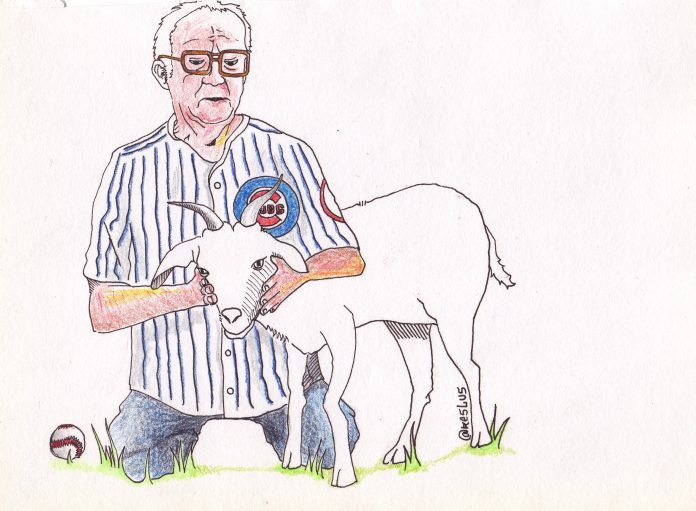
The Billy Goat Curse has become one of the most infamous in sports

The beauty of most sports is that it allows the hardest-working, most talented people and teams to rise to the top. The rules are designed so that everyone has a fair chance of winning, and the team that performs better usually ends up victorious. Of course luck can play a role in determining one’s outcome, but the law of averages gives us the comfort that in the end, things will even out. There’s a sense of order to it.

But what if it doesn’t even out? What if a team keeps getting unlucky? What if a city is unable to produce a winning franchise for half a century and counting? Are these just random acts of misfortune, or are there otherworldly forces at play, keeping certain teams, cities, and players from ever tasting victory? As we look through the years, it becomes very clear that curses in sports truly do exist.

No talk of sports curses can begin without mentioning the Chicago Cubs. This baseball team hasn’t won a World Series since 1908, six years before the start of the First World War (so don’t worry, Maple Leafs fans, life could always be worse). From 1908 until 1945 the Cubs won the National League a total of eight times, but no World Series.

However, in 1945 things got really spooky. Chicago Cubs fan Billy Sianis brought his goat to game four of the World Series versus the Detroit Tigers. For some strange reason, the fans sitting around Sianis didn’t like the goat, which led to the Wrigley Field staff kicking Sianis and his goat out. As he was leaving, Sianis said “Them Cubs, they ain’t gonna win no more”; since then, the Cubs have yet to even appear in a World Series, thus creating what is known as the “Billy Goat Curse”.

Sometimes it’s not just teams that are cursed, but entire cities. The best example of this is good ol’ Cleveland. Though this town might border a Great Lake, its teams are anything but great. The three major league teams in Cleveland are the Browns (NFL), the Cavaliers (NBA), and the Indians (MLB). The last of these teams to win a national trophy was the Browns, who won the NFL Championship in 1964. Since then, it’s been 51 years of snatching defeat from the jaws of victory. When even LeBron James can’t win you a title, you know that the city you live in has been hexed by the sports gods.

Finally, one of the oddest sports curses is brought to us by Sports Illustrated. It’s the dream of any athlete in the world to feature on the cover of this illustrious magazine; however, many of these sporting figures end up facing frightening fates in their futures. Eddie Mathews, an Atlanta Braves third baseman, was the first ever cover athlete for Sports Illustrated in 1954. After he appeared, the Braves had a nine-game winning streak end, and not long after that Mathews broke his hand.

More recently, Serena Williams was on the cover of SI when they did a story on her potentially winning her first calendar Slam. She ended up losing to unseeded Roberta Vinci in the semi-finals of the US Open, two games away from completing this feat.

Let’s hope for our sake that no Canucks players end up on the cover this season.

Let’s go Blue Jays!

0

Two weeks ago I read an article in this very paper entitled “Screw the Blue Jays.” I just moved to Burnaby six weeks ago from Whitby, Ontario, and am extremely disappointed that I am missing what is most assuredly an incredible atmosphere back home.

My love affair with the Blue Jays goes back to the late 1980s, when my dad would take me to Exhibition Stadium. We used to get $2 seats in the right field bench area and then sneak down behind home plate, or sit in the outfield for $4. I remember the agony of the 1987 season when the Jays lost seven straight games, including a painful 1–0 defeat on the final game of the season to blow a 3.5 game lead in the division and miss the playoffs.

My fondest Jays memory as a kid was attending the final game at Exhibition Stadium. This was a thriller that saw former MVP George Bell hit a walk off home run in the 11th inning to close the stadium.

The Skydome was an incredible novelty during its first years in operation. It was such a surreal experience when the roof would open or close during a live game. The World Series years were incredible. I watched every game during both playoff runs and ran around the room when Otis Nixon grounded out in 1992, and Carter “touched ‘em all” in 1993. In 1993, I also attended the victory parade. As I matured, I went to fewer games, but still had a soft spot for my boyhood team.

After I moved back to the Greater Toronto Area nine years ago, I started going to games again despite the team’s relative lack of success.  It was so much fun to ride the train downtown, go to the game and then party on Front Street. My last game before moving out west was ironically against Kansas City just after the Price and Tulowitzki trades.

Once again, the Dome was electric, just as it had been in my youth. My buddy Travis and I painted our chests and made several signs to welcome Kansas City Royals First Base Coach Rusty Kuntz. We are not Kansas City fans by any means, but we were paying homage to the man with the most awesome name in sports.

Around campus I had seen some Jays gear, but not too many people were talking about the team. Last week, though, I went to the Highland Pub to catch the deciding game between Texas and Toronto. The entire bar was packed with Jays fans yelling and screaming with every twist and turn of the game. The Bautista bat flip home run brought the house down!

If the Jays do go on to win the World Series, this may become one of the great moments in Canadian sports history. I felt the warmth of home that day at the pub. To see so many passionate Jays fans this far from home was a great demonstration of Canadian unity and pride. It showed that the Blue Jays truly are Canada’s team.

SFU hockey loses 5–3 to Eastern Washington University

0
SFU had a total of 38 penalty minutes on the night.

On Saturday October 17, the SFU hockey team played their home opener against Eastern Washington University in front of a packed house at Bill Copeland Sports Centre. Unfortunately, a promising first period was the best that the Clan could muster. Four straight EWU goals put this game out of reach early in the third, and the Clan ended up losing 5–3.

“Very poor performance by the guys in red,” said Head Coach Mark Coletta after the game. “We’re going to have to take a long look in the mirror and figure out what we come back with on Monday. I think it was a lack of effort, and hopefully we can turn it around.”

    The game started off with last year’s leading scorer Beau Walker generating an early chance with his speed. It wasn’t the last the Clan defence saw from him on the night, as he was a threat whenever he touched the puck. “He’s a great hockey player, and he’s going to find his spots,” Coletta reflected after the game. “He did that tonight.”

Eastern Washington got the first goal of the game, courtesy of Trevor Zakrajsek. After killing off a double minor for high-sticking, SFU tied the game up with Tyler Basham snapping a low shot past the goalie. Mike Sandor almost gave SFU the lead, but after the first period the score was tied at one.

“We’re going to have to take a long look in the mirror.”

The wheels started to fall off in the second period. After SFU had a couple of great chances, EWU took the lead when Brett Matthews buried the rebound in front of Liem. SFU went down the ice after the faceoff but and scored, but the goal was disallowed — the referee ruled that the puck was kicked in. That proved to be a crucial decision, as later on in the powerplay EWU player Jesse Collins scored to make it a two-goal game.

Beau Walker added a shorthanded goal near the end of the period to make it 4–1. SFU was badly outshot in the period; they only put four on target, compared to EWU’s 13.

The third period wasn’t much better. Walker added his second of the game to put the win out of reach. SFU were able to get two near the end of the period, which capped off a good stretch of play for the Clan — but it was too little too late, and the final score was 5–3 for EWU.

One thing the Clan needs to work on is their discipline. At several points during the game, it was an SFU parade to the penalty box. A total of 38 penalty minutes were called against SFU, with 14 alone called against defenceman Darnel St. Pierre.

“That was a focus point all week: ‘Stay out of the box,’” said Coletta after the game. “Obviously the message didn’t get across. We’ll have to figure out a different way, perhaps internal discipline, to keep guys out of the box. You’re never going to win hockey games when you’ve got 20, 30 minutes’ worth of penalties.

“Overall, we just make sure we’re sticking to our systems,” he added. “The guys will get better. It’s one game out of 24.”

SFU win down a man against Montana State

0
The win has moved SFU up to third place in the GNAC.

Thursday night the men’s soccer team played host to the Montana State University Billings. The visitors came in as the second-best team in the GNAC, as well as the highest-scoring team, with 31 goals in 13 games played. After a very slow and boring first half, a moment of brilliance in the second from Michael North gave the Clan a 1–0 lead. After a red card minutes later, SFU had to hold on with 10 men for nearly half an hour.

“It was a battle,” said Head Coach Clint Schneider after the match. “We got a red card, which was deserved, to be frank. [. . .] I’m glad we got the result tonight. I don’t think we gave them a whole lot to look at in front of the goal, and Michael North scored a wonder [goal].

“We’re moving forward,” Schneider continued. “Another shutout at home, that’s first class from the guys. We just have to keep it going.”

The first half did not feature that much action, to put it lightly. It was the type of first half that feeds the stereotype that soccer is a boring sport. Neither team was able to string any passes together, and the vast majority of the time was spent kicking the ball down the field. Montana State did a great job of forcing the SFU wingers to the inside, where they were promptly met by a swarm of players. 

The second half made up for the first half though. In the 57th minute, Michael North cut inside from the left wing and shot an absolute bullet into the top right corner. That goal proved to be crucial, as a few minutes later James Fraser got a straight red card. A dangerous studs up challenge right into the opposing goalie meant he was sent off, and the Clan had to defend the next 30 odd minutes a man down. After some close moments near the end, they held on for a 1–0 win.

The story by the end of the game was North’s goal, a flash of magic that broke the game open. “Sometimes you need a little bit of magic. They all knew he was going to his left foot, didn’t matter. What a finish,” exclaimed coach Schneider.

With the team still battling down a man, can they build off this success in the rest of the season? “Our guys are realising that they can win games gritty,” said Schneider. “It was a gritty result [tonight]. It’s hard to play good football when you’re down a man, [but] we still made it difficult for them.

“In every regard, I’m very proud of them.”

SFU Quidditch host their first tournament

0
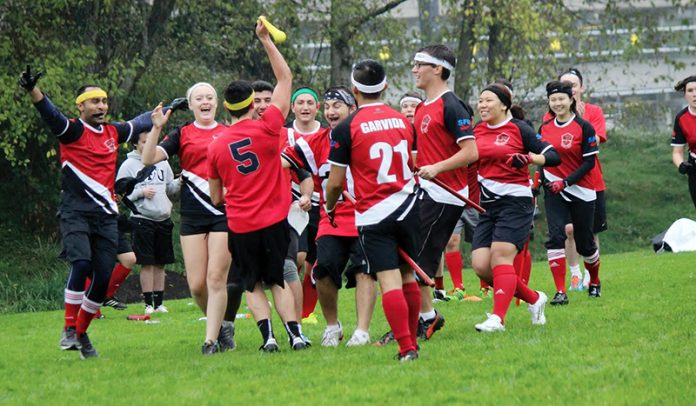
Muggles are welcome to join the SFU Quidditch team.

On Sunday Oct. 18, the Highland Trials took place at Terry Fox Field. The event was an all-BC affair, with British Columbia Quidditch Club (BCQC), SFU Quidditch, University of Victoria Valkyries, and Vancouver Vipertooths all participating. It was the first tournament hosted by the SFU Quidditch team. Quite the achievement considering a few years ago, the team did not even exist.

Despite the rain and a few hiccups, it was a successful tournament for SFU, showing how much the rec club has grown since beginning in fall 2013.

Philomena Chenne is the vice-president of SFU Quidditch, and was also in charge of organizing the Highland Trials. She said that all the experience the team has soaked in going to other tournaments signaled that the team was ready to host their own.

“Having three years [of] cumulative experience now of going to tournaments and seeing how other veteran players have hosted, just seeing how their tactics and scheduling” has been hugely valuable according to Chenne. “Just seeing how your veterans and team can commit to it.”

Once the team decided to host, Chenne had to put in the hours making sure that all the details were taken care of. That included booking the field, getting permission from SFU Rec, bringing in teams to play, making the schedule, and organizing all the volunteers for the tournament.

The volunteers make up a large part of it, as a Quidditch game will have four different types of volunteer referees (a head ref, an assistant ref, and goal judge, and a snitch ref), as well as scorekeepers and timekeepers.

Speaking of the snitch, that is another volunteer position which has to be filled — this is muggle Quidditch, after all. There isn’t any flying golden object, which means that the snitch is filled by someone running around the field trying to avoid a team’s seekers, whose goal is to take a socked tennis ball from the snitch’s pants.

Talor Mykle-Winkler is the president of SFU Quidditch. She said that the club probably wasn’t ready to put on a tournament before now, but believes that playing host won’t be a one-time thing.

“Definitely we will be trying to [host again], whether it be next semester or next year,” Mykle-Winkler said. “There’s so much that goes into the behind-the-scenes, the set up and take down, making sure that teams show up and volunteers because there are a lot of those that are needed.” 

“It’s a lot more fun hosting; you don’t have to drive as far.”

With all the successes of hosting a tournament, it was a bit of a hiccup to end, as SFU was set to face Vancouver Vipertooths in the finals. However, several of the Vipertooths had to leave early, and appeared not to have enough players to play the final match.

SFU decided to lend Vancouver some of its players and turn the final into a friendly, which the hybrid Vancouver-SFU team won by a final score of 100–30.

    Chenne said that despite how the day ended, it was very encouraging for the club to see the players come out and compete hard in the hopefully inaugural tournament on Burnaby Mountain. From here, the team will start focusing on their next tournament — the Rocky Mountain Rumble taking place in Kelowna next month.

SFU football’s offense sputters against Hardrocker defense

0
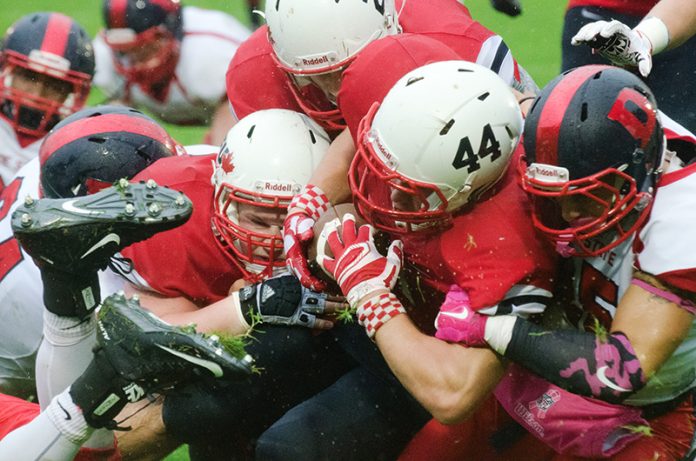
The Clan were shut out for the first time this season.

At the halfway point of the GNAC season, the Clan traveled down to take on the Hardrockers from South Dakota School of Mine and Technology (SDSMT), who are currently in second place for the GNAC title. A tough Hardrocker defense would pitch a 19–0 shutout against a Clan offense that put up four passing touchdowns in the previousmatchup against the visiting Dixie State.

SFU opened up the game on offense, but were quickly forced to punt the ball to SDSMT who would put up three points on an 86 yard drive that featured six first downs and lasted eight  minutes. Cornerback Robin Weathersby and Safety Jordan Pugh both tackled receiver Daniel Ziegler to end the drive on third and goal, forcing the Hardrockers to settle for a field goal.

On the next Hardrocker drive, Weathersby would make another big play by recovering a fumble at 50-yard line, but a quick three and out forced the Clan to give the ball right back to start the second quarter. The Hardrockers bounced back by putting together a quick 80-yard drive that was capped off by a 35-yard touchdown run from quarterback Trent McKinney.

Shorty after, the Clan defences found themselves once again with their heels against their own end zone. Jordan Pugh stepped up to make a big play by forcing a fumble at the goal line. Linebacker Jordan Herdman would recover the football and give the Clan offense a chance to score before half time.

Quarterback Ryan Stanford put together a couple of first downs, including a 29-yard pass to SFU’s leader receiver for the season, Justin Buren, but inconsistent play forced the Clan to one again call upon kicker Nikolai Karpun to punt to ball away.

“We did enough defensively to put us in a position to win but unfortunately our offense was unable to make any big plays,” said coach Bates told SFU Athletics after the game.

With only a 1:09 left to play in the first half, the Hardrockers were able to assemble yet another long drive that ended with a 19 yard touchdown pass from McKinney to wide receiver Kevin Mills.

After giving up 16 points in the first half, the SFU defense buckled down and held the Hardrockers to a single field goal in the second half to give the offense a chance to win the game for the team.

Running back Ante Milanovic-Litre has stepped up in recent weeks to become the feature back for the Clan, after replacing the injured Josh Hayden. Ante was held to only 31 rushing yards in the first half, however, adjustments in second half play calling pushed him to finish the game with a career-high 125 yards on 21 carries.

In an SFU Athletics summary, Coach Bates acknowledged Ante’s performance by stating that, “Offensively today our running game was able to establish itself [. . .]” however, he also pointed out that, “[. . .] we really struggled at the QB position and were unable to establish consistency.”

Quarterback Ryan Stanford finished the game completing 13 of 28 passes for 121 yards and an interception, while Justin Buren led the Clan in receiving with five receptions and 84 yards. Brothers Jordan and Justin Herdman led the Clan in total tackles with 19 and 11, respectively. Jake Oram and Ben Minaker also finished up with 10 tackles each.

The Clan’s next game will be against Humbolt State on the road in Arcata, California. The game starts at 1 pm.