Home Blog Page 867

Naomi Klein calls out Trudeau on “pretending to care” about climate change

74
Friday night's lecture at the Vogue Theatre was part of the SFU Vancouver Speaker Series.

What is something that former Prime Minister Stephen Harper has over Justin Trudeau? According to Naomi Klein, “at least he didn’t pretend to care” about climate change.

On Friday, the prolific writer and environmentalist spoke to the danger of a government that did not take climate change seriously at an event hosted at the Vogue Theater by the SFU Vancouver Speaker Series in partnership with SFU Department of Philosophy. The sold out show drew environmentalists, students from SFU’s semester in dialogue, as well as SFU President Andrew Petter himself.

“Is what happened in Paris a [. . .] breakthrough or an ecological disaster?” asked Klein, referring to the United Nations Climate Change Conference that took place in the French capital last year. At the end of the conference, 195 countries agreed to the Paris Agreement, which set the goal of limiting global warming to two degrees celsius above pre-industrial levels.

However, there are many criticisms against the agreement, including that it is non-binding, and may not be ambitious enough to prevent sea level rise that would wipe out some coastal nations. Klein argued that “these people [. . .] have a right to exist,” and that the lack of real effort to act in the Paris Agreement is not only disingenuous, but is “genocidal.”

This idea of social justice beyond borders is part of what brought Klein to Vancouver. Dr. Sam Black, professor of philosophy at SFU, organized a President’s Dream Colloquium course in spring 2013 that explored the idea of global social justice, and Klein’s latest book, This Changes Everything: Capitalism vs. the Climate, links social justice and climate change. In it, Klein explores the link between the rise of neoliberalism in the 1980s with the dramatic increase in carbon emissions and emphasized the need to take immediate action on climate change.

The complexity of addressing climate change, Black explained in an interview with The Peak, is partially because of how far removed the issue may seem. While Vancouverites may be moved to address homelessness because they see human suffering first hand, “in the case of global climate change, we’re talking about enduring sacrifices now for the sake of people who don’t even exist yet.”

On Friday, Klein criticized a recent statement by Trudeau that pipeline projects will pay for the transition to a low carbon economy. Klein said that the emissions resulting from projects like the proposed Liquid Natural Gas (LNG) terminal on Lelu island or the TransMountain pipeline expansion would break Canada’s carbon budget. Said Klein, “The science is clear and the numbers do not add up.” Recently, a group of 130 scientists have submitted a letter to the federal government criticizing the environmental draft report on the LNG terminal.

However, Klein ended her talk by offering some good news for those hoping for climate action.

She spoke to the gathering speed of divestment movements across North America, taking a moment to comment that so far, no major Canadian universities have committed to divest from fossil fuels. Other movements have been gaining steam however, including the extremely rapid conversion of Germany’s energy grid to renewable energy.

By tackling the multi faceted causes of excessive emissions, Klein argued that countries have an opportunity for dramatic social and economic change by promoting social programs and creating sustainable jobs.
She explained that that future is “not just better than the world if we don’t act [on climate change]; it’s better than the world right now.”

Apathy reigns supreme at SFSS Executive Debate

0
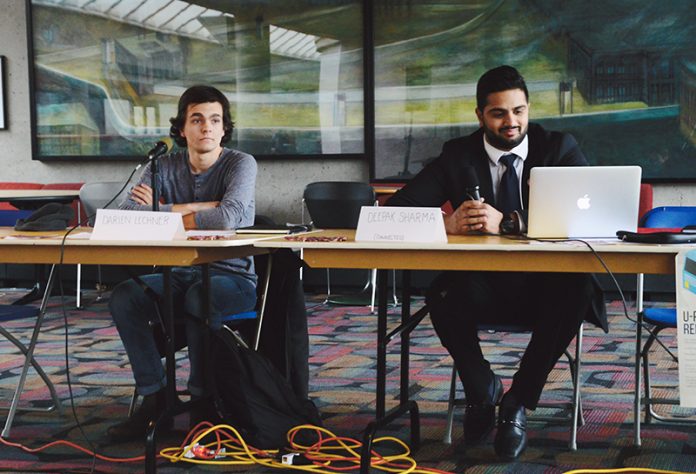
Darien Lechner (left) looks on as Deepak Sharma (right) checks his notes during the presidential debate.

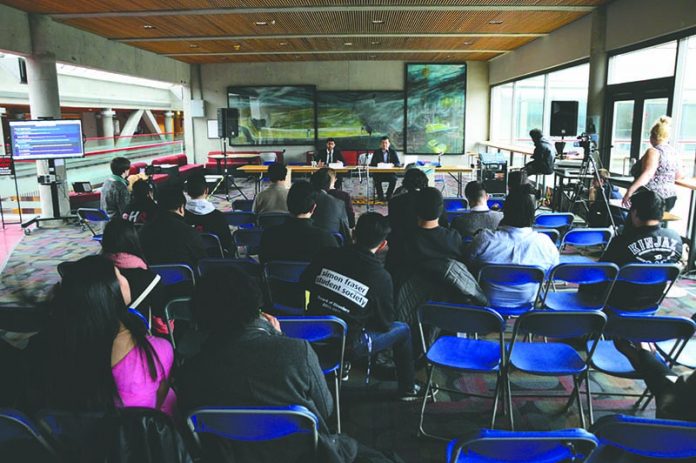
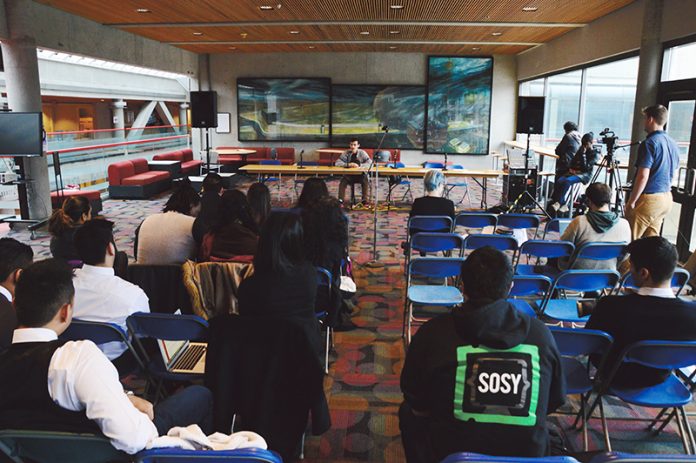
“I kind of expected there would be a lot more people up here,” remarked Simon Fraser Student Society presidential candidate Darien Lechner during his opening statement. He wasn’t the only one.

After an intense debate at last year’s Burnaby campus debates for those running for executive positions, including president and vice president positions, no one candidate was able to stand apart as a clear front-runner in a debate that took much less time than was budgeted for.

The afternoon was a low-energy question-and-answer period, with nine candidates jostling for six positions. Three of the positions (VP Student Life, VP Student Services, and VP University Relations) were uncontested, helping to contribute to the lack of debating between candidates.

There was only one slate, Connected, with members running in executive positions. Anyone else running was doing so as an independent.

VP External Relations – Archit Bansal vs. Christine Dyson (Connected)  WEB-External-Lisa Dimyadi

In their opening statements, Bansal indicated his intentions to focus on open textbooks and lowering student fees, while Dyson chose not to mention specifics.

Bansal argued that it was time for fresh faces on the board, springboarding off of members from the audience who questioned having continuity from current board members remaining board members.

Dyson responded by stating that she is currently working with open textbooks, an initiative which Bansal says he wants to get started with.

Bansal went on to campaign for his clear vision on the issues, and Dyson touted her experience and drive to find out “what students want.”

VP Finance – Ibrahim Hafeez vs. Hangue Kim (Connected)WEB-VP Finance-Lisa Dimyadi

The debate started with both Hafeez and Kim acknowledging they were friends, which came up several times throughout their short time at the microphones. Kim insisted that they had worked together on several projects throughout the year, and was glad they were having a civil and friendly competition.

Kim’s big priority for his campaign is the restructuring of cheque requisitions. He believes that, “if we improve [cheque requisition], it’s kind of a domino effect for other services.” Improving this service makes getting money back to students easier, and Kim said this was an issue that several students were complaining about.

Hafeez took a stronger stance. “I believe the system is broken,” he said answering how he felt the SFSS manages money. “The budget is created by the board before the new board is elected, and that’s not the way to go.”

He mentioned the desire to create something he called “The Opportunity Budget” which focused on incoming board members sitting down and determining a new budget that would reflect student wants and needs.

VP Student Life – Curtis Pooghkay (Connected)WEB-The Poogh-Lisa Dimyadi

Running uncontested, Curtis Pooghkay touted his ideas, which consisted of building engagement across all the campuses, and eliminating the idea of SFU being a “commuter campus,” wanting students to want to come here for more than just classes and go home.

He also threw his support behind the fraternities and sororities on campus, saying that Greek Life is “highly engaged” in student life, and they should be rewarded for their efforts.

VP Student Services – Larissa Chen (Connected) WEB-Larissa-Lisa Dimyadi

Chen highlighted her student desire to have services be more accessible in person, and pointed at the U-Pass as the number one service that students depend on, noting the importance of this year’s referendum. She also gave a shout-out to the copy centre, which she feels is an underutilized service on campus.

One of her big mandates for next year is to try and improve student well-being, specifically in regards to mental health. Chen acknowledged that issue is very dear to her, and wants to advocate for more staffing to accommodate a greater need from students.

VP University Relations – Arr Farah (Connected) WEB-University Relations-Lisa Dimyadi

The final uncontested debate was also the shortest, with Farah fielding few questions from the crowd.

He did say that while “the student society and the university have had a good relationship, [. . .] the student society has been taken advantage of by the university in many areas.” He pointed to Build SFU and maintenance as a couple examples, and said he would improve this relationship if elected, one which would allow the ability to advocate for these issues.

President – Darien Lechner vs. Deepak Sharma (Connected)WEB-Prez-Lisa Dimyadi

In the final debate of the day, the two candidates campaigning to be president got the chance to argue why they are worthy of students’ votes, with the two having to field so many questions from the audience that time had to be extended past the regulation.

Sharma pushed for the ideology of SFU to shift from a commuter school with satellite campuses to one that sees SFU as a “tri-campus university,” helping to increase connection between the three campuses.

As for Lechner, he made it clear that his main priority was to get students more involved in campus life, primarily through reducing the amount of money he was taking, and making it more obvious to student where the money that was being collected from them is going.

Both candidates were questioned by the audience about their evasive answers, with current VP University Relations going as far as to call some of their responses “fluff” on Twitter. (For more of the day’s tweets, check out our coverage here)

Current president Enoch Weng and VP Student Services Darwin Binesh had several questions for the candidates, and made sure to instill the notion that candidates could not agree to advocate for every issue brought their way, as the role of president is forced to make tough decisions.

Looking forward

With two more debates happening next week at the Surrey and Vancouver campuses, IEC chief Vanna Lodders believes that there is still plenty of time for students to show up and ask candidates about their platforms, which will be released by the debates.

She took responsibility for their unavailability today. “I extended the the due date to the 11th is because I didn’t communicate that early enough to everyone that they needed their platforms due and I know a lot of people wanted to take their time with them,” she said.

“I didn’t want to rush anybody and have them put out a platform they didn’t want and then ask me to edit it and then me tell them no. My own thinking was to give people enough time.”

Last year, the Burnaby debates were the most popular ones, with noticeably more students showing up there than the Vancouver or Surrey campuses. It will be interesting to see if more students attend the off-mountain debates given how few showed up for the main event this year.

Top 15 Tweets from the SFSS Executive Debates

0
There may not have been that many in the audience, but those that were took to Twitter.

The Simon Fraser Student Society election is in full swing: candidates for the big six positions on the SFSS Board of Directors met in the West Mall Atrium on Burnaby campus earlier today to field questions from students and debate their credentials. Several candidates are running uncontested, and references to a lack of engagement ran throughout the debate. Here are 15 key tweets from the over-two-hours debate.

  1. When the low turnout spelled doom for the debates.

(To be fair, there is a precedent for this)

  1. When the crowd went HAM on the VP External candidates.

  1. When no one was sure if Darwin was throwing shade.

  1. When the VP Finance candidates really wanted us to know they were friends.

  1. When VP Student Life candidate Curtis Pooghkay channelled Petter.

  1. When VP External Kathleen Yang got real about the SFSS’ most important services.

  1. When we maybe got a little too sassy to VP Student Services candidate Larissa Chen. (Sorry, Larissa.)

  1. When VP Student Services Darwin Binesh repped the U-Pass referendum.

  1. When our photo editor dropped some truth bombs.

https://twitter.com/Lenevalia/status/708433388965724160

  1. When Kathleen tweeted what we were all thinking.

  1. When presidential candidate Darien Lechner told us how he felt about Build SFU.

  1. When his competitor Deepak Sharma namedropped his Facebook page.

  1. When a group of kids threatened to send the whole thing off the rails.

  1. When Darwin stopped being polite and got real.

  1. When VP University Brady Yano dropped the damn mic on the whole debate.


NEW MUSIC FRIDAY

0

By: Sarah Finley, Courtney Miller, and Jessica Whitesel

Follow The Peak on Spotify to stay up to date on New Music Friday.

“Dangerous Woman” – Ariana Grande

Jessica Whitesel: I really dislike Ariana’s voice. It is too nasally. This song has so much potential to be amazing, but it needed to go to a different artist. I couldn’t even finish listening to it.

Sarah Finley: I’m not typically an Ariana Grande fan, but this new track from Grande utilizes the lower parts of her vocal range, making it distinctly different from her usual music without losing the powerful effect.

Courtney Miller: I was unsure when the song first started, but it does grow on you — the lyrics really help with that because I find them relatable. Grande’s a great vocalist, but I always feel like it never shines through on her own music because she’s in this pop music bubble.

“WHERE THE HELL ARE MY FRIENDS” – LANY

JW: I like that it is a calmer electronic inspired song, but it doesn’t really ever go anywhere. It just kind of stays on the same level for the whole song. It is also very, very, very repetitive and it becomes pretty clear with the painfully consistent backing track.

SF: My friends are all studying for midterms, so I identify strongly with the title of this track. This song is mildly repetitive with simplistic percussion and chord progression, but somehow it’s still catchy. Kudos.

CM: It’s a little repetitive, but in that good, yes-now-I-can-learn-the-lyrics way. The music is varied enough that it doesn’t get boring and I get a bit of ’90s nostalgia from the overall feel.

“Hallelujah California” – Luna Shadows

JW: This song honestly doesn’t sound that much different from a Lana Del Rey or Halsey song. It doesn’t do anything new and Lana Del Rey is doing the same thing already but better.

SF: Luna Shadows has a dreamy seductive voice, making me desperately nostalgic over the summers I spent playing in Southern California oceans with my friends. I’m guessing any listener will experience the same effect, even if they’ve never travelled south of the border.

CM: The vocals remind me of Halsey, and the music is kind of a haunting-pop with lots of echo. That being said, it’s a great mellow track for quieter moments.

“What You Talking About?” – Peter Bjorn and John

JW: I love Peter Bjorn and John. Their music is just super fun, and, even if I’m having a bad day, never ceases to make me feel better. This song is in that vein, so 10/10.

SF: Peter Bjorn and John have been a long-time favorite, and this new release doesn’t change anything.

CM: I kept waiting for something great vocally to happen but every time it built up it fizzled out. For whatever reason it makes me think of polka music and that’s not really my style.

“Ghost” – Oliver Heldens feat. Rumors

JW: I want to ghost on this song. It’s the kind of song that comes on the in the club and makes you not feeling bad about having to stop dancing to go pee for the 50th time that night.

SF: This song features weak bass drops and a weird change of pace halfway through that leaves me wondering what happened. It’s like the artist decided to give up halfway through, but their label made them finish the track.

CM: It sounds like a bad video game’s soundtrack, where the music’s the best part. I am on this cusp of not being able to decide if I like it — I want to because I like the idea and the vocals, but I can’t because of that video game quality. Multiple listens push me to the ‘no’ side of things.

“Taste the Feeling” – Avicii vs. Conrad Sewell

JW: Merp. I don’t know what feeling that sound conveys, but this song is merp. It’s just a weird remix of a song from a Coke commercial and and it doesn’t make me want to drink a Coke or dance, so merp.

SF: I’ve never really been an Avicii fan, and although this isn’t their usual sound, I’m still not overly impressed. While the beats and synthesizer are catchy, Conrad Sewell’s gentle vocals don’t particularly blend well with the electronic vibe.

CM: This I kind of love. It’s a feel-good tune where the vocals and music work together nicely and nothing feels recycled or homogenous.

“Jesus Made Me Bad” – Laora

JW: This song should be called, “Jesus Made Me Make Bad Music.” This song is trying to do things that so many other artists have already done, but Laora isn’t even close to being on the same level as them.

SF: Firstly, I really appreciate the title of this track, but if I’m being honest, that’s all I’m feeling. Tropical sounds combine with distorted and echo-y vocals, and it just didn’t come across well.

CM: I think she’s trying to incorporate too many styles and elements into one song. I can never get comfortable with it and enjoy it because as soon as I start to get down with it, it switches up and I go “wtf.” All that aside, I love the lyrics.

“Shrubbery” – Bronze Whale 5-D

JW: Their flow reminds me of Twista, but the paired down, almost video game-inspired backing track makes it feel a little less frenetic and chill. Seeing as they are talking about smoking pot for the whole song the chill vibe is a probably a good thing.

SF: I love when formerly underground artists have a breakthrough and enter my life, and this is exactly what happened here. Bronze Whale and 5-D combine to feature extremely talented lyricists, DJs, and background percussion.

CM: The shrubbery is where this belongs. . . I’m impressed they can spit their rhymes that fast, but that’s probably the only compliment I have. There’s a disconnect at times between the rhythm of the rap and the dull track.

“The Magician” – Andy Shauf

JW: I love the laid back vibe this song has, and Shauf’s voice is AMAZING. Also it’s pretty sweet that he is Canadian too, but like I can’t get over his voice. I love this song, and just gets better the longer you listen.

SF: Andy Shauf is an all-time favorite, and this track featuring soothing, masterful piano chords, string instruments, and clarinets make “The Magician” just as good as the rest of his work. Shauf’s voice is uniquely calming, reminding me of frolicking through fields with my golden retriever when I was little. I could listen to this all day.

CM: Soulful guitar, cascading piano, a brass section — I’m loving it. The vocals are emotive, but he needs a little more confidence because he seems a little unsure of himself and his choices at times.

“Shore” – Hoodies at Night feat. Milk & Bone

JW: This song isn’t going to stick around for very long. It’s been done before. The “ooooohh-ah” with the squeak at the end is too much. Also the weird vocals that sound like an untuned horn suck.

SF: This track begins with snapping, and distorted feminine vocals, but after that it’s fairly forgettable.

CM: Kind of repetitive, doesn’t seem to do anything particularly interesting throughout the song. But the slow burn from a morose melody into an upbeat jam saves it from the anonymity of monotony. I’d dub it background chill noise.

“The Woman” – Bo Baskoro

JW: I wasn’t convinced of this song at first. It sounded pretty darn generic, but about 45 seconds in, it really picks up and Baskoro really lets his voice shine. It would be nice if he did it more throughout the song, because he can sing.

SF: Don’t listen to this song if you’re going through a breakup. Aside from the heartbreaking lyrics, Bo Baskoro has a beautiful voice and combines them effortlessly with a simplistic percussion beat and keyboarding.

CM: Sturdy vocals and rhythmic, melodic music go really well together on this track and I really love Bo’s voice. If you like alt-pop, you’ll probably like this.

“One More” – Weaves

JW: I don’t know what this song is. It is like it wants to be a talk-sing-rockabilly track, but it doesn’t really do any of those things well. If Weaves picked a sound and stuck with it, it might be a more successful song.

SF: This beach rock track, while typical of the genre, isn’t really my style. The artist’s voice seems to be at its limit throughout the entirety of the track, and the electric guitars are too screech-y. I’ll stick to my heart breaking Bo Baskoro.

CM: Nope. It starts off almost alright and then it builds into this hugely discordant cacophonous vomit before returning to the almost-alrightness it started with. Dude, it’s like you went, “Okay and here I just want every instrument we have to make a random sound — it’ll be good, I promise.” Don’t make any more promises.

SFSS Non-Executive Debate emphasises student engagement

0
Many of the seats for Faculty Representative positions are going uncontested this year.

“The SFSS, although a wonderful organisation, has failed to do its job in connecting with students,” said Alam Khehra, a candidate for the position of At-Large Representative. Throughout the first debate in this year’s election for the SFSS Board of Directors, many candidates also stressed the need to engage students and suggested their own ideas for how to do so.

The position of At-Large Representative is currently the most competitive of the entire SFSS election, with five candidates running for two positions. When asked about their feelings on it by current VP Student Services Darwin Binesh, all five candidates notably supported the Build SFU project. Binesh himself called it the “biggest project in the student society’s history.”

WEB-1
From Left to Right: Jaggy Kullar, Alam Khehra, Mudiwa BK Bwakura. Paul Hans, Moein Sharifi Moghaddam

Candidates differed on what their main focus would be as an At-Large Representative. While candidates Jaggy Kullar and Alam Khehra stressed the need to listen with and engage with Departmental Student Unions (DSUs), Paul Hans argued that this might be impractical considering there are 73 DSUs [The Peak was only able to account for 53]. Candidate Moein Sharifi Moghaddam explained his main focus would be increasing awareness about the services already offered to students, supporting the women’s centre, and establishing a men’s centre, a controversial proposal that has been debated on campus for several years

Khehra questioned Hans on the promises he made when he ran for senator, such as increasing student engagement and decreasing the commuting time from Surrey. Said Hans, “If you just look at the election, sure, engagement has gone down,” adding that he did not call for reducing commuting time but instead advocating for transit services, which he argues he did by addressing pass-ups with the 145.

Alan Lee, a candidate for Applied Science Representative, asked competitor Prashant Verma about concerns that Surrey students were left out of the process out of the process of approving Build SFU. Verma argued that while there was a need for greater engagement with Surrey and Vancouver students, Surrey students will benefit from the project still and the project will make the university more competitive with other universities.

Arts and Social Sciences Representative (FASS) candidate Blossom Malhan asked rival Erwin Kwok how he would increase voter turnout in the FASS, given the importance of getting enough voters to pass the two referendum questions. Kwok said he would use social media, approaching students in-person, and liaising with DSUs, noting his own time with Criminology student association. Kwok shot back with a question of his own about Malhan’s absences when she was appointed to the Events Committee. Malhan replied that she withdrew from the committee because she didn’t have enough time: “I didn’t want to do something where I knew I couldn’t be there and it would be just for show.” 

Blossom Malhan (Left) and Erwin Kwok (Right).

Jimmy Dhesa, a candidate for Science Representative, questioned his fellow candidate Tomas Rapaport about his success as a third year representative on the Science Undergraduate Society (SUS). Said Dhesa, “Since your term in the position the involvement of science students has decreased. [. . .] Since you were unable to complete the fundamental and simple role of your position, how can students trust you to take on many other roles as a science representative?”

WEB-5
Jimmy Dhesa (Left) and Tomas Rapaport (Right).

Rapaport called the premise of the question “false” and argued that he has increased participation in the SUS, citing 16 candidates running for 11 positions when there were six candidates the year before. Dhesa said that while there was an increase, it was “not significant enough.”

All other Faculty representative positions had candidates running unopposed, except for the Environment representative, for which no one is running. Notable highlights from uncontested seats include Education Representative candidate John Ragone speaking to his wish to create a faculty student union for Education instead of the current departmental student union, considering that Education is a faculty, not a department.

Health Sciences Representative Candidate Raajan Garcha, said that she would divert funds from “unnecessary funds” to create more faculty scholarships, increase social events for Health Science students, and named mental health as a particular concern for her.

Low voter turnout could invalidate referendum questions

0
The chances of losing the U-Pass are slim, but they do exist and need to be addressed.

With the fate of the U-Pass being decided at this year’s referendum, it is important to acknowledge that the worst case scenario is that students will lose their U-Pass. While Simon Fraser Student Society board members confident in a “yes” vote, that might not be their biggest concern in keeping the U-Pass for student.


With the reduced amount of candidates this year — roughly half the amount of last year — some fear that voter turnout will be lower than it has been the last few years. While the candidates will be elected regardless, this low number could affect whether or not the referendum questions will be counted as valid.


          This is because of Bylaw 17.8, which states that “No referendum shall be deemed valid or binding on the Society unless a minimum of five (5) percent of the members in good standing of the Society have cast ballots in the referendum.”


          “The concern we have is that not enough people will vote for it,” said Binesh. “We need at least five percent of students to vote. Even if you get a yes vote and 99 percent majority but less than five percent of eligible cast ballots, it doesn’t count. It’s not binding, we lose the U-Pass.”


          Binesh went on to say that if the election happened today, he doesn’t personally believe that they’d have the support for the referendum proposal to go through.  


          The SFSS’ current member registry lists 24,001 students, meaning that the SFSS will need 1,201 students to vote in order for the referendum to be considered valid.


          The referendum question is about raising the fees of the U-Pass by $1.50 for the next two years, seeing it go from $38 to $41 overall. This was the agreement reached by TransLink and post-secondary institutions in BC, and is happening because their previous deal from 2013 has expired.


          The other referendum question on the ballot is whether or not to terminate the student levy for Schools Building Schools, a decision which VP External Relations Kathleen Yang said is based on the two parties mutually deciding to part from each other.


          While Binesh is worried about the number of students voting, he feels confident in the way in which students will cast their ballot.


We know we have a lot of student who live three zones away — we’re a commuter school, that’s why a universal transit pass makes sense,” he said.


“I would be shocked if someone who lived three zones away said that $41 is too much to pay for a transit pass.”


          Should the worst-case scenario come true, the reality is that students would likely lose their U-Pass. If that happens, getting it back will not be an easy thing to do. According to Binesh, it could not happen until the proposed agreement with TransLink ended in two years, meaning that it would not be until 2018 when it would be discussed again.  


          While there has been no referendum that didn’t meet quorum in recent years, Binesh and others fear that complacency will creep in, and that will the deciding factor.


          We’re confident that students will show their support,” said Binesh. “We’re just worried that students will think it’s a no-brainer or an easy win and they’ll flake out saying ‘I don’t need to, everyone else will.’ Usually that’s when surprises happen and we have unfortunate realities.”

The Wave redefines the disaster movie

0
A smaller disaster with stronger human impact.

On any given year, Hollywood pumps out a dozen or so disaster movies. Terrorist attacks, alien invasions, or natural disasters loom, all of which are only visible to a select few people who have to save the world. Strained logic, two-dimensional characters, and clichéd plots make for hollow spectacle. In most Hollywood disaster movies, the only believable catastrophes are the films themselves.

Enter The Wave, Norway’s first disaster movie: a small scaled mega-spectacle, a little film about a colossal event, a movie with small choices and enormous impact. Retreading clichés to correct the absurdities sometimes inherent in them, The Wave feels like a sure-handed amalgamation of European social realist films and mega-budget Hollywood action flicks. We actually believe the film. We care about the characters and what happens to them.

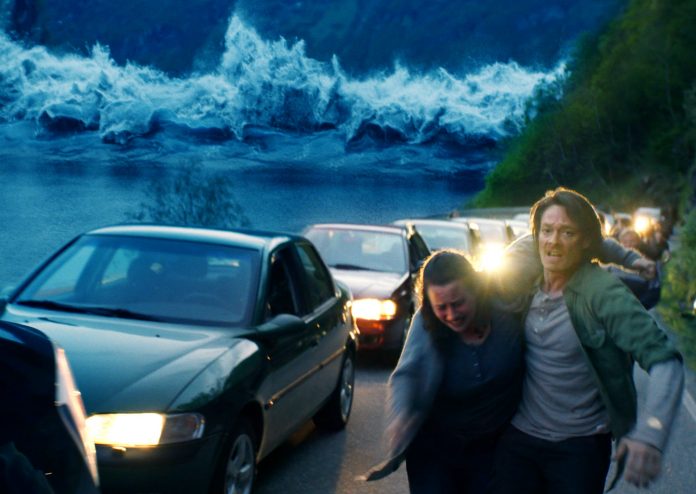
Living in a remote part of Norway, where a potentially unstable mountain could create a tsunami, a geologist, Kristian, and his family, are preparing to move when their sensors begin malfunctioning, showing contractions in the mountain. After leaving town, Kristian turns back to monitor a potential quake and landslide, which could wipe out the small, riverside town. There are implications of marital conflict, and a jaded teenage son distancing himself from the rest of the family. But, as these films have taught us, nothing brings a family together quite like death and destruction.

About half of The Wave’s running time is spent with the characters and the environment — not as a kind of commercial for the rest of the film, but an integral backbone for the visceral impact. The Wave gives itself time to build atmosphere and instill fear. In almost every shot, the mountain rests in the background, threatening to crack at any moment.

Despite a three-minute sequence towards the end that threatens to undercut the rest of the film, The Wave is grounded and sturdy, avoiding the shaky fault lines in most disaster films. The characters make logical decisions based on their situations. Kristian’s colleagues, who monitor the mountain and are skeptical of a landslide and tsunami, are more ambivalent than stupid for the plot’s sake. The film doesn’t rely on overreaching CGI, but on suggestion. Like Jaws, which didn’t depict the shark until the climax due to budgetary restrictions, The Wave uses its “money shots” conservatively and to overwhelming impact.

Although the death toll in The Wave is somewhat low, especially since the focus is narrowed to a happening in a small town, the human impact feels far greater. While in last year’s San Andreas, The Rock’s character completely ignored his duty as a search and rescue worker in order to save his family, The Wave posits that this disaster is happening to more than just the main family. Altruism comes at a cost. When people are selfish, other bystanders pay for their carelessness. No death or sacrifice goes unnoticed.

The Wave feels like the answer key to the Hollywood formula. It isn’t going to rewrite the rules, but it provides a solid solution.

Whitecaps lose 3–2 in home opener

0
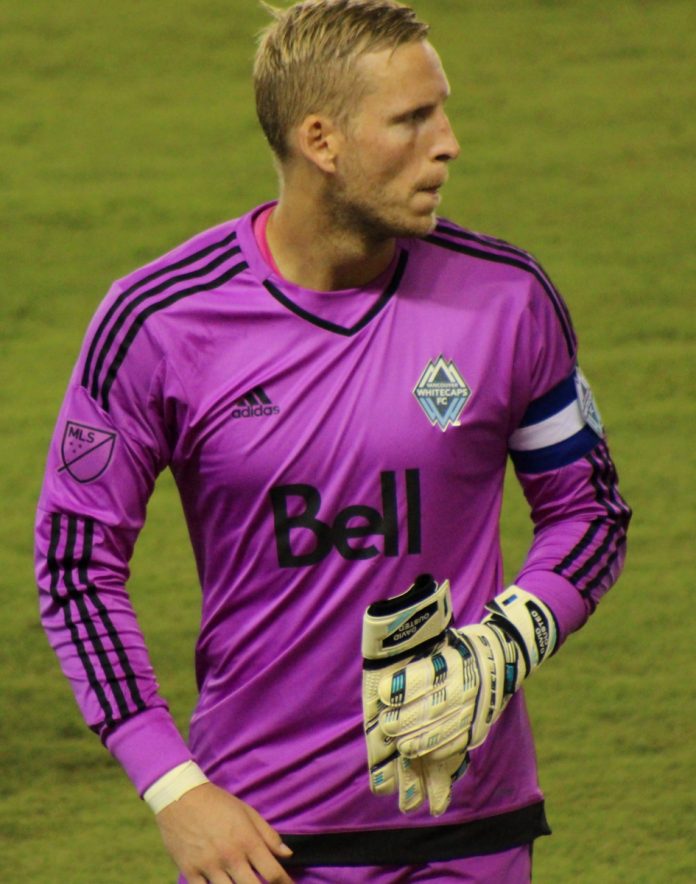
David Ousted had an uncharacteristically bad night, conceding three goals.

The Vancouver Whitecaps opened their 2016 Major League Soccer campaign at BC Place playing host to the Montreal Impact. There was much anticipation for Sunday afternoon’s matchup. Fans and local media were excited to see the new, highly touted off season acquisitions that have made this team into an MLS cup contender. This Sunday was the first time we got to take a look at this new and improved Whitecaps roster.

With all the new additions to the roster, there were some notable adjustments made to this year’s starting eleven — although it was the usual David Ousted taking command of the goal. Newly acquired right full back Fraser Aird, who is currently on loan from Scottish side Rangers F.C., was handed his first start along with right winger Christian Bolaños. Up front, in his second season with the ’Caps, was lone striker Octavio Rivero.

As the game got underway, BC Place was buzzing with energy. Until the Montreal Impact struck first in the 19th minute, as midfielder Ignacio Piatti cut inside the box and weaved his way through four ’Caps defenders before slotting it past Ousted. Subsequently, the Whitecaps nearly leveled the scoreline about a minute later, although the crossbar denied Rivero of what would have been a beautiful strike.

With the final five minutes of the first half coming to a close, the Impact struck again. This time, Whitecaps goalkeeper Ousted committed a crucial mistake, coming out of his 18 yard box to challenge Montreal forward Dominic Oduro, only to have the ball skip right by him and into the goal. However, in the final minute of the half, the Whitecaps got on the scoresheet. A beautiful set piece from the Whitecaps resulted in Jordan Harvey finishing from close range to bring the home side within one.

Following halftime, there were numerous chances for both sides. Finally, in the 88th minute the Impact broke through once again. Ghanaian international Oduro raced past the ’Caps defense and laid the ball off to Piatti, who patiently placed the ball in the back of the net for his second of the game. At this point, it was certain the Impact were heading back to Montreal with the three points. They ultimately did so, although the Whitecaps got one back as Waston headed in a cross from a Bolaños corner, a goal that was just mere consolation.

Reminiscent of last year’s home opener against Toronto, the Whitecaps once again failed to capitalize on their chances as Rivero was unable to find the back of the net, despite plenty of quality chances throughout the match.

Our lack of international cyber laws should be put to shame

1

[dropcap]I[/dropcap]n recent years, public shaming has become a popular tactic for harassing people. From cyberbullying to revenge porn, the Internet has become a new arena for psychological abuse. In many cases, the victim’s personal and professional life is negatively affected. The story of Desiree Capuano — someone whose life is being destroyed by an online revenge website set up by her ex-husband — unfortunately occurs more often than one would expect.

According to CBC, Capuano’s ex, Patrick Fox, created a site in her name in order to “make her life as miserable as possible.” Apart from calling her a drug addict, a child abuser, and a white supremacist, the website is “full of vulgar content and demeaning images and purport[s] to describe details of her sex life.” Capuano’s partners, friends, and family have also been unnecessarily included. Fox made it clear that this is a premeditated attack on the mother of his child.

While issues of stalking, cyberbullying, the threat of physical violence and the problematic involvement of children are all present in this scenario, the lack of legal options available to Capuano are as well — and it’s heartbreaking. Unable to afford the legal fees for civil court, she took her complaints to all the authorities she could. According to the CBC, this included “local sheriffs in Arizona, the FBI, the hosts of the website and several lawyers.”

While a protective order stops Fox from sending Capuano emails, the main source of harassment — the website — has not been taken down. In July 2015, Fox was arrested for a short while. Unfortunately, The Crown did not approve the charge of criminal harassment recommended by the RCMP, and Fox was subsequently released. A spokesman for The Crown mentioned that a factor affecting their decision was that the two parties live in different countries.

Here is the problem: Fox has stated plainly that he seeks to “ruin her life and destroy her.” We are witnessing an abusive man who has made it clear that he has every intention of hurting his ex-wife psychologically, emotionally, and financially. How does this not constitute as criminal harassment? How is there no way of helping her?

Despite living in different countries, Fox continues to harass Capuano with the click of a button. It is careless and wrong for people to have that kind of power, and it makes no sense not to have stronger cyber laws in place that would prevent a cyber attacker from committing crimes across national borders.

According to the Canadian Bar Association, the Criminal Code outlaws publishing defamatory libel, defined as material published that is likely to injure a person’s reputation through hate, contempt or ridicule, and insult. The definitions of cyberbullying outlined by the Canadian Bar Association are all present in this case.

Fox’s tunnel vision in destroying his wife’s life should not be overlooked. There are many ways this situation could escalate to physical violence because they live in two different countries. For instance, according to the CBC, “Fox admits he often copies his son on emails to Capuano, including [those] about his plan to hire somebody to obtain sexually explicit photos to post on the website.” If he seeks revenge porn, what would stop him from hiring someone to attack her physically?

The laws cannot just exist, they also have to be enforced. Harassment via the Internet is unique and dangerous simply because the perpetrator does not have to leave the house. The legal system has to adapt to the improvements in technology and how this affects parties living in different places.

This case is not just about the suffering of Desiree Capuano. It reflects the struggles of many adults and children on the internet. We cannot leave people helpless in the face of such cyber-harassment, even if they live in two separate countries. If Canadian and American laws worked in tandem with each other to quash such harassment, this would undoubtedly set an historical precedent in the cyber era.

Learning about BC through art

1
The Common Grounds exhibition combines knowledge of various school subjects with art.

The ArtStarts gallery is a welcoming little building nestled in the heart of downtown Vancouver. The gallery feature artwork created by kindergarten to grade 12 students from across BC. The students worked with professional artists in their classrooms, learning not only artistic techniques, but also using the arts as a way to explore different studies, such as the environment, Aboriginal peoples history and sustainability.

For example, one of the pieces on display in the gallery oversaw fourth and fifth graders from Okanagan Landing School on a trip out to their native forests to learn about invasive / non-invasive species of plants, pollinators, and birds, and their effects on the environment; in turn, the students sewed together two impressive wall to ceiling quilts with hand crafted cut outs of plants, pollinators, and birds that were separated to show which were invasive and non-invasive.

This project, with additions from other schools in BC, has developed into the gallery’s current exhibition, intelligently named Common Ground. The exhibition is showcasing the works of students from all over BC, who have explored their respective natural ecosystems, or culture and have channeled their new found knowledge into an art piece — a “common ground.” The most unique art pieces include a life size pollinator house — made by sixth and seventh graders from Strathcona Elementary in Vancouver — and hand woven, Aboriginal-inspired, miniature pouches — made by first to sixth graders from Manoah Steeves Elementary in Squamish.

Let us not forget, though, the form of art more commonly associated with galleries: paintings. While pollinator houses, miniature pouches, and enormous quilts sound unique on their own, they are art pieces that require more physical work rather than a dedicated attention to detail. And it is a fact renounced the world over, that anyone can splat colours on a canvas, but it is the artist who paints; for this, the paintings hung in the gallery are from thinkers and engineers of an older age and understanding.

Biology and art students from Mount Sentinel Secondary in South Slocan, are the focus of a collagraph printmaking type of painting piece. These students, who explored the Slocan river with the help and instructions of a field guide, were taught at first the techniques of field mapping and note taking and later, were taught to transform their findings onto a foam plate — placing actual flowers along with etched symbols, sealing the plates and dying them in an ink to make prints on paper of the original template.

To make it a more ‘common ground’ for all people to enjoy, the gallery’s entrance welcomes you with a literal display of the ground: soil jars with water, collected from all over BC, that show the dynamic breakup of water, clay, silt, and sand common to all us BC folk. The combination of art, culture, and nature is evidently strong in the exhibition’s message, and resonates effectively between the walls of the gallery. The exhibition is quick to draw an avid nature lover and art lover alike into its displays, which constitute not specifically of either content — nature or art — but, represent a perfect blend of both. More metaphorically, they represent a ‘common ground,’ an abstractness present in the human makeup of every individual: the calm balance of our natural physique and our artful intellect.

The Common Ground exhibition is running until March 2016, free of cost, at the ArtStarts gallery, located at 808 Richards Street, Vancouver. For more information, you can visit the gallery’s website at www.artstarts.com/exhibitions/commonground.