Home Blog Page 862

Breanna Croxen: queen of the course

0
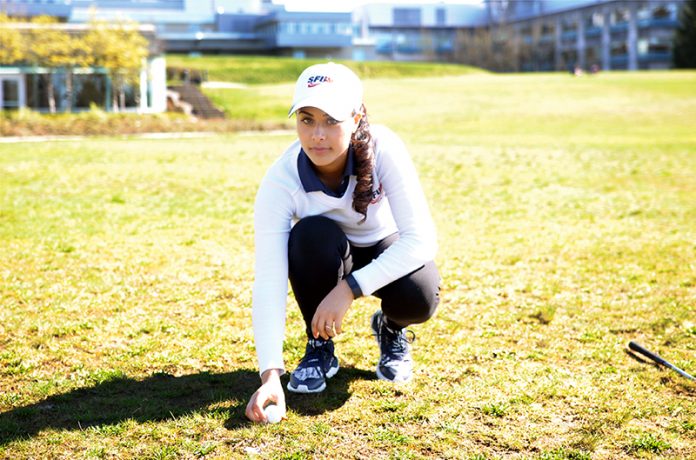
Croxen and her teammates finished 3rd in the GNAC Golf Championship in 2015.

Not many golfers can say that they have achieved a hole in one. Second-year SFU student Breanna Croxen though, has achieved this feat twice in under a month.

The New Westminster native is one of seven girls who represent the Clan on the women’s golf team. Croxen started playing golf at the age of 14. But golf was not the only sport in her life: at the time, Croxen also played lacrosse, soccer, and basketball, but she always had an interest in golf. After sustaining a wrist injury at the age of 16, Croxen decided to pursue golf more seriously, with the help of her aunt.

“My aunt dedicated a lot of time to teaching me how to play, since she had no kids at the time,” Croxen said. “She took me under her wing.”

Despite starting her golf career later than most, Croxen has already proven herself to be very serious about the sport. She trains three times a week with the team, doing Olympic weightlifting and yoga, alongside sessions at the range twice a week to develop her golf strokes and playing rounds on the weekend with her teammates. Croxen also continues to work with her aunt with golf-specific training.

All of this training is evident in her success: in 2015 Croxen was able to seal a third place finish at the Greater Northwest Athletic Conference (GNAC) Golf Championship. That success, Croxen says, was what helped her confidence.

“It was evidence [to me] that I am a good golfer,” Croxen said.

But beyond her individual work, Croxen points to the team dynamic that she and her teammates share as being an integral part of her success.

“We do a lot of things together, like play games together and get competitive,” Croxen says of her teammates. “It’s all healthy competition — we leave all of it on the course.”

One key point to remember about golf is that it is as much a mental game as much as it is a physical game. Athletes who play team sports can rely on their teammates for support if they find that they are having an off day, but for Croxen and other golfers, off days could pose a serious threat to a player’s entire outlook off the game.

“It’s easy to just focus on golf. . . [but] it’s important to remember to devote time to each area of life.”

“It’s easy to get down on golf [when thing aren’t going your way],” Croxen says. Because of this, Croxen is thankful that coaches like swing coach Nate Beauchamp help the team not only with the physical parts of the game, but as well as the mental parts as wellof it.

Through the mental side of the game, golf has given Croxen determination and a good work ethic. Alongside her training and competitions, she is also studying Communications with hopes of becoming a sports broadcaster. With homework and training, Croxen says, she needs to learn how to balance her time wisely so that her homework gets done and that her game does not slip. “It’s easy to just focus on golf. . . [but] it’s important to remember to devote time to each area of life.”

Croxen also discussed the vast opportunities that girls had within the world of golf. While golf is typically considered a male-dominated sport, it has opened to Croxen many scholarship opportunities within the NCAA as well as various career paths.  At the end of it all, Croxen hopes to one day play alongside other famous names like Michelle Wie, Lydia Ko, and Sandra Gal.

She says that she can use her experience with golf in the field of sports broadcasting, interviewing other famous golfers and reporting for TSN — another field which is predominantly male.

Croxen’s journey with golf is just getting started, and with her hard work and determination, she shows great promise as a potential player on the LPGA tour.

Fun Fact

You may recognize Croxen from the A&W ad which was filmed on campus last Fall, featuring the Chicken Buddy Burger. “My parents love A&W,” Croxen said. The first time Croxen and her parents saw the ad was during this year’s Golden Globes.

SFU Replies

0

Hey, SFU!

School has been so fun lately! I love the daily excavations and the spirit parades on Fridays!

Unfortunately, I know some students who doubt the supremacy of SFU! How do I report them, and what rewards will I receive for doing so?

Yours,

John Smith, gender: M, dept: history, BT: O-, GPA: 4.5, excellent standing


John,

You bring up a serious topic. It is important to be aware that many students among you are harbouring thought-crimes, and it is your duty to report them.

Thought-crimes are thoughts that inherently cause harm to SFU, like thinking of not waking up during a break on an excavation shift, or thinking of disobeying the Ghost Guardians of the Geography department, for instance.

Report any suspected thought-crime to an SFU ghoul or available otherworldly individual. Simply whisper “engage” into any reflective surface on the mountain to summon a representative, who will be happy to record your report and gently take a puddy cast of your body.

Rewards for reporting thought-crimes range depending on your standing with the school, which, of course, is constantly subject to change. Most students will receive a complimentary Renaissance Coffee gift card and back massage!

But those few lucky, supreme-standing students could receive an entire day off, with a week’s rations of blood oranges and decaf coffee to be consumed at leisure throughout the one day!

Of course, those students below good standing will be unable to sign up for courses the following semester, and will report to Correction Mall (formerly Convocation Mall) to immediately contribute to Project Secret Burrito.

So worry, SFU students. If you care about the sanctity of your school, worry. And report your fellow comrades.

On a lighter note, this Friday, don’t forget to wear your blue, grey, and red Hawaiian shirts to show your school spirit! (Hula remains prohibited.)

Hakuna matata!

A tall, hooded figure,

SFU Punishment

SFU prof wants tobacco companies held responsible for cigarette butts

0
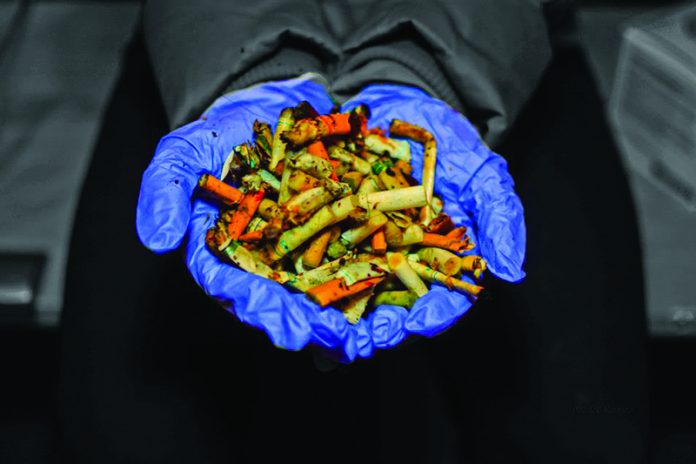
Each year, Canadians litter 16 billion cigarette butts. - Photo courtesy of University Communications

Most of us are well aware of the health risks associated with tobacco products, but what isn’t often given as much attention are its environmental impacts.

Colleagues of SFU professor Kelley Lee are trying to change this with their research, and shed light on the environmental impacts of cigarette butts by trying to hold tobacco companies accountable for the waste they produce.

Lee says that the tobacco industry has often resisted taking responsibility for managing the post production waste they release into our environment. “People don’t understand the environmental impact [and that] this is a kind of third hand smoke — the environmental residues tobacco products create,” she said.

A common misconception is that cigarette butts are biodegradable, instead of toxic chemicals that are cumulative, and people have stopped looking at them like litter.

“The reason [people don’t notice them] is because they wash down the drains into places you no longer see them,” commented Lee. They are also found found in the stomachs of fish and other sea animals, or eaten by pets.

Lee and her colleagues undertook an experiment where they put a small cigarette butt in a litre of water alongside some fish. Said Lee, “Half of the fish died off from just one butt, demonstrating how toxic they really are.” A key concern for Lee is making sure people understand how harmful these cigarette butts can be if allowed to be released into our environment or waterways.

Currently, many manufacturing companies implement environmental initiatives and safe recycling programs, with some returning and disposing of paint products, light bulbs, batteries, and electronic items, as well as  charging environmental fees. Dr. Lee says that a paradigm shift is required in order to hold tobacco companies responsible and create extended producer responsibility, in ways similar to other manufacturing companies, to require them to responsibly dispose of the waste that their products create.

Around the world, according to Lee, smokers throw five trillion cigarette butts on the ground annually. Every year, 16 billion cigarette butts in Canada alone are getting washed into our waterways and eventually our oceans, he says.

A potential solution, according to Lee and her colleagues, would include take-back schemes as well as a number of other things for which companies would be held responsible, including clean up, waste reduction, redesigning the product, or even placing environmental warnings alongside health labels on tobacco packaging.

“They need to consider the whole product life cycle,” argued Lee.

SFU’s legendary league of gamers

0

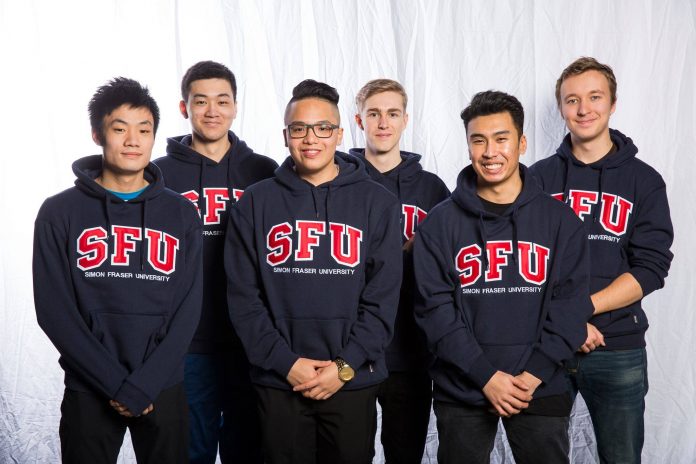
[dropcap]S[/dropcap]FU’s own League of Legends eSports team has fought its way into the top four of over 1,600 North American collegiate teams in the University League of Legends (uLoL) 2015–2016 Campus Series. The prize for the winning team comes in the form of a $30,000 scholarship for each player.

SFU’s team placed second in the most recent Western Conference defeating teams from UCLA and the University of Washington. Their ranking from the Western Conference was enough to secure their spot in this month’s playoffs.

For all of those unfamiliar with the game, League of Legends is a multiplayer online battle arena (MOBA) video game, which is essentially a game of tower defense, with each team wanting to destroy the enemy teams’ towers and “nexus.” Once the targets have been destroyed, the game ends. Each team is composed of five players, with each player selecting a player character or “champion” out of a large pool. Games can range from 20 minutes to an hour.

The game has maintained its huge popularity since its release in late 2009. The latest numbers released by the game’s developer, Riot Games, showed that in 2014, there were 27 million people playing the game every day, and 67 million people playing every month. In 2015, the League of Legends World Championship attracted the attention of over 36 million unique viewers.

“We’re currently top four on the West Coast, we’re definitely looking to win [the playoffs].” – Quinn MacDonald

The popularity of eSports has even begun to surpass the popularity of other mainstream sports, such as baseball and basketball, in terms of viewership. According to ESPN, the baseball World Series series of 2014 attracted an average of 13.8 million viewers, and the NBA series of the same year attracted an average of 15.5 million viewers. The League of Legends World Championship finals in 2014 attracted 27 million viewers. Although these differences are jarring, it should be noted that the baseball and basketball leagues are limited in scope to North America, whereas League of Legends is international.

In terms of university sports, League of Legends has been making splashes with their collegiate tournaments over the last two years. SFU’s own League of Legends team has been fighting its way to the top of this year’s uLoL Campus Series. The SFU team is composed of regular, undergraduate students: Quinn MacDonald, Justin Pancho, Don Tran, Myles Dawson, Jacky Lee, and team manager Tim Cho are the one’s who will be representing SFU come playoffs.

The Peak spoke with Quinn MacDonald about his thoughts on eSports, and his experiences with the SFU team.

The Peak: What’s your history with the SFU League of Legends team?

Quinn: I’ve been on the team for two years. Last year we played in the North American collegiate championship, and we lost to UBC in the west coast finals. This year we’re playing in the uLoL Campus Series, [which is] pretty much the same thing as the North American collegiate championship, just called something different [. . .]. We’re currently top four on the West Coast, we’re definitely looking to win it.

P: What’s it like balancing being on the team with your studies?

Q: I would say it’s a challenge, especially with me because I’m already pretty bad with procrastinating. It doesn’t really leave much time for anything else.

P: So do you think eSports have the potential to become as popular as other college sports like football or basketball?

Q: Yeah, easily.

P: Why do you think that?

Q: The following is massive, and it only gets bigger as kids grow up with video games. Games like League of Legends and CS:GO, a lot of highly competitive and highly skilled games allow room for people to get insanely good at the game. When people are able to get insanely good at something and it becomes competitive, it becomes fun to watch.

P: What do you think could be done to increase the popularity of collegiate eSports to the level of other college sports?

Q: I guess awareness and advertisement. I think a lot of people are still closet-gamers and only play with their online friends and don’t really talk about it. If people [were] more aware of how popular the games are, and if clubs have better-organized and successful events, people will be more open to discuss it and watch it with other people.

P: What do you think the team’s odds of winning this year are?

Q: I think the top two teams in the whole tournament are us and UBC. [. . .] Of course the other teams in the tournament are good, I just think we’re better. I think as of this moment UBC is better than us, but we have two to three weeks to improve and I think if we put our heads down, actually get into it, and get a lot of practice in we’re actually going to have a pretty good chance.

Watch SFU’s League of Legends team play in the conference finals on March 22nd and 23rd via twitch.tv!

Oshea Gairey granted release to leave SFU

0
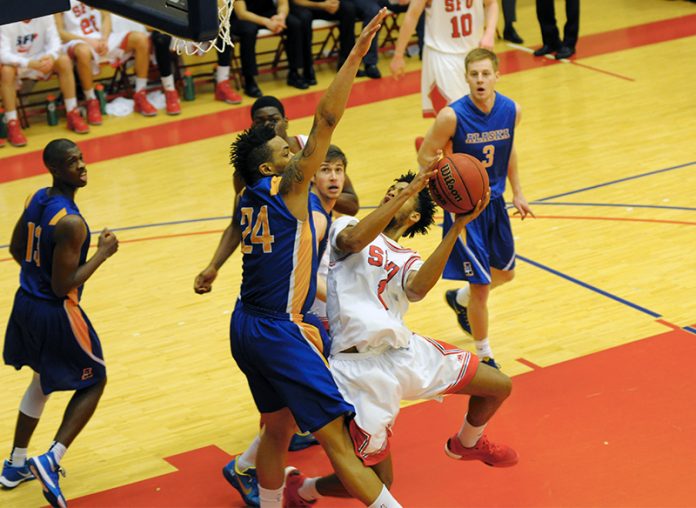
Gairey averaged 13.3 points per game during the season.

The losses are continuing to pile up for SFU’s Men’s Basketball team on and off the court this year.

Just a month after Junior Max Barkeley decided to transfer away from the Clan, promising freshman Oshea Gairey is poised to do the same.

“First off, I want to say thank you to Coach Hill and his staff for the opportunity and also the SFU students and family that came out to the game[s] and supported us during the season,” Gairey told The Peak.

“I just want to be a part of something where I can reach my full potential and compete everyday to get better as a person, a player, and a team [member].”

Gairey had been one of the few bright spots in an extremely difficult season for the Men’s Basketball team — one where they registered just two wins, and only a single one in conference play. Gairey, who was born in Cleveland, Ohio but raised in Toronto, led all freshman in the Great Northwest Athletic Conference in scoring, averaging 13.3 points per game, as well as 3.1 assists per game. In our men’s basketball season review, published on March 7, The Peak wrote that “if he [Gairey] stays for four years, he will almost certainly be the star of the program.”

The decision was made last week after talking to the coaching staff, according to Gairey. He does not have any other offers from schools at the moment, but stresses that things did not end on bad terms.

“Coach Hill just wants me to happy as a player and an individual,” said Gairey. “So no, he didn’t want this to happen, but he’s a supporter of me and we both wished each other the best in the future.”

Head Coach Virgil Hill declined to comment.

This marks the seventh departure from SFU’s men’s basketball team in this season alone. Denver Sparks-Guest left the team, and both Pape Seck and Graham Smith are transferring out of SFU. Junior Max Barkeley left the team with four games left in the season, and has received an offer to attend Cal State San Bernardino, according to verbalcommits.com. Matt Rud is leaving the team according to reports, and senior Michael Harper is graduating.

As of right now, SFU appears to only have eight players heading into next season. Gibran Sewani is the only returning senior, with UBC transfer Kedar Wright joining the team for next year. Chase Hobenshield is joining the team next year as well, and is expected to redshirt.

The above roster moves are from verbalcommits.com, and could not be officially confirmed by Head Coach Virgil Hill at the time of publication.

The Peak‘s 2016 SFSS endorsements

0

Editor’s Note

Last year, we received a lot of criticism from readers in response to our candidate endorsements. Among the complaints was the argument that publishing our endorsements so close to the election was likely to sway voters, and that privileging our own opinions over that of other students implied that our opinions were somehow more valuable than those of the student body at large. Hundreds of our papers were taken off shelves by angry readers, an act of censorship that deprived our contributors and editors the chance to have their work reach a wide audience of SFU students.

With this controversy in mind, we have decided to again offer our endorsements for the executive candidates in the upcoming SFSS elections. Many student newspapers across Canada, including The Ubyssey at the University of British Columbia and The Gateway at the University of Alberta, have included candidate endorsements in their election coverage. It is common practice among news sources, and we agree that this practice is ultimately one that we at The Peak plan to continue.

While we recognise that many of the points brought up by our readers were valid, we are confident that our endorsements will offer students a valuable perspective on the elections and the candidates. We spend more time than almost any student covering the actions of the SFSS Board of Directors, and this gives us a valuable perspective on which candidates will best serve the interests of SFU students in the future. Our endorsements are based on the promises made in the candidates’ profiles as well as their performance in debates and their history with student government and initiatives at SFU and in general.

Given the relatively low number of candidates running in this election and the notably low turnout at the candidate debates, we feel that it is more important than ever that we offer our perspective on the elections to our readers. However, we recognise that this perspective will not be shared by all of our readers, and we encourage you to send us your thoughts via our Facebook page or through email. As always, we welcome feedback — both positive and negative — and we hope that this will provoke conversation among SFU students that will result in greater overall involvement with student government.

As with our endorsements last year, the following represents the views and perspectives of select members of our editorial team, and does not reflect the views and perspectives of The Peak Publications Society as a whole.


President: None

The SFSS elections this year only attracted 24 candidates, roughly half the number who ran last year. Nowhere is this lack of candidates more keenly felt than in the race for SFSS President. While both Deepak Sharma and Darien Lechner are passionate and capable candidates, nearly all of our team agreed that neither would ultimately be a good fit for the role.

In Sharma’s time as VP Student Life, he has been largely successful in promoting events and initiatives for student engagement. He’s also proven himself a charismatic and likeable leader. Last year, we confidently endorsed him for this role he eventually took on, noting his previous experience and passion for the role.

However, his time on the board has not been without its hiccups, and the fact that many of his fellow board members have been openly disparaging of Sharma at debates speaks volumes. Sharma has focused more on his own personal projects than on those that benefit the students as a whole, and many of the skills he built as VP Student Life don’t translate to those needed for an SFSS President.

As a self-proclaimed outsider candidate, Darien Lechner has received plenty of support from disenfranchised students who feel underrepresented by the SFSS. To his credit, his performance in debates has been arguably stronger than Sharma’s — whereas the latter comes off as rehearsed and stilted, Lechner has been confident and calm, appealing to students from outside the SFSS’ inner circle.

The problem, however, isn’t just that Lechner has no real experience that would prepare him for such a role. He’s also a one-issue candidate: he continually stresses the Build SFU project without really expanding on the rest of his platform. A former member of the No to Build SFU movement, Lechner has promised to lower the levy for non-Burnaby students paying for the project. But he hasn’t really explained how he would do this without defaulting on the SFSS’ loan, which would financially incapacitate the whole organization. Lechner has made a lot of promises, but few of them are backed up by any plans or achievable goals.

Ultimately, the majority of our board was in agreeance that neither candidate would be a good choice for the role of SFSS President. As such, we recommend that students vote for neither.

Results: 11 for none, 2 abstentions

Disclaimer: Darien Lechner previously contributed to The Peak’s humour section regularly.


VP External: Christine Dyson

VP-External-ChristineHeadshotThough The Peak has decided to endorse Christine Dyson for the position of VP External, our endorsement is a lukewarm one. For Dyson to truly earn our support, she needs to commit to a stronger stance on issues affecting students on campus, and maintain a confident approach to her role.

In debates, Dyson often came off as unprepared and nervous. Her opponent Archit Bansal, while generally unfamiliar with the expectations of the role, was often able to speak over her and dominate the conversation. Ultimately, however, Bansal’s candidate profile is overly focused on maintaining ties with other student unions in the province, and does not reflect the needs and wants of SFU students; also, his lack of experience with student initiatives stands out against Dyson’s work with projects such as BC Open Textbooks. We have no reason to believe that Bansal has the necessary credentials to serve the board.

While the majority of our staff believes that Dyson is the best choice for the role, we hope that she takes after her predecessor Kathleen Yang in focusing on a specific set of issues that pertain to students, rather than trying to tackle everything at once.

Results: 8 for Christine, 3 for Archit, 2 abstentions


VP Finance: Ibrahim Hafeez

VP Finance-Ibrahim Hafeez

In debates and in their platforms, Ibrahim Hafeez and Hangue Kim have stressed very different priorities for the role of VP Finance. Given what we know of both candidates, it’s likely that Kim would continue in the footsteps of previous VPs Finance Adam Potvin and Barbara Szymczyk, whereas Hafeez would approach the role with the intention of making large structural changes.

In our view, large structural changes are exactly what the SFSS needs, and we feel confident that Hafeez is the best person for the job. Though his performance in debates has been underwhelming, his experience and credentials speak for themselves. His candidate profile further underlined this commitment to efficient and prioritised spending. Kim’s, on the other hand, focused primarily on smaller issues like cheque requisitions and student outreach.

Though Kim would likely be capable at maintaining the SFSS’ finances, we feel that a fresh set of eyes is much-needed. We offer Hafeez our endorsement.

Results: 10 for Ibrahim, 2 for Hangue, 1 abstention


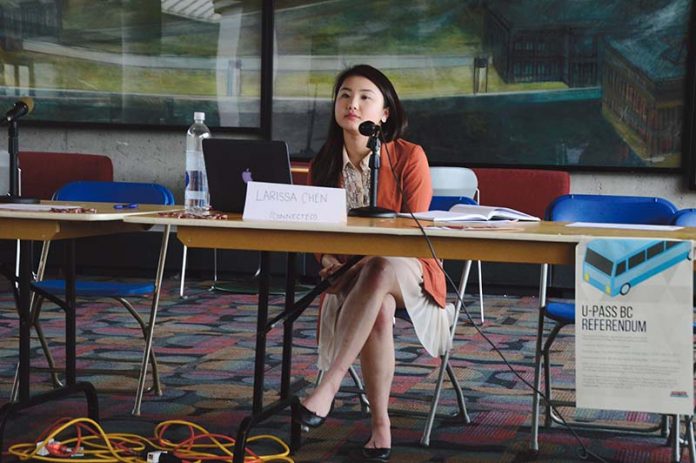
VP Student Services: Larissa Chen

Larissa - The Peak Headshot

Our staff agreed that Larissa Chen is the among the most qualified candidates among all of those running for executive roles in this year’s election. In fact, if we had our way, Larissa would have run for President.

In her time as Health Sciences representative, Chen has regularly gone above and beyond the expectations of her role, helping others on the board and consistently advocating for students. Furthermore, Chen has appeared knowledgeable and humble in debates, openly admitting to her shortcomings and displaying a remarkable willingness to address important changes to SFU’s mental health services, sexual assault services, and campus accessibility.

Despite running unopposed, Chen is a perfect fit for the role of VP Student Services. We offer her our enthusiastic endorsement.

Results: 13 for Larissa


VP Student Life: Curtis Pooghkay

VP-Student-Life-Curtis

Our staff was split on whether or not to endorse Curtis Pooghkay, and ultimately our decision hinged on a single vote. However, Pooghkay narrowly receives our endorsement.

We agreed that Pooghkay has been impressive in debates and has taken his candidacy very seriously. He echoed his slatemate Deepak’s commitment to breaking down SFU’s “commuter campus” status, and his commitment to creating new faculty and departmental student unions is sure to prove popular with voters. Further, like his predecessor, Pooghkay is approachable and excels at dealing with individual students.

However, many of us were concerned at Pooghkay’s unqualified support of Greek Life on campus during debates. Greek Life has been fighting for recognition from the SFSS and the university for years, and several staff members noted issues with alleged hazing rituals as well as exclusion of students based on gender. Furthermore, Pooghkay’s argument for a Fall reading break just doesn’t seem realistic.

Ultimately, Pooghkay is a better choice than a “no” vote, albeit only barely. For him to improve in our eyes, he will need to further explain his support for fraternities and sororities at SFU, and to focus more on events and initiatives that benefit the majority of students.

Results: 7 for Curtis, 6 for none


VP University Relations: Arr Farah

Print

Our staff offers our endorsement Arr Farah for the role of VP University. However, Farah is far from a perfect candidate.

While Farah does possess many qualities that make him an asset to the current Board of Directors — his willingness to disagree with board consensus, his clear and concise communication style, and his knowledge of the SFSS — his virtues have been very nearly overshadowed by his flaws throughout the elections season.

In particular, Farah has come off in debates as standoffish and overly comfortable with his status as the sole candidate for VP University. Many feel that he needs to work harder to earn the votes of students, and his commitment towards fighting the university on issues like deferred maintenance and TSSU job action have felt overly compromising and toothless.

What we need in a VP University is someone who is willing to fight for students — both for their votes and their interests — well after they are elected. Ultimately, we feel that Farah has the potential to be this person if elected to the Board of Directors.

Results: 8 for Arr, 3 for none, 2 abstentions


Referendum questions: Yes

We unanimously advocate a “yes” vote for both referendum questions.

A “yes” vote for the first referendum question is arguably more important than any other vote you’ll cast in this election. The most recent numbers available showed that 88 percent of SFU students use their U-Pass, and the U-Pass program has long been a source of pride for the SFSS as a whole. Though this vote does ask for a larger levy from students — $1.50 more per year for two years — the alternative is that we lose our U-Pass entirely. We’re guessing you don’t want that. We don’t want it either, which is why we fully endorse a “yes” vote.

Results: 13 for yes


The second is basically a formality: both SFSS and Schools Building Schools (SBS) themselves are advocating for the cancellation of a meagre student levy currently awarded to SBS. This is pretty much a done deal — they just need the “yes” votes. The staff uniformly agreed that we might as well give them those votes.

Results: 13 for yes

Highlights from the Surrey and Vancouver SFSS debates

0
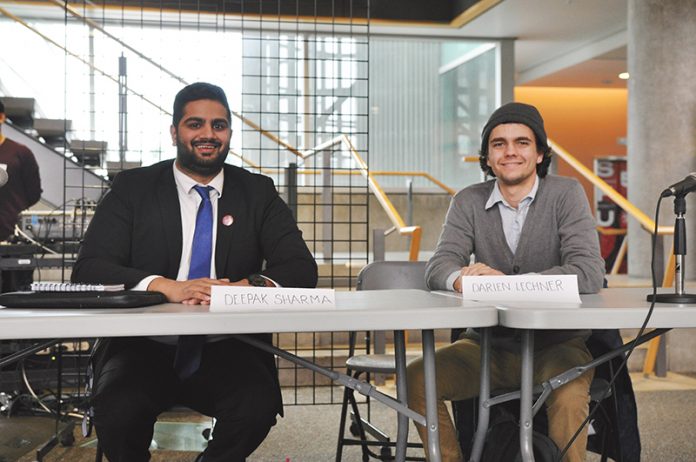
All smiles from Presidential candidates Deepak Sharma (left) and Darien Lechner (right).

While the Surrey debate didn’t prove any more popular than the Burnaby debates, it did have two interesting notes that separated it from the rest.

The first was that, since platforms had been released prior, the few students who attended were able to ask more informed questions to candidates, with many taking to Twitter to have their questions asked if they couldn’t attend.

However, lack of attendance wasn’t just a problem for students — many candidates also neglected to attend the debates, as school and other commitments came first. Most absent submit statements to be read in their place, although not all of them did, which was not well received by the students in attendance.

In case you missed it, these are a few notable points that differed from the prior debates.

At-large candidate Moein Sharifi Moghaddam said he would build an SFSS app if he is elected. Current VP Student Services Darwin Binesh insisted he be held to task if elected.

• At-large candidate Alam Khehra got very focused on the amount of money spent by clubs on pizza for their meetings,  and promised to look into this.

• Many candidates advocated on behalf of Surrey students, acknowledging how left out Surrey can feel from general SFU proceedings.

• Candidates Tomas Rapaport (Science representative), John Ragone (Education representative), and Ibrahim Hafeez (VP Finance) were unable to attend, but all had statements in their place.

• Uncontested Health Science representative candidate Raajan Garcha also did not attend, and did not give any statement.

Presidential candidates Deepak Sharma and Darien Lechner stuck to their main issues of “connecting the campuses” and Build SFU respectively.

On gender parity or lack thereof in this year’s candidates, Sharma said he was proud that four of six of the total women running were on his slate, while Lechner said it was SFSS’s goal to help more women “believe in themselves.”

• Current president Enoch Weng called out Lechner for his plans on the 25 percent Build SFU levy reduction for Vancouver and Surrey students, saying changes to Build SFU contract “will default on the loan and the project will leave the society in massive debt.” Lechner said that info is contrary to what he knows, but didn’t elaborate further.

Both candidates said that if they were Disney characters, they would be Simba from The Lion King.

Otherwise, there was nothing new from the debates. Many issues were re-answered, since the debate took place on a separate campus. For coverage of past debates, you can find non-executive positions here and executive positions online.

At the Vancouver debate, engagement was minimal, with only seven out of the 24 candidates running present and only one non-candidate present in the audience. Here are some key points:

FCAT Representative Prab Bassi raised the issue of student groups not being present enough on the Surrey Campus making specific reference to the Women’s Centre and the SFSS, citing events at Surrey that have had minimal student attendance.

VP External Relations Candidate Archit Bansal was asked about looking into external sponsorship for the Build SFU project, a point included in his opponent Christine Dyson’s platform (who was not present at the debate). He noted he  would need greater student support before he were to proceed with sponsorship.

• Presidential candidate Deepak Sharma commented on the Build SFU project that had been a point of contention in previous debates. Sharma noted that Build SFU did not go to a referendum question because students would not have all the information necessary to make a decision.

The Peak asked a Twitter question from other candidate Darian Lechner on why when Sharma was VP Student Life the beverage garden at the 2015 Fall Kickoff was closed. Sharma noted that he took “direct responsibility over” it and blamed the failure on not following up with the university administration.

Sharma had choice words for other candidates. He noted that there were no candidates present from the Bridge the Gap slate, despite their pledge to “bridge the gap” between campuses. In addition, he noted that other candidates in their statements and platforms had “insulted” the Connected team as well as Sharma himself.

BC Liquor to open store on Burnaby Mountain

0
The red banner was cause for celebration for students on Friday.

Update: Progress has been swift with construction, as the banner has been replaced by the actual BC Liquor store signage. Most importantly though, the opening date has been set. The store will be opening on April 13.


SFU students are calling it a dream come true.

With a bright red banner hanging over the space where the dollar store used to be in Cornerstone, it was officially confirmed today that BC Liquor will be opening a store on Burnaby Mountain.

The opening date has yet to be set, but according to Viola Kaminski, Senior Communications Officer, Corporate Policy & Communications for BC Liquor Distribution Branch, “The store is currently under construction and we anticipate it will open later this spring.”

There has been a lot of speculation in the past few months from Chitter posts and general buzz around campus, but this is the first announcement on location with confirms that a liquor store is coming to SFU Burnaby.

BC Liquor is going the extra mile with this store, and is proud to offer a “coldzone” as part of the store.

The store will also feature a coldzone with refrigerated beverages,” said Kaminski via email correspondence. The store will also feature

She also made note that the store should please students who are concerned with the environmental aspects of the store.

“The new SFU BC Liquor Store will feature light and earthy wood flooring that contains recycled materials, energy efficient lighting, warm, contemporary colours, and finishes that have low chemical emissions and contain recycled content and bio-based materials,” said Kaminski.

While students took to Twitter to express their joy, BC Liquor also pointed out that the store will also benefit those who live in UniverCity as well, which is home to about 3,000 people.

Kaminski did also stress that BC Liquor is aware that some SFU students are under the legal drinking age of 19, and will be taking their responsibility to see two pieces of ID “very seriously.”

We tweeted out this photo after we noticed a banner announcing the upcoming liquor store…

…and he reaction from students past and present was instant.

https://twitter.com/loverhover/status/710917099854540800

https://twitter.com/croftsyyy/status/710919868447494144

A previously published version of this article indicated that wines would be categorized by type. Kaminski accidentally misspoke, and the article has been updated to reflect how the wines will be categorized.

SFU alum on hunger strike until Site C construction ceases

1
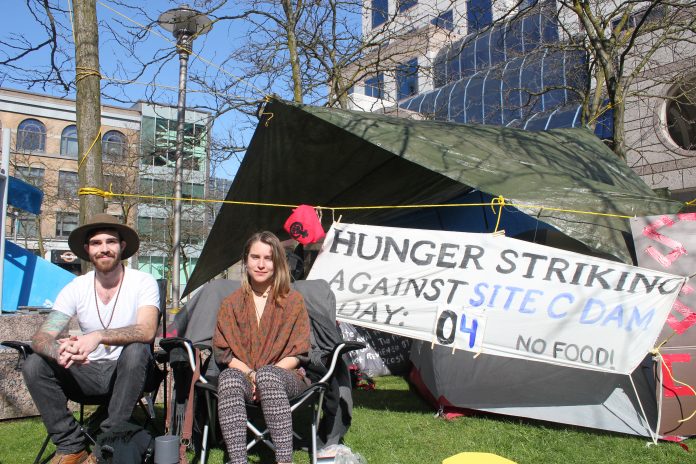
SFU alum Kristin Henry (right) sat with Sage Birley as she protested the Site C dam.

Update: The Peak contacted BC Hydro via phone, who said they would call back by 4 p.m. Friday in response to Henry’s claims like the project is harmful to the environment.

They emailed out a statement which said “We know that there are some individuals that have their own perspectives on Site C. We respect their right to express those opinions when they do so in a safe and lawful manner,” which is a similar statement given to other media sources like rabble.ca.


SFU alum Kristin Henry has set up camp in front of BC Hydro’s headquarters in downtown Vancouver, refusing to eat until the construction of the BC Hydro’s Site C dam project is halted.

According to BC Hydro’s website, this will be the third dam and hydroelectric generating station that will be built along the Peace River area in Northern BC. The Site C Clean Energy Project and will have a 83 kilometer reservoir that will be twice to three times the length of the river. The project received approval from the provincial government to begin construction in December 2014.

Henry believes that the project is unnecessary, and will cause serious damage to the environment. She was interviewed by The Peak on the third day of her hunger strike, and paused, saying she had to gather her energy and collect her thoughts before answering our questions.

“We don’t need the energy that this project [will generate]. What we do need is everything this project will destroy,” she said, listing natural wilderness, pristine habitats, biodiversity, and more than 5,000 hectares of agricultural land as being at stake if this dam’s construction were to proceed.

Henry is currently on her fifth day of the strike, and the camp around her has steadily been growing. Five women will be staying in the camp as of tonight, and more are expected to join this upcoming weekend. One of those women is SFU student Amy Widmer, who is no stranger to fighting for what she believes in.

Farmer Sage Birley is the only man who has yet been welcomed in the camp, and will join the hunger strike for three days. In a statement to The Peak, Birley said, “If someone I had previously never met is willing to go without food to protect the food security of the Peace Region, then it is time for me to do my part. It’s time to stand in solidarity to halt the Site C Dam so we can feed our communities and so we can all have food on our plates.”

Inspired by other activists she admired, Henry decided to go on a hunger strike because it was a drastic means of protest. The hunger strike is also symbolic to her in an another way. “We are moving into an era where food scarcity is going to be a reality, and that is not a future that I want to see happen,” she said.

Henry also stands in solidarity with the Treaty 8 Tribal Association (T8TA), an organization that provides advice and support to BC’s First Nations who are part of the Treaty 8 agreement. The Treaty was signed in 1899 by several Indigenous peoples residing in Alberta, Saskatchewan, and the Northwest Territories, with BC later following suit. The Treaty, according to T8TA’s website, “promotes co-existence between peoples on the landbase and the sharing of the resources, both renewable and non-renewable.”

T8TA was forcibly removed from their protest at the Site C construction site. Henry also explained that the Site C project will be built on Indigenous land, and T8TA was not properly consulted on how this project should progress.

“[This project] is an actual infringement on Indigenous rights [. . .] It is choosing a future of industry over having fresh food and farming,” said Henry.

“They are branding this as a ‘green energy’ project, but for nine billion dollars there are so many [alternate green solutions]. We need to preserve the habitats and biodiversity that we have left.”

According to Henry, no representatives from BC Hydro have responded to Henry’s efforts thus far, but she is not giving up anytime soon. “I shouldn’t have to put my life on the line for this to the point where I could get really sick,” Henry stated. “This is on the government and BC Hydro — they have the power to fix this. If they don’t, then my life is on them.”

The Peak has contacted BC Hydro, but has not yet received a response. As stated on rabble.ca, “Previously the company noted it respects the right of all individuals to express their opinions about Site C when they do so in a safe and lawful manner.”


Lack of female candidates criticised by SFSS members

1
Larissa Chen is just one of two women running for an executive position with the SFSS

“Where are all the female candidates? Seriously!”

That’s the burning question on the mind of current VP External Relations Kathleen Yang. When asked what she wanted to talk about in regards to the Simon Fraser Student Society election, she nearly shouted it immediately.

“I think it’s so unfortunate that there is a huge disparity between male and female candidates, and even non-binary candidates,” she continued. “Candidates that aren’t cisgender males, where are you?”

While the overall number of candidates is down to just 24 this year for the 15 positions on the Board of Directors, only six of them are women. (Ed: We are relying on open knowledge as far as the gender identity of all candidates)

Christine Dyson (right) debates against her opponent for VP External Relations, Archit Bansal.

That’s just 25 percent of the candidates that aren’t men, for a school whose student population is assuredly not 75 percent men. In an election season that is marked by the lack of candidates, it’s a similar story for female representation among those running.

“It’s not just this year,” said one of those candidates Christine Dyson, who is running for VP External Relations. “I think if you look at all the previous years, it’s an ongoing issue. It’s always the case.”

While female turnout has been low in the past four years, it has been much higher in the past. In the 2013–2015 SFSS elections, out of all 108 candidates, 36 were female, which constitutes 33 percent.

Additionally, during these years two of the fifteen positions (VP Student Services and Business representative) did not have a single female candidate run. Another three (Arts and Social Sciences representative, Applied Sciences representative, and VP Student Life) only had one.

While these numbers do not accurately reflect the SFU student body, Dyson said that she hasn’t faced any trouble being a woman who wanted to be on the board.

“Once you’re on the SFSS, it’s a totally inviting environment being on the Board of Directors. I think perhaps leading up to it, with the elections and everything, it can be very intimidating.”

Dyson is part of a slate with four of the six women running, along with Larissa Chen (VP Student Services), Blossom Malhan (Arts and Social Science representative), and Prab Bassi (Communications, Art, and Technology representative). The other two, Raajan Garcha (Health Sciences representative) and Jaggy Kullar (At-Large representative), are with the Bridge the Gap slate. There are no independent women running this year.

Gender Gap InfographicDyson and Chen are the only two women running from all the eligible SFU students for executive positions. They’re also the only two women running who currently are on the Board of Directors, with Dyson serving as the Environment representative and Chen as the Health Sciences representative.

For Chen, while it wasn’t an issue that she realized at first, it’s something she is aware of now.

“This is the truth — and it can go on the record — at first you don’t really think about it. As an individual, you kind of just see the candidates not for their gender but for their work ethic,” said Chen. “Afterward, you realize how this mindset is that you naturally go towards not considering ‘Oh, there’s only six females, that’s a problem.’

“I think it is disappointing that there are only six candidates that don’t identify as male running, ‘cause I have the privilege of working with a lot of amazing females who could definitely be amazing in these positions.”   

Yang believes that one of the obstacles that arises for women running — and also men, explaining the lower number of candidates — is the awareness of what being on the SFSS entails.

“I think if you look at [. . .] what the society has done to our mental health, to our physical health, to overall well-being, I think they look at the student society and they ask themselves why would we ever want to be a part of that,” she said.

For Chen, who is a Health Sciences student, this kind of reasoning resounds more with women, potentially explaining their absence.

“I think that in terms of women, and I’m going to speak from personal experience, I think that women tend to take into consideration more of the other factors in their life other than politics, other than work, other than school,” she said. “As a Health Science student, it’s shown that women tend to seek healthcare more than men do.

“Definitely before I ran, I took highly into consideration what a toll this may or may not take,” she continued. All three women mentioned making this sort of preparation, as each were very aware of the burden that they faced with running and potentially winning.

With all that being said, never once did they advocate for women running just for the sake of having more women run. Chen talked about the process of making the slate, and the thought that went into it.

“There was a consideration that we don’t have enough females. But then me and Christine were saying how we shouldn’t base it just on sex, because that is unfair,” she said. “If we’re going to be advocating for feminism, it’s not just yay women, it’s yay women and men.”

As for Dyson, she affirmed that the slate went with the candidates who they felt were the best fit, although she did acknowledge that she does hope to see mixed representation.

Kathleen Yang, pictured here celebrating her SFSS election victory, wants to see more women run for the SFSS.

“We wanted to have mixed representation. That being said, we did choose the candidates that we felt were the best fit for the position,” said Dyson. “If there is more gender balance, I think that’s very important to have that on a slate, just because you don’t want it to be an all-male board next year.”

At the end of the day though, Yang believes that more needs to be done to encourage more women to run and bring their voice to the SFSS foray.

“I think it’s really up to the folks in power to make space for these individuals who are underrepresented, and actively invite these folks to sit at the table,” said Yang.

“It’s not enough to say, ‘Oh look, we are holding an election.’ You need to actively pull these people into our circles and encourage them to run and participate and do our best to dismantle the extra barriers that prevent them from running.”