Home Blog Page 8

Black women musicians and the stubborn R&B label

0
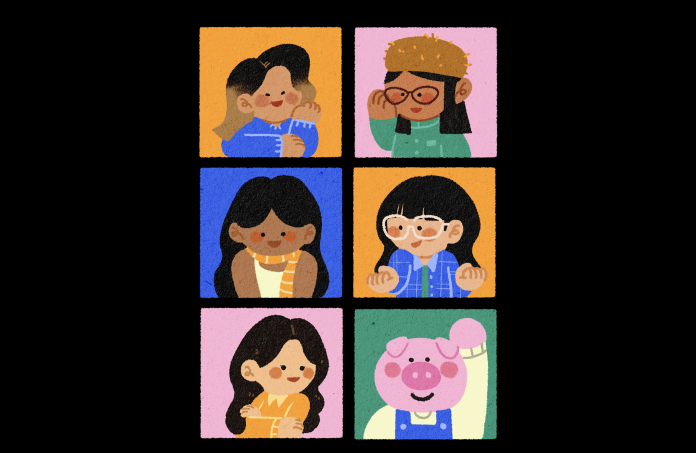
A collage of Black women musicians. From top left to right: Lu Kala, Foushee, and Fefe Dobson. From bottom left to right: Straight Line Stitch, Rachel Chinouriri.
PHOTOS: Courtesy of @igobylu (Lu Kala), @fefedobson, @rachelchinouriri, @foushee / Instagram, and Straight Line Stitch / Facebook

By: Noeka Nimmervoll, Staff Writer and Petra Chase, Features Editor

Black women in music tend to get boxed into one repeated spot: rhythm and blues, more commonly known as R&B. Black artists in general tend to get pigeonholed in genres like rap, hip-hop, and R&B. However, Black women experience a unique struggle in the music industry at the intersection of racism and misogyny. Black women artists are labelled R&B despite making music in different genres. Even in R&B, a genre where Black women thrive, they’re often overshadowed by men and fight harder to achieve the same recognition as white artists. Genres like pop, indie, and rock have often excluded women of colour, further limiting the perceived possibilities for Black musicians.

The trend of labelling Black women as R&B artists comes from racial stereotypes by record labels and the music industry. Despite sharing influences with other popular genres, the growing fluidity of genres, and artistic journeys that transcend genres, R&B remains a uniquely stubborn label for Black women in music. 

Alternative describes music that is outside the musical mainstream. However, “alternative R&B” is how many Black alternative artists are marketed to the music audience at large. Even when a Black artist makes music completely outside of the genre, the stereotype lingers. Toronto-based Canadian Congolese artist Lu Kala sometimes gets referred to as an R&B pop artist during press events. “There is nothing about my sound that is even remotely R&B . . . I get that label [because of] the way I look,” said Kala, according to ELLE. Check out “Hotter Now” or “Pretty Girl Era” for some of her hot girl pop anthems. Bright beats, synthed guitars, and rich pop vocals make her music fun, vibrant, and confident — everything you could ask from a pop singer-songwriter. Calling Kala’s music R&B is, by all understanding of the genre, illogical. 

The experimental artist FKA twigs spoke about how she started being labelled “alt-R&B” once listeners saw her picture and found out she was mixed race. Before that, people would comment that her music didn’t fit any genre. She told The Guardian, “If I was white and blonde and said I went to church all the time, you’d be talking about the ‘choral aspect.’” From classical influences to unrelenting electronic sounds, she says her music is closer to punk, and, “Fuck alternative R&B!”

Mariah the Scientist, Chlöe, Normani, and Rachel Chinouriri are some of the many Black women who have spoken about receiving the same R&B treatment.

“My music is not alternative RnB My music is not Neo Soul. My influences are indie, electronic/alternative and pop music. Black artists doing indie is not confusing.”

— Rachel Chinouriri, singer-songwriter

How tf do ppl listen to ‘So My Darling’ and think ‘RnB?’”

R&B’s role in the music industry

After WWII, many African Americans in the US left small towns and entered cities for better job opportunities, which led to a boom of Black entertainment centres opening up in every major settlement. Black musicians of many styles, from blues to jazz, collaborated in these centres and pioneered many musical advancements in the 1940s: combos mixing seven or eight jazz and blues musicians, trios featuring piano/organ, bass, and guitar, and vocal harmony groups that integrated a doo-wop acapella style. These elements were all key ingredients for the development of R&B. 

The term R&B originated in 1949 when a newspaper writer moved to replace the reductive term “race music” which was used from the 1920s to describe African American music. In the 1950s, record labels began releasing R&B artists onto the music market but often added elements of pop and Latin beats to R&B production, to make it more marketable to a mainstream audience. Some of the biggest names of the decades to follow helped establish the genre, and influenced artists to come: Etta James, Nina Simone, and Marvin Gaye, to name a few. The genre has continued to develop into the completely different sound that defines R&B today, and has been adopted by non-Black artists alike.

In Canada, Toronto, Montreal, and other major cities were where the evolution of several genres, including soul, funk, and reggae were nurtured. In the 1960s, many Black musicians immigrated from the US and Caribbean, bringing their sounds. Jackie Shane was one such icon of early R&B, bringing Southern blues traditions to the Yonge Street strip, where she built a lively audience. She topped the charts with her song “Any Other Way.”

R&B is loosely conflated with blues-influenced songs. However, many types of music are influenced by blues. Blues can be traced back to free African Americans living under Reconstruction and Jim Crow in the 1860s. Born out of the Mississippi Delta and spreading through the South, blues expressed singers’ feelings through characteristics like whining electric guitars, call-and-response lyrics, and melismatic vocals (those which stretch a syllable across notes). Its many styles and evolution, as musicians spread across the country and into urban settings, led to the creation of jazz, rock and roll, hip-hop, and rap.

“Black music is the backbone of all genres, the blood that runs through it”

—Rashad Shabazz, associate professor of African and African American studies at Arizona State University

“However, the way in which Black artists are racialized denies them the ability to identify outside of predetermined ‘Black’ categories. Hip-hop, rhythm & blues, rap: that’s where the music industry sees Black music.” 

As writer Sumiko Wilson wrote for ELLE, “What distinguishes a pop song from an R&B song is subjective, but R&B can most easily be defined by its soulful nature. By name, it’s literally rhythm and blues, though it’s currently in its most malleable iteration. The distinguishing factor could be any detail, from the tempo to the lyrical content to the melismatic singing [ . . . ] Since the lines are so commonly blurred between genres, it’s almost as if the only detail differentiating them here is the artist’s race.”

Black women break boundaries

There are many incredible Black women artists who have broken out of the mold that the music industry creates for Black musicians. For one, some of the greatest pop stars of all time have been Black women: Whitney Houston, Janet Jackson, Rihanna, and Beyonce. At the 2022 Grammys, the Best Pop Duo Award was won by SZA and Doja Cat, marking the first time Black women had won this category. 

Fefe Dobson, Canadian singer of the 2003 hit song “Everything” and 2009’s “Ghost” was pressured to become an R&B artist. Despite being reduced to an Avril Lavigne derivative, she defined her own path as a pop-punk princess and made the genre a more inclusive space for years ahead. Willow Smith and Fousheé are two artists who starkly departed from R&B debuts to release punk/metal albums, refusing to be reduced to one thing. Growing up with the stereotype that Black girls aren’t “supposed” to listen to Paramore or My Chemical Romance, Smith was inspired by her mother’s nu-metal band Wicked Wisdom, and the Black-woman fronted metalcore band Straight Line Stitch. She released her pop-punk album lately I feel EVERYTHING in 2021. Fousheé released her metal/screamo album softCORE in 2022. “It’s not acceptable for a Black woman to be angry – if we are, we’re pushed into the stereotype, when in fact we all feel angry sometimes,” she told The Guardian.

Monday Music: Immerse yourself in human expression

0
PHOTO: Pixabay / Pexels

By: Nejdana Houshyar, SFU Student

What does it mean to be human? Is it achieving your career goals, passing your exam, or facing death? Or does being human simply mean the ability to feel? In today’s society, conversations about artificial intelligence are constantly circulating in schools, online, and in personal circles. To take a break from this dreadful topic and also to resist the artificiality of today’s digital world, listen to music that captures human expression, emotion, and voice. The ability to feel, I believe, is humanity’s greatest skill. Here are three electronic songs that, in their lyrics, production, and melody, all highlight this ability.

How to Pretend by Lucy Bedroque

How to Pretend” explores love and the emotional chaos that comes with romantic connection. Bedroque depicts a relationship with misaligned attachment styles, resulting in a cruel game of push and pull. The production on the chorus creates the song’s charm. As it swells, Bedroque’s romantic emotions burst. These feelings of love are especially evident during the final chorus, where his vocals break away from the familiar melody, culminating in one last exclamation to his lover. The song is incredibly human, with its unique production — that incorporates bells, drums, harps, and synth to create a dreamlike feeling relatable lyrics, and emotions all coming together to create an unforgettable listening experience.

Music by underscores

Music” is an upbeat, energetic song about the feelings of infatuation. The songs’ production is unparalleled, and it’s all done by underscores (April Harper Grey). Each beat, instrument, and synth is layered to captivate the listener and transport them into underscore’s head as she blends her love for music with physical and emotional expression. This song is packed with human emotion and blends its lyrics perfectly. The song is a declaration of love; each line before the drop encapsulates the feelings of yearning for someone, so when the beat finally drops, the listener feels all those intense feelings released. My favourite line from the song is, “When I’m with you, it feels like music.” 

Amygdala” by Ecco2k and Bladee

The amygdala is responsible for the control of emotions and behaviour in the brain — it controls both negative and positive emotions in humans. In Ecco2k and Bladee’s song “Amygdala,” they grapple with existence and the dichotomies of the world. They pair bleak lyrics with an experimental electronic beat, confusing the listener’s own emotions. The beat is very repetitive, with the melody and rhythm only breaking in the third verse, where they repeat, “I want it / Iconic,” and I believe the duo did this on purpose to mirror the lyrics to the beat. What makes the switch in the third verse so significant is that it is the only part in the song where the lyrics actually match the beat. The third verse stands out in contrast to the rest of the song, which features existential lyrics set to a party beat.


Now, whether you’re dancing, crying, or having an existential crisis, I hope you know and feel that you are human through these songs.

Celebrating Freedom to Read Week with The Librarians

0
PHOTO: Yoona Charland / The Peak

By: Heidi Kwok, Staff Writer

Each year, libraries across Canada celebrate Freedom to Read Week, a national education campaign urging Canadians to combat the growing risk of censorship against intellectual freedom in schools and public libraries. February 22–28, 2026, marked the 42nd iteration since the campaign was first launched in 1984

In Metro Vancouver, Freedom to Read Week closed at the Rio Theatre with a screening of The Librarians, a 2025 documentary directed by Kim A. Snyder that explores the erosion of freedom of expression via coordinated book banning efforts in the US. The film follows conservative groups’ attempts to squash stories featuring racial and 2SLGBTQIA+ subject matters under the guise of protecting children from “obscene” topics. At the centre of the conflict were the defiant librarians pushing back against this censorship, despite the repercussions of being fired, unrelenting harassment, and threats of violence.

Snyder did an incredible job peeling back the layers behind the unprecedented surge in book challenges led by states such as Texas, Florida, and Iowa. In 2022, there were “1,269 demands to censor library books and resources.” Concerns voiced by parental groups towards illicit library materials featuring sex, nudity, and violence quickly became prominent. When books about racialized and queer communities became the prime target of removal, it was clear that this was a systemic attack. Digging deeper into the notorious Texas Rep. Matt Krause’s list of 850 targeted books shows that none of these books actually contained any “indoctrinating” nor sexually explicit materials as initially claimed by far-right groups. This sinister web of fabrications is spearheaded by white Christian nationalists like Moms for Liberty in their bid for power and profit. 

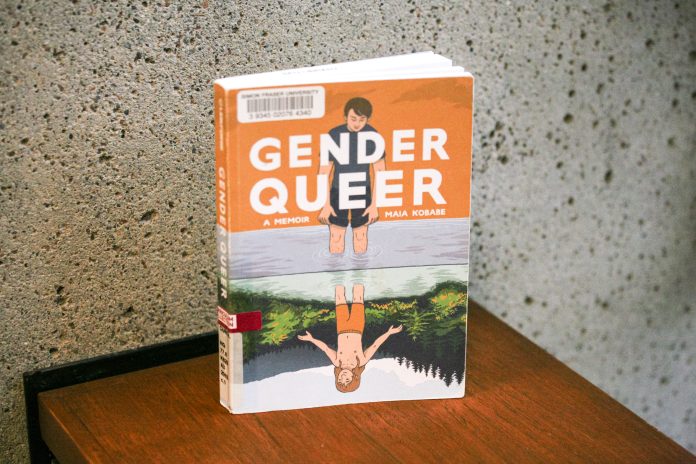
In 2024, some of the most challenged books in Canadian and American libraries were Toni Morrison’s The Bluest Eye (1970), George M. Johnson’s All Boys Aren’t Blue (2020), and Gender Queer: A Memoir by Maia Kobabe (2019). Other books featured in the documentary included The Handmaid’s Tale and Maus. It’s unsurprising that these books were scrutinized given that the far-right groups waging this war on information are opposed to any open discussions surrounding gender identity, sexuality, racism, feminism, and totalitarianism. 

On the suppression of freedom of expression, George Orwell’s dystopian work, 1984, once succinctly commented, “Who controls the past controls the future: who controls the present controls the past.” In short, staunching ready access to information is a tyrannical action that allows historical narratives to be completely rewritten and opposing viewpoints silenced. Orwell’s prediction is extremely pertinent in this age of fascism, which has contributed to a rise in hateful rhetoric across North America, Europe, and elsewhere.

Bigotry and oppression have no place in libraries, which must remain diverse and welcoming spaces of learning rather than battlegrounds for politicians to exert their extremist politics.

Young people must have the opportunity to access books that are relevant to their individual experiences over arbitrary criteria that aim to silence the voices of minorities. The right to read is a freedom that belongs to everyone, and The Librarians hit home this message on the big screen.

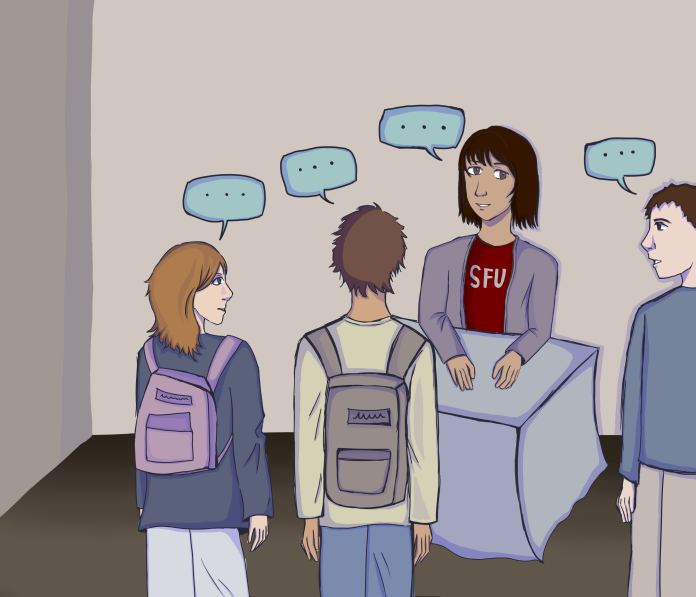
Learnings from Kyra Borland’s talk during SFU’s Multilingual Week

0
ILLUSTRATION: Stella Laurino / The Peak

By: Jonah Lazar, Staff Writer, and C Icart, co-Editor-in-Chief

SFU’s multilingual week took place from February 23–28, featuring a variety of workshops, presentations, and information booths primarily on SFU’s Burnaby campus. Multilingual week is celebrated annually by SFU to recognize the diversity in language and culture in our community. This year, a multitude of events were hosted, such as French writing workshops, Japanese calligraphy, and a film screening held at the Harbour Centre by SFU’s urban studies department. Additionally, students passing through the academic quadrangle will have noticed a half-dozen tables littered with a collection of leaflets, posters, pins, and booklets made by various language faculties and clubs under the collective multilingual week banner. 

The keynote presentation of this week was given by Kyra Borland, who spoke on “Indigenous language revitalization outside academia,” which I attended on February 26 at SFU’s newly constructed First People’s Gathering House on Lhuḵw’lhuḵw’áyten (Burnaby Mountain). Borland is “of mixed Irish and Métis heritage.” Here, animated discussions swirled between a few dozen guests over banana bread and coffee, with most heralding from SFU’s linguistics and Indigenous studies departments. 

Borland explained, “In my early career, I identified as a non-Indigenous linguist and it’s through my work with Métis Nation BC that I was able to unpack my own family’s Métis heritage and I’m actively doing the work to reclaim and position myself in that now.” 

Academia, government, and community are the main three domains that she sees working together to support Indigenous language revitalization and given that they all do the work differently, she feels it’s more useful to “talk about different principles about how we carry out the work across these domains is important so that there’s a common ground for how we approach the work.” As she continued her presentation, she provided an account of her experience working in Indigenous language revitalization, with an emphasis on four important principles required to succeed in this field: humility, flexibility, compassion, and planning. When it comes to humility, she stressed that, “We need to centre the voices of speakers and learners and language advocates in developing programming.”

She also detailed how these three domains interact with Indigenous language revitalization in different ways: within academia, the establishment of research methods and best practices come to the forefront. The government’s role in this field is largely a case of designating funding, while the community plays an important role in the boots on the ground, day-to-day process of using and reclaiming these endangered Indigenous languages. Lastly, Borland gave advice to hopeful future practitioners, telling the audience of the importance of making connections, attending events, and applying for opportunities that may come their day. 

Borland used storytelling to illustrate how the four principles she outlined have come up in her work. One of those stories even her own mother (who was in attendance) hadn’t heard before. Borland was early in her career and had crashed her car into a snowbank outside of a Stellat’en band council building on the banks of Fraser Lake. She confided in us that it had, in fact, taken nearly the whole band to help get her out of the snowbank. As I looked across to her mother in the audience, I saw her shaking her head in amusement at her daughter’s misfortune. 

I appreciated learning about the trials and tribulations required to make a difference in helping threatened languages continue to be passed down through generations. 


QUIZ: Which Peak staff member are you?

0
ILLUSTRATIONS: Cassandra Nguyen / The Peak

By: Maya Barillas Mohan

Are you a morning person? Or perhaps you gas yourself up in the morning for the long day ahead and fall right back to bed. Maybe somewhere in between? Based on your morning routines, we’ll tell you which Peak staff member you’re most like! 

What were you doing last night?

  1. Devising a plan to overthrow the “corrupt and tyrannical” authority of the paper. 
  2. Asleep. Soundly and responsibly. Definitely not dreaming about homework.
  3. Locked in.
  4. Glitching out.
  5. Workworkworkworkworkwork.
  6. Socializing AND doing a homework marathon. You can have it all.


You’re looking in your fridge before rushing out. What do you eat?

  1. Everything. Including the fridge.
  2. Leftover udon.
  3. A sitcom breakfast. Orange juice. Peanut butter. Ham.
  4. Yogurt.
  5. Iced latte! Caffeine <3 
  6. Who said rushing? I take it easy.


What are you wearing to school today?

  1. Camo to sneak around Maggie Bentson Centre and plan for my takeover of this whole campus. Just don’t dangle an apple in front of me —
  2. All black, all baggy. Maybe one metallic accent.
  3. Something cool and vintage. 
  4. My usual, an iconic fur jacket. 
  5. Something that’s giving LinkedIn vibes. 
  6. A raincoat zipped all the way up to the top.


How would you describe your commute?

  1. Quick, because I live on campus (underneath The Peak’s office). 
  2. B. Chronically early. 
  3. Harrowing, so harrowing . . . includes every chariot besides a gondola ride.
  4. I spend loads of time expressing my extreme distrust of TransLink. 
  5. Cutting it extremely close.
  6. A 30-minute free-for-all.


It’s 10:30 a.m. Are you at school yet?

  1. How many times do I have to tell you? I’ve BEEN here and want revenge.
  2. Perfect timing.
  3. Almost . . .
  4. I just left. Oops.
  5. Just . . . trying . . . to find parking . . .
  6. Should I be? Checks overloaded calendar.


Mostly A’s:

You’re most like John Pork, the self-proclaimed “REAL Editor-in-Chief” of The Peak! 

You probably take notes on a hot dog bun like the jester you are, always fixed on maximum spectacle that defies logic. You probably love taking revenge on the institutions and people that contain you, and you get everywhere on stealth mode. Embrace your porky side, you porkster!

Mostly B’s

You’re most like Michelle, one of our co-Editors-in-Chief!

You’re most likely a fantastic listener who enjoys simple, classic routines like skincare and tactically saving some of your takeout from the night before. You might have some fun strategies for reducing your screen time like using a flip phone, but can’t avoid screens forever due to your preference for online classes.

Mostly C’s

You’re most like Noeka, one of our Staff Writers!

You’re a fan of leisure in the morning and really dislike the commute to SFU because it’s just too active. Once you get there, you take notes on any random paper with any random pen, but you’ve channeled all your energy into dressing like a main character in every lecture. Even though you’re grumpy this morning, you had fun taking this quiz . . . right?

Mostly D’s

You’re most like Hannah, the News Editor!

You probably love waking up after your set alarm and listening to music in the mornings. Sleeping in is rare for you, but when it happens, that’s #bliss. You’re detail-oriented when it comes to your work and your deadlines, but probably should clean between your laptop keys. All my Hannah’s out there — don’t work too hard!

Mostly E’s 

You are most like Zainab, the Opinions Editor and incoming Editor-in-Chief. 

You probably welcome variety into your life but always come back to your favorites. You love social media and fit scrolling into your day before a busy school day, and can’t decide if you love or hate the parking situation at SFU. 

Mostly F’s

You are most like Maya, a Staff Writer. 

You probably like staying busy but get a little chaotic with it. You get your homework done early even if it means you’ve been awake for two days. You love school, but you probably should go grocery shopping when you get home.

Shark Bowl: The BC Conservative Party leadership race

0
ILLUSTRATIONS: Sonya Janeshewski / The Peak

By: Sheela McGummery, Legislative Correspondent

After John Rustad’s scandalous exit from leadership, the BC Conservative Party recently announced a new format for our leadership debates. Candidates will participate in a new reality TV show: Shark Bowl — BC Conservative Party Leadership Contenders. The race is shaping up to be an interesting one, with former prominent individuals of the now-defunct BC Liberal Party (AKA BC United) fighting against classic conservatives for the position. 

Shark Bowl will stream live on YouTube and bears a remarkable similarity to Shark Tank. Steve Kooner, a disgraced leadership contender who dropped out of the race after a few days, will be hosting the program alongside the tissues that hold his tears of embarrassment. Party members will vote candidates off a yacht on Vancouver Island until only one remains.   

Darrell Jones, former president of Pattison Food Group

Top campaign pledge: Free Western Family steak on the first Tuesday of the month for party members 

Heya, Sharks. You might know me as the president that created Save-On-Foods’ Darrell’s Deals, where I fought inflation head on with two-for-one lasagnas. If I’m chosen as your next leader, I promise to axe the tax (for myself) and bring Darrell’s Deals to a gas station grocery aisle near you. Remember: if you can’t afford groceries, just wait for the flyer with my face on it. 

Kerry-Lynne Findlay, former Conservative Member of Parliament  

Top campaign pledge: A provincial moratorium on smiling

(as she speaks, the Imperial March plays) Mwahahaha. Cackles. Breathes in like Darth Vader. Oops — didn’t realize my cosplay mask was still on! Does not take off said mask, continues to breathe evilly. Having served as a member of Stephen Harper’s cabinet, I acquired the skill of never blinking. That’s why Pierre Poilievre trusted me to run a part of his extremely successful campaign last election. If chosen as leader, I promise to turn property owners against the utter evilness of empathy and humanity. Wokeness? Step aside. It’s me — Kerry-Lynne Findlay. Mwahahahahhaa. Cackles. Breathes out like Darth Vader.

Caroline Elliott, former BC United president

Top campaign pledge: Banning Alvin and the Chipmunks  

Do you remember the good old days? There was absolutely no hate back then. Everyone was YOLO and rich as fuck. My huge base of supporters often ask me, “What are you doing here, Carrie! You’re a BC United gal!” BC United is dead, Aunt Becky. OK? Time to be a political chameleon and change my stripes once more. Oh . . . Kerry-Lynne calls me a Liberal? Well, maybe she should look in the mirror. Anyone who doesn’t believe in banning children from watching Alvin and the Chipmunks is too woke for our party!

Yuri Fulmer, businessman and friendly Australian 

Top campaign pledge: Increasing Australian immigration by 1,000%

 You might be wonderin’ what me, your average chill Australian, is doing here. Honestly, everyone needs to chill. I was the head honcho at Mr. Mikes Steakhouse, where I championed fiscally responsible policies. That’s how I’ll manage the province — (Yuri Fulmer was pushed off the boat by one Kerry-Lynne Findlay. Apparently, he wasn’t right enough for ‘em!)

Peter Milobar, MLA for Kamloops Centre 

Top campaign pledge: End human rights 

If you squint close enough, I might seem like Darrell Jones. The only thing we have in common is the deal I have for our party members. If you vote for me, I promise to take your rights away, ban unions, and make children work in the mines to pay for my tax cuts for my buddy Chip Wilson

Iain Black, former BC Liberal Party Cabinet Minister 

Top campaign pledge: Radical neoliberalism 

Remember when our provincial government tried to sell our rivers to corporations? That was my idea! This is the kind of bold, monetarist, down-to-earth policies we need to embrace as a party. Water? Who needs that when you can take an anti-woke shot? 

Editor’s note: Bruce Banman, Harman Banghu, and Warren Hamm, the other three contenders, were not available to send us a teaser video. They are currently on a taxpayer-funded trip to Hawaiʻi.

Board game cafés kill connections

0
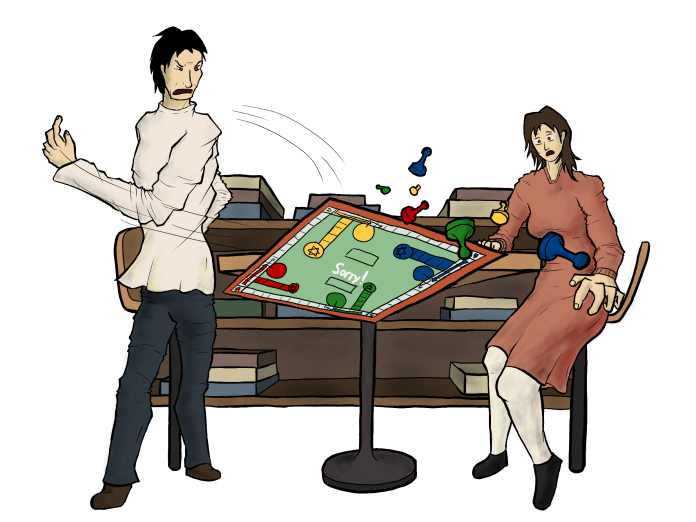
A man sweeps off the pieces of a Sorry board off of the table. His date looks on with shock.
ILLUSTRATION: Yan Ting Leung / The Peak

By: Maya Barillas Mohan, Staff Writer 

Hey, kitten. Maybe too soon for pet names, especially because I don’t know if a second date is on the cards after the way our first one went. 

I’m sorry I picked a board game café under the ruse it would be romantic. I forgot that Monopoly is a game that takes 15 hours to play and I kept going bankrupt. I promise I’m not actually broke in real life, too . . . but I see how my card declining when I tried to renew the parking space suggests that. It’s because the bank flagged it as a suspicious purchase because I don’t usually stoop as low as that kind of joint . . . showing how much I like you!!! What kind of café has hourly parking anyway??

Also, my normal disposition is not underscored with the temper of a teething two-year-old. That was just some good old-fashioned competitive spirit. And I am not a sore loser; I just have a very keen sense of justice. The board game café’s Monopoly edition was definitely missing a whole pile of money in the box we borrowed; that’s why I was so suspicious of you as the banker. 

If we picked a different board game, things would have been way better. My rant about how much I love landlords was only because I briefly owned Boardwalk and Park Place at the same time. You looked annoyed at that, but it was kind of hard to tell because that café was so crowded with other people yelling and cheering for my massive W’s. 

At least I’m not the guy that swept the whole Sorry board and pieces off the table (I only swept the pieces . . . ). There’s the risk I would have gotten bored in the middle of a puzzle and started watching videos on my phone, but I swear I was so captivated by you it would absolutely not have happened. Besides, it’s not like we even got to know each other that well. By the time we switched to Jenga, you insisted you could only pull bricks in complete silence. What do you mean by silence? Did you just not want me to talk?? If that were the case, we could have just gone to a movie. That could have spared me the second-degree burns your spilled coffee left on my lap because theatres don’t dabble in MOLTEN JAVA. 

The coffee thing literally scarred me forever. I get that board game cafés need to have minimum spends to be profitable or whatever (because people do be loitering), but you absolutely did not need that third espresso concoction after you got so jittery from the first two. I keep it simple with a matcha latte with oat milk and light ice. Why do you even drink black coffee? Who are you trying to impress? The other intellectuals in the board game café? It was all nerds. There was a five-party wait for Scrabble! That game is rigged. You can only win if you grew up with an excessive interest in literature, I swear. 

Now that I think about it, I’m not sure we fit together like puzzle pieces like I hoped. Cracking jokes that would make you laugh was even harder than playing Operation. As these game-loving losers would say in Clue: you killed my vibe with a revolver in the lounge.  

Climate change solutions and Indigenous sovereignty are deeply connected

0
a photo of a mountainous landscape in BC. There’s a narrow waterway running through the ranges. Trees and greenery cover the land.
PHOTO: Jake Hills / Unsplash

By: Noeka Nimmervoll, Staff Writer

For grassroots activists, it may feel like a brutal time to care about the planet, when our leaders do not. By 2035, it is predicted that we will hit a global temperature of 1.5℃ above pre-industrial levels — a significant threshold for the worst effects of climate change to occur. This is despite country leaders promising to keep it below this temperature at the 2015 Paris Agreement. Even though big polluters have continued to rake in a whole lot of profits it’s not time to give up on climate activism. We should focus on climate stories that really make an impact, and support them as best we can. There are many ambitious climate projects that have been spearheaded by Indigenous Nations and communities, including Indigenous Protected and Conserved Areas (IPCAs), that show great promise

IPCAs are “lands and waters where Indigenous Nations, their communities, and/or governments have the primary role in protecting and conserving ecosystems through Indigenous laws, governance, and knowledge systems.” Many IPCAs have been successfully implemented, while others require further support from Canadians. Global warming will not be solved by IPCAs or Indigenous Peoples’ efforts alone — nor would it be fair to expect Indigenous Peoples to solve an issue they did not create. 

IPCAs have the capacity to catapult Indigenous sovereignty to the frontlines of climate action, where the dignity and life of Indigenous Peoples are held at the heart of global change.

IPCAs are developed in many different ways, but they follow common themes. All IPCAs signify a devotion to long-term land conservation and elevate the rights and responsibilities of Indigenous Peoples. Since the 2017 report, many Indigenous Nations have designated and established IPCAs with the help of the Indigenous Leadership Initiative, an Indigenous-led organization that works with Nations to establish funding from the Canadian government, provide multi-level legal support, and share extensive technical knowledge on land usage. IPCAs provide opportunities for land back by designating the care of large masses of land to the Indigenous Nations that understand the land best, while simultaneously providing the opportunity for more Indigenous sovereignty. 

Currently, Canada is aiming to conserve about a third of its waters and lands by 2030, and IPCAs lead the way to help achieve this goal. In the Northwest Territories alone, three major IPCAs are established: Ts’udé Nilįné Tuyeta, Edéhzhíe, and Thaidene Nëné. Together, the land masses are approximate to the size of Costa Rica and are significant moves towards land stewardship for the K’áhshó Got’ı̨nę, Dehcho, and Łutsël K’é Dene Nations, respectively. In Northwest BC, Gitdisdzu Lugyeks (Kitasu Bay) is a marine protected area governed by the laws and people of the Kitasoo Xai’xais Nation. 

The next big IPCA in development is the Seal River Watershed. This rich watershed in northern Manitoba is 50,000 square km of land filled with endless forests, thriving wetlands, and sustained tundra, as well as being home to many animals. IPCAs also act as powerful forms of climate preservation by storing massive amounts of carbon within their healthy wetlands, forests, and oceans. Due to the large amount of CO2 produced by our countries, we need as much storage of CO2 as possible. 

The land has been cared for by four Indigenous Nations for millennia: the Sayisi Dene First Nation, O-Pipon-Na-Piwin Cree Nation, Northlands Denesuline First Nation, and Barren Lands First Nation. Together, they are referred to as the Seal River Watershed Alliance, and work to make the Seal River Watershed an official IPCA. Protecting this incredible piece of land would promise a healthy and thriving future for those who live off this land, for generations to come.

The land will experience significant environmental benefits if it is preserved. Within the watershed is a carbon bank that holds massive amounts of carbon deep underneath the surface — around 1.7B tonnes. Preserving this environment prevents this massive amount of carbon from being released into the atmosphere, which would exacerbate the negative impacts of climate change. We can help the Alliance by using our voices to tell the Manitoba Premier to support the preservation of this land via Indigenous stewardship. 

For settlers, climate change can be mitigated by supporting the Land Back Movement. This movement would grant Indigenous Peoples control over more territories, which would in turn aid in establishing more IPCAs. With the increase of Indigenous sovereignty, comes the relief of climate change harms. 

There is still so much left to do in terms of climate change. We can’t simply depend on Indigenous Peoples and their knowledge to get us out of this mess. However, IPCAs are a success story leading the way in climate activism, and they achieve it through Indigenous sovereignty. To avoid the worst effects of global warming, we need change in our society to be rooted in sustainability, and that includes environments led by sovereign Indigenous Nations.

What Grinds Our Gears: multi-factor authentication

0
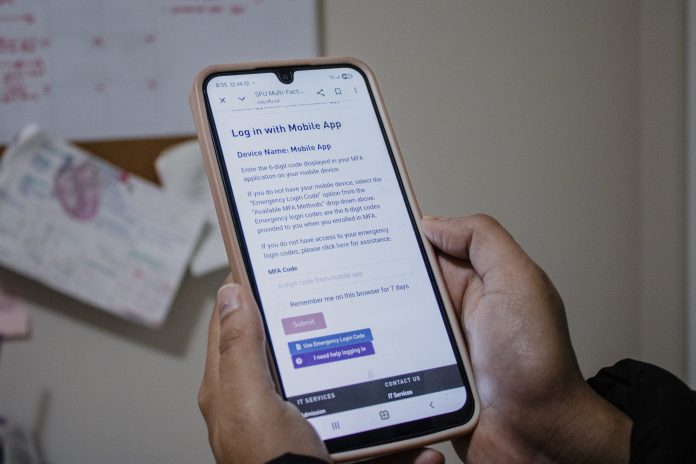
a photo of a person holding a phone in their hands. They’re trying to log onto an SFU portal, but are stopped by SFU’s multi-factor authentication.
PHOTO: Prerita Garg / The Peak

By: Nejdana Houshyar, SFU Student

I can’t be the only one who despises multi-factor authentication (MFA). If you are a student at SFU, you have likely experienced the frustrating process of trying to log in to Canvas or goSFU only for MFA to stop you. This is when the annoying process ensues. You pull out your phone, put in the code before the timer runs out, and wait to be logged in. Sometimes, it’s hard to even find the motivation to open these sites at all. Adding another hurdle to accessing Canvas isn’t necessary. 

Another gripe I have is with the “remember me on this browser for seven days” button. The fact that the duration is limited to only seven days is absurd. This means, for a semester (including the exam period), we have to enter a new code 15–16 times. Now I don’t know about you, but Monday mornings are already hectic for me — I mean, I am already running late for lectures — the last thing I want to see is the MFA page. At the very least, implementing a 14-day login would reduce my weekly groans.

You see, I understand that these extra steps are implemented for security and protection. But who could possibly be trying to log in to Canvas on my behalf? I just want to get my school work done without feeling like I’m acting out the cliché trope of a nerdy character in a movie hacking into the mainframe.

An evening to celebrate Black art and academia

0
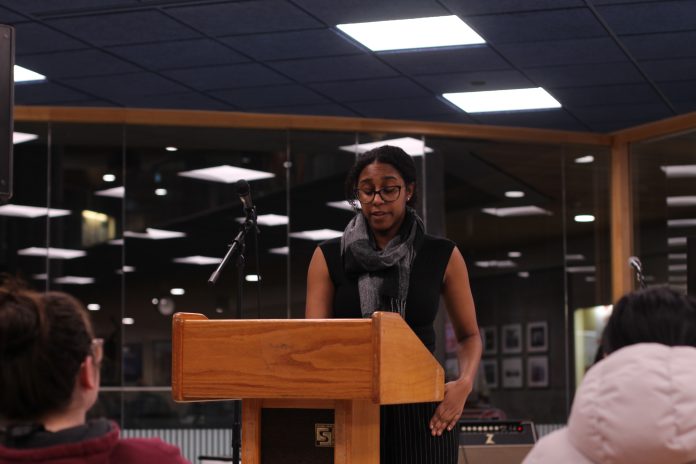
A photo of a speaker at the event speaking at the podium
PHOTO: Maya Barillas Mohan / The Peak

By: Maya Barillas Mohan, Staff Writer

“Turn it down?” Emcc K Ski retorted, grinning. “Well, we only have one more song. Too bad it’s the loudest.” His band, Beats Blues and Bars, played to their full velocity in the Black Student Centre, located in MBC 2270. The room is enclosed by a glass wall and furnished with gourd-coloured furniture. Perched on an ochre-coloured beanbag, I get a perfect view of the poets and academics poised behind the podium.

February 27’s Black Excellence event was designed by Lakeisha Barrington and Marlo Browne to recognize the artistic work Black students are doing at SFU and the greater community of the Lower Mainland.

After Beats Blues and Bars’s first set of original hip hop, poet and English masters student Odessa Twibill took the stage. They shared poems that are initially conversational, but become visceral and dizzying as they process through their motifs of transition and illusion in a post-colonial world. I found their reading intimately and intricately observant. I spoke to Twibill after the presentation ended to learn more about their presentation. 

“‘Dear Colonizer’ is a research creation project, where every line of the poem has a citation. I basically did the equivalent of the research I would do for a paper, but for a poem instead.” Twibill continued that this project was a modified version of a research creation assignment from their undergraduate years. Focusing on Black and Indigenous literatures in their MA, Twibill explained that “Indigenous is a blanket term, and Blackness can also be understood through the lens of Indigeneity.” They said this research offers different avenues “to be able to connect and find that kinship focus.”

Next was Browne. Through a reading of his poems, Browne pointed out that Black History Month should be recognized year-round, and urged the listener to think about the scrutiny behind identity, and the role art plays in a person’s life. 

When Browne’s co-organizer, Barrington, took the stage, academia and art were again closely sutured. She read the introduction to her thesis, describing the injustices that persist despite promises to dismantle them in an “apocalyptic present.” 

Lastly, Chris Outten. As Outten spoke, I thought about his invocation that movement complicates belonging and identity. What happens to the body when it moves cultures? How do we hold memory? Invisibility is resisted by announcing presence, starting as a TV Outten wheeled into the room glowed to life. As his character on the screen, Kettle Man (Outten’s personification of “imposter syndrome, racial pressure, and the quiet performances”), rattled in front of an audience of entirely silent bystanders, the viewer was left to contemplate the absurd choreography with their existing ideas of performance and bodily representation. I felt bad for my reaction of confused laughing at first, but Chris opened his presentation by saying, “humour gives breath to a heavy space.” 

Beats Blues and Bars resumed command of the room after a round of applause for the presenters. I can still hear their music pulsing through the glass while I finished my interview with Twibill. Participation in showcases like this is valuable because they are opportunities to share poetry, literature, and culture in a space for Black people and the close-knit SFU community. “It shows me what’s possible to do,” and “it really opens your mind.” Twibill urged the audience to be brave and talk to people that present and create connections.

“The biggest thing is to witness and take what you’ve learned with you, and share it if you can.”

 — Odessa Twibill, poet and English MA student