Home Blog Page 753

The future of electoral reform

0

By: Olivia Roberts

After the federal Liberal government announced the broken promise of electoral reform back in February, there remained another vote with the potential to bring about a big change.

However, the House of Commons voted on Wednesday to reject an all-party committee report on democratic reform, which recommended that the government hold a national referendum on changing the voting system to proportional representation. The report was defeated with 146 votes in favour and 159 against.

While electoral reform seems to be on hold on the federal level, the latest developments in BC politics have made it front and centre.
The election results that came out of the province’s first-past-the-post (FPTP) system resulted in a historic minority government — the first in BC since the 1950s.

Though the BC Liberals came in just shy of a majority with 43 seats, the BC NDP and the BC Greens have formed a partnership to govern the province. Electoral reform was a central part of the agreement between the two parties.

Current electoral system

In Canada, and BC, we use a majority election system with FPTP voting to determine the outcome in an election, though electoral reform has often been brought up in provincial and national politics.

Within the FPTP system, a census determines Canada’s electoral ridings and constituencies, in which voters can elect one member of Parliament from a range of parties to send to the federal House of Commons. Simply put, the person who receives the highest amount of votes wins.  

FPTP is simple and used in many countries across the globe, including the UK and the USA. However, the FPTP systems garners much criticism as there is often a skewing of results, and the person or party who wins the election often isn’t the person or party who won the highest amount of votes. This caveat is most notable in the past couple months in the recent US election, in which the Clinton campaign won the popular vote, but the Trump campaign won the presidency.

The majority election system prevents the success of many small parties, and further encourages a limited-party system. This creates a stable parliamentary majority, but can mean that some people feel unrepresented. Furthermore, it can encourage “gerrymandering,” a redistribution of constituencies in order to optimize those elected to the majority party.

Popular alternatives

When it comes to alternatives, those in favour, namely the NDP and Green parties, or the Liberals until late January of this year, are vocal about the necessity for change.

Some of SFU’s student groups affiliated with political parties feel that a change in the system would help encourage the youth vote.

“Within the context of youth and university students, we are often blamed for not turning out to vote on election day,” said Ian Soutar of the SFU Greens. “But when the system is as antiquated as it is and there are so many people from older generations telling us that our vote doesn’t count, or using other voter suppression techniques, it is very difficult to convince us that there is a benefit to marking an X on a piece of paper.

“My hope is that implementing a more inclusive system would stimulate youth into getting out the vote, as well as any other disenfranchised voters, because we know that our vote will do what we want it to do,” Soutar noted.

The main alternative to our current electoral system in a parliamentary election is the proportional representation (PR) electoral system. Popular around the world, PR aims to ensure that the percentage of votes for a party aligns with the percentage of representation of the party.

This system often encourages a multi-party system, and consequently encourages coalitions in government. Often PR electoral systems will have voters cast their votes for a party, not specific individuals, depending if the system is an open or closed list.

This electoral system is usually favoured by parties such as the NDP and the Greens on both a federal and provincial level. As part of the alliance announced this week between BC NDP leader John Horgan and BC Green leader Andrew Weaver, the parties have pledged to hold a referendum on PR next year.

Soutar said it was reassuring to see the two parties put forward electoral reform in their platforms this election. “I am very much hopeful that BC will help shift the country’s support towards proportional representation,” he said.

However, there are some commonly cited drawbacks to the PR system. Firstly, the system encourages multiple parties and creates an environment in which consensus in the form of a party-line is difficult to achieve.

Secondly, while encouraging the success of small-party representation in government, some are concerned that this may allow for extremist parties being represented in government.

A common form of proportional representation is the single transferable vote model which involves a complex system of ranked voting and redistribution. The model is praised for its ability to achieve nearly pure proportional representation, but criticized for its complexity as to how individual votes are counted.

It was defeated twice in provincial referendums in BC — once in 2005 and again in 2009.

Olivia Roberts is the vice-president of the SFU Greens.

With files from The Guardian and CBC News.

Board Shorts

0
Irene Lo / The Peak

Election report cites numerous issues

The SFSS Board of Directors unanimously approved the 2017 election report by the Independent Electoral Commission. The report covers no less than 36 issues that arose during the election period, including debate organization, ambiguous poster policies, and late hiring of the chief commissioner.

“I think it should be noted that it is a point of concern that, out of all these recommendations, a large proportion of it was regarding essentially policies in place regarding the election and the election process,” Erwin Kwok, vice-president of university relations, told the board. “I just want to note that it is something that we are going to be working on in [the] Governance committee.”

Pierre Cassidy, campaign, research, and policy coordinator, noted that the outgoing board approved a new set of election and referendum policies at the end of last term which he called “an immense improvement.”

“I think a lot of the stuff that [the chief commissioner] identified are things that are going to be improved upon already,” Cassidy said.

The SFSS is working to address the issues around the election process, he added.

Board approves budget for cleaning supplies

The board approved up to $250 for cleaning supplies so that members can clean their offices.

“We have never, at least as far back as the last two boards, they have never actually spent any single dollar on cleaning supplies,” Kwok explained. “If we expect students to come into our board office, we want it to be actually sanitary.”

He noted that members have been buying cleaning supplies out of their own pockets. SFSS President Hangue Kim added that there should be a policy developed regarding the allocation of office supplies because it is such a small part of the work done by the board.

Membership and reimbursement policies discussed

Two draft policies on membership standing and the reimbursement of membership fees were presented to the board for discussion. SFSS bylaws stipulate that students may retain their membership in the society during a gap semester when they are not enrolled in classes if they pay the membership fee. Cassidy is working on the policy to record the payment of fees by non-students.

“The goal [of this policy] is to make sure that we have a very formal process for collecting your SFSS membership fee, which, on a semester off, would keep you eligible to hold your director status,” Cassidy informed board members.   

Cassidy also told the board that the SFSS lacks a policy to deal with occasions where students are referred to the society for the refund of membership fees. Though the university is tasked with administering refunds to students, there have been cases where members were advised to collect the refund directly from the society.

“We don’t have any of the infrastructure, we don’t have any capacity to reimburse students currently,” Cassidy explained, proposing that the society set up a system whereby it can assist the students in dealing with the university.

“The idea is to position the society to advocate on behalf of members who are struggling with a reimbursement process,” he noted.

World News Beat

0

By: Sterling Hillman

ENGLAND – Tragedy strikes Manchester

Twenty-two people were killed, seven of which were children, and over 120 were injured from a bomb explosion at an Ariana Grande concert at Manchester Arena on May 22. Manchester police have determined the suicide bomber was Manchester-native, Salman Abedi. As people left the arena, Abedi ignited a bomb near the busiest exit. Manchester police have since arrested 16 other people suspected of being connected to the bombing. News agencies reported heroic actions by citizens including Stephen Jones, a man living on the street, who tended to injured children prior to the arrival of paramedics. Following the tragedy, a vigil was held to remember those who passed.

With files from Manchester Evening News, The Daily Telegraph, The BBC, The Independent and The Guardian.  

INDONESIA – Gay men jailed in Jakarta

Nearly 150 men have been arrested in Indonesia for reportedly having a “gay sex party,” according to The New York Times. The men were arrested on suspicion of breaking Indonesia’s pornography legislation, a law used to punish a variety of sexual activities. In recent months, the Indonesian police have been targeting gay people specifically. Because of government persecution, gay people are forced to gather in undercover locations such as saunas and secret parties in order to avoid arrest. Recently, two gay men received 85 public lashings each for supposedly having sex.

With files from The New York Times.

PHILIPPINES – Martial law declared following militant attacks

Martial law has been declared for 60 days on the island of Mindanao by the president of the Philippines, Rodrigo Duterte. The island sits 800km south of Manila and has been the site of warfare in recent weeks. The conflict is between the national army and several Muslim rebel groups including the Maute group and Abu Sayyaf, both of whom have pledged allegiance to the Islamic State. According to the Philippine Armed Forces, the warfare has resulted in 44 deaths which include militants, soldiers, and police. Martial law allows the military the ability to search and arrest people without a court warrant.

With files from BBC News and NBC News.

SRI LANKA – Floods displace thousands as death toll rises

Flooding and mudslides caused by monsoons have killed at least 150 people and displaced more than 500,000 people in Sri Lanka. About 100 people are still missing due to the monsoons. Sri Lanka hasn’t seen flooding this damaging since 2003. Various countries such as the United States and Pakistan are promising to provide relief supplies and India has sent three navy ships to supply various forms of aid. Mudslides have become more common during the monsoon season throughout Sri Lanka due to the high increase of deforestation in order to grow crops for exports, such as tea and rubber.

With files from The Daily Telegraph, Al Jazeera, and BBC News.

NIGERIA – Chibok schoolgirls reunited with families

Nearly a hundred Chibok schoolgirls have been reunited with their families after being held captive by the Nigerian Islamist militant group Boko Haram for over three years. In April 2014, Boko Haram kidnapped 276 Chibok schoolgirls from their dorm rooms. With the assistance of the Swiss Government, the Red Cross and several other non-governmental organizations, the Nigerian government was able to negotiate the girls’ release. Though the 82 girls have been free for more than two weeks, they are just now reuniting with family. Over 100 girls are thought to remain in the hands of Boko Haram.

With files from NPR.

Children of God is a heart-wrenching musical we all need to see

0

By: Tessa Perkins

“We’re trying to make you better,” says a priest to a little boy, implying that everything he is — his culture, his language, and everything he does — is wrong. This is how children were treated in residential schools in Canada. They were abused in many ways and made to feel like there was something wrong with them. The trauma of that experience is intergenerational — it is passed on to the children of residential school survivors and the effects linger to this day. Corey Payette’s Children of God demonstrates the realities of residential schools in gripping detail through rousing song and heart-wrenching drama. Everyone should see this play — even those who are already educated about this part of our history.

Tommy (Herbie Barnes) is one of three young boys we see growing up in a residential school, along with his older sister and two other girls. Showing how the experience affected him later in life, we later see scenes of him as an adult as he struggles with alcohol abuse and getting a job. While in school, he is not allowed to see his sister, Julia (Cheyenne Scott), but the two of them have a secret meeting spot where they manage to meet up every so often. In “The Closest Thing to Home,” they sing about what they think they can remember from their home, but they aren’t sure what’s real anymore.   

“The children have their memories of home and their language beaten out of them…”

One of the most heart-wrenching moments is hearing Tommy tell his sister that he watches the trains every day to see if their parents are on one, coming to take them home. In another scene, his mom does come to try to visit them, but she is told she can only see her children if she fills out a form which she can’t read. Tommy tries to write letters to his parents to tell them how much he hates it there and that he wants to go home, but those letters are never sent. Instead, the priest writes form letters on the board for the students to copy down and the only letters sent to parents talk about how wonderful their children are doing.

Every musical number is full of emotion and beautiful vocal harmonies while moving the plot along and adding to the intensity of the situation. In “God Only Knows,” both the students and the clergy lament their fate. Father Christopher (Michael Torontow) is a nasty man who is full of hypocrisy, whereas Sister Bernadette (Trish Lindström) has a bit more humanity. She eventually helps Tommy escape and attempts to stand up to Father Christopher a few times.

The children have their memories of home and their language beaten out of them — anything that hints at their Indigeneity is seen as a sin. It’s no wonder that as an adult, Tommy is not stable. He has trouble getting along with his mother and struggles to forget the traumatic experiences of his youth.

Tommy’s sister never makes it home from residential school. She attempts to escape, but is always found and brought back to face harsh punishment. She eventually finds some sympathy from Sister Bernadette when she tells her, “He comes when I’m alone” and we learn what Father Christopher has been doing to her. The rape scene is subtle. We are left to imagine what happened, which is often worse than anything we would see on stage.

The entire cast, only two of whom are non-Indigenous, gave outstanding performances — especially as Julia and Tommy. The lost innocence of these children is a huge tragedy, and the audience was invested in their story the whole way. In a telling scene, the boys played ‘Cowboys and Indians,’ showing just how normalized those roles were.   

In the final scene, the cast held hands across the front of the stage, chanting to the steady drum beat in honour of Julia and all the children who suffered through residential schools. Soon, everyone in the theatre was on their feet, holding hands with strangers, and thinking about this tragic piece of our past. It was a healing, cathartic, and powerful moment that I won’t soon forget.

Children of God is presented by Urban Ink, Raven Theatre, and the National Arts Centre from May 17 to June 3 at the York Theatre. For more information, visit thecultch.com.

Album Reviews

0

By: Neil MacAlister and Alexander Kenny

T-Wayne by T-Pain, Lil Wayne

Review by Neil MacAlister

In 2008, T-Pain and Lil Wayne were at their peak. Both had just dropped massively successful albums (Thr33 Ringz and Tha Carter III, respectively) and chart-topping collaborations like “Got Money” and “Can’t Believe It.” This inspired the two artists to make an entire album together. After Wayne went to Rikers Island, the project ended up collecting dust somewhere in T-Pain’s hard drive, and fans accepted that T-Wayne had gone the same route as Dr. Dre’s Detox; that is, until T-Pain unexpectedly released it on May 18. Nine years after its creation, T-Wayne serves as a nostalgic reminder of why Teddy and Weezy once dominated the airwaves.

T-Pain is as fun and corny as you remember, with goofy punchlines and an unflinching, triumphant optimism; he has become something of a punchline in recent years, but there’s no denying his pop artistry. In 2009, Wayne was still at the height of his abilities, effortlessly weaving sophomoric jokes with deceptively brilliant writing. If for no other reason, check this out for the Oompa Loompa sample in “Listen to Me,” and to hear Wayne interpolate the American Pie chorus into a song about how many Chevys there are in Florida.


Poison the Parish by Seether

Review by Alexander Kenny

South African grunge rock band Seether is back at it again with their newly-released, long-anticipated album Poison the Parish. The album touts a strong mix of the heavy, hard-hitting tracks that have become synonymous with Seether, such as “Betray and Degrade,” “Let You Down,” and “Emotionless.” These follow the themes of much of Seether’s musical history which lies in inviting their listeners to relate to stories of anger, frustration, and feeling lost in life.
The album is smattered with tracks such as “Against the Wall” which offers a slower piece and a slight departure from their signature sound, while still containing the emotional content to keep listeners drawn to the music. As always, Shaun Morgan’s unmistakable, gritty vocals bring an energy which can only be identified as “definitely Seether” and he makes each track anything but emotionally boring. The wide array of qualities across the tracks in this album demonstrate why Seether is still one of the great remaining grunge rock bands, and a must-listen for any hard-rock fan.

Stuff we like and don’t like

0
(Elena Hsu / The Peak)

By: Ana Maria Mejia Morales

Stuff we like: Justin Bieber singing in Spanish

For those who are not aware, our favourite Canadian pop icon recently released a Reggaeton song with Daddy Yankee and Luis Fonsi called “Despacito.” In summary, this sexy Latin tune is bloody fantastic and will become your favourite summer jam. JB sings in both English and Spanish; and let me tell you that the accent and pronunciation is not bad at all. This raises many questions. Who knew JB was bilingual? Will there be any more collaborations with Latin music idols? Can this young superstar be any more multifaceted? Keep it up, JB!

Stuff we don’t like: Coffee served in an avocado

We all know avocados are incredibly good. They are super flavourful and can pretty much go with any meal, but this obsession has gone too far. After a video surfaced online of a cappuccino being served in a half-empty avocado, I think it’s time to put an end to this nonsense. First of all, if you are serving coffee (the beautiful drink sent from the gods) in an avocado, your coffee must lack flavour. Because let me tell you, coffee is not meant to be flavoured with avocado. And, second of all, what a waste of avocado! What are they doing with the actual filling? Are people supposed to scoop out the remaining avocado after drinking their cup of joe? Avocadon’t.

Everything, Everything — aesthetically pleasing, but predictable

0

By: Grace Rose

Amandla Stenberg stars in a new romance film that weaves a tale of young love in the midst of unfair illness. The film utilizes a typical love story trope in which the girl falls in love with the ‘boy next door,’ who is played by relative newcomer, Nick Robinson. This is complicated by the fact that Stenberg’s character, Maddy, has an illness that prevents her from leaving her house. Nevertheless, the film takes her on a journey where she risks everything for love and learns some things about herself along the way.

“The stellar cast performs well together and embodies the story beautifully.”

As a piece of art, the film is visually stunning. The colours are bright and the scenes are dynamic, which contribute well to setting up the worlds of the two main characters. Maddy’s illness requires that she live in a pristine, sterile environment and the film sets that up visually in a way that’s very clear — especially when contrasted with the other locations of the film.

The stellar cast performs well together and embodies the story beautifully. Anika Noni Rose plays Maddy’s mother, who also serves as her primary physician. She plays really well off of Stenberg and the two of them are able to create a strong and believable mother/daughter relationship. Over the course of the film, the performances capture intense emotions through subtle actions which is a difficult task to complete. Genre films can often have over-exaggerated acting, yet this film stays away from that and it serves as a benefit.

However, the story leaves something to be desired. As it utilizes the trips of the romance genre, the film feels predictable, almost as if you’ve seen it before because the story feels so familiar. You know what choices the characters are going to make and there aren’t very many twists and turns — that is until close to the end of the film. The story takes a short, yet slightly unexpected turn close to the end which not only catches your attention, but it actually feels like it saves the story all because you don’t necessarily expect it. Yet despite this turn, the last scene of the movie ends up being as you would predict, which again makes for a lacklustre finish.

It would be remiss to not mention the fact that this film constructs Maddy’s illness or disability as something she has to overcome to live her fullest life. The crux of the story is built around the idea of the bravery and courage it takes to simply live. The main challenge with this is that it can function as a way for able-bodied people to find unnecessary inspiration from her character. While this may not seem like much, for those who are disabled or have chronic illnesses, it can continue to perpetrate harmful ideas that a disability is bad and choosing to exist normally with it is something exceptional. This understanding is a lot more nuanced than most would want to acknowledge while watching it, yet it is still important to consider.

If I had to sum up the film very briefly, I would say that it is certainly enjoyable and would make for a fun night out, but it’s not without its issues. The gorgeous visuals and superb acting save a predictable story from being one that can be completely forgotten and ignored.

SFU students wait up to two weeks to see a counsellor

0

By: Andrew Ng

SFU students with mental health concerns could find themselves waiting up to two weeks for services during midterm and final exam periods, according to SFU’s health and counselling services (HCS).

It’s during these peak periods that demand for services can increase the wait times, HCS counsellors Dylan Le Roy and Lyndsay Cotterall told The Peak via email. However, a student in urgent need is sometimes able to see a counsellor or mental health nurse when they first visit the clinic.

Following the end of the semester, some students turn to social media to voice their struggles with mental health issues, wait times for counselling services, and difficulties maintaining their grades.

As of the spring 2017 term, the total number of students seen by counselling services this academic year had reached 1,264, reported Terence Ng, health finance manager for HCS.

In the 2015–16 academic year, a total of 1,599 students used counselling services, with student enrolment at 33,624. This was a significant increase from the previous year, wherein HCS had a total of 1,410 student clients among 33,853 enrolled in the university.

According to the HCS website, “[p]ost-secondary institutions across Canada [are reporting] an increase in the number of students presenting with mental health concerns.”

“The negative impact of stress is well researched and stress can be a barrier for completion of academic work, concentration, relationships, and can have an impact on a person physiologically,” Le Roy and Cotterall stated.

When a student requests to see an HCS counsellor for mental health issues, the wait for services can depend on the student’s flexibility in scheduling, they noted. The wait times for new students with HCS and returning students do not differ.

HCS offers additional resources to students who feel that their mental health situation is affecting their academic performance, from stress relief workshops to safe-space support groups. Students on wait lists can also be referred to external supports or crisis phone lines.

If students are experiencing difficulties in tackling their schoolwork, HCS indicated that it also offers online resources, including links to online applications, that can help those experiencing distress.

On its website, the HCS summarizes the causes for increasing numbers of post-secondary students facing mental health issues identified in a study done by Gail MacKean in 2011 for the Canadian Association of College and University Student Services. They include a stressful and competitive university environment, stress from social pressure and transitions, and more adolescents who already have mental health conditions pursuing higher education.

In the 2016 National College Health Assessment (NCHA), a survey that tabulates data on student health, stress was the top factor that students reported negatively impacted their academic performance, followed by anxiety and sleep difficulties.

Work, sickness due to colds, flus, and sore throats, as well as depression and finances came after, according to Le Roy and Cotterall.

The NCHA had 1,083 SFU respondents in its 2016 assessment.

The university does have an option that students can apply to withdraw from classes retroactively if their health has negatively affected their class performance.

Concetta Di Francesco, the manager at student academic appeals, noted that students wishing to withdraw themselves from courses for mental health reasons can apply for withdrawal under extenuating circumstances.

According to the appeals section of the SFU website, a student withdrawing from a course would receive a grade of “WE,” which would leave their cumulative grade point average unaffected.

Students can visit the website for more details on how to initiate the process, Di Francesco added.

SFU researchers take greenhouses to the next level

0

SFU engineering professor Majid Bahrami, along with his research collaborators at Kwantlen Polytechnic University (KPU), were recently awarded a $725,000 grant to take sustainable technologies to the next level.

The grant was awarded by the Natural Sciences and Engineering Council of Canada (NSERC) for the team’s “From Waste to Clean Food” project to develop sustainable agricultural technologies.  

According to Bahrami, the researchers at KPU will be “developing a model of growing crops, while the researchers at SFU will be responsible for designing clean technologies that optimize crop growth conditions.”

The SFU team is working to develop closed greenhouse technology to produce sustainable crops.

“Temperature, [carbon dioxide] concentration, and humidity are the three most important abiotic factors that contribute to a plant’s growth, along with water and nutrients. But with conventional greenhouses, crops aren’t being cultivated as effectively as they could,” explained Bahrami.

When greenhouses become hot and humid, some of this air needs to be vented out so that the crops don’t wither. However, carbon dioxide that is necessary for plant growth is also released in the process. Some companies combat this issue “by injecting [carbon dioxide] into their greenhouses constantly, which can be expensive,” Bahrami said.

Closed greenhouses, which prevent the loss of carbon dioxide whilst maintaining their internal humidity and temperature, are one way to address this problem. Additionally, any crops can be cultivated within this controlled environment regardless of the season, weather and geographical location, and without the use of pesticides.

However, these greenhouses consume an enormous amount of energy. In order to control a closed greenhouse’s humidity, air conditioners must be installed.

Bahrami explained that low-grade energy, also known as ‘waste heat,’ has the potential to become an alternative source of energy for closed greenhouses. The researchers are hoping to harness this potential through new technologies.

“Waste heat is low-quality energy, and you can’t do much with this energy, except for the space heating,” Bahrami explained.

So what is waste heat? 80% of the energy we produce comes from burning fossil fuels in power plants. When you burn fossil fuels, a significant amount of its energy content converts to waste heat. It’s then released to the ambient, in the form of heat in exhaust and condensers, with temperatures below 100 degrees Celsius. In fact, almost 60% of fuel energy burnt in the engine of a car comes out of the radiator and the exhaust, which is waste heat.

Bahrami’s research will focus extensively on converting this low energy into clean energy — converting solar heat and waste heat into an alternate source of energy for air conditioning — so that we can cut back on our consumption of electricity.

The research will not only benefit the agriculture industries by reducing their electricity bill, but also the environment. The team is currently developing a new air conditioning system that operates on waste heat, but it is still in the lab-stage testing and development stage.

Bahrami recently received an award for another invention — a device that extracts water out of the atmosphere using waste heat.

Fun fact: Matt Damon uses closed greenhouses to grow potatoes and survive on Mars in The Martian.

SFU Residence is a better environment than you think

0

By: Pranaya Chakraborty

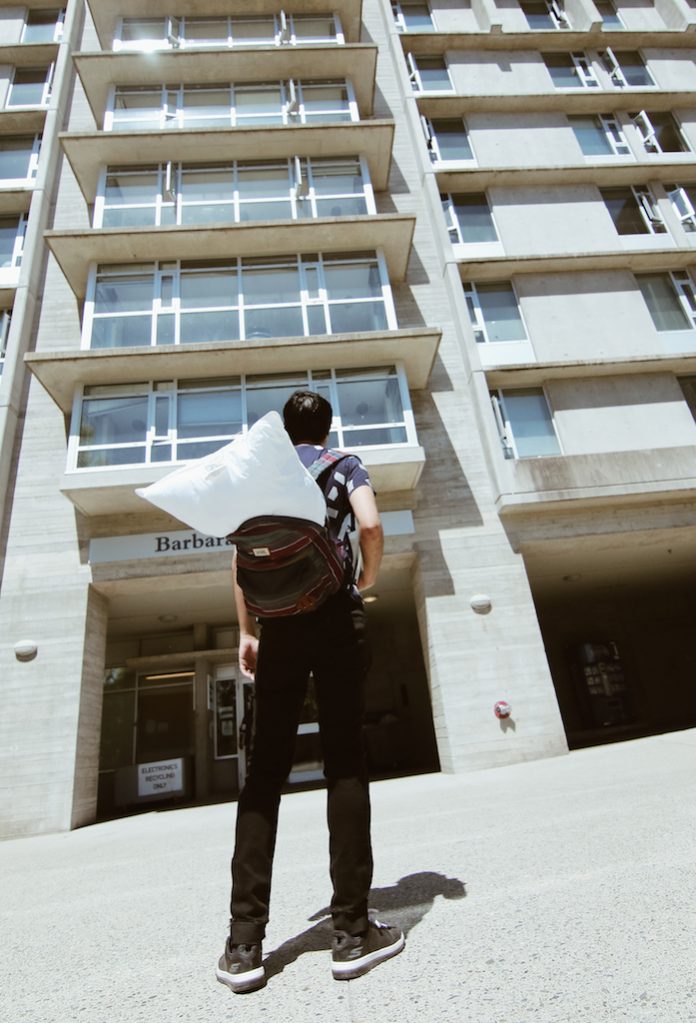
Dorms. Without a doubt, they represent an innate part of a university student’s life. From crazy all-night parties to crashing instantly on a weeknight, dorms are the place where memories are made.

Like all other major campuses across Canada, dorms are a big part of the SFU community and the dorm residents continue to be the core of this enthusiastic and thriving campus. But despite all this, the SFU res often gets a bad reputation.

It is often portrayed as a collection of unsocial community buildings where the people aren’t interested in meeting or communicating with the next person. I heard one of my friends even going so far as to compare the residences to a Soviet-era labor camp. But that is simply not true.

A person’s willingness to communicate and meet new people is a completely personal matter, which frankly has nothing to do with the university or its dorms. You shouldn’t be dissuaded from living on residence for social reasons, nor should you feel like it’s impossible to reach out; the environment is welcoming and a great place to connect.

Often people argue that the strict “no roommate” policy of the Res buildings contributes to a (largely) unsocial atmosphere. But compared to the complexities that one might face with a potentially unwelcoming and inconsiderate roommate, singular occupancy seems perfectly logical. If you decide to send welcoming vibes to your various other peers, you won’t miss a roommate.

Furthermore, although all the buildings have single-occupancy rooms, they also have active community spaces like shared kitchens and the common rooms. There’s always something going on in one of the common rooms and weekly floor meetings are held on a regular basis. Each of these community spaces give people a place to unwind after a hectic week, and often spark the best of friendships. In fact, I had my first social interaction in Canada in my dorm’s common room.

Alone in a place far from home, surrounded by snowfall, the vibe of an isolated campus on a mountaintop was pretty disheartening. But I met a guy who’d end up becoming one of my best friends on campus as we sat down to watch the finals of the Australian Open in the common room — the rare sort of best friend that I can completely trust, and not the last I made on res, either.

Do the dorms have problems that can be addressed and fixed? Certainly. Should there be more fun and engaging community activities for the residents to participate in? Absolutely. But does that mean that the SFU residences are “dead” and the people living there are “socially awkward?”

No, nothing could be further from the truth. The friends we make in res are, at the end of the day, the friends we go back to, and with whom we’re constantly in touch. They’re literally a door-knock away.  If you want to have dinner or explore the campus or even party, you call them. True, SFU might not be known as a hardcore party place, but it won’t let you down on a Friday night.

If you ask me, if you are studying at SFU and you don’t live on campus, then you are missing out on your share of experiences.