Home Blog Page 637

Show versus Show: RuPaul’s Drag Race and Drag Race Thailand

4
Photo courtesy of VH1

Written by: Winona Young

Warning: this review contains spoilers for both shows!

RuPaul’s Drag Race (Season 10, 2018)

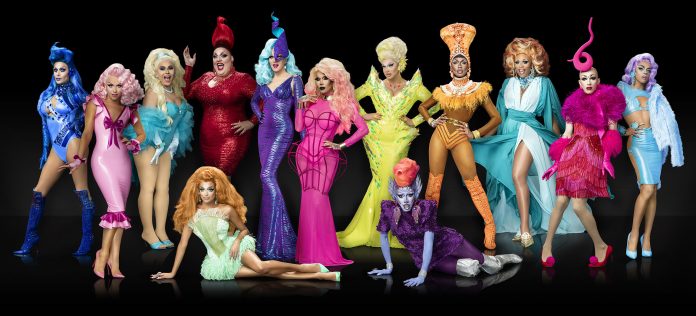
RuPaul’s Drag Race (RPDR) turns 10 and is back with finely orchestrated drama, bigger wigs, and even bigger personalities. RuPaul herself makes big promises about this season being more show-stopping than ever. She is ready to butt into these queens’ lives with sharp observations about their most personal and drag-related flaws, which brings us to the queens of this season.

     RPDR is all about fleshed-out arcs, whether they’re real or not. The season is full of shade, laughs (may I interest anyone in a Miss Vanjie reference?), and underdog arcs. However, it’s queens like The Vixen and Eureka who bring fresh drama to the screens, the former igniting a long overdue discussion about racism amongst the drag community. That aside, many charming personalities make it to RPDR this season, getting the audience cheering for underdogs like Miz Cracker and Kameron Michaels who must face daunting and sometimes confusing challenges.

     When the queens walk the runway this season, we’re witness to many glamorous and lavish looks, with fashion queens like Aquaria dominating the stage. At times RuPaul is a tad more adventurous than her usual gown, but nothing is too notable. As for lip syncs, this season includes a few lip sync assassins like Monet X Change and Kameron Michaels. Only a few queens rely on props to make their lip syncs legendary; most rely on their heart and many, many death drops.
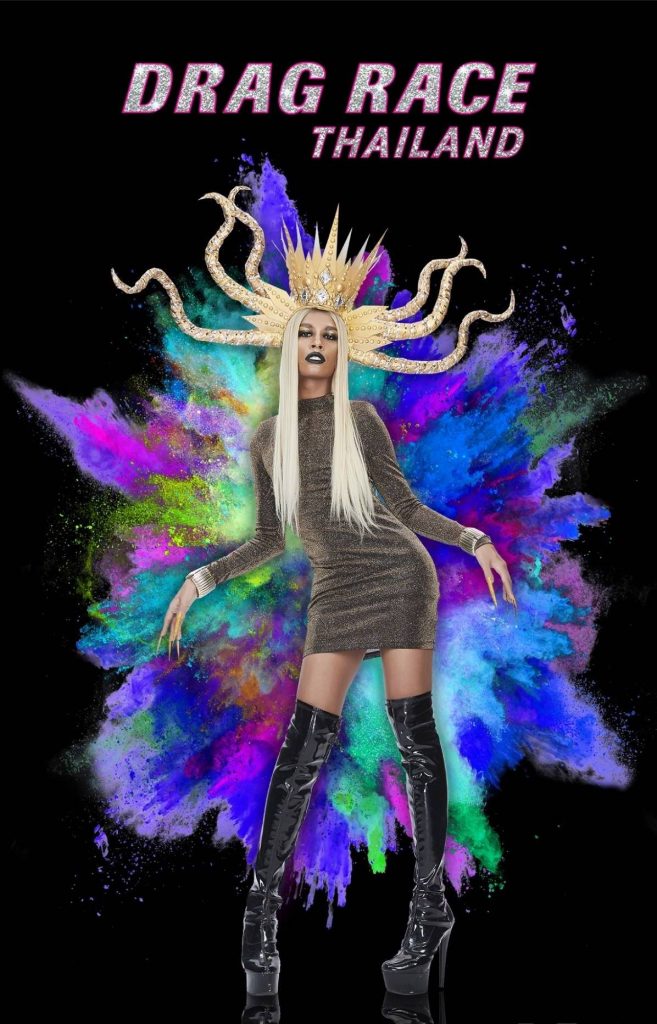
Photo courtesy of Kantana Group

Drag Race Thailand (Season 1, 2018)

Drag Race Thailand (DRT) may not include RuPaul herself, and the production of the show isn’t as stellar RPDR, but the show proves that Asian queens have just as much charisma, uniqueness, nerve, and talent as their American counterparts

     All 12 queens, diverse in both Thai and other Asian languages, are also wildly diverse in body style, size, and looks. A big difference between DRT and RPDR is that two queens are hosting the show. The first is Art Arya, whose background is more grounded on design and style than drag. She’s more subdued that RuPaul and she isn’t bursting with catchphrases, but she’s still always ready with her sharp tongue. The other host, Pangina Heals, is younger, more charismatic, and a seasoned drag queen after winning Thailand’s first drag reality TV show T Battle

     In its first season, DRT does not pull back when challenging the girls. Their first maxi challenge is to create three-in-one looks, immediately raising the bar for RPDR. Looks this season vary wildly, with some queens going for cheap and glamourous and others attempting intricate and lavish. It’s refreshing to see traditional cultural pieces like Jaja’s baro’t saya, and to see even the judges going all out; one of my favourite outfits would be Pangina walking out as a sexy bowl of noodles (no, I am not exaggerating).

     The lip syncs of the season, like the show’s production, vary wildly in quality. The Top 6 performance is a disorienting and messy dance sequence with too many pop ballads. It’s no surprise that Art Arya did a double save and elimination. In the “Dhoom Dhoom” lip sync, one queen, Natalia Pliacam, brought out a literal bag of props, which goes to show that heartfelt performances like Petchara never go out of style.

Verdict:

After almost a decade of RPDR, it’s clear that the show is struggling to top itself, raise its stakes, and keep the audience surprised. RPDR still showcases great personalities with strengths varying from pageant to comedy to looks. There’s more than enough drama to boot. But the drama has gotten contrived.

     The stunts pulled, especially in the finale with a “surprise” three-person lip sync (made especially unbelievable with a song meant for three divas), were anything but surprising, and with more and more queens getting snubbed, the show is losing the same grip it had on audiences like me.

     Drag Race Thailand, however, is a refreshing change of pace in terms of the contestant and judge aesthetics and the challenges themselves. The queens keep your attention with their shady one-liners (Meannie Minaj upon seeing another queen freak out over a win: “Are you that happy? Haven’t you been winning anything in life?”), but drama for the most part is toned down.

     Both shows have their own charm, RPDR with its drama and DRT for its fascinating looks and challenges. But I’m an extra bitch at heart, so I’m inclined to say this season of RPDR with its flaws, shenanigans, charming-as-hell queens, and over the top drama, that, Chantay, you stay.

SFU Connect transitions to SFU Mail on August 18

1
(Screenshot from connect.sfu.ca)
Written by: Srijani Datta, Assistant News Editor


“SFU Connect accounts will be accessible until March 2019.” SFU website / “The new platform will help better meet the current and future needs of the University.” SFU Website.

     Students who are currently using SFU Connect will be transitioned to SFU’s new email account on August 18, 2018. The change was decided upon in 2017, due to the SFU Connect email system updates failing to meet standards.

     The school website states that the goal behind the transition process is “to better meet the current and future needs of the University,” and that this decision was “guided by input from the SFU community.”

     Communications officer Stephanie Stewart told The Peak that, following the decision to phase out SFU Connect, the decision to narrow the focus to a Microsoft email solution was because “Microsoft Outlook is already being used by many members of the University community as their preferred mail client.”

    Stewart continued, “third-party applications and services outside of email and calendar systems are focusing their efforts on integrating only with mainstream email solutions such as Microsoft Exchange, and both Microsoft’s Outlook client and Exchange server are generally regarded as the industry standard solutions.”

     The first part of the transition was initiated and completed for “staff, faculty, sponsored, and resource accounts” on April 28, 2018. The second part of the transition is aimed at all current students and retirees. More specifically, existing students (undergraduate or graduate) with no other active staff/faculty position at SFU, or retirees with no other active staff/faculty role at SFU, are going to undergo this transition in email system.

     Once the new SFU Mail account is activated, all new emails are to be delivered to it, while the older SFU Connect account is slated to be accessible until March 2019.

     Graduate student Isabella Thet Su Aung, whose account was switched in April, mentioned to The Peak that one of her main concerns was regarding moving the existing data from SFU Connect to the new email accounts.

     SFU has announced that migration of data from SFU Connect into the related SFU Mail account will begin immediately on August 18. Within the first 48 to 72 hours, calendars, contacts, and tasks will be migrated to the new account, followed by the most recent 30 days of mail from each mail folder.  

     The initial migration period will be followed by an email stating, “Your initial set of data has been migrated to SFU Mail.”  The email will also contain an estimate of how long it will take for the remaining mail data to be completely transferred. The migration process is supposed to continue until all the data has been exported from the older account to the new mail accounts. Upon completion, each student can expect to receive a message informing them that all their data has been migrated.

     The process to completely phase out SFU Connect, powered by the Zimbra Collaboration Suite, and adopt Microsoft Exchange as the new email platform, is slated to be finished by 2019.

     Stewart confirmed that students will be able to use third-party mail clients, such as Apple Mail and Thunderbird, “through protocols including IMAP and POP. If you currently use these clients, you will be able to continue using them after the transition to the new email solution.”

     Further information regarding the transition can be found on the SFU Mail website.

Pro-tips from a self-declared wine snob

0
Illustrated by Siloam Yeung

Written by: Jessica Parsons

I know that you could never hope to be as sophisticated as me, myself being the wine connoisseur that I am. You have to have a certain palate to be an expert at it (like me). However, here are a few tips to help you impress your friends when tasting wine.

Firstly, begin by swirling it around in the glass and holding it up to your eye, just to make sure it is, indeed, wine. Then, smell it and discover that it certainly seems to be so. When you take a sip, you should slurp it through your teeth as dramatically as possible — this is very important and is something all the fanciest wine tasters do. It lets the wine stain your teeth and shows everyone that you are a sophisticated wine drinker like them (think of it like a calling card).

The actual tasting of the wine is much more difficult and something you must acquire over time, as I have. Here are a few of my latest reviews to help inspire you:

‘93 French Shiraz

This particular wine was too cheap for my sophisticated palate. Firstly, it is a ‘93, and as everyone knows, this means that there are 93 ingredients in this wine (much like the 67 on a bottle of Heinz ketchup) and that is far too many. The more ingredients, the cheaper the wine; this is why the ‘84 will cost more than the ‘93. Some people say they prefer a dry wine and this was definitely a wet wine — moist, even. The Cabernet tasted somewhat like grass (possibly one of the 93 ingredients?) with sour, grape-like notes. I added some ice cubes to it because they clearly hadn’t chilled it beforehand, and this helped slightly, but overall I was unimpressed.

Caraval Blended White (Sauvignon Blanc and Pinot Grigio)

This wine is a slightly higher-class white, as demonstrated by the fact that it is, in fact, two wines and not just one. The flavours of the Sauvignon Blanc (pronounced saving-yonk-blonk) blend wonderfully with those of the Pinot Grigio (pronounced peanut-grishoo) to create a decadent white wine.

Victoria White Zinfandel

I was surprised and appalled when the waiter poured me not a white wine, as I was expecting, but a pink one. I asked to speak to the manager and she told me that a white zinfandel was a rosé. I have never been so insulted! Do they think I am an idiot? An amateur wine taster? It says white right in the name! I left before tasting the lie.

Ricci Pink Sparkling

Often considered among the fanciest of wines, this champagne was certainly sophisticated. Make sure it is in a flute to properly aerate it. I made the mistake of using a clarinet instead of a flute, and the effect wasn’t nearly the same. I found the tastes to be slightly tangy, the same as if you were eating a lemon warhead, and the texture of the champagne to be very bubbly. Overall the Ricci Pink Sparkling wine was a fine champagne.

Are you SFU-ready? Version 1: Busting myths and spreading facts

0
Image courtesy of SFU

Myths busted by: Jennifer Low

Facts provided by: Victoria Lopatka

As you stand at the bus loop, glancing up at Simon Fraser University and trembling before the foreboding concrete maze that awaits you, your mind is plagued by the many horror stories that you were told the moment you announced that “You Are SFU.”

Fear not, troubled and confused students. The Peak’s Declassified SFU Survival Guide is here to help you feel a little less troubled, and maybe a bit less confused. Simply put: most of those horror stories are just stories. But if the legends aren’t true, then what is? We’re here to put the rumours to rest once and for all by separating fact from fiction.


Myth #1: SFU used to be a prison

SFU was never used as a jail, and was never designed to resemble a prison at all. In fact, according to the Archives and Records Management website, its design was created for a competition in 1963 that was held by Dr. Gordon Shrum, who had recently assumed the position of chancellor of the university. You have Shrum to thank for never having to walk through the rain to get to class, and for having all your large lecture theatres in one place rather than dispersed about the entire campus, as these were included in his collection of informal guidelines for SFU’s design. The winning design was created by Arthur Erickson and Geoffrey Massy in a unanimous selection by the judges.

Besides, not everyone thinks SFU looks like a prison. Its design is based on the horizontal structure of the acropolis in Athens and has been featured in many TV shows and films . . . It has served as courtyards, streets, walkways, CIA/FBI Headquarters, government research facilities, alien worlds, hospitals, and a slew of other settings. – JL

Facts:

  • Originally, Simon Fraser University’s proposed name was simply Fraser University, but Les Peterson, the minister in charge of the legislation setting the new university up, didn’t like that the abbreviation would be “FU,” so the name was changed.
  • Arthur Charles Erickson, whose works include the Canadian Embassy in Washington, the Museum of Anthropology at UBC, the MacMillan Bloedel Building and the Vancouver Art Gallery, was the architect who worked on SFU. You may have heard that Erickson designed prisons (an extension of Myth #1), which is false.
  • SFU was nicknamed the “instant university” due to its quick construction and opening. Over a span of roughly two years, the Burnaby Campus was built and ready to welcome its first class of students.
  • In 1969, a heavy snowfall cracked the glass in the roof of Convocation Mall, so the school paid $70,000 to have all the panes replaced with reinforced glass.
  • Many TV shows and movies have been filmed at SFU, including The Day the Earth Stood Still, Spy Game, Agent Cody Banks, The Sixth Day, Personal Effects, Antitrust, Fringe, Battlestar Galactica, Stargate SG-1, Millennium, and The X-Files.
  • Do you know what SFU’s coat of arms looks like? Based on the arms of the Scottish Fraser of Lovat Clan, it includes blue and white quarters, white strawberry flowers, and red crowns. It bears some books, representing education. This coat of arms replaced a previous one bearing crosses, which led students to believe SFU was a private religious institution. Today, SFU is best known for a simple red box with white letters.
  • Many students may not know the university’s official motto: “Nous sommes prêts,” which is a French phrase meaning “We are ready.” This is also inspired by the Frasers of Lovat.  – VL


Myth #2: UBC is better than SFU

Ah, there is no greater rivalry than the one that is revealed in the UBC versus SFU debate. However, this myth can be debunked, as a quick Google search will ultimately reveal that SFU and UBC are both rated as among Canada’s top universities. For this reason, it is often more important to consider the options based on the program that you are interested in.

While UBC has a larger reputation, as it is about 57 years older than SFU, SFU is still well respected. In October 2017, for the ninth time in a span of 10 years, SFU was named one of the top universities in the Maclean’s Magazine University rankings in the comprehensive universities category. According to the article: SFU was ranked as “one of Canada’s top universities for producing research that makes an impact in the real world, and was lauded by Times Higher Education World University Rankings as one of four Canadian schools that excel in tech programs such as engineering.”

Not to mention, SFU (arguably) won the Great SFU vs UBC meme war of 2017. Even UBC had to admit defeat when facing the wrath of SFU’s superior meme skills. – JL

Facts:

  • Of the 4,438 bachelor’s degrees that SFU awarded in 2008–09, the most popular majors were business, education, economics, psychology, communications, criminology, and english.
  • In 1970, SFU became the first university in Canada to implement a computerized registration system.
  • In 2008, the reflecting pond in the Academic Quadrangle was emptied by staff, revealing all the items that had been lost in it over the years. According to The Province, besides about 400 fish, they found “two pairs of glasses, three hockey pucks, a hearing aid, a ‘really boring’ diary, two cellphones, a five-pin bowling ball, some liquor bottles, and a sodden copy of the Thomas Hardy novel Tess Of The D’Urbervilles with an inscription that read: ‘She should have kicked him in the strawberries’.” Though it may not look like it, the large boulder in the reflecting pond in the AQ is actually six tons of Lillooet jade discovered in the Fraser Canyon. That mossy mass is the university’s founding stone. – VL


Myth #3: You’ll make all of your friends during the first few weeks.

In every cheesy rom-com with a college setting and every post-secondary romp flick, it always seems as though the first person the main character meets is destined to become their BFF or soulmate. For normal people like you and I, who reside in the real world and not some filtered TV-screen fantasy, this is not typically the case.

In university, the friends you make in many classes sometimes do not persist into the following semester, which is often when you no longer see one another due to lack of classes together. Having this expectation that you only have one chance to make friends can make you feel frustrated and lonely. Remember that the first day is not always the most important day. You can find friends any day of the year! Sometimes, you just don’t “click” with the first few people you meet. – JL

Facts:

  • When SFU’s first ever pub opened in 1973, beer cost 45 cents and a cup of coffee was only 25 cents. The good ol’ days, huh?
  • As more mothers started attending SFU, a demand for child-care on campus grew. In the summer of 1968, SFU administration “swiftly denied” the request for daycare services, so a group of mothers set up their own. Each mother volunteered four hours a week to watch the group of children in the AQ. – VL


Myth #4: Making friends at SFU is impossible because it’s a commuter campus

SFU is filled with diverse, talented and friendly people, but there is always the concern that SFU lacks opportunities to allow people to meet one another. While it is true that SFU does not have the same volume of students living or staying on campus as other universities, it is possible at any university to simply travel to and from class without engaging in any sort of socializing. It is truly up to you.

Making friends could be as easy as sitting next to someone in lecture, asking someone to be your partner for an in-class assignment, or just saying “hi.” The quality of one’s student experience at any university is dependent on the level of effort you are willing to put in. SFU has an abundance of social events, like the SFSS’s most well-known and anticipated event: the Fall Kickoff. One of the best ways for students to become engaged in their SFU community is by joining clubs. If you’re interested in a specific subject, developing your career, or want to become part of an activism, volunteer, spiritual, sport or hobby club, SFU has it all.

Clubs Day can often be a daunting time for a new SFU student, but the SFSS has got you covered with a fantastic directory of clubs that links students to short descriptions of the club as well as contact and website information. So whether you’re into League of Legends, public speaking, dance or even competitive dragon boating, SFU has a club for that. And if it doesn’t, you can always apply to start one. – JL

Facts:

  • The SFSS oversees about 350 clubs and an additional 50 student unions.
  • According to SFU, the university currently boasts 30 000 students divided amongst the three different campuses. Its alumni count is around 130 000 alums.
  • SFU originally had two student newspapers, The Tartan and The SF View. Each published only a few articles before they merged into a single paper, The Peak, on October 6, 1965. Upon creation, there was no name for this new newspaper, so students were asked to pick and vote on a new name.
  • Since a March 1966 referendum, where students voted overwhelmingly against having fraternities at SFU, frats haven’t been recognized by the SFSS as official SFU organizations.
  • The first-ever protest at SFU was in 1966, over the construction of a Shell gas station on campus. It was coined the “Shift Shell’ rally. I haven’t seen a gas station on campus anywhere, so the thousand students who showed up must’ve made a convincing argument.– VL

Forum raises concern tank farm poses “catastrophic” risk

0
UBC forestry professor Lori Daniels and SFU public health masters student Sally Maquet talk about forest fires. (Cecile Favron / The Peak)
Written by: Cecile Favron, Peak Associate 


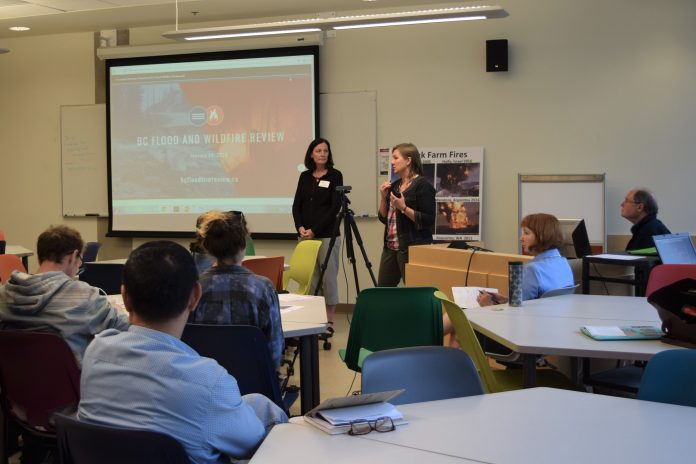
Dozens of concerned citizens gathered to discuss links between the potential for a devastating fire on Burnaby Mountain and the Kinder Morgan tank farm expansion at Simon Fraser University on June 28.

     “The pipeline is proposed to be expanded and that increases the risk of fire on the mountain,” Tim Takaro, event organizer and associate dean in the faculty of health sciences, told The Peak.

     Earlier, Takaro mentioned that the consequences of the expansion would also involve “increased catastrophic risk to the ‎university and community.”

     The Fire on Burnaby Mountain teach-in followed a university wildfire drill held earlier in the week. The drill among responders was the first time the university assessed its new emergency plans for evacuating and/or sheltering on campus.

     “‎They have this drill about forest fires but are not connecting the dots to climate change, the ‎pipeline, and the tank farm risk,” Takaro said of the impetus to hold the event.

     Many speakers at the forum voiced fears that climate change increases the risk of forest fires while the expanded tank farm also raises the possibility that fire or toxic emissions could threaten the university campus and nearby communities.

     SFU chief safety officer Mark Lalonde was in attendance to discuss the wildfire drill and concerns about safety issues stemming from the tank farm.

‎     “This [drill] was an opportunity to test the new mass evacuation and shelter-in-place plan,” Lalonde told the audience. “We’re really ‎happy with it; we know that there are some adjustments to make and that is in progress.”

    Lalonde responded to a number of questions about steps taken by the university to address safety issues around the tank farm and how the institution would respond if a fire blocked the roads to campus.

     “We’ve been repeating [our concerns] with government, all three levels of government, and the ‎National Energy Board, and with Kinder Morgan,” he responded. ‎“SFU remains opposed to anything that challenges the safety and security of our campus ‎community.” ‎

    Lalonde noted that the university is only responsible for the campus and that the municipality oversees the roads and surrounding area. In the event that the roads became impassable, the recreational trails down the mountain would not be a viable route for evacuation, he added.  

     “[This] is why our plan is shelter-in-place and mass evacuation,” Lalonde said. “That would be the reality is that we’re going to have to stay here, absolute worst-case scenario‎.”

‎     “This is one of a myriad of concerns I have about the campus here. This is certainly one of the more ‎significant, it has the most catastrophic potential impact,” he concluded.

     In 2016, a report commissioned by the university found that a fire at the facility “could envelop the university, and block access to and from SFU, thus making an evacuation difficult or impossible.”

     Jaclyn Parks, a master’s student in health sciences who helped organize the event, noted that a lot of students are unaware of the risk and how to respond.

‎     “[SFU should be] very concerned about the risk of a fire on Burnaby Mountain,” Parks said.

     “I don’t think the students have any idea that all of this is happening,” she added. “I don’t even have an idea of what happens if there is an alarm.”

“If there is a giant explosion and a fire, how do we get out?” – Jaclyn Parks, SFU student

     In response to audience questions, Lalonde explained that the university has communicated safety issues through its website and other media, but described educating the public as an “ongoing struggle.”

     He advised that students, faculty, and staff download the SFU Snap app, which will enable emergency notifications to be sent to mobile devices.

     The organizers hope that the event will spark conversation about a lesser known side of the controversy surrounding the Kinder Morgan tank farm and pipeline expansion.

     “We know this forest burns, there are a lot of people on the trails, there is a lot of opportunity for ‎accidental fires to start and we also have this enormous risk of the tank farm” Takaro said.

‎     He hopes that people came away from the event with an understanding of the need to stop the pipeline expansion.

     The Trans Mountain expansion project, intended to double the capacity of the tank farm and triple the capacity of the oil pipeline, was purchased by the federal government last month from Texas-based Kinder Morgan for the price of $4.5 billion.

Jurassic World: Fallen Kingdom is an intense sci-fi adventure thriller

0
Image courtesy of Universal Pictures

Written by: Jonathan Pabico

If you want to take a break from superhero epics for a while, check out J. A. Bayona’s Jurassic World: Fallen Kingdom. Bayona crafts a riveting sequel to Jurassic World that incorporates heart-pounding action and startling originality.

     The action sequences live up to the thrills of previous instalments. These scenes capture the harsh realities of the story’s world with breathtaking visuals and Michael Giacchino’s powerful soundtrack.

     A prominent example is the volcanic eruption at Isla Nublar. Bayona perfectly sets up this sequence: the island’s ancient ruins evoke a peaceful stillness, and the dinosaurs convey glory and majesty. With staggering colours and grim lighting producing believable textures, the island’s compelling awe foreshadows the sorrow from the eruption’s apocalyptic imagery.

     While the film is still an exhilarating dinosaur adventure, Bayona also makes this sequel terrifying through darkness-enshrouded, nightmarish atmospheres at every location. Bayona uses the story’s newest antagonist, the Indoraptor, to create havoc that feeds the characters’ fears and uncertainties. This gruesome dinosaur, complete with a devilish grin and long-reaching claws, makes for a frightening parallel to Freddy Krueger from A Nightmare on Elm Street.

     However, the movie’s stakes and plot points seem at times too similar to The Lost World: Jurassic Park. Because of this resemblance, the climax is less impactful, especially with character choices becoming more predictable as the narrative progresses.

     D. Wong returns as Dr. Henry Wu. While he adds satisfying continuity to the film, his performance is unable to go beyond his character’s usual dynamic of frantically reciting dinosaur facts just to advance the film’s tensions.

     Despite these shortcomings, Bayona and scriptwriters Derek Connolly and Colin Trevorrow make the story original. They employ the film’s corporate underworld as an ominous foreground that expands the narrative’s scope. Through the disturbing happenings there, they continue to explore the Jurassic Park franchise’s overarching moral themes, but also offer an innovative direction. In doing so, Bayona and the film’s writers transcend the series’ traditional staple of dinosaurs running loose and causing chaos.

     The film’s most compassionate relationship is between Chris Pratt as Owen Grady and his favourite velociraptor, Blue. Bayona explores the sentimentality behind this bond through Grady’s memories of raising Blue during the dinosaur’s infancy. These scenes instill a childlike innocence into the film that humanizes Blue and Grady as an unusual, but touching family. Their bond portrays their past as a happier time that differs from the story’s current world of corporate greed and ruthless corruption.

     Overall, Bayona delivers the adrenaline in Jurassic World: Fallen Kingdom. He shapes this film as a worthwhile entry that, together with realistic visuals, captivating music, and impassioned themes, create an impressive sequel to its predecessor, Jurassic World.

SFU’s David Chariandy shares insight into his latest book, I’ve Been Meaning to Tell You, and more

0
Courtney Miller / The Peak

Written by: Courtney Miller

When David Chariandy reached the door to the coffee shop, we made awkward eye contact and dithered between going for a hug or a handshake because, while this was a professional meeting, Chariandy and I had the pleasure of working together as writers just last year in his creative writing classes.

     At the time, he was working on the book we’re here to discuss: I’ve Been Meaning to Tell You: A Letter to My Daughter. The book is a deeply personal letter written to his 13-year-old daughter, “to communicate to my daughter my story about how I’ve interpreted my own experience, and perhaps, in part, [. . .] the experiences of my parents.” He confirmed that his daughter had read the book, and in fact had been integral to the process, providing notes and feedback on individual chapters as well as the whole.

     This then begged the question as to why he chose to publish it as a book. After all, her reading it did not require everyone else to be able to read it, too. His response, thought out between bites of sandwich, is that “I think it’s because of the subject matter, honestly.”

     He speaks, of course, about the current political climate, with racial tensions running high most notably in the US, but also in Canada. His book’s opening scene focuses on Chariandy and his daughter experiencing racism right here in Vancouver, when a woman pushes in front of him, stating, “I was born here. I belong here.”

     After that encounter, Chariandy set out to explain the situation to his daughter, because “within the home, I’m not a ‘visible minority.’” That racial experience would not happen in his own home, to him or his children. “It’s only when I step out into the public eye that I become this thing called a ‘visible minority,’” he explains.

     “We live out the politics of race and belonging in the public eye; this is how these matters operate,” he states. “It simply makes sense to have this message in a public experience as well.”

     Chariandy is no stranger to the discussion of racial politics. His two previous novels, Soucouyant and Brother, “most definitely do draw in very complicated ways from [his] experiences and what [he’s] felt and observed” in terms of race. But he agrees that this book “is really my first effort of this kind of platform to address real life.”

     You can tell that Chariandy took this effort seriously. The gap between Soucouyant and Brother was 10 years, but I’ve Been Meaning to Tell You followed Brother in about a year. “I could not have taken the time with this book as I did with the other books simply because it is very much of the moment. It’s about a moment in a person’s life, my daughter’s life — this book wouldn’t make sense at a later moment.” He jokes lightly about how he couldn’t exactly wait a few years again and publish the letter to his 13-year-old daughter when she was 18 or 30.

     Despite the racial commentary in the book, Chariandy is quick to say that “I don’t know if it’s a moment-in-history kind of reach; that’s not what this book is about. It’s not making grand claims about history or digressing about this social landscape.” He reiterates that the book is about his and his family’s experience; it’s not about the world, but just their place within it.

     He was influenced by the history of black writers, and wrote it to engage with “a legacy of black people writing to their loved ones and attempting to convey what it means to live in a particular moment and what they had learned from living in this particular moment. And then they are able to pass on those lessons.”

     When asked if SFU has influenced his writing, paying particular attention to the time he devotes later on in the book to Indigenous peoples, he needs a minute to think it over.

     “My awareness of how much I, as a non-Indigenous person, had to learn about Indigenous culture, Indigenous struggle, Indigenous art, is shaped by my presence here on the unceded ancestral territories of the Squamish, Tsleil-Waututh, and Musqueam people. And so I don’t think it’s so much SFU, it’s really being here when there’s a powerful presence because of Indigenous people.”

     But he turns it around to explore SFU not as some learning hub but as a community. “I would have to say that even ordinary encounters [. . .] are also sometimes very extraordinary encounters with students and colleagues and people who [ask], ‘What are you working on?’ and we’ve shared words about our writing projects,” he explains. “That’s been inspiring.” So while SFU isn’t really to thank for Chariandy’s growing understanding of Indigenous racial politics, the community that SFU has given him has been “kind and generous” and a “positive influence on the writing.”

     Looking to pass on the positivity, I asked him about any advice he has for budding writers. He’s been asked this before, even in the classes I’ve had with him, and he’s excited to answer it. “I’ve thought about it a lot because I want to offer something meaningful,” he says, but cautions that he can only speak from his own career.

     “If you truly wish to be a writer, then maybe claim that identity and say, ‘OK, well that means that this is my job.’ It’s not something I’m doing kind of in my free time, when I’m not too tired, and also when I’m in a particular mood, waiting for inspiration to hit.” He acknowledges that it’s hard to see and have writing as a profession, because it can be hard to make it or even define what making it really means.

     He says that for himself, “it’s a vocation, a very deep, serious one. Maybe that’s something to reflect upon too: what does it mean to possess that vocation as a writer?” What does it mean to diligently return to the screen or the page, day after day, and power through the work, whether it’s a whole draft within a month, or just a couple of sentences? How do you keep doing it, forcing yourself to do it?

     But Chariandy lands on the crux of the situation almost immediately. “I guess every writer wonders if his or her story matters. If their story matters.” His answer follows quickly, “tell yourself that it does matter . . . hold that in your head during the very difficult process of keeping faith in a project when maybe, at times, you’re not sure.”

     Chariandy is a professor as well as a writer, and he can’t help but ask me about my own writing since I’ve left his classroom behind. I tell him that’s not really part of the interview, but it doesn’t matter. He wants to know, writer to writer, how the vocation is going, if the project I started on is still in the realm of possibility.

     I tell him I can’t be just a writer right now. I can’t claim that identity while I’m up to my nose in homework and jobs that pay an hourly wage. But I tell him I want to keep working at it. Like the sage professor he is, he nods and gives me some encouragements, surprising me with the detail in which he can recall my project from last year.

     He’s not teaching in the fall semester, but he says he’ll be back in January 2019 for anyone who’s looking for a teacher who cares about both the students and the subject. He’s a very thoughtful man, and if you won’t take my word for it, you’ll see the care and attention he devotes to every sentence in I’ve Been Meaning to Tell You.

WHAT GRINDS OUR GEARS: Assholes who hurt my friend’s feelings

0

Written by: Winona Young, Staff Writer

It’s a little bit irrational to get angry at someone you barely know, let alone even met, but God, it’s easy when this someone messes with your best friend’s feelings. Anyone who has a friend with slightly questionable taste in romantic partners can understand my struggle.

You constantly hear about how emotionally inept this person is, and you wonder how it’s even physically possible that this much shit comes out their mouth. Even though you’re 5’2” at best and you know that your opponent can bench-press your weight, you want that shady, smelly, smelly little bitch to go down.

Of course you wouldn’t do anything that violent against your friend’s wishes, but the amount of secondhand anger you feel makes you livid — so much so that you use words such as “livid” like an outraged soccer mom. Although you probably will never confront them, you still dream of the day you can go Samuel L. Jackson on their flat ass and say, “I will strike down upon thee with great vengeance and furious anger those who attempt to poison and destroy my brothers. And you will know my name is the Lord when I lay my vengeance upon thee.”

Pride activism is more than just a rainbow flag

1
(Photo courtesy of Jim Gerhz/StarTribune)

Written by: Winona Young, Staff Writer

What do we remember most from Pride month?

Maybe it’s seeing friends and family post about marches, countless parties, family friendly outings, and all the food and free stuff from corporate sponsors or vendors, etc. But where are the protests?

Nowadays, Pride is a huge spectacle and a celebration — but it is also a social rights movement. With the Vancouver Pride festival only one month away, it’s best that we remember where Pride began. The first Pride parade was held in 1970 in commemoration of the Stonewall Riots, which were first and foremost, a form of protest. Attention to this particular social movement since the twentieth century has increased enormously. This begs the question: how commercialized has Pride become, and what does its commercialization risk?

Pride is now largely commercialized, but not necessarily through the fault of the LGBTQ+ community themselves. With the rapidly increasing commercialization of Pride these past few years, allies and members of the community should remember that despite Pride’s celebratory nature, it was born out of a protest. Thus, we mustn’t forget the necessity of protesting for rights despite the progress made.

The commercialization of Pride isn’t new. As writer Kanti Chhetri for Affinity magazine defines it, “pink capitalism” (also known as “rainbow capitalism”) describes the phenomenon of LGBTQ+ inclusivity used to benefit the capitalist economy. Prime examples included LGBTQ+ bars and nightclubs and ticketed Pride events.

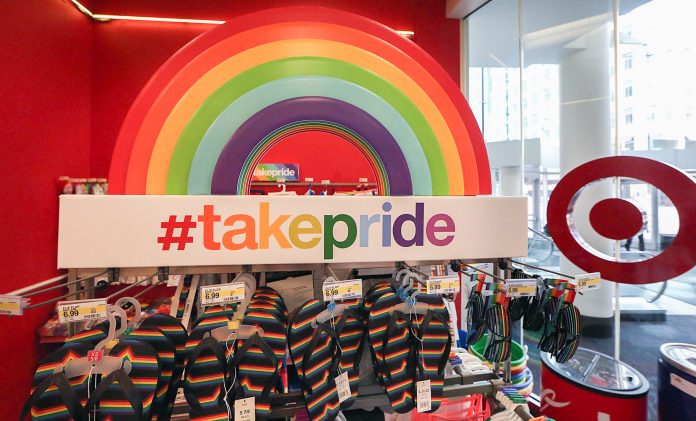
Pink-washing on the other hand, as Vox’s Alex Abad-Santos describes it, is the creation of products centered around a movement (ex. pink items for Breast Cancer; rainbow-coloured merchandise for Pride) to create a supportive image for the community. Companies sell LGBTQ+ products in order to be seen as allies to the community. Think of Facebook sporting rainbow filters, Surrey having a rainbow-coloured crosswalk, and Nike adding a pink triangle to its “BeTrue” collection.

I’m sure such efforts are well-intentioned. If anything, representation of a minority group as the LGBTQ+ community can be encouraging, as it shows support of their struggles. But slapping rainbows on clothing, merchandise, and logos, or tweeting #LoveIsLove, is not automatically activism. We must scrutinize such rainbow capitalism, otherwise, we risk throwing support to organisations who exploit Pride as a marketing campaign or trend.

YouTube, for example, released a Pride video called #ProudToCreate, showcasing the wide range of LGBTQ+ creators present on YouTube. However, YouTube itself is in the midst of a controversy involving discriminatory behaviour affecting LGBTQ+ content creators and audiences alike. The Verge reported that YouTube has been demonetizing and restricting “controversial” videos that are all primarily about LGBTQ+ issues, as well as allowing anti-gay ads within videos.

YouTube stands as a prime example of rainbow capitalism. Just because they dedicate or acknowledge LGBTQ+ creators during Pride month does not mean that they are a good ally.

Mic released a comprehensive list of companies who have released Pride products, including information on how much of the proceeds from the products would be donated and what organisations that were associated with such products.

Such widespread commercialization of Pride is obviously through no direct fault of the community as a whole. However, individuals do hold the power to reassert the political nature of Pride, commercialization aside.

For instance, The Georgia Straight conducted an interview with Vancouver Pride Society (VPS) co-executive director Andrea Arnot about a number of concerns; namely, the legitimacy of corporations being present during Pride parades/events, as well as the legitimacy of the importance of partying over politics.

Arnot told The Georgia Straight that VPS upped the standards for sponsorship from companies. A corporation’s status as an ally of the LGBTQ+ community would be determined by a number of factors like whether or not their company’s values align with VPS, what organizations they are affiliated with, etc., rather than just their advertisements. Arnot demonstrated how Pride can be supported monetarily while still maintaining the integrity of the LGBTQ+ community.

If the commercialization of Pride continues to run rampant, the movement risks preferring less outspoken acts of Pride. No longer would protests — which embody the spirit of Pride — be welcomed. If the community’s message becomes watered down, sanitized, and grossly generalized, progress cannot be achieved.

People within the LGBTQ+ community have been holding alternative events rather than just Pride, like the Dyke March. Vice recently published an article on an interview with Lourdes Ashley Hunter, director of the Trans Women of Colour Collective. They discussed the current corporate-centric nature of Pride. Hunter emphasised that Pride must be centered on “activism.” And Hunter is right.

Inaction, shallow allegiance via rainbow flags, and commercialization of the LGBTQ+ community remains a detriment to Pride’s values and its journey towards rights for all queer people. By shifting away from a Pride that is too commercialized, Pride can remain a movement filled with activism and integrity.