Home Blog Page 606

SFU announces plans for new pub

0
Chris Ho / The Peak

Written by: Amneet Mann, News Editor


October 23, 2018 correction: The original version of this article stated that the committee organized to choose a pub operator, which included representatives from the SFSS, the GSS, and a student from residence, was organized and consulted in the fall 2018 term. This has been corrected to the fall 2017 term.


As early as late November, SFU could be opening a new campus pub.

Set to open in the space that Highland Pub used to occupy, the pub, titled The Study Public House, will be operated by Joseph Richard Group (JRG), a hospitality organization comprised 25 restaurants and pubs in B.C. and Alberta.

In an interview with The Peak, Mark McLaughlin, chief commercial services officer at SFU, described the new pub as a mash-up of a bar and an arcade space.

The Study Public House is part of a larger partnership between SFU and JRG. JRG will also be providing another catering service option, named Blank Canvas Catering, under Meeting Events, and Conference Services (MECS), according to a press release published by the university. Currently, Sodexo is the sole food-service operator available under MECS.

McLaughlin noted that appointing JRG to be the operator of the new pub was a unanimous decision by the search committee.

“They’re very community-minded, professional operators, they have good experience with liquor licensing, they have a good track record,” he said.

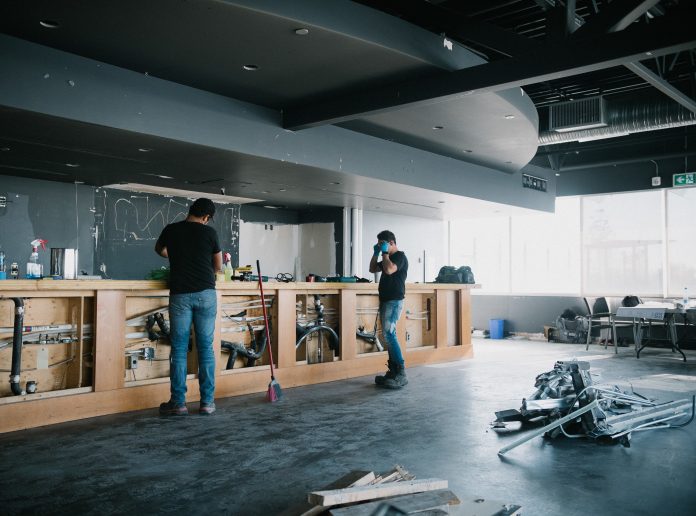
The space is currently undergoing extensive renovations. The bar area, booths, tables, and washrooms are being remodelled. The lower area of the pub space is being outfitted as an arcade which will include vintage pinball machines, shuffle board games, and ping-pong tables.

“It’s an old building — part of the pub has been here since 50 years,” said McLaughlin. “It’s been a lot of work to bring things up to standard.”

Recruitment is underway for The Study Public House — job postings for front-of-house and back-of-house positions have been posted on the job posting website Indeed. Full-time and part-time positions open to SFU students include management positions, sous chefs, line cooks, dishwashers, bartenders and servers with salaries ranging from $11.40 to $18.00 per hour. SFU is planning to release further details regarding future hiring fairs shortly via social media channels.

The new pub’s capacity will be higher than the previous Highland Pub’s capacity. Currently, the capacity stands at 330 individuals indoor and 82 on the patio. The capacity of the patio is expected to increase once the Student Union Building (SUB) opens, as it will add an additional fire exit to the patio.  

The patio will have an area where smoking — excluding cannabis smoking — is permitted.

The pub is projected to be open from 11 a.m. to 1 a.m. seven days a week, although McLaughlin noted that this is dependent on how well the establishment fares. Due to the liquor license, access to the pub will be restricted to students who are at least 19 years old.

“The university feels it’s important that the students and community have a good place to socialize, so this is really what we’re trying to do here — create a great space right in the heart of our campus.” – Mark McLaughlin, SFU chief commercial services officer

Student groups will be able to book pub nights in The Study Public House as was previously done in The Highland Pub. McLaughlin requested that groups hold off requesting pub nights until closer to the opening date of the establishment, and that SFU will be posting more information regarding this closer to that time.

The Highland Pub was closed in April 2017 by the Simon Fraser Student Society (SFSS) citing financial difficulties. In September 2017, SFU took over the former Highland Pub space, the former Higher Grounds Coffee Shop space, and the Maggie Benston Food Court from the SFSS.

The coffee shop was reopened in January 2018 as a hybrid between Higher Grounds and Renaissance Coffee.

“We promised the SFSS we’d get that coffee shop up and running [. . .] that was the easiest option, the fastest way to get it open,” said McLaughlin. “We wanted to keep our options open in case we needed that space as an extension to the pub,” he added.

As the new pub design will not require the coffee shop space, McLaughlin noted that SFU is planning to explore a more permanent concept for the coffee shop space after The Study Public House is opened.

“For sure we want to renovate it and see where we are at that time,” said McLaughlin.

McLaughlin noted that the university is also working on plans to renovate the area ranging from the Junction 65 on campus to the Global Student Center.  The renovations are designed around the core of the SUB set to open in the summer 2019 term.

According to McLaughlin, SFU organized a committee consisting of university administration, SFSS representatives, Graduate Student Society (GSS) representatives, and a student from residence to choose a pub operator for the Highland Pub space in the fall 2017 term.

The committee began by reaching out to current and past partners of the university but “realized they didn’t have the marketing savvy to really make it a big success and create that vibe and energy,” said McLaughlin.

After deciding upon JRG as the pub operator, the process of creating designs for the space, obtaining permits, sourcing new equipment, and now renovations pushed the opening date of the pub to late 2018.

 

SFU men’s soccer clinch their third consecutive GNAC title with win over SMU

0
The Clan are still undefeated with a perfect 13–0–0 record this season. (Photo courtesy of SFU Athletics)

By: Victor Gouchee

For the SFU men’s soccer team, the 2018 season has been one to remember so far. They have begun the season 13–0–0 and are the #1 ranked team in the entire NCAA DII. Their winning streak continued on Saturday as they handled Saint Martin’s University on Terry Fox Field.

The game began slow and nervy, with both teams misplacing passes and failing to find a groove. It didn’t last long, however, as the Clan broke the tie in the 14th minute when senior Mamadi Camara scored his 8th goal of the season. A run down the left flank by SFU junior Rahid Rahiem was capped by a beautiful cross in for Camara, who powered a header past the outstretched Saints goalkeeper.

Just over a minute later, the floodgates opened for SFU as sophomore Matteo Polisi blasted in a rocket from 25 yards out, which skipped by the goalkeeper. The pressure from SFU was too much for SMU to handle as in the 20th minute Matteo Polisi notched his second of the game and conference leading 17th goal of the season. The SMU goalkeeper made a nice save off of an initial shot, then after a mad scramble, the ball popped out to Matteo Polisi, who got a shot through the scrum and found the back of the net.

In less than seven minutes, the Clan opened up a 3–0 lead halfway through the first half — a lead that ultimately put the game out of reach for Saint Martin’s.

Tempers rose near the end of the half, as SFU captain Marcello Polisi received his second yellow on a questionable decision by the referee. As a result, SFU was forced to see out the entire second half down a man.

The second half continued with high tempers, as the game consisted of several late challenges and nine yellow cards being handed out. The game was a more even match in the second half while SFU was short-handed, yet the Clan were still able to muster the better chances. The Saints created a late surge in an attempt to grab a consolation goal, but only managed three shot attempts, with a single free kick from 25 yards out as their lone shot on target. SFU goalkeeper Luciano Trasolini earned his 10th clean sheet of the season while only being forced to make one save throughout the contest.

The victory on Saturday night saw SFU clinch their third straight GNAC title. The clan sit on top of the conference standings with 24 points, while Montana State Billings are in second place on 13 points. The clan are happy to repeat as GNAC champions, but still have their eyes set on the grand prize of National Champions.

What’s next:

The Clan’s season continues next week as SFU will host Seattle Pacific and Northwest Nazarene in their last two home games of the season, both kicking off at 7 p.m. on Terry Fox Field, before finishing the regular season on the road with two matches at Western Washington and Montana State.

Peak player of the game: Mamadi Camara

With a goal and an assist, Camara played a crucial role in the win for the Clan. He leads the GNAC with 12 assists in 14 games played.

Hunt for the best: Sushi edition

1
Photo courtesy of Michelle Chiang

By: Michelle Chiang


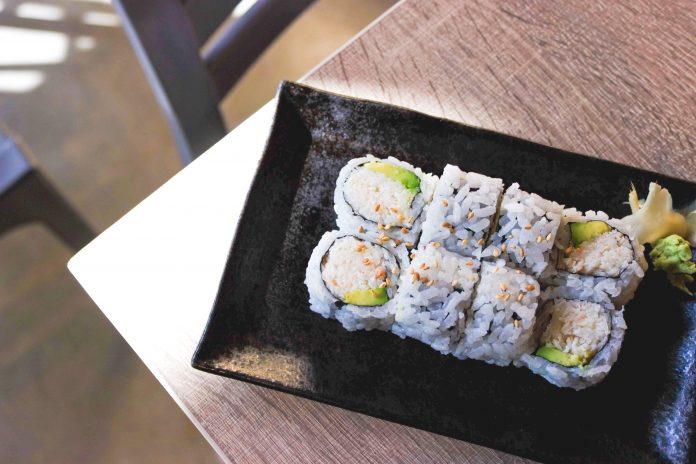
Good food is notoriously hard to find on the SFU Burnaby campus, and given the limited selection of restaurants available on campus, my friends and I decided to go on a journey to find the best sushi place here. To keep the playing field even, we bought the most basic of basic rolls in each location — the California Roll. We looked at price, distance, ambiance, but most importantly, the taste and quality of the sushi itself. So without further ado, let the battle begin.


Spicy Stone

Price: $2.86/roll

Location: 8915 Cornerstone Mews, Burnaby

Walking time from Convocation Mall: Five minutes

Hours: Monday–Friday, 10 a.m.–5 p.m., closed on weekends


My friends and I arrived around 10 a.m. Needless to say, we were delighted at the prices. Coming in at $2.86 per roll, you won’t be able to find a cheaper California Roll on campus.

       The atmosphere was a little muted and quiet, but that may have been because it was still morning. From past experience, I know this location typically plays K-pop throughout the day.

       Spicy Stone doesn’t actually specialize in sushi, so the only rolls they carry are the California Roll and the Dynamite Roll. After we ordered our California Roll, we were all quite disappointed.

        The imitation crab meat was quite dry, tasteless, and oddly textured. What was even worse was that the avocado in the California Roll had been replaced with cucumber. Also their sushi is cut into six pieces rather than the standard 8 pieces which meant that each piece was a little thicker than it should have been and a little bit harder to chew.

         Altogether, Spicy Stone wasn’t bad, but the only plus from this place is how cheap it was.

Rating: 2.5/5 rolls


Togo Sushi

Price: $3.75/roll

Location: 107-9055 University High Street, Burnaby

Walking time from Convocation Mall: Five to seven minute walk

Hours: Monday–Saturday 11 a.m.–8 p.m., closed Sundays


The moment my friends and I stepped into this restaurant, we were greeted with smooth jazz and a well-lit room. While the store itself may not be big, it makes up for it in ambiance and a friendly wait staff.

          The store specializes in sushi, so their selection is vast and covers a wide range of rolls. We ordered the California Roll at $3.75 per roll — not super cheap, but not crazy expensive either — and received it in record time, likely due to the early hour.

       The sushi itself was delightful and chewy! In terms of the rice-to-filling ratio, the rice was a little sparse, but the filling was wonderfully moist and the avocado gave it perfect creaminess.

         Customers also receive complementary tea, making for a wonderful location to just sit and chat with friends. This place is the farthest from the centre of campus, but if you’re willing to make the trek, it’s absolutely worth it.

Rating: 4.5/5 rolls


Mackenzie Café Sushi

Price: $7.19

Location: Mackenzie Café

Walking time from Convocation Mall: One to three minutes

Hours: Monday–Friday 7:30 a.m.–8 p.m., closed on weekends


Mackenzie Café is located smack dab in the middle of the Academic Quadrangle and the atmosphere inside it reflects the outside. It’s usually crowded and noisy, especially at 11:30 a.m., which was when my friends and I bought our food.

          Mackenzie had the most expensive roll to date, coming in at a whopping $7.19 for a single roll. The variety at the sushi bar wasn’t great as well — there was only one other sushi roll available at the time.

          After opening the lid, my friends and I immediately spotted two of the eight pieces contained avocado with prominent brown spots. Immediately, this turned my stomach and I found myself losing my appetite.

          The sushi itself wasn’t bad. It had very good rice-to-filling ratio and just enough chew. However, the taste does not justify the price or the quality. Do yourself a favour and get two rolls at a different location with the money you spent here.

Rating: 2/5 rolls

SFU Grappling Club is back and as strong as ever

0
SFU Grappling Club now offers opportunities to compete. (Photo courtesy of SFU Grappling Club)

By: Michelle Gomez

Ever wanted to be a pro UFC fighter? You can get started with the SFU Grappling Club. The club was resurrected a few years ago by co-presidents Jonathan Ha, Emmanuel Hung, and Solomon Yu after years of inactivity. Determined to raise interest in the sport at SFU, the Grappling Club offers practices, group workouts, and as of last week, chances to compete.

Jonathan Ha explained in an interview with The Peak that this time around, they’re focusing on recruitment and social media. They want to get the word out and get people to try it. Furthermore, their practices are more structured than they used to be, often with a specific focus – though still relaxed, Ha notes. They have also started to compete, attending their first competition on Sunday, October 14.

But what exactly is grappling? According to SFU Recreation, “grappling refers to techniques, manoeuvres, and counters applied to an opponent in order to gain a physical advantage.” It is a general umbrella term that refers to many different disciplines, including “Judo, Brazilian Jiu Jitsu, Sambo, Wrestling and Catch-Wrestling.”

Ha explained that the SFU Grappling Club focuses on styles that do not involve striking or hitting. All of the grappling techniques they practice are low-risk and low-injury, and participants can tap out whenever they want. Ha explained that since striking is not allowed, their practices mostly involve positional techniques, arm locks, leg locks, and chokes.

The Grappling Club holds two one-hour practices twice a week. They host classes with different focuses, including both sport-based and self-defence-based grappling, with the goal of teaching members a wide range of the sport. Students can sign up to join the club at the recreational office to, and can attend as many or as few classes as they wish.

Ha also noted that classes are completely open to SFU students of all levels, and that “most of our students are completely new to the sport, and more often than not they end up really liking it and going to other gyms outside of SFU.” They also host viewing parties for big UFC fights, as well as group workouts.

The competition they attended last weekend was the AVA Combat Classic competition. While participants must enter as individuals, the Grappling Club goes together and supports each other as if they were on a team.

Ha noted that aside from being a fun sport, grappling is a useful skill that can be applied to real life.

“We want to show people it doesn’t matter how big or strong you are… it’s all about technique,” he said. “It can be really practical in real life situations where self-defence is needed. A lot of people have come up to me afterward telling me how much more confident they feel after learning the sport.” In other words, you don’t necessarily have to have the body type that is commonly associated with wrestlers to excel at grappling.

For the future of the club, Ha wants to spread the word and get as many people to try it as possible. He says “anyone who is slightly interested should check out videos or just give it a shot for one semester.” He noted that he has seen a lot of people who have never done anything like it before but get hooked after a few lessons.

You can find out more information about the grappling club on their website, or email them at [email protected].

The beauty standard for fairer and lighter skin in India has grown deep and unfair

1
Illustration and photo by Waseka Nahar and Zainab Anwar, images compiled/edited by Sanya Jain / NDTV

Written by: Jasleen Bains, SFU Student

I grew up watching light-skinned Indian actresses and models on television, believing that my darker skin made me subordinate. Comments I received throughout those years — don’t play outside in the sun too much; lather up with sunscreen so you don’t get a tan — seemed harmless. However, I see now that many of these comments were deeply rooted in the cultural norm of colour shaming.

The preference for light skin is one that numerous women internalize, especially in India. There, skin-lightening products such as Fair and Lovely, designed to whiten one’s skin, form the make-up of a thriving industry worth over 400 million dollars.

The fruits of this industry teach us to desire fair skin, to treat it as superior, and we learn these underlying lessons at a young age. It’s hard for us to do otherwise when the advertisements play continuously, writing a narrative of successful light-skinned women who navigate and succeed in a harsh, Indian society.

I was neither born nor raised in India. But I’ve felt the impacts of this colourism thousands of miles away, and I’m frustrated at how it continues to be enforced. It’s become an obsession, and India considers success to be unattainable without a pale complexion.

These false notions of beauty are not just a marketing ploy; they tie into India’s colonial legacy and British imperial rule. Historically, lighter-skinned Indians were viewed as closer to the white elite and therefore more valuable. Over the years, this notion became an evident, lasting trend in Indian society, and now, lighter-skinned women dominate the socio-economic sphere while those with darker skin are shamed as inferior.

This issue is often unnervingly subtle, and it’s encouraged by the childhood comments, the advertising campaigns, and the endless light skin on television. It pushes the myth of light-skinned superiority as reality, while pushing consumerism as the solution. It’s nothing short of disheartening.

Recently though, a wave of body-positive messages and activism has spread across the globe. A Bangladesh-based artist, Waseka Nahar, recently released a piece of artwork depicting a darker-skinned woman with a tube of face cream that read Dark and Lovely, a play on Fair and Lovely. The digital art was a reinterpretation of an Instagram photo taken by Pakistani-Canadian artist Zainab Anwar. This illustration, a captivating and empowering commentary on colourism in India, went viral.

Anwar and Nahar have both described their negative experience with this skin-lightening industry, stating how their relatives would push fairness creams onto them continuously. They hope that their work pushes back against the obsession with light skin. The new generation is, as Zainab puts it, “fed up of illogical beauty standards.”

The narrative that fair skin is more desirable needs to be eradicated, and establishing this is part of the ongoing process of decolonization. Throughout history, colonization has programmed societal structures to assimilate groups of people and remove any sense of individuality one may have. Now, we need to fight and erase oppressive Eurocentric ideals of beauty.

Do not conform. Honour your skin. Celebrate it with every fibre of your being. I plan to do this through unapologetically hitting the beach to enjoy the sun soon as summer rolls around, and disregarding any person or company people who want me to feel guilty

Album Reviews

0

By: Ethan Woods and Kitty Cheung


Indigo by Wild Nothing

Returning with his fourth LP, Indigo (2018), Wild Nothing still proves to be a driving force in the realm of dream-pop and alt-rock. Even if it’s been eight years since Wild Nothing’s first album, Gemini (2010), long-time fans can still recognize his sound with Indigo but with the changes he made to his sound, this album brings him in a new direction as an artist.  

       Indigo sounds more refined than Wild Nothing’s signature dorm-recorded works; upon first listen, long-time fans may be disappointed by the lack of lo-fi sound. This change, however, isn’t necessarily bad. The album soars right away with its opener “Letting Go,” and the quality carries itself through every song, hitting peaks with “Wheel of Misfortune” and “Canyon on Fire.” However, Indigo sadly doesn’t contain the same lyrical depth as albums like Gemini and 2012’s Nocturne.

       Even though the lyrics may not strike as deeply as previous works, Wild Nothing is dipping into a realm of higher musical fidelity, which makes me eager to hear upcoming releases. – EW


Room 25 by Noname

Room 25 is a beautifully affected album filled with introspection and depth. With a background in spoken word poetry, Noname continues to rap elegantly in Room 25, interweaving intelligent social observation with poetic devices with a graceful flow.

       Soft-spoken yet powerfully articulate, Noname’s creative music is astoundingly intimate and vulnerable. One track of hers which is particularly memorable for its sentimental subject matter is “Don’t Forget About Me.” The song exhibits Noname’s self-awareness as an artist with lines like “You title email ‘Noname thank you for your sweet Telefone / It saves lives’ / The secret is I’m actually broken.” The bars hit especially hard as she compares her art’s impact on fans to her own flawed state.

     This album delicately fuses neo-soul and jazzy inspired beats. “Blaxploitation”, a track named after the film genre from which it draws its funky soul influence, directly critiques the damaging nature of black stereotypes. The cinematic, orchestral production of “no name” draws the album to a moving close, with Noname exploring her identity as an artist.

      The album also contains features from up-and-coming artists. Ravyn Lenae lends her sultry soprano to “Montego Bae,” and rappers Smino and Saba join in for a smooth collaboration on “Ace”.

      If you like chill hip-hop, and want to be moved by deft and nuanced lyricism, “Room 25” is the poetic album for you. – KC


Club Sofa LP by Club Sofa

  Following numerous shows over the past year and a half (-ish), local Vancouver surf-rock band Club Sofa has released their debut self-titled LP. Across its eight songs, Club Sofa LP proves itself to be a brilliantly relatable and fun album; powered by each member’s individual performance.

           It’s interesting to hear the difference in sound compared to the live versions of these songs. While the live performances are generally higher octane, the studio-recorded versions carry the exact same energy and identity; each song is so individually recognizable and carries itself perfectly from start to finish. Lead singer Payton’s vocals glide powerfully across the album, especially in moments like the final chorus of “Beach Bum Baby,” and lead guitarist Dom’s skills provide unbelievably catchy riffs. Alongside them, bass player Jas creates a powerful backbone for each track, and drum player Jess powers the rhythm and atmosphere. Club Sofa’s debut LP has most definitely told us they know how to make a quality album, and I’m interested to see what lies ahead. – EW

What grads do: The fascinating culture and economy of sneakers

1
Photo courtesy of Michelle La

By: Youeal Abera

Michelle La, a master’s student studying anthropology at SFU with a focus on economic anthropology, is one of the most intriguing academics I’ve ever met. Researching the explosive subculture of the sneaker industry, Michelle studies the rapidly expanding economy surrounding it. Whether she’s analyzing the social processes that get people lining up for new shoes, keeping an eye on nuanced, widely coveted brands, or diving deep into the racial history of the industry, Michelle has become exceptionally versed in sneaker culture. I had the privilege of sitting down with Michelle to discuss her exciting research as an MA student.


P: Can you tell me a little more about the research you are currently conducting?

ML: I study sneaker enthusiasts, a.k.a. sneakerheads. I study the economic practices and methods people engage with in this informal economy. I also analyze the physical and digital spaces in which sneaker enthusiasts partake in their economic activities.


P: As an anthropology student, what prompted you to select the idiosyncratic world of sneakers?

ML: Firstly, I chose to focus on this field of research because, to my knowledge, no one has written about it yet. My first love wasn’t the social sciences; my first love was fashion. I wanted to ask important questions about cultures, and, through my research, I wanted to make the familiar strange and the strange familiar. In terms of the sneaker world, I wanted to use my research to help understand the individuals within its culture.


P: What have been some of the most notable events you’ve experienced within your research?

ML: What’s interesting is that, depending on the city you’re in, what’s considered “desirable” in  the sneaker market varies. Whether you’re in Vancouver, Toronto, Los Angeles, or Paris, the taste or demand in sneaker brands will be nuanced.

I remember being in LA during February of 2016. I was in a line-up on the release day of an Adidas Ultra-Boost drop. However, on that same day, there were a new pair of Jordans being released. So, as I was lining up in front of the LA sneaker shop, Undefeated, I suddenly became confused because I couldn’t believe that people in this long line were waiting for different sneakers. I’ve never been in a line where that happened.


P: Do you ever face pretentious attitudes from other anthropologists regarding your research?

ML: First of all, I usually get a “Whoa, I didn’t know this market existed!” So, that’s funny.

I presented at an economic geography conference at a university in Kelowna this past summer. This was in front of a group of prestigious economic geographers. I was one of the very few women of colour in attendance, and I’m heavily tattooed as well. I was fairly nervous.

One of the best comments I received came from a man in attendance. After my presentation, he told me that “my research troubles economists,” because my research challenges the idea that the marketers and companies solely determine what’s of value. My research shows that sneakerheads are so engaged within the determining of what shoes are or aren’t hot, so it challenges the old norms in which economists usually abide within.

So sure, people are surprised when I first tell them what my research is based on. There’s skepticism at first, but once I explain what my work is and what’s important about it, they grow more intrigued.


P: Have you ever felt jaded in the sneaker-world simply because you’re a woman?

ML: I think so, but not just for being a woman. I’m a particularly young-looking woman. I am young. I’m a woman of colour. I’m in an industry that’s quite male-dominated.

A peculiar type of sexism I experience in the sneaker game is when guys try to impress me with unscrupulous behaviour. They don’t see me as an economic threat. While conducting research, I’ve had guys try to flirt with me. A lot of guys grow surprised when they find out that I know a lot about the sneaker culture.

I think my race plays more of an influence on how I’m treated in this industry. I think that perhaps if I wasn’t a person of colour, maybe some people would have been more forthcoming with sharing what they’ve observed, themselves, in the sneaker culture. However, for the most part, I’ve been respected.


P: Sneaker culture was manifested from the hip hop culture, which in turn was created by Afrocentric people. As the sneaker culture becomes progressively mainstream, do you think people should fear it becoming whitewashed?

ML: I don’t know if I have enough data to fully support this, but the research I now have suggests that the sneaker culture is a commodification of black masculinity. If you go to the culture’s history, it emerged from the Afrocentric neighbourhoods of New York. At its genesis, the culture helped Black boys express themselves and present their identity.

Now, with the sneaker culture’s biggest trendsetters (like Kanye West and A$AP Rocky), Blackness has been associated with what’s cool, edgy, and deviant. I don’t think people understand that it’s Blackness that’s made the sneaker culture “cool.”

Since the commercialization of the sneaker culture, blackness has been appropriated. Therefore, the sneaker culture has already become whitewashed.


P: What’s the most imperative realization you’ve made in your research?

ML: I think the most important thing, both inside and outside of my discipline, is that we need to stop looking down on millennials because the way we’ve found ways to monetize and create communities, platforms, and channels in this economy is truly spectacular. Typically, us millenials do get a lazy reputation. Hopefully, my research challenges this pre-conceived notion that’s been placed on us.

As she continues to discern the unique aspects of the sneaker culture, Michelle provides more insight into both the social constructs and buying and selling processes sneaker-heads partake in. Her work is an excellent reminder that the amalgamation of individuality, creativity, and hard work that makes us all up has a place in the world of academia. More information on Michelle’s research of the sneaker economy, and culture, can be discovered on her website: https://www.mla.space/sneakers/ .

World News Beats

0

Written by: Nathaniel Tok, Peak Associate


Kim Jong-un to invite Pope to visit North Korea

North Korean leader Kim Jong-un will reportedly invite the Pope to visit North Korea.

South Korean President Moon Jae-in is expected to extend a formal invitation to the Pope on behalf of Mr. Kim, as part of North Korea’s outreach efforts, next week during Jae-in’s Vatican visit. North Korea does not currently have a diplomatic relationship with the Vatican. No Pope has been to North Korea, but Kim Jong-un’s father Kim Jong-il reportedly invited Pope John Paul II to visit in 2000.

The Vatican has not commented on whether it would accept or reject the offer.

With files from Australian Broadcasting Corporation News and The New York Times.


Sierra Leone scraps plans to build airport with China

Sierra Leone has scrapped plans to build a $400 million Chinese-funded airport near its capital, Freetown.

Sierra Leone’s aviation minister, Kabineh Kallon, said in a statement to BBC News that the airport was not needed presently. Instead, the current international airport would be renovated with a possible bridge built to help connect it to Freetown, mentioned Kallon.

China’s ambassador to Sierra Leone, Wu Peng, said to BBC News that he did not see this event affecting future ties between the two countries.

The former president of Sierra Leone, Bai Koroma, had agreed with China to build the new airport before the former lost elections in March. China is the largest infrastructure project financier in Africa today.

With files from BBC News.


Singapore airlines reinstates longest commercial flight

On October 11, Singapore Airlines reintroduced their 16,700km Singapore-Newark flight, which is now considered the world’s longest commercial flight. The flight takes over 17 hours, flying to New Jersey over the Arctic.

The airline had cancelled the Singapore-Newark route in 2004 due to high fuel cost. Ultra-long-haul flights such as this one are now possible due to more fue- efficient planes such as the Airbus A350 and Boeing’s 787-Dreamliner. This cuts down on travelling time, which customers favour.

No economy class seats are available as the planes are outfitted with only premium-economy and business-class seats.

With files from The Straits Times and Global News.


Worldwide C-section rates undergo dramatic increase

A group of studies published in The Lancet has found that the number of caesarean sections (C-sections) performed worldwide has increased almost twofold, from 16 million in 2000 to 29.7 million in 2015.

Researchers believe that 21% of births globally are through C-section. A C-section is a surgical procedure used to deliver a baby through the abdomen and womb. The World Health Organization has called for a reduction in unneeded C-sections and greater access for women who need it. C-sections generally carry greater risk for mother and child relative to a vaginal birth.

About 26% of deliveries in Canada occur via C-section, compared to about 32% of deliveries in North America overall.

With files from CTV News and BBC News.


Album versus Album: Arctic Monkeys

0

By: Kim Regala, SFU Student


 AM (2013)

Electric guitars, heavy drumming, and Alex Turner’s mesmerizing vocals — Arctic Monkeys had all of the ingredients to create one of their most flawless albums, AM. Almost every song is arguably a hit: from “Do I Wanna Know?”, which features a memorable guitar riff, all the way down to the more affectionate sound of “I Wanna Be Yours.” The album is a cohesive collection with a clear rock-and-roll influence, blending just the right amount of headbangers and slow ballads. Without a doubt, AM is one of the most recognizable albums to date in the indie rock genre.


Tranquility Base Hotel & Casino (2018)

A complete contrast to 2013 Arctic Monkeys, Tranquility Base Hotel & Casino channels more of a cocktail-lounge vibe. The band takes a very experimental approach, leaving their electric guitars behind to favour retro keyboards. There is a definite David Bowie influence, especially in songs like “Star Treatment” and “Four Out of Five” that are rich with motifs of outer space. However, the intricate and unfamiliar verse patterns in each song are hard to follow, so at times, you might find them more confusing than enjoyable.


Verdict

An album like AM is a hard act to follow, and the release of Tranquility Base Hotel & Casino makes that clear. While I’m all for bands growing and changing their sound, it takes a particular type to appreciate the complexities in their 2018 album. AM, on the other hand, is packed with catchy tunes that no fan of indie rock could resist.

My study spot

0
Michelle G's study spot

By: Michelle Chiang, Michelle Gomez, Jennifer Low, Natasha Tar, Nathaniel Tok


Michelle C’s study spot

My favourite study spot is a quaint café and bakery called The Coffee Bun. Located in Coquitlam, a mere five-minute drive from my house, the café has just the right ambiance to study in. Their décor leans towards the natural side, with lots of wood tones and artificial greenery running throughout the store. Typically, there are only a couple of other patrons around when I arrive in the morning, so I can usually steal my coveted seat at the long table with the leather cushioned chairs.

I like to order a London Fog and their signature coffee bun before settling down. It’s here where I do most of the grunt work for my essays. With my planner and pens on one side and my food on the other, I get to typing out my first drafts. I don’t usually spend more than two or three hours there — that’s about how long it takes for me to finish that cup of coffee — but for those hours, I am absolutely focused. I’m able to get more done than I would spending an entire day at home. Not bad for six dollars.

– Michelle C


Michelle G’s study spot

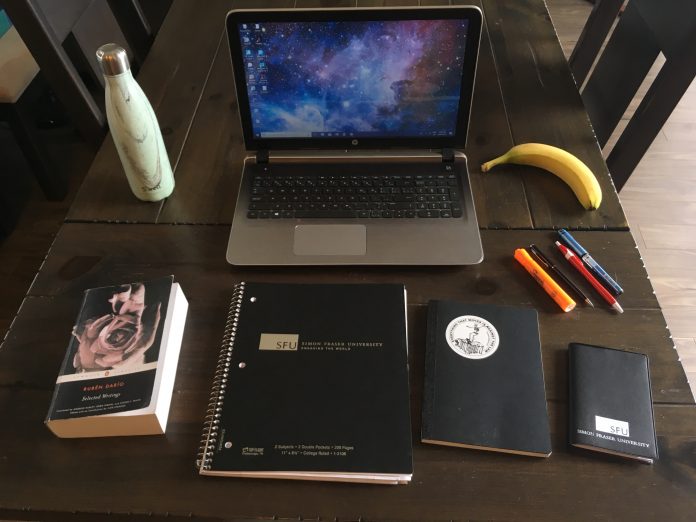
I always like to study in an area that is quiet and full of light. There can be background noise as long as it’s nothing too distracting, like single voices — it’s too easy to accidentally eavesdrop and lose my focus. I like to have my laptop, my notes, my readings, and a variety of colored pens and highlighters laid out, so that everything is within reach. I keep snacks on hand to so that I don’t forget to eat while I am in the zone.

Note that my phone is purposely missing from this photo (and not just because I used it to take the photo). I hide it either in my backpack or in my basement if I’m at home. It’s just too tempting to constantly check on my texts and social media if it is sitting in front of me.

– Michelle G


Jennifer’s study spot

With a shelf lined with some of my favorite book series and a windowsill of succulents and cacti that I haven’t accidentally murdered yet, my desk is one of the places where I study the most often. It showcases my love of organization through my collection of whiteboards and planners, which I update on a daily basis.

My study routine usually begins with turning on some music and sitting down to quickly update my planner and whiteboard calendar. Often times, if I am feeling stressed, I will use my larger whiteboard to create a prioritized list that I call my “battle plan.” This helps me organize how I will get through the next week.

Before I get to work, I also have a collection of Darth Vader magnets that I use as a little mood tracker which I like to update. My most recent Dollar Tree visit yielded the three whiteboard magnets with the headings “Don’t Forget,” “To-Do,” and “When I get to it…” which I really like using to help plan out my study session.

– Jennifer L


Natasha’s study spot

My preferred study spot is calm and isolated. I know most people go to the quiet floors of the library for spots like this, but ever since I looked on the ground beside one of those library desks and found a pile of nail clippings, I haven’t been the same.

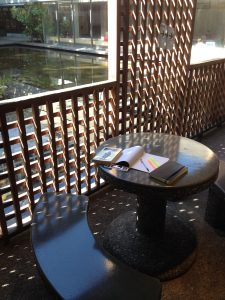
My favourite study spot is at the stone tables and benches beside the Robert C. Brown Hall, under Images Theatre. Although it’s cold in the fall and winter, the benches and tables are clean and protected from the rain. Even when the weather is nice, I don’t usually see people at this spot, maybe because the benches are frigid and literally rock hard. I usually take a coffee with me to fend off the chill, along with my planner, papers from class, and highlighters.

I take notes or draft out essays there because it’s easy to stay focused on boring tasks. There’s a little pond beside the area and it’s relaxing to watch the pond skaters and dragonflies when you’re taking mental breaks. However, there’s a room for tutorials right across from it, so bored students will probably be watching you.

– Natasha T


Nathaniel’s study spot

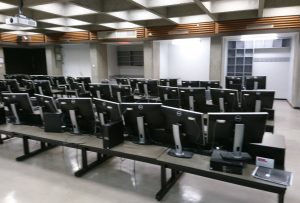
One of my favourite study spots is the basement computer lab, on the second floor of the SFU Library at the Burnaby campus. Being sort of below the surface, it’s sometimes overlooked by the other students, so it can be quieter than other places and it has more space available.

There are widescreen dual monitors for the Windows computers there, which I find easier to study with. There are also lots of charging ports, which is handy because my phone’s battery drains pretty quickly. The basement feel of the place also comes in handy during summertime since it’s a little cooler, and sometimes it even has air conditioning running. The second floor is also not a silent floor, so you can study with friends.

As for how I study, I usually have a physical copy of a textbook or the assigned readings in front of me, and then have note-taking software and lecture slides or notes open on two computer screens. I usually highlight important stuff in assigned readings and write important points from lecture notes by hand, since that helps me to remember things better. That way, when it gets closer to exams, I can study off my handwritten notes and highlights.

– Nathaniel T