Home Blog Page 600

World News Beats

0

Written by: Nathaniel Tok, Peak Associate


China unveils massive sea bridge

Chinese President Xi Jinping opened the longest sea-crossing bridge in the world, connecting Hong Kong and Macau to Zhuhai in southern China.

The bridge, spanning over 54 kilometers and featuring an undersea tunnel, took almost 10 years and $20 billion dollars to build. As the bridge reduces travelling time in the critical Pearl River delta manufacturing hub, China hopes it will help grow the economy.

While China views the bridge as a mark of national pride and “China’s engineering prowess”, Claudia Mo, a Hong Kong democratic politician, pointed out that the bridge’s practical use is outstripped by political significance. Mo stated that the bridge can be seen as reminder of their connection from China to Hong Kong.

This bridge comes a month after a new Hong Kong-China railway was finished.

With files from NBC News.


2400-year-old shipwreck found in the Black Sea

A 23-meter-long Greek merchant ship, from more than 2400 years ago, has been found in the Black Sea, 80 kilometers from Burgas, Bulgaria.

The ship, including its rudder, rowing benches, and cargo, was found 2000 metres below sea level, but it was unusually well-preserved because it was submerged in oxygen-free water. It is believed that the ship was one of the several ships tracking between Mediterranean and Greek colonies, on the coast of the Black Sea.

The British-Bulgarian team which found the ship hopes to keep studying it to see what it can reveal about technology and trade in the region during that time period.

With files from BBC News.


AI-created art sells for $432,500

A painting called “The Portrait of Edmond Belamy” created by artificial intelligence (AI) was sold at Christie Auction House for $432,500 to an unknown buyer.

According to Christie, the painting, which depicts what appears to be a French churchman, was the first painting created by AI to be sold. The selling price beat Christie’s estimate of around $7,000 to $10,000 by over 40 times.

The French art collective known as Obvious, who were behind the painting, stated that they had used an altered version of code from artist Robbie Barrat to make the painting. This has led other AI artists to call the painting unoriginal.

With files from USA Today and The New York Times.


New antibiotic in development

Pharmaceutical company Shionogi Inc. has made a new antibiotic named Cefiderocol.

When infected, the human body creates an “iron-poor environment,” according to Dr. Simon Portsmouth, and the affecting bacteria try to counter this by increasing their intake of iron. Cefiderocol drug acts like a Trojan horse in this situation, as it binds to the iron which the bacteria uptakes. The antibiotic then kills the bacteria cell from the inside.

The drug has shown promise in clinical trials involving 448 people with kidney or urinary tract infections.

New antibiotics are difficult to develop and antibiotic-resistant bacteria make infections hard to treat. Antibiotic-resistant bacterial infections could kill 10 million people each year by 2050.

With files from BBC News.

Director Joel Edgerton tells all about his process adapting the memoir, Boy Erased, to film and more

0
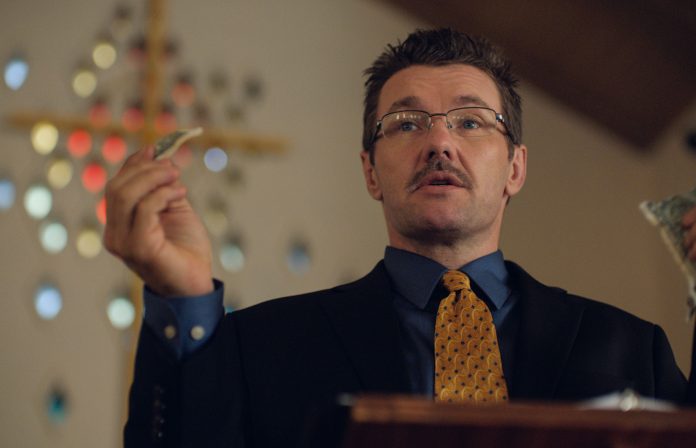
Photo courtesy of Focus Features

PC: Joel Edgerton stars in Boy Erased as head therapist, Victor Sykes


Until June 6, 2018, gay conversion therapy was still legal in Vancouver. While many may think gay conversion therapy couldn’t possibly still exist, shake their heads at the concept, and exclaim, “It’s 2018!”, it remains a reality for people in Canada and America.

        In Joel Edgerton’s new film, Boy Erased, Edgerton does not pull back on helping expose the brutal horrors, pain, and sorrow that befell a 19-year-old Jared Eamons. The Peak sat down with Joel Edgerton, and talked to him about his movie, his process in filmmaking, gay conversion therapy, and more.


PART I: The film’s origins

Boy Erased centres around the protagonist, Jared (played by Lucas Hedges), a young gay man who was outed, to the dismay of his religious parents,  Marshall (Russell Crowe) and Nancy (Nicole Kidman). Determined to “help” him, Jared is enrolled into a gay conversion therapy program entitled, Love In Action, prepared to “rehabilitate” him through group therapy, exercises and more.

     “LIA had places throughout America,” Edgerton explains, “it was under the banner of a place called Exodus International.”  As noted by the Huffington Post, Exodus International was one of the most widespread gay conversion therapy programs in the 70s, and both American and Canadian churches helped fund it.

      While the names are slightly altered in the film adaptation, the film is based off of Garrard Conley’s memoirs of the same title. Edgerton spoke of how the memoirs dealt primarily with Garrard’s therapy, but as the story unfolds, themes centering on a conflicted family are revealed.

      “I found it was drenched in irony,” Edgerton said, “And yet also drenched in empathy. Irony, because none of it should even exist in my liberal opinion, and yet it does.”

      But one of the most chilling aspects of the film, Edgerton reasoned, was not one of the obvious suspects, like the therapy or the pain Jarred endured.

      “I think the most terrifying subtle thing about this film is that everybody was trying to help Garrard,” he said. “And Garrard didn’t need any help.”

PART II: Edgerton before Boy Erased

While Joel Edgerton both directed and helped write the screenplay for the film, he is most well known for his acting career.

      When it comes to acting, and especially for choosing a role for himself such as Victor Sykes, head therapist of LIA in Boy Erased, Edgerton looks for something either relatable or complicated in a character.

      “On a macro scale, I hope that the film has some kind of nutritional value, that it’s not just flimsy or silly . . . I always want something to be taken away,” he said.

      And with a contentious topic such as gay conversion therapy, Edgerton was fascinated with Garrard Conley’s story since he read it.

      “It just felt like someone needed to make a movie of Garrard’s book, and I became so obsessed with it, I ended up putting my hand up to do that,” he explained, “and I’m very happy that I did.”

      Edgerton believes  this film is a great opportunity to provide exposure to such a painful topic, since he considers gay conversion therapy “all a mirage.”

      “And yet a lot of people don’t know it exists and there’s so much pain. It’s like this fertile ground for a lot of damage and pain that doesn’t need to exist either,” he said.

      “So I became obsessed with the family aspect of it, like: how would you feel if you were a child, and your parent told you there was something wrong with you when there wasn’t?”

      Despite not being LGBTQ+ himself, similar to the protagonist, Edgerton also grew up.

      “Nobody at high school ever came out — I remember, ever came out — and yet the slurs of bigotry around homosexuality were everywhere,” he explained.


PART III: The film’s production

Edgerton emphasized the importance of collaborating with the memoirs author, Garrard Conley.

      “First of all, everything was filtered through Garrard,” Edgerton said.

      “It was very important for me telling his story, whether I was telling his story about playing Little League as a kid, or the very painful experience he went through in Boy Erased.”

      Edgerton also travelled to Arkansas to have dinner with Conley’s family, and even met the real-life Victor Sykes. Edgerton, along with the rest of the actors, made sure to develop a relationship with the real person their character was based off of, even if their initial meeting was unexpected.

      “Very funny story about Russell,” Edgerton laughed, “the real father is called Herschel, and he has this congregation in Arkansas, and Russell just turned up one Sunday, five minutes into the congregation, [and] sat at the back.”

      Another notable fact about the film was a scene where clients of the gay conversion therapy program were required to read out a “moral inventory” of all the homosexual activity they partook in. As actor Troye Sivan mentioned in an interview with MTV, Edgerton allowed those actors to write their own speeches. As a director, by allowing the actors to speak from their own experience, Edgerton saw it as “the path of least resistance.”

      “They all had their own individual reasons to be at therapy — why they were there, whether they were dragged kicking and screaming, whether they volunteered — so that each one of them, even if [they weren’t] acting with dialogue, [had] something interesting about them going on on every single day,” Edgerton explained.


CONCLUSION

Edgerton recalls speaking to a young LGBTQ+ fan at the very first showing of the film in the Telluride Film Festival about the importance of Boy Erased.

      “He was a volunteer, he would have been your age, and he was like, ‘If only this film existed when I was 15 years old,’” Edgerton said.

      “The idea that you could watch something that is a fictional movie based on truth, where you can go, fuck, I’m not the only person . . . it’s amazing people how some people live certain experiences and don’t realize there’s a community out there of people that can help them.”

      With the film set to be released in more international countries in November, Edgerton hopes that a different kind of audience walks into the theatre.

      “The people I hope to walk into it are people who are not the obvious people to go buy ticket to Boy Erased,” he said. He elaborated that he hopes religious parents wrestling with an LGBTQ+ child see it, or that any scared teen sees it as well. As for what Edgerton hopes audiences walk out the theatre feeling or thinking, Edgerton had this to say:

      “I hope that maybe that people walk out, and if they feel that they know somebody who wouldn’t go see this movie, to let them know it’s okay to, and that it’s almost necessary in some cases.”


Boy Erased will be available in Vancouver theatres on November 9.


Men and women’s cross country both place second at GNAC Championships

0
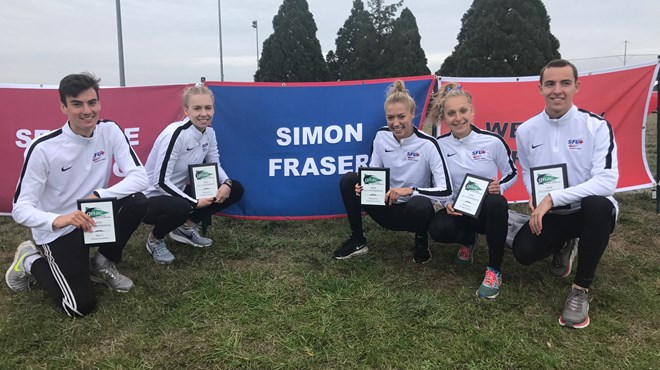
According to head coach Brit Townsend, this may be the only time both teams have finished top two. (Photo courtesy of SFU Athletics)

On Saturday, November 3, both the men and women’s SFU cross country teams competed at the GNAC Championships held in Monmouth, Oregon. Both teams placed second at the tournament, despite injury issues, which says a lot about the excellence of the program.

For the men, seniors Rowan Doherty and Sean Miller continued to lead the way, as they have all season. They finished third and fourth in the 8000-metre race with times of 24:40.5 and 24:43.4 respectively, only finishing behind Wesley Kirui and Felix Kemboi from the University of Alaska Anchorage. Unsurprisingly, UAA placed first on the men’s side at the championships.  

Doherty stayed with the UAA runners for the duration of the race, despite their move to split away from the pack, but was unable to pass them over the last 300 metres.

Strong finishes from the rest of the group rounded out the team, with Pierre-Louis Detourbe (25:23.6), Aaron Ahl (25:23.7) Chris Sobczak (25:30.8), Carlos Vargas (25:46.3), and Thomas Gallagher finishing 14th, 15th  18th, 21st and 22nd respectively.

“As we have said so many times, the men are running as a strong unit in each race and they will have some things to prove in two weeks to make up for their huge disappointment last year,” said head coach Brit Townsend.

On the women’s side, the team came second to Alaska Anchorage once again. Olivia Willett led the way for the Clan with a time of 21:49.1, good for a fourth-place finish. This is the first time she’s led the team all season. Captain Addy Townsend battled injury heading into the race, but was still able to finish seventh with a time of 21:53.6.

Rounding out the group were Chelsea Ribeiro (22:19.9), Sophie Dodd (22:43.8), and Megan Roxby (23:02.7) who finished 16th, 25th and 32nd.

“These women have come so far this year when we thought we had little hope of being a contender for a national spot they now look to be poised to earn their berth if they can keep this up through the west regional championships,” said Townsend.

What’s next:

The team will now prepare NCAA DIV II West Region Championships, which take place on November 17 at Montana State University Billings. “The next two weeks will be spent getting everyone healthy and recovered from this race as we have had several weeks of intense high volume workouts,” said Townsend.

SFU wrestling host SFU open and put up dominating performance

0
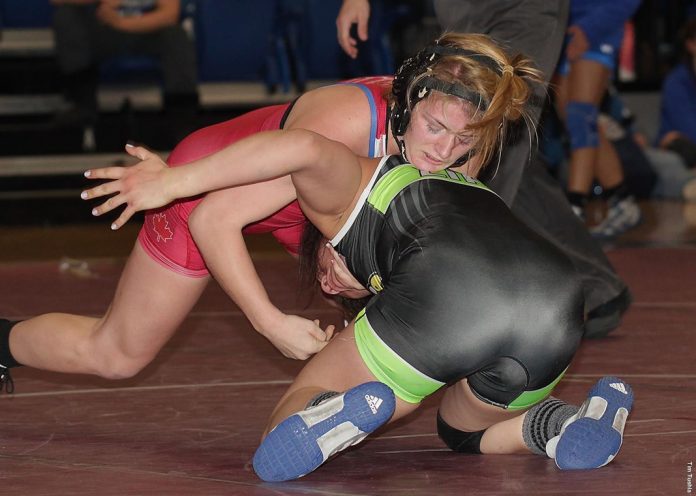
Lauren Mason pinning her opponent. (Photo courtesy of SFU Athletics)

On Saturday, November 3, Burnaby mountain hosted the SFU open wrestling tournament. The men’s and women’s teams both put up terrific performances on the day, combining to win five weight classes. Here’s how it went down.

On the men’s side, Logan Nelson, Taber Spray and Nishaun Randhawa were able to win their weight classes.

Nelson, competing in the 79-kilogram division, cruised through the tournament. All three victories were by technical fall, displaying his dominance of his opponents.

Spray also won all three of his matches in the 70-kilogram division, though these all went down to decision.

In the 97-kilogram division, Randhawa took on Arjot Gill in a battle of the big men, and was able to beat him by technical fall.

Other notable performances for the men include those by Nela Takufua, who finished second, and Riley Prough, Nolan Badovinac and Ciaran Bell, who all finished third.

On the women’s side, Alex Hedrick and Serena Woldring won their respective weight classes.

Hedrick competed in the 65-kilogram weight class, and won all three of her matches. Her closest competition actually came in her first match, when she won a tight decision 14–13 over Meghan Fendelet. She won her next match by technical fall before taking on teammate Alison Horne in her final round robin match. She would win this one 14–7.

Hedrick also competed in the 55-kilogram division, and again, took on a teammate in the final. This time it was Lauren Mason, and Hedrick came out on top with a 6–1 decision. Mason also had a great tournament, as this was her only loss.

Woldring dominated the 86-kilogram weight class, winning her first three matches by technical fall before taking on Korinahe Bullock in the final. Woldring won this match in dominating fashion, taking it by decision 5–0.

The Clan will now prepare for their dual meet against North Idaho College on December 7 at 7 p.m in the West Gym.

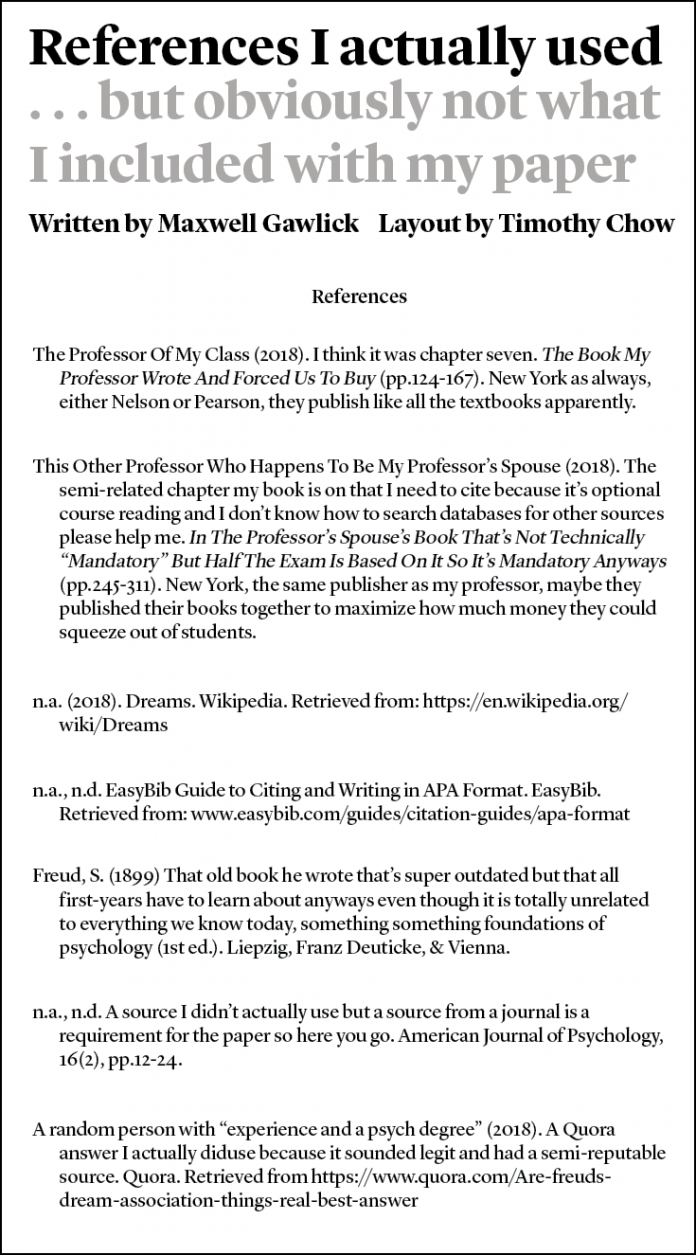
References I actually used

0
Layout by Timothy Chow

Students demand that “SFU Freeze Tuition Now!” as the university plans fee hikes

3
(Srijani Datta / The Peak)

Written by: Srijani Datta, Assistant News Editor


SFU is proposing an increase in tuition fees, but students are not happy.

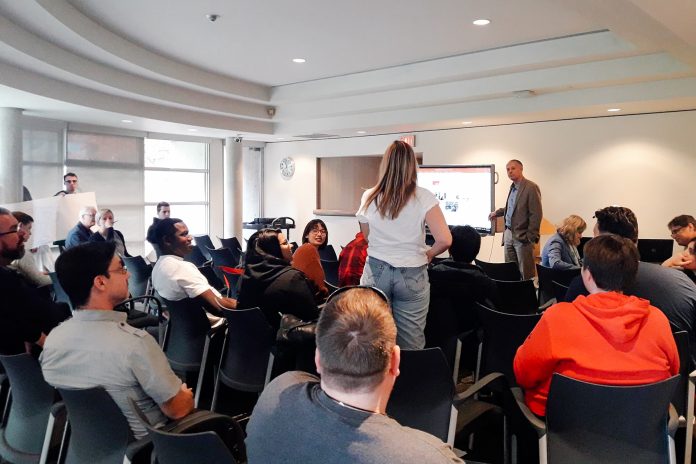
On October 23, SFU administration emailed students to invite them to a consultation session on their proposed tuition hikes, which would be held from 10 a.m. to 11:30 a.m. on October 30. Roughly 20 to 30 students attended the event.


The proposed fee increase

If approved, the proposed hike would be in effect from Fall 2019, and it would entail a 2% general tuition increase for all domestic undergraduate students. For all continuing international undergraduate students, there would be a 4% increase.

The highest fees would apply to incoming international undergraduate students. With the added 4% increase, most of those students would face a total increase of 12%. Those taking computing science, engineering science, or mechatronics courses would instead face a 16% increase, and those taking Beedie courses would experience a 20% increase.

Domestic and most international students in graduate programs will see a similar increase of 2%, except in those programs which have a different tuition rate for international students, in which case the increase will be by 4% for the international graduates.

Protesters reminded the audience that while the plan to raise fees would hit some students harder than others, it would ultimately affect every student at SFU, current and future.

“This proposed hike is dividing and conquering us,” said undergraduate student Giovanni Hosang. He explained that the hike was pitting the domestic students against the international students, while in reality, all students were facing a fee hike.

“We should stick together as a united front,” Hosang continued.


“SFU Tuition Freeze Now” campaign surfaces

As a response to the proposed hike, the Teaching Support Staff Union, SFU Left Alternative, and SFU Students of Caribbean & African Ancestry mobilized members of the SFU community to attend the consultation and give the school feedback.  Members of these groups organized a Facebook event called “SFU Tuition Freeze Now!”, intended to gather students to protest the fee hike and represent student voices at the consultation. The organizers also distributed pamphlets and put up posters across campus.

“Considering the current state of tuition costs, the proposal is absolutely unacceptable. Whether you are a domestic, international, or grad student, the price of tuition is already too high,” read the Facebook event description.


Consultation held on Burnaby campus

On October 30, the consultation took place at SFU’s Burnaby campus. Student activists mobilized by the “SFU Tuition Freeze Now!” campaign met prior to the meeting to organize support and entered the consultation premises in a procession, chanting slogans such as “No students are cash cows! Freeze Tuition Now!”

During the consultation, Martin Pochurko, vice-president finance and administration, and Peter Keller, vice-president academic and provost, headed the discussion as representatives of the SFU administration.

Keller and Pochurko presented on the financial breakdown of SFU’s budgetary needs and highlighted the lack of funding from the provincial government.

“The provincial government is paying the university for a set number of domestic undergrads and grad students. That means we have a set target of how many undergrads and grads we are expected to enroll at SFU. But SFU has exceeded that target by the most of all universities and colleges in B.C,” explained Keller.

“Currently 35% of domestic students are unfunded by the provincial government.” – Peter Keller, SFU vice-president academic and provost

Later, Pochurko stated that tuition fee increases for domestic students were currently capped at 2% a year. Keller noted that because of this freeze, raising international tuition fees is the only way for the university to compensate for its current lack of funds.

Keller and Pochurko stated that the university was committed to helping students in financial need through bursaries and scholarships.

In response, Hosang pointed out that bursaries were not a solution for students in extremely difficult financial situations with no major alternative source of funds.

Bursaries are awarded to applicants based on their financial needs, but with the added clause that they cannot be the “primary source of funding” for applicants to qualify.

“I am too poor to be eligible for bursary,” said Hosang, referring to his lack of other primary sources of funds.

Following Hosang’s statements, undergraduate student Jane Buckshon noted that not only did earning too little money disqualify students from receiving bursaries, but so did earning too much.

“If you get a job, you also don’t get bursaries,” Buckshon said, arguing that students who work a full-time job to pay tuition are often deemed ineligible for bursaries, because the pay from their job implies that they are no longer in financial need.

Students also collectively pointed out how the combination of full-time work and school negatively impacted students’ mental health and grades.

As a third year international student, Ong explained that she would have to drop out of university if her tuition fees went up by 4% every year.

“Don’t make education a privilege for those who can’t afford it.” – Ong, SFU third-year communications student 

“I will have no future at all if the tuition keeps going up.” said Ong. “My scholarships don’t cover a fraction of my tuition, and I still have a few years in school.”

The tuition increase is currently only being proposed for the 2019/20 academic year. It is unclear whether tuition will continue to increase at the same rate in subsequent years.


Students push for alternative budget solutions

In response to this explanation from the SFU administration, student members of the audience asked the administration to look for alternative sources of funding.

Matt McDonald, a PhD student in SFU’s economic department, cited figures from the university’s previous fiscal year, questioning the administration’s reasoning for the fee increase.

“Last year, SFU had a budget surplus of $65.3 million. Of that, $19 million went to the endowment, $35.3 million to ‘tangible capital assets,’ and $11 million toward increased ‘operating commitments,’ said McDonald. “Even if we assume that purchase of capital assets (buildings, vehicles, etc) was a good idea, that leaves $30 million.

“The administration claims that in 2019-20 the tuition increases along with related fees will bring in $11.8 million, which is around a third of the non-capital asset portion of the surplus.”

McDonald asked if SFU could use this surplus to make up for the provincial funding lag, rather than impose a new fee hike on students.

In response, Keller commented that the surplus was meant to go into the endowment grant for future hires.

“What’s the goal here? Educate students as cheaply as possible or pump money into endowment?” – Matt McDonald, SFU PhD student in economics

“Education is being talked about as a commodity here,” expressed Jade Hu, a PhD candidate in the education department, as she asked the administration to rethink the effect of the proposed hike on students.

Students also expressed the feeling that the consultation demonstrated the university’s poor communication with its students. Students pointed out that the chosen consultation time was inconvenient, being during midterm season, and asked for better communication from the administration on issues concerning the community.

Students stated their willingness to work with the administration towards a mutual solution. “How do we move from here? What do we do next?” asked Andrea Jones, a fourth-year health sciences student. She directed the question to Keller as she requested the administration work collaboratively with students.

Keller and Pochurko expressed that they understood and sympathized with students’ concerns, and that they would consider them during future consultations with other stakeholders of the university.

Acknowledging that the administration understood the students’ plight,  Buckshon asked Keller whether the top administration of SFU, “would take a fee cut to help the situation?”


Following the Consultation

At the end of the consultation, Pochurko stated that the “detailed budget will be approved in March 2019.”

Following the consultation, Kayla Phillips, a MA student in political science, said that while it is clear there are other options available to the university which could be used to address the  projected costs rather than hiking tuitions, the university administration seemed “simply unwilling to explore those.”

Referring to SFU’s financial information from over the last three years, McDonald stated in an email interview with The Peak that, “the SFU administration has been very consistent for years in claiming that tuition and fee hikes are necessary to maintain a balanced budget, rarely deviating from this theme.”

McDonald explained that, during annual fall semester consultations, SFU  budget projections show tuition hikes as the most viable way to avoid financial loss. However, annual financial reports from the last three years show that SFU has made annual surpluses between $31.9 million to $65.3 million, large portions of which go to the endowment fund. Over $18 million was contributed to the fund last year while the tuition hike is supposed to bring in $11.8 million.

Acknowledging that in the long run, either tuition will have to go up or the provincial government will have to step in to bring tuition relief to all students, McDonald concluded, “The SFU administration can choose to minimize financial stresses on students and cut us a break instead of cutting a cheque to the endowment fund.”

Sanjana Ramesh, MA political science student said, “We want to be able to trust their intentions, but based on the ‘consultation’ it seems clear they are unwilling to address our concerns.”

After the consultation, the students in the audience proceeded to Freedom Square to protest the proposed fee hike.

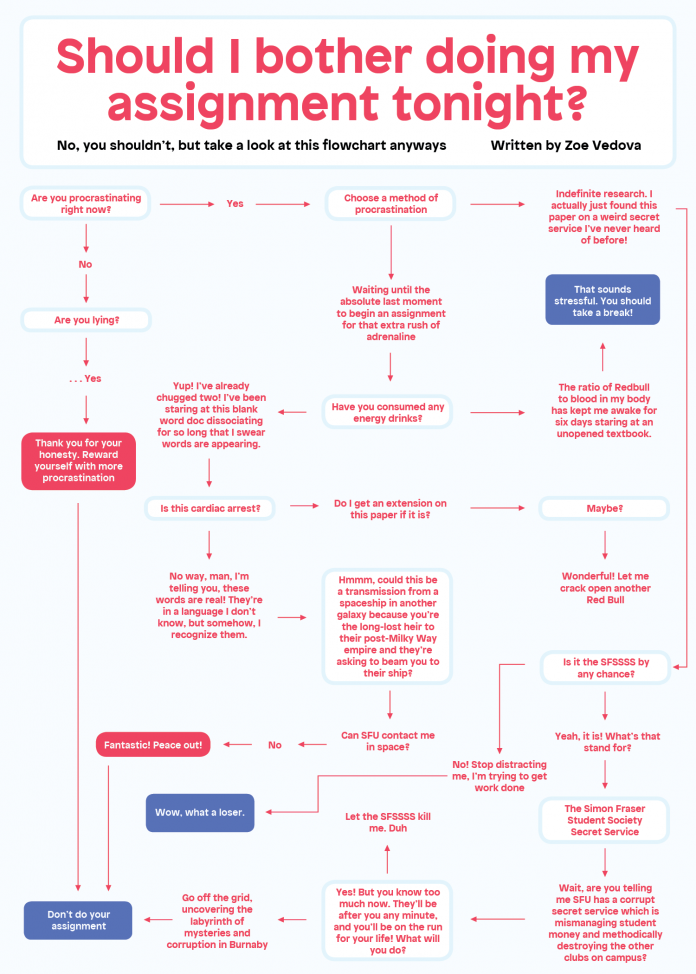
Flowchart: Should I bother doing my assignment tonight?

0
Layout by Timothy Chow

Written by: Zoe Vedova

Never forget: Stories for Remembrance Day

0
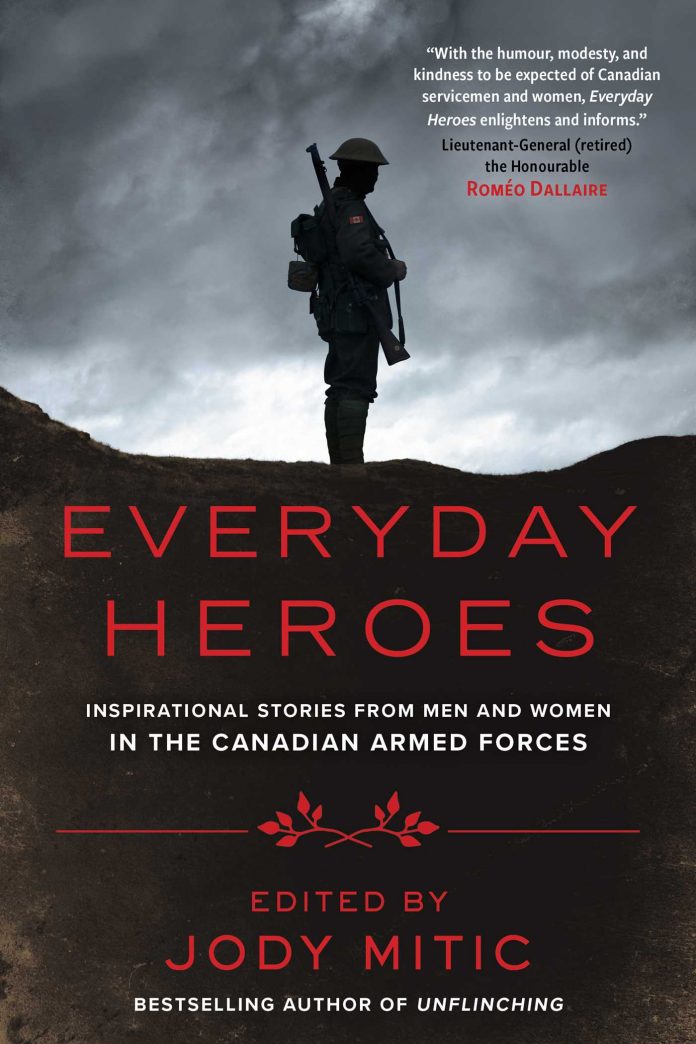
Image courtesy of Simon & Schuster Canada

By: Nathaniel Tok and Alex Bloom

Everyday Heroes

Everyday Heroes: Inspirational Stories from Men and Women in the Canadian Armed Forces is a collection of stories of Canadian Forces personnel edited by Canadian army sniper Jody Mitic.

        The service members themselves, who wrote their own stories, served in a wide variety of conflicts from the recent war in Afghanistan to the Second World War. Some of the writers did not serve in any conflicts, thereby providing a rare example of military life outside the war zone.

        The contrast between the experiences of those who served in conflict zones and those who did not creates an interesting counterpoint and differing sets of perspectives. This however was expected from men and women who served in different places and at different times. However, a similar sense of gratefulness emerges from the voices of each character describing how the Canadian military changed them and how much they valued their time spent with their fellow service members

        This creates an interesting counterpoint and differing sets of perspectives. This however was expected from men and women who served in different places and at different times but a similar sense of gratefulness emerges from the voices of each character describing how the Canadian military changed them and how much they valued their time spent with their fellow service members.

       An issue for me was that many of the stories are quite short, and do not go into as much detail as I would like, especially concerning the lives of the service members after leaving the military. However, the book still achieves its goal of sharing a wide range of stories from service members from all walks of life. – NT


Indigenes

Released to English audiences as Days of Glory, this French film tells the often glossed-over story of the North African soldiers — primarily from Algeria and Morocco — who fought and died for France during the Second World War.

        Western films about the Second World War often ignore the contributions from allied peoples other than the US, Russia, and the UK. While these are stories that are very much worth telling, it is important not to forget the great sacrifices made by other nations, many of which were colonies of France or the UK at the time.

        Indigenes is a war film that acknowledges those sacrifices made by nations such as Algeria and Morocco, and indeed from all across Africa, during one of the most horrific conflicts humanity has ever seen. The film does not shy away from dealing with themes of racism, the harsh realities of war, and the way that veterans were discriminated against by the colonial powers they fought for after the war ended.

        If you aren’t fluent in French or Arabic, you’re definitely going to need some subtitles for this film. However, even if you don’t normally watch subtitled films, I strongly recommend Indigenes for its honest portrayal of French colonialism during the Second World War. – AB

Joyeux Noel

If you want to watch a film about war that won’t leave you completely disillusioned about human nature then Joyeux Noel is the film for you.

       Taking place during the First World War, it tells the real-life story of the French, Scottish, and German soldiers who decided to put down their arms and celebrate Christmas together. Of course, being about war, it still deals with incredibly heavy themes, so it isn’t an easy watch — but no war film should be.

       Joyeux Noel follows characters from all three of the aforementioned nations, humanizing all sides of the conflict. There aren’t “good guys” and “bad guys,” just people. The film also adds another layer of respectfulness, in that all the characters speak their own languages, rather than having all the characters speak English in cheesy accents.

      Joyeux Noel is one of the few films that reliably brings a tear to my eye, and is filled with poignant moments of love triumphing over hate. One of my favourite parts of the film, for example, is when the no man’s land between the trenches is converted into a makeshift soccer pitch so that both sides can come together for a friendly game.

      What makes this film so touching is that it actually happened. Soldiers from opposing sides of one of the deadliest conflicts in human history saw through all the propaganda and hate and acknowledged each other’s common humanity. – AB

Honourable Mention: Passchendaele

Believe it or not, but the word “Canadian” used to strike fear into the hearts of battle-hardened soldiers.

      During the First World War, Canadian troops developed a reputation amongst their foes for being particularly effective soldiers — especially at the Battle of Vimy Ridge, where they captured ground that older nations had failed to take. Passchendaele tells the story of the battle by the same name, where Canadians once again proved their determination at great cost: laying down their lives in the mud and blood of the European theatre.

        While this film by Slings and ArrowsPaul Gross isn’t perfect by any means, it is good to see representation of Canada’s involvement in the war. One Rotten Tomatoes review described it saying, “[Passchendaele] crudely welds the grisly verisimilitude of Saving Private Ryan to the contempo cultural revisionism of Pearl Harbor but can’t forge the disparate tones into a powerful whole.” It’s worth taking it with a grain of salt, and the melodramatic love story Gross wrote for his character wasn’t warranted, but at the very least, Passchendaele is a high-budget film that acknowledges the sacrifices of Canadians during the First World War. – AB

What’d I miss?: Electoral Reform in B.C.

1
Photo by Chris Ho / The Peak

By: Michelle Gomez, Staff writer 

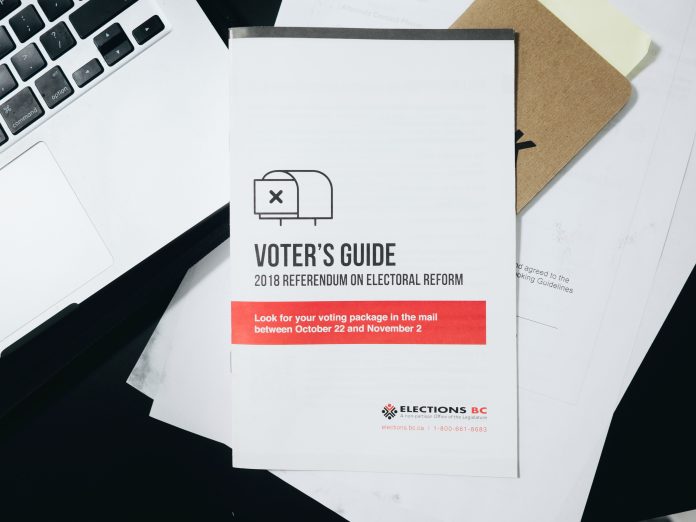
Have you noticed the ballots and pamphlets in your mailbox? B.C.’s upcoming 2018 Referendum on Electoral Reform will decide whether we keep our first-past-the-post system (FPTP) or switch to one of three proportional representation (PR) systems. This is following two previous referendums, one in 2005 and one in 2009, neither of which brought any changes.

Voting in the referendum could entirely restructure B.C.’s politics, but currently, about one third of British Columbians are undecided about how to vote. Anyone who is a Canadian citizen, is 18 or older, and has been a resident of British Columbia for at least the past six months is eligible to vote. The voting packages will be delivered until November 2, and ballots must be returned to Elections B.C. by November 30.

The referendum ballot will ask you two questions. First, it’ll ask whether we should keep our current system or switch to PR. Then, voters will be asked to rank all three proportional representation systems in order of preference on a separate ballot, so that we’ll know which system to switch to if the answer to the first question is “yes.” This second question makes it important to have an understanding of all of the systems, even if you would rather stick to first-past-the-post.  


Current: First-past-the-post (FPTP)

BC’s current voting system is first-past-the-post (FPTP).

FPTP splits up the province geographically into electoral districts, or ridings, which each elect an MLA to represent them in this case, in the provincial legislature. Voters choose one candidate for their district, and a candidate needs to win the most votes to win their seat. So, there’s one seat in the legislature for each district, and for each district a party wins, they also win a seat; the breakdown of individual votes for each party is irrelevant. FPTP is currently used in many countries, including the United Kingdom.

Critics FPTP point out that under it, legislature does not proportionally reflect the votes. This system often favours candidates from large parties, and often results in single-party majority governments (meaning that a single party holds more than 50% of the seats in the legislature and therefore holds enough votes to overrule any decision made).

Advantages of FPTP include how easy it is both for voters to to use and understand, and it is easy to administer and manage as well. Some fans of FPTP also argue that this system bars extremist or fringe parties from gaining political power.


Proportional Representation alternatives

According to Fair Vote Canada BC, “proportional representation is a principle underlying a voting system: People should be represented in proportion to how they voted.”  

In other words, under proportional representation, a party would receive roughly the same percentage of seats as they do votes.

While there are many different systems designed to yield proportional results, the three that we will be voting on in B.C. are dual-member proportional (DMP), mixed-member proportional (MMP), and rural-urban proportional (RUP).


Dual-member proportional (DMP)

Dual-member proportional representation would rearrange B.C.’s electoral districts to reconfigure how our MLAs are selected. Most ridings, aside from large rural ones, would fuse with an adjacent riding. These new ridings would each have two MLAs.

During an election, in an urban riding, each party could run a primary and secondary candidate, and voters would select their party of choice, rather than their preferred candidate. The winning party’s main candidate is elected as one of the MLAs. Independents would only be elected if they place first or second in the riding.

The second MLA is chosen by comparing the winning party’s secondary candidate to the other parties’ eligible main candidates, except that now the winning party’s secondary candidate is given half of their party’s votes. From there, seats are proportionally distributed across ridings based off of each party’s performance on a provincial level, with some extra caveats that you can read more about on B.C. Elections’ website.

CBC explains that while “this system would favour primary candidates from the party that finished second in a riding [ . . . ] sometimes, a secondary candidate from a winning party would get in if the party did both really well in that riding and across the province generally.”

DMP was developed in Canada, but is currently not used anywhere in the world.


Mixed-Member Proportional (MMP)

In mixed-member proportional representation, voters would elect one local MLA (as we do now), as well as MLAs representing a new kind of riding called a region. About 60% of the MLAs would be local, and the remaining 40% would be regional.

Under MMP, voters would choose their preferred local MLA as we do now, and the local candidates would be elected as they are now under first-past-the-post. In addition, voters would also choose their preferred regional candidate from a party list, and the regional candidates would be elected to ensure that the overall composition of MLAs reflects the proportions of the vote. Similar to the DMP system we talked about, a party must get at least 5% of the vote to gain a regional seat.

This system is currently used in Germany, New Zealand, and Scotland, among others. The specific size and limits of future electoral districts and regions have not been decided yet; these will be designated by a legislative committee if MMP is chosen in the referendum. This committee will also decide if voters have one vote or two under this system, since both are in use internationally.


Rural-urban proportional representation (RUP)

Rural-urban proportional representation merges two other systems, MMP and single transferable vote (STV), to ensure that urban and rural voters are represented equally.

In rural areas, voters would elect local and regional MLAs with the MMP system. In urban (geographically small but densely populated) areas, voters would use STV to elect their MLAs.

In STV, multiple ridings would be merged into one multi-district riding in which voters would elect a small team of MLAs. Instead of voting for their single favourite candidate, voters would number off the candidates on the ballot to indicate how much they liked each one (so you would mark your favourite candidate number-one, your second would be marked number-two, et cetera.) Parties could run many candidates per district as well.

If RUP were to be chosen, an independent commission would determine the boundaries of all the various districts. British Columbia would also be the only place in the world using RUP system, though MMP and STV are both used individually.

Michael Bublé’s intent to retire is refreshing in a toxic pop culture

1
Photo illustration by Chris Ho/The Peak

Written by: Youeal Abera, Staff Writer

Hollywood is becoming a bit of an ego-fest. Between celebrities like Khloe Kardashian advertising a “Flat Tummy Tea” on her personal Instagram and Kanye’s short-lived political career, it’s refreshing when we come across an actor or musician whose fame hasn’t afflicted them with a penchant for narcissistic antics.

Recently, Michael Bublé has certainly been one of these breaths of fresh air, and one we should really appreciate.

Like other artists of his calibre, Bublé regularly used online platforms like Twitter and Instagram. When his son was diagnosed with cancer two years ago, though, Bublé took some time out of the public gaze, and his highly active Instagram, in order to focus on the health of his son and the well-being of his family.  Now, as his son’s cancer has (thankfully) gone into remission, Michael Bublé is gearing up to release his new album, Love, in November.

In an interview with The Daily Mail, Michael discussed how he sees narcissism as an inevitable part of the music business, and that it gets in the way of his art and his efforts to be a more genuine person. He claimed that his time away from the spotlight led him to question his career and identity, going so far as to ask himself questions like, “Why are we here?” He concluded by stating that that would be his last interview, and that he’s retiring from the music business.

Weeks have passed since this interview was published, and since, Michael Bublé’s team of publicists have issued a statement which expressed that, despite these claims, Michael would not be retiring from the music business. Whether Bublé proceeds with leaving or not, it speaks to how toxic celebritydom is that the most attention-grabbing thing he wished to do was just escape.

I’ve never drank from the fountain of fame and fortune, but it’s easy to imagine many members of pop culture having similar problems and desires to leave. We’ve seen the pitfalls of former child actors (Lindsay Lohan) or pop icons (Britney Spears), individuals who have fallen into crises as the public’s vast love and adoration ceased, and their sense of identity appears to have faded with it as well. This would be crushing to anyone, and yet our media is designed to sensationalize it.

In reading that one of the biggest artists on the planet feels a need to leave, it shows just how frivolous Instagram and fame can be. I can’t help but feel grateful that there are people in pop culture who understand that the glitz and glamour truly isn’t what it’s made out to be. Instead of genuine, emotional human beings, their personal lives need to be maintained like a long-running work of fiction.

It’s unfortunate that Michael Bublé came to this revelation through the horrific experience of his son’s battle with cancer. These are heavy experiences and heavy questions, but his recognition of how fame and popularity exist in popular culture is something to keep in mind. His reasons for leaving are something for all of us to keep in mind, both in how we love ourselves and how we look at those in the spotlight.