Home Blog Page 601

Political Corner: By leaving the INF Treaty, the US is abandoning peace

0
Image courtesy of AP Photos

Written by: Kelly Grounds, Peak Associate

1987 Cold-War era Intermediate-Range Nuclear Forces (INF) treaty. The announcement came after multiple accusations by US officials that Russia has repeatedly violated the treaty since its conception.

The INF was established in the 1970s when Russia began to replace their older intermediate-range SS-4 and SS-5 missiles with a new intermediate-range missile, the SS-20. These new missiles had a firing range of up to 5000 km, far enough to reach all of Europe and northern parts of Northern Canada.

With the impending new threat, the North Atlantic Treaty Organization (NATO) began to negotiate an arms freeze with Russia, eventually resulting in the INF treaty. This created a framework for both the US and Russia to start to permanently eliminate their more powerful long-range nuclear missiles. There was also a regulation committee put in place to monitor both parties’ compliance with the treaty.

Much of why the US is dropping from the INF is due to US national security advisor John Bolton. Bolton carries a less informed attitude of American global nuclear power, showing disinterest in any compromise with potential threats to the US. His dislike towards agreements like the INF are strong enough that even his memoir is titled Surrender is not an Option.

Leaving the INF is a continuation of a pattern for the US, as they appear unwilling to be in any deal that promotes international peace. They’ve already pulled out of the Anti-Ballistic Missile (ABM) treaty, and it seems the Obama-era New Start treaty could be at risk next.

Very quickly, President Trump’s advisors are dismantling arms control with their incredibly biased advice. Peace does not appear to be something the US is interested in maintaining.

The Pittsburgh shooting is a symptom of normalized anti-Semitism in social media

1
Photo courtesy of Jeff Swensen/Getty Images

Written by: Gene Cole, Opinions Editor

On October 27, a gunman entered Tree of Life — Or L’Simcha Congregation, a synagogue in Pittsburgh, Pennsylvania, and opened fire, killing 11. It’s currently being considered by the Anti-Defamation League as the deadliest attack on the Jewish community in US history.

Being raised Jewish, this news has made me feel distressed and unsafe. At the same time though, I can’t shake that first reaction I had of total lack of surprise at such violence towards the Jewish people in America.

Besides the severity, nothing about the Pittsburgh shooting comes across as unexpected or unusual. Anti-Semitism in crime and culture is an inherent and constant part of the Jewish experience.

This feeling comes mostly from the outlet for anti-Semitism that most of us encounter daily — social media. The events of Pittsburgh were closely tied to this problem, as just before the attack the perpetrator made a number of threats and comments on Gab, a Twitter-style social media site with a large alt-right population.

Unfortunately, little can be done to end these hateful spaces. Remove them from one place, and they’ll easily find another. Microsoft even threatened to remove Gab back in August, but evidently, it very quickly found a new home.

But aside from specifically hateful places, there’s also an equally concerning steady stream of anti-Semitism on more typical social media sites like Twitter and Facebook. Offensive jokes and direct threats are all too prevalent in every kind of post about Jews. I’ve seen these sorts of comments on every subject, from serious political posts about hate crimes to Jewish or Israeli celebrities like Gal Gadot.

In other words, seemingly any mention of Judaism is likely to invite offensive users, and makes it impossible to find a space that’s truly safe or welcoming for Jews. It’s something Jews naturally have to put up with, as anti-Semitism is something we just expect from our online culture. It’s an inevitability of the Jewish experience.

Many of these websites and apps have policies in place to discourage hate and threats, but few sites moderate their users enough to stop it from spreading. After vandalism of a synagogue in New York, Twitter initially listed “Kill All Jews” as trending to display how people were talking about the event. This was likely an automated update to the site rather than an intentional error, but letting an automated system make decisions about your site means you can only reverse them after it’s too late.

The solutions to these problems on major social media sites are also painfully unrealistic. The best suggestion I’ve heard is hiring more moderators to manually make and assess reports, as automated reporting systems can result in a huge flurry of false positives. But there’s no telling just how many employees this would require, and with the internet being active 24/7 worldwide, there’s no physical way to deal with this problem.

It also doesn’t help that there’s much deceptive language about Jews embedded in anti-Semitism that wears a guise of “discussion.” A prime example is the use of the word “globalist” to imply a conspiracy that Jews secretly run the world, which has grown in use after Trump used it to describe Jewish billionaire George Soros. These words and contexts aren’t properly detectable by any automatic reporting system, and they’re a trend of ingrained anti-Semitism that can’t be effectively tackled.

This isn’t to say the world is exclusively hateful towards Jews. The protests in Pittsburgh have made a strong statement that many are indeed against anti-Semitism and violence. There’s also been much support from other minorities online, such as Muslim groups Celebrate Mercy and MPower change, who’ve so far crowdfunded over $225,000 for the victims’ families. That sort of solidarity among frequently victimized groups is both welcoming and refreshing.

Regardless though, anti-Semitism is a normal part of Judaism right now. This has been true throughout history, but the events in Pittsburgh show that we have every reason to be afraid and jaded. It’s horrible to me that those fearful attitudes can seem so reasonable to others.

Huge second period sets tone for SFU hockey in 8–3 rout of Mariners

0
The Clan scored eight unanswered goals in their blowout win. (Photo courtesy of SFU Athletics)

By: Dylan Webb

On Friday night at the Bill Copeland Sports Centre, SFU hockey inched closer to first place in the BCIHL standings with a dominating win over the Vancouver Island University Mariners. The Clan overcame a weak first period that saw them down 3–1, and managed to secure a huge win that will set the tone for tonight’s second game of the weekend series. The Clan, now 4–2 on the season, sits only one point behind the Mariners for top spot. If the Clan can win again tonight, they’ll overtake the Mariners for the league lead.

In the first period, the Mariners got off to a hot start and quickly potted three goals to take a commanding lead. However, it was all downhill from there for the Mariners. Cracks began to show in the first, as they allowed the Clan back into the game on a defensive breakdown late in the frame. The Clan soon covered the score sheet with ink during the remaining two periods, scoring eight unanswered goals across the final two frames to secure a blowout win in game one of the weekend double-header. SFU forwards Mitch Ledyard, Cole Plotnikoff, and Jordan Funk all put home their first career BCIHL goals as part of the offensive outburst.

Forwards Nicholas Holowko, Brendan Lamont, and Jordan Funk all tallied multi-point nights as the Clan benefitted from offensive input up and down the line-up. The second period saw 11 Clan skaters tally a point, as the team found their legs and throttled the opposition in what was most likely the Mariners’ most embarrassing two periods of hockey this season.

In the third, with their feet already firmly planted on the necks of their Vancouver Island opponents, the Clan would add two insurance markers for good measure on Plotnikoff’s first career BCIHL goal and Funk’s second of the game. Overall, the Clan promptly overcame their weak first period with an offensive outburst that made for the story of the night.

In goal, Michael Lenko secured his second win of the season with a solid performance that earned him first-star honours despite the offensive outburst up front. Lenko, expected to start Saturday evening as well, looks to get on a roll in his first season with the Clan as the team moves closer to first place in the league standings.

“When we are on and playing to our potential, there is no team in this league that can come close to playing with us,” said assistant coach Matt Grassi after the game, emphasizing the team’s performance over the final two periods.

Backup goaltender Ryan Sandrin echoed these sentiments. “If the team can find a way to consistently reproduce the effort that allowed us to score eight unanswered goals in two periods, the sky’s the limit for us,” Sandrin said.

The excitement in the room after the game was palpable as, throughout the roster, players new and old alike are realizing the enormous potential the team has to fight for a BCIHL league title in the coming months.

Simon Fraser now prepares for a rematch tonight at Bill Copeland, as the Mariners complete their two-game weekend visit to Burnaby. After the second game of the double header on Saturday, the Clan will look ahead to a key match-up with their rivals, the Trinity Western University Spartans. The Clan looks to start the year by breaking TWU’s perfect 4–0 record.  

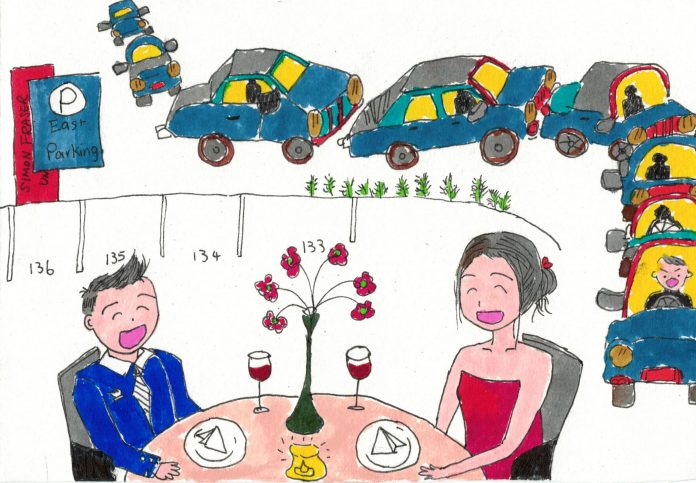
Most Romantic Spots on Campus

0
Illustrated by Momo Lin

Written by: Jennifer Low

When thinking of the most romantic places in the world, Paris, Italy, and New York are just a few places that might come to mind. But you’d be forgetting one of the most underrated romantic destinations of all time: Simon Fraser University . . . The most romantic destination this side of the Pacific, the sights here are ones you just can’t miss, and for a fraction of the price!

Can’t afford that fancy trip to the Alps this winter? Don’t worry, you sad, pathetic, hopeless romantic; The Peak has got you covered. Here are the top little-known romantic destinations at SFU:

  1. East Lot

Your S.O. wanted to go somewhere new, right? Well, head over to the far-off majestic land of East Lot. A million miles away from most of the SFU population, a parking lot actually exists.

East Lot represents one of the greatest semi-natural romantic locations SFU has to offer. Filled with “N” drivers who are still so nervous about parking that they’d rather just pull through a space, you and your S.O. will never have felt closer . . .  Let’s be honest, near-death encounters caused by erratic driving will keep you on your toes, and there is nothing like the fear of being hit by someone’s beat up Honda Civic to bring a couple together.

  1. The fifth floor of the WAC Bennett Library

Is it the eerie silence or is it merely being in your partner’s presence that’s got you feeling like you’re holding your breath? Perfect for napping or just sitting and enjoying one another’s company, nothing will render your S.O. speechless quite like getting lost in the stacks on the fifth floor of the library.

  1. Robert C. Brown Hall

RCB gets a lot of hate for being an ugly, dark, Wi-Fi-less concrete abyss. But sometimes you just need a change in perspective! Like a real-life escape room, RCB will test your ability to put up with one another and your spatial awareness as you try to navigate the maze. Let’s not forget that this is a 100% cell phone-free zone; you couldn’t get service down there if you tried. Who needs to go to horror movies or haunted houses to get your S.O. to hold your hand when you can struggle to find your way through the horrors of Robert C. Brown Hall together?

  1. The Stairs leading up to Saywell Hall

They say hikes can provide a sense of clarity and freshness for your relationship, and there’s nothing more romantic than admiring that picturesque view once you get to the top. The same goes for the climb up to Saywell Hall. Here, you get a better view than anywhere else on campus of the detailed renovations going on beneath that giant white tarp. Construction workers, broken tiles, a dark and sweaty tarp. What more could you want from a view? So whether you are celebrating an anniversary or trying to impress someone on a first date, Saywell Hall is an experience made better by being together.

  1. Math West

A relatively new building at SFU, Math West has plenty of natural lighting, but what makes this spot so appealing has to be the ambience for sure. Math West exudes a romantic aura that has left a lasting impression on the soul and life of numerous students, students whose tears watered the surface of every piece of furniture in sight as they suffered through their math assignments. This space truly is one to visit so you can experience the celebration of raw human emotion and struggle.

SFYou: Katrina Chen’s road to becoming Burnaby-Lougheed’s MLA

0
Katrina Chen, photo courtesy of Burnaby Now

By: Youeal Abera, Staff Writer 

Fast facts

Name: Katrina Chen

Pronouns: She / her / hers

Department affiliation: Political science and history

Hometown: Chen was born in Taiwan, but has lived in British Columbia for many years

Occupation: Aside from serving as Burnaby-Lougheed’s MLA since 2017, Chen is also the Minister of State for Child Care


In the midst of midterm season, finding a source of motivation in the long nights of caffeine consumption and studying can be hard. School may be a dreary journey at times, but the greatest incentive to persevere can be looking at how academic and social student experiences can empower us on our quests towards community and societal improvement. A good example of this is the story of SFU alumna Katrina Chen.

Katrina, Burnaby-Lougheed’s MLA, has found herself in an immensely busy season of her career with the Proportional Representation Referendum arriving in British Columbia — especially since she represents the BC NDP, who ran on a platform of electoral reform in 2017.

Katrina is an advocate for proportional representation, and during our phone interview, she talks about why she’s been working so hard to reach out to her community about the referendum.

“During the past 10–11 years of working in the community, I always hear people say that they don’t feel like their vote counts, the issues that they care about [are] not reflected in the government policies, or that the government just isn’t listening to them,” Katrina says.

“Part of the reason for this is because we don’t have a better electoral system. Proportional representation is about fair representation of seats in the legislature. I think that it is an important time for us to look at our current electoral system and see how we can improve it.”

Additionally, Katrina speaks on how important it is to take provincial politics, including events like the referendum, just as seriously as what transpires on the federal level.

“I think the three levels of government each have different responsibilities and I think we’re equally important because we serve different areas. I also think it’s important to have partners from different levels of government be able to work together.”

Referendum and current political business aside, the most inspiring element of Katrina Chen’s story for me is how a little over a decade ago, Katrina was, like us, an SFU student with big plans. Katrina’s recollections of her experience at SFU shows how much she cherished her time in university, the community she found here, and the education she received.

“I’m fortunate and very thankful that I had a lot of support from my family to be able to help me finish my education,” Katrina recalls.

After graduating with a bachelor’s degree with a major in political science and a minor in history, Katrina dove right into her community as she sought ways to improve the lives of those around her.

“After I graduated, I stayed in my community to work in a local non-profit organization,” she said. “My first job was to knock on doors, and that really opened my eyes and helped me learn local issues, like how families are struggling with high costs of living, housing, childcare, and transportation. These were all things that could be impacted through government policies. Through this experience, I became motivated to get involved in my community more.”

Now, as the MLA of Burnaby-Lougheed, Katrina’s entire job is enhancing the community she loves so much.

“My background has always been pretty much on the grassroots level, and now I feel very honoured and very thankful that I have the opportunity to work in Victoria with the provincial government and also as the Minister of State for Child Care,” Katrina said of her current career path. “My goal now is to bring in the universal child care plan to support families, to support our children, and to build a stronger foundation for the future.”

As the MLA for Burnaby-Lougheed, Minister of State for Child Care, and the mother of a four-year-old, Katrina seems to do it all, and to do it well.

When I inquire about her hectic schedule, Katrina chuckles. “There’s a lot of things happening. I enjoy and am thankful for the opportunities in this work. I have a great team of staff, and I’m very thankful that I have amazing people working around me and supporting my work. We try to prioritize things so I can better manage my schedule and also keep a little bit of time for my family.”

Katrina stresses that a huge reason why she’s so busy is that she has to juggle her time in the legislature with her time in the community, and the ways she can stay connected to Burnaby-Lougheed’s residents. In spite of how much time she spends in Victoria, Katrina lets me know that, whenever she finds herself in Burnaby, she’s always more than willing to meet face to face with community members.

“I love knocking on doors whenever I have time in Burnaby. When I’m back in Burnaby, I love reconnecting with people and continuing to stay on the grassroots level and hearing their stories. Like I said, I can bring their voices and stories back to the legislature and see how our policies can work for people in our communities.”

More than her impressive work ethic and strenuous workload, I notice how positive Katrina is. Upon asking what the highlight of her position is, she cheerily responds, “I would say the best is that I’m learning so much every single day. I’m thankful for that opportunity.”

Katrina articulates how much she adores how diverse her community is, expressing that the greatest attribute of such diversity is that it encourages its inhabitants to learn from each other. As an Asian-Canadian woman, Katrina acknowledges the significance of diversity in her field, and how imperative it is to have political leaders reflect the citizens of their communities.

Katrina is earnest about how huge the issue is to her, and on how proud she is that the current provincial government’s cabinet is gender balanced and diverse.

“Our own experiences helps to improve the work that we do as elected officials and to be able to bring a different perspective. So these diverse voices help when we’re talking about an issue because, before we make decisions, we need to ask how is it going to impact the different people in our community.”

As we complete our conversation, we come to the subject of university students and our incentive to be informed about local politics. With the same vehemence she expresses for her job, Katrina stresses the importance of B.C.’s young people being involved and informed, including with the proportional representation referendum.

“Whoever you are and wherever you’re from, every one of us has a unique experience and all of our voices and votes count. I would encourage for youth to get to know about your local government and local elected officials, and to be more engaged because everything that we do the taxes we pay, the water we drink, the food we eat, and the schools we go to are all connected to government policies.”

Conversations around cultural appropriation sparked at SFU

0
(Image courtesy of Teen Vogue/Party City)

Written by: Amneet Mann, News Editor


This Halloween season, SFU’s intercultural engagement team is working alongside other university departments, such as Residence and Housing, to prompt conversations around cultural appropriation.

The intercultural engagement team is promoting a #notacostume campaign around the university to educate students about how certain costumes can be culturally appropriative or otherwise offensive.

“Most people do not pick out a costume with the intention of being offensive,” reads the campaign page on SFU’s website. “However regardless of intention, costumes can still perpetuate harmful stereotypes. [ . . . ] Cultural appropriation can take many forms, but around Halloween it often refers to people wearing ‘costumes’ that may reduce cultures to jokes and/or stereotypes.”

The campaign included putting up posters around the university, holding an information session on October 23, and offering additional informational resources for students online.

“I believe it’s the first time that I’ve seen a campaign like this at SFU that is being marketed as well as this one, and is accessible as this one is to our students,” said Zoe Woods, associate director of residence life for SFU’s Residence and Housing department, in an interview with The Peak.

“I think [it] gives us a platform to be able to have the conversation in an even more tangible way,” Woods added.

The campaign this year is being supported throughout SFU’s residences, but Woods explained that the topic of cultural appropriation was not new for the residence staff. She stated that student staff in residences receive consistent training throughout the term to prepare them to have conversations that may be sensitive to residents.

“I know there have been conversations that occurred in our residence communities in the past on a smaller scale around cultural appropriation, so I’m excited to see it happening on this level and to [see it] be talked about as much as it is in our community,” said Woods.

According to Woods, between 40% and 60% of residents are international students, making it “an even more important topic within our residence halls and on our campus than in other areas of our Burnaby community.”

The conversation around cultural appropriation has been opened up in the university in other ways, such as by SFU archaeology professor George Nicholas who recently published an article on the subject in Sapiens digital magazine.

While Nicholas acknowledged that stereotypes perpetuated through culturally appropriated costumes may be harmful, he argued that Halloween “is essentially a display of cultural anarchy,” which makes the topic difficult to objectively approach during the season.

“Is a Pocahontas costume more or less acceptable than a slasher? What if the child wearing it is Native American? Is a zombie costume so far removed from Haitian folklore that it no longer counts as culturally derivative? Is a white child dressing up as a black superhero from the recent Black Panther movie a positive counterpoint to years of black children dressing as white superheroes?” Nicholas asked in his article.

Nicholas moved on to the distinction between “cultural borrowing,” a benign practice, and “cultural appropriation,” which involves the commodification of another’s heritage and ultimately ends up harming the culture being appropriated.

Both Woods and Nicholas expressed that it was good to open up conversations around the subject and let students reflect on their own understanding of cultural appropriation.

Woods believed that the biggest impact of the campaign so far had been felt in the conversations heard between students on residence.

“[Our front desk staff] had a lot of conversations with students about, ‘oh, I didn’t recognize that a vampire costume may be inappropriate,’ or ‘hey, I was going to dress up as XYZ for Halloween and maybe I should think about that a bit more,’” said Woods.

“I think becoming more aware and [ . . . ] getting those conversations started and providing the language for students to explore that has been really important.” – Zoe Woods, associate director of residence life, SFU Residence and Housing department

Woods encourages students who have had negative experience around this issue to seek out university resources. For residents, Woods noted that their community advisors or front desk in the housing office would be available to support students. For SFU students who are not residents, Woods encouraged them to reach out to either SFU’s International Services for Students office — whether or not they are international students — or the Health and Counselling department.


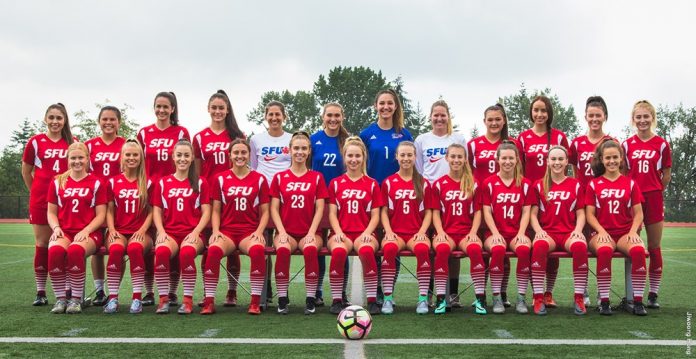
SFU women’s soccer team’s excellence displayed in GNAC awards

0
Seven SFU players were recognized in the GNAC awards. (Photo courtesy of SFU Athletics)

Despite losing a heartbreaking match on Thursday in the GNAC Semi Finals, there is still reason to be excited about the SFU women’s soccer team’s season. On Tuesday, October 30, the Great Northwest Athletic Conference (GNAC) announced the award winners for women’s soccer.

Given the SFU women’s soccer team’s fantastic season, finishing tied for third in the GNAC and leading the conference in goals scored, it was expected for the team to take home some of the awards. Nonetheless, it was exciting to see just which awards, and how many of them, the team received. Here are the highlights:

Jenna-lee Baxter wins GNAC player of the year

If ever there was a shoe-in for a player of the year award, this was it. Baxter led the GNAC in points with 32, tied for first in goals with 11, and tied for first in assists with 10. Watching her play this year, it was clear that she made everybody around her better.

On attack, she was capable of drifting into the wing or playing behind striker Emma Pringle in a supportive role. She was the team’s primary free-kick taker, and created countless opportunities on corners and other set piece plays.

Her presence also created opportunities for other attackers, as the defense was forced to defend her closely from up to 30 yards out given her shooting ability, leaving other attackers open. All in all, Baxter was clearly the best player in the GNAC this season, and arguably one of the best players in the entire nation in 2018. What a way to go out for the senior.

Emma Pringle named to GNAC All-Conference first team

Emma Pringle tied for the GNAC lead with 11 goals on the season. (Photo courtesy of SFU Athletics)

Two things are certain on Burnaby mountain come the fall: it’s going to rain, and Emma Pringle is going to score.

For the second straight season, she finished among the top two in scoring in the GNAC. Last year, she was one goal shy of Western Washington’s Gabriela Pelogi, while this year she finished tied with Baxter at the top. Her ability to score in a multitude of ways made her the perfect striker for this year’s Clan, as she was able to consistently finish off crosses from the team’s wingers, get behind the defence, and use her cannon of a shot from outside the box.

Scoring truly comes naturally to Pringle. For example, in a game where head coach Annie Hamel thought Pringle had an off night, the striker was still able to get a hattrick. Only special players are able to do that, and we look forward to seeing her continuing her Clan career as she goes into her senior year next season.

Katelyn Erhardsen named to All-GNAC second team

Katelyn Erhardsen tied for the GNAC lead with 10 assists. (Photo courtesy of SFU Athletics)

While Erhardsen may not have been one of the leading goalscorers in the GNAC this season, her importance as a winger for the Clan this year cannot be understated. Erhardsen finished the season tied for the GNAC lead with 10 assists, and also contributed with four goals of her own.

Her ability to beat defenders down the wing and put in picture-perfect crosses created havoc for opposing teams, and often ended in a goal by Pringle or another Clan attacker. She gave the Clan speed and width that opened up room for Pringle and Baxter to operate centrally, capping off the most dynamic trio of attackers in the conference.

Erhardsen took the next leap forward as a player in her senior year, improving on a three-goal, six-assist season in 2017. Another great way to end her Clan career.

Annie Hamel wins GNAC coach of the year

When speaking to the head coach before the season started, Hamel told The Peak, “Right now, we have the players and the experience to be playing an attacking brand of football, we want to play at pace, be mentally strong and grind.” This season, the team did that and more under her guidance.

There was not one game this season where the Clan did not look like an offensively dominant team, and while they certainly had some fantastic players up front, it is up to the coach to use their skillsets. Without Hamel’s attacking game plan, it is quite possible that we would not have seen the seasons that we did from Baxter, Pringle, Erhardsen and others. On attack, the team operated as one, often dominating possession and the scoring chances in a game.

This exciting brand of football made the Clan a must-watch team this year, and their place in the GNAC Championships is evidence that it worked.

Honourable Mentions

Four SFU players were also selected as honourable mentions to the All-GNAC team: goalkeeper Nicole Anderson, defenders Allyson Dickson and Carli Grosso, and forward Christina Dickson.

Anderson was tasked with the starting goalkeeper role in her freshman season for the Clan, and surpassed all expectations. She won the starting role at the beginning of the season and never looked back, and will be a key player for SFU in the upcoming years.

Allyson Dickson had a fantastic senior season for the Clan, and was a valuable member of the teams back line throughout the season. Her ability to defend and attack made her a versatile asset, and she was imperative to the attacking style of play that SFU played with, despite her role as a defender.

Grosso was a rock on defence all season, and displayed a high soccer IQ when playing as a centre back this season. Her ability to play the ball as a centre back can not be understated, and she cut out scoring opportunities for SFU opponents with consistency.

While other attacking players may have received more credit this season, Christina Dickson had a great year for the Clan. She scored four goals and had one assist, and also contributed defensively throughout the campaign.


Hamish and Jo’s adventures in France: Still no schoolwork, but a new continent!

1
Illustration by Siloam Yeung

By: Hamish Clinton and Jozsef Varga 

Much has changed since our last update. For starters, we have not cut our hair in several months. In fact, it seems we have embraced the nomadic ways of expert travellers by growing it out. Next thing you know, we might be bathing in streams, sleeping in caves, and eating the berries off bushes.

Since we last spoke, we have been to four new countries. Sadly, among these is Monaco. (We have nothing, we repeat, nothing against Monaco. It’s just that this means we are counting the teenie-weenie microstate — still a state! — completely surrounded by France that also happens to be a mere few minutes away from us by train.)

That is not to say we aren’t proud of the places that we have seen so far. We have been lucky enough to visit wonderful places, ranging from Milan in Italy, with its beautiful churches and ancient Roman ruins, to Tunis, capital of Tunisia, with its giant Medina bustling and overflowing with the smells and sounds of the city . . . and of course, more ancient Roman ruins, which seem to be a bit of a theme around the Mediterranean.

All in all, it’s been another month here on the sunny south coast of France, and so naturally, we’ve not done much of any schoolwork, knowing full well that it will all be coming in the next month. Rather, we have preferred to spend our time here basking in the sunshine on the beach and exploring as many different cultures and countries as possible.

We began our travels with a trip to Saint-Tropez, a town on the French Riviera which was just a train and a short boat ride away. With multimillion dollar yachts lining the marina and luxury brand-name boutiques mirroring them along the city centre, immense wealth was on full display. Nevertheless, we managed to find ways to make our trip work for budget-wary millennials.

After strolling through the streets and admiring the beauty of Saint-Tropez, we bought some bread and sandwich fixings and hiked to the top of the hill where the Saint-Tropez Citadel is located. We made our way down to a secluded beach where we stayed for hours, before bringing our sunburnt bodies back to the boat and across the bay and to the train, bringing us back to our home away from home in Menton.

The next trip we went on was a whirlwind of activities. In just a few days, we went from Menton to Nice, Tunis, Amsterdam, and back.

We were only in Tunis for about 36 hours, but we managed to do a lot in that time. Not only did we meet up with a friend of ours from our days working in Parliament over the summer, but we also did quite a bit of exploring. We experienced the Medina, a marketplace dating from the arrivals of the Arabs in the area hundreds of years ago; saw the ruins of Carthage, which date back to when Tunis (or Carthage, as it was known) was an ancient Roman city; and walked through Sidi Bou Said, a town atop a nearby hill painted in the whites and blues of a Greek island village.

On our way back to Tunis, the children in our train car would have provoked even the most indifferent North American mother’s anxiety. They were hanging out the doors of the moving train, climbing on the roof, seeing how far they could swing their legs out. At each stop, they’d run alongside the train as it departed to see how late and at what speed they could still manage to slip between the propped-open doors before the platform suddenly dropped off.

After our short journey to Tunis — and let the records show that this will not be our last time in North Africa— we made our way to Amsterdam.

Now, before diving into detail about what happened in Amsterdam, let us note how hard it was to plan this whole trip.

As we are budget travellers, always looking for the cheapest flights, we had booked our trips on websites that are less than trustworthy in the omniscient eyes of credit card companies. For the first leg of our journey, Nice to Tunis, we booked directly through an airline that we had never heard of, NouvelAir, which offers budget flights between France and Tunisia. So even though we got to the airport in Nice two hours early (as per any good traveler’s norm), we were waiting a needlessly long time for a flight we weren’t sure actually existed.

On the French side, everything was a breeze, and they even allowed us to drink our pre-purchased beers on the flight to Tunis. Once we arrived and entered the airport, we were greeted with what might affectionately be called Dante’s eighth circle of Hell, but was actually four seemingly endless lines for customs in what resembled a fluorescent-lit hangar. Also worth mentioning was the lack of cell service and Wi-Fi, leaving us with no way to contact our Airbnb host after our two-hour delay. Thankfully, after getting ripped off by a fake cab driver and a decent amount of aimless walking, we managed to navigate to where our friend was staying and contact our host via hotel Wi-Fi.

For the leg of our journey from Tunis to Amsterdam, things were just as sketchy. This time, we were flying TunisAir, an airline with a little bit more exposure, so we were more reassured that the flight actually existed. However, this time, we had to book through a third-party website, one so suspicious that the bank suspended the credit card we used for a week following the attempted purchase, while neglecting to reply to any inquiries as to why. Third-party website purchase aside, it’s likely that it’s just a red flag in general to book multiple cross-continental flights all on the same day.

In any case, apparently arriving two hours in advance at the Tunis airport was not enough time, and we were left asking other passengers if we could budge in front of them in the customs line, in order to not miss our flight that had already begun to board and was issuing last call messages.

Once we made it to Amsterdam, we met up with our new exchange friends for a weekend of [something that is now legal in Canada, so it’s fine] and culture! After eating as many [something that is now legal in Canada, so it’s fine] brownies as possible, we made our way to the Sex Museum, followed by the Cannabis Museum, where we learned all about the usefulness of hemp, the medical benefits of cannabis, and the impact of cannabis on popular culture throughout the last half-century.

We also went to the Van Gogh Museum, which was incredible. If you’re going to be there, we highly (hehe) recommend the audio guides, available for just a few euros more and in a variety of languages. The guides really allowed us to appreciate the history of the art and get an inside look into the life of Vincent Van Gogh (as well as the lives of Gauguin and Laval, who featured in an amazing side exhibition).

Getting home from Amsterdam could also have proved challenging. One of the aftereffects of the TunisAir debacle and mercy-killing of our credit card was that we were, for the longest time, unable to book our return flights from Amsterdam! We had flights to Tunis, and from Tunis to Amsterdam, but no way of returning to Nice. Thankfully, a mere two weeks before the trip, the card was reinstated and we were able to purchase easyJet flights home to Nice.

To sum things up, we are quickly realizing that not even 1500 words is enough to get the full low-down on the life of Jo and Hamish because every day we find more new things begging to be tried and places begging to be visited. There remains so much we have yet to see, and so, to address this very issue, we are about to do the impossible, something that if you know us at all, is utterly unheard of.

Soon.

Very soon.

This amazing duo…

…is going to SPLIT UP.

We will be going our separate ways in just a few days time during our reading week, and we can’t wait to tell you about all the adventures (and inevitably awkward situations, run-ins with the law, near death experiences . . . the usual) to come. For about a week of activities, Hamish is heading to the beautiful, busy, and bedazzled city of Barcelona while Jozsef takes off to the humble, homely and heatless Helsinki.

‘Til next time!

Get to know Vancouver’s Chinatown

0
Photo courtesy of Culture Trip

By: Anindita Gupta

Chinatown is one of Vancouver’s most cultural neighbourhoods, and it carries a significant history. Not only is this part of the city famous amongst tourists, but it is also a favourite among locals, because it is the third largest Chinatown in North America.

Chinatown shares borders with Gastown, the downtown financial district, and Strathcona. Its history takes us back to 1886, to Vancouver’s incorporation, though Chinese settlers had arrived in Canada much earlier. By the 1910s, Vancouver’s Chinatown had grown bigger than Victoria’s, becoming the largest Chinatown in Canada. Existing parallel to Chinatown were Canton and Shanghai Alley, which were known as the “deviant alleys” of Vancouver at the time because they were booming sites of the sex trade. These notions solidified pre-existing stereotypes against Chinese Canadians, who faced an incredible amount of violence and discrimination which affected their abilities to work, own certain businesses, vote, own property in certain parts of Vancouver, or run for public office.  

Chinatown has always featured a mixture of Western elements and Chinese architecture, which is one of the reasons that it became a National Historic Site of Canada in 2011 and for good reason! If you walk to Chinatown from Gastown, you will enter the neighbourhood through the massive and majestic Millennium Gate (inaugurated in 2002).

Among other things you can do in this neighbourhood, you can visit the Dr. Sun Yat-Sen Gardens. Opening hours and prices depend on the season, though students with a valid student ID receive a discount. The garden is a model of a Ming Dynasty scholar’s home, and every element that fills the garden, from the plants and rocks to the traditional lattice doors, has been shipped in from China. Surrounded by the elegant architecture, the large koi ponds and the beautiful Penzing trees at these gardens, you find yourself in a quaint haven in the middle of a rather bustling Chinatown.

For fun, if you want to hunt down the narrowest commercial building in the world, you’re in the right part of the right city! The Sam Kee building on Pender Street is supposedly the “shallowest commercial building in the world,” and was mentioned in the Guinness Book of World Records for being only 4’11’’ wide on the bottom most floor, and 6’ long on the second floor. The building goes by many fun nicknames, such as “Slender on Pender.” If you have trouble recognizing it, it’s the building that says “Jack Chow Insurance” just as you enter Chinatown through the Millennium Gate!

One wonderful attraction is located in Shanghai Alley  — it’s the West Han Dynasty Bell. This bell is a replica of an original that was excavated from the city of Guangzhou, dating back to the second millennia. The cities of Guangzhou and Vancouver are considered sister cities, the former gifting the bell to Vancouver in 2001. In Guangzhou, the bell archaeologically confirms the establishment of the first-ever urban settlement in the Pearl River Delta area, while closer to home it symbolizes the origins of Vancouver’s Chinese community.

If you’re interested in bringing something home, you can stop by the Chinese Tea Shop on East Pender, which boasts an impressive assortment of tea and teaware. The owner is deeply invested in the shop and knowledgeable, and will be happy to tell you more about the tea you’re buying and its origins.

Now, to cover the food options of Chinatown!

The first is a dim sum house, called Jade Dynasty Restaurant, and they sell some mind-blowing dim sum! Personally, I am a fan of the shrimp dumplings and the atmosphere inside the restaurant. The ambience is busy and bustling, the staff are nice and attentive, even though the restaurant can be loud due to flurry of waitresses running around with trays and trolleys of food. It is all a very different brunch experience. In addition, the dim sum menu has a 20% off before 11 a.m., so try heading there for brunch!

You can also go to Chinatown to find one of the best, most highly rated restaurant in the area, Phnom Penh. They are rated 4.9 out of a 5, on Zomato (an app I live by), and serve authentic Cambodian noodle soups and rice dishes, as well as Vietnamese spring rolls and buns. Some of their most famous dishes, though, are the fancily served butter beef, the oyster pancakes, the beef luc-lac, and the deep-fried chicken wings.

Something surprising to run into in a neighbourhood called Chinatown is a famous German bakery! Bestie is a German café that serves up sausage in all possible ways. You can have the bratwurst or a currywurst on fries, stuffed in a pretzel, or just on its own. They have beer on tap and even serve a Chinatown iced tea, made of the tea available in the neighbourhood.

Crackle Crème is another spot in Chinatown that is one of the most famous dessert spots in the city. The café serves some of the cutest macarons I have ever seen, in the forms of tiny, round Pikachus, minions, emojis and other animal motifs. Their main attraction is the various flavours of crème brulée, such as the Vietnamese coffee, Earl Grey, pandan coconut, Bourbon, and white chocolate rose. They also serve coffees and teas and affogato, so there is something for everyone to enjoy.

There are definitely a ton of other places to visit, eat and drink at, but if you decide to take a day and stroll around Chinatown, you could make a day out of this list!

SFU women’s soccer season comes to a heartbreaking end against Western Washington University

0
The Clan came so close in their last match of the season. (Photo courtesy of SFU Athletics)

A fantastic season has come to an abrupt end. On Thursday night, the SFU women’s soccer team travelled to Portland, Oregon to compete in the GNAC Championship Semi Finals. Unfortunately, they were matched up against defending GNAC champions Western Washington, who also finished this GNAC season at the top of the table with a 10–1–1 conference record. In other words, the Clan were in for a tough game.

Despite this adversity, SFU played admirably. The first half saw a stellar performance from SFU goalkeeper Nicole Anderson, who did everything possible to keep Western Washington off the scoreboard. She made four saves in the first half, three of which were over a three minute stretch early in the game. Her efforts gave the Clan a fighting chance going into the second half with a score of 0–0.

This momentum was quickly stopped at the beginning of the second half, as the Vikings were able to get off to a quick lead. The goal came off the foot of defender Lindsay Fujiwara, who let a shot fly from 30 feet out. The ball flew over the head of the unsuspecting Anderson, for a rare goal for the WWU defender.

The highlight of the game for the Clan came after a hard-fought 30 minutes by SFU. In the 80th minute, Jenna-lee Baxter lined up for a free kick. After putting the ball in the box, Vikings keeper Natalie Dierickx attempted to punch the ball into safety. Luckily for the Clan, the ball landed on the foot of Samantha Donald, who calmly placed the ball into the net for the late equalizer.

This excitement would be very short-lived, however, as Western Washington answered back almost immediately. Again it was via a free kick, as defender Taylor Hallquist was able to find forward Emily Bunnell in the box, who scored her first goal of the season. While SFU were able to create one more chance with Katelyn Erhardsen dribbling into the box, they were unable to find another late goal.

This final battle marked the end of the Clan season, but there is still a lot to be excited about with how the team played this year. The team finished with a 10–6–1 overall record, and a 8–3–1 conference record. Their attacking style of play was exciting to watch, and it often produced great results for the team. Check out our article on the awards that the SFU women’s team won this season, and be sure to catch the men’s soccer team as they continue on their quest for a national title.