Home Blog Page 574

Celebrities set a good example when they voice their politics

0
Photo courtesy of Lisa Blumenfeld/Getty Images

Written by: Sho Yamamoto, SFU Student

As a child growing up in a new country, I was faced with learning new customs of life. I was six years old, and although I understood a good amount of English, there were plenty of cultural norms to which I needed to adjust.

One of those customs came up a few years later during an election, when my mother told me not to tell other people who she had voted for. It was meant to be kept private. I may have been too young back then to know why, but the idea of keeping your political affiliation quiet is still around. People are worried of judgement.

But this idea has definitely changed in the past few years through a wave of public political engagement offered by celebrities. More and more, icons of pop culture proudly and explicitly show their partisan support for a particular political party or candidate.

This is exactly what my mother told me not to do! But it’s important that these cultural figures weigh in on important political topics. Even if their careers are built around our entertainment, it’s healthy to see them leverage their audience to talk about things in the real world, because there’s more happening in it than just their latest game or movie.

This isn’t an attitude everyone shares. Many — particularly those who lean politically right-wing — will often question or criticize celebrities who offer their voices in political matters, demanding they should stick to what they know. Much of their argument is that celebrities are meant to offer an escape from the real world, and not to bring politics into their art and image.

Of those remarkers, I would ask why the current president of the United States is a former reality TV star, and why California was governed by action star Arnold Schwarzenegger for eight years. Both have spent time in Hollywood before they entered into politics, and that attention can lead to real-world changes; some bad, but potentially a lot more good.

Celebrities don’t exist in a vacuum. We’ve already seen famous figures delve into the world of politics, so clearly, they have a right to give their opinions and rally their audience for a greater good.

Whenever someone in the spotlight takes a stance on a political issue, we’ve seen major backlashes. Back in 2003, the Dixie Chicks said they were “ashamed the president of the United States (then, George W. Bush) is from Texas (their home state)”, which led to radio stations banning their music. More recently, Taylor Swift has come out of her silence on politics by praising two Democratic candidates, and people were quick to denounce her choice.

Being a celebrity and having a political stance can be dangerous to your overall brand image. But celebrity goes beyond entertainment, and affects the real world in a way that most people typically can’t.

Looking back at my childhood, I understood that politics were a bit taboo to talk openly about. But now, celebrities are setting an example that we can and should be open with politics, and it shows that we shouldn’t feel shame about it. We should always be willing to have the conversation, and when icons in our culture promote awareness or real-world action, it makes people more open to talk and learn.

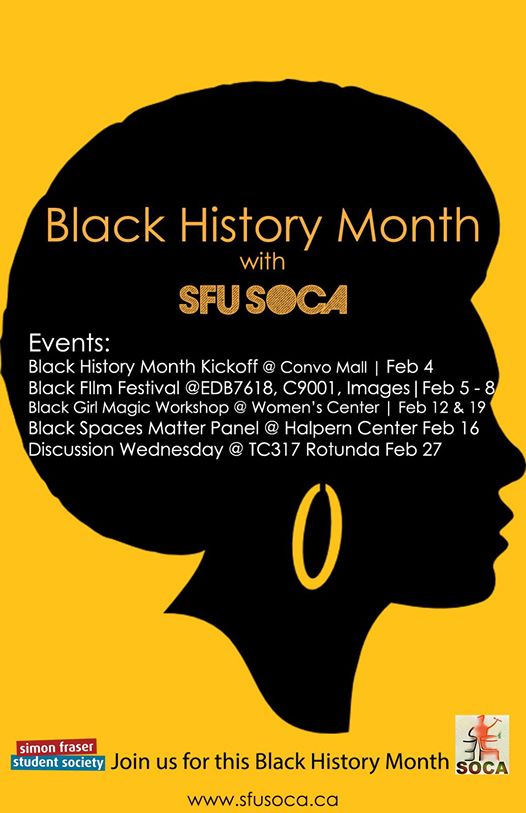
Spend Black History Month with SOCA

0
Image courtesy of SOCA

By: Winona Young

February is not only the month of love, but more importantly, Black History Month! Spend the month right here at SFU with events planned by SOCA (Students of Caribbean and African Ancestry).

In case you missed it, SOCA already held movie screenings of films by Black directors and were led by Black characters. You can catch their last screening of Blackkklansman at Images Theatre on Feb. 8!

A few highlights of the many events they’ll be holding for the rest of February will be the Black Girl Magic Workshop at the Women’s Centre, held on February 12 and 19. That workshop in particular will focus on self-love for Black women, so ladies, feel free to drop by! If any students want to listen in on Black issues, there will also be the Black Spaces Matter: Panel Discussion that will revolve around the necessity for spaces for Black students on university campuses.

The biggest event of them all however will be AfroFest! Starting at 6 p.m. on February 28, AFROFESTIVAL is a cultural event that will feature free food, music, and a space to celebrate those of African ancestry. Done in collaboration with the UBC Black Student Union as well as other organizations, this festival will also feature performances from SinBirds, Kenyan Lewis, Diane Mutabaruka, and Rabbit with a live DJ.

The Peak spoke to SOCA’s President, Giovanni Hosang through email to speak further on his organization’s events. “SOCA holds the various Black History Month to showcase and raise awareness of the contributions that many black trailblazers and changemakers, black organizations, black-owned companies or black political blocs have made and continue to make to society,” Hosang wrote.

When asked about whether Black SFU students who aren’t as active within the community could benefit from their events, Hosang remarked that they absolutely could.

“For Black Students who aren’t as active, they definitely benefit from attending these events, through being able to connect and resonate with the experiences of other black students and through the shared stories of many that come before us,” Hosang mentioned. Hosang also noted that even non-Black students could benefit from attending such event. He wrote of how it’d be an opportunity to have important conversations towards anti-Black racism and help serve as an ally.

When asked to describe SOCA’s Black History Month events in one word, Hosang replied simply: “Fulfilling, and I will steal another word, lit.”

All of SOCA’s events will be free.

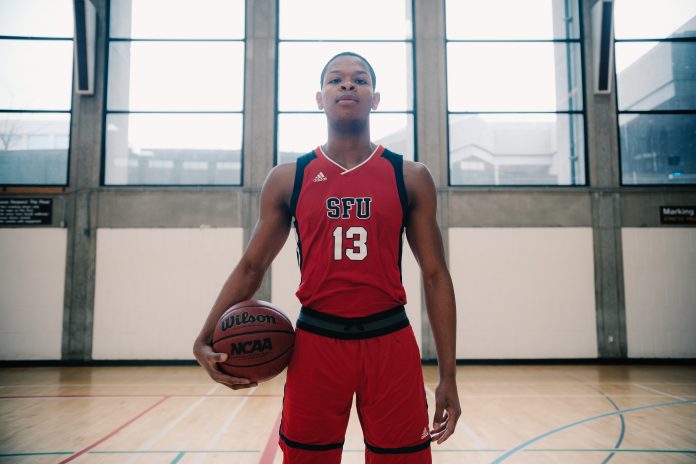
SFU men’s basketball’s Bongani Moyo talks about his journey into the NCAA

0
After three years trying, Moyo made the SFU men's basketball team as a walk-on. (Chris Ho / The Peak)

By: Shepard Kanyekanye

Year: Senior

Hometown: Harare, Zimbabwe

Major: Finance and Marketing

Bongani Moyo, an active player on the SFU men’s basketball team, is currently in his fifth year and looking to graduate this spring. His basketball journey, although seemingly coming to an end here at SFU, is one that has come with its fair share of challenges as well as life lessons that anyone with a goal can use for inspiration.

These lessons particularly came from Bongani’s basketball journey, where having no name, game footage, or respectable references — all things that today’s NCAA requires for teams to even consider you — led him to defy the status quo by suiting up to play valuable minutes. He has fit perfectly into his role on the team simply due to him being stubborn when told “no,” has been wise enough to ask coaches how he could improve, and has allowed a supporting cast of people to speak the impossible into his life.

The Peak: Who would you say is the most influential person in your life?

Bongani Moyo: I have a couple — obviously my parents, my brother and my high school coach are pretty influential to me. I’ve had a lot of coaches that have definitely influenced me in high school. Whether it be basketball, golf or hockey I’d say they all contributed in moments of my life.

P: So you developed your love for basketball back in high school right? With your coaches. How did these coaches help you build that passion and love for basketball?

BM: The best way to describe it is that they let me do me and they had a lot of confidence in me, which helped me gain confidence in myself; so they never tried to hold me back or stop me from doing anything. It was more like okay, do this, and if I messed up, yeah, I messed up, and they would be like, “Hey, you messed up and this is why you messed up, next time try to do this,” instead of them saying “Hey, don’t do this.”

P: That’s interesting; can you tell us about your story on how you came from the basketball system in Zimbabwe to wanting to get into the NCAA system?

BM: When I got here, the first thing I did — like, in the first week — was that I spoke to the coach. I asked, hey, are you guys hosting any tryouts? [ . . . ] That year, which was the 2014–2015 season, [the team] had a 22 [man] roster. He basically said, “We’d have no space for you,” and I was like, okay, fair enough, it is what it is.

The second year, that coach left and it was a new coach that was coming in, and he was coming in with a bunch of new players so I figured that would be my chance to try out. So I spoke to him and he was like, yeah, for sure, come down. We’ll give you a week, you can practise with us, and then that can be your one-week trial to see whether you could fit into our system or not.

After a week, he basically pulled me into his office and said, hey, as much as we like the way you play, etc. we don’t think that you are able to help us right now [ . . . ] You’re close, but not close enough; sorry, but we can’t take you on.

I was like, fair enough, that’s fine, and I asked him during that same conversation if there was anything that I could do between now and next season to kind of improve.

Fast-forward to the end of the season. That coach also leaves, and the assistant coach gets promoted to the head coach. So I messaged the assistant coach afterwards, and I was like, hey, you guys are doing post-season training now — would it be okay if I came and trained with you guys during the postseason just so that I can get a feel of what level I need to get up to; to see if I can play with these guys? And he was like, yeah, for sure.

So I trained with those guys for about two weeks, and then one day I got an email from the assistant coach offering me a position on the team and I was like, hell yeah, I’ll take it! That’s what I’ve been working for this entire time. So it was pretty cool: the journey and the process.

P: You spoke about how you asked the coaches here at SFU where to improve in terms of your game. Could you go into more detail on what they pointed out?

BM: I would say the biggest thing was my basketball knowledge. Coming from Zimbabwe, basketball isn’t that great. North America is where basketball lives, so the people are far more developed coming out of high school than we are, making it a lot tougher. For example, the stuff that we are learning at 17 and 18 years old is the stuff they are learning when they’re 13 and 14 years old. So they have that much more time to polish and start [reading] the game better as opposed to just learning how to play, which is what I was still doing.

P: Were there ever people along your journey — teammates, students — that kept you going along the way?

BM: Oh definitely! My first team high school coach [Eric Banda], I still talk to him, like the times I’ll have a bad game and explain to him why I played badly, to which he would give me his own two cents on what he thinks I need to do better. Obviously, my teammates are just amazing, everyone’s uplifting even if you play terribly and coach rips your head off; everyone is just like “Listen, man, don’t worry about it, it’s all good. Just keep doing you,” which I think is great.

P: Could you take me through your first game here at Simon Fraser University?

BM: So it was at home… against Douglas, which was a pretty decent team. I had been sitting on the bench most of the game, you know, obviously coach kind of had his people, he knew who his main guys were and I wasn’t one them, which is fine, because I wasn’t good enough at the time.

So I’m on the bench, got my call up, and went on super scared! I was like a deer in headlights just because everyone on the court looked so comfortable and I was not, which made me even more uncomfortable. But I just tried my best to do what coach was asking and just contribute to the team.

Athlete’s Corner

To anyone with any goals or aspirations, don’t let failure discourage and demoralize you. I can guarantee that the most successful people have all experienced failure before, but the difference is the way they responded to failure. I implore everyone reading this to look at their failures as a source of inspiration and motivation, rather than a deterrent from trying again.

You aren’t defined by your failures; I know that the fear of failure can sometimes be overwhelming, but I’ve found that the fear of failure pales in comparison to the feeling of regret. So don’t let failure hold you back from doing what you want to do, after all, the only true failure is when you stop trying.


Stress Dream Journal

0
Illustration by Marissa Ouyang

By: Kitty Cheung, Staff writer

At the recommendation of some mom blog I encountered during one journey down a 2 a.m. Internet rabbit hole, I’ve decided to keep a dream journal to figure out how to get the stench of my nightmares out of my bedsheets. I’ve collected some entries here from the past week and included possible symbols to see how my unconscious may be fucking me over.


Feb. 3, 2 a.m.

I remember swimming in a pool. The water was all nice and warm, then suddenly, it got way too hot too quickly. I realized the water was no longer water but hot coffee, and it was scalding my skin. The coffee started rising in waves, becoming a bitter, caffeinated tsunami that both drowned and burned me.

Possible Symbols

  • Water . . . swimming . . . wet . . . does this count as a wet dream?
  • I’ll mull it over tomorrow morning once I’ve had some coffee.


Feb. 7, 4:17 a.m.

I think I just had a lucid dream. I felt like there was someone hiding under my bed. When I finally got the courage to get up in my dream and look underneath, it was my term paper from last semester, but it was all ripped, crumpled, and angry. It started slicing me up with papercuts, but I was bleeding black ink instead of blood. The ink was soaking through the floor and I guess it must have been dripping underneath, because my landlady Gloria saw and told me I’d have to pay for damages.

Possible interpretations:

  • But I thought I got a good mark in that one W course.
  • Should I visit the Student Learning Commons about this?
  • Fuck. I just remembered rent’s due tomorrow. And that ink stain’s never coming out.


Feb. 11, 3:58 a.m.

My mom came to class to drop off my lunch, but it was weird because it was in the AQ. I was getting embarrassed and so I told her that it was fine and that I’d see her at home, but she kept insisting that I take the lunch, so I finally accepted it.

But when I opened up the bag, an actual raccoon sprang out and started clawing me in the face.

So I’m trying to pull it off, yelling and shrieking. My mom does some sort of high-pitched whistle and the raccoon just stops, gets all calm as it jumps to the ground. It sits back on its haunches, scratches its tummy, then lumbers over to hop on my mom’s shoulder and they leave together. Then I just spend the rest of lecture with my face all raw and scratched up, but no one, not the prof, not any of my classmates, says anything.

Possible Symbols

  • Is this bad karma for that half-sandwich I snuck to a raccoon last night? Raccoon obesity is a real problem, but it was so thiccc and floofy . . .
  • The last time Ma made me lunch was in high school. Maybe I’m reverting back to the days of being nurtured by her. I’ll call her tomorrow.
  • I bet this has to do with my stepdad Randy. He’s probably the reason I forgot my lunch in the first place. Asshole.


So you got some emails about SFU’s governing bodies, huh?

0
Image courtesy of SFU Faculty of Education

By: Gabrielle McLaren, Features editor 

So. The emails you’ve gotten. They’re definitely emails, and you’ve definitely seen them while frantically emailing group members and professors and getting spammed by Canvas… and while you might not have actually opened them, that’s okay, because you’re here now. Those emails were about upcoming votes to elect new students to the SFU Senate, the Board of Governors, and the SFU Community Trust. We’ll talk about what they are, what makes each entity unique, how they impact undergraduates, and what your next step towards being a good involved little student could look like.


SFU Senate

What is this: The SFU Senate is the body responsible for “the academic governance of the University,” according to its website. Their concern is anything at SFU related to learning, teaching, and research. They meet once a month, and their agendas and documentation are readily available online. You can also find some Peak coverage of the senate’s activities online under our “senate” tag.

To give you a more concrete idea of their role, some examples of things the senate has done in the past are: discuss emergency protocols on campus, debate the creation of a School of Environmental Sciences, and work out the logistics of how to distribute bursaries to international students.   

Why do we have this: Not only is SFU Senate governed by the provincial University Act, but this act guarantees their existence as components of the university. The University Act also helpfully outlines the senate’s roles, notably managing convocation and adding names to the convocation list (ergo, giving you your degree). But really, the senate has twenty-four powers listed in the Act, to give you an idea of how exhaustive the Act gets. Some standout features include:

  • Determine admission requirements (academic and other)
  • Forming standing committees that deal with things like the university’s budget, academic discipline appeals, and relations with other colleges and universities in B.C., as well as standing committees to monitor issues as needed.
  • Oversee and recommend changes to education across all faculties
  • Grant degrees, diplomas, and proficiency — including the honorary degrees that we give out to the likes of Jane Goodall and Bill Nye the Science Guy. For whatever reason, degrees and certificates in theology are specifically excluded.
  • Award fellowships, scholarships, bursaries, and prizes to students (so please let me take this opportunity to say thank you).
  • My personal favourite: “to make rules for the management and conduct of the library,” which also extends to the conservation of heritage objects and collections that are in the university’s care.  

And since there’s never a bad time to take a potshot at UBC: shoutout to UBC for having two senates and a council of senates to manage their two senates. You’re right, UBC: Mom loves you more.

Who is part of this: Back to SFU. As with most non-teaching universities (which are seperate), you’ll find the following people on the senate: the chancellor (Anne Giardini), the president (Andrew Petter) who also acts as the chair, the academic vice president (Dr Peter Keller), faculty deans, the chief librarian (surprise, this is a thing — ours is Gwen Bird whose title is actually University Librarian and Dean of Libraries), and the director of continuing education (Dr Julia Denholm is our Dean of Lifelong Learning).

Think of these people as the senate’s core. Add to that a number of faculty members twice as big, which includes at least two elected members from each faculty. For each of these “core members,” you’ll also have an equal amount of students who are members of the SFSS or GSS (again, a seat is guaranteed for at least one student per faculty). For fun, sprinkle in four non-faculty members who are elected by the convocation (which is a separate group of people you can read Part 4 of the University Act to find out more about), and one member elected by the governing body of any college affiliated with the university. In SFU’s case, that would be FIC. The senate can also choose to elect additional members, as long as that doesn’t mess with the previously outlined ratio.

That’s a grand total of 40 people currently in SFU’s senate, which doesn’t account for three vacant positions. Speaking of vacancies: unlike the SFSS, where terms last a year and there are therefore annual board overhauls, Senate terms last either one or three years. Every May 31, some terms expire. SFU students are asked to apply if they want to be on the senate (spoiler alert: if you’re reading this, you’ve missed the deadline), and those of us who don’t want to be on the senate get to elect those who do.

When is this happening: The campaigning period was from February 4-12, so keep your eyes peeled for posters and so on. From February 13-15, you’ll be asked (or are being asked, depending on when you read this) to vote for the next students that will be representing you on the senate. Links will be emailed to students, and these will include instructions on how to vote and links to candidate statements that you can use to make an informed decision.

Eleven candidates are up to be elected by acclamation, which essentially means a yes/no vote, including Russell Dunsford, who has served on the SFSS board of directors as the environmental faculty representative.

Was this helpful? If not, at least I can let you know that according to SFU, “Questions about elections may be directed to Steven Noel, Senate Assistant and Electoral Officer, at 778-782-3168 or email [email protected].”


Board of Governors

The Board of Governors at SFU is different than the senate, since their goal is the business side of the university. Again, they’re governed by the one, the only, the University Act.

Unless you’re UBC, your board of governors should have 15 members (including the president and chancellor once again). As regulated, there are two students on the Board of Governors: one undergraduate and one graduate level student. One candidate per position has applied, and will be elected by acclamation: Sarah Lord Ferguson (a graduate student in business) and Ali Versi (a FASS undergrad).

Reassuringly, the University Act prescribes that these people “must act in the best interests of the university,” before going into further details. More specifically, they focus on “the management, administration and control of the property, revenue, business and affairs of the university.” This includes setting and collecting fees, but also appointing, removing, and granting tenure to teaching staff.  They meet six times a year, and are not remunerated for their work on the board.


Senate Graduate Studies Committee (SGSC)

Remember those committees the senate forms as needed? Well, here’s one specifically related to developing new graduate programs, maintaining the academic excellence standards set by the senate, and advise the senate on all things grad-school-related.

I would go on about it more, but no nominations were received to fill one of four positions available. You can still go read up on the SGSC online, where meeting minutes and annual reports can be found.


SFU Community Trust

So this one’s fun and a little different, more SFU-centric, and (you might want to sit down for this) does not involve the University Act.

The SFU Community Trust oversees the development of UniverCity, the community neighbouring the Burnaby campus. According to an email sent to the student body as a whole on January 30, “The SFU Community Corporation is governed by an independent Board of Directors that includes SFU stakeholders, faculty and student representatives, as well as external members.  As trustee, that Board sets policy for SFU Community Trust, helping to shape the future of UniverCity.”

Essentially, we’re trying to play nice with the kids next door in a productive, sustainable way. As a bonus, funds from the development of UniverCity have funneled their way back to SFU in the form of the Community Trust Endowment Fund (CTEF), and are now being put to various causes including supporting the Strategic Research Plan which does things like provide research grants and financial support to students.

The main takeaway for this one is that three students are vying for one spot: Christopher Correia, Jasdeep Gill, and John Pickering. So yes: you will have to make a decision, click a button, and vote.

Read all you can at the 34th Annual Jewish Book Festival

1

By: Winona Young

Calling all bookworms: the Cherie Smith JCC Jewish Book Festival is here! Running from February 9 to 14, this year’s festival is packed with entertaining events, reading and discussion panels, and more.

There are several notable events to look out for. Mike Reiss, a writer for The Simpsons for over 30 years, is talking about his book, Springfield Confidential: Jokes, Secrets and Outright Lies from a Lifetime Writing for The Simpsons. Another speaker will be CBC’s Dr. Brian Goldman, presenting on his book about the importance of empathy, The Power of Kindness. Author Ellen Schwartz will appear for her book, The Princess Dolls, a tale of friendship set against Vancouver in 1942. Some events will also be in French and Yiddish!

When The Peak spoke with the festival’s director, Dana Camil-Hewitt, Hewitt felt that non-Jewish students would also be able to benefit from attending the festival.

“It is not a faith-based festival by any means,” Hewitt elaborated. “It has nothing to do with religion, it’s purely cultural.”

Hewitt emphasized that the featured authors don’t necessarily write about their Jewish experience, but about life overall.

“[Jewish authors] can also write about love, loss, the world, children, historical fiction . . . you name it, they write about it! So it is truly universal, anyone can have interest can find interest in our events, and we program with this very much in mind,” she concluded.

The festival is only six days long and is held at various venues, so check out their schedule and plan your trip now!

Tickets for single events range from $18 to $24

SFU men’s basketball win second straight game against top GNAC opponent

0
The game came down to a last second shot attempt from Northwest Nazarene. (Photo courtesy of SFU Athletics)

By: Brandon Braich

SFU’s men’s basketball team, fresh off an upset win over the #13 ranked Saint Martin’s University Saints on February 2, took on the #24 ranked Northwest Nazarene University Nighthawks on Thursday, February 7 at the West Gym on Burnaby Mountain.

After a thrilling final minute, SFU walked away with a 78–77 victory after Jayden Bezzant’s three point attempt at the buzzer fell short for the visiting side. The win improved SFU to 11–10 overall and 5–8 in GNAC play. Jasdeep Singh led the way offensively, finishing the night with 17 points on 6–9 shooting for SFU.

Early in the first, it looked similar to these two teams’ previous match, a 88–72 victory for the Nighthawks. Despite a few early buckets by Singh, Northwest Nazarene jumped ahead to a 19–12 start, controlling both ends of the floor. After a loose ball ended with a jump-ball call, a slight skirmish between SFU’s Michael Provenzano and the Nighthawks’ Adonis Arms broke out, resulting in a technical foul on Arms, and then another technical to the Nighthawks head coach, Paul Rush.

The altercation quickly increased the intensity of play, leading to a spirited first half. After sinking the technical free throws, Provenzano broke the trap and found Julian Roche under the basket for a layup. This spurred a 15–0 run that turned an early deficit into a 27–19 lead for the Clan. Roche was a force on the defensive end, finishing with two blocks and altering several shots at the rim.

“I think we took some bad shots, when we fell down,” SFU head coach Steve Hanson said. “But we just settled down, and played tough.”

The Nighthawks began to tighten their defense as the half drew to a close, and pulled within four, but a three by Drew Bryson pushed the lead back up to 42–35 going into the break.

The Clan came out energized, quickly building their lead in the second half. Othniel Spence (9 points) got it started with a layup to extend the Clan lead. Singh followed with a putback and then a shot from long range to push the lead to 49–40.

SFU’s defense was locked in, led by great perimeter defense by Michael Hannon. Hannon was all over the court, not only picking up two steals, but finishing with a game-high eight rebounds.

The final half was a physical affair, Wilfried Balata was relentless attacking the rum. Although he struggled to finish, Balata was able to get to the line 13 times, making 10 of them.

The teams went back and forth, with the Nighthawks pushing the pace in order to prevent SFU from setting up their defense, while playing a high pressure defense themselves.

“I think we just did such a good job in the half court,” Hanson said. “They just wanted to speed things up. They were pressing us, getting us out of our rhythm offensively.

“We did a poor job getting back for about a four minute stretch there, and they capitalized.”

But with 7:20 left, a pull up two by Provenzano gave the Clan firm control with a 67–55 lead.

However, with five minutes to go, Arms began to put his mark on the game. He hit multiple threes to close the gap to four, 73–69. After an offensive foul on SFU, Arms came back down and scored again, pulling the game within two.

With momentum swinging against them, Balata backed down his man and hit a tough shot at the rim plus the foul. With under two minutes to go, Arms drove to the rim and hit a layup. Then the Nighthawks forced a critical turnover with their full court press, leading to free throws.

After a missed shot by Spence, Arms scored again making it a 76–75 game going into the final minute. Needing a basket desperately, SFU put the ball back in the hands of Balata, who backed down his man again and forced another foul. After hitting the first free throw, Balata missed the second keeping the lead to just two.

With the ball back in the hands of Arms, he drove once against to the rim. This time, SFU was ready, with Singh rotating over to contest at the rim leading to a wild miss by Arms. Balata came down with the rebound and was immediately fouled.

Balata once again hit one of two, leaving the door open for the Nighthawks. But after another stop, the Clan had a final chance to ice it at the line, but Muir-Keng missed both free throws giving the Nighthawks one final chance. Despite his big night, the ball never saw Arms’ hands on the final possession, resulting in a missed three by Bezzant, giving SFU the thrilling victory.

Hanson was pleased with his team’s performance, especially with their play on the glass.

“They’re a tremendous rebounding team,” Hanson said. “I think tonight, we were plus one or plus two on the boards and that was huge for us.”

What’s Next:

SFU will look to continue their run against Central Washington University (9–12). The last time these two teams met, Central Washington walked away with a 85–84 victory in overtime. The game will start at 7 p.m on February 9 in the West Gym.

Canada can and should better support Venezuelans

0
Photo by George Castellanos/Getty Images

Written by: Tatum Miller, Peak Associate

The worst humanitarian and economic crisis in the history of Latin America is currently unfolding in Venezuela. Much of the population lacks access to food or medicine, poverty is reaching all-time highs, and infant mortality is on the rise. Tensions are rising, as both Venezuela and the international community are entangled in a leadership dispute and a military schism. Canada’s response, while a strong start, should be broadened to mitigate the consequences of Venezuela’s crises.

More than three million Venezuelans have already fled, with some economists forecasting that that number will rise to eight million in the next few years. To compare, an estimated six million Syrians have fled since their country. The majority of Venezuelan refugees have arrived in Columbia or Brazil, who are struggling to cope with the massive influx of people. How can it be that the Syrian refugee crisis stoked such debate within Canada, but as a crisis unfolds close to home we barely mention it?

The crisis was caused by decades of poor economic planning that has left the Venezuelan economy in freefall. Nine out of 10 people are in poverty, and hyperinflation has eclipsed one million per cent, rendering the country’s currency absolutely worthless. The average person can only afford just 900 calories per day, far below the nearly 50,000 they could afford in 2012. The plummet has no end in sight.

Government responses to regain control of the economy have included price controls, minimum wage increases, and even issuing a dubious new cryptocurrency to replace the Bolivar. These solutions will have no effect under hyperinflation, and the oil dependant economy will continue to slide.

Opposition leader Juan Guaidó has declared himself interim president in opposition to Nicolás Maduro, and is urging the military to join his camp. This could spark a civil war if the military becomes further divided. Guaidó has gathered support from Canada, the USA and other Western powers, but Russia and China still support Maduro. Experts are drawing parallels with the Cold-War.

International responses, both to aid the people and to coerce the government into reforms, have been ineffective. This certainly hasn’t been helped by Venezuelan President Maduro’s repeated denial of foreign aid, appearing intentionally ignorant to the depth of the country’s situation. Canada, the USA, and allies have levied sanctions against Venezuela and are supporting the opposition in order to pressure Maduro, though the Venezuelan people will still suffer in the short run.

This denouncement of the Venezuela government is a step in the right direction, but there are multiple strategies that Canada should also consider.

First, we should begin reviewing Canada’s refugee policy to include Venezuela alongside Syria. The Liberal Party proudly promotes welcoming Syrian refugees, and this should include Venezuelans as well. In the upcoming 2019 election, this opportunity to provide international relief could be a major platform opportunity for any candidate.

Second, Canada should increase cooperation with the Organization of American States (OAS), the Lima Group, and bolster neighbouring countries that have already taken in refugees. The crisis will become worse before it gets better, and in the wake of this catastrophic socioeconomic breakdown, civil war or total state collapse is not far-fetched. The region must be stable to minimize spillover effects.

Canada historically has taken in refugees during times of crisis, from the Vietnam war to the recent Syrian crisis. We pride ourselves on giving humanitarian aid and we continue to do so in many countries today. It is urgent that we shift our gaze to the dangers faced by Venezuela and make a positive impact where we can.

SFU hockey clinch playoff spot with big win in Victoria

0
Brendan Lamont had a goal and a assist over the two contests. (Photo courtesy of SFU hockey)

By: Dylan Webb

After a rollercoaster first three quarters of their BCIHL season, the SFU hockey team was finally able to clinch a playoff spot on Friday night in Victoria. Defeating the UVIC Vikes for the third time in four games, the Clan officially closed the book on any faint playoff hopes the Vikes were holding onto. As their three-win season winds down, the Vikes will visit SFU for their final two meetings of the season on February 22 and 23.

Firing just seven shots on the Clan net through two periods, the Vikes were unable to generate substantial offense throughout the game. On the other hand, SFU benefitted from an offensive outburst that included three power-play tallies — two from leading goal-scorer Mitch Newsome and one from forward Mac Colasimone. Complemented by even-strength goals courtesy of forwards Jakob Krannabetter and Brendan Lamont, SFU would outshoot the Vikes by a final margin of 44–17 in a dominating 5–1 win, punching their ticket to the first round of the BCIHL playoffs.

On Saturday night, as the Clan’s focus shifted to securing favourable playoff seeding for their first round series, they rolled into Nanaimo to face a much stiffer challenge in the second-place Vancouver Island University Mariners. This much was evident after the first period as the Mariners threw as many shots toward the Clan net in the first period as the Vikes did in the entire game the previous night. Fighting back from a two-goal, first-period deficit with goals from forwards Mitch Newsome and Nic Holowko, the Clan were able to maintain a tied game until late in the third period.

With just eight minutes remaining in the final frame, VIU forward Brett Witala continued his strong offensive season with a power-play tally that put the Mariners up for good. Adding two empty netters in the dying minutes allowed the Mariners a bit of breathing room toward the end of the game, and the final push from the Clan wasn’t enough to tie the game.

With this loss, the Clan now find themselves in an uphill battle for playoff positioning. While they now sit a full six points behind the Selkirk College Saints for third place in the league standings, the Clan do have two games in hand which makes catching the Saints for third, or even the Mariners for second, a challenging yet feasible task.

Having started both games for the Clan over the weekend, goaltender Ryan Sandrin had one of the best weekends of play in his BCIHL career. Stopping 52 of 56 shots he faced over the span of both games, Sandrin stayed sharp on a slow night in Victoria and followed up the winning effort by giving his team a chance to win on Saturday in Nanaimo. Facing a barrage of 17 shots in the first period in Nanaimo alone, Sandrin kept the Clan within striking distance throughout and appears to be solidifying the starting role as playoffs rapidly approach.

Discussing the biggest differences between the Clan’s playoff spot clinching win over the Vikes on Friday and their loss to the same team just a week before, Sandrin emphasized that the team simply had “much better puck possession and execution.” Pointing to the fact that the team collectively “clogged the middle in the defensive zone and pushed everything to the outside,” Sandrin was appreciative of the strong effort by his teammates that allowed him to face only 17 shots in the contest.

What’s next:

SFU now faces another extended break from regular-season action, this time a full twelve days, before returning to the ice on Vancouver Island with another key matchup against the VIU Mariners.

At the risk of over emphasizing the importance of a single game in a 24-game regular season schedule, it’s possible that SFU’s playoff positioning could be largely determined by the result of the game on February 15 in Nanaimo. With a win, the Clan would inch toward both VIU and Selkirk for the second and third playoff seeds whereas a loss would all but guarantee a fourth-place finish for the team.

Following the game in Nanaimo, the Clan will host the league leading Trinity Western University Spartans for a Family day matinee game. Puck drop is at 3 p.m on the February 18 Family day holiday at the Bill Copeland Sports Centre.

SFU men’s basketball split road trip against Seattle Pacific University and Saint Martin’s University

0
Roche's last minute jumper was the difference in Saturday's game. (Photo courtesy of SFU Athletics)

From Thursday, January 31 to Saturday, February 2, the SFU men’s basketball team travelled down to the states for a two-game road trip against the Seattle Pacific University Falcons and the Saint Martin’s University Saints. Given that these are two of the top teams in the GNAC, coming away with one win would be considered a success for the Clan. After losing against the 8–4 Falcons, the Clan bounced back for an impressive win against the conference-leading Saints.

Game 1:

In this one, SFU just didn’t have what it takes to beat the Falcons. Consistently one step behind Seattle Pacific throughout both halves, they would eventually fall 92–76, in a game where the Clan could do nothing to stop the Falcons’ attack.

On the offensive end, however, some players were able to get it going, particularly Othniel Spence. The Clan sharpshooter was firing on all cylinders in this one, exploding for a game high 26 points on 9–17 shooting. He also hit four threes in the contest, and hit all four free throw attempts.

Off of the bench, Jordan Muir-Keung also had a fine game, scoring 16 points on 7–14 shooting. Michael Provenzano was the only other play in double digit scoring for SFU, finishing the game with 10 points.

The Clan defence just wasn’t able to keep up. The Falcons shot 31–55 from the field (.564) including 10–19 from three (.529). SFU also gave up 11 offensive rebounds.

Game 2:

The second game of the road trip could not have been more different for SFU. Particularly on the defensive end, the Clan brought their A-game against the conference-leading Saint Martin’s Saints.

SMU only shot 20–58 from the field (.345) against SFU’s defence, including only going 11–34 from three (.324). This is particularly impressive given that the Saints are known for their offensive prowess.

On the offensive end, Julian Roche was an absolute beast. After having a quiet night on Thursday (seven points and three rebounds), Roche carried SFU on his back on Saturday. He finished the game with a 23 point, 10 rebound double-double, and was a force on the inside all night. He also scored the game winning bucket with five seconds remaining in the game, putting the Clan up 61–59.

They would pull off the win after a missed three-pointer by Saints player Luke Chavez.

With the win, the Clan are now 4–8 in the GNAC conference this season.

What’s next:

SFU will now return home for three games. The first comes against the tough Northwest Nazarene Nighthawks, who are tied with Saint Martin’s with a 10–2 conference record. The game is February 7 in the West Gym, with tip off at 7 p.m.