Home Blog Page 553

Catch it before it’s gone: Spaces for Reading at the SFU Gallery has less than a month left

0
The installation invites you to sit down and take a break to enjoy some art. Image by Blaine Campell courtesy of SFU Galleries.

By: Kitty Cheung, Staff Writer

Hurrying through the AQ hallways between classes, you may have passed by a room with what seems like a large white block, dotted with books and pillows. The SFU Gallery’s current exhibit, Spaces for Reading, combines the work of artists Ann Beam and the late Carl Beam. By displaying the work of these artists in the same space, the exhibit is rich with insights from the different lenses through which the two artists create.

The gallery is minimalist in its style of display. Framed artworks by Ann Beam and Carl Beam are hung in a line, creating a single row that extends across several walls. Walking through the exhibit, the space overall is quiet and contemplative, and the two artists seem to be in dialogue with each other through the gallery.

There is a sense of public and private communication going on through the pieces, demonstrating the intimate relationship between the two artists. The exhibit includes images of the couple building their home together from adobe bricks and even reading materials on display that discuss their creative relationship with their daughter, Anong Migwans Beam, who is also a visual artist.

Carl’s work focuses on Indigenous issues, using an image transfer process as a medium to empower. Untitled (17 Works) (1998) is a series of nonlinear collages depicting historical events charged with political commentary.

Concurrently, Ann’s work tends to focus on the woman — as a mother, homebuilder, nurturer, and more. Her feminist artistry is especially prevalent in her “Studies for the Motherline” collection, some pieces of which can be found in the exhibit. She even goes on to explore outer space, creating watercolour paintings of planets and suns.

The centre of the room holds a large terraced white block, with reading materials selected in response to the works hung on the walls. The selected readings include work by poet Mackenzie Ground, artist Sandra Semchuk, and writer Richard Hill. These reading materials, which are spaced throughout one level of the terraced structure, include books and publications featuring Indigenous art, history, and perspectives. Pillows are also neatly arranged on a lower level, so that the space itself extends an invitation for each gallery visitor to sit down and peruse its reading materials.

On the white block centrepiece, one can also find exhibit pamphlets, which include an annotated bibliography contributed by Ground, Semchuk and Hill, as well as a conversation between Semchuk and Hill about Ann Beam and Carl Beam. I would recommend picking up one of these pamphlets for a more insightful gallery experience, as the intention and reasoning behind the way works are displayed can be just as important as the works themselves. The annotations, or comments about the reading materials chosen to be in the exhibit, offer direct explanations from Ground, Semchuk, and Hill about the decision behind each selection. Semchuk and Hill’s conversation also provides additional perspectives on the works from Ann Beam and Carl Beam.

Before you rush off to the next 145 after class, I would encourage you to take some time to explore the work of Ann Beam and Carl Beam.

Spaces for Reading will be on display in the SFU Gallery (open Tuesday–Thursday from noon to 5 p.m. in AQ 3004) until June 20.

Need to Know, Need to Go: May 27-31

0
Sky Chart courtesy of SFU Trottier Observatory

By: Marco Ovies, Peak Associate, Winona Young, Head Staff Writer, and Alison Wick, Arts Editor

Trottier Observatory Starry Nights

If you ever wanted to learn more about space, look no further than Starry Nights at the SFU Trottier Observatory on Burnaby Mountain. At these evening star parties, you will be able to discover many of the wondrous celestial objects that inhabit our solar system. You can even bring your own telescope and have experienced astronomers teach you how to use it and what to look for.

The next star party to be held will be on May 31 at 9 p.m. weather permitting. Check out @sfutrottobs on Twitter for up to date information on the status of Star Parties.

Logo image by Samaqani Cocahq / Natalie Sappier courtesy of Skoden Festival

Skoden Indigenous Film Festival

The Skoden Indigenous Film Festival is being held at the SFU Goldcorp Centre for the Arts, inside the Djavad Mowafaghian Cinema. The one-day festival will consist of two film programs, an awards ceremony, and an after-party.

Skoden is an Indigenous slang term for “let’s go then” and reflects the festival’s intentions to bring people together to celebrate Indigenous-centred filmmaking of the Pacific NorthWest, and Indigenize SFU. The festival will be within Musqueam, Sḵwxwú7mesh, and Tsleil-Waututh territories, with the family screening at 1 p.m, followed by the adult screening at 4 p.m. Both showings will require separate tickets.

The Skoden Indigenous Film Festival on Saturday, June 1, 2019. The event has a sliding scale for tickets which consists of: Salmon $0 / Bear $5 / Raven $10 / Coyote $20. Separate tickets are required for the 1 p.m. and 4 p.m. screening. The awards ceremony requires no tickets but has limited seating.

IVAs 2019 Logo Courtesy of the Indigenous Voices Awards

Indigenous Voices Awards 2019 Gala

This is the second year of the annual Indigenous Voices Awards, which seeks to highlight, celebrate, and award the literary accomplishments of emerging Indigenous writers. This year there are 14 finalists in seven categories, and a total of $1,400 dollars will be awarded to the different writers at the gala on June 4. The IVAs are not just about prizes, however, as they also seek to foster relationships and create connections to reject the individualism and lack of support of prize culture.

The gala will be held at UBC this year and will feature performances and readings in addition to the awards themselves. Spearheaded by SFU’s own Dr Deanna Reder (Cree/Métis), the Indigenous Voices Awards 2019 Gala is the perfect opportunity to learn about, experience, and celebrate the variety and talent of Indigenous voices.

The Gala is being held June 4 at UBC. Tickets are free, and you can RSVP through Eventbrite.

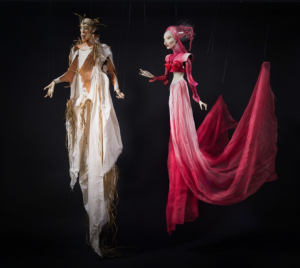
Image courtesy of MOA

Shadows, Strings, and Other Things at the MOA

Think Potter Puppet Pals, only from different countries and centuries and even better at storytelling.

Theatrical takes on a new meaning with the Museum of Anthropology’s exhibition of Shadows, Strings, and Other Things: The Enchanting Theatre of Puppets. With 250 handcrafted pieces from all over the world, including Portugal, China, and the UK, this puppet exhibition is bursting with a diverse array of art styles. As curator Dr. Nicola Levell of UBC insists, “no matter the origin, size, or medium, puppets are powerful conduits of creativity, activism, and social commentary.”

Shadows, Strings, and Other Things is being exhibited from May 16 to October 14, 2019 in The Museum of Anthropology at the University of British Columbia. Tickets are $16 (without tax) for students, $10 on Thursday evenings from 5 to 9 p.m, and are free for Indigenous peoples.

Joshua Whitehead’s full-metal indigiqueer is inspired by love, identity, and the Internet

0
full-metal indigiqueer cover art. Image courtesy of Talon Books.

By: Alison Wick, Arts Editor

I often find poetry to be a difficult medium of literature to digest. I think, as for many of us, this largely comes from an understanding that poetry is not really meant to be understood or read for fun. As we are force-fed Shakespeare and Milton throughout high school, we learn that poetry is not something to have fun with but rather something to sit in the classroom and analyze. It’s an ivory-tower pursuit wholly detached from the real world.

However, most writers of poetry will tell you, and books like full-metal indigiqueer will show you, the opposite.

Joshua Whitehead’s full-metal indigiqueer is poetry like you may have never seen before. It is as much a visual piece of art as it is a literary piece of poetry. The book opens with “birthing sequence,” 15 pages that read like a comic flip book as a white dot grows to reveal what feels like binary code. The page becomes filled by a pattern made with colons and spaces, and the word “H3R314M” at the centre. You then turn the page and are thrown right into Whitehead’s visually and linguistically complex book of poetry with the poem “i no bo — d[i]y” which explores the idea of authenticity and the complexity of names.

This collection of poems is created through Whitehead’s Indigequeer character Zoa, who, as the book’s back cover puts it, “brings together the organic (the protozoan) and the technological (the binaric) to re-beautify and re-member queer Indigeneity.” Whitehead rethinks the construction of the English poetry canon by reimagining Indigenous Peoples and characters at the centre or these works — disrupting, changing, and reclaiming narratives — through his two-spirit trickster character, Zoa. This was a large reason he created the trickster, to create a character that would be able to shapeshift and travel between, through, and within these texts. Shakespeare, Milton, and Dickens are some of the names and dead celebrities of poetry that Zoa breaks apart and rearranges.

Although the book is technically a collection, the poems are still all intimately connected through the sense of disruption and revisionism. The cyberpunk poems all seek to dissect and break down their topics — right down the words on the page. Numbers are mixed with letters, single words are cut up and spread out across the page, and colons are used to create code-like patterns as the book downloads the poems onto the page.

A visually striking and thematically challenging book, I highly recommend full-metal indigiqueer to anyone who enjoys exploring new kinds of poetry and anyone interested in giving the genre another try. There is much more to poetry than roses by any other names.

Last year full-metal indigiqueer was a finalist in the category of Most Significant Work of Poetry in English at the Indigenous Voices Awards 2018 Gala. This year Whitehead is a finalist again, this time in the Category of Best Published Prose with his second book and first novel Jonny Appleseed. The 2019 Awards gala will be happening at UBC on June 4 and is open to the public.

SFSS directors need to be prepared to answer for how they vote

0
Photo by Andres Chavarriaga/The Peak

By: Nicole Magas, Opinions Editor

New SFSS president Giovanni HoSang said it best when he called the April 18 outgoing board’s decision to stop publishing voting decisions a “slap in the face.” The decision makes it such that SFSS board members no longer have the decisions of individual board members made public — a move that dramatically limits the power of the undergraduate student body to hold their student society accountable. The sudden reversal of this policy is an insult to everyone who voted for the outgoing board believing their promises of clarity, openness, and transparency.

Former vice-president university relations, Jackson Freedman, explained that, “We [the board of directors] deal with a lot of controversial issues [ . . . ] Individuals shouldn’t have to be held personally accountable for their decisions; the board of directors should be held accountable for their decisions.” He further states that the SFSS is not a political body, and shouldn’t be subject to political expectations of transparency. “We talk about student politics,” he said. “We see ourselves as student politicians, but that’s really not what this is. We’re a not-for-profit organization, and this is just not standard practice with any not-for-profit organization that I’ve really ever seen.”

There are several problems with this reasoning. First off, no one is forcing unprepared students to run for or assume a role on the Board of Directors. These are elected, paid positions. Students campaign for board positions on clearly defined platforms that the undergraduate student body then votes on. Theoretically, no one is going into this blind. Besides, when has “I’m new to this job” ever been a good reason to avoid taking responsibility for a mistake? You own it, you learn from it, you adjust, and move on.

Similarly, in regard to the pressures of the role, let me suggest that the SFSS Board of Directors should not be an entry-level position. Ideally, elected board members should have some experience as an executive in a lower-stakes organization such as a departmental student union. In fact, several 2018–19 members cited previous volunteer experience as proof that they were ready for the responsibility of being on the board. There is no excuse, then, for backtracking on transparency because the Board doesn’t want a paper trail to follow its “inexperienced” members.

As far as not technically being a student government goes, be that as it may, the fact remains that the SFSS and its Board of Directors is ultimately accountable to its member base — in this case, the entirety of the undergraduate student body. We have a right to know how our board’s members are voting and whether or not they are actually representing us. This is the only way to ensure an informed voter base for future elections.

Many of the 2018–19 directors campaigned on platforms of transparency and greater trust with the student unions who collectively represent the larger student body. This 180-degree reversal on a policy designed to make board decisions open and transparent to the students is a worrying dismissal of sort the values students voted for.

As undergraduates yes, we are students; yes we may not have years of experience making far-reaching decisions, but we are the future of politics — both as politicians and as voters. We should demand better of our organizations now, and build a culture of trust and transparency to carry forward into tomorrow.


Centennial College is addressing the lack of menstrual products in washrooms — it’s time for SFU to step up as well

0
Photo by Gudrun Wai Gunnarsson/The Peak

By: Encina Roh, Peak Associate

Mother Nature is wonderful. Except when she shows up on the day you have a four-hour long lecture, with only a 10-minute break to run to the bathroom and pray that the line isn’t too long.

If this topic makes you uncomfortable, queasy, or disgusted, then I do apologize for the discomfort my discomfort causes you. It’s not, however, the least bit surprising to anyone who has experienced or continues to experience menstruation.

There is an undeniable stigma attached to menstruation. Despite this being a natural process, many of us who bleed feel the need to be as secretive about our “time of the month” as possible. We hide our pads in makeup bags, or shove them up into our sleeves in hopes that no one will notice as we sneak out of the classroom. We don’t tell anyone who doesn’t also experience menstruation that we are on our periods for fear that anything we feel or say might be invalidated because we’re just “PMS-ing.”

The stigma is just the cherry on top of the awful cake of hormones and physical discomfort we already have to suffer through. On top of the aches, emotional distress, and the social aversion to the topic in general, there is a conspicuous lack of available feminine hygiene products stocked in public washrooms. If SFU truly cares about the well-being of its students, offering menstrual products in bathrooms is an absolute necessity. It is just as important as other campus health and social services meant to alleviate student struggles and facilitate a better, healthier environment for learning.

To be clear, the Women’s Centre and the Health and Counselling Services Centre do provide free products, but getting there is a bit of a nightmare. Between the traffic jam of students and the maze of construction the Convocation Mall area has become, it’s unfeasible to expect anyone to run there in an emergency between classes or during a break. And although the Women’s Centre does its best to keep sanitary products available in its 24/7 lounge, if they happen to run out outside of office hours, there’s little they can do.

A journey taken to the Maggie Benston Centre, the Rotunda, or to Nesters at Cornerstone is a time sink that students in a bind can’t afford during class. And God forbid nature should rear her red head suddenly during an exam.

SFU wouldn’t even be the first campus to implement sanitary products in washrooms. In Toronto, Centennial College’s “Free The Tampon” project has allowed students access to free menstrual products across the college’s campuses. Shannon Brooks, Centennial’s associate vice-president of corporate services, lauds prioritizing student experience ahead of the relatively small costs accrued by the service in an interview with CBC. Centennial recognizes that even with the federal tax on menstrual hygiene products lifted, the costs can still rack up on a student’s budget. An average cost of about $66 a year might not seem like a lot, but on a tight student budget, it can add up. Comparatively, the $12,000 that Centennial estimates its project costs annually is a much lighter load for a larger institution to bear.

Menstruators shouldn’t have to sacrifice our dignity risking the ridicule of a leak. Nor should we have to sacrifice the education we put money into in order to address a process that already feels like a punishment. And for the last time, for the ones in the back: we don’t choose or control this!

The fact that menstrual cycles are sometimes unpredictable adds to the difficulty of always having a spare pad or tampon in our bags. Even when we are prepared, the stigma around periods turns a quick shuffle to the washroom with a pad in hand into a walk of shame. Campus facilities should be providing these products in washrooms in the event an emergency situation occurs. Sanitary products should be a given on the same level as toilet paper. Again, we don’t control this, and we don’t want to risk bleeding through our clothes or onto communal seats either.

Access to menstrual hygiene products should be a right. They should be made available in every washroom on campus open to menstruators. If SFU feels the need to charge a fee for such products, it should realistically fit into a student budget.

That said, the goal of providing these products shouldn’t be to turn a sadistic profit, but rather to enable students to go about their day with fewer worries. As one of the most prominent institutions of higher learning in British Columbia, SFU needs to take care of the student community that feeds their reputation. Offering access to menstrual hygiene products is a near-effortless way of demonstration care for the health and well-being of students, and respect for their learning experience at SFU.

Skoden Indigenous Film festival promises to showcase some of the best in cinema

1
Logo image by Samaqani Cocahq / Natalie Sappier. Courtesy of Skoden

By: Alison Wick, Arts Editor

Update: An earlier version of this article, including the printed version, included a mistake that the festival is on Friday, June 1. The correct date is Saturday, June 1. This has been changed in the online exclusive version of the article.

Skoden [skoh-den] action 1. Indigenous slang term for “let’s go then” 2. Attitude and rallying cry.

The Skoden Indigenous Film Festival is happening for the first time ever this Saturday, June 1, and there are many reasons you should be excited. The first is the incredible, unparalleled list of films that Carr Sappier (Wolastoqiyik) and Grace Mathisen, SFU School of Contemporary Art film students and festival directors, have gathered for their inaugural festival. The second is really everything else.

The variety of filmmakers being showcased at the festival is striking, and emphasizes the diversity of Indigenous film, even just in the Northwest. The festival will feature two shorts programs, an awards ceremony, and a special after event. The programs are divided based on appropriateness, with a family screening (Stoodis First) at 1 p.m. and an adult screening (Stoodis Next) at 4 p.m. Since none of the films are rated, it’s a helpful and unique way to make the one-day festival accessible to community members of all ages.

Among this programming are a few notable names. Hunkpapa Lakota filmmaker Dana Claxton’s 2009 film Her Sugar is? and Michif filmmaker Amanda Strong’s 2018 stop-motion animation Biidaaban (The Dawn Comes) are featured in Stoodis Next. Helen Haig Brown (Tsilhqot’in), who co-directed the recent VIFF and TIFF favourite Edge of the Knife (SG̲aawaay Ḵʹuuna) film told entirely in Haida, is also included in the Adult screening. Haig Brown’s film being screened is  ?E?ANX (The Cave), also told entirely in an Indigenous language, this time in Tsilhqot’in. This only scratches the surface of the talent that Skoden has gathered for audiences, as the festival also features young and upcoming artists including some local highschool students.

The festival was born out of Sappier and Mathisen’s aspiration to both highlight and support Indigenous voices in film. As stated in their press release, they “wanted to create a platform that supported Indigenous filmmakers who were telling their stories the way they wanted to tell them.” Sappier and Mathisen explain that “the idea for the festival came out of [them] talking about what [they] could do to build a stronger Indigenous presence at SFU and amplify the voices of Indigenous people in our community.”

Not only will the festival be hosted at SFU, but it is in fact a part of the SCA’s summer programming. Woodwards is frequently used as a festival venue, and so Skoden’s explicit association with the school is very deliberate. It’s important that the school promotes and supports events like the festival. Skoden is not just about creating space for filmmakers to show their work, but making space within the SFU community, and the public, to see it and have active discussions.

As the festival is named, the showcase is a declaration and rallying cry to celebrate, experience, and learn from the powerful and unique Indigenous film being made in the Northwest. The festival will begin with a welcoming ceremony and witness, and will take place on the unceded territories of the Musqueam, Sḵwxwú7mesh, and Tsleil-Waututh Peoples.

Skoden? Stoodis!

(Stoodis [stew-dis] Action/response 1. Indigenous slang term for “let’s do this.”)

Tickets to each screening are on a sliding scale and can be purchased through eventbrite. After this article was written, The Peak was able to interview Sappier and Mathisen over email. They talk about how the festival got started, the naming process, how children are the future! The exclusive conversation can be found online the-peak.ca.

A full list of all the films can be found on their SCA and facebook event pages.

SFU’s “Sharing of Textbook PDFs Fact Sheet” fails to consider students’ constraints

0
Photo by Andres Chavarriaga/The Peak

By: Gabrielle McLaren, Editor-in-Chief

I want to preface my crankiness over SFU Library’s “Sharing of Textbook PDFs Fact Sheet” by stating that I understand intellectual property laws. I understand why they’re so important to protect the work of academics and other content producers. Is it crazy for a university to discourage students from pirating textbooks? No. I’ve been lucky enough to borrow textbooks from friends who’ve taken classes previously as well. I’m also lucky to be in a discipline with few $250 textbooks. Otherwise, I buy my textbooks legally and manage to do so through a lot of price-shopping, and by mostly buying used and electronic copies.

That being said, this is the extent of what I can do as a student. SFU’s list of alternatives to textbook PDF sharing demonstrates a lack of consideration for students’ financial realities, and a lack of institutional initiative and responsibility.

In answer to the question, “What can I do if I can’t afford my textbook?” students are advised to do three things:

The first recommendation is for students to check to see if their course materials are available at SFU libraries. But if more than a handful of students are looking to save textbook costs this way, one course will quickly exhaust the library’s resources. Likewise, some web licenses only allow you to download and print a few chapters of an ebook (so hopefully your prof hasn’t assigned a whole text), or even limit how many students can be reading at a time. If you happen to be in a class where the professor has restricted or banned electronic devices altogether, then cheaper electronic options may not even be that useful.

The next suggestion is that “Students can also contact an SFU financial aid and awards advisor to discuss possible options that may be available for the term.” This is honestly kind of insulting. As a student who isn’t majoring in an applied science or criminology, my summer 2019 scholarship options are limited. I was only eligible for three scholarships this summer, none of which I am likely to receive. I’m going to spitball here and say that this applies to a lot of students.  

If the rise of movements like SFU Tuition Freeze Now and the growing trend of students working throughout their degrees tells us anything, it’s that students are struggling to afford our education, even taking into account whatever financial aid the school has been able to offer. SFU telling students who are pirating PDFs to simply get more money if they also want to buy groceries is frankly belittling. Students don’t struggle financially for the fun of it, and pirating textbooks is a sign that students have exhausted all of their “get more money” options. Scholarships, bursaries, and work-study are all helpful options, but they are limited in what they can do for us, and who they can help.  

SFU Library also lets students know that they can “encourage their instructors to consider using Open Education Resources (OERs).” While OERs are a useful and tangible solution to this issue, it again fails to acknowledge what is realistic to ask for students. By the time a student gets a syllabus, the class’ structure and materials are pretty much already set in stone — so you’re stuck with the textbook pricetag. While a lot of professors do use OERs or build their reading lists out of articles available through the library, they do it out of the goodness of their own hearts, out of consideration for their students, and by factoring in what materials are best for their classes.

This unfortunately may mean that the $275 textbook really will be the best resource. Whatever the reasoning behind textbook choice, it’s unrealistic that an undergrad will shake a tenure-track professor who’s been teaching the same class for 150 years into changing the syllabus that they’ve crafted. Asking students to affect this kind of change is unrealistic and unlikely.   

That being said: could SFU implement textbook price caps for classes that would encourage professors to get creative and look for alternative materials? Could SFU offer professors stipends and other incentives to go out and redesign their syllabuses to make them as affordable as possible? Yes. Absolutely. Could SFU modernize its digital learning policies to make it so professors can’t stop you from using your laptop or tablet to read digital textbooks and materials in class? Sure.

These institutional changes are all possible, but the university would need to act. Expecting students to do more than we are already doing — which is throwing money at the bookstore and hoping for the best — is unproductive and won’t get us anywhere.  

Women* supporting women* is the key to our success and identity in STEM

0
Photo courtesy of nwPlus via Facebook

By: Kitty Cheung, Staff Writer

Author’s Note: The asterisks (*) have been included by the writer, as organizers of nwPlus UBC have, in order to “specifically and intentionally include cis and trans women, as well as non-binary, agender and intersex people” in their definition of women.

I found my high school science department to be uninspiring, to say the least. At this critical point in adolescence and education, whatever I was learning in science classes in the poor way it was taught deterred me from wanting to pursue science further.

When a science, technology, engineering and mathematics (STEM) club was founded at my school, I remember being excited. Rather than remaining deep in textbooks, I finally had the opportunity to learn hands-on by playing with robotics kits and trying out coding challenges.  

One of my problems getting there, though, was that I was only one of the few female* students in that club. When I tried reaching out to other female* friends within my grade, there didn’t seem to be many people who had genuine interest in doing science for fun. How much of that I can attribute to their inherent interest and how much to lack of external encouragement, I cannot guess.

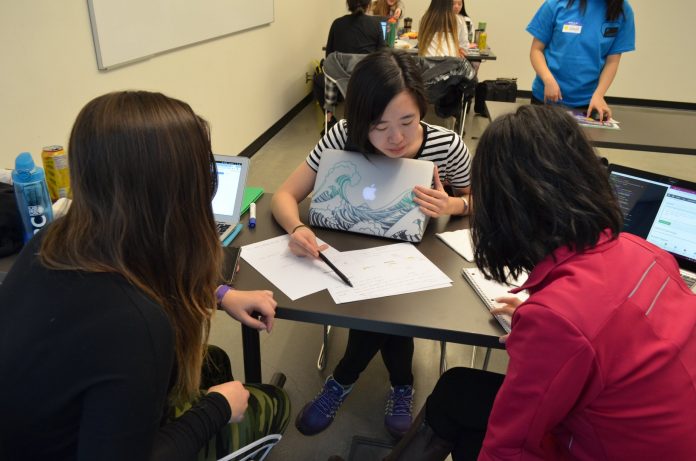
Recently, I had the opportunity to attend an all-women* hackathon. A hackathon is an event where teams of people work together on technical projects within a time limit, and network while they’re together in a space. The tech industry is known for being a sausage party of sorts, and the need for an event such as this hackathon was made clear by the over 150 other hackers who signed up. The event, titled “cmd-f,” was hosted by nwPlus UBC and marketed as “Vancouver’s first all-female* hackathon”.

One thing that I really admire about the way this hackathon was coordinated was that one of the organizing principles was “Women* Helping Women*.” Throughout the weekend, I saw this value being implemented in activities such as a clothing swap, where all leftover garments would be donated to women* in the Downtown Eastside. Mentors providing guidance to teams for their projects. The development of ideas that were geared towards women*’s safety in STEM workplaces.

Most important was the general camaraderie between my fellow girl* geeks. It was an uplifting experience to focus on themes that supported our identities as women* rather than just students of STEM.

In my meagre hackathon experience, I’ve never seen so many women* gathered together in a STEM-themed event. Often times I’ve felt out of place and lacking in experience compared to my male teammates, who seemed to be light-years ahead of me in terms of skill level. In contrast, this hackathon was an optimal environment for me; it was beginner-friendly and supportive, screaming “girl* power!” in its very inception.

Closing the STEM gender gap has been the focus of quite a few recent programs, such as AI4ALL, a summer program to teach young women* about Artificial Intelligence (AI), the SFU branch of which is directed by Dr. Angelica Lim, and Kode with Klossy, a coding camp for girls* launched by fashion model Karlie Kloss. There are many other male-dominated industries — tech is just one. It’s creating a community of women* helping women* that makes for a more gender-inclusive and diverse workplace.

Rather than merely placing women* in these roles of leadership, I think it’s especially important that women* are able to create their own leadership roles and partnerships, so that we ourselves can foster confidence and allyship among fellow women*. The aforementioned programs are STEM examples, of course, but this concept of women* helping women* can be applied to any other discipline. Women* can kick ass and empower each other to kick ass in any field.


Long story short: if you are lost, drunk, and alone, I am your mother now

0
Image credit Tiffany Chan

By: Gabrielle McLaren, Editor-in-Chief


One of the unexpected outcomes of working at The Peak is that you spend a lot of time on campus late at night, notably on Fridays when we make the paper. Burnaby Mountain is actually quite nice in the evening: the stars are so visible that you can etch out constellations, the air is fresh and clear, and campus is quite peaceful when it’s devoid of student activity and construction.

The bus situation is less than ideal as TransLink service gets spottier, so there was quite a wait for the 145. I was alone at the bus loop when an event on campus let out and a flood of well-dressed students stumbled into the world. Immediately noticeable was a girl and a guy holding up another friend, teetering in her heels, head lolling a bit. She’d obviously had some fun at this event, and my heart immediately swelled with the very specific sympathy that comes from seeing someone else take care of their drunken friends.  

A 95 pulled up, and the first member of that little trio said goodnight and got on.

Then a 145 pulled up. I boarded, took my seat, and watched what unfolded next with absolute horror. The girl I’d sympathized with just 10 minutes earlier helped her drunk friend make the step to get on the bus, tap her card, and in the words of my younger cousins: yeet. She just left her incredibly inebriated friend to make her way down the mountain and home on her own.

A little about me: I’m the mom friend of any given friend group. If there’s a friend group with a pre-existing Mom, surprise, we’re co-parents now. At parties, my drinking is usually timed so that by the time everyone else has metamorphosed into a human disaster, I’m clear and ready to pick up vomit and make sure that everyone gets in the right Uber. And as we learned on this specific night, it turns out I don’t even need to be your friend to be your “mom.”

So I watched this poor girl struggling to get to her seat and tripping in her heels as our bus driver sped down the mountain, as desperate to escape SFU as the rest of us.

We made eye contact and I smiled at her, and apparently that was enough incentive for her to make her way down. She sat down behind me, leaning against the window. When we got to the last stop, she woke up and looked around her. The P.A. system had just announced that we’d reached Production Way-University Station, and the bus had stopped. She asked me if this was Production. I thought oh boy but said “yes,” and I offered her an arm to get off the bus.

She was incredibly apologetic as we made our way from the bus stop to the train station, promising that she didn’t usually drink this much. She just forgot how many shots she had somewhere around the seventh one, which I assured her wasn’t a problem. She’d mixed too and felt pretty crummy about it. I promised it was OK — we’ve all done it. I was also sneakily feeding her a scavenged granola bar from my bag and walking super slowly to assess her situation. Over the course of this conversation, she probably gave me the same apology many times, and we repeated the same conversation around seven times.

I offered to call her a cab. I’d actually found $20 in my spring coat not long before, so I had it handy. I’d convinced myself that fate had specifically slipped that cash in my pocket for this occasion. She wasn’t interested and promised that she didn’t have far to go since she lived walking distance from a SkyTrain station in Burquitlam. To my complete horror, this was also when she informed me that she’d just moved to the area. I quietly increased my panic level to DEFCON 12, but smiled and asked her about how she liked it.

Again, I told her I’d pay for a cab, but she assured me that she was fine — so up the stairs of Production Station we went. I told her I used to live in Burquitlam and could walk her home, but she said she didn’t want to be trouble. I promised she wouldn’t, but she was sure. In between chats about our majors, yet more apologies, and commiseration about both of us having to get up early the next day to go to work and class specifically, we swapped phone numbers and Snapchats. She wanted my Instagram too, but I’m not cool enough to have one.

I made her pinky swear to text me as she walked home and to text me when she made it to her final destination safe and sound. She took that pinky-swear very seriously. I gave her very strict instructions to take some Advil, drink some water, and sleep with a trash can on hand, just in case. I also asked her to write her address in a note on my phone, just in case I didn’t hear back from her. I did all of this while making eye contact with the two men who were also getting on the SkyTrain and who had previously been looking at her with mocking grins on their faces.

At the end of the day, she made it home in one piece and texted me the next morning to thank me for taking care of her, and to confirm that 9 a.m. Saturday classes were indeed the worst.  

Over the course of the night, I did ask her if there was a family member she could call to come pick her up. She was an international student — I told her I didn’t have family in Vancouver either. I asked her if there was a roommate we could call, so that someone would be waiting for her back home. Since she’d just moved, she didn’t know the other girls in her home very well yet — again, I could relate to this because I’ve moved around and lived alone myself. I asked her where the friends she’d gone out with were, and she told me they’d wanted to stay at the event longer, and had sent her home.

That was the thing that stood out to me from our encounter, quite possibly because that was the part of her story I couldn’t identify with. When I thought to myself who I would call if I had been in her shoes, names came to mind. Friends who would come pick me up, friends who would stay on the phone with me and guide me home, friends who would send me a cab. But, before all of that: friends who wouldn’t keep partying when I was sick, friends who wouldn’t abandon me on a bus, and friends who wouldn’t leave me to my own devices in an incredibly dangerous situation.

As I think about this story again and write it out, I am thankful that I was at the right place at the right time to meet this girl. I dare hope that nobody out in the world that night would have acted against her, and I hope that if I’d been stuck in the office for an hour longer somebody else would have reached out to her. But I know that those two things aren’t given. So I am also thankful for the band of friends I have, thanks to whom I know I would never be in this kind of danger.

Keep your friends close, and random drunk girls who need your help closer.

The Reflecting Pond Boulder: A Monument To Failure

0
Photo courtesy of Patrick Klosowski

By: Nicole Magas, Opinions Editor

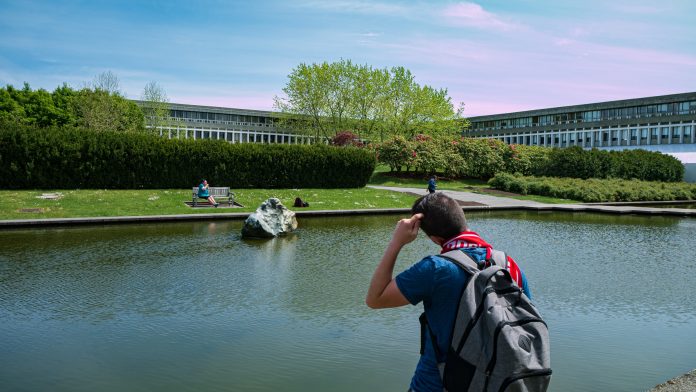
For SFU students, the reflecting pond, located at the centre of the Academic Quadrangle, is perhaps one of the more beautiful places on campus. In the warmer months, the surface ripples over the sinuous bodies of koi fish. In the winter, the pond freezes so completely that for a few brief weeks, students can stand on the ice. But for the most part, the still waters surrounded by lush lawns give students a quiet place to reflect on their time at university — on the experiences they’ve had, the people they’ve met, and the path that lies ahead of them.

But of all the lessons, ideas, and bits of knowledge students will take away from SFU, one question lingers: what the heck is up with that giant rock in the pond?

Over the years, many objects have been dumped in the reflecting pond: chairs, books, bowling balls, cell phones . . . But who dropped a boulder into the water and why is it still something of a mystery for many students? Of course, true to its name, if students reflect deeply enough on the surface of the water, they will find the answer. Literally.

On a submerged plaque made of the same Lillooet jade as the pond boulder, an inscription tells a story of SFU’s founding and the decision to commemorate the event with a big-ass rock. The story takes us back — all the way back — to 1805, when a 29-year-old Simon Fraser set off across the Rocky Mountains to find a trading route to the Pacific Ocean for the fur company he was partnered at, the North West Company.

True to the form of previous European explorers, Fraser got lost along the way, trying to find the Columbia River. Instead, he tried to follow the soon-to-be-named Fraser River to its mouth. But after he determined that the river was too difficult to travel for trade, he turned back and went home.

It’s worth noting that although he had been warned how hard it was to traverse the river by Indigenous people living in the area, the impossible river was apparently something Simon needed to experience for himself. It’s important to underscore that people with long-standing connections within the geography of the region were trying to help him, and he chose not to listen. Our Western presentation of history often relies on false or misleading narratives of great men. This tends to leave out the more nuanced contributions of those whose voices have traditionally been excluded from collective Canadian history.

So Fraser led a crew of inexperienced, malnourished men down the river. The Dictionary of Canadian Biography describes his journey as one of surging rapids and impossibly steep banks. On June 10, he was finally willing to admit that the advice given to him by Indigenous people was correct: this was a fool’s journey.

Fraser was forced to make the rest of his journey on foot, but he never actually reached the Pacific Ocean. In one final demonstration of how completely out of his depth he was, Fraser guestimated that the Pacific was probably pretty close.

It was 225 kilometres away.

So what does the reflecting pond boulder have to do with a failed fur trader/explorer? As it happens, the area around Lillooet, where Fraser was forced to abandon his canoes when he finally decided to turn around, is also the location of a jade deposit.

Whilst searching for a centerpiece to be used at SFU’s official opening in 1965, the head of the History Department, Professor Allan Cunningham suggested that a jade stone be used. As jade boulders aren’t readily found or easy to purchase, the idea was only allowed when the O’Keefe Brewing Company offered to pay for it.

A six-tonne boulder of this jade was discovered by rookie jade expert Peter A. White in the area known as Hell’s Gate. The giant green rock was then polished at the Chandlers Memorial Works in Vancouver and brought to the university to honour Fraser’s failed journey down the river to the Pacific.

At the opening ceremonies of the university, then Premier W.A.C. Bennett and SFU’s first president Dr. Patrick McTaggart-Cowan introduced the fledgling university to its new jade cornerstone.

“The premier has just unveiled the plaque to be placed on 8,993 pounds of beautiful, polished B.C. jade, from Hell’s Creek on the route followed by Simon Fraser, the explorer,” Dr. McTaggart-Cowan said of the event.

The 12 thousand pounds of jade were put in storage for two years while people argued over what to do with the hunk of stone. Eventually, due to its strange shape and large size, it was finally placed at the very heart of the Academic Quadrangle, smack in the middle of the pond.

So the next time you find yourself at the reflecting pond, pondering what’s to come from the next steps of your life, just remember: six tonnes of pretty green rock were discovered by a hobby geologist and funded by a brewery, in celebration of an explorer who ignored all advice and found failure when he was searching for a damn ocean.

Next time you’re panicking at the prospect of surviving your semester, remember that weirder things have happened.