Home Blog Page 552

Cryptids of SFU

0
Photo curtesy of rolexforums

Written by: Ahmed Ali

Exploratory Journal of Unconfirmed Science  

May 20th of the year 2019

I, Count Henry Hamilton Reginald III, embarked on a bone-chilling adventure into one of the world’s most isolated environments: The Mysterious Mountain of Simon Fraser. As the cryptozoologist spearheading this expedition, I intended to investigate the plethora of monstrous creatures who reside in the foggy shadows, but the cryptids I unveiled were so much more than myth.

Over-Achiever in the Basement

Bootecem Lickatus

Estimated Population: 2 per semester

Danger Level: May attack if it feels it’s study spot is threatened.
Habitat: The William Andrew Cecil Bennett library basement

Creature description: With a diet of mostly coffee with large amounts of sugar, these rare specimens are seen to be constantly reviewing indecipherable lines of chemistry, usually under the inane drive of getting into med school. In the cutthroat, dog-eat-dog world of science, where 40% is the average grade, you may stumble across a creature forced into the complete solitude of endless studying to maintain perfect grades. They have adapted to their no-calorie diet by remaining sedentary, hoarding study rooms for entire semesters, and sulking about on that bottom floor.  

Child
Miniaturium Horrorous

Estimated Population: Unconfirmed  

Danger Level: Unfathomable danger to those who wish to stay in adulthood

Habitat: 5th Floor AQ

Details: According to urban legends (all denounced by the official SFU website), children who become separated from their summer camp groups terrorize students on the fifth floor of the AQ. On nights when a student has found themselves in a dimly lit empty stretch of the AQ, they have turned to see a small, pinnie-wearing child. With a haunted look in their eyes, the child whispers, “I want to be like you when I grow up.” Students who have encountered this creature have said the only course of action is to run away, for if the child touches you, it’s rumoured they take your place as an adult, and you become the ghost.

The Grade Sucker

Evanescet Discipulus

Estimated Population: Uncountable. They keep themselves hidden until it’s too late

Danger Level: Could cause you to lose your mind when you cannot get a hold of them.

Habitat: Not the study room where the whole fucking group agreed to meet, apparently!

Details: One of the rarest specimens to ever supposedly exist, this creature is said to appear once, and only once, when a teacher says to get into groups. It’s said that one will know who this is when they disappear off the face of the earth after the first or second meeting, along with any pencils or notebooks you lent them that will never be returned. While not the most dangerous, they will enrage students and cultivate deep trust issues in humanity that the students will carry long into their future lives. So tread with caution…

Yarn mystery still to be unravelled

0
Image courtesy of flagelknittingfiles.blogspot.com

By: Ana Staskevich, Staff Writer

SFU has been a surprising target for quite a few “knit graffiti” pieces. Knit graffiti, also known as yarn bombing, is often described as a new installation of street art. Instead of painting objects, one knits or crochets to create colourful, entertaining displays. This type of art is meant to decorate streetscapes, drawing attention to the aesthetics that can also be used to promote types of activism.

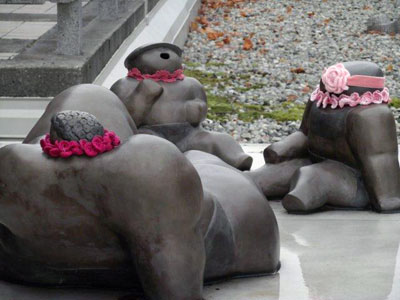
In the recent past, SFU has had a few of its notable art pieces “yarn-bombed,” such as the “On the Beach” statue. The statue definitely benefitted from the bright colors, as the reds and pinks created a fun contrast against the pale texture of the stone. Maybe not the most expected piece to get yarn-bombed, but it was definitely noticeable!

Image courtesy of flagelknittingfiles.blogspot.com

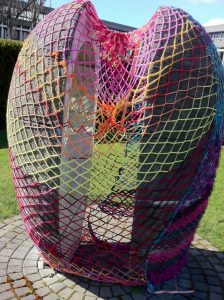
The infamous avocado sculpture also fell victim to yarn bombing years ago, along with the Terry Fox statue in the Academic Quadrangle garden, which sported a crocheted headband for a little while.

As far as we can tell, SFU has been the perfect place for yarn bombers to unleash their creativity. That’s why it was a pleasant surprise to see that in recent months, new yarn-bombing pieces have started popping up all over campus.

Fortunately, we were able to get in contact with the elusive Yarn Bomber that is responsible for these displays. While respecting their anonymity, we decided to conduct an interview to get answers to some of our burning questions.

Q: What gives you inspiration for your projects?

A: Mostly the Internet. Some people undertake incredible yarn-bombing projects, and I find a lot of inspiration in those. When I see certain art pieces at SFU or fixtures that people may ignore, like payphones, I really want to add to them so people are drawn or redrawn to them. There’s a lot of beautiful art at all three SFU campuses, but I feel like people don’t notice it. I want to add something colourful and new to art pieces so that people will notice them, maybe even for the first time. If people are surprised and amused by the yarn bombs, then I think the time I put into them is worth it.

Q: What type of yarn do you use?

A: Acrylic yarn, usually from Michaels.

Q: What got you interested in doing yarn bombing?

A: There’s a free book library near my apartment. One day, I found a book called Yarn Bombing: The Art of Crochet and Knit Graffiti by Mandy Moore and Lianne Prain (who is also an SFU alumna). I had recently learned to crochet, but had never heard of yarn bombing before. The book gave me so many ideas for ways to brighten up different spaces. I immediately thought of SFU Burnaby, and how drab our campus is. I thought it would be cool to bring some colour and life to it.

Q: Any hints for future locations?

A: I haven’t planned any yet, unfortunately. The Terry Fox statue has been on my bucket list for a while, but I know other people love to dress him up already. I might bring some yarn graffiti to the Burnaby campus bus loops and other art pieces on campus.

The identity of this secret Yarn Bomber remains a mystery, and it goes without saying that we may never find out. However, that shouldn’t stop us from enjoying their masterpieces and anticipating their future creations!

There are quite a few yarn-bombing sites still around, and we encourage you to check them out for yourselves! One of the crochet displays is located on the payphone in MBC, and the other one is located on the payphone in the AQ, right by Mackenzie Cafe.

Ranking Indoor Study Spaces

0
Image courtesy of Kitty Cheung

By: Kitty Cheung, Staff Writer

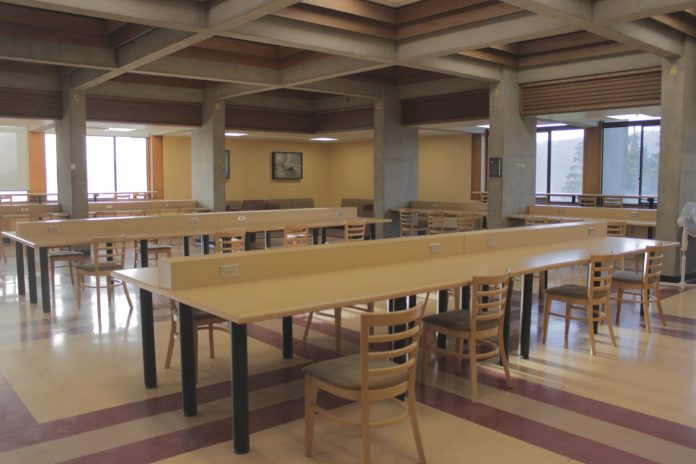
#1: WAC Bennett Library, sixth floor

  • Available seating and table space – 4/5 notebooks
  • Access to gendered washrooms – 4/5 notebooks
  • Access to gender inclusive washrooms – 3/5 notebooks
  • Traffic and construction noise – 5/5 notebooks
  • Comfort – 4/5 notebooks

If you’re anything like me, your dream work environment is a J.D. Salinger-worthy reclusive hangout. To avoid the most people while still maintaining good lighting, check out an individual table on the sixth floor of the library for a quiet, comfortable space.

*Gender neutral / wheelchair accessible washrooms are available on the first and seventh floors.

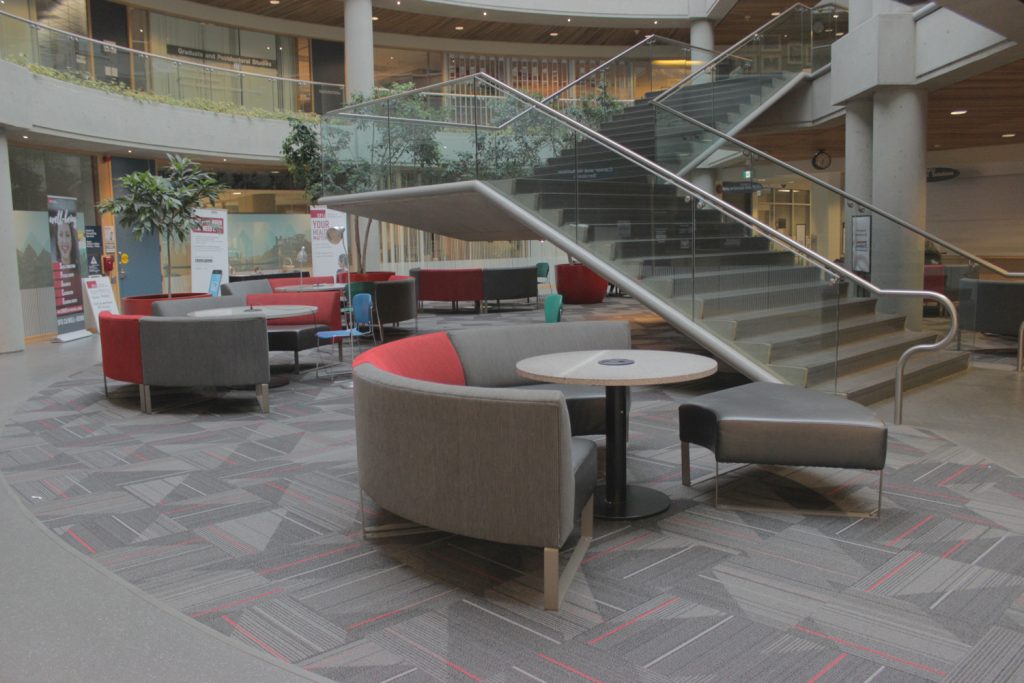
#2: Maggie Benston Centre (MBC) — bottom floor

Image courtesy of Kitty Cheung
  • Available seating and table space — 3.5/5 notebooks
  • Access to gendered washrooms — 4/5 notebooks
  • Access to gender inclusive washrooms – 4/5 notebooks
  • Traffic and construction noise — 4/5 notebooks
  • Comfort — 4/5 notebooks

During the day, the massive glass ceiling of Maggie Benston lets daylight reach even into the deepest crevices of this space. Once it gets darker, this area is also equipped with lamps which provide adequate lighting, even though they may cast harsh shadows on the pages of your textbook.

* Gender neutral / wheelchair accessible washrooms are available on all floors of MBC.

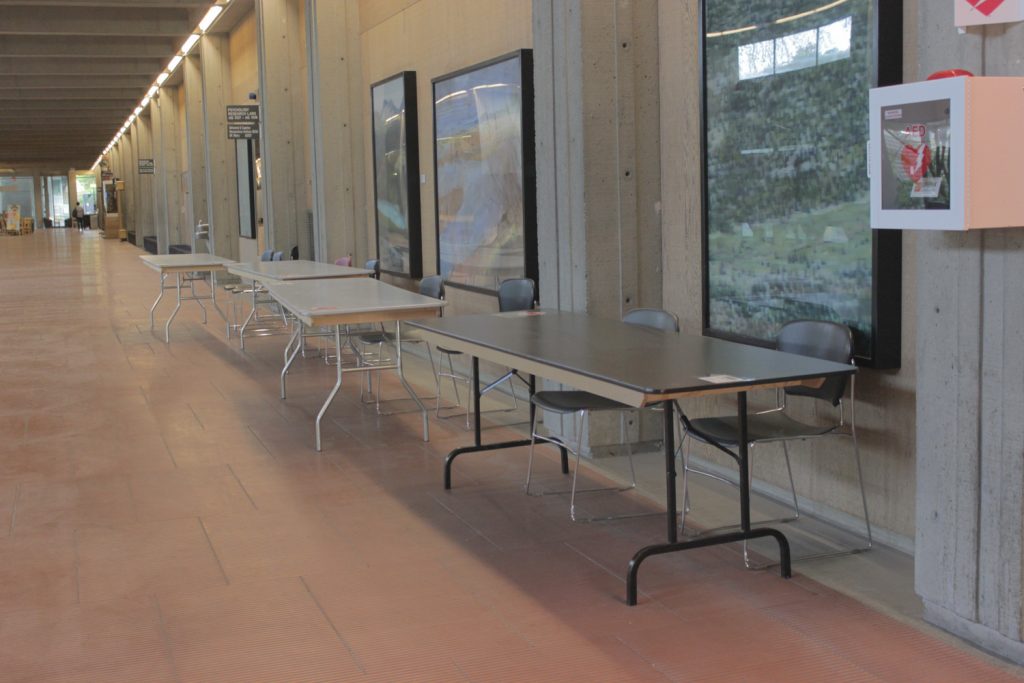
#3: Academic Quadrangle (AQ) — foldable tables

Image courtesy of Kitty Cheung
  • Available seating and table space — 3/5 notebooks
  • Access to gendered washrooms — 3.5/5 notebooks
  • Access to gender inclusive washrooms – 3/5 notebooks
  • Traffic and construction noise — 2/5 notebooks
  • Comfort — 1/5 notebooks

Lots of foot traffic throughout the AQ hallways makes this space distracting and noisy. The foldable tables and chairs are also as creaky and uncomfortable as a first-time tutorial.

*Gender neutral / wheelchair accessible washrooms are available at various high traffic AQ locations — some washrooms lack automatic doors.

Image courtesy of Kitty Cheung

#4: Academic Quadrangle (AQ) — Southeast Corner outside of Mackenzie Café

  • Available seating and table space — 1.5/5 notebooks
  • Access to gendered washrooms — 3.5/5 notebooks
  • Access to gender inclusive washrooms – 3/5 notebooks
  • Traffic and construction noise — 1/5 notebooks
  • Comfort — 1/5 notebooks

This space is plagued by scaffolding and construction noise. Good luck trying to get work done here as the AQ construction workers above don’t make for great study buddies.

*Gender neutral / wheelchair accessible washrooms are available at various high traffic AQ locations — some washrooms lack automatic doors.

Skoden Festival directors talk reconciliation, community engagement, and the festival’s first year

2
Images Courtesy of Skoden Film Festival and SFU School of Contemporary Arts.

By: Alison Wick, Arts Editor

Skoden is a one day Indigenous Film Festival happening Saturday, June 1 at SFU Woodwards. Skoden, an Indigenous slang term for “let’s go then”, promises to showcase Indigenous filmmaking in BC and to foster conversations about reconciliation and what it really means. In anticipation for their inaugural festival, I interviewed Carr Sappier (Wolastoqiyik) and Grace Mathisen, the festival’s directors and former SFU film students, over email about how the festival got started and why SFU needs it.

Alison Wick: When/how did you come up with the idea of an Indigenous film showcase at SFU? Was there a specific instance that made you realize the need for a showcase like this, or was it always something that you wanted to do?

Carr Sappier: It was something I always wanted to do. I just didn’t know it was going to happen so soon.

Grace Mathisen: It was Carr’s idea. We were studying together for a midterm when they told me about it. At the time, I was president of the Film Student Union, and I asked Carr for ways we could do more for reconciliation which led to a bigger conversation about how to be more proactive.

CS: You have to work actively with the community and involve the local community to practice reconciliation. I specifically remember you (Grace) asking, “What would you do?” and I told you my idea for what would become Skoden and you said, “Let’s do it.”

GM: SCA has an equity committee. I went to one of their meetings and told the faculty Carr’s idea. They were all really responsive to it. When I left the meeting, I texted Carr that it was happening.

CS: We were super surprised! We immediately had a team!

GM: It was crazy how quickly it all came together.

Why do you feel it is important that this is a part of the SCA/SFU and not simply an autonomous event?

CS: Reconciliation is a two-way thing between Indigenous and Non-Indigenous peoples. Our festival is one example of many to practice reconciliation proactively. Being organized by an Indigenous and non-Indigenous student equally, working with the community and involving people of all ages and experiences to be a part of this event. For us, youth plays a big role in this festival so involving them and giving them space in these practices, we ensure that they’re part of the discussions that are happening.

GM: It’s not important that this is part of the SCA/SFU. It’s important that SCA/SFU supports and hosts events such as Skoden. There’s a lack of Indigenous students in SCA, like one or less Indigenous students in the room. A lot of our courses have an Indigenous component and this is supposed to be an institution creating the next generation of artists. What does that mean when there’s such a small representation of Indigenous students in our classrooms?

How did you decide on the festival name (which is perfect by the way), were there other things you were considering?

GM: Coyote Beautiful.

CS: Oh yeah, that’s right! We came up with the logo first.

GM: We both love trickster heroes so the coyote was always there.

CS: We’re both queer, so having a male and female coyote made it two-spirit.

GM: Another option was TIFF (Trickster Indigenous Film Festival) which would’ve been confusing and hilarious.

CS: We ultimately decided on Skoden though because it encapsulated the spirit of our festival best and what we were trying to do.

You have some pretty big names in your program (which is really exciting especially for the first year) so I am curious about the submissions process — did you reach out to specific filmmakers to submit or did they all enter on their own? Were you mostly evaluating films individually or were you thinking about how they could fit into a larger program?

GM: We really have to thank Kathleen Mullen for that one. She is our festival mentor and she got us into contact with a lot of great artists and organizations.

CS: We narrowed down our range of films by having all of the Indigenous Artists be tied to BC in some way.

GM: We took submissions through filmfreeway, too. We made it free to be as inclusive as possible, but then we go over 800 submissions worldwide which was very daunting.

CS: We thought about the essence of Skoden and the qualities of a trickster. Films that embraced being creative, pushing boundaries, and themes of identity. It was also important that even though Indigenous people had to be involved in major creative roles, the films themselves did not have to be about Indigenous issues. When we created the program, we didn’t want to separate the artists by their skill level, like treating youth as a niche category, but interweaving all the films equally.

GM: We ended up separating the two screenings by what was family-friendly and what had mature subject matter.

What have you learned in the process of creating and organizing this festival?

CS: Truly understanding how much work goes into organizing this kind of event. Opening ourselves up to criticism and learning to be vulnerable and leaning on each other.

GM: How to make better spreadsheets on Google. But if I’m being serious, the ethics surrounding my involvement throughout this process and what it meant for Carr and I share this responsibility. Our mentors and professors put a lot of trust in us in regards to making this happen for which we’re very grateful, but has also made the possibility of screwing this up really terrifying. From the very beginning, we’ve had two major goals for Skoden: the first was to celebrate the art of Indigenous filmmakers and performers, the second was to create a safe space for more dialogues to occur surrounding reconciliation. In a way, we made this festival so that we could continue to learn.

CS: I remember Sempulyan (The Elder who will be doing the Land Acknowledgements and facilitating the Witness Ceremony) saying, we’re always going to be striving towards reconciliation. It’s an ongoing process. I’m paraphrasing, but we just have to keep ourselves open to the possibilities of what reconciliation can look like.

Do you plan on continuing the festival annually? If so, what are you hopes and plans for future festivals (if you have some)?

CS: I don’t want to let go of there being a student presence on the organizing committee. We both have plans for our own careers as artists after graduation, but we really want to engage with more students who want to be involved in Skoden and be able to pass those roles down to them.

GM: We’ve discussed this already between us, but there’s no way I’d do it without Carr next year. Not because Carr’s amazing (though they are), but because if I stayed on and Carr didn’t, I’d be colonizing on the issues I came to support. Carr’s from the east coast so they’re not sure if they’re gonna be here next year.

CS: We’ve laid down the foundation and worked out a lot of the kinks, but we’re hoping the committee can get more creative next year and have more resources and connections at their disposal. We want to grow, but we want to be smart about it.

What are you most excited about for the festival this year? What do you want people to take away from the day?

CS: The youth! [To see] their reactions to their films on the screen and [for them to] be able to meet other filmmakers and film students at SFU. If we can help facilitate connections between the youth and people in the industry, we’ve done our job.

GM: Fuck yeah.

Skoden is on June 1 at the Djavad Mowafaghian Cinema in SFU Woodwards. There are two film programs divided based on appropriateness: the family showing at 1 p.m. (Stoodis First) and the adult showing at 4 p.m. (Stoodis Next). Tickets are required for each screening and are being sold through eventbrite on a sliding scale to welcome everyone regardless of funds.

You can read more about the specifics of the festival itself in our preview “Skoden Indigenous Film Festival promises to showcase some of the best in cinema,” which can be found online and in print.

A Pint of Science

0
Image courtesy of news wire

By: Onosholema Ogoigbe, News Team Member

This week, SFU’s Department of Earth Science sponsored the first Pint of Science Festival in Vancouver. Pint of Science is a non-profit organization that brings some exceptional scientists to a local pub to talk about their latest research over a pint of beer with interested locals. According to city co-ordinator Elizabeth Dingle, who is currently undergoing her postdoc in Geography at SFU, the events are mostly volunteer-run with each theme getting three to four volunteers organizing venues and speakers.

The Pint of Science festival occurs every May, with occasional events run during other months. The organisation itself started in 2012 in the UK and the first Pint of Science events held in Canada were in 2016. This is Vancouver’s first year participating.

The event spanned over three days, May 20–22, with three event themes: Planet Earth, Our Body, and Beautiful Mind. On May 21, The Peak attended the Planet Earth themed event, titled “Where things are wetter: oceans and coasts” at Mahony & Sons. Both speakers, Simon Brandl and Jessica Pilarczyk, were affiliated with SFU.

Brandl, a postdoctoral research fellow in the department of biological sciences, presented on cryptobenthic fish and coral reefs, their role in ecosystems, why they were important, and their relevance in conversations about climate change. When asked about his decision to partake in the event, Brandl admitted that he enjoys talking to the public about his research, though he does not often get to do so.

“Unfortunately, as scientists, we don’t often have the opportunity to talk in a public forum like [Pint of Science] so it was… a no-brainer,” said Brandl.

After Brandl’s presentation, there was a question period for the audience followed by a brief intermission and a science-based trivia game to engage festival-goers.

The second speaker of the evening was Jessica Pilarczyk, an assistant professor of earth sciences. Her presentation centred around tsunamis, and how future tsunamis can be anticipated using fossilized microorganisms living on the seafloor.

When asked why she wanted to speak at Pint of Science Vancouver, Pilarczyk responded by saying that she’d always liked the idea of making science “fun and informative.” She added that she considered the experience a “win-win” where those attending would learn something new and she in turn would be presented with questions that would make her “think and see her research in a different way.”

The event ended with questions for Pilarczyk, a brief note of thanks, recommendations to attend the next and last couple events of the series and a reminder to take home and plant the Pint of Science beer mats provided during the event.


SFSS president Giovanni HoSang plans to work remotely during summer co-op in Seattle

2
Reslus

By: Gabrielle McLaren, Editor-in-Chief

At the first board meeting for the 2019–20 SFSS Board of Directors on May 16, SFSS president Giovanni HoSang presented his mandate and goals for this summer, including how he would juggle his responsibilities as president with a co-op in Seattle with Microsoft, from June to August.

HoSang outlined how he planned to act as president remotely, with goals such as responsive communication through email and text, especially on weekends. He spoke of fulfilling his engagement hours via Skype and Google Hangouts. The slides for this presentation were shared on HoSang’s presidential Facebook page “SFSS President – Giovanni HoSang” on May 17.

HoSang also listed ways his time with Microsoft could benefit the society. Knowledge and contacts he could gain within the tech industry could modernize the SFSS and upgrade the society’s structure, he stressed.

“It’s not a vacancy,” HoSang said at the conclusion of the presentation. “It is remote work.”

HoSang stated that he was hired by Microsoft in November 2018, at which point he shared the information on his personal social media. When he was elected president, HoSang tried to postpone his co-op but was told that this would not be possible.

Part of HoSang’s plan included delegating presidential responsibilities to some fellow SFSS directors with parallel portfolios, and establishing emergency points of contact within the board. This point was addressed during the ensuing discussion by Jasdeep Gill, vice-president external relations, who was the first to speak.

“My first initial thought about this… it wasn’t developed with the exec team or with anyone being looped in that you’re expecting us to take on these responsibilities,” Gill said. “I do have a problem with this being framed as your absence from board being a benefit to the board.”

HoSang also stated that he would waive his stipend for the period he was working remotely, if allowed by the vice-president finance. A guest in attendance asked if that stipend could be split between the executives who would be taking on his presidential duties. Executive Director Sylvia Ceacero clarified that due to the B.C. Societies Act, she would check in with a lawyer about this.

“Before we can say he can waive it and redistribute it, I need to check and do due diligence for the board,” Ceacero said.

Gill also voiced concerns that HoSang’s absence would harm the board of directors’ growth, as the board was still developing their annual board plan. Gill worried that this plan would not be complete by the time HoSang left for Seattle.

These concerns were echoed by vice-president finance Tawanda Nigel Chipati.

“I think this would have been better if we had finished our priorities, spoken together and your mandates would have been in alignment with what the board was trying to achieve together. And then that way it will be easier now to say, ‘Now you’re leaving, and the team your leaving behind, they’re carrying forward the vision that they’ve [created] all together.’ But that hasn’t been done…”

In a follow-up interview with The Peak, Gill expressed frustration over HoSang’s plans.

“When we saw these slides and I saw my role mentioned, it was automatically, in his eyes, assumed that I would take on these additional roles and responsibilities,” Gill said. “It was never a conversation.”

Jessica Nguyen, vice-president student life, shared Gill’s concern. In the board meeting, she questioned how the board would function efficiently without the president. Nguyen noted that she had shared her frustrations with HoSang in the past, and she felt that he was not taking those concerns seriously.

“The mitigation that I can do is what I have done,” HoSang responded.

Gill pushed back. “You are taking a position that you were elected to by students and you are vacating it for three months. And you say it’s not a vacancy, it’s remote work, but you’re going to be at your internship from normal business hours [ . . . ] If you expect us to take additional responsibilities or work on the weekends and after hours, I don’t see how you can justify that that’s not going to be detrimental to the board as a whole.”

Gill also drew on her experience as a board member in 2018–19, when the board functioned without a president following Jas Randhawa’s impeachment.

“What happens is that the exec team [ . . . ] would be burdened with the roles that the president was supposed to be doing in the first place. And I think it’s going to lead to a lot of conflict, whether it’s internally or externally.”

Nguyen echoed these concerns, who shared them with HoSang in the meeting. “You said that there will be a president to contact in times of need. But what if my times of need are when you are at your internship? Then I don’t have a president to contact.”

As a returning board member, Nguyen also questioned whether the president could mentor new board members while working remotely.

“I am trying to support [new board members] but it’s extremely draining,” Nguyen said, citing her own pre-existing responsibilities on the board.

Stating that he was unsure what else could be done, HoSang reiterated that he would be available electronically.

“I don’t understand why you even ran, and said you’d be there for students,” Nguyen summed up. “I don’t feel like you’re here for the students when you’re going on an internship with Microsoft. You knew that going in, when you ran.”

Various guests present at the board meeting spoke up on the matter, many of whom voiced support of HoSang’s plans. Ali Versi, who attended the board meeting as a guest, commended HoSang for being proactive, and brought up the fact that the 2018-2019 board had previously operated with no president at all.

“I have faith that you guys can work this out together,” he said.  

“I do understand both sides of the story,” another guest, Simran Randshawa, spoke up. She later stated that, “I have worked with Giovanni for a lot of projects [ . . . ] You can always reach out to him.”  

GSS director of external relations Matthew McDonald was also present, and told the board that “I have the fullest confidence in VP Shina to be my negotiating partner during [meetings with SFU in HoSang’s absence] [ . . . ]  I want to express full confidence in this arrangement from my side. . .”

HoSang also stated that, “This has all been very transparent.” HoSang referred to announcements on his personal social media channels, and on the Facebook page created during his campaign, “SFSS President – Giovanni HoSang,” through which his co-op was communicated.

In a follow-up email interview, HoSang confirmed that the earliest mention of his co-op through his presidential Facebook page was on April 30, eight days after the election results had been announced.

HoSang wrote: “I notified multiple students in various conversations and before and during campaigning about the co-op and my intention to continue fighting for students every step of the way, I said I notified students of the co-op on the Facebook Page of my President Page (in this case on April 30), as well as my personal page from as early as October.”

“I know he claims that he made all these Facebook statuses, but it was told to board members at different times,” Nguyen said in a follow-up interview with The Peak. She learned of his co-op during a one-on-one held shortly after the election.

Gill found out through other board members. She had heard that HoSang had been offered an internship, but she had assumed that he would defer it once elected to the board.

In an interview with The Peak following the meeting, HoSang expressed that he did not think that his working remotely had to be communicated through official SFSS channels as “I will continue the [president’s] work.”

“Working remotely is not a vacancy,” he reiterated once more. “I will still continue to work with students [ . . . ] This is more for internal purposes, but there will be no impact on the society’s performance or the performance of the president.”


Lot 21 graduate housing governance brought to GSS Council’s attention

0
Chris Ho/The Peak

By Kitty Cheung, Staff Writer

Sibo Chen, graduate student and former SFU UniverCity Community Trust board member, presented a briefing on Lot 21, a graduate student housing project to be built in UniverCity to the Graduate Student Society (GSS) during their May 14 council meeting. The presentation was given with the intent to include the GSS in the conversation surrounding Lot 21 and its eventual management.

Accompanied by professor emeritus Robert Anderson, Chen told the council that 50 units will be designated as family-oriented housing and 50 studio units will be for single students. The pricing will be 10% below market rate, which Chen characterized as not truly affordable. When asked by a TSSU representative if that pricing was open to negotiation, Chen responded that “If GSS joins the conversation [ . . . ] maybe.” However, having just finished his term on the board of the SFU Community Trust, he “[could] not say.”

During the meeting, the TSSU representative later provided data on the costs of housing in the Louis Riel Building, a former SFU graduate residence which has now been demolished. According to this TSSU representative, Louis Riel costed $759 per month for a one bedroom residence ($896 per month after today’s inflation). For a two-bedroom residence, this would be $897 per month ($1050 today). To put that into perspective, the TSSU representative cited the “most recent statistics” from the City of Vancouver regarding affordable housing as $1,900 for one bedroom and $2,700 for two bedroom.

This project comes from an earlier program that did not go through called “SFU Burnaby Mountain College.” Chen said that a college structure could be established to improve graduate student life.

When asked during the meeting about what this college structure would entail, Chen responded by using UBC’s Green College as an example, stating that it functions as a residence and also has  a small budget to facilitate graduate-student-only activities. Chen described the college as a “management structure” which would govern what kind of residents will live in that building, as well as the programming which would be developed “to create a more collective graduate life.”

According to Chen,  all of the engineering details have been confirmed but the board has yet to finalize a contractor. However, the main issue with this housing project is management.

Chen stated that the board would finish the building but currently does not have anyone assigned to govern it. Chen is now coming forward to the GSS about getting involved in the management of Lot 21, asking the council to “agree in principle to initiate a working group to discuss the issue.” According to Chen, the Dean of Graduate Studies is already in favour of this housing project, but that by going directly to the GSS, a conversation could be initiated with graduate students themselves.

During the question period, the TSSU representative brought up that a GSS working group had been established regarding the 2016 demolition of the Louis Riel Building. Having been a part of this working group, the TSSU representative suggested using the same framework to assist with any Lot 21 discussions, since it also dealt with graduate housing issues.

GSS Advocate and Policy Advisor Harjap Grewal expressed that if a working group was created, the GSS would need people who work well together to step up. “Even if at this meeting, we can get an indication of some people [ . . . ] who are interested in joining, that would be really helpful for us to get going,” Grewal stated.

Matthew McDonald, director of external relations, added that his predecessor Noortje de Weers had worked on Lot 21, and that he himself will be involved in making sure that this housing project will be as “affordable as possible” for graduate students.

“Personally, a working group on this sounds like a great idea and I’d be [a] part of it,” stated McDonald.

SOCA’s proposal for tier 2 constituency postponed

0
Andres Chavarriaga

By: Winona Young, Staff Writer

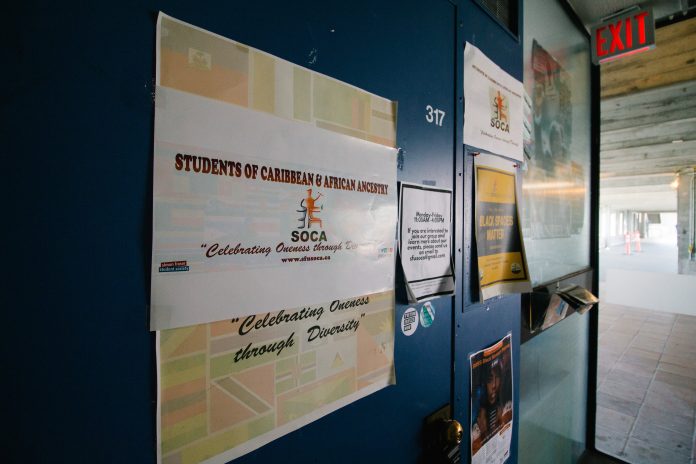
On Thursday, May 16, SFU Students of Caribbean and African Ancestry (SOCA) delivered a presentation to the SFSS Board proposing that SOCA receive status as a tier 2 constituency group.

According to the SFSS, any SFU group that are “student-run bodies that represent undergraduate students that share an experience of oppression, systemic discrimination and/or barriers” are constituency groups. There are three tiers of constituency groups with corresponding benefits.

For context, Students United for Disability Support (SUDS) are comparable in tier 2 status, since they are recognized within the Student Union Resource Office. The First Nations Student Association (FNSA) and Out on Campus (OOC) are tier 3 as they are a “collective.”

If recognized as a tier 2 constituency, SOCA would receive a seat and vote on SFSS Council, and funding from the Student Union Resource Office. The group’s governance and administration would need to match that of other departmental and faculty student unions, such as SUDS.

The presentation was led by SOCA member Balqees Jama and vice president Sebastian Baretto. The half-hour presentation began with the pair explaining what SOCA does, what they’ve accomplished, as well as incidents of racism Black students have faced at SFU.

With issues of complaints being met with ambivalence and a sense of alienation among the Black community of SFU, Baretto emphasised the necessity of SOCA.

“SOCA acting as a cultural hub allows student experiences to be proliferated,” said Baretto. “ It shows Black students and our allies [ . . . ] that there is a place that can be afforded to you.”

Later in the presentation, Jama discussed why tier 2 constituency would be important to SOCA, particularly in terms of funding.

“It means increased funding, so up to $300 [ . . .] that would be incredible, because so much of SOCA’s funds come from our personal pockets,” she said.

In a follow-up email with The Peak, Baretto further elaborated on how tier 2 status would help SOCA.

“Tier 2 constituency status would allocate better funding to be used for social advocacy, outreach and community events,” he wrote.

Baretto expanded by insisting that SOCA would grow further as a group to further uplift SFU’s Black students and community. The vice president emphasized the potential to strengthen the image of the SFSS as an organization that supports marginalized groups and to create a more welcoming environment overall.

In the ensuing discussion that followed the presentation, some board members expressed a desire to postpone the motion. Jasdeep Gill, vice-president external relations, and Tawanda Nigel Chipati, vice-president finance, both stated their desire for more time to fully grasp the tier system.

Not every board member agreed with this assessment. Health sciences representative Osob Mohamed noted that it appeared fairly clear what the tiers were under the policy distributed prior to the meeting, further questioning what else the board needed to understand the system. Guests also spoke to the board, with one pointing out that the tier system was, at the moment, ill-defined in the SFSS’ practises and was never intended as policy.

Ultimately, the SFSS board ruled to postpone the decision. In a follow-up statement emailed to The Peak, Barreto outlined SOCA’s position on the matter.

“The SFSS Board’s postponement of the vote was disappointing from SOCA’s perspective as we believe the emotion and truth of our presentation may be lost.”

“However, we are looking forward to the board’s vote and we remain hopeful that we will be recognized as a Tier 2 Constituency.”

Andrew Petter unable to leave SFU after becoming trapped in construction labyrinth of his own making

0
Illustration by Alice Zhang

Written by: Kitty Cheung, Staff Writer & Zoe Vedova, Humour Editor

BURNABY, B.C. — After announcing his intent to step down from presidency in December 2018, SFU president Andrew Petter, 66, became unable to vacate his position after becoming trapped in the construction labyrinth that is Burnaby campus. Having slated Petter to remain president until August 2020, the university is now at a loss.

University administration confirms that for the last 39 days, Petter has been stuck in the mess of blue fencing, massive tarps, and cumbersome construction scaffolding that his own school commissioned. As students cross through campus on their way to class, one can listen closely to hear Petter’s howls of despair mixed into the cacophony of construction clamour as he attempts to escape the construction maze.

According to local satyr Robert Engaginghoof, 201, Petter was last seen exhausted and dehydrated, briefcase in hand as he dodged orange pylons and scrambled across cardboard flooring in Convocation Mall. The Order of Canada honouree had supposedly been running away from the monstrous creatures who reside within the labyrinth: construction workers, irritated undergraduates, and apathetic security guards.

“A narrow escape,” comments Engaginghoof as he munches on what The Peak has identified as Petter’s term contract. “His briefcase pretty much exploded as he ran away. It was such a flurry of paperwork — makes for a great snack.”

Confused harpy Heather Plumage, 138, alleges that she has actually been in contact with the ill-fated ex-SFU president. “We were both competing with the local raccoons for any small prey lurking in the shadows,” she states. “Despite the fact he could reasonably enter the Maggie Benson Centre for a bubble waffle, they seem to be his only sustenance.”

When asked about the former MLA’s psychological state, Plumage replies, “Ugh, he kept going on and on about the terrifying drone of a jackhammer coming ever closer, saying he can’t escape blah blah how he’ll be stuck here forever yada yada.” After a rustling of feathers and an audible sigh, Plumage continues, “It was so inconvenient for the hunt. He kept scaring off the high school tour groups.”

On the one-month anniversary of the day Petter fell into the construction trap, a vigil was held. Petter’s family and close colleagues read excerpts from his book, The Politics of the Charter: The Illusive Promise of Constitutional Rights and hoped for his safe return, despite him being no more than 17 metres from where they stood. Candles were lit as more scaffolding was set up among the tarps surrounding the AQ pond.

An extraction team of youngblood demigods have been commissioned to search the construction maze. The Peak has received an audio recording from the team, on which can be heard the sound of deafening drills interspersed with what has been identified as Petter screaming, “OH GOD WHY DID I SIGN OFF ON THIS? MY OWN HUBRIS HAS LED ME HERE!” A snippet of this audio is now available as the jingle to the new Peak Speaks podcast, created in collaboration with CJSF 90.1FM.

With the demigod team’s most recent reports, however, The Peak can conclude that Petter has since opted out of his esteemed position in the New Democratic Party to become a construction minotaur.


Pokémon Detective Pikachu: Hollywood’s latest nostalgia film

0
Courtesy of Warner Bros

By: Marco Ovies, Peak Associate

Within the first couple shots of the Pidgeot flying across the screen, I felt like a kid starting my own Pokémon adventure again. Seeing all these creatures I grew up with perfectly exist in the real world had me giddy with excitement.

Movies based on video games are always tough to execute, but Pokémon Detective Pikachu flawlessly creates the world of Pokémon that fans will instantly fall into. The story revolves around Tim, played by Justice Smith, who ventures to Rhyme City after the mysterious death of his father. There he meets Detective Pikachu, voiced by Ryan Reynolds, and together they must solve the mystery of Tim’s father’s death.

The thing that Detective Pikachu does extremely well is create a world where Pokémon and people coexist. Within the first frames, we dive head first into this world of stunning CGI. Studios quite often struggle with bringing video-game characters to life (as we saw in the Sonic the Hedgehog trailer), but here director Rob Letterman and his team has absolutely nailed the look of all these extremely unique creatures.

There was never a point in the film where the Pokémon felt fake or animated. The expressive creatures added a depth to the story that other CGI films seem to lack. In particular, the animation of Detective Pikachu himself was wonderful. The textures of his fur-covered body looked realistic and his tiny face was extremely expressive.

Overall, however, the plot is quite simple. The movie involves little character development aside from Justice Smith’s character Tim, who has a miniscule moment of self-discovery. Viewers will find that the ending is, unfortunately, as predictable as you might expect for a blockbuster children’s movie. Walking into Detective Pikachu, I had my theories on what the big plot twist would be, but I don’t think anyone was surprised by the film’s ending — I know I wasn’t. But perhaps, since this was a movie involving my beloved childhood characters, I had walked in with my expectations too high.

However, both the young and the old will find something to enjoy with Detective Pikachu. The movie has a couple of good laughs from the incredibly talented Ryan Reynolds — though don’t expect to be reprising his role of Deadpool as Detective Pikachu. Great moments included the scene involving Mr. Mime being forced to communicate strictly through, well, pantomime.

At the end of the day, this is just another film that reuses old — if beloved — characters, but one that I gladly dove head first into. But what makes Pokémon Detective Pikachu good is the fact that it does more than just play off of nostalgia. It features a real story that may not be complex but will captivate the attention of movie-goers. I give this movie three and a half out of five Poké Balls for its stunning visual effects, comedic moments, and fun, if simple, story.