Home Blog Page 532

Shimmering with Julie Hammond and Other Inland Empires

0
Julie Hammond in Other Inland Empires in 2017. Image courtesy of Vilhelm Sundin.

By: Alison Wick, Arts Editor

Julie Hammond is a Vancouver artist whose practice focuses on place and identity. She recently completed her MFA in Contemporary Arts at SFU in 2017, and her grad project is being mounted again this week for the rEvolver festival at the Cultch.

Other Inland Empires is the fictionalized real story of Hammond’s quest to learn to surf in Slovakia. The desire to explore the surf culture of a landlocked country came from Hammond’s discovery that the iconic California surfer girl “Gidget” was the daughter of Jewish refugees, prompting Hammond to explore her own Jewish roots in Eastern Europe and think about this timeline and cultural exchange in reverse.

Past works of Hammond’s like Object Karaoke (2018 and 2019) ask what stories objects and places hold and how these histories affect our experiences in the present. This kind of site specificity and spatial recognition are core components of her work — including in this show, which is regularly changing location.

“There is something that’s funny about theatre spaces because they are blank and not. We are trained as audience members to think of them as anywhere but they are very particular and each venue not only has its own shape and its own quirks…but the spaces also have the memory and the archive of all the things that have been there before.”

This is not only the memories of the space itself, but the memories that we bring as audience members. Hammond talked about having a sense of being at the theatre for the specific performance but also being aware of everything else she has seen in the space.

For Other Inland Empires, she includes these acknowledgements of place in the show itself, not simply added on to the theatre introduction or in the program. In the opening scenes of the show, the characters’ dialogue include lines about the territories the play is being performed on and the theatre in which they are performing. Weaving these changing realities and considerations of space into the show itself refuses to let the audience dissolve themselves into the narrative. Neither does it let the narrative dissolve into itself and forget that it’s a performance taking place on a stage in real time.

This multi-layered and in-between experience is what Hammond explored in her masters research, an experience which she calls a “shimmer”. This was a recurring theme throughout her research and preparation for this show as she traveled to Eastern Europe. She found, among other elements of Eastern European surf culture, an indoor tropical island built in a former air ship factory on the site of a Nazi air force base.

“It’s a very weird sense to be there…that’s really where this idea of shimmer came up for me,” she says of this tropical theme park, where the real and fake intersect and begin to blend together. The physical space has changed so much yet remains unchanged at the same time.

A parallel history can be found in the town her grandparents were born in, Prešov, Slovakia, whose nationality and governance were in flux for almost a century. “The site is remaining the same or the land is the same,” Hammond says, “but all of the signifiers around it are changing and moving.” This research and these experiences greatly inform the show, which is above all about the relationship between sense, place, and self.

Complete with family recordings, archival projections, blow-up palm trees, and a plastic sunset, Other Inland Empires promises to be a personal, inventive, and unforgettable show full of shimmer.

Other Inland Empires will be playing at the rEvolver festival at the Cultch May 22—26 before travelling to Portland to perform at the Playhouse June 26—30.


SFU student is “like, pissed” nobody is applauding them for taking one (1) summer course

0
Photo curtesy of Flickr

Written by: Winona Young, Head Staff Writer

Local SFU student Ivanna Trancefer is outraged at the lack of recognition from the academic community after she enrolled in one (1) course this summer 2019 term.

“Like, I don’t get why I’m not being recognized for putting in maximum effort, y’know?” the student said. “At this rate, I’m gonna be valedictorian, ayy,” she continued, pairing the phrase with an odd hand gesture the reporter later discovered to be a dab.

A third-year student, Trancefer reported that she has a “two-point-something-something” GPA, and has not declared her major so far.

Sources close to Trancefer report that she will be taking CMNS 130 with Brody Jaker, which she understands will be a very academically rigorous course. The Peak asked Tracefer if she had any concerns about taking only one course. But Trancefer emphasized she felt confident with her academic decisions.

“My mom was all, ‘Wouldn’t it be better to take a heavier course load?’ But then I said, ‘It’s like one summer. How much longer could it be for me ‘til graduation, right?” She laughed.

Trancefer also mentioned that her choice came with many difficult sacrifices.

For instance, Trancefer cited a study claiming that successful individuals only spend less than five hours on the Internet. To show her commitment to the one (1) course, Trancefer has announced she’s started training for this Herculean academic feat. Trancefer has been adhering to a dedicated training schedule that will limit her time spent scrolling through Instagram and time spent on her phone to nine hours per day, down from the usual 14. The few weeks leading up to classes have been an adjustment for her.

Trancefer recently reported on a crushing blow she has endured as a student; resorting to attending the 9:30 a.m. tutorial.

“Jesus,” said Faculty of Education professor Dr. S.F. Usukz when alerted to Traceferès heroism. “What a champ.”

Another notable consumption sacrifice was made in terms of alcohol.
“It wasn’t an easy decision. Like, I can’t get shitfaced at Fortune every week like when I was in my freshman year,” Trancefer said.

To remedy this, the student plans to party at The Study, and (God forbid) Club Ilia, if she must get her drink on.

Trancefer mentioned that since undertaking this mentally rigorous load, she has been searching for SFU bursaries and scholarships for students who gave up drinking on weeknights for summer classes. Upon clarification from The Peak staff that there were none, Trancefer gave a quote, which, due to construction, was not heard. Nonetheless, she was visibly enraged.

However, Trancefer’s efforts were not entirely in vain.

SFU’s new president, Knot Andrewpetter, is to officially award the student with the official title of, “Smartest Son of a Bitch I Know.”

The ceremony is to take place in Convocation Mall when all campus construction is complete in Fall 2089.


Album Reviews: Kevin Abstract’s ARIZONA BABY and Still Woozy’s Lately

0
Courtesy of Question Everything Inc.

By: Kitty Cheung, Staff Writer

ARIZONA BABY by Kevin Abstract

ARIZONA BABY is the latest experimental hip-hop album from Kevin Abstract. The content of the album ranges from high-energy bangers like “Joyride” to more sentimental slow songs such as “Baby Boy.” Offering raw and personal lyricism, the Brockhampton founder taps into topics such as being marginalized for his homosexuality, regrets about his family, complicated friendships (even making reference to former bandmate Ameer Vann in “Corpus Christi”), and more.

A heartfelt and authentic artist, Abstract tends to expose his vulnerabilities through his work makes him. The production of the album is noteworthy for its experimental nature as well as its attentive execution. “American Problem” comes to mind as particularly impressive: the beat starts off as whimsical before transitioning to become vicious, sharp, and almost murderous. With ARIZONA BABY, Abstract once again proves himself to be an artistic visionary with unstoppable creative energy.

Courtesy of Still Woozy

Lately by Still Woozy

Still Woozy’s Lately is an EP packed with dreamy sounds. This genre-stretching artist combines funk, soul and electronic with mellow grace. The five-song collection opens with “Lava,” a New Age love ballad that is tender-hearted, sweet, and groovy as hell. “Ipanema,” notable for its morbid lyricism juxtaposed with playful beat, carries a strange romance: Omar Apollo croons a verse in Spanish, while Elujay lends his voice in English. “Habit” is a catchy slow jam that will have you floating along to Still Woozy’s gentle vocals. I would recommend Lately to any listeners interested in a brief and charming adventure.

Vancouver’s Pee and Poo mascots are an unfortunate necessity

0
Photo courtesy of Gabor Monori via Unsplash

19/05/19: This story was corrected from an older version. The waste management campaign was incorrectly attributed to The City of Vancouver instead of Metro Vancouver.

By: Ben McGuinness, SFU Student

Metro Vancouver recently unveiled two new mascots: Pee and Poo, who look like, well, an engorged droplet of pee and a hefty lump of poo. Reactions to the pair have included jokes, insults, and disgust at the explicitness of the characters. A sardonic tone underlies the spectrum of reactions, with everyone wondering if the region really needed to resort to such a childish campaign.

I’m not a fan of the overexposure of emojis (especially the poop emoji which Poo resembles), nor of capitalist bureaucrats’ transparent attempts to plug into youth pop culture like digital narcs. And I’m definitely not a fan of Pee and Poo — can you imagine meeting these two on the street?

However, since the Greater Vancouver Regional District (GVRD) has to deal with our waste, it’s the GVRD who gets to decide whether we need Pee and Poo. And if the problems that still plague our sewage system are anything to go by, then as ridiculous as they are, Pee and Poo are definitely necessary.

Dental floss, condoms, feminine hygiene products, and items with thick fibres like paper towels are just some of the things that shouldn’t be flushed. Yet they’re regularly found in our sewers. It’s unlikely that people chucking these things down the toilet are deliberately making things hard for the region, but our sewer system is only designed to manage human waste and toilet paper — that’s it. If people aren’t aware of that already, it’s time to shock the lesson into them.

Some may see Pee and Poo as the GVRD being childish, obscene, or patronizing. But the very fact that officials feel the need to employ such juvenile mascots for something so simple is a reflection of how Vancouverites treat the region’s sewage system. I’m not looking forward to seeing Pee and Poo around events in Vancouver, but the sooner we learn to use our toilets properly, the sooner we can put these mascots and the mockery they’ve inspired behind us.

For now, this is a time to reflect on all the different waste management services we take for granted, and to remember the impact we each have on them. The waste we humans produce does not magically disappear. Someone is given the never-ending task of keeping it from sight and mind.

If we’re making this task harder than it already is, then we deserve Pee and Poo, and all the laughter and finger-pointing that comes with them.

Evan Lee’s “Fugazi” is a Critique on the Diamond Industry and its Fabrication of Value

0
Evan Lee, Test Images for Fugazi, 2015. Courtesy the artist and Monte Clark Gallery via SFU galleries

By: Kim Regala, Peak Associate

At first glance, the floor to ceiling images appear to simply be arrays of colour blended within geometric shapes. But an even closer look begs us to see that the photographs are in fact enlarged extreme close-ups of prism-like objects that look like diamonds, and the colours are products of light refractions passing through.

This is Evan Lee’s photo-based installation Fugazi, set to remain until April of next year at SFU Vancouver’s Teck Gallery. The exposition, which opened May 11, features two large-scale images that fill the entirety of two opposite walls. Just as we think that we’ve finally figured it out, the gallery description reveals that the images are not actually that of diamonds, but are of its much cheaper counterpart instead: the cubic zirconia.

Lee used photographic scans of cubic zirconia, a man-made stone identical to diamonds, and magnified it to the greatest scale in order to capture every detail of its composition. The result is a spectacular light display of various distortions and fractures, shining through the crystal. These images, which feature an extreme close-up view, reveal sharp features that are uncapturable to the human eye.

However, what is most striking is the three-dimensionality that the images are able to construct. The zoomed-in stones appear to be protruding from their two-dimensional walls, allowing the piece to truly stand out from its setting. At the same time, the two walls seem to mimic each other, as if one was a reflection of the other. This effect is best seen when standing right in the middle of the two opposing walls — a perfect spot to notice all the little details of the image without losing the full picture.

Another interesting element of the installation is the dialogue it seems to create with its environment. Located at the Teck Gallery in Harbour Centre, a space initially funded by a mining company, the exhibition overlooks the industrial Burrard Inlet and expansive North Shore Mountains, establishing an interesting juxtaposition with these natural and commercial landscapes. The large windows also allow for natural light to seep in, which illuminate the images themselves. As a result, even this natural source of light is able to play a role in the delivery of the piece.

Fugazi, meaning fake or damaged beyond repair, is a slang term that refers to counterfeit gemstones that are consequently seen as less valuable than the original. Fittingly, Lee’s use of cubic zirconia aims to criticize the ways in which the diamond industry has come to fabricate a high sense of rarity and value towards their product, creating a monopoly that feeds off of the extraction of Earth’s natural resources.

Cubic zirconia, Lee insists, serves as a possible solution to end or at least lessen the demand for diamonds as they are visually identical but at a lower cost. His piece aims to spark a conversation among us regarding how we have come to treat our land, the impacts of capitalism, and the neglect for sustainable alternatives.

Evan Lee: Fugazi is on display at the Teck Gallery in SFU Harbour Centre from May 11, 2019 to April 26, 2020. Installed at the back of the first floor around study spaces, there is no fee for entry.

First-week classes are vital, whether we want to be there or not

0
Photo courtesy of Mikael Kristenson via Unsplash

By: Encina Roh, SFU Student

The first week of classes brings a slog of student complaints about returning to our disassembled university for yet another punishing semester. There is something especially irritating about the first step you take back into the halls of SFU after bidding adieu to last term with passionate finality.

It can seem pointless to come back for barely an hour during syllabus week. For the most part, it seems as though we don’t really do much. We show up, we hear the professor read us the syllabus, and we exchange names we have no hope of remembering next week. If we’re lucky, we may even get a short lecture where everyone — even the professor — looks anxious to leave.

However, despite how unnecessary this all seems to be, a lot of useful things happen in the first classes of the semester. The opening week serves as a crucial transition between the relaxation of a long break and settling back into the attentive mentality that school demands. An extended break followed by an immediate start to course content could shock students harder than a gentler lead-in does. I know that my first class back after a long break from school would feel far more overwhelming if I were hit with heavy lectures, piles of reading, and rigorous seminars right away.

For the most part, professors and lecturers use the first week of classes to provide a general overview of the course content and answer questions. This model helps to ensure that students have a chance to consider the class holistically before committing three months to study its material, and, you know, pay the tuition. Unsatisfied students then have the opportunity to enrol in a different class, secure in the knowledge that they haven’t missed out on anything too significant in the switch. Simply jumping right into lecture content might not allow students the breathing room to fully understand what each course entails.

Whether or not you find the first week of classes annoying, it’s hard to argue that they are unnecessary. I know the commute up for a 30-minute lecture feels like a waste of time (and sleep), but the existence of first-week classes not only let students settle back into university life but also helps them finalize their course selections. Returning to school after so much time spent unwinding is difficult, but I am certain that I would much rather be eased into the process of learning than leap straight from the high dive into a massively intellectual conversation or assignment.

Without a warm-up class, I might just embarrass myself in front of the professor on the first day. I’d rather do that slowly over the course of the entire semester than offer all I have to give right upfront.

Need to Know, Need to Go: May 20–24

0
Book Cover courtesy of Sternberg Press

By: Winona Young, Head Staff Writer

Judy Radul’s This is Television book launch

SFU School of Contemporary Arts’ visual arts professor, Judy Radul, is launching her new work, This is Television. The book is based on her art exhibition of the same name which was showcased in Berlin in 2013.

Radul will be joined by Allison Collins, a Vancouver-based curator, at Vancouver’s Or Bookstore. The two will be discussing Radul’s new work, which centres around the medium’s growth towards obsoletion, as well as figuring out what television “is.” As noted by Radul on her website, “Like many technologies [television] was a collection of parts, a way of viewing and a habit, as much as a being.”

Judy Radul’s book launch will be held at Or Bookstore on Tuesday, May 28, from 6 p.m. to 8 p.m.

Study Abroad — the musical! Destination: U.K.

Ever fantasize about ditching class and going abroad halfway through a semester? For our freshly dumped protagonist, Cheryl, this fantasy becomes a reality. Our heroine takes a musical journey to Brighton, finding passion, new loves, and more in her journey.

The musical will be playing for one night only, so catch these tunes while you can. Study Abroad is directed by SFU SCA student, Cheryl Olvera, as a requirement for her BFA directed study. The work also features SCA students Erica Regehr and Matt Brown.

Study Abroad — the musical! Destination: U.K. will be shown for one night only on Thursday, May 23, at 7:30 p.m. The musical will be held in SFU’s Goldcorp Centre for the Arts at the David Mowafaghian World Art Centre. Entrance is free.

TSSU hosts Welcome BBQ and Walking Tour

0
Photo courtesy of The Peak Archives

By Onosholema Ogoigbe, News Team Editor

Organized as a summer kickoff event to get members acquainted with one another and commemorate International Workers’ Day, the Teaching Support Staff Union (TSSU) held a Summer BBQ Welcome & SFU Labour Walking Tour on May 10.

According to Yi Chien Jade Ho, a PhD student in education as well as an organizer/member of TSSU, the event was put together as a summer semester equivalent to the socials that the TSSU often holds as part of the Spring and Summer Week of Welcomes organized by SFU.

The event was put together and run by the TSSU’s membership mobilization committee. Starting the day with a barbeque, hot dogs, burgers, pizzas and drinks were served.

Then, the SFU Labour Walking Tour began. Led by Ho, the tour started off with a land acknowledgement. Ho provided a quick history of SFU’s former reputation as a “radical campus” and its relationship with the TSSU, before offering an outline of the places of interest on the tour.

The tour discussed historical events in Freedom Square in Convocation Mall, Residences, the SFU Transportation Centre, James Douglas Safe Study Area, the Education Building, and Strand Hall.

The theme of the walking tour was “collective action gets the goods,” and each place visited had at least one history of collective action that was mentioned during the tour.

The first stop on the tour was Freedom Square, where Ho told the story of how it got its name due to the number of rallies that occurred there.

The second stop was at the top of Convocation Mall, overlooking the residence and the bus loop, because the tour route was modified due to construction. According to Ho, in 1977 the bus loop hosted the SFU site of a province-wide student protest against tuition fee increases. SFU students set up a picket line at Curtis and Gaglardi Way, a main intersection through which buses access SFU.

As for Residences, in the 60s, the oil company Shell had a lot of financial influence on SFU campus, and SFU, in a bid to thank Shell for their financial contributions, decided that they would name Louis Riel, a subsidized family housing on campus, the “Shell House.” This did not go over very well with students, and they reacted with a lot of demonstrations around the Shell House that were against the proposition.

Ho’s tour then moved to Douglas Study Place, which saw the birth of the 2018 Tuition Freeze Now movement. Next came the Education Building, which inspired the Mould Campaign of 2013 that resulted in its renovation.

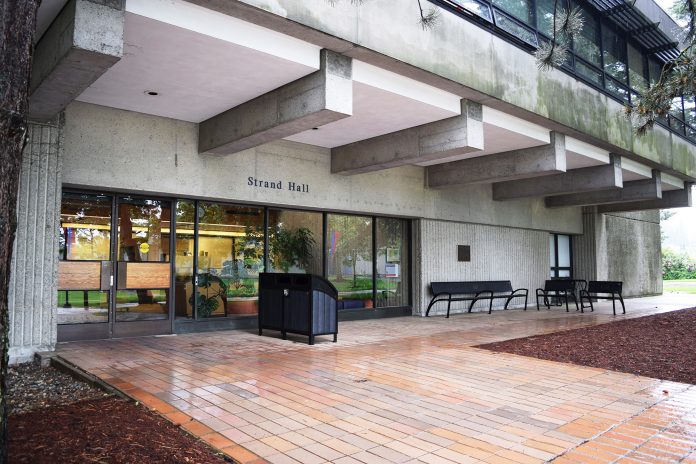
The last stop on the tour was Strand Hall, where TSSU members in the past taped postcards around the building as a protest against the senior administrative meetings. According to Ho, the senior administrative staff was “not bargaining in good faith at the time [and] they were also not having the right person at the table as well.” .

The TSSU is the union which describes itself as representing all “Teaching Assistants, Tutor Markers, Sessional instructors and Language instructors at Simon Fraser University.” They make sure all teaching support staff have good working conditions.

“Good working conditions allow [support staff] to be good educators,” says Ho, who has been a teaching assistant for five years.

Red Dresses are a Meaningful Art Installation, Not Forgotten Clothing

0
All images courtesy of Kim John

By: Alison Wick, Arts Editor

All images courtesy of Kim John

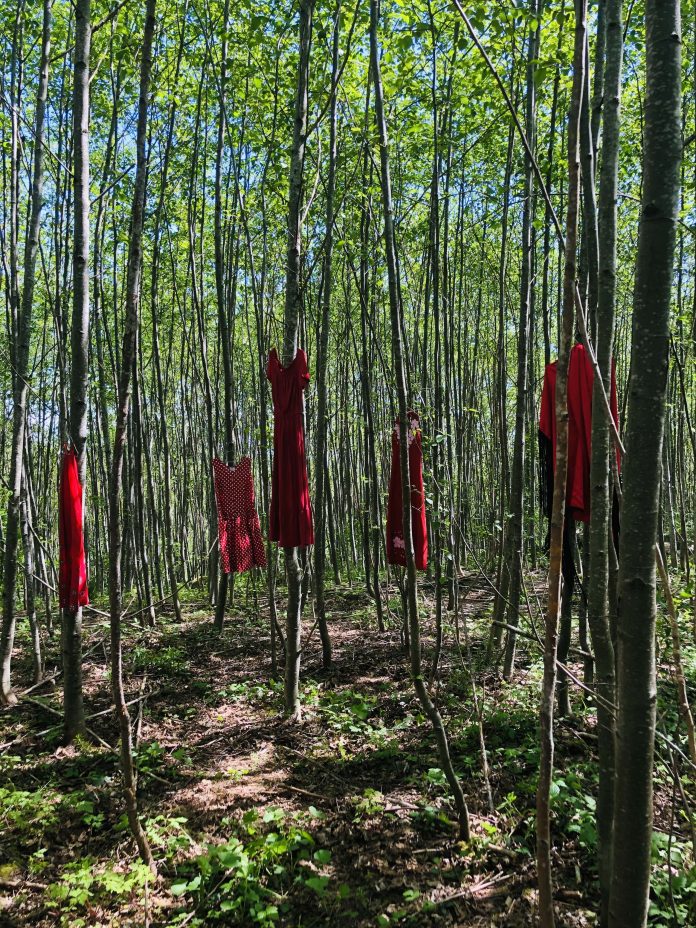
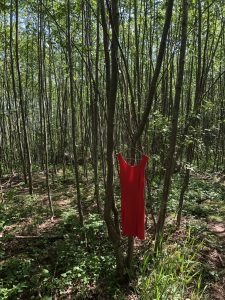
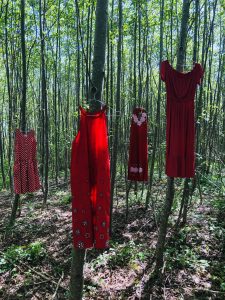
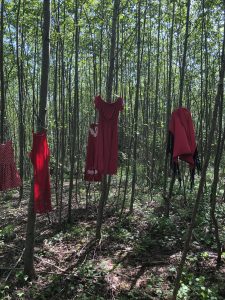
On May 5, the unofficial National Day of Awareness for Missing and Murdered Indigenous Women and Girls (MMIWG), SFU music student Toni Yake (Mohawk) and health sciences student Kim John (Coast Salish) hung seven red dresses in the trees off University Road East on Burnaby Mountain. The bright red dresses were hauntingly beautiful, as the colour red simultaneously evokes femininity, beauty, and blood. Amongst the mossy green hues of the forest, the red dresses and their slight movement in the wind delicately demanded our attention. The dresses are pieces of art that call awareness to an ongoing and unresolved national crisis.

A few days later, Yake went back to visit the dresses and take photos. She found that they had all been removed.

It is disgraceful, to say the least. The seven red dresses were hung with care and intention and were unmistakably put up for a reason. They were a striking visual in the forest — meant to be there and to be together. They are not mere items of clothing; they are meaningful and significant cultural objects anchored in history and protest.

The REDress project was started by interdisciplinary Métis artist Jaime Black in Winnipeg, over six years ago. Red dresses were initially displayed in public spaces as well as in a few gallery exhibitions, notably at the Canadian Museum for Human Rights in 2014, but have now moved from the gallery into grassroots art pieces across the country. As Black outlines on the project website, the project “is an aesthetic response to the more than 1000 missing and murdered [Indigenous women and girls] in Canada.”

Now, the red dresses are an artistic symbol held by the public; anyone anywhere can hang a red dress to create a presence through absence.

It’s heinous that so many missing persons’ cases of women and girls have gone unsolved and ignored by the Canadian government, RCMP, and local police forces, but I don’t want to desensitize this story with numbers. Each dress represents not a statistic but an individual woman and the collective of real women that have been taken from their families and communities.

However, if you are unfamiliar with this issue, I urge you to look at the Native Women’s Association of Canada page’s Understanding MMIWG, the Indigenousefoundations.arts.ubc section on the Marginalization of Aboriginal women, and Amnesty International’s No More Stolen Sisters campaign to learn more about the causes, realities, and channels of support for MMIWG.

The REDress project and its daughter movement are examples of how art can function as a powerful piece of activism. In my first draft, I ended this article encouraging you to take a walk in the forest, and see the dresses hanging in the trees. Since the dresses have been taken down, I encourage you to learn about this issue and reflect on how you are standing in solidarity with Indigenous women and girls and fighting anti-Indigenous misogyny and racism.

For Indigenous students, the Indigenous Student Centre has Indigenous counsellors as well as a smudging area and medicine for all Indigenous students to use.

QUIZ: What’s Your Perfect Summer Getaway That You’ll Never Go On?

0

Written by: Zoe Vedova

[typeform_embed type=”embed” url=”https://peakmultimedia.typeform.com/to/h4IsJm”]