Home Blog Page 510

UnbeLEAFable plant life found at SFU

0
Image courtesy of Anindita Gupta

By: Anindita Gupta, Peak Associate

With the SFU Burnaby campus buzzing with the sound of drilling and the whacking of hammers, it is difficult to appreciate the surrounding beauty. With the uncalled-for summer rains, it is even harder. But, on a damp and gloomy Burnaby day, I decided to walk around campus to really notice the things that become even prettier in the rain – the plants! 

Before I begin, I would have to thank technology, without whom this would not have been possible! I found an app called PictureThis, that helps you snap pictures of plants and identify them. (If any passionate botanists are upset with me for bungling any of the names, it was the app!)

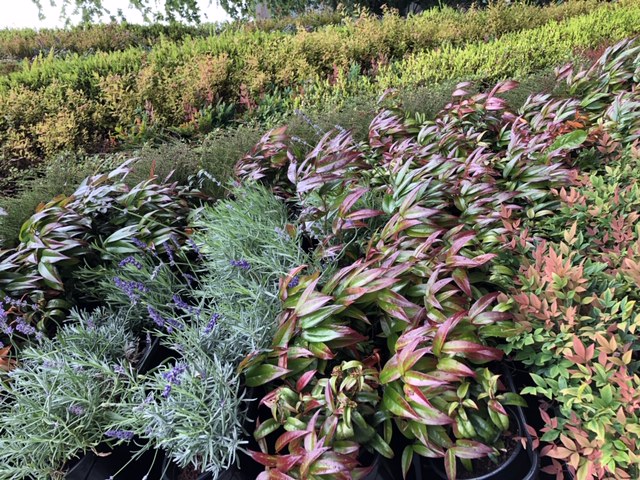
The first beautiful set of plants that anyone comes across when they first enter SFU from the Cornerstone entrance is the beautiful living wall of potted plants that are varying in colour and form. I did not end up catching every single species on the wall, but I did manage to identify a few. The first of these potted plants is the one that has leaves with a tinge of red on them. The Leucothoe axillaris, or coastal doghobble, is said to be a native to the North American continent. 

Another potted plant right above the previous one is the lavandin, or the garden lavender. Its scientific name is one of the less intimidating ones: Lavandula intermedia. This particular one is supposed to be a hybrid between the English and Portuguese lavender; ah, what a mix SFU has!

Image courtesy of Anindita Gupta

Moving on from the bus loop/Saywell Hall area, I walked to the Applied Science Building (ASB), but through the walkway with a canopy of greenery. In here, we have a mix of different trees which we may not notice in the everyday hustle and bustle of running into the ASB. Some of the trees that make this canopy are the western red cedar, scientifically identified as the thuja plicata, and the vine maple, scientifically recognized as the acer circinatum. The red cedar in particular is a very common tree on campus. (You notice only this if you’re really paying attention, like I was this time . . . like a bird-watcher, er, of trees!) It is a native to the continent and a giant coniferous tree often associated with the Douglas fir. The vine maple is a smaller tree compared to the first. Something interesting about the vine maple is that Coast Salish peoples sometimes used this tree to make fishing nets, and the Lower Thompson people sometimes used the wood from it to make cradles!


Image courtesy of Anindita Gupta

I made my way now towards the library, and my main intention was to find out about the two trees that are put on the side of the AQ stairs: the ones that are lit during the winter months. But as it turns out, they were removed due to the construction. Instead, all around these show-stealers, I located the Japanese maple, or the acer palmatum. These are the beauties that change their vibrant shades every season; they’re green in the summer and orange/red in the fall.  

Finally, what better place to end my SFU-trotting, plant-spotting experience than at the gorgeous water lilies in the AQ pond? The European white water lily, or nymphaea alba, floats almost all year round in our pond along with the many swimming koi fish! 

SFU, even in the midst of the construction noise and dust, does still have a very beautiful campus. I suggest taking a walk through it to clear your mind of midterms, papers, and finals in the coming few days. And the rain helps this walk in a way you wouldn’t imagine!

Image courtesy of Anindita Gupta

Paperless education: yay or nay?: An interview with Dr. Paula MacDowell

0
Image courtesy of Leila Amouzandeh and Matt Koyanagi

By: Leila Amouzandeh, SFU Student

For me, paperless education reminds me of EDUC 358: Foundations of Educational Technology, which I took with Dr. Paula MacDowell. Dr. MacDowell is a lecturer, instructing courses in educational technology and learning design. She is known at SFU for making tremendous headway in the EdTech realm and shaking up learning environments by enriching them with technology in her classroom. In her course, I learned how to use the iBooks Author app and explored a topic of my choice relating to educational technology. In a sense, we were using technology to write about technology. 

Personally, I was interested in writing my chapter on iBooks Author, since it went beyond writing. I could incorporate media elements that would best be suited for my research, such as videos, hyperlinks, scrolling galleries, images, etc. to create a chapter that was visually appealing, bright, and complimented my words. There wasn’t a doubt in my mind who to reach out to discuss a paperless education, because Dr. MacDowell proves that it is possible!


The Peak: When you think about a paperless education, what comes to mind?

Dr. Paula MacDowell: Sustainability, student productivity, increased engagement, collaborative learning, efficient grading, meaningful feedback, and streamlined classroom management.

P: What is your take on technology, specifically laptops and tablets, helping students learn?

PM: Learning with technology is not about a specific tablet, tool, or technique. It is about the freedom that we all have to contribute and create something new: a game, an image, or a unique point of view. 

P: How does using technology in class help students learn? and what about those naysayers who argue that it is distracting or it promotes too much screen time? 

PM: It is important to meaningfully integrate media and technology. Meaningful integration of technology can be a powerful enabler of creative problem solving, collaboration, diversity, and digital knowledge construction. I have very few issues with technology being distracting from learning in my courses, but it is frustrating when the technology doesn’t work as expected or the Internet is unreliable. 

P: Where does technology in education fit in terms of 21st century skills and sustainability? 

PM: Questions that I spend a great deal of time thinking about are, “How can I teach sustainable design principles that lead to attentive practices of sustainable behaviours? How can I improve the reach and effectiveness of student engagement on sustainability issues through digital creation techniques such as designing educational apps for pro-social and environmental change?”

P: What are your thoughts on students as creators? Why is it important for students to not only be digital consumers? 

PM: I believe that learners of all ages benefit from opportunities to be the creators, coders, builders, inventors, makers, and changemakers of our world. This involves an understanding of how our world is designed and that it is capable of being redesigned — not only the material world but also its knowledge, systems, processes, values, narratives, and perspectives. 

P: You often incorporate apps, such as iBooks Author into the courses you teach. As iBooks are an interesting form of a paperless term research paper, Why did you decide to incorporate that into the courses that you have taught? 

PM: iBooks Author empowers students to construct, represent, and communicate knowledge in novel and productive ways. When I see the light shining through my student’s eyes as they tell me how proud they are of their work, I know that’s why I continue to use iBooks Author and champion the success of all the students I’m privileged to teach.

 P: Is this where you think the future of education may be heading? 

PM: SFU is Canada’s most community-engaged research university and designated as a Changemaker Campus [by Ashoka U]. I think the future of education involves openness, cultural sustainability, environmental integrity, social innovation, and community engagement. Therefore, I challenge my classes to research and design education resources that are freely accessible learning materials for anyone to use and learn from. 

My students are motivated by the fact that their course assignments are available for people around the world to download from the iTunes store, or on display in a media arts exhibit, or as recommended curricular resources for the BC Ministry of Education. Together we create and contribute our knowledge and skills to make a difference with and for our communities.

P: Are there any student websites or apps that you would recommend (for learning or creating)? 

PM: The educational apps that I use most often in my courses are iBooks Author, Canva, ZapWorks, Plotagon, Zeetings, Pear Deck, Flip Grid, Piktochart, Padlet, Kahoot, Quizizz, Class Dojo, Screencast-O-Matic, and edpuzzle. Try them out!


SFU is recognized for its engagement, and students are not only constantly active and hands-on in writing and designing but also empowered when sharing their work with a global audience. Technology helps to create spaces for making content that is meaningful and memorable. Likewise, it plays a part in knowledge mobilization due to the fact that your prof won’t be the only person reading the research you spent tireless hours working on. It puts you in the driver’s seat. 


Take a look at some easy ways to incorporate technology in your learning suggested by Dr. MacDowell:

(Please note that these descriptive quotes are from each app’s official webpage)

Engaging Presentations:

  • Zeetings: “Transform your meetings, presentations, lessons and events by empowering everyone to participate from their own device.” 
  • Pear Deck: “You can add the magic of formative assessments and interactive questions to your presentations”

Create and Communicate: 

  • Flipgrid:Flipgrid is the leading video discussion platform for millions of PreK to PhD educators, students, and families in 180+ countries.”
  • Plotagon: Animate your message, turn ordinary text into video and communicate in a way that resonates
  • Padlet: “Make beautiful boards, documents, and webpages that are easy to read and fun to contribute to.”
  • Class Dojo: Useful for “School messaging and portfolios”

Design: 

  • iBooks Author: “Create and publish amazing books for iPad, iPhone, and Mac.” 
  • Canva: Whether you need an Instagram story, logo maker, or birthday invitation—create all these graphic design needs and more on Canva” 
  • ZapWorks: “Create your own augmented reality experience”
  • Piktochart: “Create infographics, presentations, reports, flyers and posters” 

Quiz Makers

  • Quizizz: “Free self-paced quizzes to review, assess, and engage—in class and at home.”
  • Kahoot!: “Kahoot! makes it easy to create, share and play fun learning games or trivia quizzes in minutes.”

Video Creators

  • edpuzzle: “Make any video your lesson. Choose a video, give it your magic touch and track your students’ comprehension.”
  • Screencast-O-Matic: “Video creation for everyone. At Screencast-O-Matic, we don’t believe that video recording and editing should be difficult, or cost a fortune. Our simple and intuitive tools help you get the job done easily.” 

Below are the links to the iBooks created by students at SFU:

Weirdest Library AskAway Asks

0
Photo curtesy of Wikimedia Commons

Written by:  Tiffany Chang, Peak Associate 

We’ve all had those inevitable mental breakdowns when writing papers. These normally happen when we can’t find the articles we need and end up screaming at our computer screens. 

Everyone sometimes needs that extra help from those valiant heroes of SFU — the library AskAway chat operators. But what if our emotions were to get the best of us? What if we were to start telling them a little too much information? 


AskAway Live Chat at 3:00 AM

3:05 AM

HELP.

I know its really late and the chat service probably isn’t available, but I NEED HELP.


-Hello. What can I help you with?


CAN YOU SEND SOMEONE FROM THE LIBRARY TO KILL ME? I ALWAYS WAIT UNTIL THE LAST MINUTE TO START PAPERS,  I’M A MENACE TO SOCIETY THAT MUST LEAVE THIS WORLD! 

BTW I’m craving a burger really badly. Do you think it’s safe if I go to one of those 24-hour drive-thrus and pick up something?


-I always encourage students to start their papers at least two weeks in advance. And I wouldn’t go out this late if I were you.


Literally trying to ignore the hunger pains. Can you direct me to any database that might have journals even remotely related to what I’m writing about?


-Yes, of course. Could you tell me what your topic is?


Wait. Crap. What am I writing about again…?  

Oh yeah. How Modernism is constructed.


-Please give me a moment.


3:20 AM

-I was able to find a few that you might be of use to you: www.allthejournalsunistudentsneed.org and www.articlesthatarelikleytosaveyourlife.ca

-Are you there? I hope we’re still connected. 


Yup. Still here.

Thank you!


-You’re welcome.


I apologize for the delay. I couldn’t go another second without a cup of coffee. 

Hey, how many cups of coffee do you normally drink throughout the day? 

Is it more than 2? 


-I understand that it can be difficult at times as an undergraduate, but I strongly suggest you get as much rest as possible. 


Do you sleep for at least 8 hours a night? I got 4 last Tuesday! Feel great.


-I don’t mean to be rude, but I think we should stick to the task at hand here. 

-I hope I’ve helped. Do you have any other questions?

3:23 AM


I’m writing my introduction paragraph as we speak. Do you think you could talk me through the conclusion paragraph, though? I hate writing those. 

I decided to eat something else and my burger craving is gone. Are you hungry? If you need to take a break and grab a snack or something, I totally get it. 


-I’m fine, thank you. And I’m afraid it would be difficult to help you with your conclusion paragraph one-on-one through an online chat.


Yuck. I just sneezed on my laptop. Could you hold on a sec? I need to wipe my keyboard.

So, what do you do in your spare time? I really hope it isn’t staying at the library. 


-That’s a very offensive assumption… But thank you for using the AskAway online chat service. Have a nice day! 🙂


Thanks for the help! Do you want to do this again sometime? 


Chat is Disconnected 

The Great Derangement: Climate change and the unthinkable

0
Courtesy of Indian Summer Festival.

By: Aritro Mukhopadhyay, SFU Student

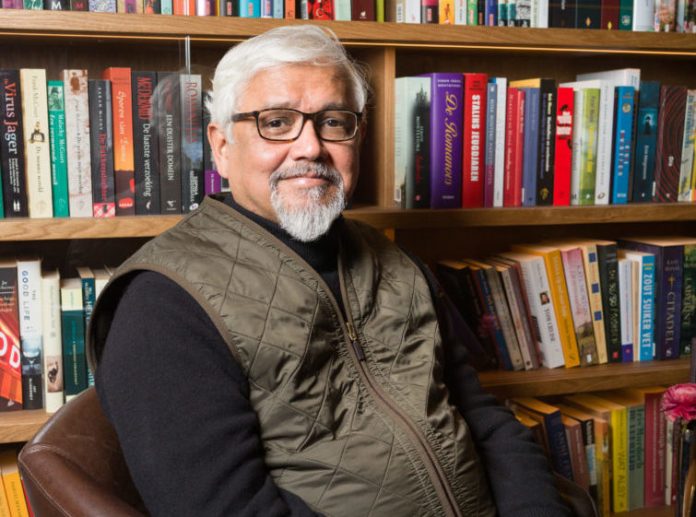
When I first noticed that the Indian Summer Festival had invited prolific author Amitav Ghosh for an evening of ideas and literature, I was over the moon. I remember a much younger me trying to tackle The Sea Of Poppies, his 2008 novel set during the opium wars, and failing to understand its significance. As a grown-up, I have come to understand him and his novels — and my mother’s passion when she vehemently talked about Ghosh being her single most favourite author.

Being a Bangali myself (belonging to the state of West Bengal, India), it was reassuring to see someone from the same community being listened to. The fact that I was able to exchange a few words with in after the event in our common mother tongue was the icing on the cake.

On July 9 at SFU Woodward’s, Ghosh lead a talk that dealt with the topic of climate change from a very unique perspective. His book, The Great Derangement, reflects upon our so-called “deranged” political and socio-economic decisions through the spectrum of literature, history, and politics. In the book, Ghosh highlights that human thought, literature, and writing have simply failed to address the impending danger of climate change. That, as a society, we have been postponing the inevitable without establishing appropriate precautions.

Ghosh is alarmed by the fact that climate change, even though imminent and omnipresent, is still treated with a sense of denial and as something that cannot be overturned. Ghosh also links events such as the wars in Syria and Turkey, as well as their subsequent migration crises, and even Brexit as proponents of climate change. It isn’t something from a distant future, and we aren’t just mere spectators to its growing impacts.

The almost voracious rise in sea levels in the Sundarbans (Bengal), the massive long lasting droughts in Chennai, and freak tornadoes are a few obvious signs of climate change that India has been experiencing in recent years. The Great Derangement is a reminder to all artists and writers that it is their responsibility to create mutual understanding and space for apocalyptic thinking. Climate awareness needs to have a place in their work as a document of change that has set in in the anthropocene. Ghosh calls for collective action rather than individual efforts to tackle the problem — if it is left up to individuals to decide, the gravity of the scenario will fizzle out.

What (not) to do when your friends are all getting engaged

0
Illustration by Alice Zhang

Written by: Hannah Davis, Peak Associate
Illustrated by: Alice Zhang 

So your friends are all getting engaged without you? So you were minding your own damn business and doing the classic “reviewing lecture notes while browsing Instagram” study technique when your eyes were assaulted by a horrible vision of yet another friend who has now embarked on their happy path to marriage? So you’re tearing up but you’re not sure if it’s from panic or joy?

You’re lucky you’ve stumbled across this article, because we have some helpful tips on what not to do in this situation. 

Do not compare your life to theirs and wonder how you are still fighting for your Degree in Important Things when they are preparing to make a down payment on a house.

Do not stare longingly at a picture of Danny DeVito and fantasize about a person like that getting down on one knee for you. 

Do not become a fiery ball of anxiety and message people on Tinder to see if they would accompany you to a wedding you may or may not be invited to. 

Do not be upset that your friends are getting more attention and more Instagram likes than you because they are now fancy, Engaged People.

Do not call your newly Engaged Friends “unrecognizable fools who are greedy for banal marital sex” the next time you get drunk.

Do not buy some new pants and call them your “Sex Lord Pants.”

Do not go to a party and use your Sex Lord Pants to hit on people you have never met before. These people have names like “Sherry” and “Grog,” and should not be trusted, not with your precious and fragile heart. 

Do not go home with Grog anyways and only realize in his bedroom that his name is actually “Greg.” Don’t be embarrassed at the mistake, and definitely do not try to correct him and tell him that his name is actually “Grog.” 

Do not be alarmed at the amount of condoms Greg has in his wardrobe and do not call him an “unbelievable fool greedy for good sexual health.” 

Do not propose to Greg to be like your Engaged Friends. 

Do not spontaneously tell your new Engaged Friends, when you run into them at the grocery store, that you are “oh so proud” of their new “life change.”

Instead, cut straight to the point and confront them about why you were not asked to be in the bridal party.

When they tell you, “Well, I just didn’t think we were that close, we haven’t really seen each other for a few years,” refrain from bitterly reminding your Engaged Friend that the new fiancee “isn’t even that hot anyway.”

After this, faint in disbelief and make a scene in Aisle Four. When you awake in the grocery store and discover that your Engaged Friends have left you there, unconscious, on the cold linoleum floor next to the rows of refried beans, do not be alarmed. Once you’re afraid, you’ll start pulling the cans off the shelves and it’ll only be a matter of time before you’ve built a fort with the produce you have simply pulled off the shelves. At this juncture, simply inhabit this fort in the grocery store in order to avoid seeing any more of your friends getting engaged.

Despite all of it, you will be fine.
And alone.
Forever. 


0
Illustration by Joy Tian

Written by: Nathan Tok
Illustrated by: Joy Tian

We all had that wonderful TA that saved the year for us. Remember when your lecture notes looked like gibberish to you until that TA turned it the right way around? Or how during chem lab, the TA looked the other way when you recovered 10 times more mass of the substance then what you originally started out with? 

Good TAs are the heroes we lowly undergraduates do not deserve. But they’re also the heroes we need, because as anyone who’s done a “gatekeeper” class knows, sometimes the TA is the only thing standing between you and the shame you will bring to your parents. So in honour of their most valiant efforts to make sense of our half-assed 4 a.m. rambling papers, here is a meaningful gift basket you can get your TA to thank them.

It includes: 

A picture of the sun

Very handy in winter when your TA gets to campus before the sun rises and leaves after the sun sets. Have your TA hang the picture in their basement lab deep within the bowels of the AQ so they can remember what natural light looks like.

Thesis pillow

Help your grad student TA better understand their feelings about their thesis by giving them a thesis pillowcase. Filled with printed drafts of their work, they can abuse the pillow when feeling like an incompetent fraud and hug it when feeling like the most brilliant genius to have ever lived. As a bonus, they can then use that pillow to sleep in their office and/or lab so they can get more research done and make their supervisor happy. 

Generate data button

Press to generate useful, relevant, and clean research data that proves your hypothesis to make your supervisor happy.

Candy

To bribe people into participating during tutorials.

Markers

Because SFU never has enough markers that work on the whiteboards and overheads in tutorial rooms. 

Their supervisor’s child’s phone number

This is borderline stalking, but can you think of a better person for the grad student to voice their issues to? You would give your favourite TA a lobbyist towards their supervisor that cannot be ignored. Bonus if the kid is a university student as well who can better understand the pain.

Go Away shirt

You know how TAs have to answer the same question over and over to those students who don’t attend class or read stuff on Canvas? Questions like “When is the midterm?” “Which readings do we have to do?” or “How come the professor doesn’t know how to use YouTube?”

Help your TA deal with these questions by getting them a shirt that says “did you even go to lecture?” on one side and “check the syllabus” on the other side. That way, your TA can simply point to their shirt when students come in person with those type of questions. 

Actually become a good student

Ironically, the best gift you can give your TA is to actually study and to do your work properly. This way, they can do their marking faster (since it’s easier to mark things correct rather than marking them wrong and then looking for partial marks), you get better grades, and everyone is happier. The only issue? This involves you actually becoming a better student and studying harder so it’ll probably never happen.

De Adder’s termination shows that corporate interests in media are a Canadian problem too

0
The cartoon believed to have contributed to Michael de Adder's termination at BNI. Illustration: Michael de Adder/Twitter

By: Gabrielle McLaren, Editor-in-Chief

After 17 years of drawing for Brunswick News Inc. (BNI), Michael de Adder was let go soon after sharing one of his cartoons on his personal social media. The cartoon drew mixed reactions for featuring Donald Trump golfing beside the bodies of two fallen Mexican migrants. 

Or at least that’s the cause for termination that de Adder himself has shared on Twitter and during interviews, citing BNI’s failure to provide a clear alternative reason for his termination. BNI, meanwhile,”vehemently denies” this in a published statement, claiming that they had been taking steps to replace de Adder for weeks. This is something that editorial cartoonist Greg Perry has corroborated, though Perry told CBC News he was never told that he was slotted to replace de Adder specifically. 

BNI’s official statement regarding this paints de Adder’s statements as “a reckless and careless spread of misinformation [ . . . ] in an era of fake news.” (Never mind that de Adder is an individual, not a news or media organization, but I digress).   

BNI owns all of New Brunswick’s English-language daily papers, as well as most weeklies. The company is owned by the Irving family, which is extensively tied to other business interests in the province as well as in the United States. In 2008, a Senate committee on media integrity raised concerns about the Irvings’ monopoly on New Brunswick’s media, noting a resulting pro-Irving (and pro-business) tinge from their reporters. Continuing perceptions that Brunswick News Inc.’s corporate links limit its editorial independence make it especially alarming that de Adder claims he had suspected in the past that his Trump cartoons weren’t well-received by his editors.

De Adder’s national (and now international) reputation and the attention he drew to BNI brings to light the fact that Canada’s media is not as untouchable and pristine as we might expect or like. This might seem insignificant, since de Adder’s termination is now at the “he said, she said” stage. However, I would argue that we should be attentive to the fact that one of the country’s leading and most published cartoonists might so much as be feeling the pressure of editorial censorship. 

As someone who’s been in the belly of the beast, de Adder is in a unique position to speak from within BNI. What he’s telling the rest of us is uncomfortable and worrying.

It might also become easy to ignore this blip in Canadian media because of the strenuous pressure and more blatant attacks faced by journalists elsewhere. The fact that our federal leader isn’t an honourary woodpecker on Fox and Friends like one not-to-be-named Commander-in-Chief is definitely encouraging, but let’s not pretend that Canada’s media is immune to censorship and corporate intrusions. If nothing else, de Adder’s termination draws attention to the complexities and flaws of our media in a time when it’s easy to look at our borderline dystopic Southern neighbours and take the win by default. 

Heading into a federal election, Canadians should be especially concerned with the integrity, strength, and diversity of our media. We should also recognize the importance of our smaller, local media organs that will report on local issues, and be mindful of their own limitations and origins as well. 


SFU Lifeline raises concerns about misrepresentation to SFSS Board

0
Photo via Facebook courtesy of SFU Lifeline

By: Ana Staskevich, Staff Writer, and Onosholema Ogoigbe, News Team Member

Editor’s note: Previously, this piece featured quotes attributed to Lily Moric. However, The Peak has been unable to verify these quotes and have removed them accordingly.

On July 11, SFU Lifeline members gave a presentation at the SFSS Board Of Directors meeting concerning the Board’s plans to assert its pro-choice stance.  According to SFU Lifeline vice president Lily Moric, the presentation was given to address concerns they had about the possibility of the SFSS removing their club status. They referenced a previous Peak news article reporting the SFSS’ discussion on adopting a pro-choice stance as a society.  

During that discussion, SFSS president Giovanni HoSang stated the importance of the board actively enforcing a pro-choice stance through policymaking. 

According to the SFSS’ club directory, SFU Lifeline’s mandate is “[advocating] for pre-born children whose human rights are violated by abortion.” 

At the meeting, SFU Lifeline confirmed their stance on abortion with a club representative stating that “as a club we take the mandate that abortion should be illegal [ . . . ] in every case.”

SFU Lifeline expressed concern about the SFSS asserting their pro-choice stance through further policymaking, which is currently set out by the Women’s Centre’s mandate. 

Members expressed concern that if this policy is emphasized, campus will be made a less safe environment for women, citing harassment that some of their members had faced because of their pro-life view. They highlighted one of their recent welcome meetings where signs they described as offensive and vulgar had been set up in the room as an example of why campus would be less safe.  

In the presentation, SFU Lifeline president Lois Umali clarified that they are not a religiously affiliated club. The presentation emphasized that the 2012 Genocide Awareness Project, which showcased enlarged images of aborted fetuses and had been previously brought up as a concern by board members, no longer represented how SFU Lifeline operates as a club. 

SFU Lifeline instead introduced a new project that they are working on called the Bloody Sexism Project, which features a banner with the quote, “92% of Canadians disagree with sex selective abortion; what’s your opinion?” According to SFU Lifeline, this banner is meant to incite dialogue, with members attempting to engage with the opinions of students who walk past.

During the question period after the presentation, Osob Mohamed, health sciences representative, inquired about SFU Lifeline’s views regarding the legal status of abortion. Mohamed referenced a Supreme Court decision in R. v. Morgentaler, 1988.

“A right to abortion was in the Charter. . .  [the Supreme Court Judges decided] that it is a fundamental part of the Canadian institution and [making it illegal] violates the security of the person,” Mohamed stated, basing her words off of the court decision. 

In response, Moric stated that they would question what the charter considers a human life. 

No resolution was reached as the discussion came to an end. The discussion was cut short by at-large representative and acting chair Rayhaan Khan due to shortage of time.

What SFU Needs: more services open on the weekends

0
This is the future SFU dorm kids want. Illustration: Marissa Ouyang/The Peak

By: Winona Young, Head Staff Writer

Do you like going to SFU on the weekends? Of course you don’t — it’s empty, nothing’s open, and you didn’t ask for a ghost campus when you paid your tuition. But students on residence are at SFU 24/7. This unfortunately means that they see SFU and SFSS services like Health and Counselling closed, the Fitness Centre’s hours reduced, and half the eateries on campus completely shut down come Friday. We have a whole section of mountain called “UniverCity” — are we really asking our residence kids to bus down the mountain to avoid being shut-ins on the weekend? 

WHAT WE LACK

  • Weekend hours for the Burnaby campus Health & Counselling
  • Extended weekend and holiday hours for cafeterias like Mackenzie Cafe and MBC Food Court, so that Cornerstone and Dining Hall aren’t the only dining options left 
  • Longer Fitness Centre hours for people who don’t have time in the working week to exercise
  • An art gallery that is open for more than three days out of a week
  • A student hub that’s open at all (looking at you, SUB) 

THE VISION

Introducing the Services Every Weekend (SEW) initiative, which will stitch our campus community together with a wide array of available services, seven days a week. Of course, this will mean a higher demand for SFU’s workforce, but we will be creating jobs as well as ensuring that more SFU students are getting what they need right here on campus. That means SFU students getting treated for injuries and seeing counsellors on the weekends, because sicknesses don’t stop after Friday. More students leaving their houses and dorms to actually hang out around campus, to see an art exhibit, enjoy a broad dining experience. More incentives to be at SFU other than just school.

WHY WE NEED IT 

With all the residence buildings and condos sprouting up on Burnaby Mountain, there’s got to be hundreds of students stuck here every weekend. These students are desperate to get out of their dorm rooms. And surprisingly? They don’t want to spend every weekend of their uni years at the Dining Hall, Tim’s, or Starbucks. In addition, sickly and bored students shouldn’t need to commute off-campus to be relieved of their ailments. With more options and services right here on the mountain, SFU can finally start to have some semblance of community up here. SFU is already a commuter campus, and doesn’t have the most vibrant student life. With more services available on the weekends, students have incentives to get out of their caves once in a while, walk about, and help foster a campus life worth sticking around for.


Where are Black women in SFU politics?

0
Ebuka Okafor/The Peak

[25/07/19]: This story was corrected from an older version. Corbett Gildersleeve was identified as an SFU alumnus and a co-organizer of the event. Gildersleeve is an SFU alumnus who attended the event to show his support. 

By: Ana Staskevich, Staff Writer

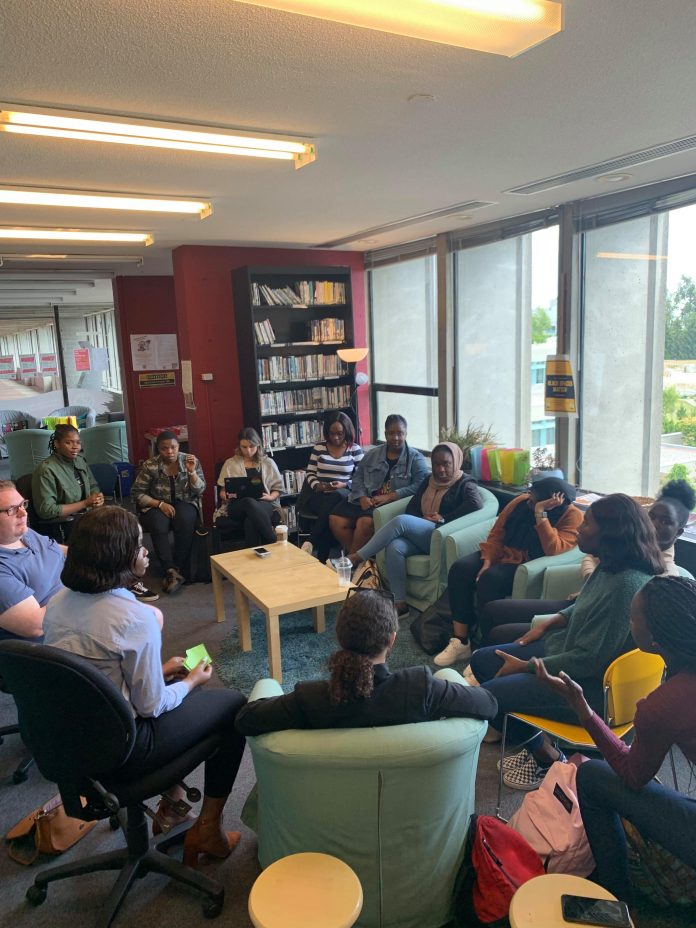
On June 20, Stephanie Chiakwelu, SFSS at-large representative 2019 candidate, brought forth a dialogue-based event that tackled the lack of representation of Black women in SFU politics. Open to the public, Chiakwelu eagerly welcomed both students and non-students to sit down and discuss the topic of young Black women leaders.

The event emphasized several issues of underrepresentation of Black students in SFU’s political sphere, with one of the main focuses being the problem of inaccessibility to political platforms. Chiakwelu and various attendees agreed that the lack of awareness was another big factor, as many young Black students aren’t often reached out to in terms of elections and the inner workings of student unions.

“Sometimes [we] feel like these spaces are not open to us,” said Chiakwelu, explaining that she felt the least involved during her run for the SFSS as she had barely any prior experience compared to other candidates.

Chiakwelu hoped to brainstorm ideas to get more Black students involved in SFU political positions, including how to find feasible media platforms to reach out to these individuals. A common agreement amongst the attendees at the event was that a big problem within the SFU political sphere was nepotism. Particular skill sets seemed to matter less when it came to public projects, as connections and social networks came first. To combat this, Chiakwelu proposed to create a stronger network of Black students, where everyone could share resources and recommend each other for opportunities. 

“You need to figure out what you want to do. . . You have to be proactive and seek stuff out, but it is hard to find these things,” said Corbett Gildersleve, an SFU alumnus in attendance.

Hoping to use his extensive experiences in various SFU positions to help prepare those wanting to get involved, Gildersleve introduced a few key points about preparing oneself for leadership roles. These included learning soft skills such as public speaking and conflict resolution, as well as building on patience.

The event concluded on an encouraging note, as Chiakwelu expressed her hope to form a group out of the meeting in order to take the first step to change.